Evaluating Investment Decisions: Payback, NPV & Non-Monetary

Verified

Added on  2023/06/12

|8
|1181
|343
Report
AI Summary
This report delves into the crucial aspects of business decision-making, focusing on investment appraisal techniques such as the payback period and net present value (NPV). It calculates and interprets the payback periods for two distinct projects, highlighting the importance of this metric in investment decisions. The report further utilizes NPV to evaluate the same projects, providing a more sophisticated analysis that considers the time value of money. Additionally, it explores the significant monetary and non-monetary variables that influence corporate decision-making, including financial leverage, finance statistics, shareholder relationships, and administrative frameworks. The analysis emphasizes that effective decision-making requires a comprehensive understanding of both quantifiable financial metrics and qualitative, non-financial factors to ensure the sustainability and success of the company.

Document Page
Business Decision
Making
tabler-icon-diamond-filled.svg

Paraphrase This Document

Need a fresh take? Get an instant paraphrase of this document with our AI Paraphraser
Document Page
Contents
Contents...........................................................................................................................................2
INTRODUCTION...........................................................................................................................1
MAIN BODY..................................................................................................................................1
P&P plc's payback period and net present value are calculated..................................................1
Explicitly stating the monetary and non-monetary variables that aid in decision-making..........3
CONCLUSION................................................................................................................................4
REFERENCES................................................................................................................................5
Document Page
Document Page
INTRODUCTION
Corporate decision-making is a procedure wherein the company has a number of options to
choose from (Ahrens and Ferry, 2020). It is a phase procedure that assists in evaluating the
numerous options. There seem to be a variety of judgments to make, including administrative,
tactical, and monetary ones. The ability to make decisions aids in the achievement of corporate
goals. The computation of different asset evaluation approaches like payback time and net
present value approach is covered in this paper. Such strategies aid in determining the feasibility
of initiatives. It also contains a full description of the many monetary and non-monetary aspects
that influence the company's current decision-making.
MAIN BODY
P&P plc's payback period and net present value are calculated
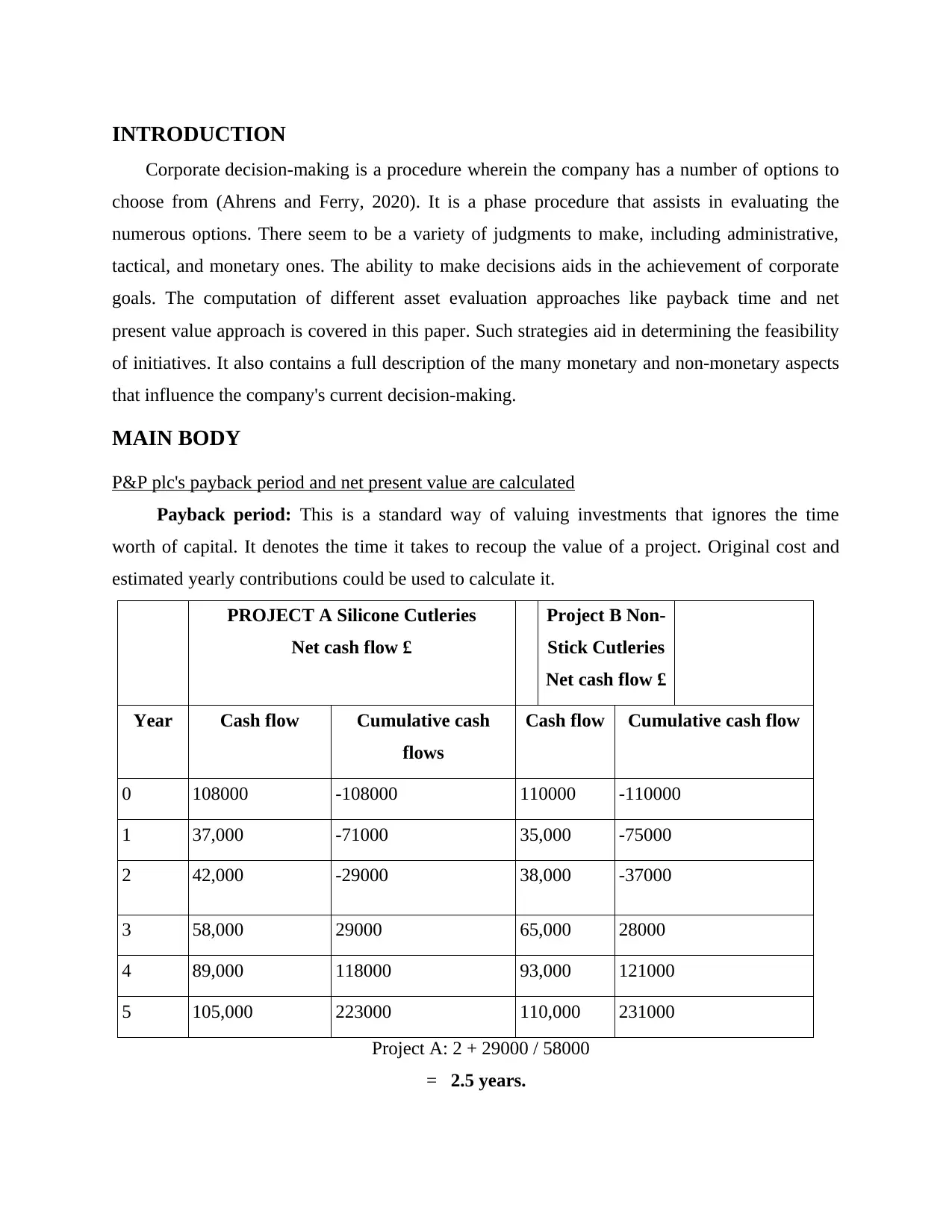
Payback period: This is a standard way of valuing investments that ignores the time
worth of capital. It denotes the time it takes to recoup the value of a project. Original cost and
estimated yearly contributions could be used to calculate it.
PROJECT A Silicone Cutleries
Net cash flow £
Project B Non-
Stick Cutleries
Net cash flow £
Year Cash flow Cumulative cash
flows
Cash flow Cumulative cash flow
0 108000 -108000 110000 -110000
1 37,000 -71000 35,000 -75000
2 42,000 -29000 38,000 -37000
3 58,000 29000 65,000 28000
4 89,000 118000 93,000 121000
5 105,000 223000 110,000 231000
Project A: 2 + 29000 / 58000
= 2.5 years.
tabler-icon-diamond-filled.svg

Paraphrase This Document

Need a fresh take? Get an instant paraphrase of this document with our AI Paraphraser
Document Page
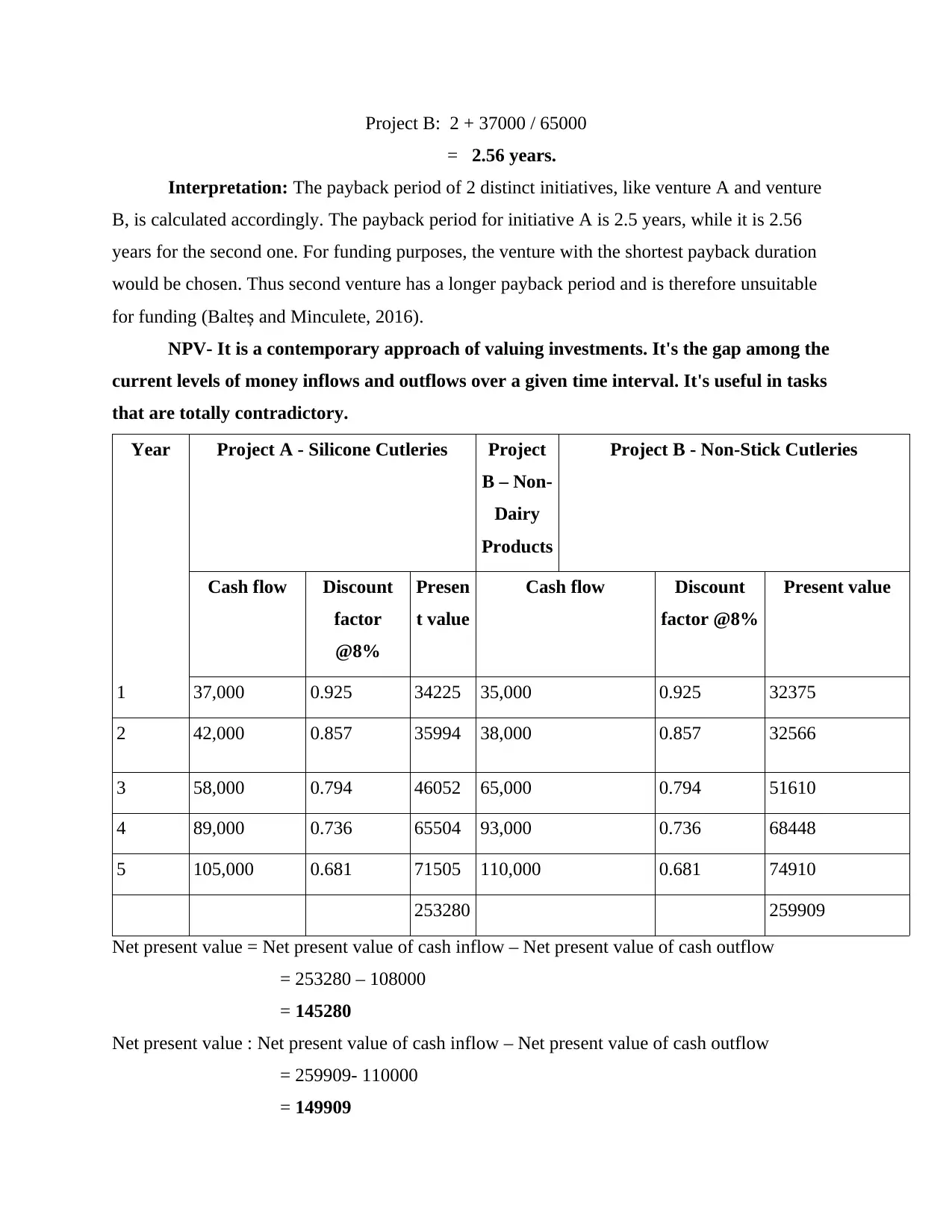
Project B: 2 + 37000 / 65000
= 2.56 years.
Interpretation: The payback period of 2 distinct initiatives, like venture A and venture
B, is calculated accordingly. The payback period for initiative A is 2.5 years, while it is 2.56
years for the second one. For funding purposes, the venture with the shortest payback duration
would be chosen. Thus second venture has a longer payback period and is therefore unsuitable
for funding (Balteș and Minculete, 2016).
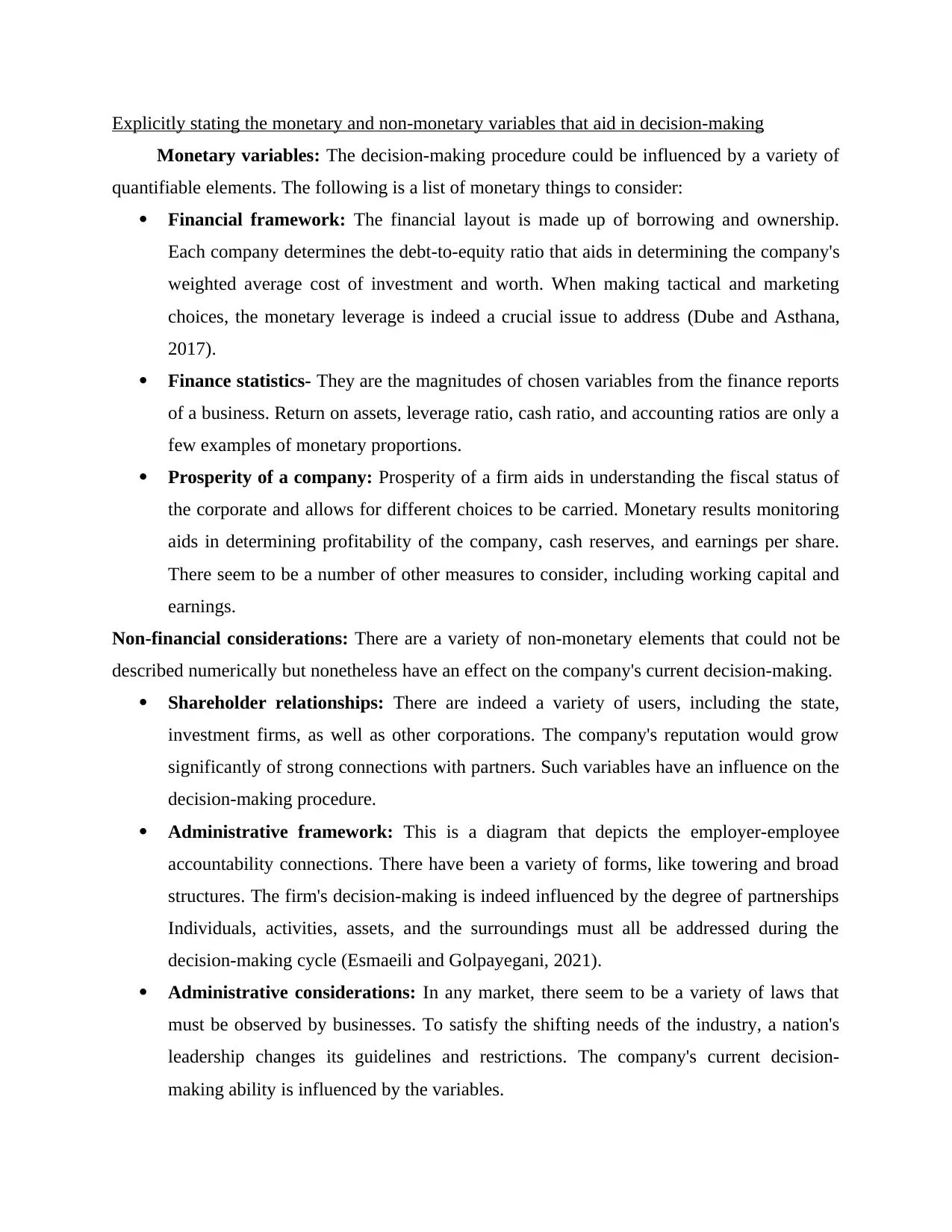
NPV- It is a contemporary approach of valuing investments. It's the gap among the
current levels of money inflows and outflows over a given time interval. It's useful in tasks
that are totally contradictory.
Year Project A - Silicone Cutleries Project
B – Non-
Dairy
Products
Project B - Non-Stick Cutleries
Cash flow Discount
factor
@8%
Presen
t value
Cash flow Discount
factor @8%
Present value
1 37,000 0.925 34225 35,000 0.925 32375
2 42,000 0.857 35994 38,000 0.857 32566
3 58,000 0.794 46052 65,000 0.794 51610
4 89,000 0.736 65504 93,000 0.736 68448
5 105,000 0.681 71505 110,000 0.681 74910
253280 259909
Net present value = Net present value of cash inflow – Net present value of cash outflow
= 253280 – 108000
= 145280
Net present value : Net present value of cash inflow – Net present value of cash outflow
= 259909- 110000
= 149909
Document Page
Explicitly stating the monetary and non-monetary variables that aid in decision-making
Monetary variables: The decision-making procedure could be influenced by a variety of
quantifiable elements. The following is a list of monetary things to consider:
Financial framework: The financial layout is made up of borrowing and ownership.
Each company determines the debt-to-equity ratio that aids in determining the company's
weighted average cost of investment and worth. When making tactical and marketing
choices, the monetary leverage is indeed a crucial issue to address (Dube and Asthana,
2017).
Finance statistics- They are the magnitudes of chosen variables from the finance reports
of a business. Return on assets, leverage ratio, cash ratio, and accounting ratios are only a
few examples of monetary proportions.
Prosperity of a company: Prosperity of a firm aids in understanding the fiscal status of
the corporate and allows for different choices to be carried. Monetary results monitoring
aids in determining profitability of the company, cash reserves, and earnings per share.
There seem to be a number of other measures to consider, including working capital and
earnings.
Non-financial considerations: There are a variety of non-monetary elements that could not be
described numerically but nonetheless have an effect on the company's current decision-making.
Shareholder relationships: There are indeed a variety of users, including the state,
investment firms, as well as other corporations. The company's reputation would grow
significantly of strong connections with partners. Such variables have an influence on the
decision-making procedure.
Administrative framework: This is a diagram that depicts the employer-employee
accountability connections. There have been a variety of forms, like towering and broad
structures. The firm's decision-making is indeed influenced by the degree of partnerships
Individuals, activities, assets, and the surroundings must all be addressed during the
decision-making cycle (Esmaeili and Golpayegani, 2021).
Administrative considerations: In any market, there seem to be a variety of laws that
must be observed by businesses. To satisfy the shifting needs of the industry, a nation's
leadership changes its guidelines and restrictions. The company's current decision-
making ability is influenced by the variables.
Document Page
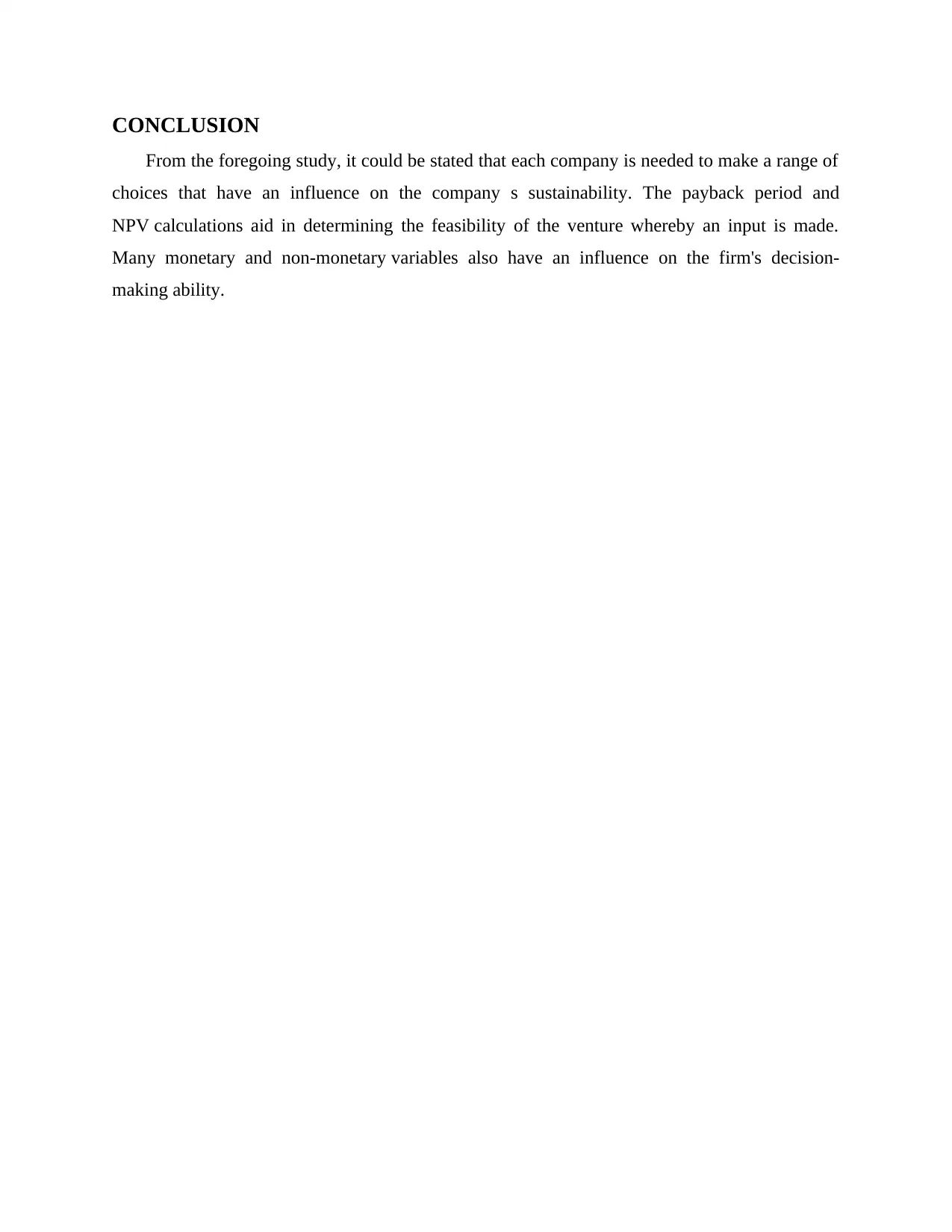
CONCLUSION
From the foregoing study, it could be stated that each company is needed to make a range of
choices that have an influence on the company s sustainability. The payback period and
NPV calculations aid in determining the feasibility of the venture whereby an input is made.
Many monetary and non-monetary variables also have an influence on the firm's decision-
making ability.
tabler-icon-diamond-filled.svg

Paraphrase This Document

Need a fresh take? Get an instant paraphrase of this document with our AI Paraphraser
Document Page
REFERENCES
Books and journals
Ahrens, T. and Ferry, L., 2020. Financial resilience of English local government in the aftermath
of COVID-19. Journal of Public Budgeting, Accounting & Financial Management.
Balteș, N. and Minculete, G.D., 2016. Study on the financial performance of companies
operating in the pharmaceutical industry in Romania. Studia Universitatis Vasile Goldiș
Arad, Seria Științe Economice, 26(1), pp.58-68.
Dube, V.S. and Asthana, P.K., 2017. A comparative study on Financial Literacy of Uttar Pradesh
with Central Zone states in India. IOSR Journal of Business and Management (IOSR-
JBM), 19(10), pp.22-27.
Esmaeili, L. and Golpayegani, A.H., 2021. A novel method for discovering process based on the
network analysis approach in the context of social commerce systems. Journal of
theoretical and applied electronic commerce research, 16(2), pp.34-62.
chevron_up_icon
1 out of 8
circle_padding
hide_on_mobile
zoom_out_icon
[object Object]