NR 400 Air Quality Assignment
VerifiedAdded on 2019/09/16
|5
|1394
|457
Homework Assignment
AI Summary
This document provides solutions to a homework assignment related to air quality regulations, specifically focusing on Wisconsin Administrative Code (NR) chapters. The assignment covers topics such as the difference between PM10 and PM2.5, fugitive emissions, RACT emission limitations, air quality control regions, construction permit requirements, hazardous air pollutants, ozone transport regions, and emission inventory reporting. The solutions are based on the specific sections of the Wisconsin Administrative Code, providing detailed answers to each question.
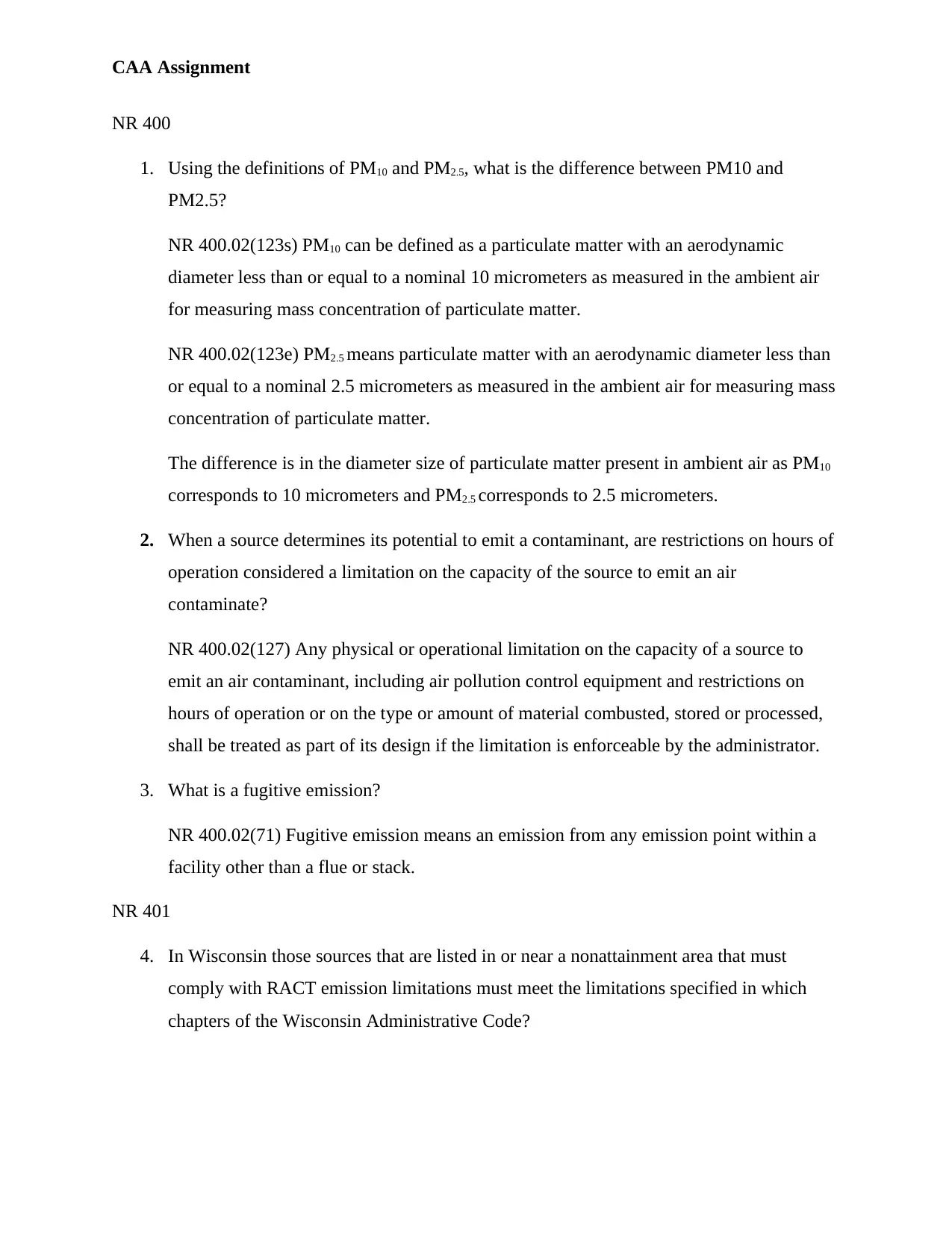
CAA Assignment
NR 400
1. Using the definitions of PM10 and PM2.5, what is the difference between PM10 and
PM2.5?
NR 400.02(123s) PM10 can be defined as a particulate matter with an aerodynamic
diameter less than or equal to a nominal 10 micrometers as measured in the ambient air
for measuring mass concentration of particulate matter.
NR 400.02(123e) PM2.5 means particulate matter with an aerodynamic diameter less than
or equal to a nominal 2.5 micrometers as measured in the ambient air for measuring mass
concentration of particulate matter.
The difference is in the diameter size of particulate matter present in ambient air as PM10
corresponds to 10 micrometers and PM2.5 corresponds to 2.5 micrometers.
2. When a source determines its potential to emit a contaminant, are restrictions on hours of
operation considered a limitation on the capacity of the source to emit an air
contaminate?
NR 400.02(127) Any physical or operational limitation on the capacity of a source to
emit an air contaminant, including air pollution control equipment and restrictions on
hours of operation or on the type or amount of material combusted, stored or processed,
shall be treated as part of its design if the limitation is enforceable by the administrator.
3. What is a fugitive emission?
NR 400.02(71) Fugitive emission means an emission from any emission point within a
facility other than a flue or stack.
NR 401
4. In Wisconsin those sources that are listed in or near a nonattainment area that must
comply with RACT emission limitations must meet the limitations specified in which
chapters of the Wisconsin Administrative Code?
NR 400
1. Using the definitions of PM10 and PM2.5, what is the difference between PM10 and
PM2.5?
NR 400.02(123s) PM10 can be defined as a particulate matter with an aerodynamic
diameter less than or equal to a nominal 10 micrometers as measured in the ambient air
for measuring mass concentration of particulate matter.
NR 400.02(123e) PM2.5 means particulate matter with an aerodynamic diameter less than
or equal to a nominal 2.5 micrometers as measured in the ambient air for measuring mass
concentration of particulate matter.
The difference is in the diameter size of particulate matter present in ambient air as PM10
corresponds to 10 micrometers and PM2.5 corresponds to 2.5 micrometers.
2. When a source determines its potential to emit a contaminant, are restrictions on hours of
operation considered a limitation on the capacity of the source to emit an air
contaminate?
NR 400.02(127) Any physical or operational limitation on the capacity of a source to
emit an air contaminant, including air pollution control equipment and restrictions on
hours of operation or on the type or amount of material combusted, stored or processed,
shall be treated as part of its design if the limitation is enforceable by the administrator.
3. What is a fugitive emission?
NR 400.02(71) Fugitive emission means an emission from any emission point within a
facility other than a flue or stack.
NR 401
4. In Wisconsin those sources that are listed in or near a nonattainment area that must
comply with RACT emission limitations must meet the limitations specified in which
chapters of the Wisconsin Administrative Code?

Paraphrase This Document
Need a fresh take? Get an instant paraphrase of this document with our AI Paraphraser
CAA Assignment
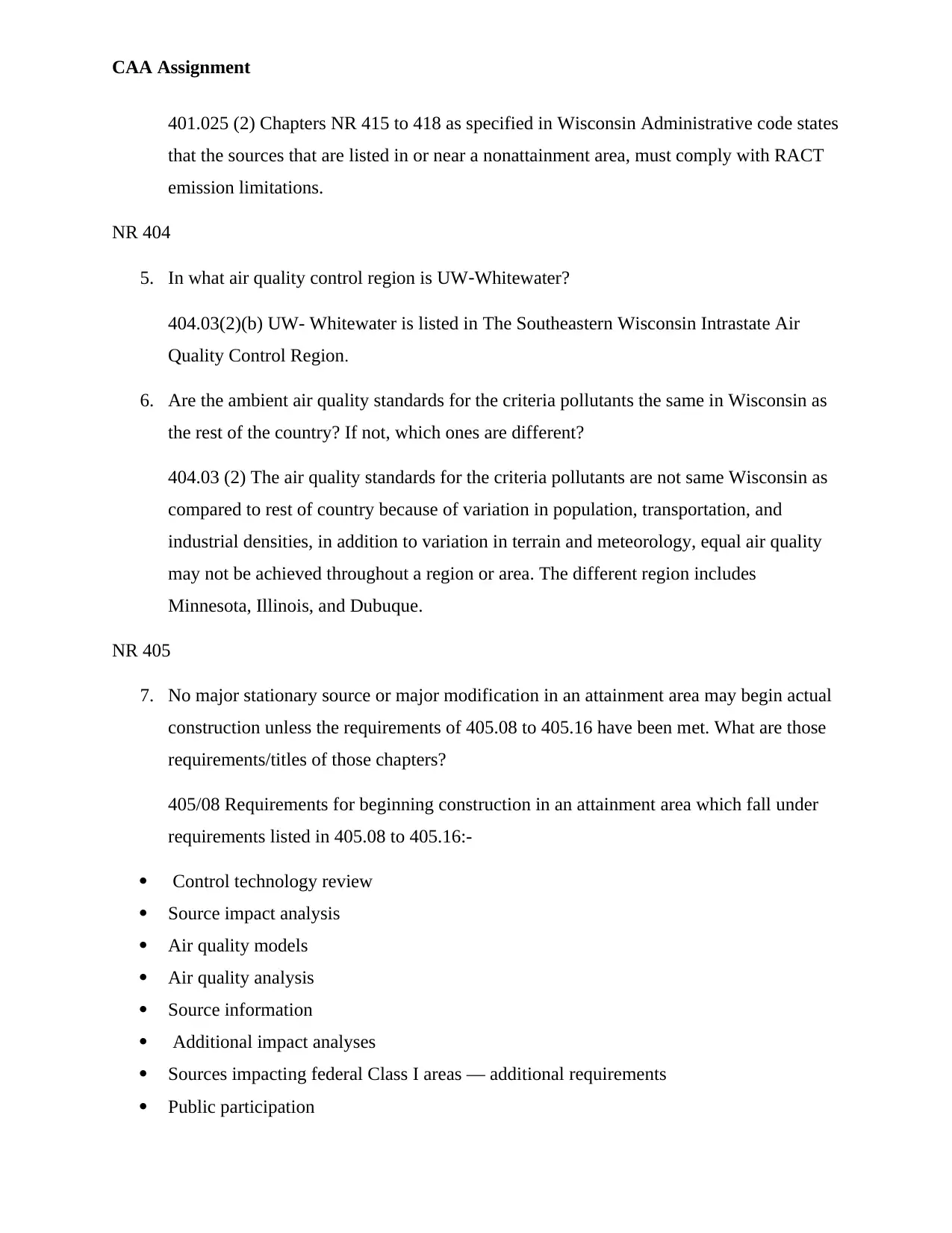
401.025 (2) Chapters NR 415 to 418 as specified in Wisconsin Administrative code states
that the sources that are listed in or near a nonattainment area, must comply with RACT
emission limitations.
NR 404
5. In what air quality control region is UW‐Whitewater?
404.03(2)(b) UW- Whitewater is listed in The Southeastern Wisconsin Intrastate Air
Quality Control Region.
6. Are the ambient air quality standards for the criteria pollutants the same in Wisconsin as
the rest of the country? If not, which ones are different?
404.03 (2) The air quality standards for the criteria pollutants are not same Wisconsin as
compared to rest of country because of variation in population, transportation, and
industrial densities, in addition to variation in terrain and meteorology, equal air quality
may not be achieved throughout a region or area. The different region includes
Minnesota, Illinois, and Dubuque.
NR 405
7. No major stationary source or major modification in an attainment area may begin actual
construction unless the requirements of 405.08 to 405.16 have been met. What are those
requirements/titles of those chapters?
405/08 Requirements for beginning construction in an attainment area which fall under
requirements listed in 405.08 to 405.16:-
Control technology review
Source impact analysis
Air quality models
Air quality analysis
Source information
Additional impact analyses
Sources impacting federal Class I areas — additional requirements
Public participation
401.025 (2) Chapters NR 415 to 418 as specified in Wisconsin Administrative code states
that the sources that are listed in or near a nonattainment area, must comply with RACT
emission limitations.
NR 404
5. In what air quality control region is UW‐Whitewater?
404.03(2)(b) UW- Whitewater is listed in The Southeastern Wisconsin Intrastate Air
Quality Control Region.
6. Are the ambient air quality standards for the criteria pollutants the same in Wisconsin as
the rest of the country? If not, which ones are different?
404.03 (2) The air quality standards for the criteria pollutants are not same Wisconsin as
compared to rest of country because of variation in population, transportation, and
industrial densities, in addition to variation in terrain and meteorology, equal air quality
may not be achieved throughout a region or area. The different region includes
Minnesota, Illinois, and Dubuque.
NR 405
7. No major stationary source or major modification in an attainment area may begin actual
construction unless the requirements of 405.08 to 405.16 have been met. What are those
requirements/titles of those chapters?
405/08 Requirements for beginning construction in an attainment area which fall under
requirements listed in 405.08 to 405.16:-
Control technology review
Source impact analysis
Air quality models
Air quality analysis
Source information
Additional impact analyses
Sources impacting federal Class I areas — additional requirements
Public participation
CAA Assignment
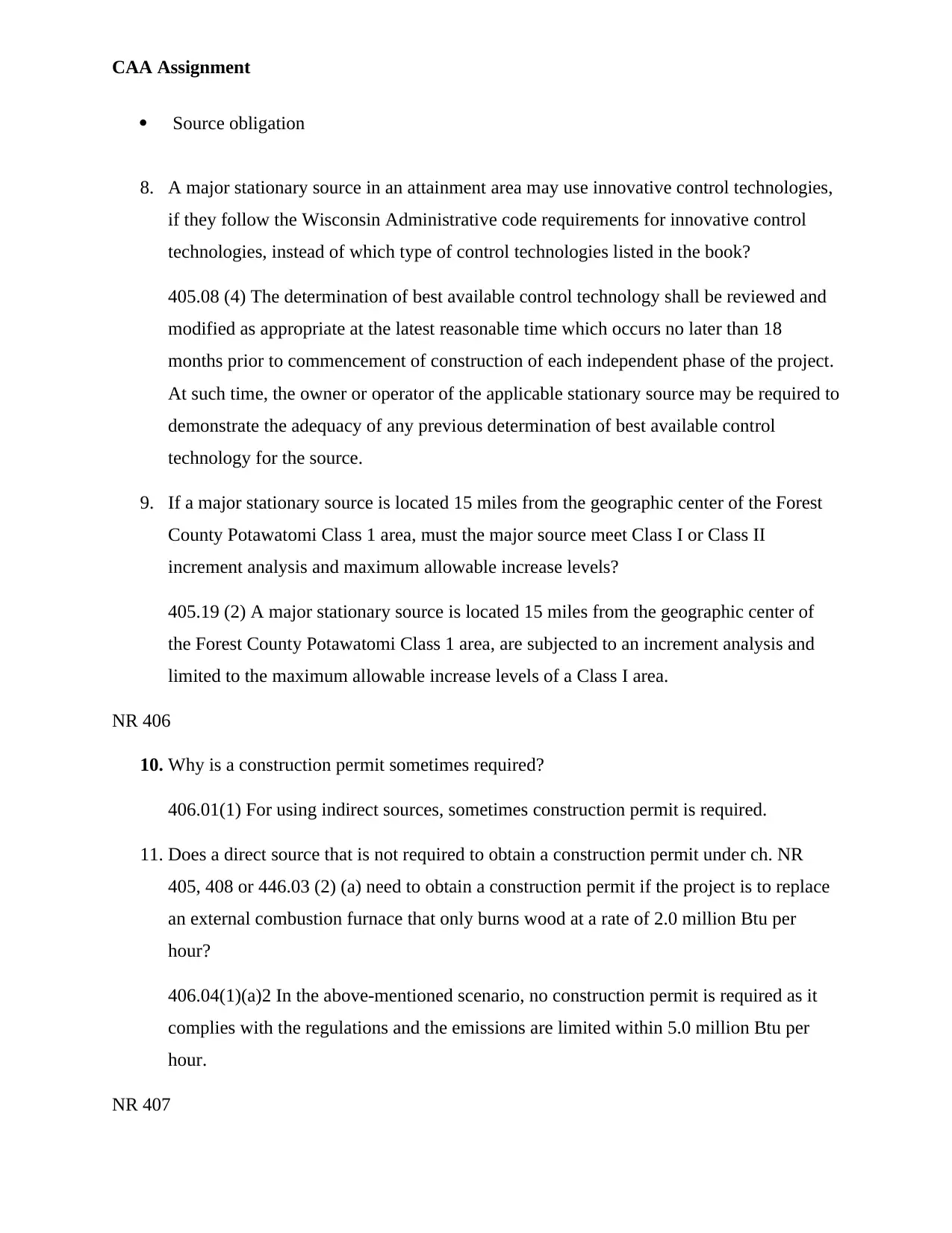
Source obligation
8. A major stationary source in an attainment area may use innovative control technologies,
if they follow the Wisconsin Administrative code requirements for innovative control
technologies, instead of which type of control technologies listed in the book?
405.08 (4) The determination of best available control technology shall be reviewed and
modified as appropriate at the latest reasonable time which occurs no later than 18
months prior to commencement of construction of each independent phase of the project.
At such time, the owner or operator of the applicable stationary source may be required to
demonstrate the adequacy of any previous determination of best available control
technology for the source.
9. If a major stationary source is located 15 miles from the geographic center of the Forest
County Potawatomi Class 1 area, must the major source meet Class I or Class II
increment analysis and maximum allowable increase levels?
405.19 (2) A major stationary source is located 15 miles from the geographic center of
the Forest County Potawatomi Class 1 area, are subjected to an increment analysis and
limited to the maximum allowable increase levels of a Class I area.
NR 406
10. Why is a construction permit sometimes required?
406.01(1) For using indirect sources, sometimes construction permit is required.
11. Does a direct source that is not required to obtain a construction permit under ch. NR
405, 408 or 446.03 (2) (a) need to obtain a construction permit if the project is to replace
an external combustion furnace that only burns wood at a rate of 2.0 million Btu per
hour?
406.04(1)(a)2 In the above-mentioned scenario, no construction permit is required as it
complies with the regulations and the emissions are limited within 5.0 million Btu per
hour.
NR 407
Source obligation
8. A major stationary source in an attainment area may use innovative control technologies,
if they follow the Wisconsin Administrative code requirements for innovative control
technologies, instead of which type of control technologies listed in the book?
405.08 (4) The determination of best available control technology shall be reviewed and
modified as appropriate at the latest reasonable time which occurs no later than 18
months prior to commencement of construction of each independent phase of the project.
At such time, the owner or operator of the applicable stationary source may be required to
demonstrate the adequacy of any previous determination of best available control
technology for the source.
9. If a major stationary source is located 15 miles from the geographic center of the Forest
County Potawatomi Class 1 area, must the major source meet Class I or Class II
increment analysis and maximum allowable increase levels?
405.19 (2) A major stationary source is located 15 miles from the geographic center of
the Forest County Potawatomi Class 1 area, are subjected to an increment analysis and
limited to the maximum allowable increase levels of a Class I area.
NR 406
10. Why is a construction permit sometimes required?
406.01(1) For using indirect sources, sometimes construction permit is required.
11. Does a direct source that is not required to obtain a construction permit under ch. NR
405, 408 or 446.03 (2) (a) need to obtain a construction permit if the project is to replace
an external combustion furnace that only burns wood at a rate of 2.0 million Btu per
hour?
406.04(1)(a)2 In the above-mentioned scenario, no construction permit is required as it
complies with the regulations and the emissions are limited within 5.0 million Btu per
hour.
NR 407
⊘ This is a preview!⊘
Do you want full access?
Subscribe today to unlock all pages.

Trusted by 1+ million students worldwide
CAA Assignment
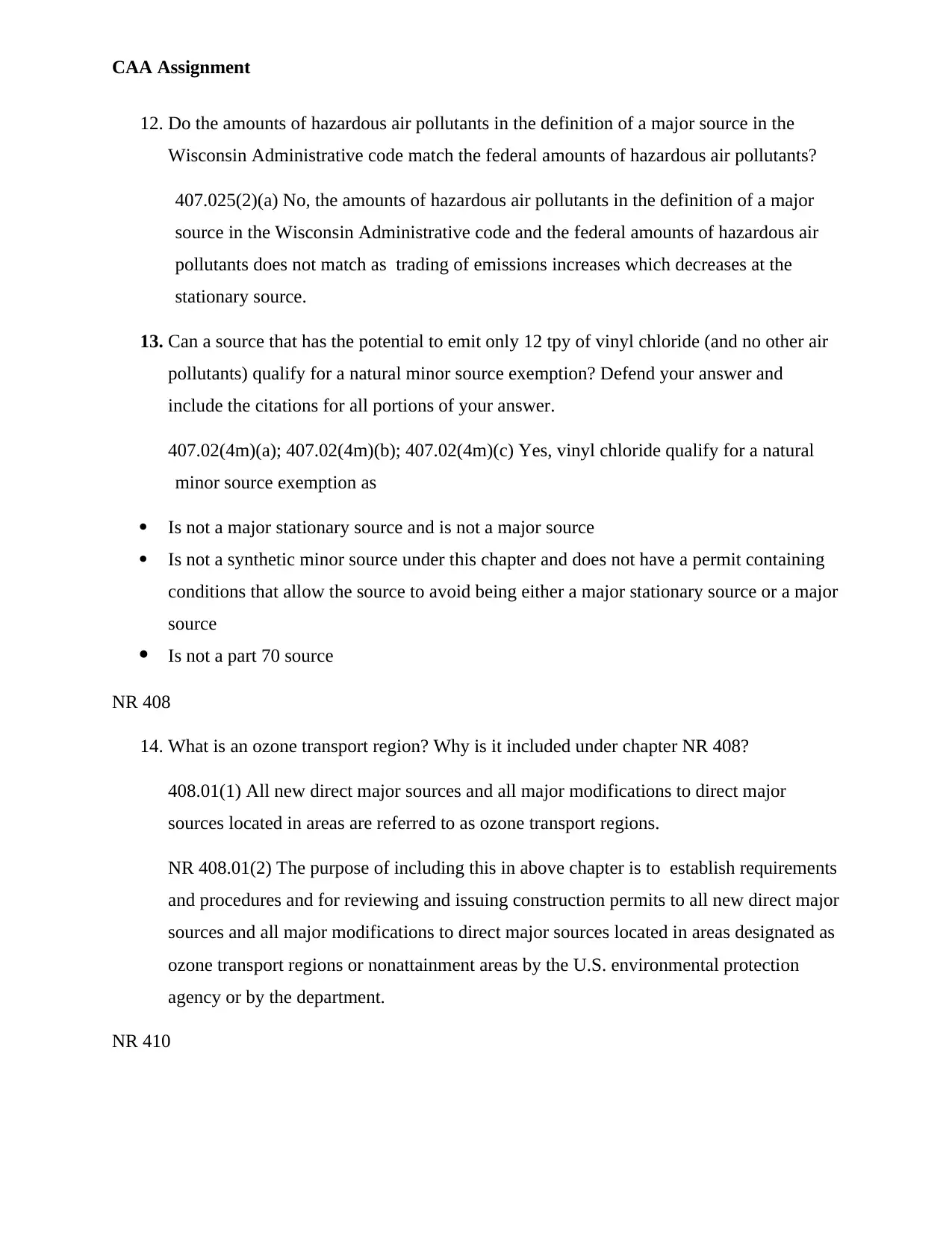
12. Do the amounts of hazardous air pollutants in the definition of a major source in the
Wisconsin Administrative code match the federal amounts of hazardous air pollutants?
407.025(2)(a) No, the amounts of hazardous air pollutants in the definition of a major
source in the Wisconsin Administrative code and the federal amounts of hazardous air
pollutants does not match as trading of emissions increases which decreases at the
stationary source.
13. Can a source that has the potential to emit only 12 tpy of vinyl chloride (and no other air
pollutants) qualify for a natural minor source exemption? Defend your answer and
include the citations for all portions of your answer.
407.02(4m)(a); 407.02(4m)(b); 407.02(4m)(c) Yes, vinyl chloride qualify for a natural
minor source exemption as
Is not a major stationary source and is not a major source
Is not a synthetic minor source under this chapter and does not have a permit containing
conditions that allow the source to avoid being either a major stationary source or a major
source
Is not a part 70 source
NR 408
14. What is an ozone transport region? Why is it included under chapter NR 408?
408.01(1) All new direct major sources and all major modifications to direct major
sources located in areas are referred to as ozone transport regions.
NR 408.01(2) The purpose of including this in above chapter is to establish requirements
and procedures and for reviewing and issuing construction permits to all new direct major
sources and all major modifications to direct major sources located in areas designated as
ozone transport regions or nonattainment areas by the U.S. environmental protection
agency or by the department.
NR 410
12. Do the amounts of hazardous air pollutants in the definition of a major source in the
Wisconsin Administrative code match the federal amounts of hazardous air pollutants?
407.025(2)(a) No, the amounts of hazardous air pollutants in the definition of a major
source in the Wisconsin Administrative code and the federal amounts of hazardous air
pollutants does not match as trading of emissions increases which decreases at the
stationary source.
13. Can a source that has the potential to emit only 12 tpy of vinyl chloride (and no other air
pollutants) qualify for a natural minor source exemption? Defend your answer and
include the citations for all portions of your answer.
407.02(4m)(a); 407.02(4m)(b); 407.02(4m)(c) Yes, vinyl chloride qualify for a natural
minor source exemption as
Is not a major stationary source and is not a major source
Is not a synthetic minor source under this chapter and does not have a permit containing
conditions that allow the source to avoid being either a major stationary source or a major
source
Is not a part 70 source
NR 408
14. What is an ozone transport region? Why is it included under chapter NR 408?
408.01(1) All new direct major sources and all major modifications to direct major
sources located in areas are referred to as ozone transport regions.
NR 408.01(2) The purpose of including this in above chapter is to establish requirements
and procedures and for reviewing and issuing construction permits to all new direct major
sources and all major modifications to direct major sources located in areas designated as
ozone transport regions or nonattainment areas by the U.S. environmental protection
agency or by the department.
NR 410
Paraphrase This Document
Need a fresh take? Get an instant paraphrase of this document with our AI Paraphraser
CAA Assignment
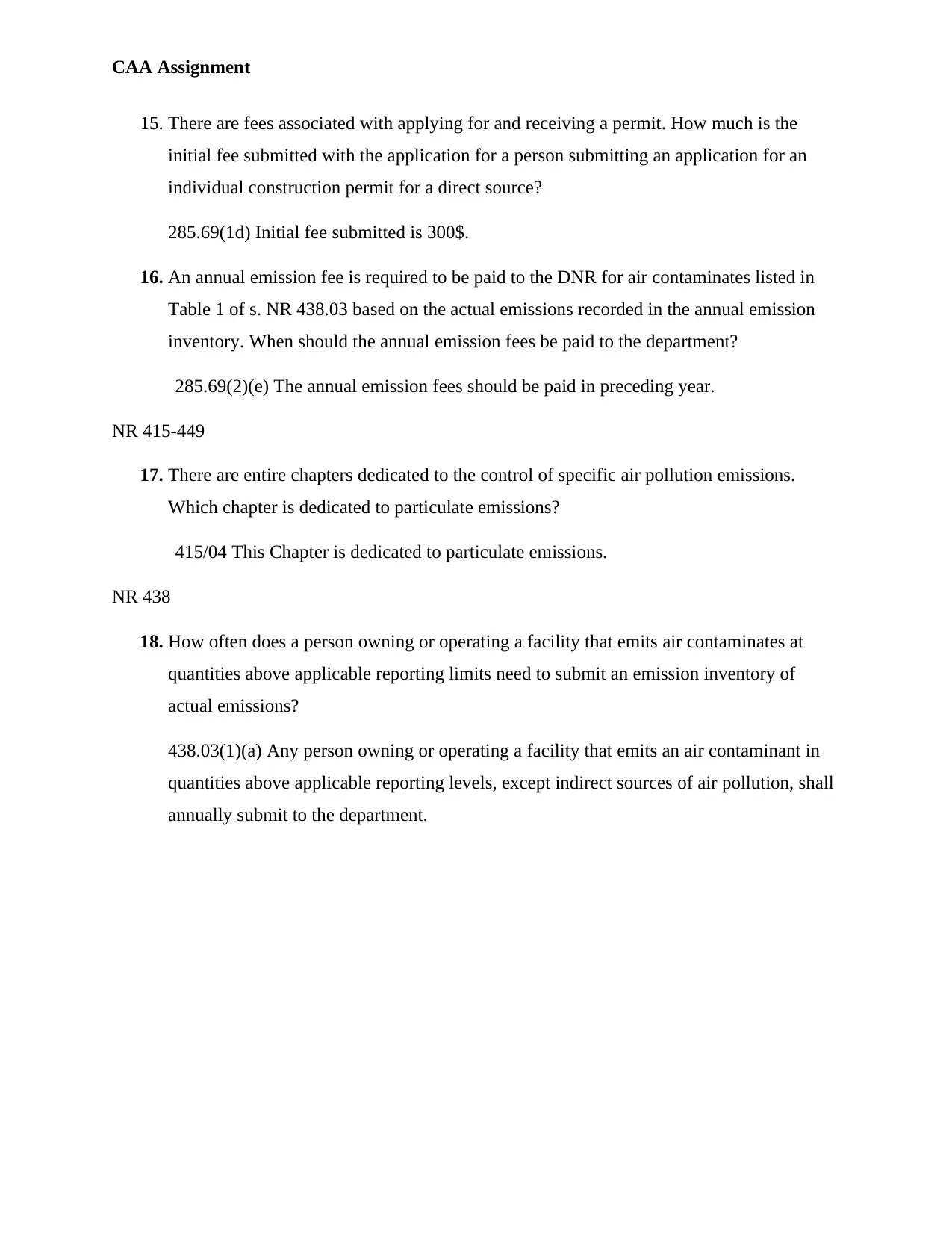
15. There are fees associated with applying for and receiving a permit. How much is the
initial fee submitted with the application for a person submitting an application for an
individual construction permit for a direct source?
285.69(1d) Initial fee submitted is 300$.
16. An annual emission fee is required to be paid to the DNR for air contaminates listed in
Table 1 of s. NR 438.03 based on the actual emissions recorded in the annual emission
inventory. When should the annual emission fees be paid to the department?
285.69(2)(e) The annual emission fees should be paid in preceding year.
NR 415-449
17. There are entire chapters dedicated to the control of specific air pollution emissions.
Which chapter is dedicated to particulate emissions?
415/04 This Chapter is dedicated to particulate emissions.
NR 438
18. How often does a person owning or operating a facility that emits air contaminates at
quantities above applicable reporting limits need to submit an emission inventory of
actual emissions?
438.03(1)(a) Any person owning or operating a facility that emits an air contaminant in
quantities above applicable reporting levels, except indirect sources of air pollution, shall
annually submit to the department.
15. There are fees associated with applying for and receiving a permit. How much is the
initial fee submitted with the application for a person submitting an application for an
individual construction permit for a direct source?
285.69(1d) Initial fee submitted is 300$.
16. An annual emission fee is required to be paid to the DNR for air contaminates listed in
Table 1 of s. NR 438.03 based on the actual emissions recorded in the annual emission
inventory. When should the annual emission fees be paid to the department?
285.69(2)(e) The annual emission fees should be paid in preceding year.
NR 415-449
17. There are entire chapters dedicated to the control of specific air pollution emissions.
Which chapter is dedicated to particulate emissions?
415/04 This Chapter is dedicated to particulate emissions.
NR 438
18. How often does a person owning or operating a facility that emits air contaminates at
quantities above applicable reporting limits need to submit an emission inventory of
actual emissions?
438.03(1)(a) Any person owning or operating a facility that emits an air contaminant in
quantities above applicable reporting levels, except indirect sources of air pollution, shall
annually submit to the department.

1 out of 5


Your All-in-One AI-Powered Toolkit for Academic Success.
+13062052269
info@desklib.com
Available 24*7 on WhatsApp / Email
![[object Object]](/_next/static/media/star-bottom.7253800d.svg)
Unlock your academic potential
Copyright © 2020–2026 A2Z Services. All Rights Reserved. Developed and managed by ZUCOL.