Benefits and Drawbacks of Nuclear Power Generation: ALS MCE Sem 2

Verified

Added on  2022/09/18

|3
|492
|31
Homework Assignment
AI Summary
This assignment analyzes the benefits and drawbacks of nuclear power generation, addressing the question of whether countries should invest in nuclear power to meet their energy demands. The student's response, written in formal academic style, synthesizes information from provided articles from BBC News and Nature, focusing on the advantages such as reduced carbon emissions and the availability of uranium, and the disadvantages including high initial costs and the risk of accidents. The analysis also considers the long-term cost-effectiveness and safety improvements in modern nuclear power plants. The essay concludes by advocating for investment in nuclear power as a sustainable solution to meet growing energy needs, while acknowledging the challenges and risks involved. The assignment follows the specified formatting guidelines, including citations and a reference list.
Document Page
Name, ALS class day
Nuclear Power
By (Student’s Name)
Name of the course
Instructor’s Name
Institutional Affiliation
Department
Date
tabler-icon-diamond-filled.svg

Paraphrase This Document

Need a fresh take? Get an instant paraphrase of this document with our AI Paraphraser
Document Page
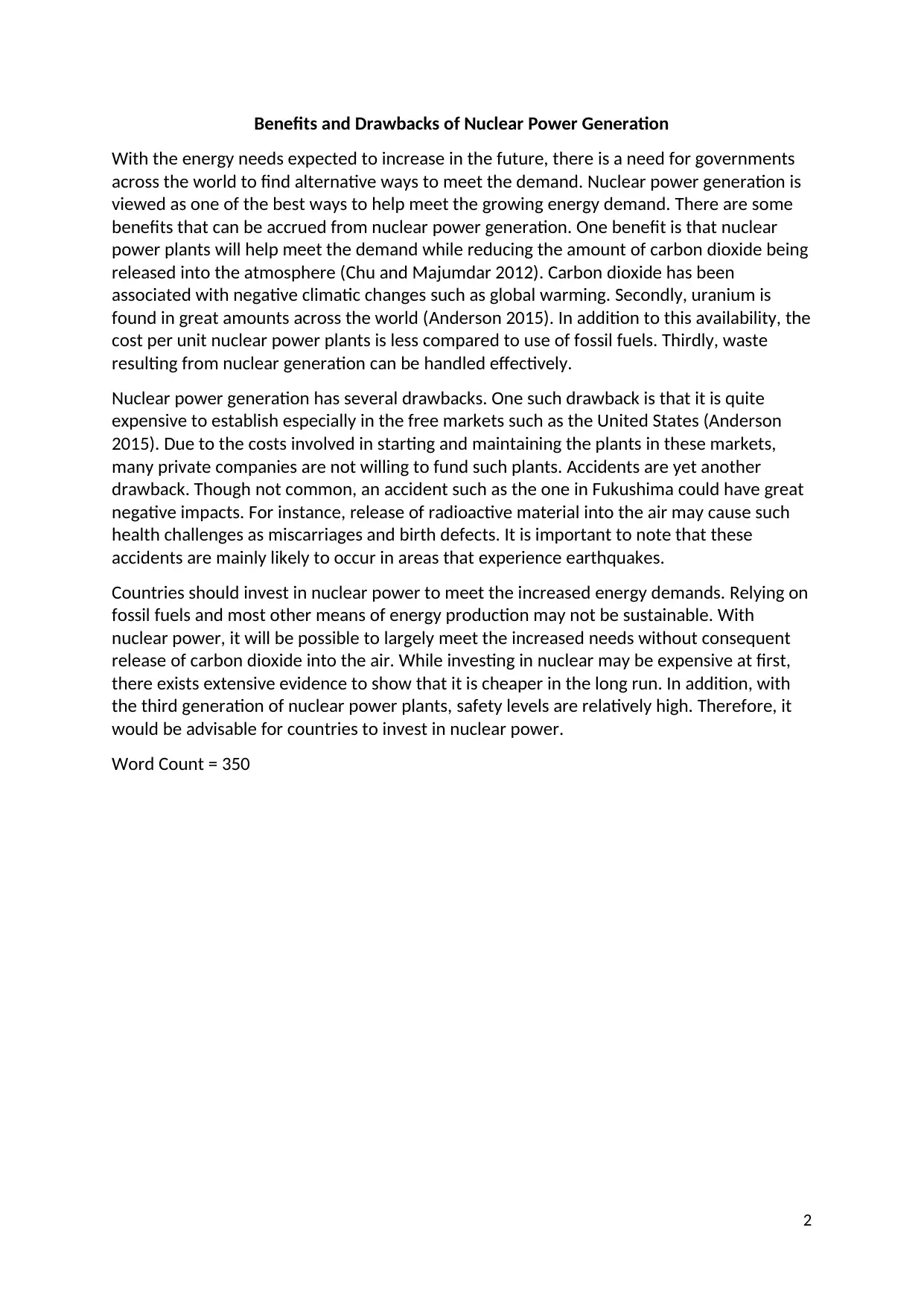
Benefits and Drawbacks of Nuclear Power Generation
With the energy needs expected to increase in the future, there is a need for governments
across the world to find alternative ways to meet the demand. Nuclear power generation is
viewed as one of the best ways to help meet the growing energy demand. There are some
benefits that can be accrued from nuclear power generation. One benefit is that nuclear
power plants will help meet the demand while reducing the amount of carbon dioxide being
released into the atmosphere (Chu and Majumdar 2012). Carbon dioxide has been
associated with negative climatic changes such as global warming. Secondly, uranium is
found in great amounts across the world (Anderson 2015). In addition to this availability, the
cost per unit nuclear power plants is less compared to use of fossil fuels. Thirdly, waste
resulting from nuclear generation can be handled effectively.
Nuclear power generation has several drawbacks. One such drawback is that it is quite
expensive to establish especially in the free markets such as the United States (Anderson
2015). Due to the costs involved in starting and maintaining the plants in these markets,
many private companies are not willing to fund such plants. Accidents are yet another
drawback. Though not common, an accident such as the one in Fukushima could have great
negative impacts. For instance, release of radioactive material into the air may cause such
health challenges as miscarriages and birth defects. It is important to note that these
accidents are mainly likely to occur in areas that experience earthquakes.
Countries should invest in nuclear power to meet the increased energy demands. Relying on
fossil fuels and most other means of energy production may not be sustainable. With
nuclear power, it will be possible to largely meet the increased needs without consequent
release of carbon dioxide into the air. While investing in nuclear may be expensive at first,
there exists extensive evidence to show that it is cheaper in the long run. In addition, with
the third generation of nuclear power plants, safety levels are relatively high. Therefore, it
would be advisable for countries to invest in nuclear power.
Word Count = 350
2
Document Page
References
Anderson, R., 2015. Nuclear Power: The Future or The Past? [online] BBC News. Available at:
<https://www.bbc.com/news/business-30919045> [Accessed 8 April 2020].
Chu, S. and Majumdar, A., 2012. Opportunities and challenges for a sustainable energy
future. nature, 488(7411), pp.294-303.
3
chevron_up_icon
1 out of 3
circle_padding
hide_on_mobile
zoom_out_icon
[object Object]