Avondale University NURS20024 Assignment: Carol's Case Study Analysis
VerifiedAdded on 2022/10/10
|13
|4208
|266
Homework Assignment
AI Summary
This assignment provides a comprehensive analysis of a nursing case study involving a patient, Carol, who experienced a STEMI (ST-segment elevation myocardial infarction) and underwent Percutaneous Coronary Intervention (PCI). The assignment addresses various aspects of Carol's case, including the affected areas of the heart, laboratory test results (CRP levels), anticipated laboratory tests (d-dimers, chest x-ray, troponin), and the medications administered (nitroglycerin, heparin, amiodarone, beta-blockers, aspirin). It also discusses concerning vital signs, potential causes for changes in vital signs post-procedure, necessary actions to be taken, the role of PCIs, nursing preparations and care required before and after PCI, potential complications (such as stent thrombosis), and the importance of cardiac rehabilitation. Furthermore, the assignment covers the positioning of chest leads, lifestyle modifications, and the benefits of cardiac rehabilitation programs for patients post-PCI. The assignment references relevant literature to support the answers and recommendations provided.
Student Number:
Student Name:
Lecturer’s Name:
Unit Code:
Unit Name:
Assignment Title:
Due Date:
Date of Submission:
Extension Details (if applicable):
Word Length (excluding list of references):
Check you have used the following file name convention: ☐Checked
surname_student ID_unit code_assessment task #_ year
e.g. jones_11225577_EDUC12500_task2_2019.doc
Note: Only .doc or .docx files may be submitted
INTELLECTUAL PROPERTY STATEMENT
By checking the box below: I certify that this assignment is my own work and is free from plagiarism. I understand that
the assignment may be checked for plagiarism by electronic or other means and may be transferred and stored in a
database for the purposes of data-matching to help detect plagiarism. The assignment has not previously been
submitted for assessment in any other unit or to any other institution. I have read and understood
Avondale's Academic Integrity Policy.
☐Agree
Date:
1
ASSIGNMENT COVER PAGE
Student Name:
Lecturer’s Name:
Unit Code:
Unit Name:
Assignment Title:
Due Date:
Date of Submission:
Extension Details (if applicable):
Word Length (excluding list of references):
Check you have used the following file name convention: ☐Checked
surname_student ID_unit code_assessment task #_ year
e.g. jones_11225577_EDUC12500_task2_2019.doc
Note: Only .doc or .docx files may be submitted
INTELLECTUAL PROPERTY STATEMENT
By checking the box below: I certify that this assignment is my own work and is free from plagiarism. I understand that
the assignment may be checked for plagiarism by electronic or other means and may be transferred and stored in a
database for the purposes of data-matching to help detect plagiarism. The assignment has not previously been
submitted for assessment in any other unit or to any other institution. I have read and understood
Avondale's Academic Integrity Policy.
☐Agree
Date:
1
ASSIGNMENT COVER PAGE

Paraphrase This Document
Need a fresh take? Get an instant paraphrase of this document with our AI Paraphraser
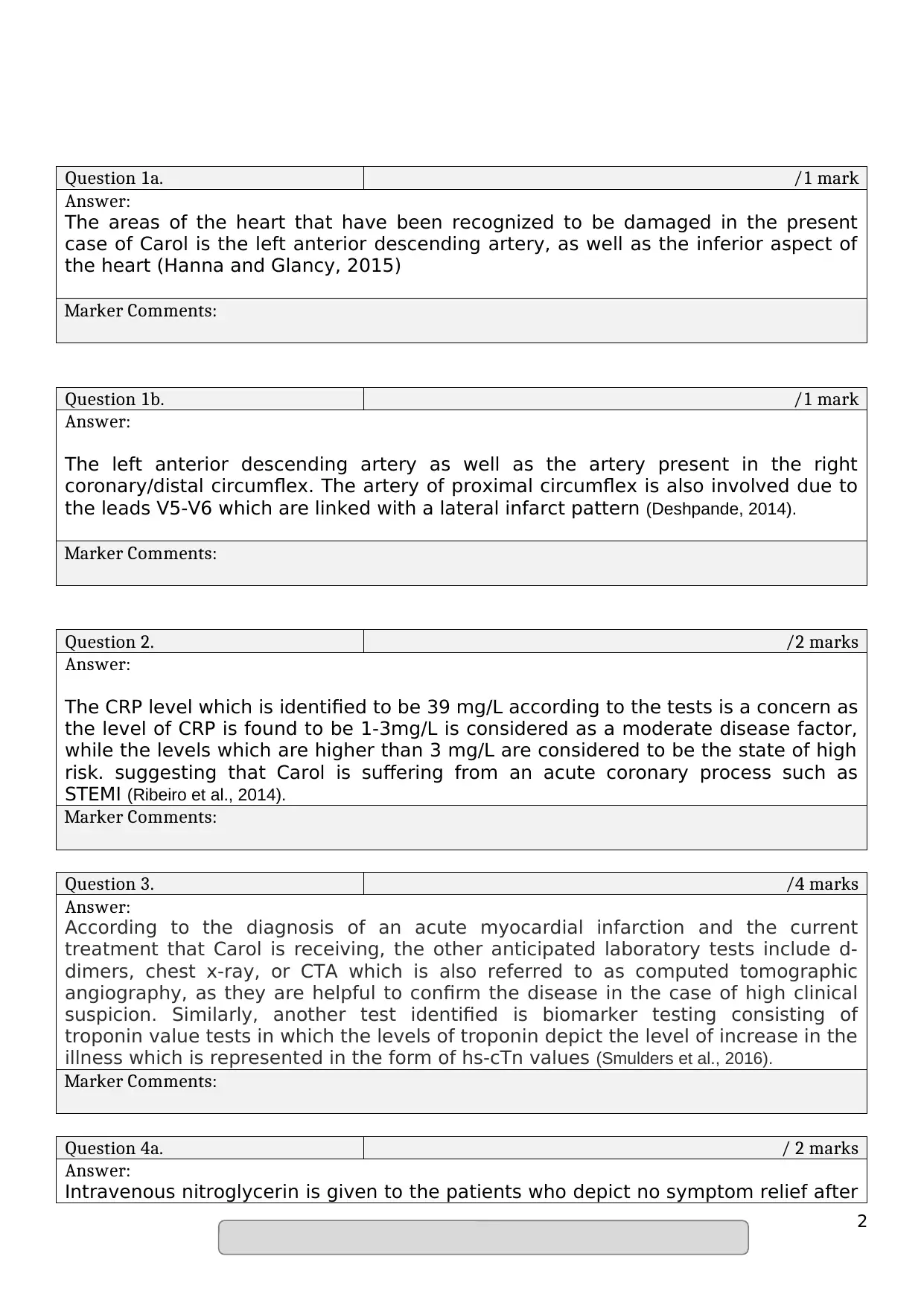
Question 1a. /1 mark
Answer:
The areas of the heart that have been recognized to be damaged in the present
case of Carol is the left anterior descending artery, as well as the inferior aspect of
the heart (Hanna and Glancy, 2015)
Marker Comments:
Question 1b. /1 mark
Answer:
The left anterior descending artery as well as the artery present in the right
coronary/distal circumflex. The artery of proximal circumflex is also involved due to
the leads V5-V6 which are linked with a lateral infarct pattern (Deshpande, 2014).
Marker Comments:
Question 2. /2 marks
Answer:
The CRP level which is identified to be 39 mg/L according to the tests is a concern as
the level of CRP is found to be 1-3mg/L is considered as a moderate disease factor,
while the levels which are higher than 3 mg/L are considered to be the state of high
risk. suggesting that Carol is suffering from an acute coronary process such as
STEMI (Ribeiro et al., 2014).
Marker Comments:
Question 3. /4 marks
Answer:
According to the diagnosis of an acute myocardial infarction and the current
treatment that Carol is receiving, the other anticipated laboratory tests include d-
dimers, chest x-ray, or CTA which is also referred to as computed tomographic
angiography, as they are helpful to confirm the disease in the case of high clinical
suspicion. Similarly, another test identified is biomarker testing consisting of
troponin value tests in which the levels of troponin depict the level of increase in the
illness which is represented in the form of hs-cTn values (Smulders et al., 2016).
Marker Comments:
Question 4a. / 2 marks
Answer:
Intravenous nitroglycerin is given to the patients who depict no symptom relief after
2
Answer:
The areas of the heart that have been recognized to be damaged in the present
case of Carol is the left anterior descending artery, as well as the inferior aspect of
the heart (Hanna and Glancy, 2015)
Marker Comments:
Question 1b. /1 mark
Answer:
The left anterior descending artery as well as the artery present in the right
coronary/distal circumflex. The artery of proximal circumflex is also involved due to
the leads V5-V6 which are linked with a lateral infarct pattern (Deshpande, 2014).
Marker Comments:
Question 2. /2 marks
Answer:
The CRP level which is identified to be 39 mg/L according to the tests is a concern as
the level of CRP is found to be 1-3mg/L is considered as a moderate disease factor,
while the levels which are higher than 3 mg/L are considered to be the state of high
risk. suggesting that Carol is suffering from an acute coronary process such as
STEMI (Ribeiro et al., 2014).
Marker Comments:
Question 3. /4 marks
Answer:
According to the diagnosis of an acute myocardial infarction and the current
treatment that Carol is receiving, the other anticipated laboratory tests include d-
dimers, chest x-ray, or CTA which is also referred to as computed tomographic
angiography, as they are helpful to confirm the disease in the case of high clinical
suspicion. Similarly, another test identified is biomarker testing consisting of
troponin value tests in which the levels of troponin depict the level of increase in the
illness which is represented in the form of hs-cTn values (Smulders et al., 2016).
Marker Comments:
Question 4a. / 2 marks
Answer:
Intravenous nitroglycerin is given to the patients who depict no symptom relief after
2
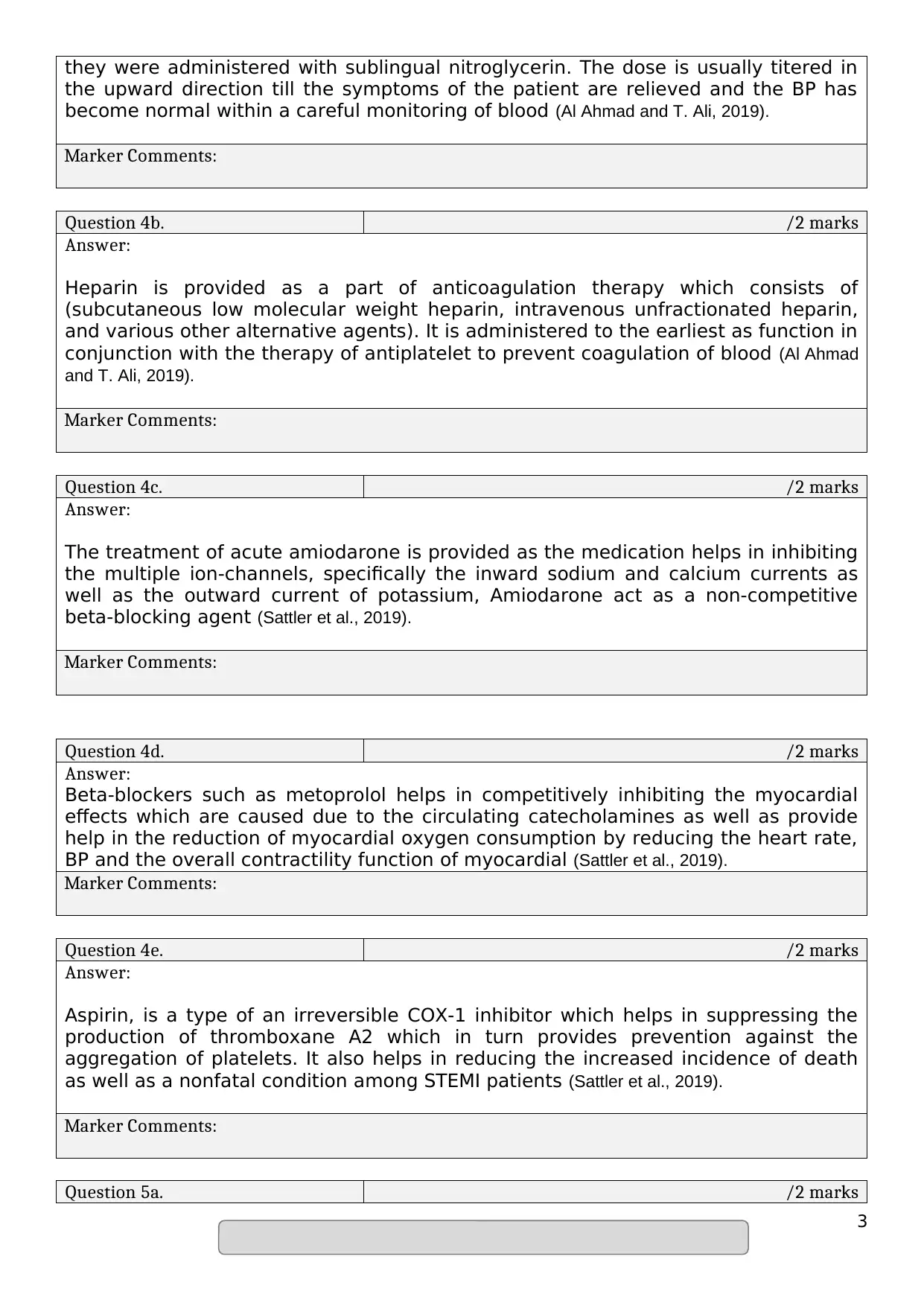
they were administered with sublingual nitroglycerin. The dose is usually titered in
the upward direction till the symptoms of the patient are relieved and the BP has
become normal within a careful monitoring of blood (Al Ahmad and T. Ali, 2019).
Marker Comments:
Question 4b. /2 marks
Answer:
Heparin is provided as a part of anticoagulation therapy which consists of
(subcutaneous low molecular weight heparin, intravenous unfractionated heparin,
and various other alternative agents). It is administered to the earliest as function in
conjunction with the therapy of antiplatelet to prevent coagulation of blood (Al Ahmad
and T. Ali, 2019).
Marker Comments:
Question 4c. /2 marks
Answer:
The treatment of acute amiodarone is provided as the medication helps in inhibiting
the multiple ion-channels, specifically the inward sodium and calcium currents as
well as the outward current of potassium, Amiodarone act as a non-competitive
beta-blocking agent (Sattler et al., 2019).
Marker Comments:
Question 4d. /2 marks
Answer:
Beta-blockers such as metoprolol helps in competitively inhibiting the myocardial
effects which are caused due to the circulating catecholamines as well as provide
help in the reduction of myocardial oxygen consumption by reducing the heart rate,
BP and the overall contractility function of myocardial (Sattler et al., 2019).
Marker Comments:
Question 4e. /2 marks
Answer:
Aspirin, is a type of an irreversible COX-1 inhibitor which helps in suppressing the
production of thromboxane A2 which in turn provides prevention against the
aggregation of platelets. It also helps in reducing the increased incidence of death
as well as a nonfatal condition among STEMI patients (Sattler et al., 2019).
Marker Comments:
Question 5a. /2 marks
3
the upward direction till the symptoms of the patient are relieved and the BP has
become normal within a careful monitoring of blood (Al Ahmad and T. Ali, 2019).
Marker Comments:
Question 4b. /2 marks
Answer:
Heparin is provided as a part of anticoagulation therapy which consists of
(subcutaneous low molecular weight heparin, intravenous unfractionated heparin,
and various other alternative agents). It is administered to the earliest as function in
conjunction with the therapy of antiplatelet to prevent coagulation of blood (Al Ahmad
and T. Ali, 2019).
Marker Comments:
Question 4c. /2 marks
Answer:
The treatment of acute amiodarone is provided as the medication helps in inhibiting
the multiple ion-channels, specifically the inward sodium and calcium currents as
well as the outward current of potassium, Amiodarone act as a non-competitive
beta-blocking agent (Sattler et al., 2019).
Marker Comments:
Question 4d. /2 marks
Answer:
Beta-blockers such as metoprolol helps in competitively inhibiting the myocardial
effects which are caused due to the circulating catecholamines as well as provide
help in the reduction of myocardial oxygen consumption by reducing the heart rate,
BP and the overall contractility function of myocardial (Sattler et al., 2019).
Marker Comments:
Question 4e. /2 marks
Answer:
Aspirin, is a type of an irreversible COX-1 inhibitor which helps in suppressing the
production of thromboxane A2 which in turn provides prevention against the
aggregation of platelets. It also helps in reducing the increased incidence of death
as well as a nonfatal condition among STEMI patients (Sattler et al., 2019).
Marker Comments:
Question 5a. /2 marks
3
⊘ This is a preview!⊘
Do you want full access?
Subscribe today to unlock all pages.

Trusted by 1+ million students worldwide
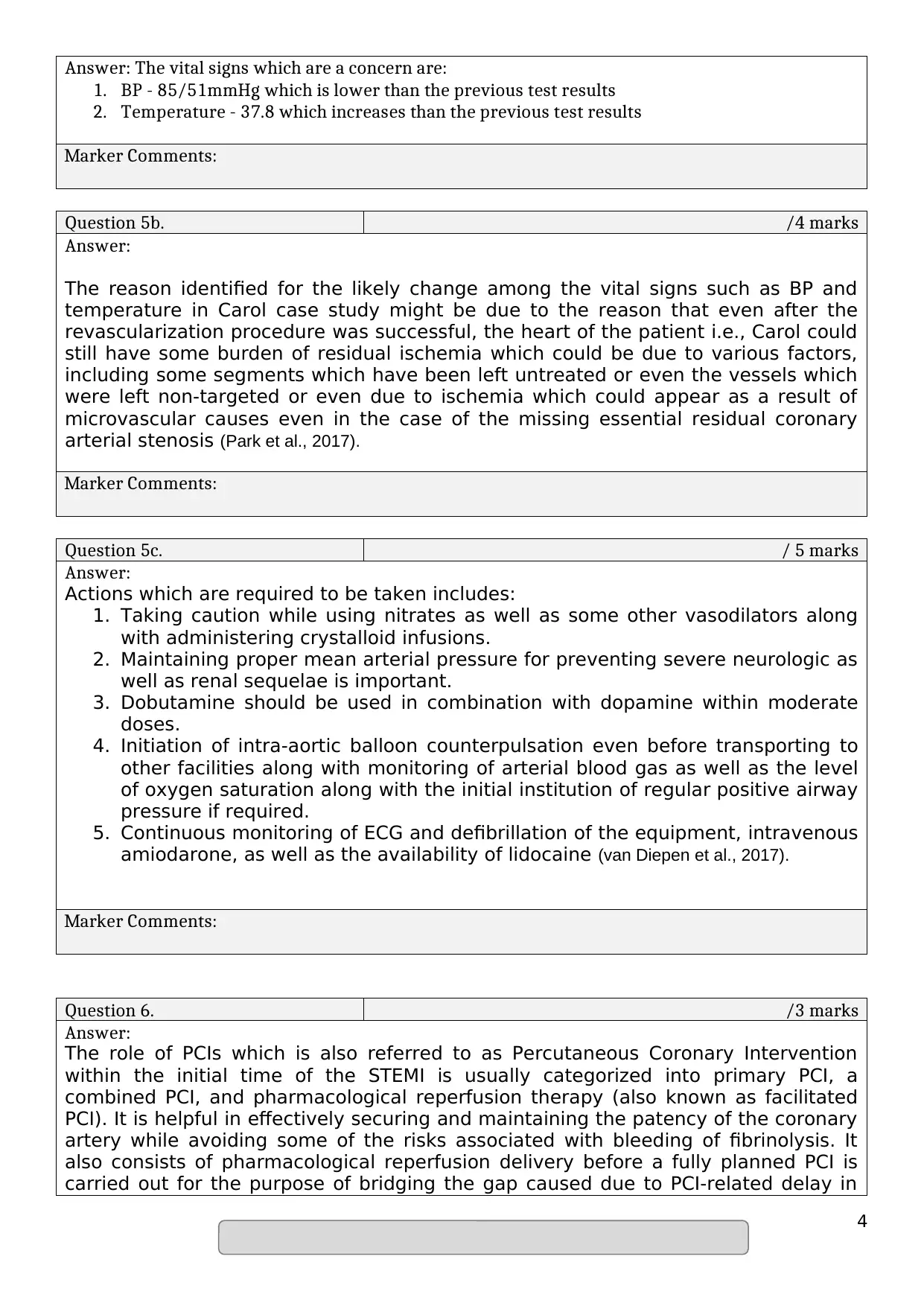
Answer: The vital signs which are a concern are:
1. BP - 85/51mmHg which is lower than the previous test results
2. Temperature - 37.8 which increases than the previous test results
Marker Comments:
Question 5b. /4 marks
Answer:
The reason identified for the likely change among the vital signs such as BP and
temperature in Carol case study might be due to the reason that even after the
revascularization procedure was successful, the heart of the patient i.e., Carol could
still have some burden of residual ischemia which could be due to various factors,
including some segments which have been left untreated or even the vessels which
were left non-targeted or even due to ischemia which could appear as a result of
microvascular causes even in the case of the missing essential residual coronary
arterial stenosis (Park et al., 2017).
Marker Comments:
Question 5c. / 5 marks
Answer:
Actions which are required to be taken includes:
1. Taking caution while using nitrates as well as some other vasodilators along
with administering crystalloid infusions.
2. Maintaining proper mean arterial pressure for preventing severe neurologic as
well as renal sequelae is important.
3. Dobutamine should be used in combination with dopamine within moderate
doses.
4. Initiation of intra-aortic balloon counterpulsation even before transporting to
other facilities along with monitoring of arterial blood gas as well as the level
of oxygen saturation along with the initial institution of regular positive airway
pressure if required.
5. Continuous monitoring of ECG and defibrillation of the equipment, intravenous
amiodarone, as well as the availability of lidocaine (van Diepen et al., 2017).
Marker Comments:
Question 6. /3 marks
Answer:
The role of PCIs which is also referred to as Percutaneous Coronary Intervention
within the initial time of the STEMI is usually categorized into primary PCI, a
combined PCI, and pharmacological reperfusion therapy (also known as facilitated
PCI). It is helpful in effectively securing and maintaining the patency of the coronary
artery while avoiding some of the risks associated with bleeding of fibrinolysis. It
also consists of pharmacological reperfusion delivery before a fully planned PCI is
carried out for the purpose of bridging the gap caused due to PCI-related delay in
4
1. BP - 85/51mmHg which is lower than the previous test results
2. Temperature - 37.8 which increases than the previous test results
Marker Comments:
Question 5b. /4 marks
Answer:
The reason identified for the likely change among the vital signs such as BP and
temperature in Carol case study might be due to the reason that even after the
revascularization procedure was successful, the heart of the patient i.e., Carol could
still have some burden of residual ischemia which could be due to various factors,
including some segments which have been left untreated or even the vessels which
were left non-targeted or even due to ischemia which could appear as a result of
microvascular causes even in the case of the missing essential residual coronary
arterial stenosis (Park et al., 2017).
Marker Comments:
Question 5c. / 5 marks
Answer:
Actions which are required to be taken includes:
1. Taking caution while using nitrates as well as some other vasodilators along
with administering crystalloid infusions.
2. Maintaining proper mean arterial pressure for preventing severe neurologic as
well as renal sequelae is important.
3. Dobutamine should be used in combination with dopamine within moderate
doses.
4. Initiation of intra-aortic balloon counterpulsation even before transporting to
other facilities along with monitoring of arterial blood gas as well as the level
of oxygen saturation along with the initial institution of regular positive airway
pressure if required.
5. Continuous monitoring of ECG and defibrillation of the equipment, intravenous
amiodarone, as well as the availability of lidocaine (van Diepen et al., 2017).
Marker Comments:
Question 6. /3 marks
Answer:
The role of PCIs which is also referred to as Percutaneous Coronary Intervention
within the initial time of the STEMI is usually categorized into primary PCI, a
combined PCI, and pharmacological reperfusion therapy (also known as facilitated
PCI). It is helpful in effectively securing and maintaining the patency of the coronary
artery while avoiding some of the risks associated with bleeding of fibrinolysis. It
also consists of pharmacological reperfusion delivery before a fully planned PCI is
carried out for the purpose of bridging the gap caused due to PCI-related delay in
4
Paraphrase This Document
Need a fresh take? Get an instant paraphrase of this document with our AI Paraphraser
time (Valaker et al., 2017).
Marker Comments:
Question 7. /5 marks
Answer:
The nursing preparation/care that needs to be completed to prepare Carol for her PCI includes:
Overall Inspection:
● Examining the circulatory as well as the hydration status of both the
extremities
Palpating:
● Palpation of the central as well as the peripheral pulses to check the rate, its
rhythm and overall volume.
Auscultating:
● Auscultation of the apical side of the pulse and chest for the type of heart
sounds.
Providing sedative to Carol to help her relax.
Marker Comments:
Question 8. /4 mark
Answer:
1. Assessing the puncture site for any type of bleeding, pressure check on the
dressing to observe any type of oozing of blood on the site and if any make a
mark on the particular site.
2. Assessment of the vital signs which include any fluctuation in BP, bradycardia
or signs of hypotension, any pain in the abdomen or groin or back, agitation,
and reduced level of hemoglobin.
3. Assessing the ECG rhythm with the help of cardiac monitor and making sure
that Carol is in sinus rhythm.
4. Checking for any change in behavior such as being alert, or feeling lethargic,
irritable etc, along with the neurovascular observation (Banning et al., 2015).
Marker Comments:
Question 9. /1 mark
Answer:
The other method is the second arterial graft (also known as multi arterial coronary
artery bypass graft (i.e., MA-CABG) which helps in enhancing the intermediate as
well as the long-term outcomes and have better patency in terms of arterial grafts
(Habib et al., 2015).
5
Marker Comments:
Question 7. /5 marks
Answer:
The nursing preparation/care that needs to be completed to prepare Carol for her PCI includes:
Overall Inspection:
● Examining the circulatory as well as the hydration status of both the
extremities
Palpating:
● Palpation of the central as well as the peripheral pulses to check the rate, its
rhythm and overall volume.
Auscultating:
● Auscultation of the apical side of the pulse and chest for the type of heart
sounds.
Providing sedative to Carol to help her relax.
Marker Comments:
Question 8. /4 mark
Answer:
1. Assessing the puncture site for any type of bleeding, pressure check on the
dressing to observe any type of oozing of blood on the site and if any make a
mark on the particular site.
2. Assessment of the vital signs which include any fluctuation in BP, bradycardia
or signs of hypotension, any pain in the abdomen or groin or back, agitation,
and reduced level of hemoglobin.
3. Assessing the ECG rhythm with the help of cardiac monitor and making sure
that Carol is in sinus rhythm.
4. Checking for any change in behavior such as being alert, or feeling lethargic,
irritable etc, along with the neurovascular observation (Banning et al., 2015).
Marker Comments:
Question 9. /1 mark
Answer:
The other method is the second arterial graft (also known as multi arterial coronary
artery bypass graft (i.e., MA-CABG) which helps in enhancing the intermediate as
well as the long-term outcomes and have better patency in terms of arterial grafts
(Habib et al., 2015).
5
Marker Comments:
Question 10. /5 mark
Answer:
1. The incidence of dull pain in the chest post PCI is considered to be linked with
abnormal ECG indicating MI. Hence, ECG would be taken for the follow-up.
2. The elevation in cTnI is also considered to be linked with the pain, hence cTnI
will be used as a sensitive marker to detect the major complications.
3. The Colour of the puncture will be assessed for its color and appearance along
with capillary Refill Time (also known as CRT).
4. Check for the presence of oedema on both the central or the peripheral region
along with providing quick medications through an intravenous (IV) line.
5. Place electrodes on the body of the patient for monitoring the heart along with
a small device known as the pulse oximeter to track the level of oxygen inside
her blood (Chiang et al., 2016).
Marker Comments:
Question 11. /3 mark
Answer:
The dull pain in the chest post PCI might be caused due to acute stent thrombosis,
or even due to incomplete revascularization, and other causes including, restenosis,
not so proper vasoconstriction, stretching of stent, and even due to illness
progression which doesn’t involve the target lesion. Another possible cause of the
pain could be abnormal ECG post-PCI which indicates the reason to be STEMI. The
chest pain could be due to previous ischemic insult suggesting the ineffectiveness of
the treatment of PCI which was not able to be ruled out (Habib et al., 2015).
Marker Comments:
Question 12. /3 marks
Answer:
The 6 chest leads which are labelled as "V" are namely V1-V6 has a specific position
on the rib cage. The gap found between the ribs is known as 2nd Intercostal space.
The 4th intercostal space meets the sternum is where lead V1 is located, and where
the 4th intercostal space meets with the sternum is the location of lead V2.
Furthermore, the location of V4 is found within the 5th intercostal space lying in the
middle of mid-clavicular. The location of lead V3 is found in between V2 and V4. At
the beginning of the axilla, the location of V5 lead is there while the mid-axilla is the
position for lead V6 (Francis, 2016).
Marker Comments:
6
Question 10. /5 mark
Answer:
1. The incidence of dull pain in the chest post PCI is considered to be linked with
abnormal ECG indicating MI. Hence, ECG would be taken for the follow-up.
2. The elevation in cTnI is also considered to be linked with the pain, hence cTnI
will be used as a sensitive marker to detect the major complications.
3. The Colour of the puncture will be assessed for its color and appearance along
with capillary Refill Time (also known as CRT).
4. Check for the presence of oedema on both the central or the peripheral region
along with providing quick medications through an intravenous (IV) line.
5. Place electrodes on the body of the patient for monitoring the heart along with
a small device known as the pulse oximeter to track the level of oxygen inside
her blood (Chiang et al., 2016).
Marker Comments:
Question 11. /3 mark
Answer:
The dull pain in the chest post PCI might be caused due to acute stent thrombosis,
or even due to incomplete revascularization, and other causes including, restenosis,
not so proper vasoconstriction, stretching of stent, and even due to illness
progression which doesn’t involve the target lesion. Another possible cause of the
pain could be abnormal ECG post-PCI which indicates the reason to be STEMI. The
chest pain could be due to previous ischemic insult suggesting the ineffectiveness of
the treatment of PCI which was not able to be ruled out (Habib et al., 2015).
Marker Comments:
Question 12. /3 marks
Answer:
The 6 chest leads which are labelled as "V" are namely V1-V6 has a specific position
on the rib cage. The gap found between the ribs is known as 2nd Intercostal space.
The 4th intercostal space meets the sternum is where lead V1 is located, and where
the 4th intercostal space meets with the sternum is the location of lead V2.
Furthermore, the location of V4 is found within the 5th intercostal space lying in the
middle of mid-clavicular. The location of lead V3 is found in between V2 and V4. At
the beginning of the axilla, the location of V5 lead is there while the mid-axilla is the
position for lead V6 (Francis, 2016).
Marker Comments:
6
⊘ This is a preview!⊘
Do you want full access?
Subscribe today to unlock all pages.
Trusted by 1+ million students worldwide
Question 13a. /1 marks
Answer (No reference required):
Marker Comments:
Question 13b. /1 mark
Answer:
Marker Comments:
Question 13c. /2 marks
Answer (No reference required):
Marker Comments:
Question 13d. /2 marks
Answer:
Marker Comments:
Question 14. /3 mark
Answer:
It involves to maintain a good health-promoting lifestyle involving a control on
behaviors in the daily today life which have a deeper effect on Carol’s future health
and to select behaviors which are relevant for her own health status. Carol should
focus on healthy way of living which should include quitting smoking, being a part of
several physical activities while maintaining a proper diet could significantly help in
reducing the risk of its recurrence (Xiao et al., 2018).
Marker Comments:
Question 15. /10 marks
Answer:
Cardiac rehabilitation (also referred to as CR) programs helps in providing a cost-
effective therapy which focuses on accelerating the recovery followed by an acute
event while decreasing the risk of its recurrence with the help of structured physical
exercise prescription, health education as well as modification of the risk factor
(Anderson et al., 2016), CR program after PCI is recommended along with exercise
therapy which is constantly recognized as the central element. Moreover, the
suggestions on exercise‐based CR program are found to have become an important
component of the comprehensive care provided to such patients (Karmali 2014).
CR programmes based on exercise are considered to be safe in an observational
study carried out among more than 25 thousand of individuals undergoing CR
program have reported a single cardiac event for about 50 thousand hours of
7
Answer (No reference required):
Marker Comments:
Question 13b. /1 mark
Answer:
Marker Comments:
Question 13c. /2 marks
Answer (No reference required):
Marker Comments:
Question 13d. /2 marks
Answer:
Marker Comments:
Question 14. /3 mark
Answer:
It involves to maintain a good health-promoting lifestyle involving a control on
behaviors in the daily today life which have a deeper effect on Carol’s future health
and to select behaviors which are relevant for her own health status. Carol should
focus on healthy way of living which should include quitting smoking, being a part of
several physical activities while maintaining a proper diet could significantly help in
reducing the risk of its recurrence (Xiao et al., 2018).
Marker Comments:
Question 15. /10 marks
Answer:
Cardiac rehabilitation (also referred to as CR) programs helps in providing a cost-
effective therapy which focuses on accelerating the recovery followed by an acute
event while decreasing the risk of its recurrence with the help of structured physical
exercise prescription, health education as well as modification of the risk factor
(Anderson et al., 2016), CR program after PCI is recommended along with exercise
therapy which is constantly recognized as the central element. Moreover, the
suggestions on exercise‐based CR program are found to have become an important
component of the comprehensive care provided to such patients (Karmali 2014).
CR programmes based on exercise are considered to be safe in an observational
study carried out among more than 25 thousand of individuals undergoing CR
program have reported a single cardiac event for about 50 thousand hours of
7
Paraphrase This Document
Need a fresh take? Get an instant paraphrase of this document with our AI Paraphraser
physical training, which is found to be equal to 1.3 cardiac arrests/million patient‐
hours (Risom et al., 2014). Furthermore, another study states a case study based on the
ventricular fibrillation/111,996 patient‐hours of physical training and another with 1
myocardial infarction/294,118 patient‐hours (Risom et al., 2014).
Marker Comments:
Question 16. /5 marks
Answer:
The cardiovascular danger of sexual intimation after PCI is likely to be identified with
the sufficiency of coronary revascularization. Carol with complete revascularization
ought to have the option to continue sexual action inside long stretches of PCI if
there are no difficulties identified with femoral vascular access. Conversely, sexual
action as right on time as one-week after MI in the steady patient. Since the
investment of stable patients in heart CR programs one-a week after MI has
demonstrated safe, resumption of sexual activity not long after uncomplicated MI
appears to be sensible in the steady patient who is asymptomatic with mellow to
direct physical action (Levine et al., 2012).
Marker Comments:
Question 17. /10 marks
Answer:
The cardio accelerator focus increases cardiovascular capacity by controlling pulse
and stroke volume by means of sympathetic incitement from the heart quickening
agent nerve. Changes in the distance across influence fringe opposition, pressure,
and stream, which thusly influence cardiac yield.
A key modulator of blood consistency is the renin-angiotensin system (RAS), a
hormone framework that controls circulatory strain and water balance. Plasma renin
at that point does the change of angiotensinogen discharged by the liver to
angiotensin I.
Aldosterone causes the tubules of the kidneys to expand the reabsorption of sodium
and water into the blood. This builds the volume of liquid in the body, which
additionally expands circulatory strain. In the event that the renin-angiotensin-
aldosterone framework is excessively dynamic, the pulse will be excessively high.
Fitting fundamental blood vessel weight is the absolute most significant necessity
for the legitimate activity of the cardiovascular framework. Without adequate blood
vessel weight, the mind and the heart doesn't get sufficient bloodstream, regardless
of what alterations are made in their vascular obstruction by neighborhood control
instruments.
Blood vessel weight is constantly observed by different sensors situated inside the
body. In the long haul (minutes to days), different systems, for example, changes in
heart yield realized by changes in blood volume assume an inexorably significant
8
hours (Risom et al., 2014). Furthermore, another study states a case study based on the
ventricular fibrillation/111,996 patient‐hours of physical training and another with 1
myocardial infarction/294,118 patient‐hours (Risom et al., 2014).
Marker Comments:
Question 16. /5 marks
Answer:
The cardiovascular danger of sexual intimation after PCI is likely to be identified with
the sufficiency of coronary revascularization. Carol with complete revascularization
ought to have the option to continue sexual action inside long stretches of PCI if
there are no difficulties identified with femoral vascular access. Conversely, sexual
action as right on time as one-week after MI in the steady patient. Since the
investment of stable patients in heart CR programs one-a week after MI has
demonstrated safe, resumption of sexual activity not long after uncomplicated MI
appears to be sensible in the steady patient who is asymptomatic with mellow to
direct physical action (Levine et al., 2012).
Marker Comments:
Question 17. /10 marks
Answer:
The cardio accelerator focus increases cardiovascular capacity by controlling pulse
and stroke volume by means of sympathetic incitement from the heart quickening
agent nerve. Changes in the distance across influence fringe opposition, pressure,
and stream, which thusly influence cardiac yield.
A key modulator of blood consistency is the renin-angiotensin system (RAS), a
hormone framework that controls circulatory strain and water balance. Plasma renin
at that point does the change of angiotensinogen discharged by the liver to
angiotensin I.
Aldosterone causes the tubules of the kidneys to expand the reabsorption of sodium
and water into the blood. This builds the volume of liquid in the body, which
additionally expands circulatory strain. In the event that the renin-angiotensin-
aldosterone framework is excessively dynamic, the pulse will be excessively high.
Fitting fundamental blood vessel weight is the absolute most significant necessity
for the legitimate activity of the cardiovascular framework. Without adequate blood
vessel weight, the mind and the heart doesn't get sufficient bloodstream, regardless
of what alterations are made in their vascular obstruction by neighborhood control
instruments.
Blood vessel weight is constantly observed by different sensors situated inside the
body. In the long haul (minutes to days), different systems, for example, changes in
heart yield realized by changes in blood volume assume an inexorably significant
8
job in the control of blood vessel weight (Magder, 2018).
Marker Comments:
Question 18. /4 marks
Answer:
Standard 3: Keeps up the ability for training as directed wellbeing experts, are
dependable and responsible for guaranteeing they are protected, and have the
capacity for training. This incorporates continuous self administration and reacting
when there is worry about other wellbeing experts' ability for training.
The RN:
3.1 considers and reacts in an auspicious way to the wellbeing and prosperity of self
as well as other people in connection to the ability for training 3.2 gives the data
and instructions required to upgrade individuals' authority over wellbeing 3.3 uses a
long lasting learning approach for proceeding with expert advancement of self as
well as other people 3.7 distinguishes and advances the basic job of nursing practice
and the calling in affecting better well being results for individuals. Give proper ECG
training to staff such as CPR was started on Carol when no pulse was palpated and
when the arrest team arrived 2 minutes later, she was successfully defibrillated
after two shocks (Madgar, 2018).
Standard 4: Extensively leads appraisals RNs precisely direct complete and
deliberate evaluations. They dissect data and information and impart results as the
reason for training.
The RN: 4.1 behaviors appraisals that are comprehensive just as socially proper 4.2
uses a scope of evaluation procedures to deliberately gather pertinent and precise
data and information to illuminate practice 4.3 works in organization to decide
factors that effect, or possibly influence, the wellbeing and prosperity of individuals
and populaces to decide needs for activity as well as for referral, and 4.4 surveys
the assets accessible to advise arranging. Incorporate instructive substance and
"hands-on" practice with return exhibition of lead arrangement (Australian Nursing and
Midwifery Federation, 2014).
Marker Comments:
Question 19. /2 marks
Answer:
There is a commitment to advise the patient or the family about each undesirable
occasion in social insurance settings. Moreover, today, it is outstanding that such
divulgences will upgrade patients' trust to social insurance experts while making
them mindful of that which is going on around them and through this methodology,
medicinal services experts can regard the patients' independence and poise (Habib
et al., 2015).
9
Marker Comments:
Question 18. /4 marks
Answer:
Standard 3: Keeps up the ability for training as directed wellbeing experts, are
dependable and responsible for guaranteeing they are protected, and have the
capacity for training. This incorporates continuous self administration and reacting
when there is worry about other wellbeing experts' ability for training.
The RN:
3.1 considers and reacts in an auspicious way to the wellbeing and prosperity of self
as well as other people in connection to the ability for training 3.2 gives the data
and instructions required to upgrade individuals' authority over wellbeing 3.3 uses a
long lasting learning approach for proceeding with expert advancement of self as
well as other people 3.7 distinguishes and advances the basic job of nursing practice
and the calling in affecting better well being results for individuals. Give proper ECG
training to staff such as CPR was started on Carol when no pulse was palpated and
when the arrest team arrived 2 minutes later, she was successfully defibrillated
after two shocks (Madgar, 2018).
Standard 4: Extensively leads appraisals RNs precisely direct complete and
deliberate evaluations. They dissect data and information and impart results as the
reason for training.
The RN: 4.1 behaviors appraisals that are comprehensive just as socially proper 4.2
uses a scope of evaluation procedures to deliberately gather pertinent and precise
data and information to illuminate practice 4.3 works in organization to decide
factors that effect, or possibly influence, the wellbeing and prosperity of individuals
and populaces to decide needs for activity as well as for referral, and 4.4 surveys
the assets accessible to advise arranging. Incorporate instructive substance and
"hands-on" practice with return exhibition of lead arrangement (Australian Nursing and
Midwifery Federation, 2014).
Marker Comments:
Question 19. /2 marks
Answer:
There is a commitment to advise the patient or the family about each undesirable
occasion in social insurance settings. Moreover, today, it is outstanding that such
divulgences will upgrade patients' trust to social insurance experts while making
them mindful of that which is going on around them and through this methodology,
medicinal services experts can regard the patients' independence and poise (Habib
et al., 2015).
9
⊘ This is a preview!⊘
Do you want full access?
Subscribe today to unlock all pages.
Trusted by 1+ million students worldwide
Marker Comments:
Question 20. /2 marks
Answer:
Provision 2. The attendant's essential responsibility is to the patient, regardless of
whether an individual, family, gathering, network, or populace.
The patient ought to consistently be a first and essential concern. The attendant
must perceive the requirement for the patient to incorporate their individual idea
into consideration rehearses. Joint effort with inner and outside groups to cultivate
best patient consideration is a need. Understanding proficient limits and how they
identify with patient consideration results is significant (Australian Nursing and Midwifery
Federation, 2014).
Marker Comments:
Total Marks /95
Overall Marker Comments:
10
Question 20. /2 marks
Answer:
Provision 2. The attendant's essential responsibility is to the patient, regardless of
whether an individual, family, gathering, network, or populace.
The patient ought to consistently be a first and essential concern. The attendant
must perceive the requirement for the patient to incorporate their individual idea
into consideration rehearses. Joint effort with inner and outside groups to cultivate
best patient consideration is a need. Understanding proficient limits and how they
identify with patient consideration results is significant (Australian Nursing and Midwifery
Federation, 2014).
Marker Comments:
Total Marks /95
Overall Marker Comments:
10
Paraphrase This Document
Need a fresh take? Get an instant paraphrase of this document with our AI Paraphraser
References
Al Ahmad, Y. and T. Ali, M. (2019). Non-ST Elevation Myocardial
Infarction: Diagnosis and Management. Myocardial Infarction.
Anderson, L., Thompson, D., Oldridge, N., Zwisler, A., Rees, K., Martin,
N. and Taylor, R. (2016). Exercise-based cardiac rehabilitation for
coronary heart disease. Cochrane Database of Systematic
Reviews.
Australian Nursing and Midwifery Federation (2014). NATIONAL
PRACTICE STANDARDS Australian Nursing and Midwifery
Federation Standards funded by the Australian Government
Department of Health. [online] Anmf.org.au. Available at:
https://www.anmf.org.au/documents/National_Practice_Standards_f
or_Nurses_in_General_Practice.pdf [Accessed 19 Aug. 2019].
Banning, A., Baumbach, A., Blackman, D., Curzen, N., Devadathan, S.,
Fraser, D., Ludman, P., Norell, M., Muir, D., Nolan, J. and Redwood,
S. (2015). Percutaneous coronary intervention in the UK:
recommendations for good practice 2015. Heart, 101(Suppl 3),
pp.1-13.
Chiang, C., Chang, C., Chen, Y., Ong, E., Chen, W., Chang, C. and
Chen, K. (2016). Chest pain after percutaneous coronary
intervention in patients with stable angina. Clinical Interventions in
Aging, Volume 11, pp.1123-1128.
Deshpande, A. (2014). ST-segment elevation: Distinguishing ST
elevation myocardial infarction from ST elevation secondary to
nonischemic etiologies. World Journal of Cardiology, 6(10), p.1067.
Francis, J. (2016). ECG monitoring leads and special leads. Indian
Pacing and Electrophysiology Journal, 16(3), pp.92-95.
Habib, R., Dimitrova, K., Badour, S., Yammine, M., El-Hage-Sleiman, A.,
Hoffman, D., Geller, C., Schwann, T. and Tranbaugh, R. (2015).
11
Al Ahmad, Y. and T. Ali, M. (2019). Non-ST Elevation Myocardial
Infarction: Diagnosis and Management. Myocardial Infarction.
Anderson, L., Thompson, D., Oldridge, N., Zwisler, A., Rees, K., Martin,
N. and Taylor, R. (2016). Exercise-based cardiac rehabilitation for
coronary heart disease. Cochrane Database of Systematic
Reviews.
Australian Nursing and Midwifery Federation (2014). NATIONAL
PRACTICE STANDARDS Australian Nursing and Midwifery
Federation Standards funded by the Australian Government
Department of Health. [online] Anmf.org.au. Available at:
https://www.anmf.org.au/documents/National_Practice_Standards_f
or_Nurses_in_General_Practice.pdf [Accessed 19 Aug. 2019].
Banning, A., Baumbach, A., Blackman, D., Curzen, N., Devadathan, S.,
Fraser, D., Ludman, P., Norell, M., Muir, D., Nolan, J. and Redwood,
S. (2015). Percutaneous coronary intervention in the UK:
recommendations for good practice 2015. Heart, 101(Suppl 3),
pp.1-13.
Chiang, C., Chang, C., Chen, Y., Ong, E., Chen, W., Chang, C. and
Chen, K. (2016). Chest pain after percutaneous coronary
intervention in patients with stable angina. Clinical Interventions in
Aging, Volume 11, pp.1123-1128.
Deshpande, A. (2014). ST-segment elevation: Distinguishing ST
elevation myocardial infarction from ST elevation secondary to
nonischemic etiologies. World Journal of Cardiology, 6(10), p.1067.
Francis, J. (2016). ECG monitoring leads and special leads. Indian
Pacing and Electrophysiology Journal, 16(3), pp.92-95.
Habib, R., Dimitrova, K., Badour, S., Yammine, M., El-Hage-Sleiman, A.,
Hoffman, D., Geller, C., Schwann, T. and Tranbaugh, R. (2015).
11
CABG Versus PCI. Journal of the American College of Cardiology,
66(13), pp.1417-1427.
HANNA, E. and GLANCY, D. (2015). ST-segment elevation: Differential
diagnosis, caveats. Cleveland Clinic Journal of Medicine, 82(6),
pp.373-384.
Karmali, K., Davies, P., Taylor, F., Beswick, A., Martin, N. and Ebrahim,
S. (2014). Promoting patient uptake and adherence in cardiac
rehabilitation. Cochrane Database of Systematic Reviews.
Levine, G., Steinke, E., Bakaeen, F., Bozkurt, B., Cheitlin, M., Conti, J.,
Foster, E., Jaarsma, T., Kloner, R., Lange, R., Lindau, S., Maron, B.,
Moser, D., Ohman, E., Seftel, A. and Stewart, W. (2012). Sexual
Activity and Cardiovascular Disease. Circulation, 125(8), pp.1058-
1072.
Magder, S. (2018). The meaning of blood pressure. Critical Care, 22(1).
Park, H., Hong, Y., Cho, J., Sim, D., Yoon, H., Kim, K., Kim, J., Ahn, Y.,
Jeong, M., Cho, J. and Park, J. (2017). Blood Pressure Targets and
Clinical Outcomes in Patients with Acute Myocardial Infarction.
Korean Circulation Journal, 47(4), p.446.
Ribeiro, D., Ramos, A., Vieira, P., Menti, E., Bordin Jr., O., Souza, P.,
Quadros, A. and Portal, V. (2014). High-Sensitivity C-Reactive
Protein as a Predictor of Cardiovascular Events after ST-Elevation
Myocardial Infarction. Arquivos Brasileiros de Cardiologia.
Risom, S., Zwisler, A., Johansen, P., Sibilitz, K., Lindschou, J., Taylor, R.,
Gluud, C., Svendsen, J. and Berg, S. (2014). Exercise-based cardiac
rehabilitation for adults with atrial fibrillation. Cochrane Database
of Systematic Reviews.
Sattler, S., Lubberding, A., Skibsbye, L., Jabbari, R., Wakili, R.,
Jespersen, T. and Tfelt-Hansen, J. (2019). Amiodarone Treatment in
the Early Phase of Acute Myocardial Infarction Protects Against
Ventricular Fibrillation in a Porcine Model. Journal of Cardiovascular
12
66(13), pp.1417-1427.
HANNA, E. and GLANCY, D. (2015). ST-segment elevation: Differential
diagnosis, caveats. Cleveland Clinic Journal of Medicine, 82(6),
pp.373-384.
Karmali, K., Davies, P., Taylor, F., Beswick, A., Martin, N. and Ebrahim,
S. (2014). Promoting patient uptake and adherence in cardiac
rehabilitation. Cochrane Database of Systematic Reviews.
Levine, G., Steinke, E., Bakaeen, F., Bozkurt, B., Cheitlin, M., Conti, J.,
Foster, E., Jaarsma, T., Kloner, R., Lange, R., Lindau, S., Maron, B.,
Moser, D., Ohman, E., Seftel, A. and Stewart, W. (2012). Sexual
Activity and Cardiovascular Disease. Circulation, 125(8), pp.1058-
1072.
Magder, S. (2018). The meaning of blood pressure. Critical Care, 22(1).
Park, H., Hong, Y., Cho, J., Sim, D., Yoon, H., Kim, K., Kim, J., Ahn, Y.,
Jeong, M., Cho, J. and Park, J. (2017). Blood Pressure Targets and
Clinical Outcomes in Patients with Acute Myocardial Infarction.
Korean Circulation Journal, 47(4), p.446.
Ribeiro, D., Ramos, A., Vieira, P., Menti, E., Bordin Jr., O., Souza, P.,
Quadros, A. and Portal, V. (2014). High-Sensitivity C-Reactive
Protein as a Predictor of Cardiovascular Events after ST-Elevation
Myocardial Infarction. Arquivos Brasileiros de Cardiologia.
Risom, S., Zwisler, A., Johansen, P., Sibilitz, K., Lindschou, J., Taylor, R.,
Gluud, C., Svendsen, J. and Berg, S. (2014). Exercise-based cardiac
rehabilitation for adults with atrial fibrillation. Cochrane Database
of Systematic Reviews.
Sattler, S., Lubberding, A., Skibsbye, L., Jabbari, R., Wakili, R.,
Jespersen, T. and Tfelt-Hansen, J. (2019). Amiodarone Treatment in
the Early Phase of Acute Myocardial Infarction Protects Against
Ventricular Fibrillation in a Porcine Model. Journal of Cardiovascular
12
⊘ This is a preview!⊘
Do you want full access?
Subscribe today to unlock all pages.
Trusted by 1+ million students worldwide

1 out of 13


Related Documents


Your All-in-One AI-Powered Toolkit for Academic Success.
+13062052269
info@desklib.com
Available 24*7 on WhatsApp / Email
![[object Object]](/_next/static/media/star-bottom.7253800d.svg)
Unlock your academic potential
Copyright © 2020–2026 A2Z Services. All Rights Reserved. Developed and managed by ZUCOL.