Evaluating Nurse Confidence and Competence in Palliative Care Settings
VerifiedAdded on 2023/01/06
|58
|11643
|98
Report
AI Summary
This comprehensive report presents a qualitative research study investigating the confidence and competence of nurses working in private nursing homes when providing palliative and end-of-life care. The study aims to identify potential care improvements by analyzing data collected through a questionnaire administered to qualified nurses. The research explores the current state of palliative care, identifies gaps in knowledge and training, and assesses the impact on patient care and outcomes. The report includes an executive summary, literature review, methodology, results, discussion of findings, and conclusion, along with appendices containing the consent form, questionnaire, and ethics form. The ultimate goal is to enhance patient care, improve the end-of-life experience, and potentially reduce financial pressures on healthcare systems by ensuring patients receive appropriate care when and where they need it.

Comments on any unusual/mitigating circumstances:
ASSIGNMENT
COVER PAGE
ASSIGNMENT
COVER PAGE

Paraphrase This Document
Need a fresh take? Get an instant paraphrase of this document with our AI Paraphraser
Table of Contents:
Table of Contents
ASSIGNMENT COVER PAGE.............................................................................................................1
Executive Summary:..............................................................................................................................3
Chapter One..........................................................................................................................................4
Introduction and Background:...........................................................................................................4
Chapter Two..........................................................................................................................................6
Literature Review:.............................................................................................................................6
Chapter Three......................................................................................................................................14
Methodology:..................................................................................................................................14
Chapter Four........................................................................................................................................22
Results:............................................................................................................................................22
Chapter Five........................................................................................................................................47
Summary and discussions of findings:.............................................................................................47
Chapter Six..........................................................................................................................................49
Conclusion.......................................................................................................................................49
References:..........................................................................................................................................52
Appendices:.........................................................................................................................................55
Appendix A - Consent Form............................................................................................................55
Appendix B – Questionnaire............................................................................................................56
Appendix C - Ethics Form.................................................................................................................58
Table of Contents
ASSIGNMENT COVER PAGE.............................................................................................................1
Executive Summary:..............................................................................................................................3
Chapter One..........................................................................................................................................4
Introduction and Background:...........................................................................................................4
Chapter Two..........................................................................................................................................6
Literature Review:.............................................................................................................................6
Chapter Three......................................................................................................................................14
Methodology:..................................................................................................................................14
Chapter Four........................................................................................................................................22
Results:............................................................................................................................................22
Chapter Five........................................................................................................................................47
Summary and discussions of findings:.............................................................................................47
Chapter Six..........................................................................................................................................49
Conclusion.......................................................................................................................................49
References:..........................................................................................................................................52
Appendices:.........................................................................................................................................55
Appendix A - Consent Form............................................................................................................55
Appendix B – Questionnaire............................................................................................................56
Appendix C - Ethics Form.................................................................................................................58
Executive Summary:
The aim of this assignment is to encompass and explore the process of a primary
piece of research in the anticipation that this will identify potential care
improvements. This piece of research will be formulated into a qualitative
questionnaire, targeting qualified nurses working in private nursing homes,
assessing their confidence and competence when caring for individuals with a
palliative diagnosis and receiving end of life care. From the data being collected and
analysed, this will potentially highlight if a need for further training around this subject
is required in order to improve patient care that residents are currently receiving
within the nursing homes. This has an ultimate goal to improve the patient’s journey
as they reach the end of their life but also will reduce financial pressures on the
National Health Service (NHS) organisations. This would be achieved by patients
only accessing NHS community and specialist services when they have a health
requirement that necessitates this instead of this being at a time of crisis when end
of life care cannot be achieved.
The aim of this assignment is to encompass and explore the process of a primary
piece of research in the anticipation that this will identify potential care
improvements. This piece of research will be formulated into a qualitative
questionnaire, targeting qualified nurses working in private nursing homes,
assessing their confidence and competence when caring for individuals with a
palliative diagnosis and receiving end of life care. From the data being collected and
analysed, this will potentially highlight if a need for further training around this subject
is required in order to improve patient care that residents are currently receiving
within the nursing homes. This has an ultimate goal to improve the patient’s journey
as they reach the end of their life but also will reduce financial pressures on the
National Health Service (NHS) organisations. This would be achieved by patients
only accessing NHS community and specialist services when they have a health
requirement that necessitates this instead of this being at a time of crisis when end
of life care cannot be achieved.
⊘ This is a preview!⊘
Do you want full access?
Subscribe today to unlock all pages.

Trusted by 1+ million students worldwide
Protocol Title: To ascertain how confident and competent nurses working within
private nursing homes feel when caring for patients who are palliative and receiving
end of life care.
Chapter One
Introduction and Background:
This research protocol will explore and develop an opportunity for a structured
qualitative research study to be carried out, exploring how confident and competent
nurses working within private nursing homes feel when caring for patients who are
palliative and receiving end of life care. This piece of primary research supports and
further develops in conjunction with the previous project management study as part
of the MSc in Healthcare Leadership, underpinning the essential need for palliative
and end of life care changes and improvements within none national health service
(NHS) run care providers. From both a professional and personal encounter, there
has been a highlighted significant difference in the standard of care these patients
receive in comparison with those who are cared for within NHS run organisations.
This assignment will explore and potentially offer a protocol to expose the gaps and
absences in care for there to be an opportunity for care improvements. It is thought
that this can be improved by offering support, knowledge, training and skills to a set
of care providers who arguably need it the most.
Dixon (2015) describes an individual receiving ‘palliative care’ as someone who is
incurable, having a ‘palliative diagnosis’, meaning that an individual is being cared
for in their last phase of life. This can be defined as ‘end of life care’ which
categorises someone to be approximately within the last year of life. This however
can be narrowed down further to patients within the last months, weeks, days and
private nursing homes feel when caring for patients who are palliative and receiving
end of life care.
Chapter One
Introduction and Background:
This research protocol will explore and develop an opportunity for a structured
qualitative research study to be carried out, exploring how confident and competent
nurses working within private nursing homes feel when caring for patients who are
palliative and receiving end of life care. This piece of primary research supports and
further develops in conjunction with the previous project management study as part
of the MSc in Healthcare Leadership, underpinning the essential need for palliative
and end of life care changes and improvements within none national health service
(NHS) run care providers. From both a professional and personal encounter, there
has been a highlighted significant difference in the standard of care these patients
receive in comparison with those who are cared for within NHS run organisations.
This assignment will explore and potentially offer a protocol to expose the gaps and
absences in care for there to be an opportunity for care improvements. It is thought
that this can be improved by offering support, knowledge, training and skills to a set
of care providers who arguably need it the most.
Dixon (2015) describes an individual receiving ‘palliative care’ as someone who is
incurable, having a ‘palliative diagnosis’, meaning that an individual is being cared
for in their last phase of life. This can be defined as ‘end of life care’ which
categorises someone to be approximately within the last year of life. This however
can be narrowed down further to patients within the last months, weeks, days and
Paraphrase This Document
Need a fresh take? Get an instant paraphrase of this document with our AI Paraphraser
hours of life (Dixon, 2015). How long an individual has left to live has a huge
implication on preparation, decision making and what care that person requires.
Without these skills or understanding across diverse care levels, there is an increase
in the risk in ambiguity within palliative and end of life care (Wallerstedt et al., 2019).
Swami and Case (2018) explain how palliative care is exploring in detail the physical,
emotional and spiritual suffering that individuals can experience through knowledge,
understanding and effective communication. Improved outcomes for patients with a
palliative diagnosis have been identified when early integration of palliative care has
been introduced (Swami, Case, 2018).This involves care staff initiating
conversations around wishes and choices early enough so these can be actioned.
This is called Advance Care Planning (ACP). ACP is a written record of patient’s
wishes, choices and preferences whilst having capacity. ACP is an umbrella term for
many different factors which can include choices around resuscitation and
implementation of medications, fluids and nutrition and preferred places of care and
death (Hold et al., 2019).ACP is a large part of palliative care plan and treatment and
should have equal amount of skill and training when discussing this with appropriate
patients. ACP was implemented from ‘respecting patient choices’ which was
introduced within healthcare services in the 1980’s (Bradshaw, Smith & Sinclair,
2016). This then developed to become ACP where the emphasis encompassed
patients’ choices, beliefs, values and what was personally important.
implication on preparation, decision making and what care that person requires.
Without these skills or understanding across diverse care levels, there is an increase
in the risk in ambiguity within palliative and end of life care (Wallerstedt et al., 2019).
Swami and Case (2018) explain how palliative care is exploring in detail the physical,
emotional and spiritual suffering that individuals can experience through knowledge,
understanding and effective communication. Improved outcomes for patients with a
palliative diagnosis have been identified when early integration of palliative care has
been introduced (Swami, Case, 2018).This involves care staff initiating
conversations around wishes and choices early enough so these can be actioned.
This is called Advance Care Planning (ACP). ACP is a written record of patient’s
wishes, choices and preferences whilst having capacity. ACP is an umbrella term for
many different factors which can include choices around resuscitation and
implementation of medications, fluids and nutrition and preferred places of care and
death (Hold et al., 2019).ACP is a large part of palliative care plan and treatment and
should have equal amount of skill and training when discussing this with appropriate
patients. ACP was implemented from ‘respecting patient choices’ which was
introduced within healthcare services in the 1980’s (Bradshaw, Smith & Sinclair,
2016). This then developed to become ACP where the emphasis encompassed
patients’ choices, beliefs, values and what was personally important.
Chapter Two
Literature Review:
There are over 470,000 individuals that die each year within the UK from having a
palliative diagnosis and from this figure, 33 percent of these patients are currently
cared for in a nursing home. However, 92,000 people from the identified category
had no palliative care input which resulted in uncontrolled symptoms. The nurses
caring for these patients felt they were unable to meet these patients’ needs due to
the lack of competence, confidence, knowledge and skills (Dixon, 2015). The Royal
College of Nursing (2015) understand how complex caring for a patient that is dying
can be and recognises how for patients care and symptoms to be managed
effectively there requires a high level of skill, experience and knowledge. Palliative
care nursing is described as anevidence-based science that required advanced skills
and knowledge, complex assessment and compassion in equal measure, which is
sensitive, dynamic, hopeful and meaningful. For this to be achieved successfully
there needs to be a level of increased knowledge and competent training and skills
(Becker, 2009).
Owen (2008) explains how nurses working within nursing homes feel unable to offer
high standard palliative and end of life care due to lack of education and training.
Patients who have a nursing home as their main place of residence have been
described as having the most complex palliative, end of life care needs but these
requirements are not recognised or met due to the lack of palliative knowledge and
understanding (Dixon, 2015). Due to the lack of faith patients and families have in
the appropriate care being received within this environment, patients change their
minds where they wish to die as they are nearing the end of their life due to nursing
Literature Review:
There are over 470,000 individuals that die each year within the UK from having a
palliative diagnosis and from this figure, 33 percent of these patients are currently
cared for in a nursing home. However, 92,000 people from the identified category
had no palliative care input which resulted in uncontrolled symptoms. The nurses
caring for these patients felt they were unable to meet these patients’ needs due to
the lack of competence, confidence, knowledge and skills (Dixon, 2015). The Royal
College of Nursing (2015) understand how complex caring for a patient that is dying
can be and recognises how for patients care and symptoms to be managed
effectively there requires a high level of skill, experience and knowledge. Palliative
care nursing is described as anevidence-based science that required advanced skills
and knowledge, complex assessment and compassion in equal measure, which is
sensitive, dynamic, hopeful and meaningful. For this to be achieved successfully
there needs to be a level of increased knowledge and competent training and skills
(Becker, 2009).
Owen (2008) explains how nurses working within nursing homes feel unable to offer
high standard palliative and end of life care due to lack of education and training.
Patients who have a nursing home as their main place of residence have been
described as having the most complex palliative, end of life care needs but these
requirements are not recognised or met due to the lack of palliative knowledge and
understanding (Dixon, 2015). Due to the lack of faith patients and families have in
the appropriate care being received within this environment, patients change their
minds where they wish to die as they are nearing the end of their life due to nursing
⊘ This is a preview!⊘
Do you want full access?
Subscribe today to unlock all pages.
Trusted by 1+ million students worldwide
staff being unable to control their symptoms. This results in only 43 per cent of the
dying population, who achieve their preferred place of death (Dixon, 2015). Nursing
staff within nursing homes have admitted to feeling unable to meet the needs of their
patients including difficulty in engaging with their patients in end of life conversations.
These barriers include nurses feeling uncomfortable and inexperienced (Towsely
and Hirschman 2018). Murphy-Jones and Timmons (2016) have highlighted the
devastating reality and consequences of nursing staff feeling unable to meet the
needs of their patients anticipated deterioration and the reality being that patients are
often being transferred from nursing homes to emergency departments and dying in
cubicle bays.
More than 405,000 individuals over the age of 65 years live in care homes in the
United Kingdom (UK). From these identified figures 17% of deaths in the UK occur in
nursing homes. The proportion of deaths occurring in care homes increases with
age, and almost 40% of people aged 90 years and over die in a care home
(Hewison, Badger & Swani, 2011).
Handley et al, (2014) explain how nursing/care homes are the main providers of
long-term health care for the older population within England. Residents within these
care environments have a limited life expectancy due to their age and frailty. Kalseth
and Antun (2016) explain how nursing homes have become an increasingly essential
setting for patients who are receiving end of life care and this has a large impact on
their quality of death and dying. With these facts in mind, investment in training and
enablement for these staff members looking after these vulnerable set of patients is
essential for effective end of life care to be delivered. These investments provide a
structure of approach to encourage advance care planning, manage signs and
symptoms, reduce unplanned admissions to acute settings and increase nursing
dying population, who achieve their preferred place of death (Dixon, 2015). Nursing
staff within nursing homes have admitted to feeling unable to meet the needs of their
patients including difficulty in engaging with their patients in end of life conversations.
These barriers include nurses feeling uncomfortable and inexperienced (Towsely
and Hirschman 2018). Murphy-Jones and Timmons (2016) have highlighted the
devastating reality and consequences of nursing staff feeling unable to meet the
needs of their patients anticipated deterioration and the reality being that patients are
often being transferred from nursing homes to emergency departments and dying in
cubicle bays.
More than 405,000 individuals over the age of 65 years live in care homes in the
United Kingdom (UK). From these identified figures 17% of deaths in the UK occur in
nursing homes. The proportion of deaths occurring in care homes increases with
age, and almost 40% of people aged 90 years and over die in a care home
(Hewison, Badger & Swani, 2011).
Handley et al, (2014) explain how nursing/care homes are the main providers of
long-term health care for the older population within England. Residents within these
care environments have a limited life expectancy due to their age and frailty. Kalseth
and Antun (2016) explain how nursing homes have become an increasingly essential
setting for patients who are receiving end of life care and this has a large impact on
their quality of death and dying. With these facts in mind, investment in training and
enablement for these staff members looking after these vulnerable set of patients is
essential for effective end of life care to be delivered. These investments provide a
structure of approach to encourage advance care planning, manage signs and
symptoms, reduce unplanned admissions to acute settings and increase nursing
Paraphrase This Document
Need a fresh take? Get an instant paraphrase of this document with our AI Paraphraser
staff’s confidence in their own ability to provide a good standard of palliative/end of
life nursing care (Handley et al, 2014). Di Giulio et al (2019) explain how there is still
so much that can be improved to increase the quality of care that palliative patients
receive. Due to these identified breaches within care, only several elements of
palliative care are partially provided or not provided at all. These barriers include
insufficient connections between specialist palliative services, lack of expertise and
lack or absence of staff training.Towsley and Hirschman (2018) describe other
barriers to these conversations, including nursing staff feeling unprepared and
uncomfortable, concerned that they will cause distress by engaging in conversations
around end of life care.
Handley et al (2014) explain how nursing staff working within care homes feel that
their level of knowledge and proficiency is undervalued.
Murphy-Jones, Timmons, (2016)have highlighted howcommon patient transfers are
occurring from a nursing home to the emergency department when patients are
nearing the end of their life. This has been described as inappropriate, having
negative consequences and losing the ability to provide dignified and appropriate
care.
Kalseth and Antun (2016) express their concerns around transfers of relocation
when patients are nearing death and state that this can be traumatic. Concerns
around frequent hospital admissions are apparent and a high proportion of hospital
deaths have been described as an inappropriate setting for end of life care.
Paramedic staff are often having to make a best interest decision weighing the risks
and benefits of hospitalisation when the patient no longer has capacity. Martin,
(2015) express how there is an increasing number of admissions to hospital when
life nursing care (Handley et al, 2014). Di Giulio et al (2019) explain how there is still
so much that can be improved to increase the quality of care that palliative patients
receive. Due to these identified breaches within care, only several elements of
palliative care are partially provided or not provided at all. These barriers include
insufficient connections between specialist palliative services, lack of expertise and
lack or absence of staff training.Towsley and Hirschman (2018) describe other
barriers to these conversations, including nursing staff feeling unprepared and
uncomfortable, concerned that they will cause distress by engaging in conversations
around end of life care.
Handley et al (2014) explain how nursing staff working within care homes feel that
their level of knowledge and proficiency is undervalued.
Murphy-Jones, Timmons, (2016)have highlighted howcommon patient transfers are
occurring from a nursing home to the emergency department when patients are
nearing the end of their life. This has been described as inappropriate, having
negative consequences and losing the ability to provide dignified and appropriate
care.
Kalseth and Antun (2016) express their concerns around transfers of relocation
when patients are nearing death and state that this can be traumatic. Concerns
around frequent hospital admissions are apparent and a high proportion of hospital
deaths have been described as an inappropriate setting for end of life care.
Paramedic staff are often having to make a best interest decision weighing the risks
and benefits of hospitalisation when the patient no longer has capacity. Martin,
(2015) express how there is an increasing number of admissions to hospital when
people are at the end of their life. This is described as a negative act and a palliative
care approach with the nursing homes is advocated. Unfortunately, this is not always
achieved and in some cases, when a person has lost capacity, a best interest
decision must be addressed. This is described as a valued judgement in what the
patient would have wanted if/when they did have capacity considering beliefs,
choices and values (Martin, 2015). Paramedics have found this increasingly
challenging to equilibrium what is in the patient’s best interest and deal with the
pressures from nursing staff working within the care homes (Murphy-Jones and
Timmons, 2016). Care at the end of life is complex, challenging,emotive and can be
uncoordinated and inconsistent. For these challenges to be accomplished theremust
be a fundamental level of training delivered and understood within nursing homes in
order for an appropriate standard of care to be delivered (Hewison, Badger and
Swani 2011).Hewison, Badger and Swani (2011) explain how the most significant
and common dominator within end of life care in the UK is the highlighted insufficient
training of staff at all levels. Staff education within nursing homes hasbeen described
as one of ten top transformations necessary to improve end-of-life care(Hewison,
Badger & Swani, 2011).The NHS long term plan (2019) states how their strategy is
to integrate services in order to support older people in keeping themout of hospital
enabling independence. This includes preventing an estimated 50,000 hospital
admissions, with hope that some of these will be patients nearing end of life care.
The communication and organisation within end-of-life care remains a challenge for
nursing homes. Nursing staff have trouble in introducing and initiating conversations
about the end of life and advance care planning but also managing the complexity of
an anticipated deteriorating patient(Hewison, Badger and Swani, 2011).
care approach with the nursing homes is advocated. Unfortunately, this is not always
achieved and in some cases, when a person has lost capacity, a best interest
decision must be addressed. This is described as a valued judgement in what the
patient would have wanted if/when they did have capacity considering beliefs,
choices and values (Martin, 2015). Paramedics have found this increasingly
challenging to equilibrium what is in the patient’s best interest and deal with the
pressures from nursing staff working within the care homes (Murphy-Jones and
Timmons, 2016). Care at the end of life is complex, challenging,emotive and can be
uncoordinated and inconsistent. For these challenges to be accomplished theremust
be a fundamental level of training delivered and understood within nursing homes in
order for an appropriate standard of care to be delivered (Hewison, Badger and
Swani 2011).Hewison, Badger and Swani (2011) explain how the most significant
and common dominator within end of life care in the UK is the highlighted insufficient
training of staff at all levels. Staff education within nursing homes hasbeen described
as one of ten top transformations necessary to improve end-of-life care(Hewison,
Badger & Swani, 2011).The NHS long term plan (2019) states how their strategy is
to integrate services in order to support older people in keeping themout of hospital
enabling independence. This includes preventing an estimated 50,000 hospital
admissions, with hope that some of these will be patients nearing end of life care.
The communication and organisation within end-of-life care remains a challenge for
nursing homes. Nursing staff have trouble in introducing and initiating conversations
about the end of life and advance care planning but also managing the complexity of
an anticipated deteriorating patient(Hewison, Badger and Swani, 2011).
⊘ This is a preview!⊘
Do you want full access?
Subscribe today to unlock all pages.
Trusted by 1+ million students worldwide
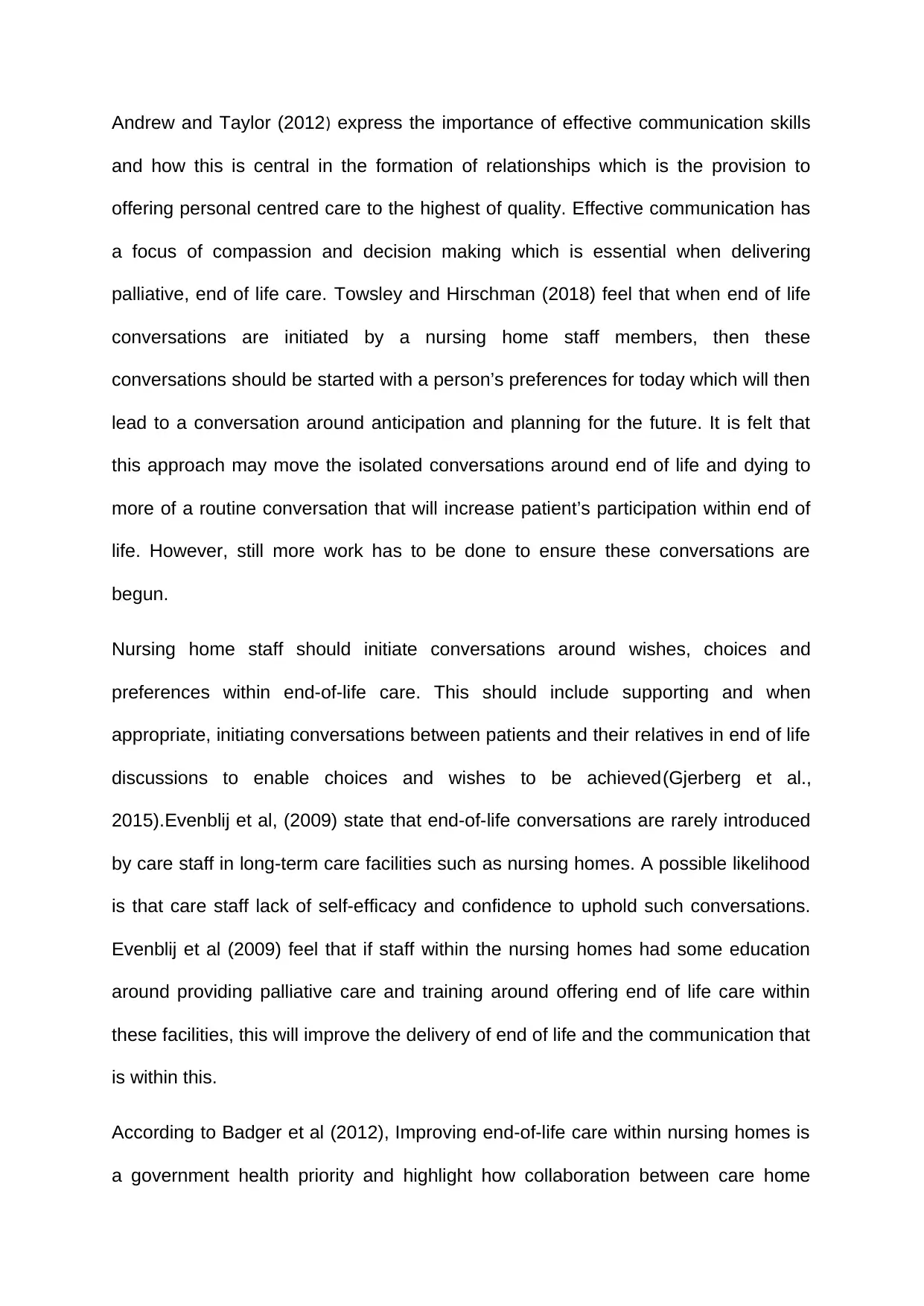
Andrew and Taylor (2012) express the importance of effective communication skills
and how this is central in the formation of relationships which is the provision to
offering personal centred care to the highest of quality. Effective communication has
a focus of compassion and decision making which is essential when delivering
palliative, end of life care. Towsley and Hirschman (2018) feel that when end of life
conversations are initiated by a nursing home staff members, then these
conversations should be started with a person’s preferences for today which will then
lead to a conversation around anticipation and planning for the future. It is felt that
this approach may move the isolated conversations around end of life and dying to
more of a routine conversation that will increase patient’s participation within end of
life. However, still more work has to be done to ensure these conversations are
begun.
Nursing home staff should initiate conversations around wishes, choices and
preferences within end-of-life care. This should include supporting and when
appropriate, initiating conversations between patients and their relatives in end of life
discussions to enable choices and wishes to be achieved(Gjerberg et al.,
2015).Evenblij et al, (2009) state that end-of-life conversations are rarely introduced
by care staff in long-term care facilities such as nursing homes. A possible likelihood
is that care staff lack of self-efficacy and confidence to uphold such conversations.
Evenblij et al (2009) feel that if staff within the nursing homes had some education
around providing palliative care and training around offering end of life care within
these facilities, this will improve the delivery of end of life and the communication that
is within this.
According to Badger et al (2012), Improving end-of-life care within nursing homes is
a government health priority and highlight how collaboration between care home
and how this is central in the formation of relationships which is the provision to
offering personal centred care to the highest of quality. Effective communication has
a focus of compassion and decision making which is essential when delivering
palliative, end of life care. Towsley and Hirschman (2018) feel that when end of life
conversations are initiated by a nursing home staff members, then these
conversations should be started with a person’s preferences for today which will then
lead to a conversation around anticipation and planning for the future. It is felt that
this approach may move the isolated conversations around end of life and dying to
more of a routine conversation that will increase patient’s participation within end of
life. However, still more work has to be done to ensure these conversations are
begun.
Nursing home staff should initiate conversations around wishes, choices and
preferences within end-of-life care. This should include supporting and when
appropriate, initiating conversations between patients and their relatives in end of life
discussions to enable choices and wishes to be achieved(Gjerberg et al.,
2015).Evenblij et al, (2009) state that end-of-life conversations are rarely introduced
by care staff in long-term care facilities such as nursing homes. A possible likelihood
is that care staff lack of self-efficacy and confidence to uphold such conversations.
Evenblij et al (2009) feel that if staff within the nursing homes had some education
around providing palliative care and training around offering end of life care within
these facilities, this will improve the delivery of end of life and the communication that
is within this.
According to Badger et al (2012), Improving end-of-life care within nursing homes is
a government health priority and highlight how collaboration between care home
Paraphrase This Document
Need a fresh take? Get an instant paraphrase of this document with our AI Paraphraser
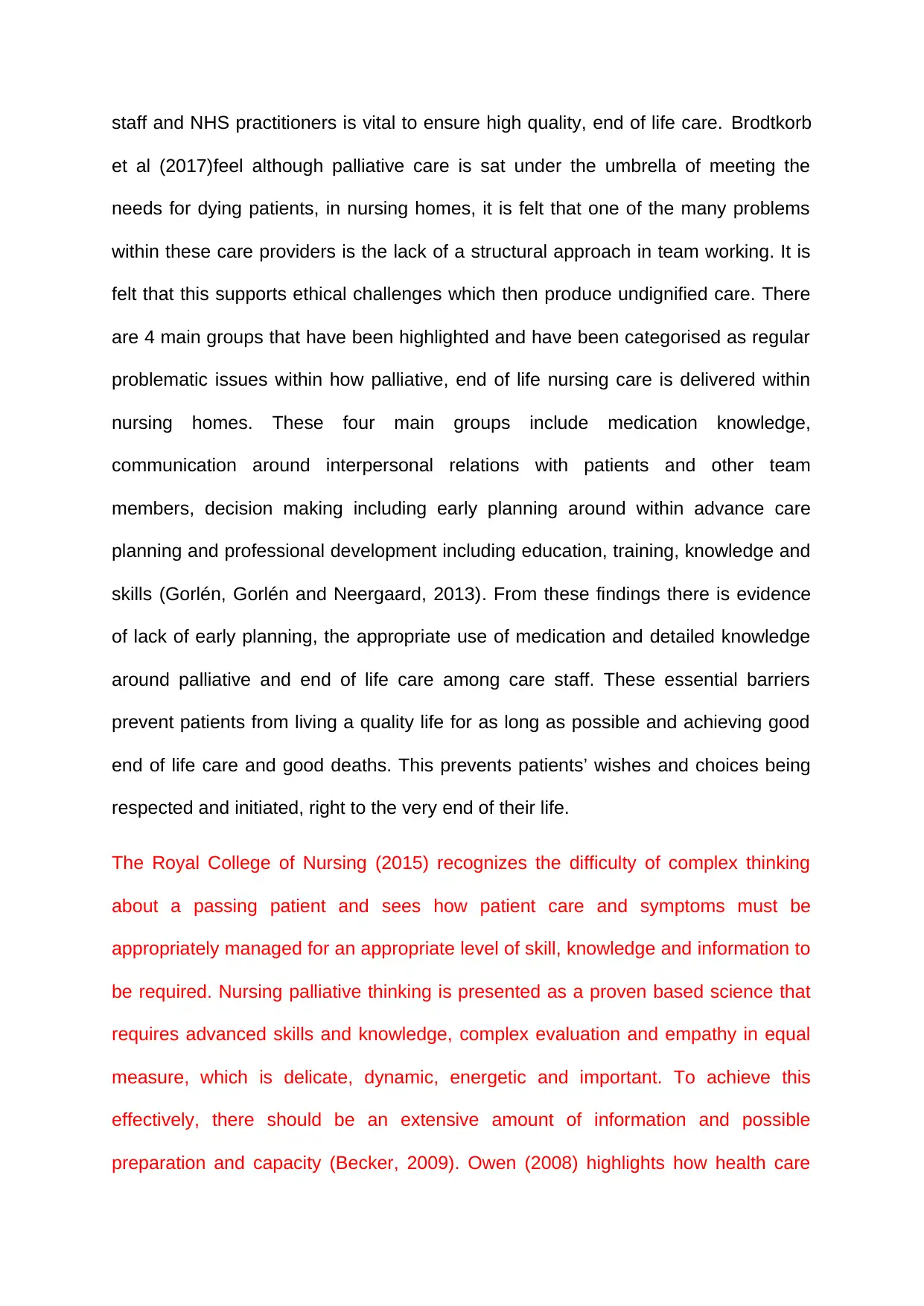
staff and NHS practitioners is vital to ensure high quality, end of life care. Brodtkorb
et al (2017)feel although palliative care is sat under the umbrella of meeting the
needs for dying patients, in nursing homes, it is felt that one of the many problems
within these care providers is the lack of a structural approach in team working. It is
felt that this supports ethical challenges which then produce undignified care. There
are 4 main groups that have been highlighted and have been categorised as regular
problematic issues within how palliative, end of life nursing care is delivered within
nursing homes. These four main groups include medication knowledge,
communication around interpersonal relations with patients and other team
members, decision making including early planning around within advance care
planning and professional development including education, training, knowledge and
skills (Gorlén, Gorlén and Neergaard, 2013). From these findings there is evidence
of lack of early planning, the appropriate use of medication and detailed knowledge
around palliative and end of life care among care staff. These essential barriers
prevent patients from living a quality life for as long as possible and achieving good
end of life care and good deaths. This prevents patients’ wishes and choices being
respected and initiated, right to the very end of their life.
The Royal College of Nursing (2015) recognizes the difficulty of complex thinking
about a passing patient and sees how patient care and symptoms must be
appropriately managed for an appropriate level of skill, knowledge and information to
be required. Nursing palliative thinking is presented as a proven based science that
requires advanced skills and knowledge, complex evaluation and empathy in equal
measure, which is delicate, dynamic, energetic and important. To achieve this
effectively, there should be an extensive amount of information and possible
preparation and capacity (Becker, 2009). Owen (2008) highlights how health care
et al (2017)feel although palliative care is sat under the umbrella of meeting the
needs for dying patients, in nursing homes, it is felt that one of the many problems
within these care providers is the lack of a structural approach in team working. It is
felt that this supports ethical challenges which then produce undignified care. There
are 4 main groups that have been highlighted and have been categorised as regular
problematic issues within how palliative, end of life nursing care is delivered within
nursing homes. These four main groups include medication knowledge,
communication around interpersonal relations with patients and other team
members, decision making including early planning around within advance care
planning and professional development including education, training, knowledge and
skills (Gorlén, Gorlén and Neergaard, 2013). From these findings there is evidence
of lack of early planning, the appropriate use of medication and detailed knowledge
around palliative and end of life care among care staff. These essential barriers
prevent patients from living a quality life for as long as possible and achieving good
end of life care and good deaths. This prevents patients’ wishes and choices being
respected and initiated, right to the very end of their life.
The Royal College of Nursing (2015) recognizes the difficulty of complex thinking
about a passing patient and sees how patient care and symptoms must be
appropriately managed for an appropriate level of skill, knowledge and information to
be required. Nursing palliative thinking is presented as a proven based science that
requires advanced skills and knowledge, complex evaluation and empathy in equal
measure, which is delicate, dynamic, energetic and important. To achieve this
effectively, there should be an extensive amount of information and possible
preparation and capacity (Becker, 2009). Owen (2008) highlights how health care
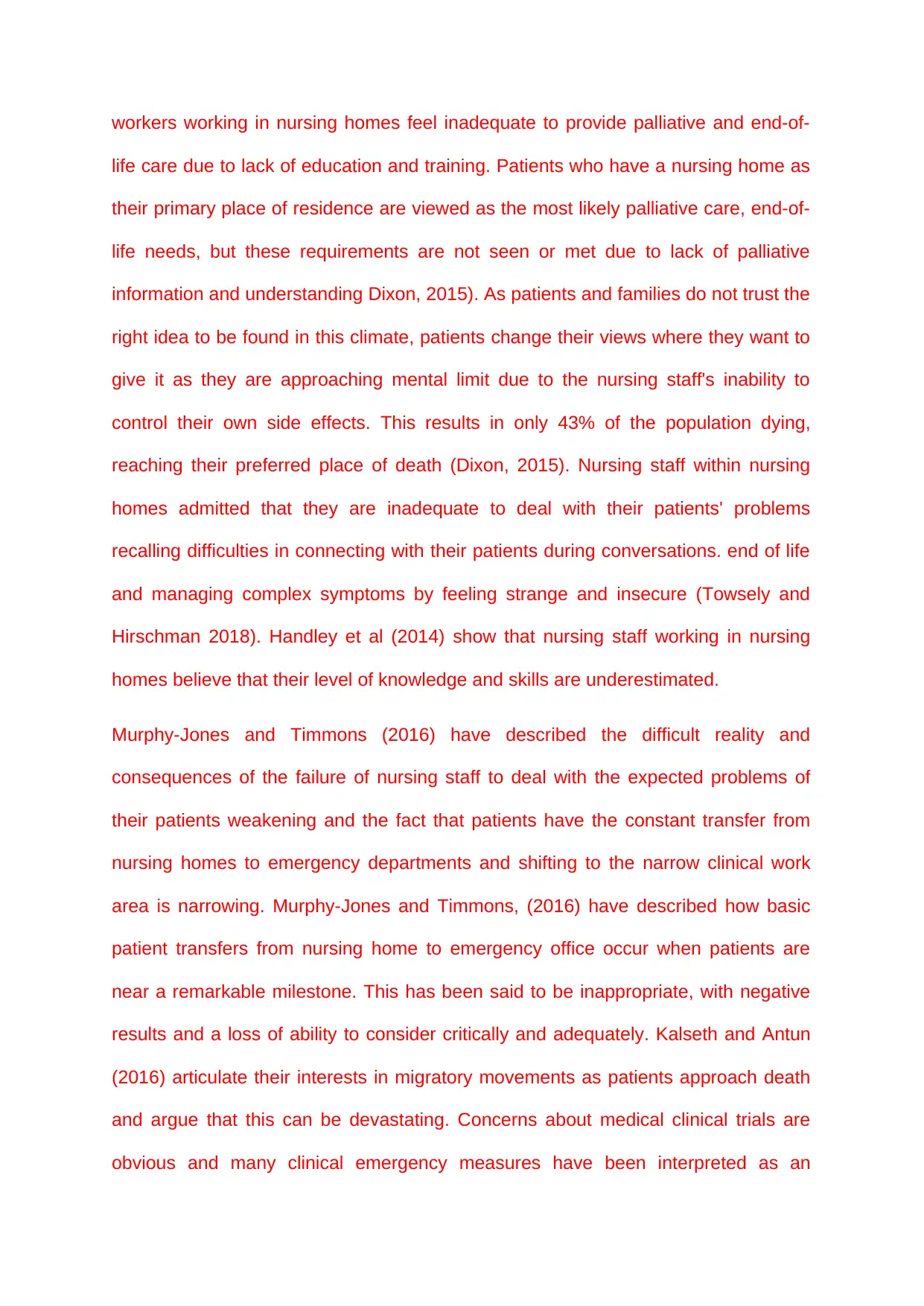
workers working in nursing homes feel inadequate to provide palliative and end-of-
life care due to lack of education and training. Patients who have a nursing home as
their primary place of residence are viewed as the most likely palliative care, end-of-
life needs, but these requirements are not seen or met due to lack of palliative
information and understanding Dixon, 2015). As patients and families do not trust the
right idea to be found in this climate, patients change their views where they want to
give it as they are approaching mental limit due to the nursing staff's inability to
control their own side effects. This results in only 43% of the population dying,
reaching their preferred place of death (Dixon, 2015). Nursing staff within nursing
homes admitted that they are inadequate to deal with their patients' problems
recalling difficulties in connecting with their patients during conversations. end of life
and managing complex symptoms by feeling strange and insecure (Towsely and
Hirschman 2018). Handley et al (2014) show that nursing staff working in nursing
homes believe that their level of knowledge and skills are underestimated.
Murphy-Jones and Timmons (2016) have described the difficult reality and
consequences of the failure of nursing staff to deal with the expected problems of
their patients weakening and the fact that patients have the constant transfer from
nursing homes to emergency departments and shifting to the narrow clinical work
area is narrowing. Murphy-Jones and Timmons, (2016) have described how basic
patient transfers from nursing home to emergency office occur when patients are
near a remarkable milestone. This has been said to be inappropriate, with negative
results and a loss of ability to consider critically and adequately. Kalseth and Antun
(2016) articulate their interests in migratory movements as patients approach death
and argue that this can be devastating. Concerns about medical clinical trials are
obvious and many clinical emergency measures have been interpreted as an
life care due to lack of education and training. Patients who have a nursing home as
their primary place of residence are viewed as the most likely palliative care, end-of-
life needs, but these requirements are not seen or met due to lack of palliative
information and understanding Dixon, 2015). As patients and families do not trust the
right idea to be found in this climate, patients change their views where they want to
give it as they are approaching mental limit due to the nursing staff's inability to
control their own side effects. This results in only 43% of the population dying,
reaching their preferred place of death (Dixon, 2015). Nursing staff within nursing
homes admitted that they are inadequate to deal with their patients' problems
recalling difficulties in connecting with their patients during conversations. end of life
and managing complex symptoms by feeling strange and insecure (Towsely and
Hirschman 2018). Handley et al (2014) show that nursing staff working in nursing
homes believe that their level of knowledge and skills are underestimated.
Murphy-Jones and Timmons (2016) have described the difficult reality and
consequences of the failure of nursing staff to deal with the expected problems of
their patients weakening and the fact that patients have the constant transfer from
nursing homes to emergency departments and shifting to the narrow clinical work
area is narrowing. Murphy-Jones and Timmons, (2016) have described how basic
patient transfers from nursing home to emergency office occur when patients are
near a remarkable milestone. This has been said to be inappropriate, with negative
results and a loss of ability to consider critically and adequately. Kalseth and Antun
(2016) articulate their interests in migratory movements as patients approach death
and argue that this can be devastating. Concerns about medical clinical trials are
obvious and many clinical emergency measures have been interpreted as an
⊘ This is a preview!⊘
Do you want full access?
Subscribe today to unlock all pages.
Trusted by 1+ million students worldwide

1 out of 58


Related Documents


Your All-in-One AI-Powered Toolkit for Academic Success.
+13062052269
info@desklib.com
Available 24*7 on WhatsApp / Email
![[object Object]](/_next/static/media/star-bottom.7253800d.svg)
Unlock your academic potential
Copyright © 2020–2025 A2Z Services. All Rights Reserved. Developed and managed by ZUCOL.