Critical Evaluation: Research on Needle Stick Injuries Among RNs
VerifiedAdded on 2023/04/22
|11
|2703
|293
Report
AI Summary
This report critically examines a research paper focusing on the incidence and risk factors of needle stick and sharp injuries among registered nurses (RNs) in Thailand. The research employs a survey-based approach, collecting data from RNs who have experienced such injuries. The study identifies working shift hours as a significant contributing factor to these incidents. The analysis reveals that RNs are the most prevalent victims of these injuries. The report discusses the methodology, data collection, literature review, and ethical considerations of the original research. It also highlights the limitations of the survey method and suggests the potential benefits of conducting interviews for more precise data. Recommendations include implementing stricter safety measures and refining research methods to better understand and prevent needle stick and sharp injuries among healthcare professionals. Desklib provides access to this and other solved assignments for students.
Running head: RESEARCH IN NURSING
RESEARCH IN NURSING
Name of the student:
Name of the university:
Author note:
RESEARCH IN NURSING
Name of the student:
Name of the university:
Author note:

Paraphrase This Document
Need a fresh take? Get an instant paraphrase of this document with our AI Paraphraser
Running head: RESEARCH IN NURSING
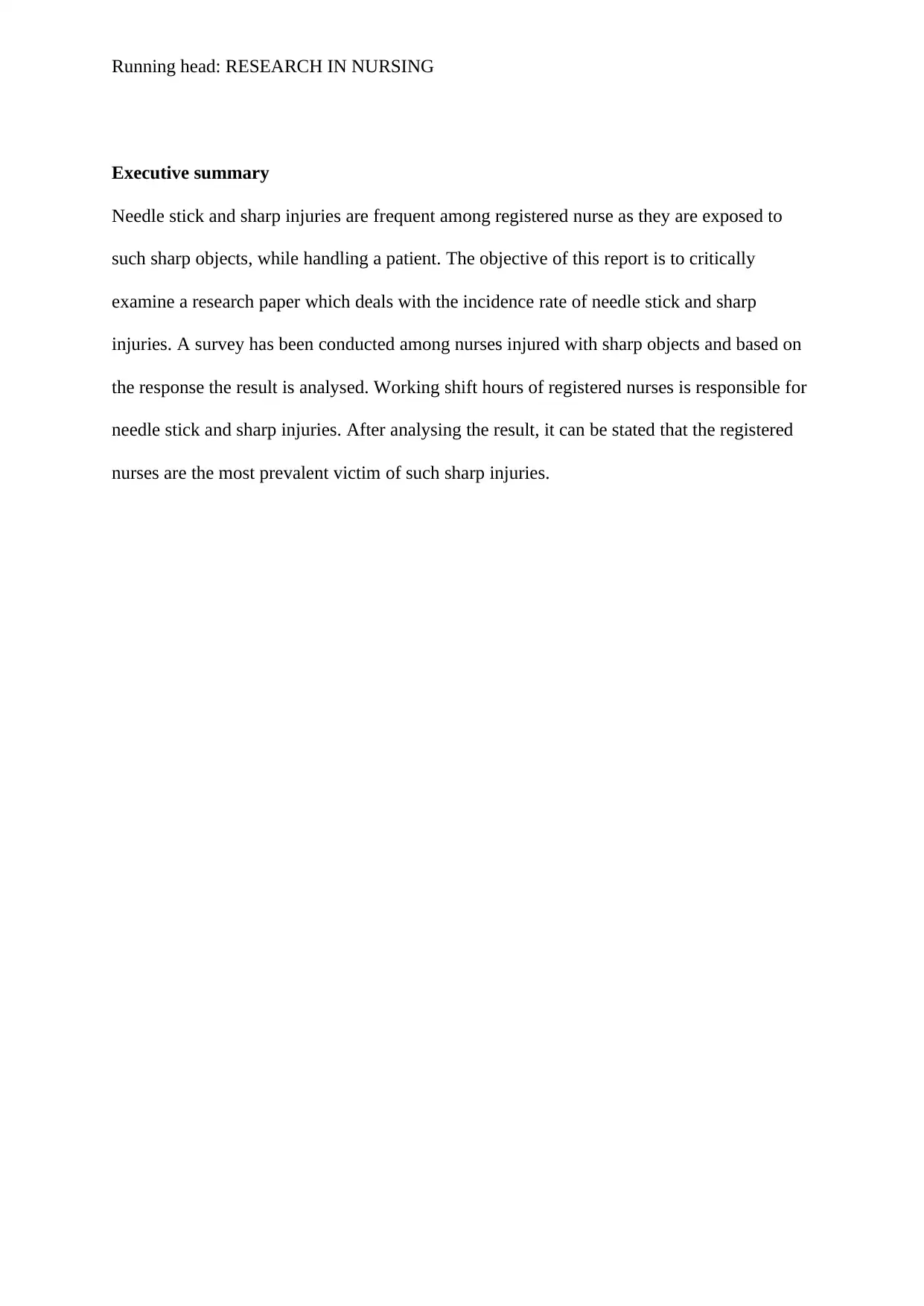
Executive summary
Needle stick and sharp injuries are frequent among registered nurse as they are exposed to
such sharp objects, while handling a patient. The objective of this report is to critically
examine a research paper which deals with the incidence rate of needle stick and sharp
injuries. A survey has been conducted among nurses injured with sharp objects and based on
the response the result is analysed. Working shift hours of registered nurses is responsible for
needle stick and sharp injuries. After analysing the result, it can be stated that the registered
nurses are the most prevalent victim of such sharp injuries.
Executive summary
Needle stick and sharp injuries are frequent among registered nurse as they are exposed to
such sharp objects, while handling a patient. The objective of this report is to critically
examine a research paper which deals with the incidence rate of needle stick and sharp
injuries. A survey has been conducted among nurses injured with sharp objects and based on
the response the result is analysed. Working shift hours of registered nurses is responsible for
needle stick and sharp injuries. After analysing the result, it can be stated that the registered
nurses are the most prevalent victim of such sharp injuries.
Running head: RESEARCH IN NURSING
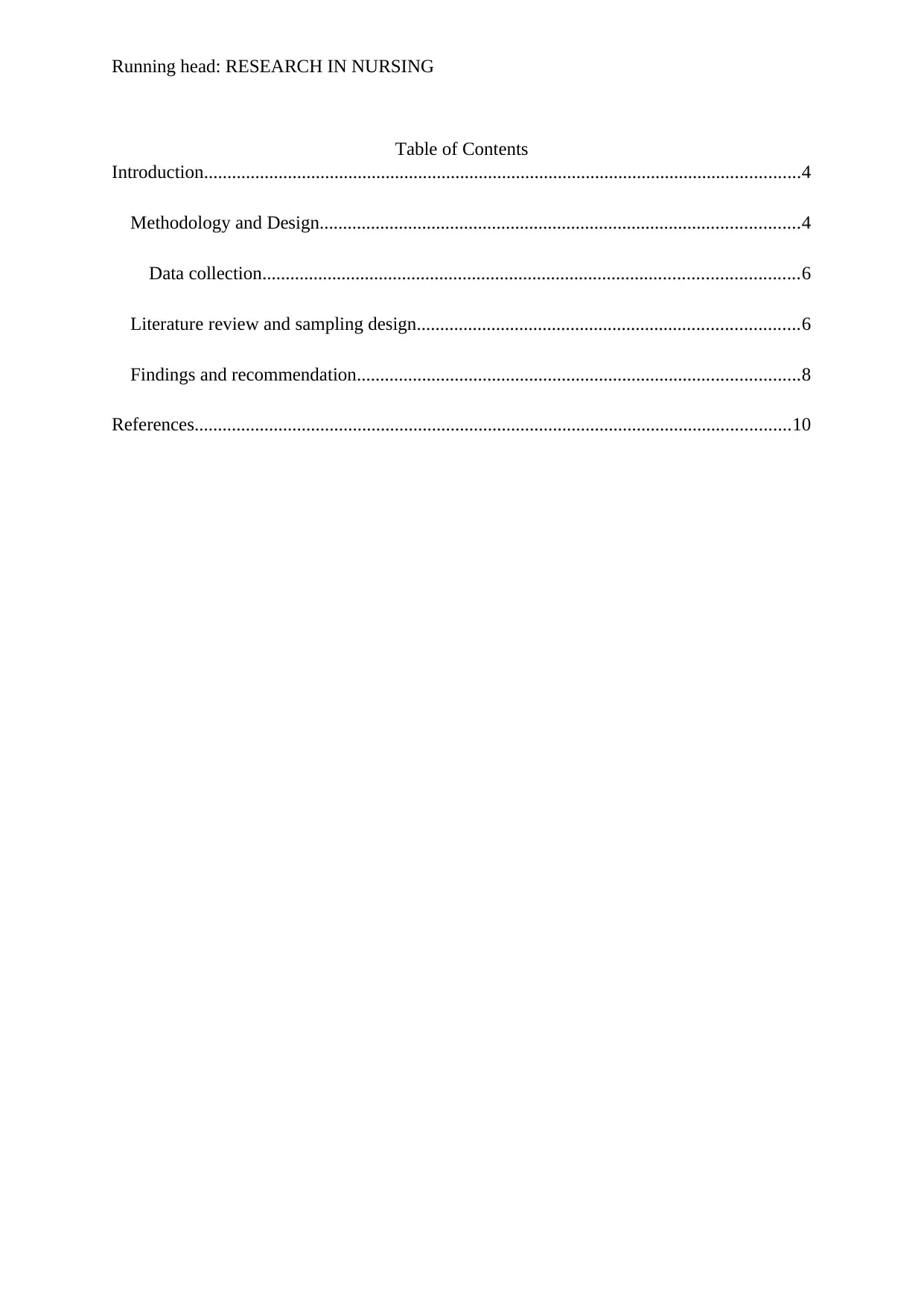
Table of Contents
Introduction................................................................................................................................4
Methodology and Design.......................................................................................................4
Data collection...................................................................................................................6
Literature review and sampling design..................................................................................6
Findings and recommendation...............................................................................................8
References................................................................................................................................10
Table of Contents
Introduction................................................................................................................................4
Methodology and Design.......................................................................................................4
Data collection...................................................................................................................6
Literature review and sampling design..................................................................................6
Findings and recommendation...............................................................................................8
References................................................................................................................................10
⊘ This is a preview!⊘
Do you want full access?
Subscribe today to unlock all pages.

Trusted by 1+ million students worldwide
Running head: RESEARCH IN NURSING
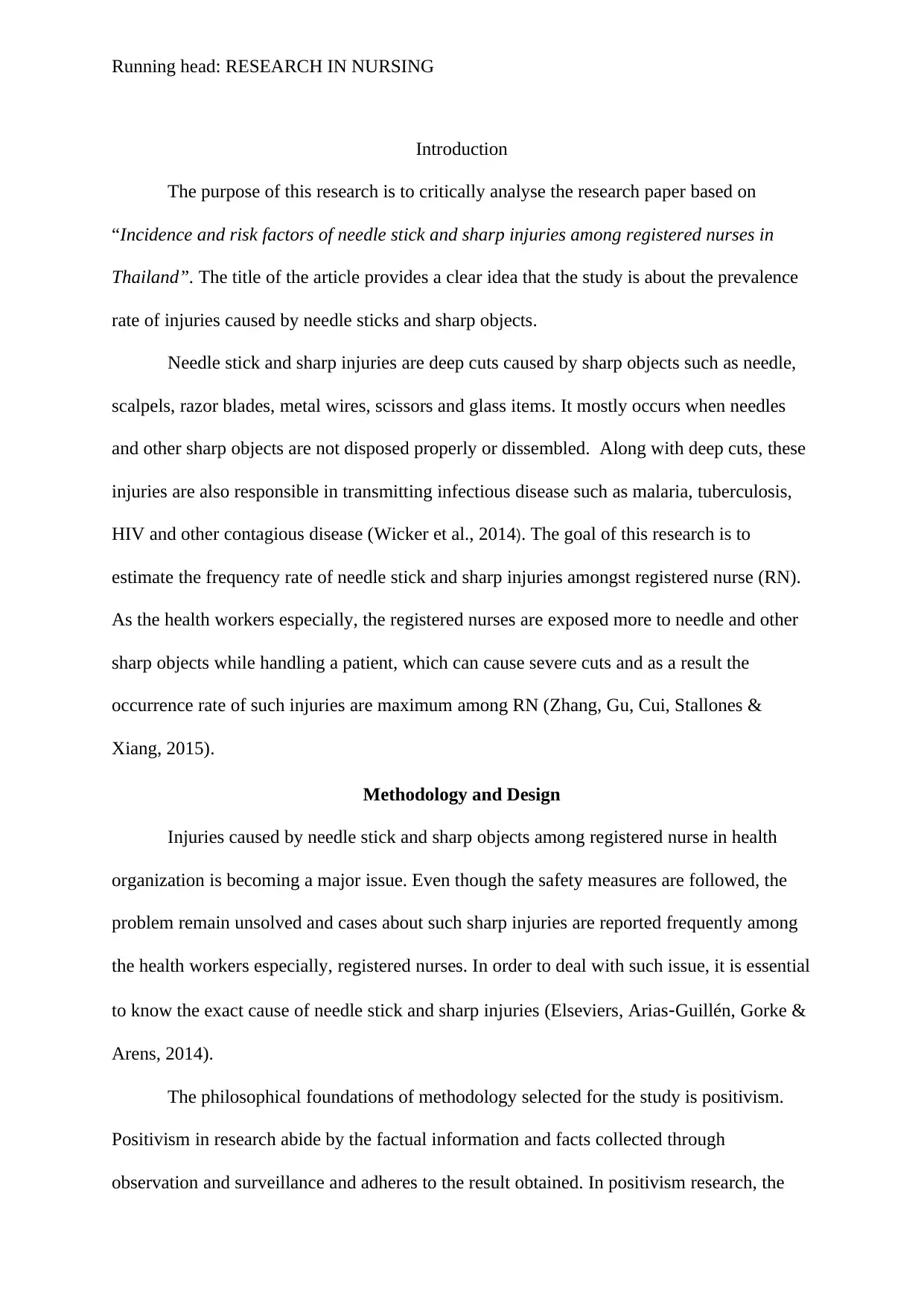
Introduction
The purpose of this research is to critically analyse the research paper based on
“Incidence and risk factors of needle stick and sharp injuries among registered nurses in
Thailand”. The title of the article provides a clear idea that the study is about the prevalence
rate of injuries caused by needle sticks and sharp objects.
Needle stick and sharp injuries are deep cuts caused by sharp objects such as needle,
scalpels, razor blades, metal wires, scissors and glass items. It mostly occurs when needles
and other sharp objects are not disposed properly or dissembled. Along with deep cuts, these
injuries are also responsible in transmitting infectious disease such as malaria, tuberculosis,
HIV and other contagious disease (Wicker et al., 2014). The goal of this research is to
estimate the frequency rate of needle stick and sharp injuries amongst registered nurse (RN).
As the health workers especially, the registered nurses are exposed more to needle and other
sharp objects while handling a patient, which can cause severe cuts and as a result the
occurrence rate of such injuries are maximum among RN (Zhang, Gu, Cui, Stallones &
Xiang, 2015).
Methodology and Design
Injuries caused by needle stick and sharp objects among registered nurse in health
organization is becoming a major issue. Even though the safety measures are followed, the
problem remain unsolved and cases about such sharp injuries are reported frequently among
the health workers especially, registered nurses. In order to deal with such issue, it is essential
to know the exact cause of needle stick and sharp injuries (Elseviers, Arias‐Guillén, Gorke &
Arens, 2014).
The philosophical foundations of methodology selected for the study is positivism.
Positivism in research abide by the factual information and facts collected through
observation and surveillance and adheres to the result obtained. In positivism research, the
Introduction
The purpose of this research is to critically analyse the research paper based on
“Incidence and risk factors of needle stick and sharp injuries among registered nurses in
Thailand”. The title of the article provides a clear idea that the study is about the prevalence
rate of injuries caused by needle sticks and sharp objects.
Needle stick and sharp injuries are deep cuts caused by sharp objects such as needle,
scalpels, razor blades, metal wires, scissors and glass items. It mostly occurs when needles
and other sharp objects are not disposed properly or dissembled. Along with deep cuts, these
injuries are also responsible in transmitting infectious disease such as malaria, tuberculosis,
HIV and other contagious disease (Wicker et al., 2014). The goal of this research is to
estimate the frequency rate of needle stick and sharp injuries amongst registered nurse (RN).
As the health workers especially, the registered nurses are exposed more to needle and other
sharp objects while handling a patient, which can cause severe cuts and as a result the
occurrence rate of such injuries are maximum among RN (Zhang, Gu, Cui, Stallones &
Xiang, 2015).
Methodology and Design
Injuries caused by needle stick and sharp objects among registered nurse in health
organization is becoming a major issue. Even though the safety measures are followed, the
problem remain unsolved and cases about such sharp injuries are reported frequently among
the health workers especially, registered nurses. In order to deal with such issue, it is essential
to know the exact cause of needle stick and sharp injuries (Elseviers, Arias‐Guillén, Gorke &
Arens, 2014).
The philosophical foundations of methodology selected for the study is positivism.
Positivism in research abide by the factual information and facts collected through
observation and surveillance and adheres to the result obtained. In positivism research, the
Paraphrase This Document
Need a fresh take? Get an instant paraphrase of this document with our AI Paraphraser
Running head: RESEARCH IN NURSING
part of the researcher is restricted to data assortment and interpretation of the data (Aliyu,
Bello, Kasim & Martin, 2014). Here the research is conducted through survey among a large
sample size of registered nurses, who had been wounded or injured with sharp objects. The
result obtained after the survey is seem to be reliable and dependable, which is the foundation
off positive research paradigm.
The research was conducted by applying Thai Nurse Cohort Study (TNCS) and a 3
year follow-up based on the incidence of NSI. Baseline Survey was conducted by TNCS in
2009 and 2012 in wave 1 and wave 2 respectively. The research design is arrangement of
collection to give an effective result. The research design selected for this research is
descriptive, as the data is collected through survey by distributing questionnaire online
among registered having license nurse as well as work experience of 12 months and above.
The descriptive research design followed in this research has advantage over other design.
Descriptive research are highly representatives and it is the most convenient way of gathering
information from a large population. In addition, the respondents are observed in their natural
environment and through descriptive research in-depth information can be collected (Nassaji,
2015). However, it has some limitation also such as respondents may give wrong response to
maintain their privacy. As injuries caused by needle stick and sharp objects can also cause
contagious disease such as AIDS, hence such respondents may offer incorrect response to
maintain their confidentiality. In that case, if interview is conducted instead of descriptive
research, it can give more precise information. As in interview they can share their feelings
and opinions to the interviewer.
The sample size is selected through stratified random sampling method. Stratified
sampling method is done by dividing the whole population into smaller sets acknowledged as
strata. This sampling method provides advantage when dealing with large population size.
The advantage of this method is the outcome of the research, which is extremely precise as
part of the researcher is restricted to data assortment and interpretation of the data (Aliyu,
Bello, Kasim & Martin, 2014). Here the research is conducted through survey among a large
sample size of registered nurses, who had been wounded or injured with sharp objects. The
result obtained after the survey is seem to be reliable and dependable, which is the foundation
off positive research paradigm.
The research was conducted by applying Thai Nurse Cohort Study (TNCS) and a 3
year follow-up based on the incidence of NSI. Baseline Survey was conducted by TNCS in
2009 and 2012 in wave 1 and wave 2 respectively. The research design is arrangement of
collection to give an effective result. The research design selected for this research is
descriptive, as the data is collected through survey by distributing questionnaire online
among registered having license nurse as well as work experience of 12 months and above.
The descriptive research design followed in this research has advantage over other design.
Descriptive research are highly representatives and it is the most convenient way of gathering
information from a large population. In addition, the respondents are observed in their natural
environment and through descriptive research in-depth information can be collected (Nassaji,
2015). However, it has some limitation also such as respondents may give wrong response to
maintain their privacy. As injuries caused by needle stick and sharp objects can also cause
contagious disease such as AIDS, hence such respondents may offer incorrect response to
maintain their confidentiality. In that case, if interview is conducted instead of descriptive
research, it can give more precise information. As in interview they can share their feelings
and opinions to the interviewer.
The sample size is selected through stratified random sampling method. Stratified
sampling method is done by dividing the whole population into smaller sets acknowledged as
strata. This sampling method provides advantage when dealing with large population size.
The advantage of this method is the outcome of the research, which is extremely precise as
Running head: RESEARCH IN NURSING
compared to other sampling method, but it cannot be used widely in all research which serves
as a limitation of the method (Singh & Masuku, 2014). As the sample size selected in this
research is large, the stratified sampling method is finest to get an effective and accurate
result.
Data collection
The tool used for collecting the data used in the research is survey. Survey is the best
method of data gathering. Research is conducted among registered nurse about the injuries
caused by needle and sharp objects. Surveys are highly representatives and it is the most
convenient way of gathering information within a limited time from a large population
(Nardi, 2018). In addition, cost of conducting a survey is extremely low and also it is
statistically significant as compared to other methods. However, if the research was
conducted through interviews it can provide more precise and specific result. Process of
survey also has some limitation such as, it has an inflexible design and also it is not ideal for
ethical and controversial issue.
Reliable in research is referred as uniformity of a measure (Gao & Bian, 2014). The
result obtained from the survey is reliable. Validity in research discusses about the accuracy
of the result (Zribi, 2017). Outcome of a survey is valid but if interview was conducted, it
could have more validity. However, conducting interview among such large population size
is not possible.
Literature review and sampling design
The topic of the research is the incident rate of wound caused by needle stick and
sharp objects among registered nurse in a health organization. In the literature review, the
prevalence rate of health worker effected by such injuries are revealed which is vital for
examining the severity of the incident. In addition, the risk factor related to the injury are also
stated. Mortality and morbidity rate of individual suffering from infectious disease which
compared to other sampling method, but it cannot be used widely in all research which serves
as a limitation of the method (Singh & Masuku, 2014). As the sample size selected in this
research is large, the stratified sampling method is finest to get an effective and accurate
result.
Data collection
The tool used for collecting the data used in the research is survey. Survey is the best
method of data gathering. Research is conducted among registered nurse about the injuries
caused by needle and sharp objects. Surveys are highly representatives and it is the most
convenient way of gathering information within a limited time from a large population
(Nardi, 2018). In addition, cost of conducting a survey is extremely low and also it is
statistically significant as compared to other methods. However, if the research was
conducted through interviews it can provide more precise and specific result. Process of
survey also has some limitation such as, it has an inflexible design and also it is not ideal for
ethical and controversial issue.
Reliable in research is referred as uniformity of a measure (Gao & Bian, 2014). The
result obtained from the survey is reliable. Validity in research discusses about the accuracy
of the result (Zribi, 2017). Outcome of a survey is valid but if interview was conducted, it
could have more validity. However, conducting interview among such large population size
is not possible.
Literature review and sampling design
The topic of the research is the incident rate of wound caused by needle stick and
sharp objects among registered nurse in a health organization. In the literature review, the
prevalence rate of health worker effected by such injuries are revealed which is vital for
examining the severity of the incident. In addition, the risk factor related to the injury are also
stated. Mortality and morbidity rate of individual suffering from infectious disease which
⊘ This is a preview!⊘
Do you want full access?
Subscribe today to unlock all pages.
Trusted by 1+ million students worldwide
Running head: RESEARCH IN NURSING
include, hepatitis C virus human immunodeficiency virus and hepatitis B virus caused by
sharp injuries are also mentioned. As the topic mainly deals with the incident rate of NSI
among registered nurses, the occurrence rate of NSI among nurses in Japan, Australia, Iran
and Nepal are also represented (Zhang, Gu, Cui, Stallones & Xiang, 2015). Hence, the
literature review done in the research is relevant to the topic and covers the topic entirely.
Nursing is a profession where an individual have to deal with patient suffering from
different types of pernicious disease. While handling a patient, they have to work with needle
and other sharp objects (Parahoo, 2014). If the articles is not assembled or disposed properly
it can cause deep cuts. These cuts and injuries can also cause infectious disease by the
transfer of blood and other serum from the patient’s body. The target population of the
research are registered nurses as they are the most common victim of NSI.
The samples are obtained by conducting a survey among the registered injured by
needle stick and sharp objects. Only the registered nurse having nursing license approved by
Thailand Nursing and Midwifery Council (TNC) are included in the survey. According to
TNCs database, total 142,699 RNs possess nursing license. Out of the total, questionnaire
sent to only 50,200 who were selected by stratified random sampling. Registered nurses who
were unemployed, student or working in academia and nursing administration were excluded
from the process. Registered nurses involved in patient handling and having work experience
of 12 months and above are only considered. Hence after considering all these factors only
13,754 were included in the process in wave 1 held in 2009 and 5,920 in wave 2 held in 2012.
Lastly among all the registered nurse, response of only those nurses who had been wounded
with needle and sharp objects are included and based on that the result is analysed (Setthamas
etal., 2018).
While conducting any survey, ethical issue associated with the research should be
considered. There are several ethical issue such as, maintaining confidentiality of the
include, hepatitis C virus human immunodeficiency virus and hepatitis B virus caused by
sharp injuries are also mentioned. As the topic mainly deals with the incident rate of NSI
among registered nurses, the occurrence rate of NSI among nurses in Japan, Australia, Iran
and Nepal are also represented (Zhang, Gu, Cui, Stallones & Xiang, 2015). Hence, the
literature review done in the research is relevant to the topic and covers the topic entirely.
Nursing is a profession where an individual have to deal with patient suffering from
different types of pernicious disease. While handling a patient, they have to work with needle
and other sharp objects (Parahoo, 2014). If the articles is not assembled or disposed properly
it can cause deep cuts. These cuts and injuries can also cause infectious disease by the
transfer of blood and other serum from the patient’s body. The target population of the
research are registered nurses as they are the most common victim of NSI.
The samples are obtained by conducting a survey among the registered injured by
needle stick and sharp objects. Only the registered nurse having nursing license approved by
Thailand Nursing and Midwifery Council (TNC) are included in the survey. According to
TNCs database, total 142,699 RNs possess nursing license. Out of the total, questionnaire
sent to only 50,200 who were selected by stratified random sampling. Registered nurses who
were unemployed, student or working in academia and nursing administration were excluded
from the process. Registered nurses involved in patient handling and having work experience
of 12 months and above are only considered. Hence after considering all these factors only
13,754 were included in the process in wave 1 held in 2009 and 5,920 in wave 2 held in 2012.
Lastly among all the registered nurse, response of only those nurses who had been wounded
with needle and sharp objects are included and based on that the result is analysed (Setthamas
etal., 2018).
While conducting any survey, ethical issue associated with the research should be
considered. There are several ethical issue such as, maintaining confidentiality of the
Paraphrase This Document
Need a fresh take? Get an instant paraphrase of this document with our AI Paraphraser
Running head: RESEARCH IN NURSING
respondents, attaining information consent, minimising the threat of harm, avoiding deceptive
practices and allowing respondents to withdraw their participation any time should be
followed (Haahr, Norlyk, & Hall, 2014). It is necessary to get approval for the research from
the ethics committee in order to avoid future complications. The survey was conducted by
TNCS which was approved by Ministry of Public Health’s Human Research and Ethics
Committee in Thailand and the research was sanctioned and approved by human research’s
Khonkaen University Ethics Community. Hence it can be stated that the ethical issues were
considered while conducting the research.
Findings and recommendation
The findings obtained from critically analysing the research paper, is that the threat of
NSI is maximum among registered nurses. The incident rate is more in developing countries
such as United States, Japan, Australia and France. Nurses working in Shift hours, especially
9:00 pm to 7:00 pm have high risk of NSI. Age of the nurse is also an issue as they face
difficulty while dealing with sharp objects and gets infected frequently (Setthamas etal.,
2018).
The research was conducted through a survey, which has inflexible design and can be
taken as a limitation of the study. Survey provides more generalized result, as the question
asked during the survey was formulated based on the whole population of respondents not by
considering a particular individual. However, if the research was conducted through
interview it would provide more precise and accurate information. Apart from shift hours,
other factor such as fatigue, emotional exhaustion and work environment also a major cause
that is neglected in the study. Hence to avoid such injuries, safety measures should be
followed strictly in health organisation (Setthamas etal., 2018).
From the research it can be concluded that, the incidence rate of Needlestick and
sharp injures are highest among registered nurses. Nurses are exposed to such sharp objects
respondents, attaining information consent, minimising the threat of harm, avoiding deceptive
practices and allowing respondents to withdraw their participation any time should be
followed (Haahr, Norlyk, & Hall, 2014). It is necessary to get approval for the research from
the ethics committee in order to avoid future complications. The survey was conducted by
TNCS which was approved by Ministry of Public Health’s Human Research and Ethics
Committee in Thailand and the research was sanctioned and approved by human research’s
Khonkaen University Ethics Community. Hence it can be stated that the ethical issues were
considered while conducting the research.
Findings and recommendation
The findings obtained from critically analysing the research paper, is that the threat of
NSI is maximum among registered nurses. The incident rate is more in developing countries
such as United States, Japan, Australia and France. Nurses working in Shift hours, especially
9:00 pm to 7:00 pm have high risk of NSI. Age of the nurse is also an issue as they face
difficulty while dealing with sharp objects and gets infected frequently (Setthamas etal.,
2018).
The research was conducted through a survey, which has inflexible design and can be
taken as a limitation of the study. Survey provides more generalized result, as the question
asked during the survey was formulated based on the whole population of respondents not by
considering a particular individual. However, if the research was conducted through
interview it would provide more precise and accurate information. Apart from shift hours,
other factor such as fatigue, emotional exhaustion and work environment also a major cause
that is neglected in the study. Hence to avoid such injuries, safety measures should be
followed strictly in health organisation (Setthamas etal., 2018).
From the research it can be concluded that, the incidence rate of Needlestick and
sharp injures are highest among registered nurses. Nurses are exposed to such sharp objects
Running head: RESEARCH IN NURSING
mostly during their shift hours which can cause injury. Working shift hour, fatigue, work
environment and emotional exhaustion are one of the vital cause of NSI.
After considering the risk factor involved for NSI, it is recommended to implement
safety measures to avoid NSI in future. After evaluating the research it is suggested that
questionnaire should contain more precise question or if possible the research should be
conducted through interviews to get more accurate result.
mostly during their shift hours which can cause injury. Working shift hour, fatigue, work
environment and emotional exhaustion are one of the vital cause of NSI.
After considering the risk factor involved for NSI, it is recommended to implement
safety measures to avoid NSI in future. After evaluating the research it is suggested that
questionnaire should contain more precise question or if possible the research should be
conducted through interviews to get more accurate result.
⊘ This is a preview!⊘
Do you want full access?
Subscribe today to unlock all pages.
Trusted by 1+ million students worldwide
Running head: RESEARCH IN NURSING
References
Aliyu, A. A., Bello, M. U., Kasim, R., & Martin, D. (2014). Positivist and non-positivist
paradigm in social science research: Conflicting paradigms or perfect partners. J.
Mgmt. & Sustainability, 4, 79. Retieved from:
https://heinonline.org/HOL/LandingPage?handle=hein.journals/jms4&div=40&id=&p
age=
Elseviers, M. M., Arias‐Guillén, M., Gorke, A., & Arens, H. J. (2014). Sharps injuries
amongst healthcare workers: review of incidence, transmissions and costs. Journal of
renal care, 40(3), 150-156. DOI: https://doi.org/10.1111/jorc.12050
Gao, Y., & Bian, Z. (2014, November). A reliability analysis to runway incursion based on
improved CREAM. In 2014 International Conference on Mechatronics, Electronic,
Industrial and Control Engineering (MEIC-14). Atlantis Press. DOI:
https://doi.org/10.2991/meic-14.2014.16
Haahr, A., Norlyk, A., & Hall, E. O. (2014). Ethical challenges embedded in qualitative
research interviews with close relatives. Nursing ethics, 21(1), 6-15.
https://doi.org/10.1177/0969733013486370
Nardi, P. M. (2018). Doing survey research: A guide to quantitative methods. Routledge.
https://doi.org/10.4324/9781315172231
Nassaji, H. (2015). Qualitative and descriptive research: Data type versus data analysis.
https://doi.org/10.1177/1362168815572747
Parahoo, K. (2014). Nursing research: principles, process and issues. Macmillan
International Higher Education. Retrieved from: https://books.google.co.in/books?
hl=en&lr=&id=5ti3AwAAQBAJ&oi=fnd&pg=PP1&dq=nursing&ots=RByASzLlx1
&sig=jrcrCzghYPRPzfDISOXsnxZgRVU#v=onepage&q=nursing&f=false
References
Aliyu, A. A., Bello, M. U., Kasim, R., & Martin, D. (2014). Positivist and non-positivist
paradigm in social science research: Conflicting paradigms or perfect partners. J.
Mgmt. & Sustainability, 4, 79. Retieved from:
https://heinonline.org/HOL/LandingPage?handle=hein.journals/jms4&div=40&id=&p
age=
Elseviers, M. M., Arias‐Guillén, M., Gorke, A., & Arens, H. J. (2014). Sharps injuries
amongst healthcare workers: review of incidence, transmissions and costs. Journal of
renal care, 40(3), 150-156. DOI: https://doi.org/10.1111/jorc.12050
Gao, Y., & Bian, Z. (2014, November). A reliability analysis to runway incursion based on
improved CREAM. In 2014 International Conference on Mechatronics, Electronic,
Industrial and Control Engineering (MEIC-14). Atlantis Press. DOI:
https://doi.org/10.2991/meic-14.2014.16
Haahr, A., Norlyk, A., & Hall, E. O. (2014). Ethical challenges embedded in qualitative
research interviews with close relatives. Nursing ethics, 21(1), 6-15.
https://doi.org/10.1177/0969733013486370
Nardi, P. M. (2018). Doing survey research: A guide to quantitative methods. Routledge.
https://doi.org/10.4324/9781315172231
Nassaji, H. (2015). Qualitative and descriptive research: Data type versus data analysis.
https://doi.org/10.1177/1362168815572747
Parahoo, K. (2014). Nursing research: principles, process and issues. Macmillan
International Higher Education. Retrieved from: https://books.google.co.in/books?
hl=en&lr=&id=5ti3AwAAQBAJ&oi=fnd&pg=PP1&dq=nursing&ots=RByASzLlx1
&sig=jrcrCzghYPRPzfDISOXsnxZgRVU#v=onepage&q=nursing&f=false
Paraphrase This Document
Need a fresh take? Get an instant paraphrase of this document with our AI Paraphraser
Running head: RESEARCH IN NURSING
Setthamas, M., Sawaengdee, K., Theerawit, T., Tangcharoensathien, V., Pitaksanurat, S.,
Thinkamrop, B., ... & Thinkhamrop, W. (2018). Incidence and risk factors of needle
stick and sharp injuries among registered nurses in Thailand. Journal of Public
Health and Development, 16(1), 17-28. Retrieved from
https://www.tci-thaijo.org/index.php/AIHD-MU/article/view/109075
Singh, A. S., & Masuku, M. B. (2014). Sampling techniques & determination of sample size
in applied statistics research: An overview. International Journal of Economics,
Commerce and Management, 2(11), 1-22. Retrieved from:
http://citeseerx.ist.psu.edu/viewdoc/download?
doi=10.1.1.678.1300&rep=rep1&type=pdf
Wicker, S., Stirn, A. V., Rabenau, H. F., Von Gierke, L., Wutzler, S., & Stephan, C. (2014).
Needlestick injuries: causes, preventability and psychological impact. Infection, 42(3),
549-552. DOI https://doi.org/10.1007/s15010-014-0598-0
Zhang, X., Gu, Y., Cui, M., Stallones, L., & Xiang, H. (2015). Needlestick and sharps
injuries among nurses at a teaching hospital in China. Workplace health & safety,
63(5), 219-225. https://doi.org/10.1177/2165079915580035
Zribi, A. (2017). Multiple model bank selection based on a new validity criterion. Journal of
Control Engineering and Applied Informatics, 19(4), 43-51. Retrieved from:
http://ceai.srait.ro/index.php?journal=ceai&page=article&op=view&path%5B
%5D=4397&path%5B%5D=0
Setthamas, M., Sawaengdee, K., Theerawit, T., Tangcharoensathien, V., Pitaksanurat, S.,
Thinkamrop, B., ... & Thinkhamrop, W. (2018). Incidence and risk factors of needle
stick and sharp injuries among registered nurses in Thailand. Journal of Public
Health and Development, 16(1), 17-28. Retrieved from
https://www.tci-thaijo.org/index.php/AIHD-MU/article/view/109075
Singh, A. S., & Masuku, M. B. (2014). Sampling techniques & determination of sample size
in applied statistics research: An overview. International Journal of Economics,
Commerce and Management, 2(11), 1-22. Retrieved from:
http://citeseerx.ist.psu.edu/viewdoc/download?
doi=10.1.1.678.1300&rep=rep1&type=pdf
Wicker, S., Stirn, A. V., Rabenau, H. F., Von Gierke, L., Wutzler, S., & Stephan, C. (2014).
Needlestick injuries: causes, preventability and psychological impact. Infection, 42(3),
549-552. DOI https://doi.org/10.1007/s15010-014-0598-0
Zhang, X., Gu, Y., Cui, M., Stallones, L., & Xiang, H. (2015). Needlestick and sharps
injuries among nurses at a teaching hospital in China. Workplace health & safety,
63(5), 219-225. https://doi.org/10.1177/2165079915580035
Zribi, A. (2017). Multiple model bank selection based on a new validity criterion. Journal of
Control Engineering and Applied Informatics, 19(4), 43-51. Retrieved from:
http://ceai.srait.ro/index.php?journal=ceai&page=article&op=view&path%5B
%5D=4397&path%5B%5D=0

1 out of 11


Related Documents


Your All-in-One AI-Powered Toolkit for Academic Success.
+13062052269
info@desklib.com
Available 24*7 on WhatsApp / Email
![[object Object]](/_next/static/media/star-bottom.7253800d.svg)
Unlock your academic potential
Copyright © 2020–2026 A2Z Services. All Rights Reserved. Developed and managed by ZUCOL.