University Nursing Assignment 2: Endocarditis Interventions and Care

Verified

Added on  2020/05/08

|4
|671
|102
Homework Assignment
AI Summary
This nursing assignment focuses on endocarditis, an infection of the heart's inner lining. It details the causes, risk factors, and various interventions. The assignment covers drug treatments, primarily antibiotics like Staphylococcus aureus and Streptococcus viridians, which are the mainstays of treatment. It also explores non-pharmacologic interventions, such as oral hygiene, pain management, and rest, to prevent the entry and multiplication of germs. Furthermore, the assignment discusses prophylactic treatments, including the administration of antibiotics to patients with prosthetic heart valves and other conditions. Patient education is emphasized, including the importance of completing antibiotic courses, avoiding drug and alcohol abuse, maintaining oral hygiene, and taking rest after strenuous activity. The assignment concludes with a reflection on the student's enhanced understanding of the disease's pathophysiology and treatment procedures.
Document Page
Running head: NURSING ASSIGNMENT
Endocarditis interventions
Name of the Student
Name of the University
Author Note
tabler-icon-diamond-filled.svg

Paraphrase This Document

Need a fresh take? Get an instant paraphrase of this document with our AI Paraphraser
Document Page
1NURSING ASSIGNMENT
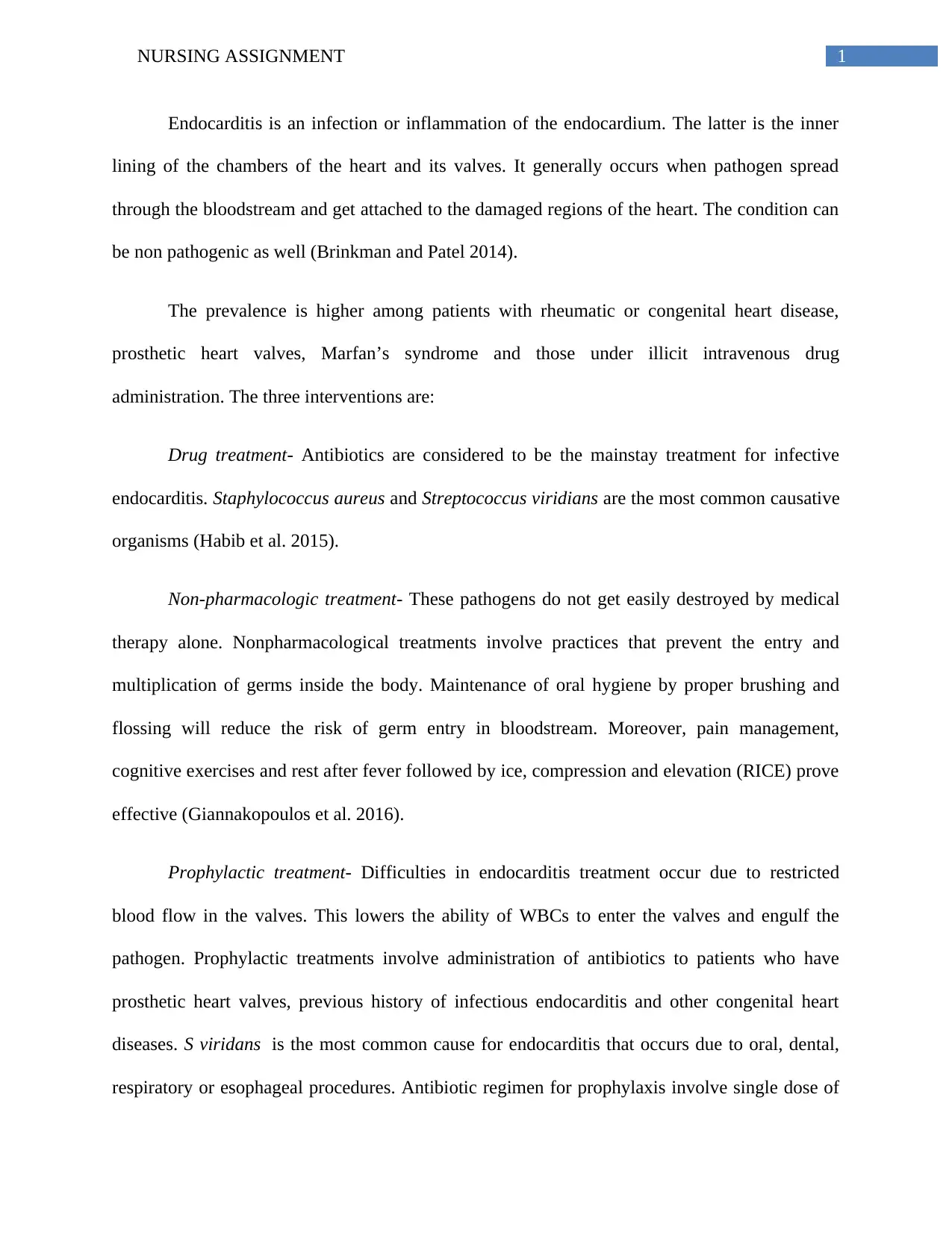
Endocarditis is an infection or inflammation of the endocardium. The latter is the inner
lining of the chambers of the heart and its valves. It generally occurs when pathogen spread
through the bloodstream and get attached to the damaged regions of the heart. The condition can
be non pathogenic as well (Brinkman and Patel 2014).
The prevalence is higher among patients with rheumatic or congenital heart disease,
prosthetic heart valves, Marfan’s syndrome and those under illicit intravenous drug
administration. The three interventions are:
Drug treatment- Antibiotics are considered to be the mainstay treatment for infective
endocarditis. Staphylococcus aureus and Streptococcus viridians are the most common causative
organisms (Habib et al. 2015).
Non-pharmacologic treatment- These pathogens do not get easily destroyed by medical
therapy alone. Nonpharmacological treatments involve practices that prevent the entry and
multiplication of germs inside the body. Maintenance of oral hygiene by proper brushing and
flossing will reduce the risk of germ entry in bloodstream. Moreover, pain management,
cognitive exercises and rest after fever followed by ice, compression and elevation (RICE) prove
effective (Giannakopoulos et al. 2016).
Prophylactic treatment- Difficulties in endocarditis treatment occur due to restricted
blood flow in the valves. This lowers the ability of WBCs to enter the valves and engulf the
pathogen. Prophylactic treatments involve administration of antibiotics to patients who have
prosthetic heart valves, previous history of infectious endocarditis and other congenital heart
diseases. S viridans is the most common cause for endocarditis that occurs due to oral, dental,
respiratory or esophageal procedures. Antibiotic regimen for prophylaxis involve single dose of
Document Page
2NURSING ASSIGNMENT
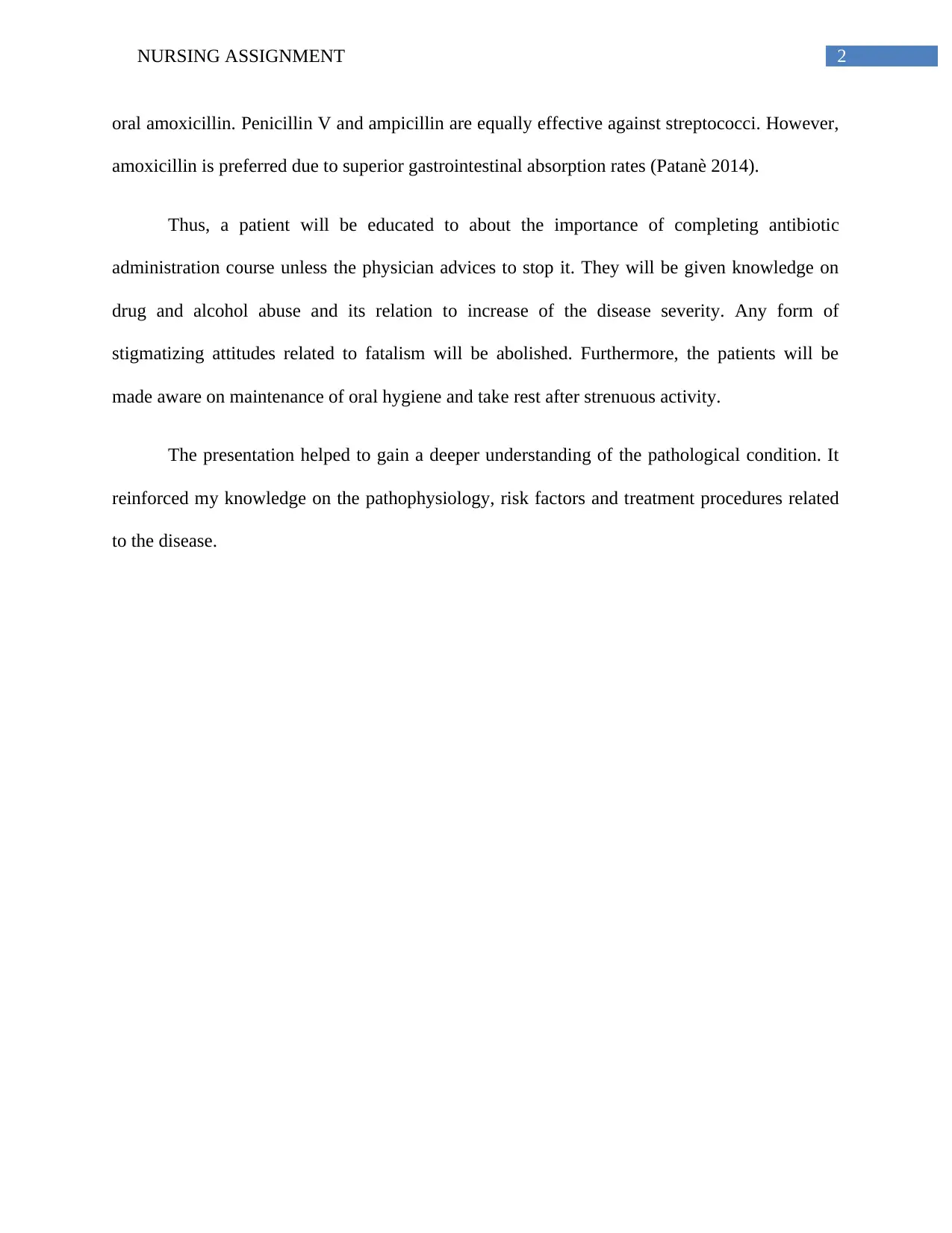
oral amoxicillin. Penicillin V and ampicillin are equally effective against streptococci. However,
amoxicillin is preferred due to superior gastrointestinal absorption rates (Patanè 2014).
Thus, a patient will be educated to about the importance of completing antibiotic
administration course unless the physician advices to stop it. They will be given knowledge on
drug and alcohol abuse and its relation to increase of the disease severity. Any form of
stigmatizing attitudes related to fatalism will be abolished. Furthermore, the patients will be
made aware on maintenance of oral hygiene and take rest after strenuous activity.
The presentation helped to gain a deeper understanding of the pathological condition. It
reinforced my knowledge on the pathophysiology, risk factors and treatment procedures related
to the disease.
Document Page
3NURSING ASSIGNMENT
References
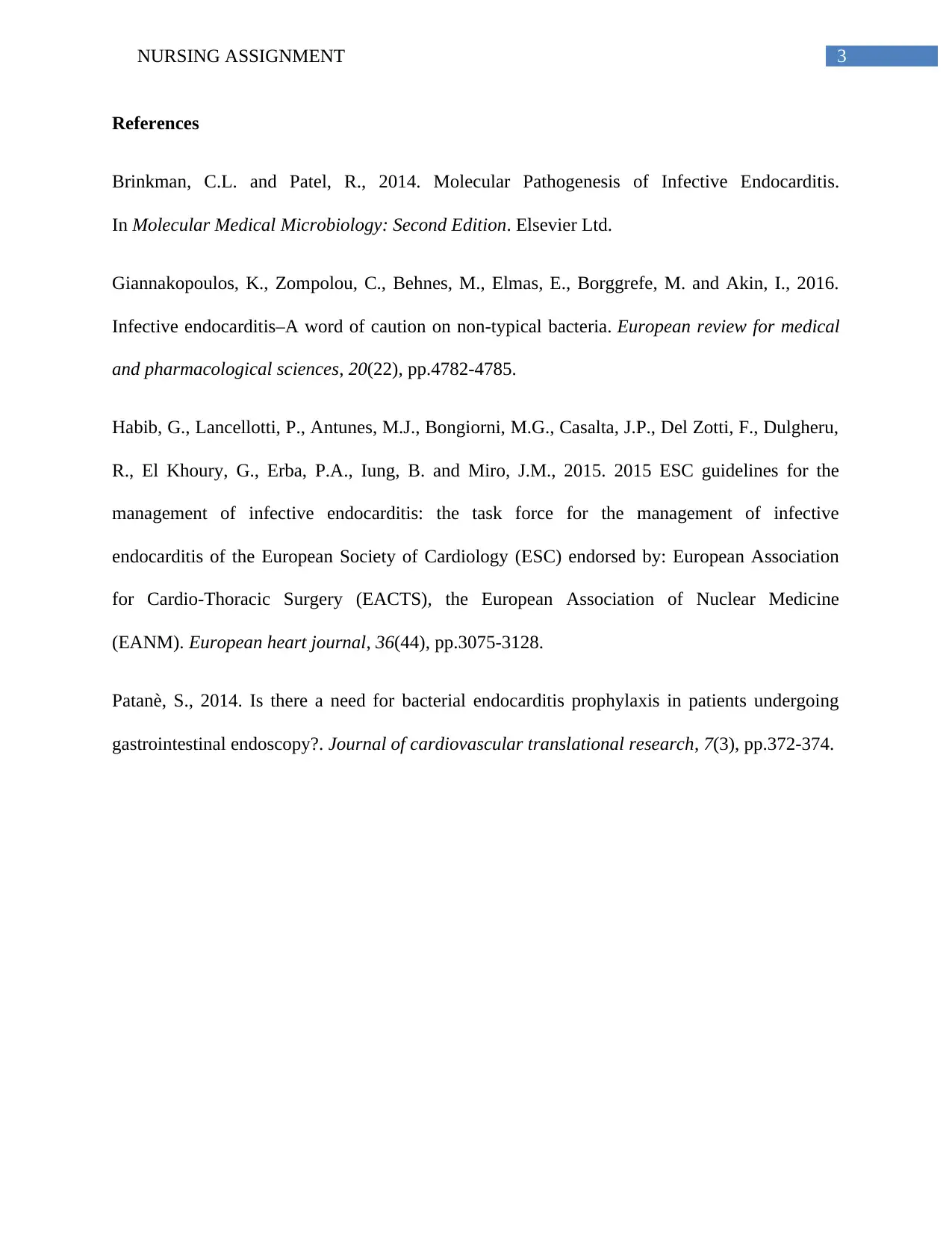
Brinkman, C.L. and Patel, R., 2014. Molecular Pathogenesis of Infective Endocarditis.
In Molecular Medical Microbiology: Second Edition. Elsevier Ltd.
Giannakopoulos, K., Zompolou, C., Behnes, M., Elmas, E., Borggrefe, M. and Akin, I., 2016.
Infective endocarditis–A word of caution on non-typical bacteria. European review for medical
and pharmacological sciences, 20(22), pp.4782-4785.
Habib, G., Lancellotti, P., Antunes, M.J., Bongiorni, M.G., Casalta, J.P., Del Zotti, F., Dulgheru,
R., El Khoury, G., Erba, P.A., Iung, B. and Miro, J.M., 2015. 2015 ESC guidelines for the
management of infective endocarditis: the task force for the management of infective
endocarditis of the European Society of Cardiology (ESC) endorsed by: European Association
for Cardio-Thoracic Surgery (EACTS), the European Association of Nuclear Medicine
(EANM). European heart journal, 36(44), pp.3075-3128.
Patanè, S., 2014. Is there a need for bacterial endocarditis prophylaxis in patients undergoing
gastrointestinal endoscopy?. Journal of cardiovascular translational research, 7(3), pp.372-374.
chevron_up_icon
1 out of 4
circle_padding
hide_on_mobile
zoom_out_icon
[object Object]