Nursing Care Plan Report: HLTENN004, Mrs. Natia Euta, University
VerifiedAdded on 2023/05/30
|16
|3553
|248
Report
AI Summary
This nursing care plan report focuses on Mrs. Natia Euta, a 76-year-old patient admitted with a cerebrovascular accident (CVA), alongside a medical history of obesity, type 2 diabetes, transient ischemic attacks, and osteoarthritis. The report details the medical diagnosis, age-related considerations, and preparation for procedures, including privacy and dignity protocols. Risk identification covers age-related, anesthesia/surgery-related, and cognitive status risks, as well as risks associated with deep vein thrombosis and immobility. Part B presents a nursing care plan utilizing the clinical reasoning cycle, addressing problems such as pain, insomnia, increased susceptibility to falls, and increased risk of obesity and cardiovascular complications. The plan outlines goals, interventions, and evaluation of outcomes for each identified issue, including medication management, physical activity, nutritional planning, and family involvement to improve patient outcomes. The plan also includes references to support the nursing interventions.
Running head: NURSING INTERVENTION AND CARE PLAN
NURSING INTERVENTION AND CARE PLAN
Name of the Student:
Name of the University:
Author note:
NURSING INTERVENTION AND CARE PLAN
Name of the Student:
Name of the University:
Author note:

Paraphrase This Document
Need a fresh take? Get an instant paraphrase of this document with our AI Paraphraser
1NURSING INTERVENTION AND CARE PLAN
Executive Summary
The following sheds light on the key diagnostic features, medical risk factors and associated
nursing care plan for the aged patient Mrs. Natia, who has been admitted concerned her
detrimental medical history and occurrence of cerebrovascular accident. Prolonged lack of
treatment of her medical condition and associated medical history will further increase her
susceptibility of strokes, loss of mobility and cognition and uncontrolled diabetes and obesity.
However, a multidisciplinary approach must be adopted considering her aged physiological
status. Further, the required nursing care plan has been designed to meet her actual problems of
pain and insomnia and her potential problems of obesity and susceptibility to falls in the near
future.
Executive Summary
The following sheds light on the key diagnostic features, medical risk factors and associated
nursing care plan for the aged patient Mrs. Natia, who has been admitted concerned her
detrimental medical history and occurrence of cerebrovascular accident. Prolonged lack of
treatment of her medical condition and associated medical history will further increase her
susceptibility of strokes, loss of mobility and cognition and uncontrolled diabetes and obesity.
However, a multidisciplinary approach must be adopted considering her aged physiological
status. Further, the required nursing care plan has been designed to meet her actual problems of
pain and insomnia and her potential problems of obesity and susceptibility to falls in the near
future.
2NURSING INTERVENTION AND CARE PLAN
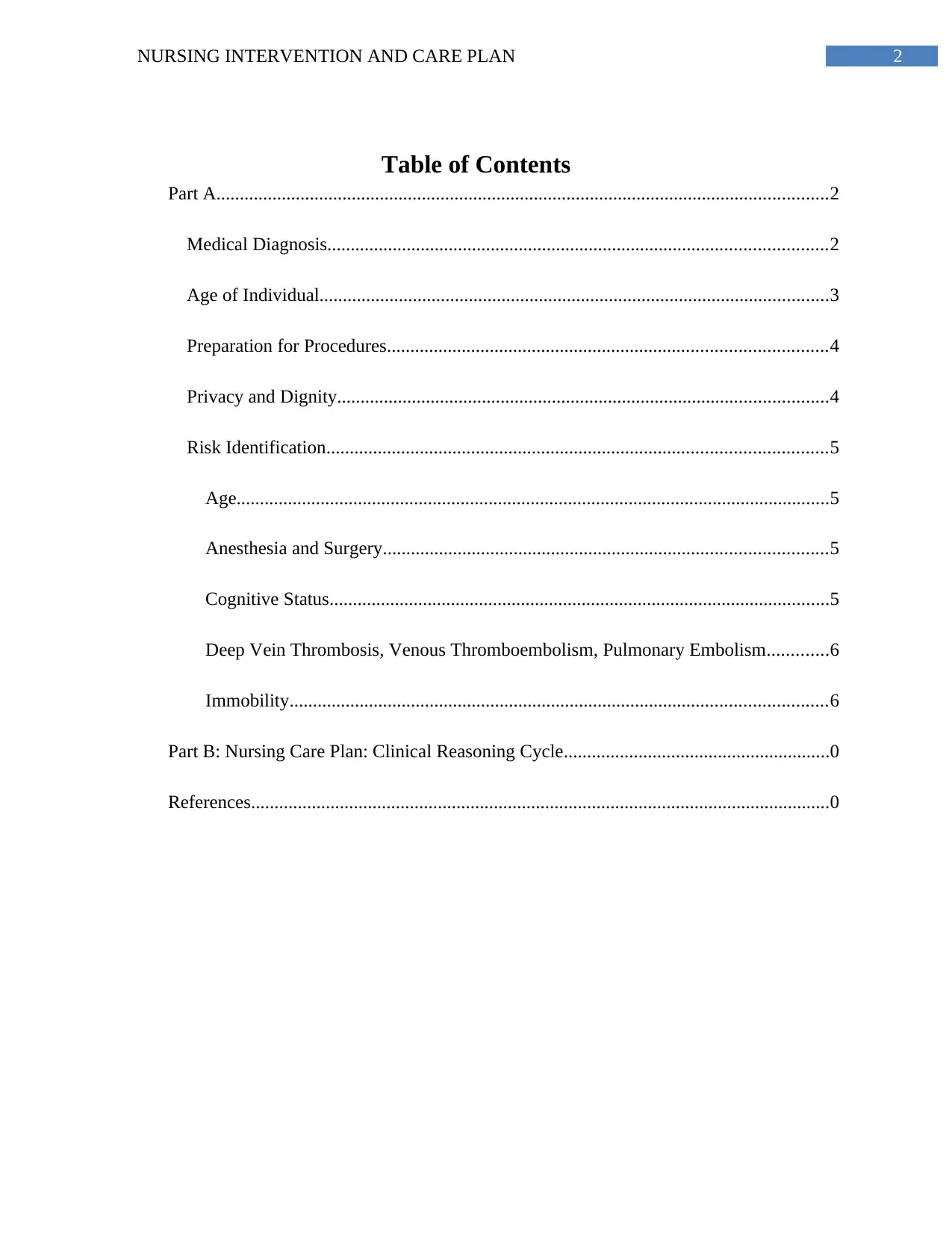
Table of Contents
Part A...................................................................................................................................2
Medical Diagnosis...........................................................................................................2
Age of Individual.............................................................................................................3
Preparation for Procedures..............................................................................................4
Privacy and Dignity.........................................................................................................4
Risk Identification...........................................................................................................5
Age...............................................................................................................................5
Anesthesia and Surgery...............................................................................................5
Cognitive Status...........................................................................................................5
Deep Vein Thrombosis, Venous Thromboembolism, Pulmonary Embolism.............6
Immobility...................................................................................................................6
Part B: Nursing Care Plan: Clinical Reasoning Cycle.........................................................0
References............................................................................................................................0
Table of Contents
Part A...................................................................................................................................2
Medical Diagnosis...........................................................................................................2
Age of Individual.............................................................................................................3
Preparation for Procedures..............................................................................................4
Privacy and Dignity.........................................................................................................4
Risk Identification...........................................................................................................5
Age...............................................................................................................................5
Anesthesia and Surgery...............................................................................................5
Cognitive Status...........................................................................................................5
Deep Vein Thrombosis, Venous Thromboembolism, Pulmonary Embolism.............6
Immobility...................................................................................................................6
Part B: Nursing Care Plan: Clinical Reasoning Cycle.........................................................0
References............................................................................................................................0
⊘ This is a preview!⊘
Do you want full access?
Subscribe today to unlock all pages.

Trusted by 1+ million students worldwide
3NURSING INTERVENTION AND CARE PLAN
Part A
Medical Diagnosis
Mrs. Natia Euta, has been admitted to the hospital upon being inflicted with a
cerebrovascular accident. If left untreated, the stroke can lead to long term negative impacts in
the form of loss or difficulty of speech, movement, cognition or swallowing, which can lie
undetected from weeks to almost years after the episode (Rashid et al., 2016). The patient also
has a medical history of obesity and type 2 diabetes mellitus. If left untreated, obesity as well as
diabetes has been associated with long term impacts of an abnormal lipid metabolism, result in
adipose and fatty steak deposition in the blood vessels, further increasing the susceptibility of the
patient to cardiovascular diseases and myocardial infarction in the future (Furukawa et al., 2017).
Lack of treatment of the medical history of hypertension, may result in long term impact of
artery hardening and narrowing, blood vessel bulging or aneurysms, enlargement or left
ventricular hypertrophy, irregular heartbeat or arrhythmia and further susceptibility blood vessel
rupturing, stroke and hemorrhages (Zanchetti, 2017). The patient also has a medical history of a
transient ischemic stroke which produces symptoms similar to a stroke. Despite the absence of
permanent or severe damages, lack of treatment leads to long term impacts of increasing the
susceptibility of stroke (van Rooji et al., 2016). Mrs. Natia also has a past medical history of
osteoarthritis. Lack of treatment can lead to long term impacts of muscles and joints stiffening
and losing mobility over time, leading to loss of movement, susceptibilities to fracture and
possible joint deformities (Paterson et al., 2015).
Part A
Medical Diagnosis
Mrs. Natia Euta, has been admitted to the hospital upon being inflicted with a
cerebrovascular accident. If left untreated, the stroke can lead to long term negative impacts in
the form of loss or difficulty of speech, movement, cognition or swallowing, which can lie
undetected from weeks to almost years after the episode (Rashid et al., 2016). The patient also
has a medical history of obesity and type 2 diabetes mellitus. If left untreated, obesity as well as
diabetes has been associated with long term impacts of an abnormal lipid metabolism, result in
adipose and fatty steak deposition in the blood vessels, further increasing the susceptibility of the
patient to cardiovascular diseases and myocardial infarction in the future (Furukawa et al., 2017).
Lack of treatment of the medical history of hypertension, may result in long term impact of
artery hardening and narrowing, blood vessel bulging or aneurysms, enlargement or left
ventricular hypertrophy, irregular heartbeat or arrhythmia and further susceptibility blood vessel
rupturing, stroke and hemorrhages (Zanchetti, 2017). The patient also has a medical history of a
transient ischemic stroke which produces symptoms similar to a stroke. Despite the absence of
permanent or severe damages, lack of treatment leads to long term impacts of increasing the
susceptibility of stroke (van Rooji et al., 2016). Mrs. Natia also has a past medical history of
osteoarthritis. Lack of treatment can lead to long term impacts of muscles and joints stiffening
and losing mobility over time, leading to loss of movement, susceptibilities to fracture and
possible joint deformities (Paterson et al., 2015).
Paraphrase This Document
Need a fresh take? Get an instant paraphrase of this document with our AI Paraphraser
4NURSING INTERVENTION AND CARE PLAN
Age of Individual
Mrs. Natia is of 76 years of age, which increases her susceptibilities of acquiring the
physiological changes associated with ageing. Ageing leads to detrimental changes in the
muscoskeletal system leading to shrinkage in the size and reduction in flexibility of muscle
tissues and difficulty in mobility. Further loss of bone density results in weakening of bones and
age associated osteoarthritis as can be observed in Mrs. Natia. Hence, her age will considerable
reduce her abilities of locomotion and movement, further making it difficult for her to conduct
daily life activities (Curtis et al., 2015). Ageing has also been associated with detrimental
neuroendocrinal activities resulting in increased insulin resistance leading to impaired
metabolism and associated diabetes as observed in Mrs. Natia, which will affect her daily life by
reducing her body’s ability to metabolize and utilize essential nutrients (Das, 2015). Ageing also
has been linked to reductions in the cardiac output followed by hardening of blood vessels and
increase in hypertension, further increasing one’s susceptibility to strokes, myocardial infarction
and atherosclerosis as observed in Mrs. Natia’s risk of stroke acquisition as observer in her
medical history (Merz & Cheng, 2016). Ageing also leads to loss of alveolar elasticity and gas
exchange abilities which may negatively affect Mrs. Natia’s daily activities through occurrences
of breathing difficulties and chest tightening (Haq & McElhaney, 2014). Ageing has been
associated with decreased functioning of the central nervous system due to decrease in the
number of neuronal dendrites, which can negatively affect the patient’s performance of daily
activities through reduced cognition and increased susceptibilities to mental health disorders like
anxiety which has already been observed in Mrs. Natia (Rawji et al., 2016).
Age of Individual
Mrs. Natia is of 76 years of age, which increases her susceptibilities of acquiring the
physiological changes associated with ageing. Ageing leads to detrimental changes in the
muscoskeletal system leading to shrinkage in the size and reduction in flexibility of muscle
tissues and difficulty in mobility. Further loss of bone density results in weakening of bones and
age associated osteoarthritis as can be observed in Mrs. Natia. Hence, her age will considerable
reduce her abilities of locomotion and movement, further making it difficult for her to conduct
daily life activities (Curtis et al., 2015). Ageing has also been associated with detrimental
neuroendocrinal activities resulting in increased insulin resistance leading to impaired
metabolism and associated diabetes as observed in Mrs. Natia, which will affect her daily life by
reducing her body’s ability to metabolize and utilize essential nutrients (Das, 2015). Ageing also
has been linked to reductions in the cardiac output followed by hardening of blood vessels and
increase in hypertension, further increasing one’s susceptibility to strokes, myocardial infarction
and atherosclerosis as observed in Mrs. Natia’s risk of stroke acquisition as observer in her
medical history (Merz & Cheng, 2016). Ageing also leads to loss of alveolar elasticity and gas
exchange abilities which may negatively affect Mrs. Natia’s daily activities through occurrences
of breathing difficulties and chest tightening (Haq & McElhaney, 2014). Ageing has been
associated with decreased functioning of the central nervous system due to decrease in the
number of neuronal dendrites, which can negatively affect the patient’s performance of daily
activities through reduced cognition and increased susceptibilities to mental health disorders like
anxiety which has already been observed in Mrs. Natia (Rawji et al., 2016).
5NURSING INTERVENTION AND CARE PLAN
Preparation for Procedures
In the case of Mrs. Natia, along with the detrimental effects of her ageing, her extensive
medical complications further puts her at increased risk of complications. Hence, prior to
surgical procedures, a multidisciplinary team must be adopted considering the varied medical
conditions of Mrs. Natia (Pearce et al., 2016). The clinical team prior to procedures, must carry
out preoperative assessments in the fields of cardiac assessment, pulmonary assessment, abilities
to make decisions, dementia and associated impaired cognition, risk of falls, mobility, risk for
delirium post operation, medications consumed, availability of adequate support from patient’s
family and social networks, counseling, fraility and status of food and nutrient intake (Knittel &
Wildes, 2016). Assessments of fraility and risk of falls must be conducted considering the
patient’s history of osteoarthritis while cardiac assessment is essential to monitor existing cardiac
functioning considering patient’s history of strokes and hypertension (Kim et al., 2016). Surgical
procedures often leave elders confused and anxious, hence requiring delirium assessment as Mrs.
Nadia has already begun to show signs and symptoms of distress and anxiety (Robinson &
Rosenthal, 2015). Obese patients are susceptible to hemorrhages or blood loss prior to surgery
due to their associated hypertension, hence along with cardiac assessment, nutritional screening
must be performed in Mrs. Natia considering her medical history (Clavellina-Gaytán et al.,
2015).
Privacy and Dignity
While caring for Mrs. Natia, the nurse or doctor must always ask for permission before
entering her room, followed closing of doors and curtains during appropriate times. Considering
her gender, the medical team must aim to provide same sex accommodation to Mrs. Natia along
with provision of same sex bathrooms which are clean and hygienic (Quinn & Happell, 2015).
Preparation for Procedures
In the case of Mrs. Natia, along with the detrimental effects of her ageing, her extensive
medical complications further puts her at increased risk of complications. Hence, prior to
surgical procedures, a multidisciplinary team must be adopted considering the varied medical
conditions of Mrs. Natia (Pearce et al., 2016). The clinical team prior to procedures, must carry
out preoperative assessments in the fields of cardiac assessment, pulmonary assessment, abilities
to make decisions, dementia and associated impaired cognition, risk of falls, mobility, risk for
delirium post operation, medications consumed, availability of adequate support from patient’s
family and social networks, counseling, fraility and status of food and nutrient intake (Knittel &
Wildes, 2016). Assessments of fraility and risk of falls must be conducted considering the
patient’s history of osteoarthritis while cardiac assessment is essential to monitor existing cardiac
functioning considering patient’s history of strokes and hypertension (Kim et al., 2016). Surgical
procedures often leave elders confused and anxious, hence requiring delirium assessment as Mrs.
Nadia has already begun to show signs and symptoms of distress and anxiety (Robinson &
Rosenthal, 2015). Obese patients are susceptible to hemorrhages or blood loss prior to surgery
due to their associated hypertension, hence along with cardiac assessment, nutritional screening
must be performed in Mrs. Natia considering her medical history (Clavellina-Gaytán et al.,
2015).
Privacy and Dignity
While caring for Mrs. Natia, the nurse or doctor must always ask for permission before
entering her room, followed closing of doors and curtains during appropriate times. Considering
her gender, the medical team must aim to provide same sex accommodation to Mrs. Natia along
with provision of same sex bathrooms which are clean and hygienic (Quinn & Happell, 2015).
⊘ This is a preview!⊘
Do you want full access?
Subscribe today to unlock all pages.
Trusted by 1+ million students worldwide
6NURSING INTERVENTION AND CARE PLAN
Mrs. Natia is a Samoan and may have preferences and needs unique to her culture. Hence the
medical team must communicate with her to enquire about her cultural beliefs or employ an
interpreter for with possessing similar cultures in order to make her feel respected and at ease.
The hospital can communicate further with the nearest interpreter, aboriginal or multicultural
institute for the purpose of providing culture competent treatment (Betz & Wintemute, 2015).
Risk Identification
Age
With age, Mrs. Natia may be at a risk of reduced mobility and increased susceptibility to
fractures due to her comprised muscoskeletal and bone health associated with reduced number
and flexibility of muscle fibers and reduced bone densities. Age puts her at a risk of
cardiovascular ailments due to age associated artery hardening, increased hypertension and
reduced cardiac output. Age also puts the patient at a risk of reduced cognition due to reduction
in neuronal dendrites and increased metabolic disorders due to age associated insulin sensitivity
(Scott-Warren & Maguire, 2017).
Anesthesia and Surgery
Usage of anesthesia prior to surgery in elderly patients has been documented to increase
the risk of post operative cognitive dysfunction and delirium (Rajesh, 2015).
Cognitive Status
Ageing puts Mrs. Natia at a risk for reduced cognition due to age associated loss of
neurons. Surgery also puts her at a risk of cognitive loss since surgical procedures in the elderly
has been documented to increase the risk of post operative cognitive dysfunction and delirium.
Mrs. Natia is a Samoan and may have preferences and needs unique to her culture. Hence the
medical team must communicate with her to enquire about her cultural beliefs or employ an
interpreter for with possessing similar cultures in order to make her feel respected and at ease.
The hospital can communicate further with the nearest interpreter, aboriginal or multicultural
institute for the purpose of providing culture competent treatment (Betz & Wintemute, 2015).
Risk Identification
Age
With age, Mrs. Natia may be at a risk of reduced mobility and increased susceptibility to
fractures due to her comprised muscoskeletal and bone health associated with reduced number
and flexibility of muscle fibers and reduced bone densities. Age puts her at a risk of
cardiovascular ailments due to age associated artery hardening, increased hypertension and
reduced cardiac output. Age also puts the patient at a risk of reduced cognition due to reduction
in neuronal dendrites and increased metabolic disorders due to age associated insulin sensitivity
(Scott-Warren & Maguire, 2017).
Anesthesia and Surgery
Usage of anesthesia prior to surgery in elderly patients has been documented to increase
the risk of post operative cognitive dysfunction and delirium (Rajesh, 2015).
Cognitive Status
Ageing puts Mrs. Natia at a risk for reduced cognition due to age associated loss of
neurons. Surgery also puts her at a risk of cognitive loss since surgical procedures in the elderly
has been documented to increase the risk of post operative cognitive dysfunction and delirium.
Paraphrase This Document
Need a fresh take? Get an instant paraphrase of this document with our AI Paraphraser
7NURSING INTERVENTION AND CARE PLAN
Further, occurrence of cerebral stroke as experienced by the patient, increases the risk of
cognitive mental disabilities such as Alzheimer’s and dementia (Kubu et al., 2017).
Deep Vein Thrombosis, Venous Thromboembolism, Pulmonary Embolism
Deep Vein Thrombosis, Venous Thromboembolism and Pulmonary Embolism increases
the risk of strokes and hemorrhages as evident in Mrs. Natia suffering from prolonged
headaches, which further puts the patient at a risk of loss of speech, movement and food
ingestion behaviors like swallowing. Strokes due to thromboembolism also increase the risk of
dementia and Alzheimer’s (Chung et al., 2014).
Immobility
Loss of movement due to the patient’s arthritic condition increases the risk of pressure
ulcers. Immobility also increases the risk of age associated muscle wastage or sarcopenia in
elders like Mrs. Natia (Abe et al., 2016).
Further, occurrence of cerebral stroke as experienced by the patient, increases the risk of
cognitive mental disabilities such as Alzheimer’s and dementia (Kubu et al., 2017).
Deep Vein Thrombosis, Venous Thromboembolism, Pulmonary Embolism
Deep Vein Thrombosis, Venous Thromboembolism and Pulmonary Embolism increases
the risk of strokes and hemorrhages as evident in Mrs. Natia suffering from prolonged
headaches, which further puts the patient at a risk of loss of speech, movement and food
ingestion behaviors like swallowing. Strokes due to thromboembolism also increase the risk of
dementia and Alzheimer’s (Chung et al., 2014).
Immobility
Loss of movement due to the patient’s arthritic condition increases the risk of pressure
ulcers. Immobility also increases the risk of age associated muscle wastage or sarcopenia in
elders like Mrs. Natia (Abe et al., 2016).
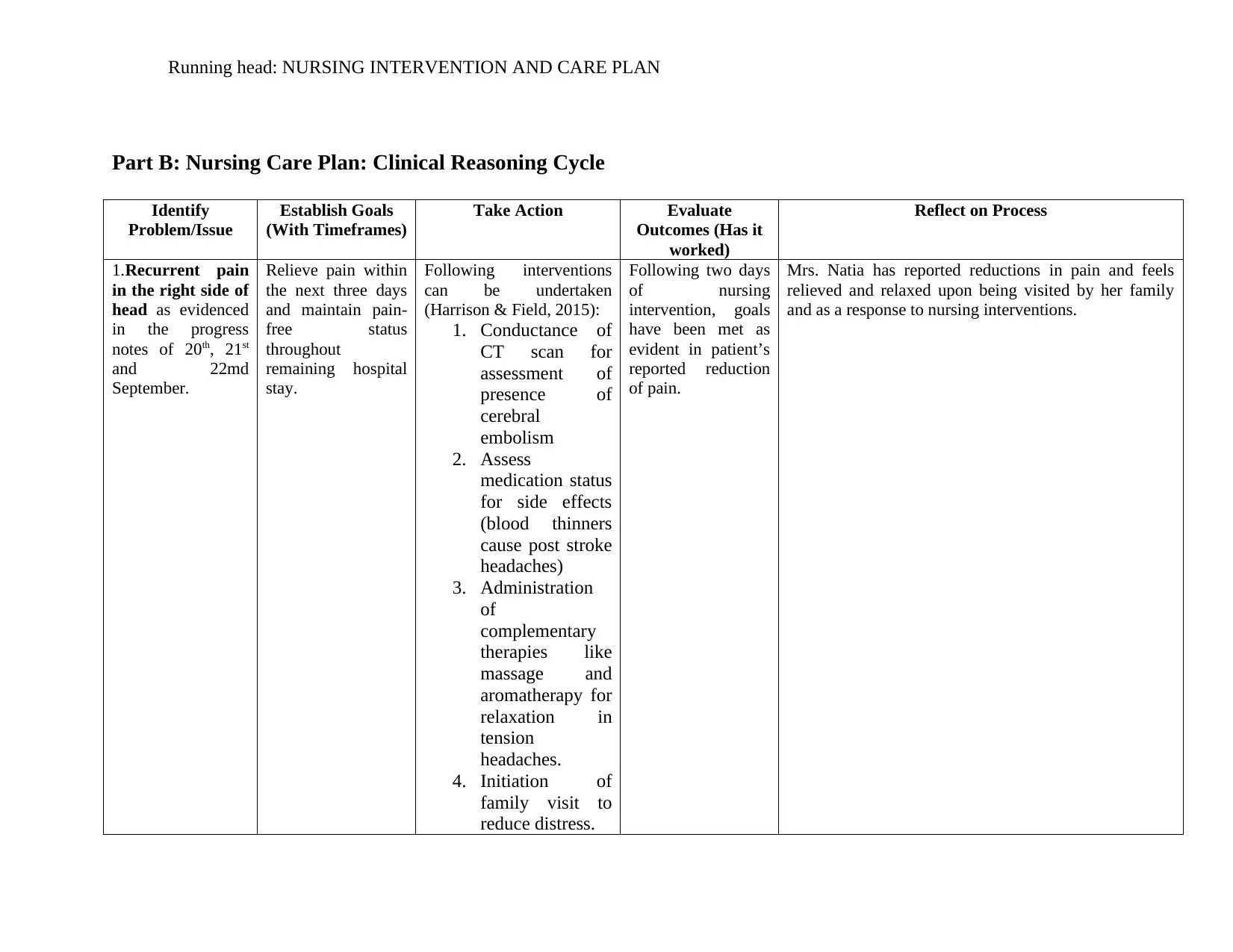
Running head: NURSING INTERVENTION AND CARE PLAN
Part B: Nursing Care Plan: Clinical Reasoning Cycle
Identify
Problem/Issue
Establish Goals
(With Timeframes)
Take Action Evaluate
Outcomes (Has it
worked)
Reflect on Process
1.Recurrent pain
in the right side of
head as evidenced
in the progress
notes of 20th, 21st
and 22md
September.
Relieve pain within
the next three days
and maintain pain-
free status
throughout
remaining hospital
stay.
Following interventions
can be undertaken
(Harrison & Field, 2015):
1. Conductance of
CT scan for
assessment of
presence of
cerebral
embolism
2. Assess
medication status
for side effects
(blood thinners
cause post stroke
headaches)
3. Administration
of
complementary
therapies like
massage and
aromatherapy for
relaxation in
tension
headaches.
4. Initiation of
family visit to
reduce distress.
Following two days
of nursing
intervention, goals
have been met as
evident in patient’s
reported reduction
of pain.
Mrs. Natia has reported reductions in pain and feels
relieved and relaxed upon being visited by her family
and as a response to nursing interventions.
Part B: Nursing Care Plan: Clinical Reasoning Cycle
Identify
Problem/Issue
Establish Goals
(With Timeframes)
Take Action Evaluate
Outcomes (Has it
worked)
Reflect on Process
1.Recurrent pain
in the right side of
head as evidenced
in the progress
notes of 20th, 21st
and 22md
September.
Relieve pain within
the next three days
and maintain pain-
free status
throughout
remaining hospital
stay.
Following interventions
can be undertaken
(Harrison & Field, 2015):
1. Conductance of
CT scan for
assessment of
presence of
cerebral
embolism
2. Assess
medication status
for side effects
(blood thinners
cause post stroke
headaches)
3. Administration
of
complementary
therapies like
massage and
aromatherapy for
relaxation in
tension
headaches.
4. Initiation of
family visit to
reduce distress.
Following two days
of nursing
intervention, goals
have been met as
evident in patient’s
reported reduction
of pain.
Mrs. Natia has reported reductions in pain and feels
relieved and relaxed upon being visited by her family
and as a response to nursing interventions.
⊘ This is a preview!⊘
Do you want full access?
Subscribe today to unlock all pages.
Trusted by 1+ million students worldwide
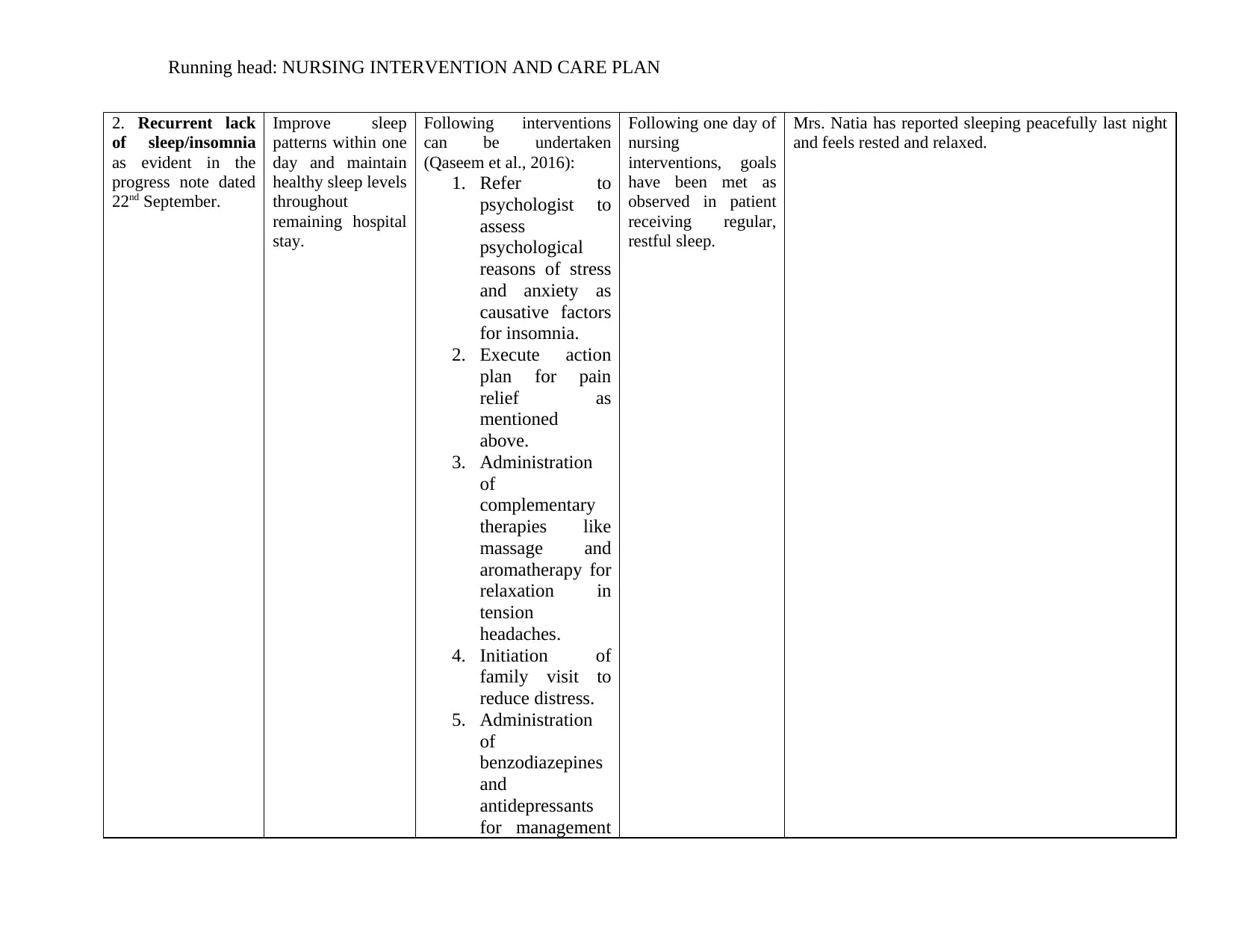
Running head: NURSING INTERVENTION AND CARE PLAN
2. Recurrent lack
of sleep/insomnia
as evident in the
progress note dated
22nd September.
Improve sleep
patterns within one
day and maintain
healthy sleep levels
throughout
remaining hospital
stay.
Following interventions
can be undertaken
(Qaseem et al., 2016):
1. Refer to
psychologist to
assess
psychological
reasons of stress
and anxiety as
causative factors
for insomnia.
2. Execute action
plan for pain
relief as
mentioned
above.
3. Administration
of
complementary
therapies like
massage and
aromatherapy for
relaxation in
tension
headaches.
4. Initiation of
family visit to
reduce distress.
5. Administration
of
benzodiazepines
and
antidepressants
for management
Following one day of
nursing
interventions, goals
have been met as
observed in patient
receiving regular,
restful sleep.
Mrs. Natia has reported sleeping peacefully last night
and feels rested and relaxed.
2. Recurrent lack
of sleep/insomnia
as evident in the
progress note dated
22nd September.
Improve sleep
patterns within one
day and maintain
healthy sleep levels
throughout
remaining hospital
stay.
Following interventions
can be undertaken
(Qaseem et al., 2016):
1. Refer to
psychologist to
assess
psychological
reasons of stress
and anxiety as
causative factors
for insomnia.
2. Execute action
plan for pain
relief as
mentioned
above.
3. Administration
of
complementary
therapies like
massage and
aromatherapy for
relaxation in
tension
headaches.
4. Initiation of
family visit to
reduce distress.
5. Administration
of
benzodiazepines
and
antidepressants
for management
Following one day of
nursing
interventions, goals
have been met as
observed in patient
receiving regular,
restful sleep.
Mrs. Natia has reported sleeping peacefully last night
and feels rested and relaxed.
Paraphrase This Document
Need a fresh take? Get an instant paraphrase of this document with our AI Paraphraser
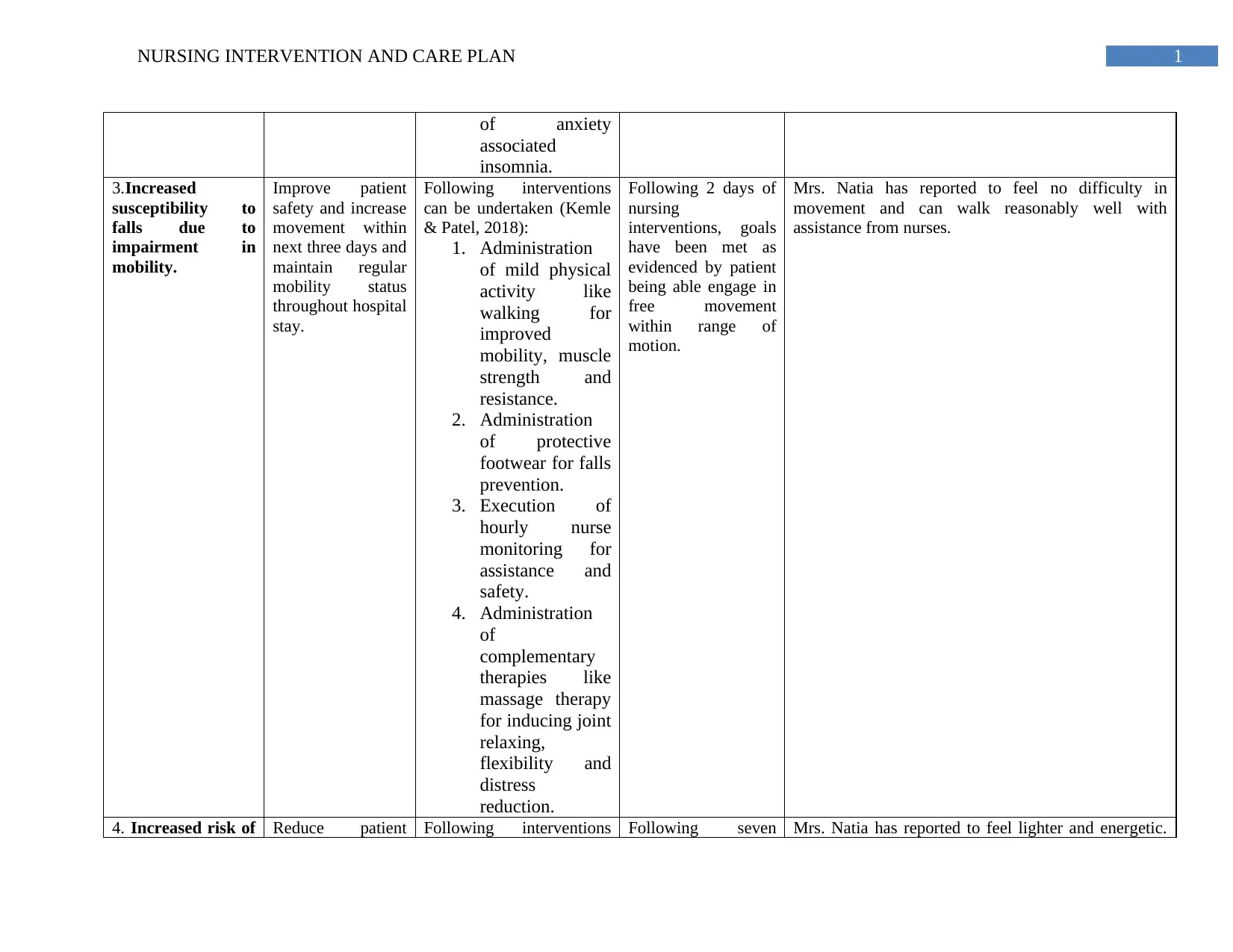
1NURSING INTERVENTION AND CARE PLAN
of anxiety
associated
insomnia.
3.Increased
susceptibility to
falls due to
impairment in
mobility.
Improve patient
safety and increase
movement within
next three days and
maintain regular
mobility status
throughout hospital
stay.
Following interventions
can be undertaken (Kemle
& Patel, 2018):
1. Administration
of mild physical
activity like
walking for
improved
mobility, muscle
strength and
resistance.
2. Administration
of protective
footwear for falls
prevention.
3. Execution of
hourly nurse
monitoring for
assistance and
safety.
4. Administration
of
complementary
therapies like
massage therapy
for inducing joint
relaxing,
flexibility and
distress
reduction.
Following 2 days of
nursing
interventions, goals
have been met as
evidenced by patient
being able engage in
free movement
within range of
motion.
Mrs. Natia has reported to feel no difficulty in
movement and can walk reasonably well with
assistance from nurses.
4. Increased risk of Reduce patient Following interventions Following seven Mrs. Natia has reported to feel lighter and energetic.
of anxiety
associated
insomnia.
3.Increased
susceptibility to
falls due to
impairment in
mobility.
Improve patient
safety and increase
movement within
next three days and
maintain regular
mobility status
throughout hospital
stay.
Following interventions
can be undertaken (Kemle
& Patel, 2018):
1. Administration
of mild physical
activity like
walking for
improved
mobility, muscle
strength and
resistance.
2. Administration
of protective
footwear for falls
prevention.
3. Execution of
hourly nurse
monitoring for
assistance and
safety.
4. Administration
of
complementary
therapies like
massage therapy
for inducing joint
relaxing,
flexibility and
distress
reduction.
Following 2 days of
nursing
interventions, goals
have been met as
evidenced by patient
being able engage in
free movement
within range of
motion.
Mrs. Natia has reported to feel no difficulty in
movement and can walk reasonably well with
assistance from nurses.
4. Increased risk of Reduce patient Following interventions Following seven Mrs. Natia has reported to feel lighter and energetic.
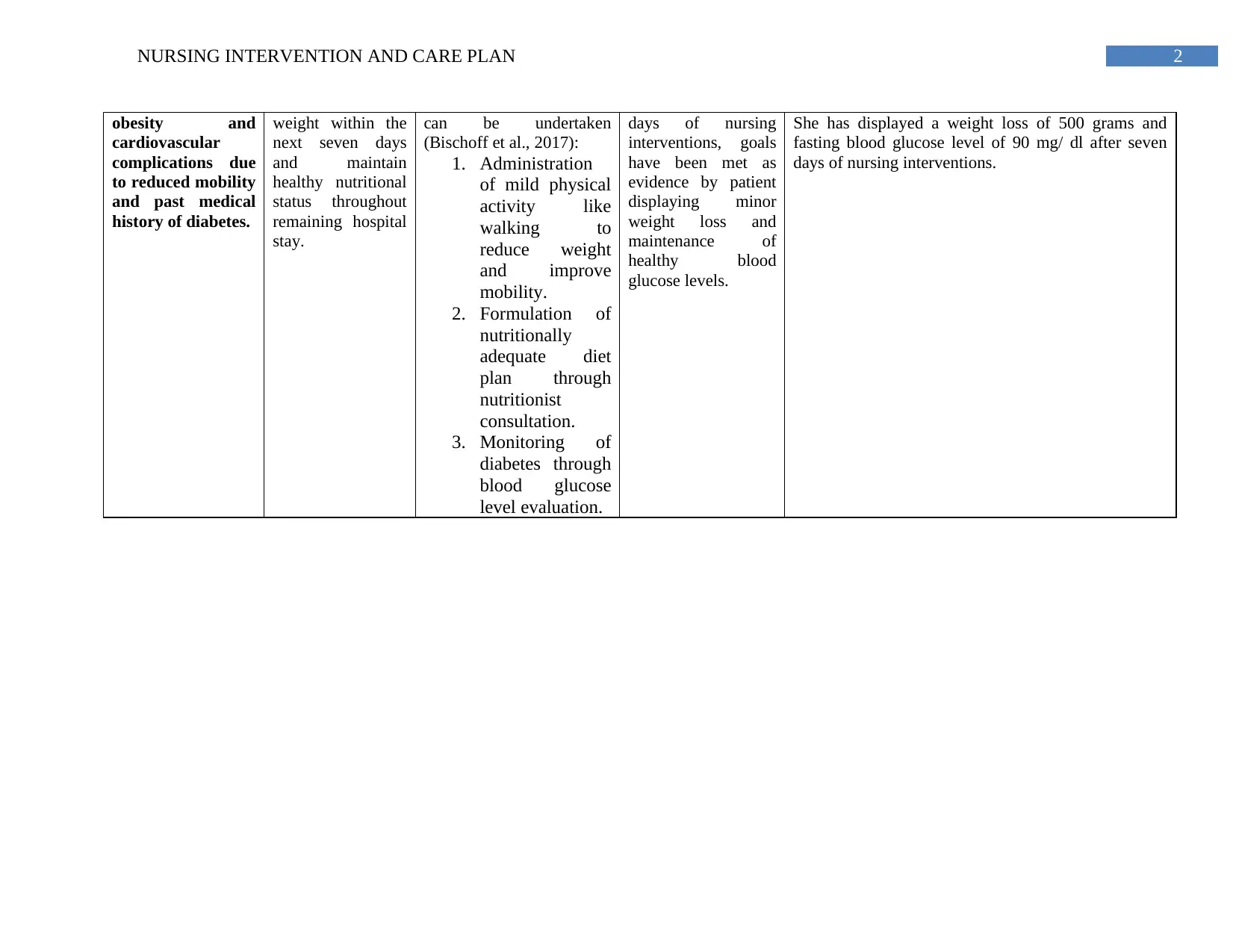
2NURSING INTERVENTION AND CARE PLAN
obesity and
cardiovascular
complications due
to reduced mobility
and past medical
history of diabetes.
weight within the
next seven days
and maintain
healthy nutritional
status throughout
remaining hospital
stay.
can be undertaken
(Bischoff et al., 2017):
1. Administration
of mild physical
activity like
walking to
reduce weight
and improve
mobility.
2. Formulation of
nutritionally
adequate diet
plan through
nutritionist
consultation.
3. Monitoring of
diabetes through
blood glucose
level evaluation.
days of nursing
interventions, goals
have been met as
evidence by patient
displaying minor
weight loss and
maintenance of
healthy blood
glucose levels.
She has displayed a weight loss of 500 grams and
fasting blood glucose level of 90 mg/ dl after seven
days of nursing interventions.
obesity and
cardiovascular
complications due
to reduced mobility
and past medical
history of diabetes.
weight within the
next seven days
and maintain
healthy nutritional
status throughout
remaining hospital
stay.
can be undertaken
(Bischoff et al., 2017):
1. Administration
of mild physical
activity like
walking to
reduce weight
and improve
mobility.
2. Formulation of
nutritionally
adequate diet
plan through
nutritionist
consultation.
3. Monitoring of
diabetes through
blood glucose
level evaluation.
days of nursing
interventions, goals
have been met as
evidence by patient
displaying minor
weight loss and
maintenance of
healthy blood
glucose levels.
She has displayed a weight loss of 500 grams and
fasting blood glucose level of 90 mg/ dl after seven
days of nursing interventions.
⊘ This is a preview!⊘
Do you want full access?
Subscribe today to unlock all pages.
Trusted by 1+ million students worldwide

1 out of 16


Related Documents


Your All-in-One AI-Powered Toolkit for Academic Success.
+13062052269
info@desklib.com
Available 24*7 on WhatsApp / Email
![[object Object]](/_next/static/media/star-bottom.7253800d.svg)
Unlock your academic potential
Copyright © 2020–2026 A2Z Services. All Rights Reserved. Developed and managed by ZUCOL.