HLTENN003 Diploma of Nursing: Clinical Assessment Knowledge Test
VerifiedAdded on 2023/06/11
|21
|3668
|374
Homework Assignment
AI Summary
This document presents a student's answers to a knowledge test on clinical assessment and nursing care planning, likely for the HLTENN003 unit within a Diploma of Nursing program. The questions cover various aspects of nursing assessment, including the importance of patient history, holistic care, documentation, vital signs measurement, and interpretation of clinical data. Specific topics addressed include fluid balance, urinalysis, bradycardia, tachypnea, cyanosis, hypotension, jaundice, pallor, turgor, petechiae, and stages of development. The assignment includes practical scenarios and calculations, such as interpreting intake and output charts and calculating body mass index. The document also emphasizes the importance of recognizing unusual symptoms and conducting appropriate investigations for various medical conditions. Desklib is a platform where you can find past papers and solved assignments for students.
Running head: QUESTIONS AND ANSWERS
QUESTIONS AND ANSWERS
Name of the student:
Name of the university:
Author note:
QUESTIONS AND ANSWERS
Name of the student:
Name of the university:
Author note:
Paraphrase This Document
Need a fresh take? Get an instant paraphrase of this document with our AI Paraphraser

1
QUESTIONS AND ANSWERS
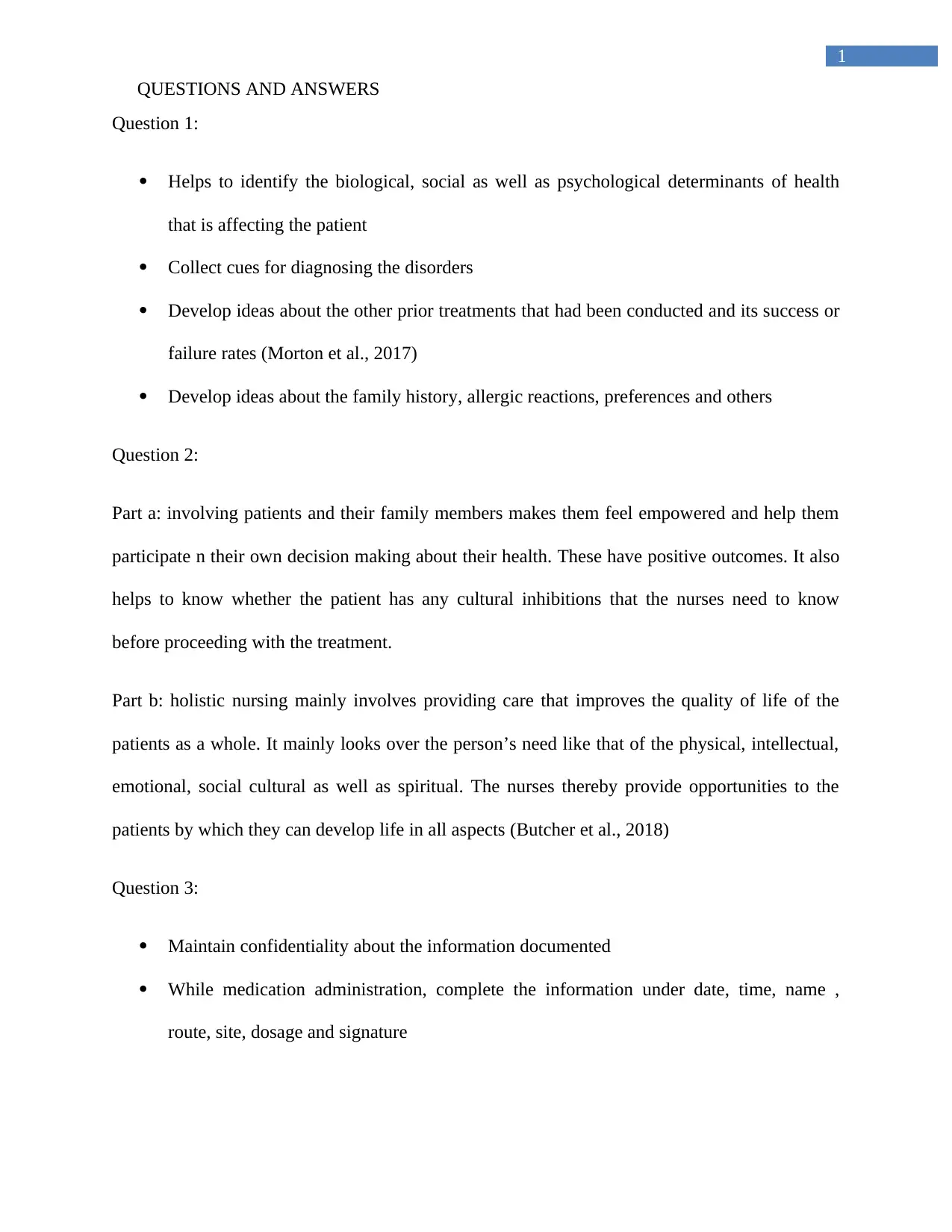
Question 1:
Helps to identify the biological, social as well as psychological determinants of health
that is affecting the patient
Collect cues for diagnosing the disorders
Develop ideas about the other prior treatments that had been conducted and its success or
failure rates (Morton et al., 2017)
Develop ideas about the family history, allergic reactions, preferences and others
Question 2:
Part a: involving patients and their family members makes them feel empowered and help them
participate n their own decision making about their health. These have positive outcomes. It also
helps to know whether the patient has any cultural inhibitions that the nurses need to know
before proceeding with the treatment.
Part b: holistic nursing mainly involves providing care that improves the quality of life of the
patients as a whole. It mainly looks over the person’s need like that of the physical, intellectual,
emotional, social cultural as well as spiritual. The nurses thereby provide opportunities to the
patients by which they can develop life in all aspects (Butcher et al., 2018)
Question 3:
Maintain confidentiality about the information documented
While medication administration, complete the information under date, time, name ,
route, site, dosage and signature
QUESTIONS AND ANSWERS
Question 1:
Helps to identify the biological, social as well as psychological determinants of health
that is affecting the patient
Collect cues for diagnosing the disorders
Develop ideas about the other prior treatments that had been conducted and its success or
failure rates (Morton et al., 2017)
Develop ideas about the family history, allergic reactions, preferences and others
Question 2:
Part a: involving patients and their family members makes them feel empowered and help them
participate n their own decision making about their health. These have positive outcomes. It also
helps to know whether the patient has any cultural inhibitions that the nurses need to know
before proceeding with the treatment.
Part b: holistic nursing mainly involves providing care that improves the quality of life of the
patients as a whole. It mainly looks over the person’s need like that of the physical, intellectual,
emotional, social cultural as well as spiritual. The nurses thereby provide opportunities to the
patients by which they can develop life in all aspects (Butcher et al., 2018)
Question 3:
Maintain confidentiality about the information documented
While medication administration, complete the information under date, time, name ,
route, site, dosage and signature

2
QUESTIONS AND ANSWERS
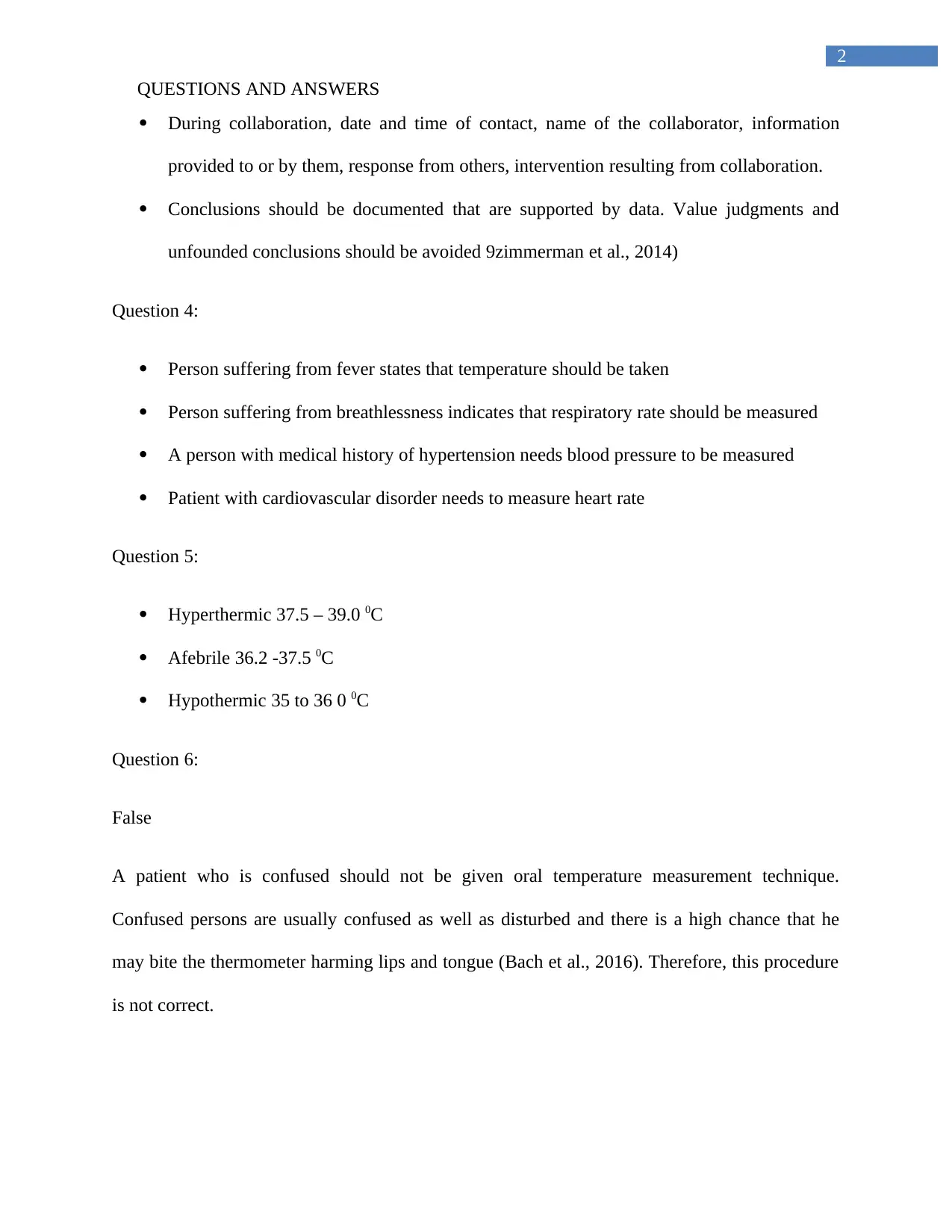
During collaboration, date and time of contact, name of the collaborator, information
provided to or by them, response from others, intervention resulting from collaboration.
Conclusions should be documented that are supported by data. Value judgments and
unfounded conclusions should be avoided 9zimmerman et al., 2014)
Question 4:
Person suffering from fever states that temperature should be taken
Person suffering from breathlessness indicates that respiratory rate should be measured
A person with medical history of hypertension needs blood pressure to be measured
Patient with cardiovascular disorder needs to measure heart rate
Question 5:
Hyperthermic 37.5 – 39.0 0C
Afebrile 36.2 -37.5 0C
Hypothermic 35 to 36 0 0C
Question 6:
False
A patient who is confused should not be given oral temperature measurement technique.
Confused persons are usually confused as well as disturbed and there is a high chance that he
may bite the thermometer harming lips and tongue (Bach et al., 2016). Therefore, this procedure
is not correct.
QUESTIONS AND ANSWERS
During collaboration, date and time of contact, name of the collaborator, information
provided to or by them, response from others, intervention resulting from collaboration.
Conclusions should be documented that are supported by data. Value judgments and
unfounded conclusions should be avoided 9zimmerman et al., 2014)
Question 4:
Person suffering from fever states that temperature should be taken
Person suffering from breathlessness indicates that respiratory rate should be measured
A person with medical history of hypertension needs blood pressure to be measured
Patient with cardiovascular disorder needs to measure heart rate
Question 5:
Hyperthermic 37.5 – 39.0 0C
Afebrile 36.2 -37.5 0C
Hypothermic 35 to 36 0 0C
Question 6:
False
A patient who is confused should not be given oral temperature measurement technique.
Confused persons are usually confused as well as disturbed and there is a high chance that he
may bite the thermometer harming lips and tongue (Bach et al., 2016). Therefore, this procedure
is not correct.
⊘ This is a preview!⊘
Do you want full access?
Subscribe today to unlock all pages.

Trusted by 1+ million students worldwide

3
QUESTIONS AND ANSWERS
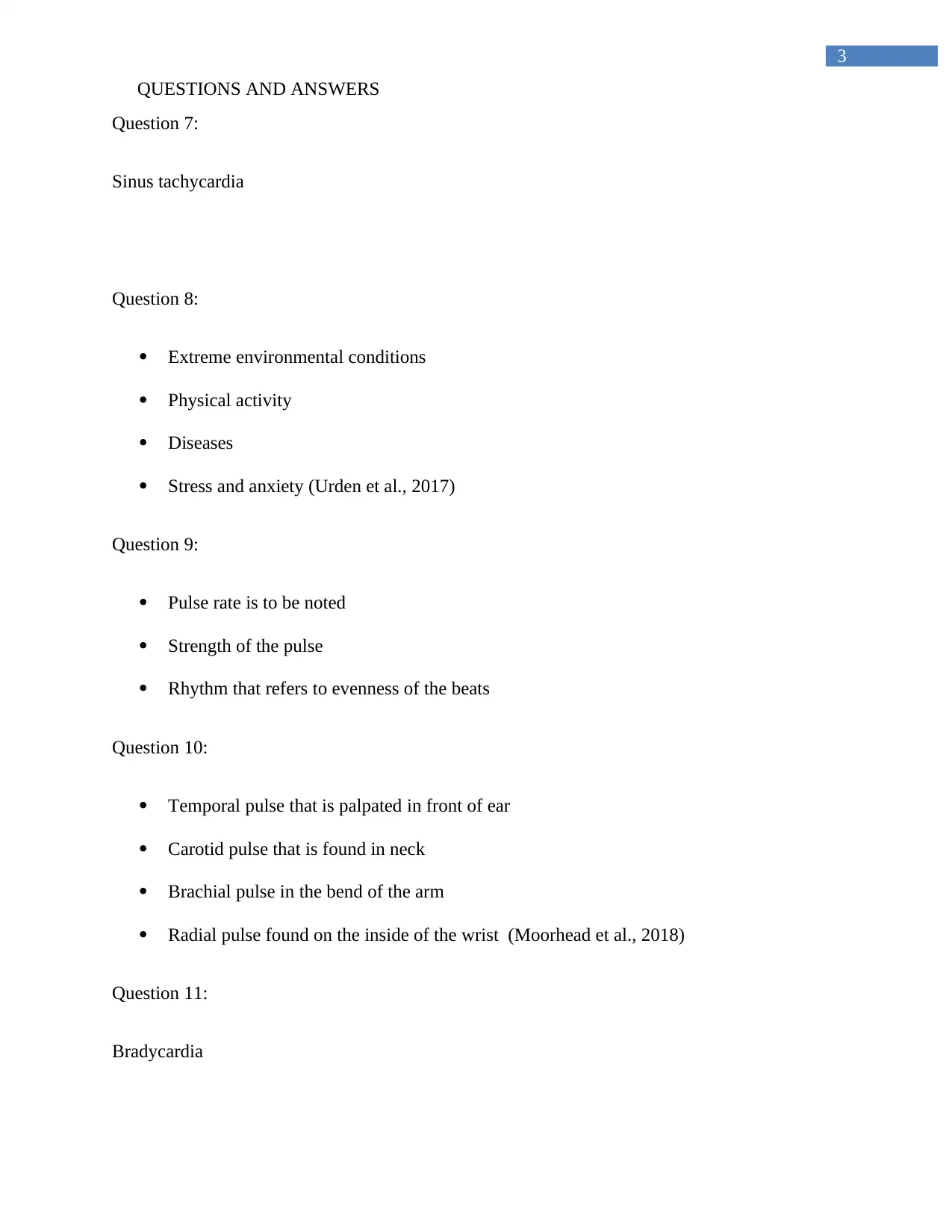
Question 7:
Sinus tachycardia
Question 8:
Extreme environmental conditions
Physical activity
Diseases
Stress and anxiety (Urden et al., 2017)
Question 9:
Pulse rate is to be noted
Strength of the pulse
Rhythm that refers to evenness of the beats
Question 10:
Temporal pulse that is palpated in front of ear
Carotid pulse that is found in neck
Brachial pulse in the bend of the arm
Radial pulse found on the inside of the wrist (Moorhead et al., 2018)
Question 11:
Bradycardia
QUESTIONS AND ANSWERS
Question 7:
Sinus tachycardia
Question 8:
Extreme environmental conditions
Physical activity
Diseases
Stress and anxiety (Urden et al., 2017)
Question 9:
Pulse rate is to be noted
Strength of the pulse
Rhythm that refers to evenness of the beats
Question 10:
Temporal pulse that is palpated in front of ear
Carotid pulse that is found in neck
Brachial pulse in the bend of the arm
Radial pulse found on the inside of the wrist (Moorhead et al., 2018)
Question 11:
Bradycardia
Paraphrase This Document
Need a fresh take? Get an instant paraphrase of this document with our AI Paraphraser

4
QUESTIONS AND ANSWERS
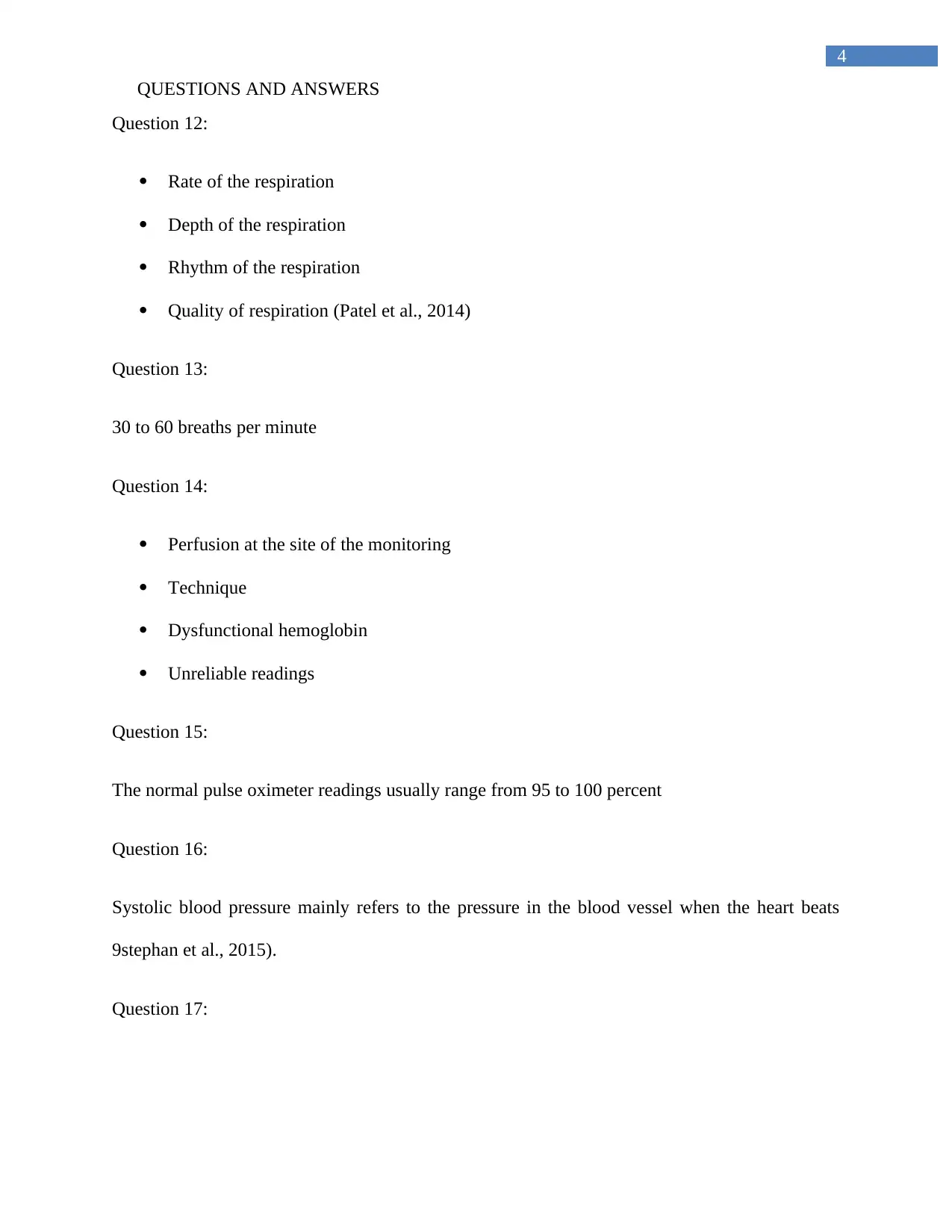
Question 12:
Rate of the respiration
Depth of the respiration
Rhythm of the respiration
Quality of respiration (Patel et al., 2014)
Question 13:
30 to 60 breaths per minute
Question 14:
Perfusion at the site of the monitoring
Technique
Dysfunctional hemoglobin
Unreliable readings
Question 15:
The normal pulse oximeter readings usually range from 95 to 100 percent
Question 16:
Systolic blood pressure mainly refers to the pressure in the blood vessel when the heart beats
9stephan et al., 2015).
Question 17:
QUESTIONS AND ANSWERS
Question 12:
Rate of the respiration
Depth of the respiration
Rhythm of the respiration
Quality of respiration (Patel et al., 2014)
Question 13:
30 to 60 breaths per minute
Question 14:
Perfusion at the site of the monitoring
Technique
Dysfunctional hemoglobin
Unreliable readings
Question 15:
The normal pulse oximeter readings usually range from 95 to 100 percent
Question 16:
Systolic blood pressure mainly refers to the pressure in the blood vessel when the heart beats
9stephan et al., 2015).
Question 17:

5
QUESTIONS AND ANSWERS
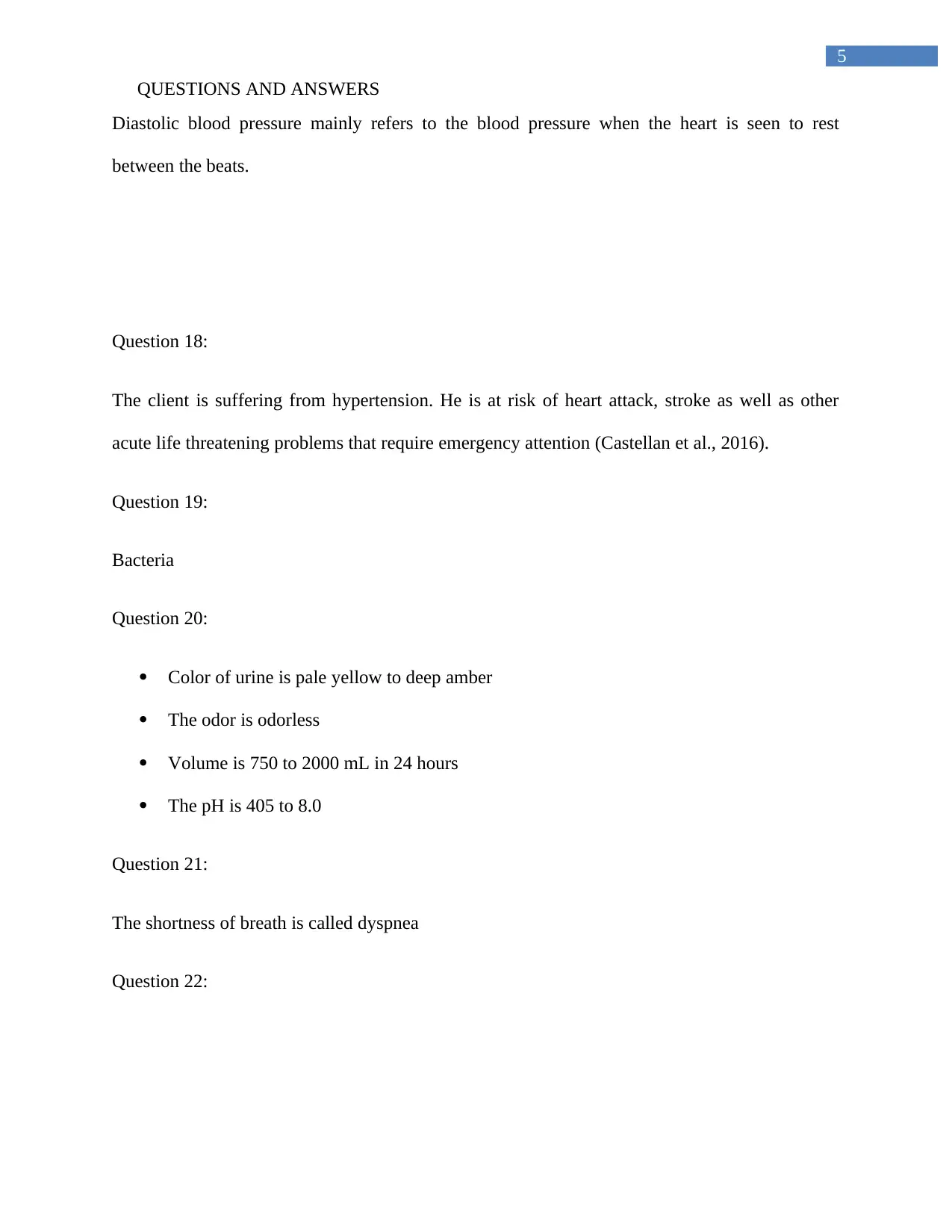
Diastolic blood pressure mainly refers to the blood pressure when the heart is seen to rest
between the beats.
Question 18:
The client is suffering from hypertension. He is at risk of heart attack, stroke as well as other
acute life threatening problems that require emergency attention (Castellan et al., 2016).
Question 19:
Bacteria
Question 20:
Color of urine is pale yellow to deep amber
The odor is odorless
Volume is 750 to 2000 mL in 24 hours
The pH is 405 to 8.0
Question 21:
The shortness of breath is called dyspnea
Question 22:
QUESTIONS AND ANSWERS
Diastolic blood pressure mainly refers to the blood pressure when the heart is seen to rest
between the beats.
Question 18:
The client is suffering from hypertension. He is at risk of heart attack, stroke as well as other
acute life threatening problems that require emergency attention (Castellan et al., 2016).
Question 19:
Bacteria
Question 20:
Color of urine is pale yellow to deep amber
The odor is odorless
Volume is 750 to 2000 mL in 24 hours
The pH is 405 to 8.0
Question 21:
The shortness of breath is called dyspnea
Question 22:
⊘ This is a preview!⊘
Do you want full access?
Subscribe today to unlock all pages.

Trusted by 1+ million students worldwide

6
QUESTIONS AND ANSWERS
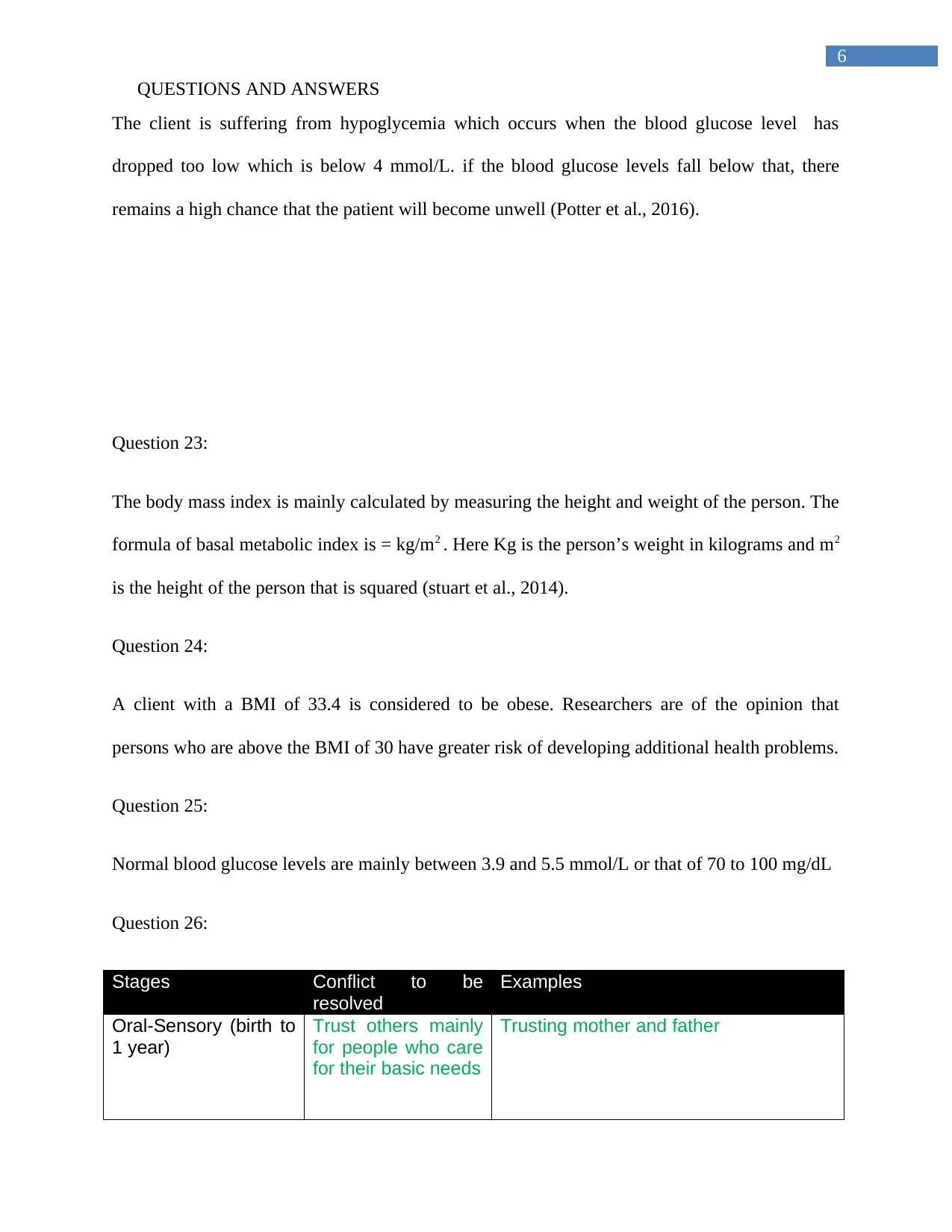
The client is suffering from hypoglycemia which occurs when the blood glucose level has
dropped too low which is below 4 mmol/L. if the blood glucose levels fall below that, there
remains a high chance that the patient will become unwell (Potter et al., 2016).
Question 23:
The body mass index is mainly calculated by measuring the height and weight of the person. The
formula of basal metabolic index is = kg/m2 . Here Kg is the person’s weight in kilograms and m2
is the height of the person that is squared (stuart et al., 2014).
Question 24:
A client with a BMI of 33.4 is considered to be obese. Researchers are of the opinion that
persons who are above the BMI of 30 have greater risk of developing additional health problems.
Question 25:
Normal blood glucose levels are mainly between 3.9 and 5.5 mmol/L or that of 70 to 100 mg/dL
Question 26:
Stages Conflict to be
resolved
Examples
Oral-Sensory (birth to
1 year)
Trust others mainly
for people who care
for their basic needs
Trusting mother and father
QUESTIONS AND ANSWERS
The client is suffering from hypoglycemia which occurs when the blood glucose level has
dropped too low which is below 4 mmol/L. if the blood glucose levels fall below that, there
remains a high chance that the patient will become unwell (Potter et al., 2016).
Question 23:
The body mass index is mainly calculated by measuring the height and weight of the person. The
formula of basal metabolic index is = kg/m2 . Here Kg is the person’s weight in kilograms and m2
is the height of the person that is squared (stuart et al., 2014).
Question 24:
A client with a BMI of 33.4 is considered to be obese. Researchers are of the opinion that
persons who are above the BMI of 30 have greater risk of developing additional health problems.
Question 25:
Normal blood glucose levels are mainly between 3.9 and 5.5 mmol/L or that of 70 to 100 mg/dL
Question 26:
Stages Conflict to be
resolved
Examples
Oral-Sensory (birth to
1 year)
Trust others mainly
for people who care
for their basic needs
Trusting mother and father
Paraphrase This Document
Need a fresh take? Get an instant paraphrase of this document with our AI Paraphraser

7
QUESTIONS AND ANSWERS
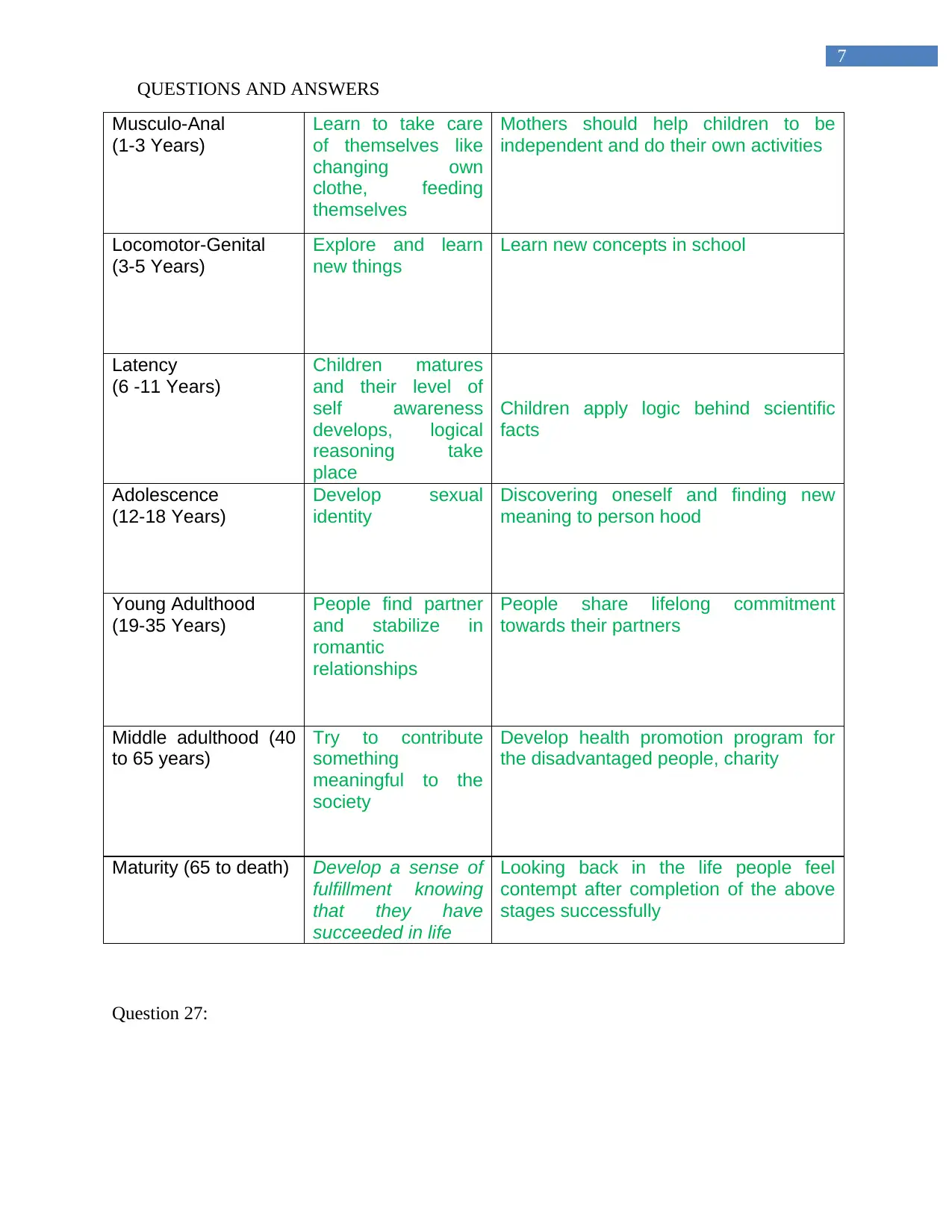
Musculo-Anal
(1-3 Years)
Learn to take care
of themselves like
changing own
clothe, feeding
themselves
Mothers should help children to be
independent and do their own activities
Locomotor-Genital
(3-5 Years)
Explore and learn
new things
Learn new concepts in school
Latency
(6 -11 Years)
Children matures
and their level of
self awareness
develops, logical
reasoning take
place
Children apply logic behind scientific
facts
Adolescence
(12-18 Years)
Develop sexual
identity
Discovering oneself and finding new
meaning to person hood
Young Adulthood
(19-35 Years)
People find partner
and stabilize in
romantic
relationships
People share lifelong commitment
towards their partners
Middle adulthood (40
to 65 years)
Try to contribute
something
meaningful to the
society
Develop health promotion program for
the disadvantaged people, charity
Maturity (65 to death) Develop a sense of
fulfillment knowing
that they have
succeeded in life
Looking back in the life people feel
contempt after completion of the above
stages successfully
Question 27:
QUESTIONS AND ANSWERS
Musculo-Anal
(1-3 Years)
Learn to take care
of themselves like
changing own
clothe, feeding
themselves
Mothers should help children to be
independent and do their own activities
Locomotor-Genital
(3-5 Years)
Explore and learn
new things
Learn new concepts in school
Latency
(6 -11 Years)
Children matures
and their level of
self awareness
develops, logical
reasoning take
place
Children apply logic behind scientific
facts
Adolescence
(12-18 Years)
Develop sexual
identity
Discovering oneself and finding new
meaning to person hood
Young Adulthood
(19-35 Years)
People find partner
and stabilize in
romantic
relationships
People share lifelong commitment
towards their partners
Middle adulthood (40
to 65 years)
Try to contribute
something
meaningful to the
society
Develop health promotion program for
the disadvantaged people, charity
Maturity (65 to death) Develop a sense of
fulfillment knowing
that they have
succeeded in life
Looking back in the life people feel
contempt after completion of the above
stages successfully
Question 27:

8
QUESTIONS AND ANSWERS
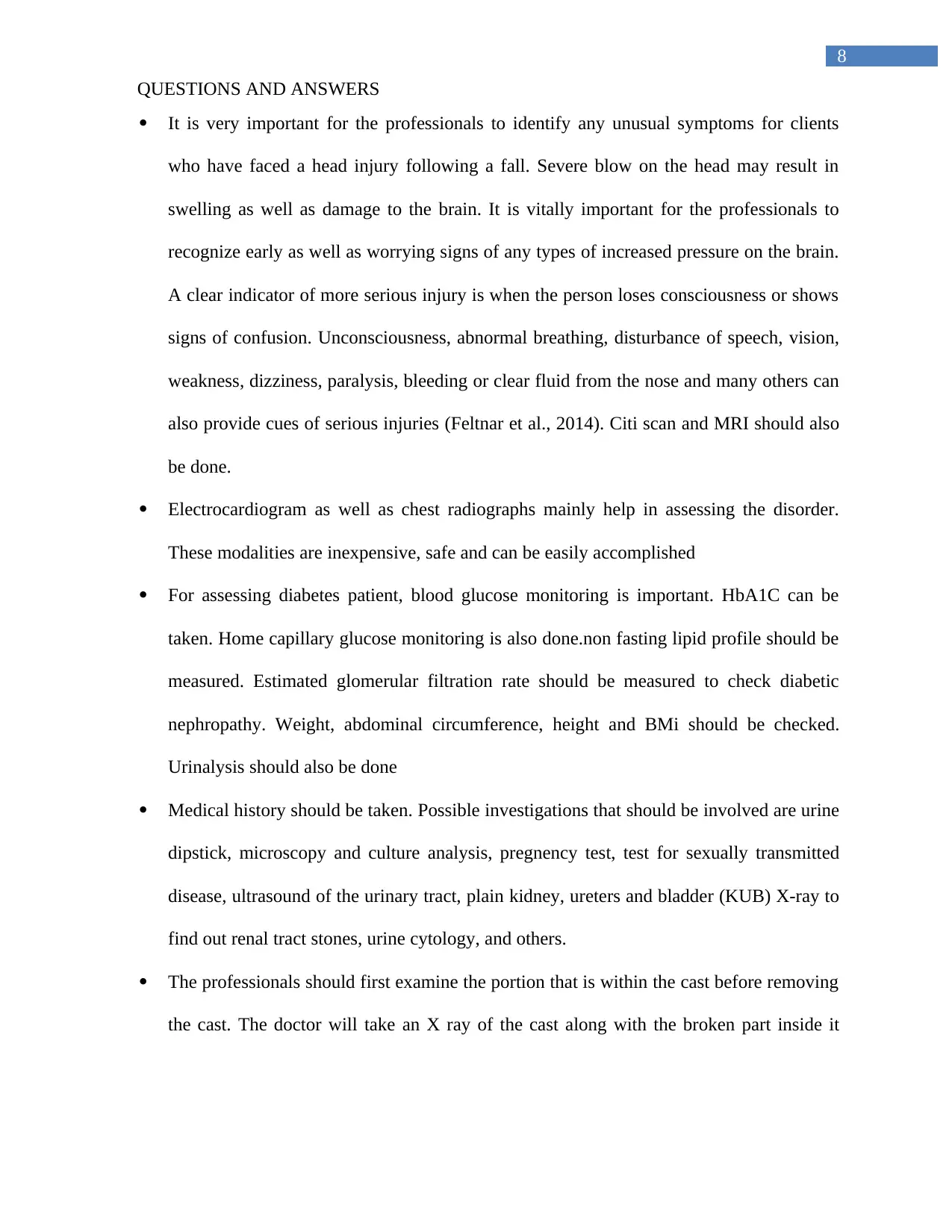
It is very important for the professionals to identify any unusual symptoms for clients
who have faced a head injury following a fall. Severe blow on the head may result in
swelling as well as damage to the brain. It is vitally important for the professionals to
recognize early as well as worrying signs of any types of increased pressure on the brain.
A clear indicator of more serious injury is when the person loses consciousness or shows
signs of confusion. Unconsciousness, abnormal breathing, disturbance of speech, vision,
weakness, dizziness, paralysis, bleeding or clear fluid from the nose and many others can
also provide cues of serious injuries (Feltnar et al., 2014). Citi scan and MRI should also
be done.
Electrocardiogram as well as chest radiographs mainly help in assessing the disorder.
These modalities are inexpensive, safe and can be easily accomplished
For assessing diabetes patient, blood glucose monitoring is important. HbA1C can be
taken. Home capillary glucose monitoring is also done.non fasting lipid profile should be
measured. Estimated glomerular filtration rate should be measured to check diabetic
nephropathy. Weight, abdominal circumference, height and BMi should be checked.
Urinalysis should also be done
Medical history should be taken. Possible investigations that should be involved are urine
dipstick, microscopy and culture analysis, pregnency test, test for sexually transmitted
disease, ultrasound of the urinary tract, plain kidney, ureters and bladder (KUB) X-ray to
find out renal tract stones, urine cytology, and others.
The professionals should first examine the portion that is within the cast before removing
the cast. The doctor will take an X ray of the cast along with the broken part inside it
QUESTIONS AND ANSWERS
It is very important for the professionals to identify any unusual symptoms for clients
who have faced a head injury following a fall. Severe blow on the head may result in
swelling as well as damage to the brain. It is vitally important for the professionals to
recognize early as well as worrying signs of any types of increased pressure on the brain.
A clear indicator of more serious injury is when the person loses consciousness or shows
signs of confusion. Unconsciousness, abnormal breathing, disturbance of speech, vision,
weakness, dizziness, paralysis, bleeding or clear fluid from the nose and many others can
also provide cues of serious injuries (Feltnar et al., 2014). Citi scan and MRI should also
be done.
Electrocardiogram as well as chest radiographs mainly help in assessing the disorder.
These modalities are inexpensive, safe and can be easily accomplished
For assessing diabetes patient, blood glucose monitoring is important. HbA1C can be
taken. Home capillary glucose monitoring is also done.non fasting lipid profile should be
measured. Estimated glomerular filtration rate should be measured to check diabetic
nephropathy. Weight, abdominal circumference, height and BMi should be checked.
Urinalysis should also be done
Medical history should be taken. Possible investigations that should be involved are urine
dipstick, microscopy and culture analysis, pregnency test, test for sexually transmitted
disease, ultrasound of the urinary tract, plain kidney, ureters and bladder (KUB) X-ray to
find out renal tract stones, urine cytology, and others.
The professionals should first examine the portion that is within the cast before removing
the cast. The doctor will take an X ray of the cast along with the broken part inside it
⊘ This is a preview!⊘
Do you want full access?
Subscribe today to unlock all pages.

Trusted by 1+ million students worldwide

9
QUESTIONS AND ANSWERS
altogether. He would also check the pain level. Only after the professional is satisfied,
then he will take off the cast with the help of a special saw.
Question 28
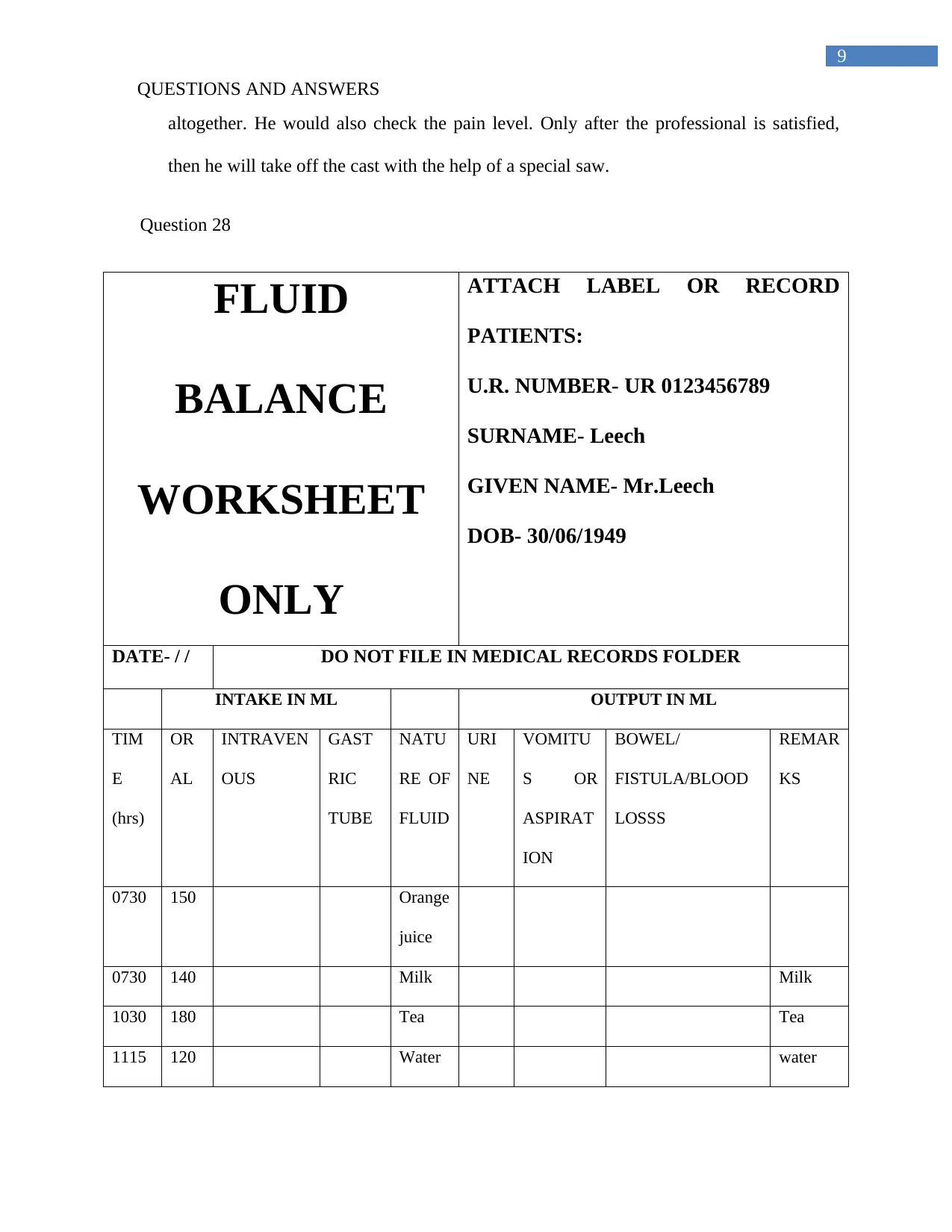
FLUID
BALANCE
WORKSHEET
ONLY
ATTACH LABEL OR RECORD
PATIENTS:
U.R. NUMBER- UR 0123456789
SURNAME- Leech
GIVEN NAME- Mr.Leech
DOB- 30/06/1949
DATE- / / DO NOT FILE IN MEDICAL RECORDS FOLDER
INTAKE IN ML OUTPUT IN ML
TIM
E
(hrs)
OR
AL
INTRAVEN
OUS
GAST
RIC
TUBE
NATU
RE OF
FLUID
URI
NE
VOMITU
S OR
ASPIRAT
ION
BOWEL/
FISTULA/BLOOD
LOSSS
REMAR
KS
0730 150 Orange
juice
0730 140 Milk Milk
1030 180 Tea Tea
1115 120 Water water
QUESTIONS AND ANSWERS
altogether. He would also check the pain level. Only after the professional is satisfied,
then he will take off the cast with the help of a special saw.
Question 28
FLUID
BALANCE
WORKSHEET
ONLY
ATTACH LABEL OR RECORD
PATIENTS:
U.R. NUMBER- UR 0123456789
SURNAME- Leech
GIVEN NAME- Mr.Leech
DOB- 30/06/1949
DATE- / / DO NOT FILE IN MEDICAL RECORDS FOLDER
INTAKE IN ML OUTPUT IN ML
TIM
E
(hrs)
OR
AL
INTRAVEN
OUS
GAST
RIC
TUBE
NATU
RE OF
FLUID
URI
NE
VOMITU
S OR
ASPIRAT
ION
BOWEL/
FISTULA/BLOOD
LOSSS
REMAR
KS
0730 150 Orange
juice
0730 140 Milk Milk
1030 180 Tea Tea
1115 120 Water water
Paraphrase This Document
Need a fresh take? Get an instant paraphrase of this document with our AI Paraphraser

10
QUESTIONS AND ANSWERS
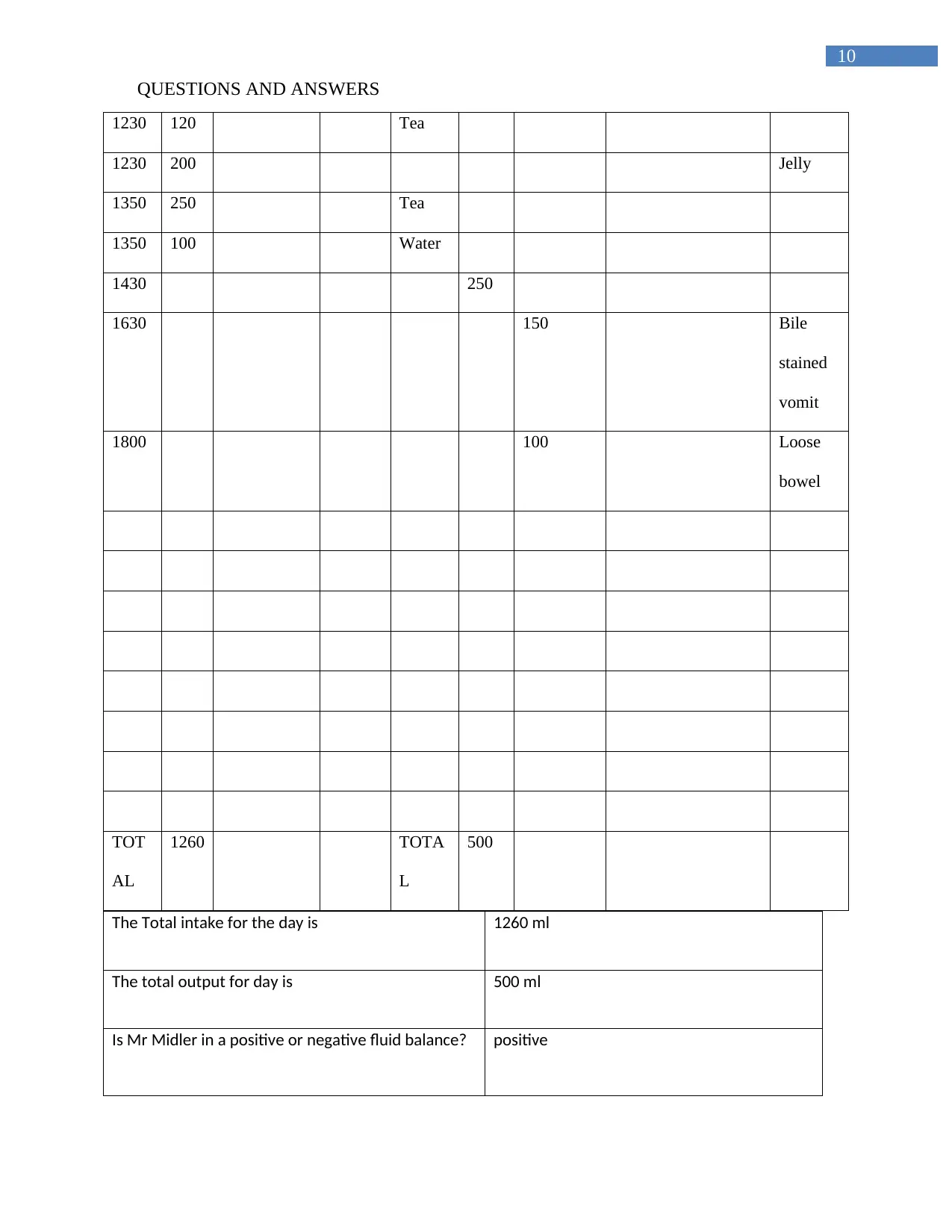
1230 120 Tea
1230 200 Jelly
1350 250 Tea
1350 100 Water
1430 250
1630 150 Bile
stained
vomit
1800 100 Loose
bowel
TOT
AL
1260 TOTA
L
500
The Total intake for the day is 1260 ml
The total output for day is 500 ml
Is Mr Midler in a positive or negative fluid balance? positive
QUESTIONS AND ANSWERS
1230 120 Tea
1230 200 Jelly
1350 250 Tea
1350 100 Water
1430 250
1630 150 Bile
stained
vomit
1800 100 Loose
bowel
TOT
AL
1260 TOTA
L
500
The Total intake for the day is 1260 ml
The total output for day is 500 ml
Is Mr Midler in a positive or negative fluid balance? positive

11
QUESTIONS AND ANSWERS
Question 29:
Urinalysis can be defined as the procedure that can help in identifying a number of diseases
even them which had not causes important signs as well as symptoms. It is commonly used a
the part of routine health screening (Felnar et al., 2014). It is mainly used to diagnose kidney
or urinary tract infection that helps in evaluation of the causes of kidney failures. It also helps
in screening for progression of some chronic conditions like that of hypertension and high
blood pressure.
Question 30:
Bradycardia can be defined as the condition when the heart of human beings is seen to
beat slower than normal. The normal heart rate is 60 to 100 times per minute but in case
of the disorder, it beats slower than 60 beats per minute.
Tacghypnea can be defined as the disorder where the person faces abnormal respiration
rate. Normal respiration rate is 12 to 20 beats per minute where in case of the disorders,
the respiration rate increases greater than 20 beats per minute
Cyanosis is the condition where bluish cast occurs to the skin as well as to the mucous
membranes. Peripheral cyanosis can be seen to occur when there is bluish coloration to
hands and feet. This mainly occurs due to low amount of oxygen in the red blood
corpuscles or when there is problem getting oxygen to the body.
Hypotension is the condition when the blood pressure in the body decreases than the
normal. Blood pressure is the force of blood that is pushed against the walls of the artery.
QUESTIONS AND ANSWERS
Question 29:
Urinalysis can be defined as the procedure that can help in identifying a number of diseases
even them which had not causes important signs as well as symptoms. It is commonly used a
the part of routine health screening (Felnar et al., 2014). It is mainly used to diagnose kidney
or urinary tract infection that helps in evaluation of the causes of kidney failures. It also helps
in screening for progression of some chronic conditions like that of hypertension and high
blood pressure.
Question 30:
Bradycardia can be defined as the condition when the heart of human beings is seen to
beat slower than normal. The normal heart rate is 60 to 100 times per minute but in case
of the disorder, it beats slower than 60 beats per minute.
Tacghypnea can be defined as the disorder where the person faces abnormal respiration
rate. Normal respiration rate is 12 to 20 beats per minute where in case of the disorders,
the respiration rate increases greater than 20 beats per minute
Cyanosis is the condition where bluish cast occurs to the skin as well as to the mucous
membranes. Peripheral cyanosis can be seen to occur when there is bluish coloration to
hands and feet. This mainly occurs due to low amount of oxygen in the red blood
corpuscles or when there is problem getting oxygen to the body.
Hypotension is the condition when the blood pressure in the body decreases than the
normal. Blood pressure is the force of blood that is pushed against the walls of the artery.
⊘ This is a preview!⊘
Do you want full access?
Subscribe today to unlock all pages.

Trusted by 1+ million students worldwide
1 out of 21
Related Documents
Your All-in-One AI-Powered Toolkit for Academic Success.
+13062052269
info@desklib.com
Available 24*7 on WhatsApp / Email
Unlock your academic potential
Copyright © 2020–2025 A2Z Services. All Rights Reserved. Developed and managed by ZUCOL.