Detailed Nursing Care Plan for Cyril Smith: Post-Operative Recovery

Verified

Added on  2023/01/11

|3
|864
|95
Case Study
AI Summary
This case study presents a detailed nursing care plan for Cyril Smith, focusing on post-operative care. It identifies a nursing diagnosis of acute pain and outlines a goal of care, along with three nursing actions for pain assessment and management, including verbalizing concerns and implementing comfort measures. Each action is supported by a rationale explaining its effectiveness, such as promoting relaxation and preventing complications. Evaluation strategies, such as monitoring the patient's pain level and overall condition, are included to assess the effectiveness of interventions. References to relevant literature support the nursing actions and rationales. The care plan emphasizes a patient-centered approach, considering both physical and emotional needs to facilitate optimal recovery. It is a comprehensive analysis of the patient’s condition and the interventions required to ensure a positive health outcome.
Document Page
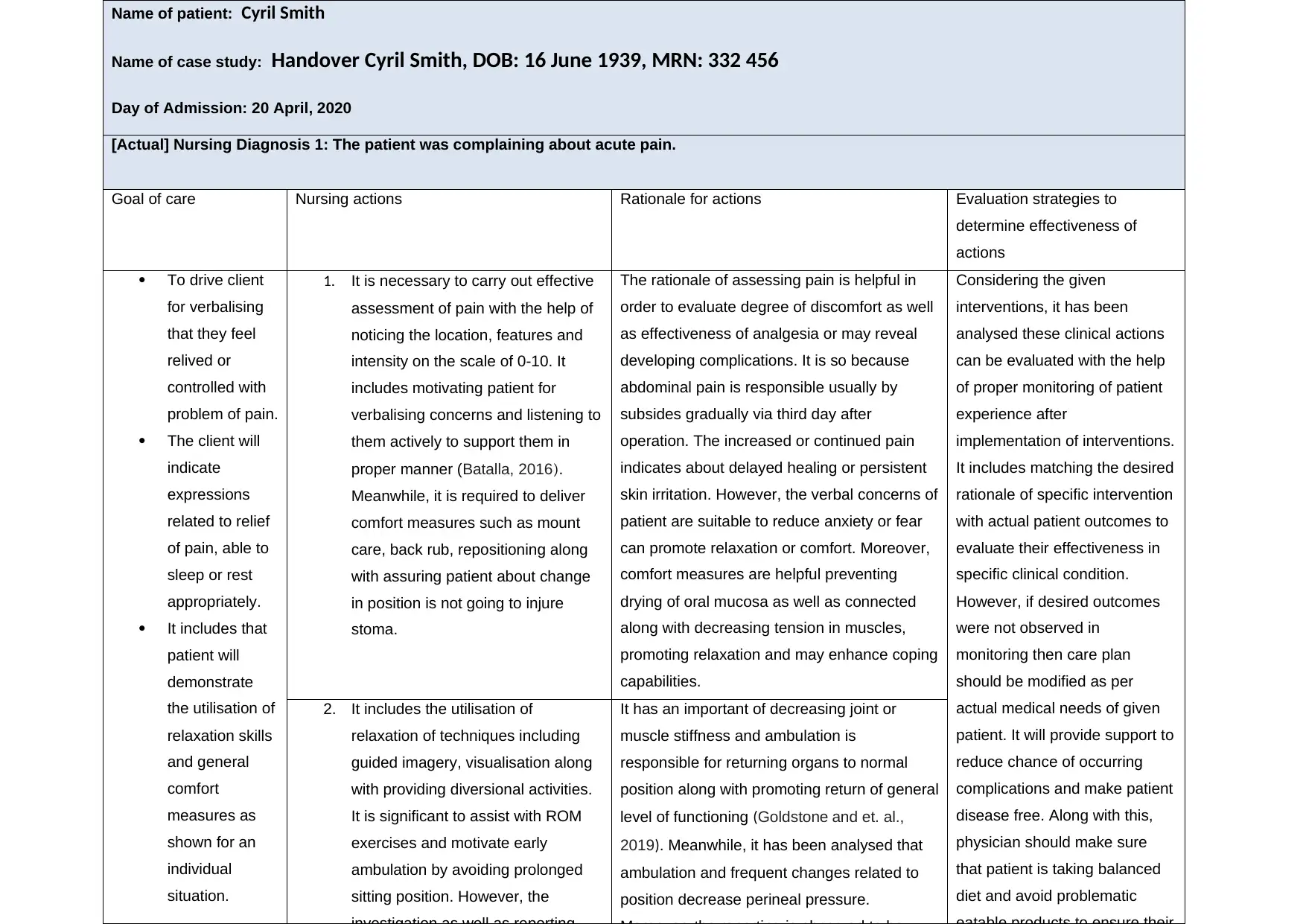
Name of patient: Cyril Smith
Name of case study: Handover Cyril Smith, DOB: 16 June 1939, MRN: 332 456
Day of Admission: 20 April, 2020
[Actual] Nursing Diagnosis 1: The patient was complaining about acute pain.
Goal of care Nursing actions Rationale for actions Evaluation strategies to
determine effectiveness of
actions
To drive client
for verbalising
that they feel
relived or
controlled with
problem of pain.
The client will
indicate
expressions
related to relief
of pain, able to
sleep or rest
appropriately.
It includes that
patient will
demonstrate
the utilisation of
relaxation skills
and general
comfort
measures as
shown for an
individual
situation.
1. It is necessary to carry out effective
assessment of pain with the help of
noticing the location, features and
intensity on the scale of 0-10. It
includes motivating patient for
verbalising concerns and listening to
them actively to support them in
proper manner (Batalla, 2016).
Meanwhile, it is required to deliver
comfort measures such as mount
care, back rub, repositioning along
with assuring patient about change
in position is not going to injure
stoma.
The rationale of assessing pain is helpful in
order to evaluate degree of discomfort as well
as effectiveness of analgesia or may reveal
developing complications. It is so because
abdominal pain is responsible usually by
subsides gradually via third day after
operation. The increased or continued pain
indicates about delayed healing or persistent
skin irritation. However, the verbal concerns of
patient are suitable to reduce anxiety or fear
can promote relaxation or comfort. Moreover,
comfort measures are helpful preventing
drying of oral mucosa as well as connected
along with decreasing tension in muscles,
promoting relaxation and may enhance coping
capabilities.
Considering the given
interventions, it has been
analysed these clinical actions
can be evaluated with the help
of proper monitoring of patient
experience after
implementation of interventions.
It includes matching the desired
rationale of specific intervention
with actual patient outcomes to
evaluate their effectiveness in
specific clinical condition.
However, if desired outcomes
were not observed in
monitoring then care plan
should be modified as per
actual medical needs of given
patient. It will provide support to
reduce chance of occurring
complications and make patient
disease free. Along with this,
physician should make sure
that patient is taking balanced
diet and avoid problematic
2. It includes the utilisation of
relaxation of techniques including
guided imagery, visualisation along
with providing diversional activities.
It is significant to assist with ROM
exercises and motivate early
ambulation by avoiding prolonged
sitting position. However, the
It has an important of decreasing joint or
muscle stiffness and ambulation is
responsible for returning organs to normal
position along with promoting return of general
level of functioning (Goldstone and et. al.,
2019). Meanwhile, it has been analysed that
ambulation and frequent changes related to
position decrease perineal pressure.
tabler-icon-diamond-filled.svg

Paraphrase This Document

Need a fresh take? Get an instant paraphrase of this document with our AI Paraphraser
Document Page
Document Page
Reference List
Batalla, M. G. A. P. (2016). Patient factors, preoperative nursing interventions, and quality of life of new Filipino ostomates. World Council of Enterostomal
Therapists Journal, 36(3), 30.
Goldstone, R. N. & et. al. (2019). The effect of surgical training and operative approach on outcomes in acute diverticulitis: should guidelines be
revised?. Diseases of the Colon & Rectum, 62(1), 71-78.
Saraidaridis, J. T. & et. al. (2018). Colorectal surgery fellowship improves in-hospital mortality after colectomy and proctectomy irrespective of hospital and
surgeon volume. Journal of Gastrointestinal Surgery, 22(3), 516-522.
Rencuzogullari, A. & et. al. (2017). Predictors of anastomotic leak in elderly patients after colectomy: nomogram-based assessment From the American
College of Surgeons National Surgical Quality Program Procedure-Targeted Cohort. Diseases of the Colon & Rectum, 60(5), 527-536.
Al-Khamis, A. & et. al. (2016). Sigmoid colectomy for acute diverticulitis in immunosuppressed vs immunocompetent patients: outcomes from the ACS-NSQIP
database. Diseases of the Colon & Rectum, 59(2), 101-109.
Orcutt, S. T. & et. al. (2016). Ninety-day readmission after colorectal cancer surgery in a Veterans Affairs cohort. Journal of Surgical Research, 201(2), 370-
377.
Sceats, L. A. & et. al. (2019). Surgery, stomas, and anxiety and depression in inflammatory bowel disease: a retrospective cohort analysis of privately insured
patients. Colorectal Disease.
McGee, M. F., & Cataldo, P. A. (2016). Intestinal stomas. In The ASCRS Textbook of Colon and Rectal Surgery (pp. 971-1013). Springer, Cham.
chevron_up_icon
1 out of 3
circle_padding
hide_on_mobile
zoom_out_icon
[object Object]