Professional Caring Nursing Philosophy for Registered Nurses

Verified

Added on  2021/04/19

|4
|889
|136
Essay
AI Summary
This essay outlines a student nurse's developing philosophy of professional caring. It emphasizes integrating personal values of compassion and commitment with professional standards. The philosophy incorporates Jean Watson's caring theory, particularly the caritas of being sensitive to self and others and creative problem-solving. The student plans to apply the nursing process and evidence-based practice to provide holistic, patient-centered care and minimize medical errors. The essay highlights the importance of professional standards, ethical considerations, and continuous learning to ensure high-quality nursing practice. The student aims to be a culturally sensitive and responsive nurse, making patient values central to clinical decisions. The essay references key nursing literature to support the development of a comprehensive and effective caring philosophy.
Document Page
Running head: PROFESSIONAL CARING NURSING
Professional caring nursing
Name of the student:
Name of the University:
Author’s note
tabler-icon-diamond-filled.svg

Paraphrase This Document

Need a fresh take? Get an instant paraphrase of this document with our AI Paraphraser
Document Page
1PROFESSIONAL CARING NURSING
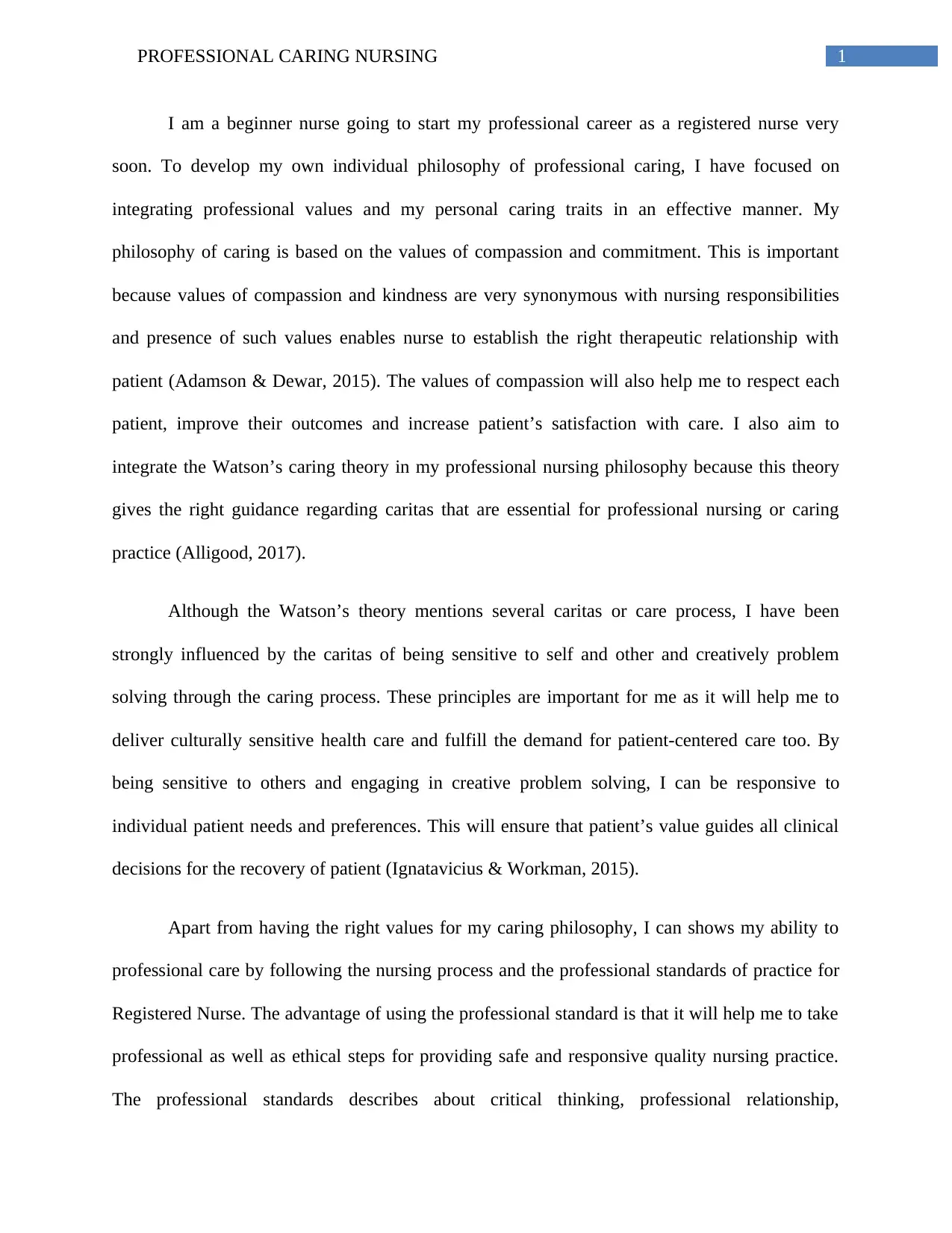
I am a beginner nurse going to start my professional career as a registered nurse very
soon. To develop my own individual philosophy of professional caring, I have focused on
integrating professional values and my personal caring traits in an effective manner. My
philosophy of caring is based on the values of compassion and commitment. This is important
because values of compassion and kindness are very synonymous with nursing responsibilities
and presence of such values enables nurse to establish the right therapeutic relationship with
patient (Adamson & Dewar, 2015). The values of compassion will also help me to respect each
patient, improve their outcomes and increase patient’s satisfaction with care. I also aim to
integrate the Watson’s caring theory in my professional nursing philosophy because this theory
gives the right guidance regarding caritas that are essential for professional nursing or caring
practice (Alligood, 2017).
Although the Watson’s theory mentions several caritas or care process, I have been
strongly influenced by the caritas of being sensitive to self and other and creatively problem
solving through the caring process. These principles are important for me as it will help me to
deliver culturally sensitive health care and fulfill the demand for patient-centered care too. By
being sensitive to others and engaging in creative problem solving, I can be responsive to
individual patient needs and preferences. This will ensure that patient’s value guides all clinical
decisions for the recovery of patient (Ignatavicius & Workman, 2015).
Apart from having the right values for my caring philosophy, I can shows my ability to
professional care by following the nursing process and the professional standards of practice for
Registered Nurse. The advantage of using the professional standard is that it will help me to take
professional as well as ethical steps for providing safe and responsive quality nursing practice.
The professional standards describes about critical thinking, professional relationship,
Document Page
2PROFESSIONAL CARING NURSING
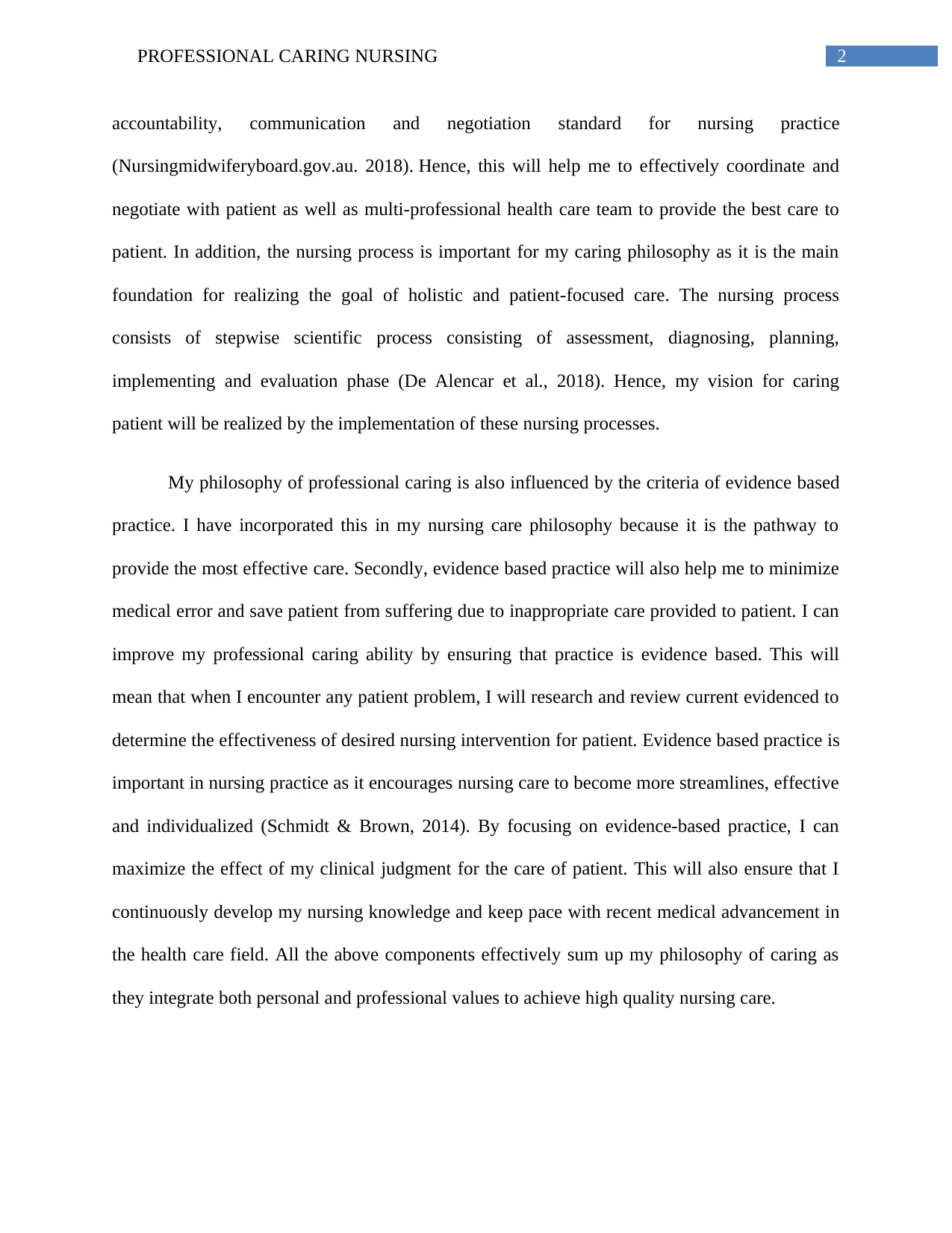
accountability, communication and negotiation standard for nursing practice
(Nursingmidwiferyboard.gov.au. 2018). Hence, this will help me to effectively coordinate and
negotiate with patient as well as multi-professional health care team to provide the best care to
patient. In addition, the nursing process is important for my caring philosophy as it is the main
foundation for realizing the goal of holistic and patient-focused care. The nursing process
consists of stepwise scientific process consisting of assessment, diagnosing, planning,
implementing and evaluation phase (De Alencar et al., 2018). Hence, my vision for caring
patient will be realized by the implementation of these nursing processes.
My philosophy of professional caring is also influenced by the criteria of evidence based
practice. I have incorporated this in my nursing care philosophy because it is the pathway to
provide the most effective care. Secondly, evidence based practice will also help me to minimize
medical error and save patient from suffering due to inappropriate care provided to patient. I can
improve my professional caring ability by ensuring that practice is evidence based. This will
mean that when I encounter any patient problem, I will research and review current evidenced to
determine the effectiveness of desired nursing intervention for patient. Evidence based practice is
important in nursing practice as it encourages nursing care to become more streamlines, effective
and individualized (Schmidt & Brown, 2014). By focusing on evidence-based practice, I can
maximize the effect of my clinical judgment for the care of patient. This will also ensure that I
continuously develop my nursing knowledge and keep pace with recent medical advancement in
the health care field. All the above components effectively sum up my philosophy of caring as
they integrate both personal and professional values to achieve high quality nursing care.
Document Page
3PROFESSIONAL CARING NURSING
References
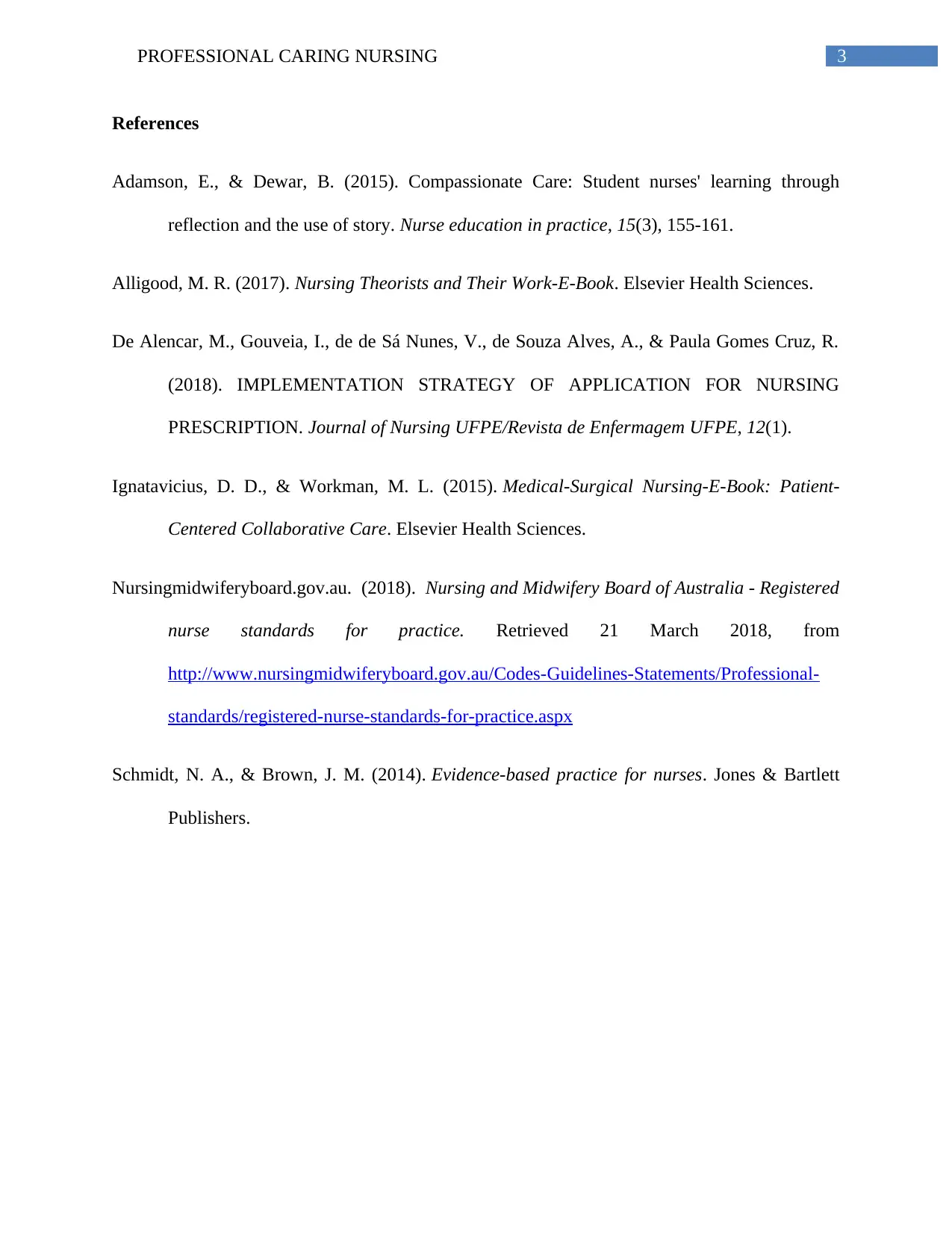
Adamson, E., & Dewar, B. (2015). Compassionate Care: Student nurses' learning through
reflection and the use of story. Nurse education in practice, 15(3), 155-161.
Alligood, M. R. (2017). Nursing Theorists and Their Work-E-Book. Elsevier Health Sciences.
De Alencar, M., Gouveia, I., de de Sá Nunes, V., de Souza Alves, A., & Paula Gomes Cruz, R.
(2018). IMPLEMENTATION STRATEGY OF APPLICATION FOR NURSING
PRESCRIPTION. Journal of Nursing UFPE/Revista de Enfermagem UFPE, 12(1).
Ignatavicius, D. D., & Workman, M. L. (2015). Medical-Surgical Nursing-E-Book: Patient-
Centered Collaborative Care. Elsevier Health Sciences.
Nursingmidwiferyboard.gov.au. (2018). Nursing and Midwifery Board of Australia - Registered
nurse standards for practice. Retrieved 21 March 2018, from
http://www.nursingmidwiferyboard.gov.au/Codes-Guidelines-Statements/Professional-
standards/registered-nurse-standards-for-practice.aspx
Schmidt, N. A., & Brown, J. M. (2014). Evidence-based practice for nurses. Jones & Bartlett
Publishers.
chevron_up_icon
1 out of 4
circle_padding
hide_on_mobile
zoom_out_icon
[object Object]