University Nursing Case Study: Bruce Wallace - Patient Analysis & Care
VerifiedAdded on 2022/09/08
|10
|2930
|27
Case Study
AI Summary
This case study focuses on Bruce Wallace, an elderly patient admitted to aged care after a heart attack. The patient has a history of diabetes, glaucoma, and neuropathic pain. The essay analyzes the patient's interrelated physiological conditions, including pathophysiology and pharmacology. It discusses investigation methods, recommendations for improved patient outcomes, and the impact of proper treatment and care on both the patient and the nurse's experience. The study covers the patient's medications (Lantus insulin, Lyrica, Furosemide, and Aspirin), investigations (HbA1c, blood glucose monitoring, DM four interview, monofilament test, nerve conduction, and autonomic testing), and the importance of vital sign monitoring. Recommendations include exercise, ADL training, counseling, and dietary adjustments. The reflection highlights improved critical thinking, therapeutic communication, and the importance of patient-centered care, referencing the NMBA standards for practice.
Running Head: Nursing
Nursing Case Study
Name of the Student
Name of the University
Authors Note
Nursing Case Study
Name of the Student
Name of the University
Authors Note

Paraphrase This Document
Need a fresh take? Get an instant paraphrase of this document with our AI Paraphraser
1Nursing Case Study
Introduction
The case study revolves around Bruce Wallace, an aged patient, who was admitted
to the hospital after she had heart attack. The patient lived alone in an aged care after
his wife died as nobody was looked after him. Both of his children lived separately therefore
he decided to admit in the aged care facility. The person was diabetic and used take
Lantus insulin 6o unit twice a day. The patient also had glaucoma and neuropathic pain.
The person started living in aged care home and now he is suffering for the diabetes
only . Other signs and symptoms heart attack are observed in him now. The social
condition of the patient has improved as per the case study after he shifted to aged
care .Interrelated physiological conditions will be analysed in this essay with reference to
the pathophysiology and pharmacology of the patient. The essay will be discussed how to
investigate the condition of the patient. After recognising the effect of physiological
condition of the patient, recommendations suitable for the patient will be discussed in the
essay. The recommendations will improve the condition of patient and help him to live his
life with better experiences with better quality of life. This essay will reflect that proper
treatment and care provision not only enhance a patient’s condition but also a nurse’s
experiences.
Pathophysiology and pharmacology
Diabetic neuropathy happens due to imbalance among nerve fibres by damaging
the functionalities of the fibres. The damaging process will affect the person’ s distal and
autonomic sensory fibres(Hussain & Adrian, 2017). This resulted in to progressive loss of
sensation in the patient. Along with the above discussed metabolic factors , the ischemic
factors are also responsible for the incidence of diabetic neuropathy and the
inflammation. The metabolic factors are seemed to be prevailed in the length-dependent
diabetic polyneuropathy. The inflammation is imposed on the nerve lesions or the severe
forms of the focal neuropathies. The hyalinization of the small blood vessels due to the
Introduction
The case study revolves around Bruce Wallace, an aged patient, who was admitted
to the hospital after she had heart attack. The patient lived alone in an aged care after
his wife died as nobody was looked after him. Both of his children lived separately therefore
he decided to admit in the aged care facility. The person was diabetic and used take
Lantus insulin 6o unit twice a day. The patient also had glaucoma and neuropathic pain.
The person started living in aged care home and now he is suffering for the diabetes
only . Other signs and symptoms heart attack are observed in him now. The social
condition of the patient has improved as per the case study after he shifted to aged
care .Interrelated physiological conditions will be analysed in this essay with reference to
the pathophysiology and pharmacology of the patient. The essay will be discussed how to
investigate the condition of the patient. After recognising the effect of physiological
condition of the patient, recommendations suitable for the patient will be discussed in the
essay. The recommendations will improve the condition of patient and help him to live his
life with better experiences with better quality of life. This essay will reflect that proper
treatment and care provision not only enhance a patient’s condition but also a nurse’s
experiences.
Pathophysiology and pharmacology
Diabetic neuropathy happens due to imbalance among nerve fibres by damaging
the functionalities of the fibres. The damaging process will affect the person’ s distal and
autonomic sensory fibres(Hussain & Adrian, 2017). This resulted in to progressive loss of
sensation in the patient. Along with the above discussed metabolic factors , the ischemic
factors are also responsible for the incidence of diabetic neuropathy and the
inflammation. The metabolic factors are seemed to be prevailed in the length-dependent
diabetic polyneuropathy. The inflammation is imposed on the nerve lesions or the severe
forms of the focal neuropathies. The hyalinization of the small blood vessels due to the
2Nursing Case Study
process of reduplication of basal lamina surrounding to the endothelial cells. Endoneurial
oxygen tension in the sural nerves of patients with high blood sugar levels with
polyneuropathy. There are different conditions which are responsible for diabetic
neuropathy development such as the polyol pathway, nonenzymatic glycation, oxidative
stress, the hexosamine pathway, protein kinase C pathway, decreasing in neurotrophic
factors and various pathogenetic factors. Diabetes is a prominent risk factor for developing
glaucoma in a patient .Glaucoma is responsible for increasing the pressure level in eyes.
Pressure development in eyes will damage retina and optic nerves of eyes(Song, Aiello &
Pasquale, 2016). Optic nerves are the most important part of eyes which send the stimuli
or more specifically the visual stimuli to the brain of a person. Due to diabetic
retinopathy, blood vessels and retina will be damaged. After the blood vessels are damaged
, new blood vessels are formed but these blood vessels are malformed by influence of
diabetes. The damaged blood vessels form retinal scars and the bleeding in iris. Diabetes
is one of the risk factors for sudden cardiac arrest as high blood glucose level is the
cause of micro vascular disease and autonomic neuropathy. Sudden Cardiac arrest is also
related to the diabetes mellitus as the risk of atherosclerotic coronary artery disease,
myocardial fibrosis and irregularities of electrical circulation in the myocardium.
Lyrica has been administered to the patient as it reduces the neuropathic pain in
the patient. This medication will help to reduce the neuropathic pain which is caused by
diabetes or spinal cord injury and fibromyalgia. The medication will help to reduce seizures
caused by side effects of other medicines(Mallick-Searle, Snodgrass & Brant, 2016).
Furosemide is used as loop diuretics which prevents the body to absorb excess salt. With
the help of this medication excess salt is excreted through urine (Silbert et al., 2017).
Furosemide is administered for preventing fluid retention in the patients who are survivor of
congestive heart failure liver disease or kidney disorders. In this case Bruce had a cardiac
attack few months ago. Therefore furosemide is given to him for preventing oedema. Aspirin
has also been prescribed to the patient. Aspirin is used to reduce pain specially muscle pain
process of reduplication of basal lamina surrounding to the endothelial cells. Endoneurial
oxygen tension in the sural nerves of patients with high blood sugar levels with
polyneuropathy. There are different conditions which are responsible for diabetic
neuropathy development such as the polyol pathway, nonenzymatic glycation, oxidative
stress, the hexosamine pathway, protein kinase C pathway, decreasing in neurotrophic
factors and various pathogenetic factors. Diabetes is a prominent risk factor for developing
glaucoma in a patient .Glaucoma is responsible for increasing the pressure level in eyes.
Pressure development in eyes will damage retina and optic nerves of eyes(Song, Aiello &
Pasquale, 2016). Optic nerves are the most important part of eyes which send the stimuli
or more specifically the visual stimuli to the brain of a person. Due to diabetic
retinopathy, blood vessels and retina will be damaged. After the blood vessels are damaged
, new blood vessels are formed but these blood vessels are malformed by influence of
diabetes. The damaged blood vessels form retinal scars and the bleeding in iris. Diabetes
is one of the risk factors for sudden cardiac arrest as high blood glucose level is the
cause of micro vascular disease and autonomic neuropathy. Sudden Cardiac arrest is also
related to the diabetes mellitus as the risk of atherosclerotic coronary artery disease,
myocardial fibrosis and irregularities of electrical circulation in the myocardium.
Lyrica has been administered to the patient as it reduces the neuropathic pain in
the patient. This medication will help to reduce the neuropathic pain which is caused by
diabetes or spinal cord injury and fibromyalgia. The medication will help to reduce seizures
caused by side effects of other medicines(Mallick-Searle, Snodgrass & Brant, 2016).
Furosemide is used as loop diuretics which prevents the body to absorb excess salt. With
the help of this medication excess salt is excreted through urine (Silbert et al., 2017).
Furosemide is administered for preventing fluid retention in the patients who are survivor of
congestive heart failure liver disease or kidney disorders. In this case Bruce had a cardiac
attack few months ago. Therefore furosemide is given to him for preventing oedema. Aspirin
has also been prescribed to the patient. Aspirin is used to reduce pain specially muscle pain
⊘ This is a preview!⊘
Do you want full access?
Subscribe today to unlock all pages.

Trusted by 1+ million students worldwide
3Nursing Case Study
tooth x common cold and cough and headaches. This medicine can also be used for
reducing swelling or to prevent arthritis. Aspirin is also prescribed to diabetic patient as they
have higher risk of heart disease. Aspirin therapy is administered to Bruce as he has an
evidence of heart disease.
Investigations
Hba1c or glycated haemoglobin is the oxygen carrying protein in red blood
corpuscles which are bonded with the molecules of glucose in in bloodstream. The bonding
of haemoglobin with glucose is called glycation (Tashrifi, Haghani Nasimi,Abdollahi, &
Moradi,2018). The higher number of blood glucose bound with the hemoglobin the more
higher level of hba1c will be present in the patient.
Blood glucose level will be tested by the help of blood glucose monitoring. Blood
glucose can be monitored by in the NDSS-funded blood glucose testing strips. Does testing
strips will be e used by patience all the support workers. High blood glucose level will be
responsible for ketoacidosis.DM four interview questionnaire was used to assess the
neuropathic characteristic. This question has question related to pain quality and
paraesthesia.10g Semmens Winstein monofilament test was performed to detect tactile
hypoparathesia(Olaiya et al., 2019). The filament test will perform on the patient skin to test
neurological evidences. Non-invasive test for sensory testing was conducted for
understanding the nervous responses two vibration and temperature changing (Xiong et al,
2018). Nerve conduction testing was performed to assess the leg and arm movements with
respect to electrical signals. Muscle Response Testing or Electromyography was used to
assess the muscle movements in the response of electrical conduction(Wong et al., 2017).
Autonomic testing is one of the special test which was conducted to understand how blood
pressure is related to neuropathic pain.
tooth x common cold and cough and headaches. This medicine can also be used for
reducing swelling or to prevent arthritis. Aspirin is also prescribed to diabetic patient as they
have higher risk of heart disease. Aspirin therapy is administered to Bruce as he has an
evidence of heart disease.
Investigations
Hba1c or glycated haemoglobin is the oxygen carrying protein in red blood
corpuscles which are bonded with the molecules of glucose in in bloodstream. The bonding
of haemoglobin with glucose is called glycation (Tashrifi, Haghani Nasimi,Abdollahi, &
Moradi,2018). The higher number of blood glucose bound with the hemoglobin the more
higher level of hba1c will be present in the patient.
Blood glucose level will be tested by the help of blood glucose monitoring. Blood
glucose can be monitored by in the NDSS-funded blood glucose testing strips. Does testing
strips will be e used by patience all the support workers. High blood glucose level will be
responsible for ketoacidosis.DM four interview questionnaire was used to assess the
neuropathic characteristic. This question has question related to pain quality and
paraesthesia.10g Semmens Winstein monofilament test was performed to detect tactile
hypoparathesia(Olaiya et al., 2019). The filament test will perform on the patient skin to test
neurological evidences. Non-invasive test for sensory testing was conducted for
understanding the nervous responses two vibration and temperature changing (Xiong et al,
2018). Nerve conduction testing was performed to assess the leg and arm movements with
respect to electrical signals. Muscle Response Testing or Electromyography was used to
assess the muscle movements in the response of electrical conduction(Wong et al., 2017).
Autonomic testing is one of the special test which was conducted to understand how blood
pressure is related to neuropathic pain.
Paraphrase This Document
Need a fresh take? Get an instant paraphrase of this document with our AI Paraphraser
4Nursing Case Study
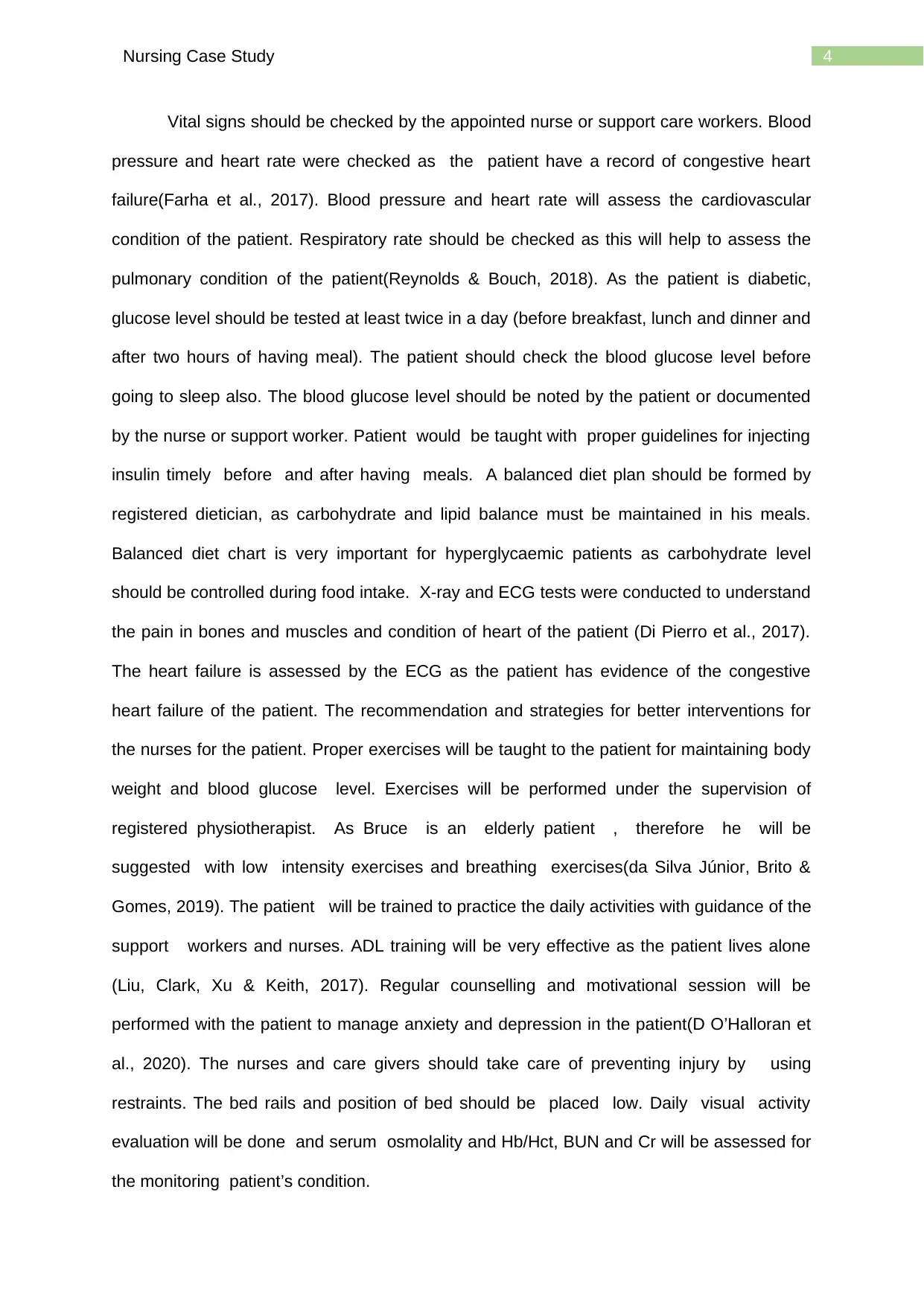
Vital signs should be checked by the appointed nurse or support care workers. Blood
pressure and heart rate were checked as the patient have a record of congestive heart
failure(Farha et al., 2017). Blood pressure and heart rate will assess the cardiovascular
condition of the patient. Respiratory rate should be checked as this will help to assess the
pulmonary condition of the patient(Reynolds & Bouch, 2018). As the patient is diabetic,
glucose level should be tested at least twice in a day (before breakfast, lunch and dinner and
after two hours of having meal). The patient should check the blood glucose level before
going to sleep also. The blood glucose level should be noted by the patient or documented
by the nurse or support worker. Patient would be taught with proper guidelines for injecting
insulin timely before and after having meals. A balanced diet plan should be formed by
registered dietician, as carbohydrate and lipid balance must be maintained in his meals.
Balanced diet chart is very important for hyperglycaemic patients as carbohydrate level
should be controlled during food intake. X-ray and ECG tests were conducted to understand
the pain in bones and muscles and condition of heart of the patient (Di Pierro et al., 2017).
The heart failure is assessed by the ECG as the patient has evidence of the congestive
heart failure of the patient. The recommendation and strategies for better interventions for
the nurses for the patient. Proper exercises will be taught to the patient for maintaining body
weight and blood glucose level. Exercises will be performed under the supervision of
registered physiotherapist. As Bruce is an elderly patient , therefore he will be
suggested with low intensity exercises and breathing exercises(da Silva Júnior, Brito &
Gomes, 2019). The patient will be trained to practice the daily activities with guidance of the
support workers and nurses. ADL training will be very effective as the patient lives alone
(Liu, Clark, Xu & Keith, 2017). Regular counselling and motivational session will be
performed with the patient to manage anxiety and depression in the patient(D O’Halloran et
al., 2020). The nurses and care givers should take care of preventing injury by using
restraints. The bed rails and position of bed should be placed low. Daily visual activity
evaluation will be done and serum osmolality and Hb/Hct, BUN and Cr will be assessed for
the monitoring patient’s condition.
Vital signs should be checked by the appointed nurse or support care workers. Blood
pressure and heart rate were checked as the patient have a record of congestive heart
failure(Farha et al., 2017). Blood pressure and heart rate will assess the cardiovascular
condition of the patient. Respiratory rate should be checked as this will help to assess the
pulmonary condition of the patient(Reynolds & Bouch, 2018). As the patient is diabetic,
glucose level should be tested at least twice in a day (before breakfast, lunch and dinner and
after two hours of having meal). The patient should check the blood glucose level before
going to sleep also. The blood glucose level should be noted by the patient or documented
by the nurse or support worker. Patient would be taught with proper guidelines for injecting
insulin timely before and after having meals. A balanced diet plan should be formed by
registered dietician, as carbohydrate and lipid balance must be maintained in his meals.
Balanced diet chart is very important for hyperglycaemic patients as carbohydrate level
should be controlled during food intake. X-ray and ECG tests were conducted to understand
the pain in bones and muscles and condition of heart of the patient (Di Pierro et al., 2017).
The heart failure is assessed by the ECG as the patient has evidence of the congestive
heart failure of the patient. The recommendation and strategies for better interventions for
the nurses for the patient. Proper exercises will be taught to the patient for maintaining body
weight and blood glucose level. Exercises will be performed under the supervision of
registered physiotherapist. As Bruce is an elderly patient , therefore he will be
suggested with low intensity exercises and breathing exercises(da Silva Júnior, Brito &
Gomes, 2019). The patient will be trained to practice the daily activities with guidance of the
support workers and nurses. ADL training will be very effective as the patient lives alone
(Liu, Clark, Xu & Keith, 2017). Regular counselling and motivational session will be
performed with the patient to manage anxiety and depression in the patient(D O’Halloran et
al., 2020). The nurses and care givers should take care of preventing injury by using
restraints. The bed rails and position of bed should be placed low. Daily visual activity
evaluation will be done and serum osmolality and Hb/Hct, BUN and Cr will be assessed for
the monitoring patient’s condition.
5Nursing Case Study
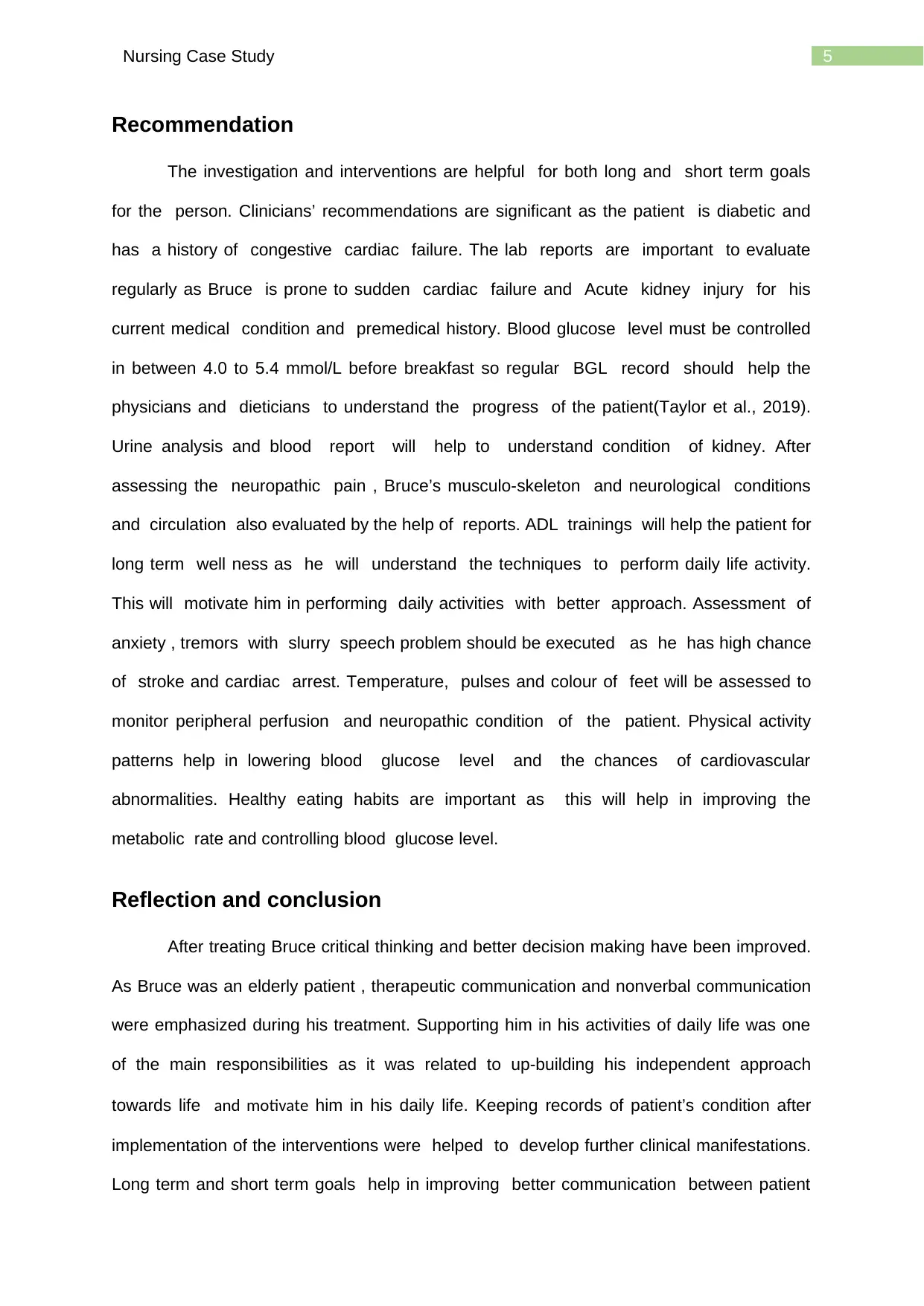
Recommendation
The investigation and interventions are helpful for both long and short term goals
for the person. Clinicians’ recommendations are significant as the patient is diabetic and
has a history of congestive cardiac failure. The lab reports are important to evaluate
regularly as Bruce is prone to sudden cardiac failure and Acute kidney injury for his
current medical condition and premedical history. Blood glucose level must be controlled
in between 4.0 to 5.4 mmol/L before breakfast so regular BGL record should help the
physicians and dieticians to understand the progress of the patient(Taylor et al., 2019).
Urine analysis and blood report will help to understand condition of kidney. After
assessing the neuropathic pain , Bruce’s musculo-skeleton and neurological conditions
and circulation also evaluated by the help of reports. ADL trainings will help the patient for
long term well ness as he will understand the techniques to perform daily life activity.
This will motivate him in performing daily activities with better approach. Assessment of
anxiety , tremors with slurry speech problem should be executed as he has high chance
of stroke and cardiac arrest. Temperature, pulses and colour of feet will be assessed to
monitor peripheral perfusion and neuropathic condition of the patient. Physical activity
patterns help in lowering blood glucose level and the chances of cardiovascular
abnormalities. Healthy eating habits are important as this will help in improving the
metabolic rate and controlling blood glucose level.
Reflection and conclusion
After treating Bruce critical thinking and better decision making have been improved.
As Bruce was an elderly patient , therapeutic communication and nonverbal communication
were emphasized during his treatment. Supporting him in his activities of daily life was one
of the main responsibilities as it was related to up-building his independent approach
towards life and motivate him in his daily life. Keeping records of patient’s condition after
implementation of the interventions were helped to develop further clinical manifestations.
Long term and short term goals help in improving better communication between patient
Recommendation
The investigation and interventions are helpful for both long and short term goals
for the person. Clinicians’ recommendations are significant as the patient is diabetic and
has a history of congestive cardiac failure. The lab reports are important to evaluate
regularly as Bruce is prone to sudden cardiac failure and Acute kidney injury for his
current medical condition and premedical history. Blood glucose level must be controlled
in between 4.0 to 5.4 mmol/L before breakfast so regular BGL record should help the
physicians and dieticians to understand the progress of the patient(Taylor et al., 2019).
Urine analysis and blood report will help to understand condition of kidney. After
assessing the neuropathic pain , Bruce’s musculo-skeleton and neurological conditions
and circulation also evaluated by the help of reports. ADL trainings will help the patient for
long term well ness as he will understand the techniques to perform daily life activity.
This will motivate him in performing daily activities with better approach. Assessment of
anxiety , tremors with slurry speech problem should be executed as he has high chance
of stroke and cardiac arrest. Temperature, pulses and colour of feet will be assessed to
monitor peripheral perfusion and neuropathic condition of the patient. Physical activity
patterns help in lowering blood glucose level and the chances of cardiovascular
abnormalities. Healthy eating habits are important as this will help in improving the
metabolic rate and controlling blood glucose level.
Reflection and conclusion
After treating Bruce critical thinking and better decision making have been improved.
As Bruce was an elderly patient , therapeutic communication and nonverbal communication
were emphasized during his treatment. Supporting him in his activities of daily life was one
of the main responsibilities as it was related to up-building his independent approach
towards life and motivate him in his daily life. Keeping records of patient’s condition after
implementation of the interventions were helped to develop further clinical manifestations.
Long term and short term goals help in improving better communication between patient
⊘ This is a preview!⊘
Do you want full access?
Subscribe today to unlock all pages.
Trusted by 1+ million students worldwide
6Nursing Case Study
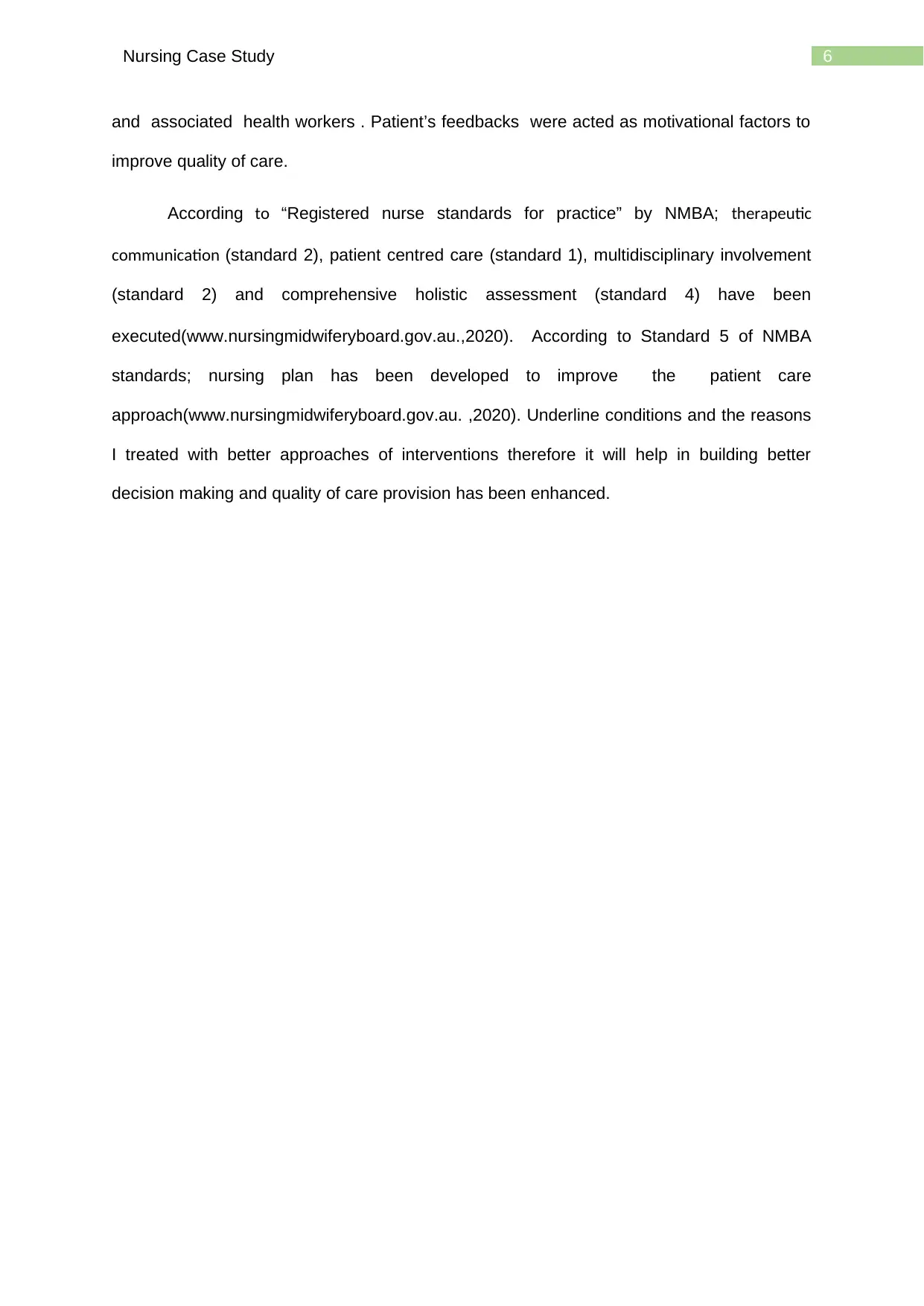
and associated health workers . Patient’s feedbacks were acted as motivational factors to
improve quality of care.
According to “Registered nurse standards for practice” by NMBA; therapeutic
communication (standard 2), patient centred care (standard 1), multidisciplinary involvement
(standard 2) and comprehensive holistic assessment (standard 4) have been
executed(www.nursingmidwiferyboard.gov.au.,2020). According to Standard 5 of NMBA
standards; nursing plan has been developed to improve the patient care
approach(www.nursingmidwiferyboard.gov.au. ,2020). Underline conditions and the reasons
I treated with better approaches of interventions therefore it will help in building better
decision making and quality of care provision has been enhanced.
and associated health workers . Patient’s feedbacks were acted as motivational factors to
improve quality of care.
According to “Registered nurse standards for practice” by NMBA; therapeutic
communication (standard 2), patient centred care (standard 1), multidisciplinary involvement
(standard 2) and comprehensive holistic assessment (standard 4) have been
executed(www.nursingmidwiferyboard.gov.au.,2020). According to Standard 5 of NMBA
standards; nursing plan has been developed to improve the patient care
approach(www.nursingmidwiferyboard.gov.au. ,2020). Underline conditions and the reasons
I treated with better approaches of interventions therefore it will help in building better
decision making and quality of care provision has been enhanced.
Paraphrase This Document
Need a fresh take? Get an instant paraphrase of this document with our AI Paraphraser
7Nursing Case Study
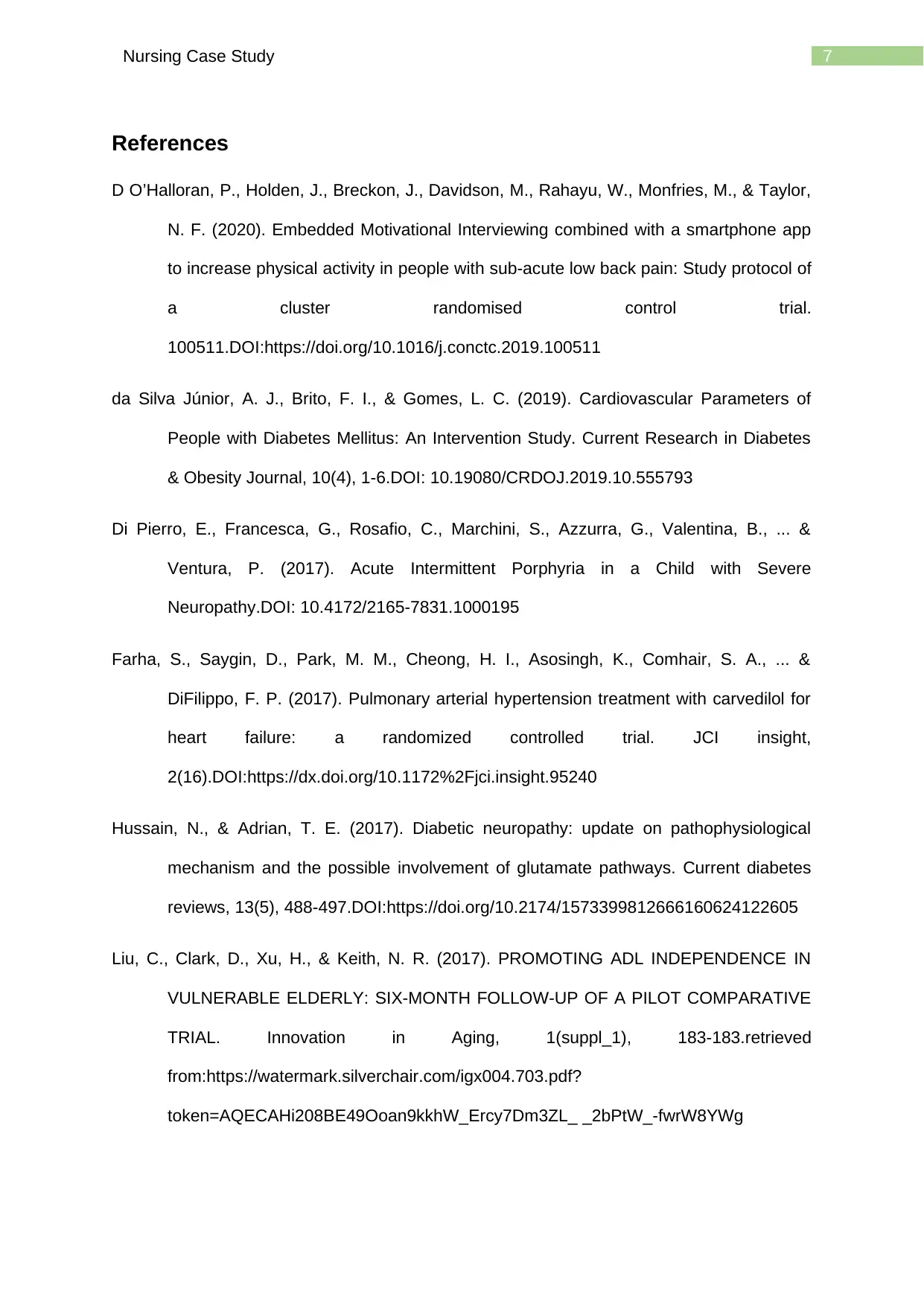
References
D O’Halloran, P., Holden, J., Breckon, J., Davidson, M., Rahayu, W., Monfries, M., & Taylor,
N. F. (2020). Embedded Motivational Interviewing combined with a smartphone app
to increase physical activity in people with sub-acute low back pain: Study protocol of
a cluster randomised control trial.
100511.DOI:https://doi.org/10.1016/j.conctc.2019.100511
da Silva Júnior, A. J., Brito, F. I., & Gomes, L. C. (2019). Cardiovascular Parameters of
People with Diabetes Mellitus: An Intervention Study. Current Research in Diabetes
& Obesity Journal, 10(4), 1-6.DOI: 10.19080/CRDOJ.2019.10.555793
Di Pierro, E., Francesca, G., Rosafio, C., Marchini, S., Azzurra, G., Valentina, B., ... &
Ventura, P. (2017). Acute Intermittent Porphyria in a Child with Severe
Neuropathy.DOI: 10.4172/2165-7831.1000195
Farha, S., Saygin, D., Park, M. M., Cheong, H. I., Asosingh, K., Comhair, S. A., ... &
DiFilippo, F. P. (2017). Pulmonary arterial hypertension treatment with carvedilol for
heart failure: a randomized controlled trial. JCI insight,
2(16).DOI:https://dx.doi.org/10.1172%2Fjci.insight.95240
Hussain, N., & Adrian, T. E. (2017). Diabetic neuropathy: update on pathophysiological
mechanism and the possible involvement of glutamate pathways. Current diabetes
reviews, 13(5), 488-497.DOI:https://doi.org/10.2174/1573399812666160624122605
Liu, C., Clark, D., Xu, H., & Keith, N. R. (2017). PROMOTING ADL INDEPENDENCE IN
VULNERABLE ELDERLY: SIX-MONTH FOLLOW-UP OF A PILOT COMPARATIVE
TRIAL. Innovation in Aging, 1(suppl_1), 183-183.retrieved
from:https://watermark.silverchair.com/igx004.703.pdf?
token=AQECAHi208BE49Ooan9kkhW_Ercy7Dm3ZL_ _2bPtW_-fwrW8YWg
References
D O’Halloran, P., Holden, J., Breckon, J., Davidson, M., Rahayu, W., Monfries, M., & Taylor,
N. F. (2020). Embedded Motivational Interviewing combined with a smartphone app
to increase physical activity in people with sub-acute low back pain: Study protocol of
a cluster randomised control trial.
100511.DOI:https://doi.org/10.1016/j.conctc.2019.100511
da Silva Júnior, A. J., Brito, F. I., & Gomes, L. C. (2019). Cardiovascular Parameters of
People with Diabetes Mellitus: An Intervention Study. Current Research in Diabetes
& Obesity Journal, 10(4), 1-6.DOI: 10.19080/CRDOJ.2019.10.555793
Di Pierro, E., Francesca, G., Rosafio, C., Marchini, S., Azzurra, G., Valentina, B., ... &
Ventura, P. (2017). Acute Intermittent Porphyria in a Child with Severe
Neuropathy.DOI: 10.4172/2165-7831.1000195
Farha, S., Saygin, D., Park, M. M., Cheong, H. I., Asosingh, K., Comhair, S. A., ... &
DiFilippo, F. P. (2017). Pulmonary arterial hypertension treatment with carvedilol for
heart failure: a randomized controlled trial. JCI insight,
2(16).DOI:https://dx.doi.org/10.1172%2Fjci.insight.95240
Hussain, N., & Adrian, T. E. (2017). Diabetic neuropathy: update on pathophysiological
mechanism and the possible involvement of glutamate pathways. Current diabetes
reviews, 13(5), 488-497.DOI:https://doi.org/10.2174/1573399812666160624122605
Liu, C., Clark, D., Xu, H., & Keith, N. R. (2017). PROMOTING ADL INDEPENDENCE IN
VULNERABLE ELDERLY: SIX-MONTH FOLLOW-UP OF A PILOT COMPARATIVE
TRIAL. Innovation in Aging, 1(suppl_1), 183-183.retrieved
from:https://watermark.silverchair.com/igx004.703.pdf?
token=AQECAHi208BE49Ooan9kkhW_Ercy7Dm3ZL_ _2bPtW_-fwrW8YWg
8Nursing Case Study
Mallick-Searle, T., Snodgrass, B., & Brant, J. M. (2016). Postherpetic neuralgia:
epidemiology, pathophysiology, and pain management pharmacology. Journal of
multidisciplinary healthcare, 9, 447.doi:https://dx.doi.org/10.2147%2FJMDH.S106340
Olaiya, M. T., Hanson, R. L., Kavena, K. G., Sinha, M., Clary, D., Horton, M. B., ... &
Knowler, W. C. (2019). Use of graded Semmes Weinstein monofilament testing for
ascertaining peripheral neuropathy in people with and without diabetes. Diabetes
research and clinical practice, 151, 1-10.doi:https://doi.org/10.1186/s12967-017-
1291-8
Reynolds, N., & Bouch, C. (2018). Respiratory Assessment in Obesity. Core Topics in
Anaesthesia and Perioperative Care of the Morbidly Obese Surgical Patient, 63.
retrieved from :https://books.google.co.in/books?
hl=en&lr=&id=KjdqDwAAQBAJ&oi=fnd&pg=PA63&dq=respiratory+assessment&ots=
HWqacqg1hY&sig=EKAgsuFrnSMWoZ6KIv
Silbert, B. I., Ho, K. M., Lipman, J., Roberts, J. A., Corcoran, T. B., Morgan, D. J., ... & Mori,
T. A. (2017). Does furosemide increase oxidative stress in acute kidney
injury?.doi:https://doi.org/10.1089/ars.2016.6845
Song, B. J., Aiello, L. P., & Pasquale, L. R. (2016). Presence and risk factors for glaucoma in
patients with diabetes. Current diabetes reports, 16(12),
124.DOI:https://dx.doi.org/10.1007%2Fs11892-016-0815-6
Tashrifi, F., Haghani Nasimi, O., Abdollahi, M., & Moradi, B. (2018). Fasting Blood Sugar,
Glucose Challenge Test and One-Two Hour Glucose Tolerance Test in Diagnosis of
Gestational Diabetes in Women without Risk Factor. Iranian Journal of Diabetes and
Obesity, 10(2), 106-108.http://ijdo.ssu.ac.ir/browse.php?
a_id=406&slc_lang=fa&sid=1&printcase=1&hbnr=1&hmb=1
Taylor, P. J., Thompson, C. H., Luscombe-Marsh, N. D., Wycherley, T. P., Wittert, G., &
Brinkworth, G. D. (2019). Efficacy of real-time continuous glucose monitoring to
Mallick-Searle, T., Snodgrass, B., & Brant, J. M. (2016). Postherpetic neuralgia:
epidemiology, pathophysiology, and pain management pharmacology. Journal of
multidisciplinary healthcare, 9, 447.doi:https://dx.doi.org/10.2147%2FJMDH.S106340
Olaiya, M. T., Hanson, R. L., Kavena, K. G., Sinha, M., Clary, D., Horton, M. B., ... &
Knowler, W. C. (2019). Use of graded Semmes Weinstein monofilament testing for
ascertaining peripheral neuropathy in people with and without diabetes. Diabetes
research and clinical practice, 151, 1-10.doi:https://doi.org/10.1186/s12967-017-
1291-8
Reynolds, N., & Bouch, C. (2018). Respiratory Assessment in Obesity. Core Topics in
Anaesthesia and Perioperative Care of the Morbidly Obese Surgical Patient, 63.
retrieved from :https://books.google.co.in/books?
hl=en&lr=&id=KjdqDwAAQBAJ&oi=fnd&pg=PA63&dq=respiratory+assessment&ots=
HWqacqg1hY&sig=EKAgsuFrnSMWoZ6KIv
Silbert, B. I., Ho, K. M., Lipman, J., Roberts, J. A., Corcoran, T. B., Morgan, D. J., ... & Mori,
T. A. (2017). Does furosemide increase oxidative stress in acute kidney
injury?.doi:https://doi.org/10.1089/ars.2016.6845
Song, B. J., Aiello, L. P., & Pasquale, L. R. (2016). Presence and risk factors for glaucoma in
patients with diabetes. Current diabetes reports, 16(12),
124.DOI:https://dx.doi.org/10.1007%2Fs11892-016-0815-6
Tashrifi, F., Haghani Nasimi, O., Abdollahi, M., & Moradi, B. (2018). Fasting Blood Sugar,
Glucose Challenge Test and One-Two Hour Glucose Tolerance Test in Diagnosis of
Gestational Diabetes in Women without Risk Factor. Iranian Journal of Diabetes and
Obesity, 10(2), 106-108.http://ijdo.ssu.ac.ir/browse.php?
a_id=406&slc_lang=fa&sid=1&printcase=1&hbnr=1&hmb=1
Taylor, P. J., Thompson, C. H., Luscombe-Marsh, N. D., Wycherley, T. P., Wittert, G., &
Brinkworth, G. D. (2019). Efficacy of real-time continuous glucose monitoring to
⊘ This is a preview!⊘
Do you want full access?
Subscribe today to unlock all pages.
Trusted by 1+ million students worldwide
9Nursing Case Study
improve effects of a prescriptive lifestyle intervention in type 2 diabetes: a pilot study.
Diabetes Therapy, 10(2), 509-522.doi:https://doi.org/10.1007/s13300-019-0572-z
Wong, K. H., Chow, M. B. C. Y., Lui, T. H., Cheong, Y. K., & Tam, K. F. (2017). Denervation
pseudohypertrophy of calf muscles associated with diabetic neuropathy. Radiology
case reports, 12(4), 815-820.doi:https://doi.org/10.1016/j.radcr.2017.06.011
www.nursingmidwiferyboard.gov.au. (2020). Nursing and Midwifery Board of Australia -
Registered nurse standards for practice. Nursingmidwiferyboard.gov.au. Retrieved 4
April 2020, from https://www.nursingmidwiferyboard.gov.au/Codes-Guidelines-
Statements/Professional-standards/registered-nurse-standards-for-practice.aspx.
Xiong, Q., Lu, B., Ye, H. Y., Liu, S. Y., Zheng, H. P., Zhang, R. Y., ... & Yi, N. (2018).
Corneal confocal microscopy as a non-invasive test to assess diabetic peripheral
neuropathy. Diabetes research and clinical practice, 136,
85-92.doi:https://doi.org/10.1016/j.diabres.2017.11.026
improve effects of a prescriptive lifestyle intervention in type 2 diabetes: a pilot study.
Diabetes Therapy, 10(2), 509-522.doi:https://doi.org/10.1007/s13300-019-0572-z
Wong, K. H., Chow, M. B. C. Y., Lui, T. H., Cheong, Y. K., & Tam, K. F. (2017). Denervation
pseudohypertrophy of calf muscles associated with diabetic neuropathy. Radiology
case reports, 12(4), 815-820.doi:https://doi.org/10.1016/j.radcr.2017.06.011
www.nursingmidwiferyboard.gov.au. (2020). Nursing and Midwifery Board of Australia -
Registered nurse standards for practice. Nursingmidwiferyboard.gov.au. Retrieved 4
April 2020, from https://www.nursingmidwiferyboard.gov.au/Codes-Guidelines-
Statements/Professional-standards/registered-nurse-standards-for-practice.aspx.
Xiong, Q., Lu, B., Ye, H. Y., Liu, S. Y., Zheng, H. P., Zhang, R. Y., ... & Yi, N. (2018).
Corneal confocal microscopy as a non-invasive test to assess diabetic peripheral
neuropathy. Diabetes research and clinical practice, 136,
85-92.doi:https://doi.org/10.1016/j.diabres.2017.11.026

1 out of 10


Related Documents


Your All-in-One AI-Powered Toolkit for Academic Success.
+13062052269
info@desklib.com
Available 24*7 on WhatsApp / Email
![[object Object]](/_next/static/media/star-bottom.7253800d.svg)
Unlock your academic potential
Copyright © 2020–2026 A2Z Services. All Rights Reserved. Developed and managed by ZUCOL.