Nursing Care for Clients with Chronic Health Issues
VerifiedAdded on 2020/03/23
|9
|1731
|467
Report
AI Summary
This report provides a comprehensive overview of nursing care for clients with various chronic health problems. It begins by discussing chronic kidney disease, its clinical manifestations, and the physical and psychological impacts on patients. The report then outlines planning considerations for discussing health issues with healthcare teams, followed by detailed care plans for patients with stomach cancer requiring palliative care and interventions for congestive cardiac disease. It covers tracheostomy care, stroke management, and health issues associated with severe dementia. A problem-solving approach to establishing the effects of chronic disease is presented, along with information collected during client discharge and the healthcare team's involvement. The report also addresses breaking down barriers for stigmatized clients and details code blue team roles, responsibilities, scenarios, and progress notes. Finally, it discusses cultural and religious considerations, chronic rehabilitation strategies, and age, gender, and legal requirements for nursing practice, referencing key literature throughout.
Implementing and Monitoring Nursing Care for Clients with Chronic Health Problems
Paper:
Date:
975 Words
Name:
Institution:
Paper:
Date:
975 Words
Name:
Institution:
Paraphrase This Document
Need a fresh take? Get an instant paraphrase of this document with our AI Paraphraser

1.1 Chronic Kidney Disease and its Clinical Manifestation
This is a condition portrayed by a progressive improper kidney functioning over a
period1.When kidney disease develops to severe levels, toxins accumulate in the blood making
the victim to develop diseases like high blood pressure, nerve damage, and heart ailment.
Symptoms include edema, blood in urine, insomnia and itchy skin2.
1.2 Explaining Possible Physical or Psychological impacts
Chronic kidney disease sources other complications leading to inactivity in some patients
limiting their movement and carrying their daily activities. This is accompanied by psychological
problems since the patient lives with uncertainty. Thus, physicians should be precise in giving
information to ensure adequate measures are taken to manage the disease.
1.3 Planning on how to discuss health issues with healthcare team
Handling a client with chronic illness needs one to have the health history of the client.
Hence consulting with the healthcare team on how to help the client will require one to know the
social, emotional and cognitive status of the client and identifying the needs of the patient
through screening for priority reasons.
1 Levey, Andrew S., et al. "National Kidney Foundation practice guidelines for chronic kidney disease: evaluation,
classification, and stratification", Annals of internal medicine, vol. 139, no. 2, 2003, p. 145
2 Schiffrin et al. "Chronic kidney disease", Circulation vol. 116, no. 1, 2007, p. 87
This is a condition portrayed by a progressive improper kidney functioning over a
period1.When kidney disease develops to severe levels, toxins accumulate in the blood making
the victim to develop diseases like high blood pressure, nerve damage, and heart ailment.
Symptoms include edema, blood in urine, insomnia and itchy skin2.
1.2 Explaining Possible Physical or Psychological impacts
Chronic kidney disease sources other complications leading to inactivity in some patients
limiting their movement and carrying their daily activities. This is accompanied by psychological
problems since the patient lives with uncertainty. Thus, physicians should be precise in giving
information to ensure adequate measures are taken to manage the disease.
1.3 Planning on how to discuss health issues with healthcare team
Handling a client with chronic illness needs one to have the health history of the client.
Hence consulting with the healthcare team on how to help the client will require one to know the
social, emotional and cognitive status of the client and identifying the needs of the patient
through screening for priority reasons.
1 Levey, Andrew S., et al. "National Kidney Foundation practice guidelines for chronic kidney disease: evaluation,
classification, and stratification", Annals of internal medicine, vol. 139, no. 2, 2003, p. 145
2 Schiffrin et al. "Chronic kidney disease", Circulation vol. 116, no. 1, 2007, p. 87

2. Planning the care of stomach cancer patient requiring palliative care
Palliative care is usually given to patients with life-threatening sickness whose chances
of survival are minimal3. Caring for such a patient will include relief of pain and related
symptoms, counseling and suffering support, help for emotional, cultural and spiritual aspects
and connections to services like home help and monetary support.
3. Interventions for congestive Cardiac Disease.
Supplement oxygen should be administered to increase oxygen for heart muscles uptake to
counter the outcome of hypoxia. Reducing or avoiding salty liquids helps in decreasing
myocardial workload since salty solutions leads to liquid retention. The legs should be elevated
to counter pressure on the knees to decrease venous stasis and decreasing occurrences of
thrombus. Administer vasodilators for example Nitro-Dur and Isordil which increases heart
output and reduces circulating volume hence decrease ventricular workload administering
morphine sulphate also reduces myocardial workload escpecially when heart congestion is
present. Motivate rest to decreases heart muscle oxygen demand or consumption and workload4.
4. Tracheostomy care
3 Copp, Gina. "Palliative care nursing education: a review of research findings", Journal of
AdvancedNursing vol.19, no. 3, 1994, p. 553
4 McMurray, John JV, et al. "ESC Guidelines for the diagnosis and treatment of acute and chronic heart failure
2012." European journal of heart failure, vol. 14, no. 8, 2012 p. 833
Palliative care is usually given to patients with life-threatening sickness whose chances
of survival are minimal3. Caring for such a patient will include relief of pain and related
symptoms, counseling and suffering support, help for emotional, cultural and spiritual aspects
and connections to services like home help and monetary support.
3. Interventions for congestive Cardiac Disease.
Supplement oxygen should be administered to increase oxygen for heart muscles uptake to
counter the outcome of hypoxia. Reducing or avoiding salty liquids helps in decreasing
myocardial workload since salty solutions leads to liquid retention. The legs should be elevated
to counter pressure on the knees to decrease venous stasis and decreasing occurrences of
thrombus. Administer vasodilators for example Nitro-Dur and Isordil which increases heart
output and reduces circulating volume hence decrease ventricular workload administering
morphine sulphate also reduces myocardial workload escpecially when heart congestion is
present. Motivate rest to decreases heart muscle oxygen demand or consumption and workload4.
4. Tracheostomy care
3 Copp, Gina. "Palliative care nursing education: a review of research findings", Journal of
AdvancedNursing vol.19, no. 3, 1994, p. 553
4 McMurray, John JV, et al. "ESC Guidelines for the diagnosis and treatment of acute and chronic heart failure
2012." European journal of heart failure, vol. 14, no. 8, 2012 p. 833
⊘ This is a preview!⊘
Do you want full access?
Subscribe today to unlock all pages.

Trusted by 1+ million students worldwide

Nurses give tracheostomy care to maintain the required openness of the tube and limiting
infections. Infection maybe as a result of inhaled air that is filtered. To achieve this, suctioning
and cleaning of the tracheostomy regularly is essential.
5. Course of Action of Stroke
Stroke associated with clotting of blood, clot-dissolving medication for example tissue
plasminogen activator (tPA) is administered. Other interventions include giving antiplatelet
medication preventing clot formation and anticoagulants such as aspirin as a blood thinner5.
6. Health Issues for Severe Dementia
Dementia is a cognitive ailment hence affecting judgment and leads to memory loss. This
makes it hard to treat associated health issues. However, health conditions such as depression
due to limited interaction with people and cognitive weakening and fall-related injuries resulted
by poor balance usually accompanies dementia. Other health issues for dementia are limited
movement, poor feeding and dehydration, and bladder infection6.
5 Saver, Jeffrey L., et al. "Time to treatment with intravenous tissue plasminogen activator and outcome from acute
ischemic stroke." Jama vol. 309, no. 23, 2013, p. 2485
6 Herrmann, Nathan, and Serge Gauthier. "Diagnosis and treatment of dementia: 6. Management of severe
Alzheimer disease." Canadian Medical Association Journal vol. 179, no. 12, 2008, p. 1284
infections. Infection maybe as a result of inhaled air that is filtered. To achieve this, suctioning
and cleaning of the tracheostomy regularly is essential.
5. Course of Action of Stroke
Stroke associated with clotting of blood, clot-dissolving medication for example tissue
plasminogen activator (tPA) is administered. Other interventions include giving antiplatelet
medication preventing clot formation and anticoagulants such as aspirin as a blood thinner5.
6. Health Issues for Severe Dementia
Dementia is a cognitive ailment hence affecting judgment and leads to memory loss. This
makes it hard to treat associated health issues. However, health conditions such as depression
due to limited interaction with people and cognitive weakening and fall-related injuries resulted
by poor balance usually accompanies dementia. Other health issues for dementia are limited
movement, poor feeding and dehydration, and bladder infection6.
5 Saver, Jeffrey L., et al. "Time to treatment with intravenous tissue plasminogen activator and outcome from acute
ischemic stroke." Jama vol. 309, no. 23, 2013, p. 2485
6 Herrmann, Nathan, and Serge Gauthier. "Diagnosis and treatment of dementia: 6. Management of severe
Alzheimer disease." Canadian Medical Association Journal vol. 179, no. 12, 2008, p. 1284
Paraphrase This Document
Need a fresh take? Get an instant paraphrase of this document with our AI Paraphraser

7. A problem-solving approach to establishing effects of chronic disease.
The approach entails assessing the situation where the nurse gathers information on the
impacts or the effects of the disease. The report will be picked by talking to the family members
taking care of the patient and the patient.
8.1 Information collected when discharging a client with Chronic Disease.
According to Medicare, discharge plan is a procedure used to determine the needs of a
patient for a smooth movement from one level of health care to another7. The information
gathered in discharging include evaluation of the patient if moving is necessary, having the
clients mind or family about the movement, planning for another care facility, determining the
need for training the caregiver and arrangements for follow up tests.
8.2 Healthcare team involved in discharging a client with chronic ailment
Doctors give the green light for releasing a client from the hospital after doing tests and
determining their conditions. The ones that process he discharging plan to its completion are the
nurses, health workers or case managers. The family members or support groups in the
community take care of the patient after being discharged from the hospital.
9. Breaking down the barriers of a stigmatized client.
Stigma results from negative social identity where a stigmatized individual shows marks
of failure or shame. The victim feels rejected, excluded and discriminated8. Breaking down the
7Bull, Margaret J., Helen E. Hansen, and Cynthia R. Gross. "Predictors of elder and family caregiver satisfaction
with discharge planning." Journal of Cardiovascular Nursing, vol. 14 no. 3, 2000, p. 82
8Overstreet, Nicole M., and Diane M. Quinn. "The intimate partner violence stigmatization model and barriers to
help seeking." Basic and applied social psychology, vol. 35, no. 1, 2013, p. 116
The approach entails assessing the situation where the nurse gathers information on the
impacts or the effects of the disease. The report will be picked by talking to the family members
taking care of the patient and the patient.
8.1 Information collected when discharging a client with Chronic Disease.
According to Medicare, discharge plan is a procedure used to determine the needs of a
patient for a smooth movement from one level of health care to another7. The information
gathered in discharging include evaluation of the patient if moving is necessary, having the
clients mind or family about the movement, planning for another care facility, determining the
need for training the caregiver and arrangements for follow up tests.
8.2 Healthcare team involved in discharging a client with chronic ailment
Doctors give the green light for releasing a client from the hospital after doing tests and
determining their conditions. The ones that process he discharging plan to its completion are the
nurses, health workers or case managers. The family members or support groups in the
community take care of the patient after being discharged from the hospital.
9. Breaking down the barriers of a stigmatized client.
Stigma results from negative social identity where a stigmatized individual shows marks
of failure or shame. The victim feels rejected, excluded and discriminated8. Breaking down the
7Bull, Margaret J., Helen E. Hansen, and Cynthia R. Gross. "Predictors of elder and family caregiver satisfaction
with discharge planning." Journal of Cardiovascular Nursing, vol. 14 no. 3, 2000, p. 82
8Overstreet, Nicole M., and Diane M. Quinn. "The intimate partner violence stigmatization model and barriers to
help seeking." Basic and applied social psychology, vol. 35, no. 1, 2013, p. 116

barriers should include ensuring the client feels accepted and safe in the hospital environment
and letting them know that you understand what they are going through.
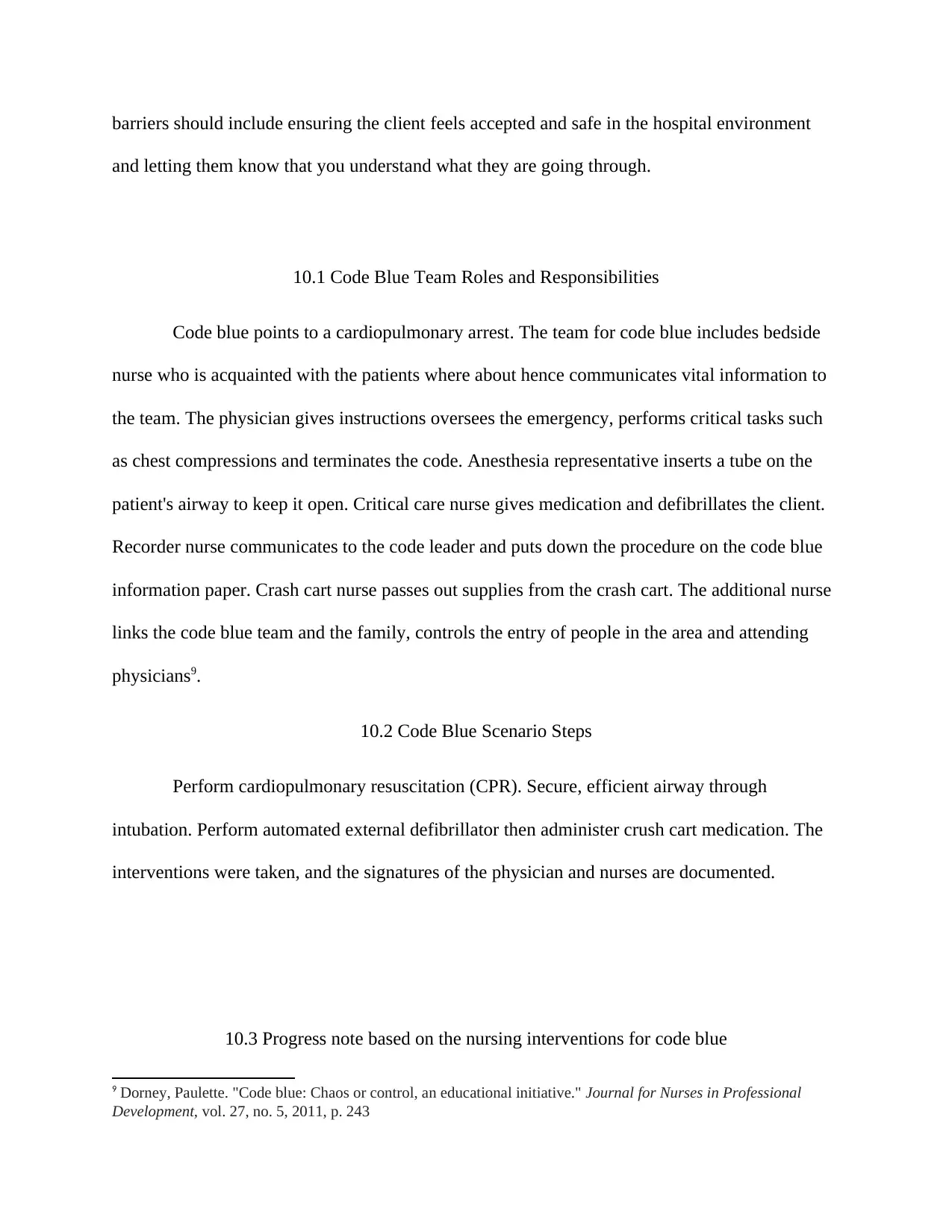
10.1 Code Blue Team Roles and Responsibilities
Code blue points to a cardiopulmonary arrest. The team for code blue includes bedside
nurse who is acquainted with the patients where about hence communicates vital information to
the team. The physician gives instructions oversees the emergency, performs critical tasks such
as chest compressions and terminates the code. Anesthesia representative inserts a tube on the
patient's airway to keep it open. Critical care nurse gives medication and defibrillates the client.
Recorder nurse communicates to the code leader and puts down the procedure on the code blue
information paper. Crash cart nurse passes out supplies from the crash cart. The additional nurse
links the code blue team and the family, controls the entry of people in the area and attending
physicians9.
10.2 Code Blue Scenario Steps
Perform cardiopulmonary resuscitation (CPR). Secure, efficient airway through
intubation. Perform automated external defibrillator then administer crush cart medication. The
interventions were taken, and the signatures of the physician and nurses are documented.
10.3 Progress note based on the nursing interventions for code blue
9 Dorney, Paulette. "Code blue: Chaos or control, an educational initiative." Journal for Nurses in Professional
Development, vol. 27, no. 5, 2011, p. 243
and letting them know that you understand what they are going through.
10.1 Code Blue Team Roles and Responsibilities
Code blue points to a cardiopulmonary arrest. The team for code blue includes bedside
nurse who is acquainted with the patients where about hence communicates vital information to
the team. The physician gives instructions oversees the emergency, performs critical tasks such
as chest compressions and terminates the code. Anesthesia representative inserts a tube on the
patient's airway to keep it open. Critical care nurse gives medication and defibrillates the client.
Recorder nurse communicates to the code leader and puts down the procedure on the code blue
information paper. Crash cart nurse passes out supplies from the crash cart. The additional nurse
links the code blue team and the family, controls the entry of people in the area and attending
physicians9.
10.2 Code Blue Scenario Steps
Perform cardiopulmonary resuscitation (CPR). Secure, efficient airway through
intubation. Perform automated external defibrillator then administer crush cart medication. The
interventions were taken, and the signatures of the physician and nurses are documented.
10.3 Progress note based on the nursing interventions for code blue
9 Dorney, Paulette. "Code blue: Chaos or control, an educational initiative." Journal for Nurses in Professional
Development, vol. 27, no. 5, 2011, p. 243
⊘ This is a preview!⊘
Do you want full access?
Subscribe today to unlock all pages.

Trusted by 1+ million students worldwide

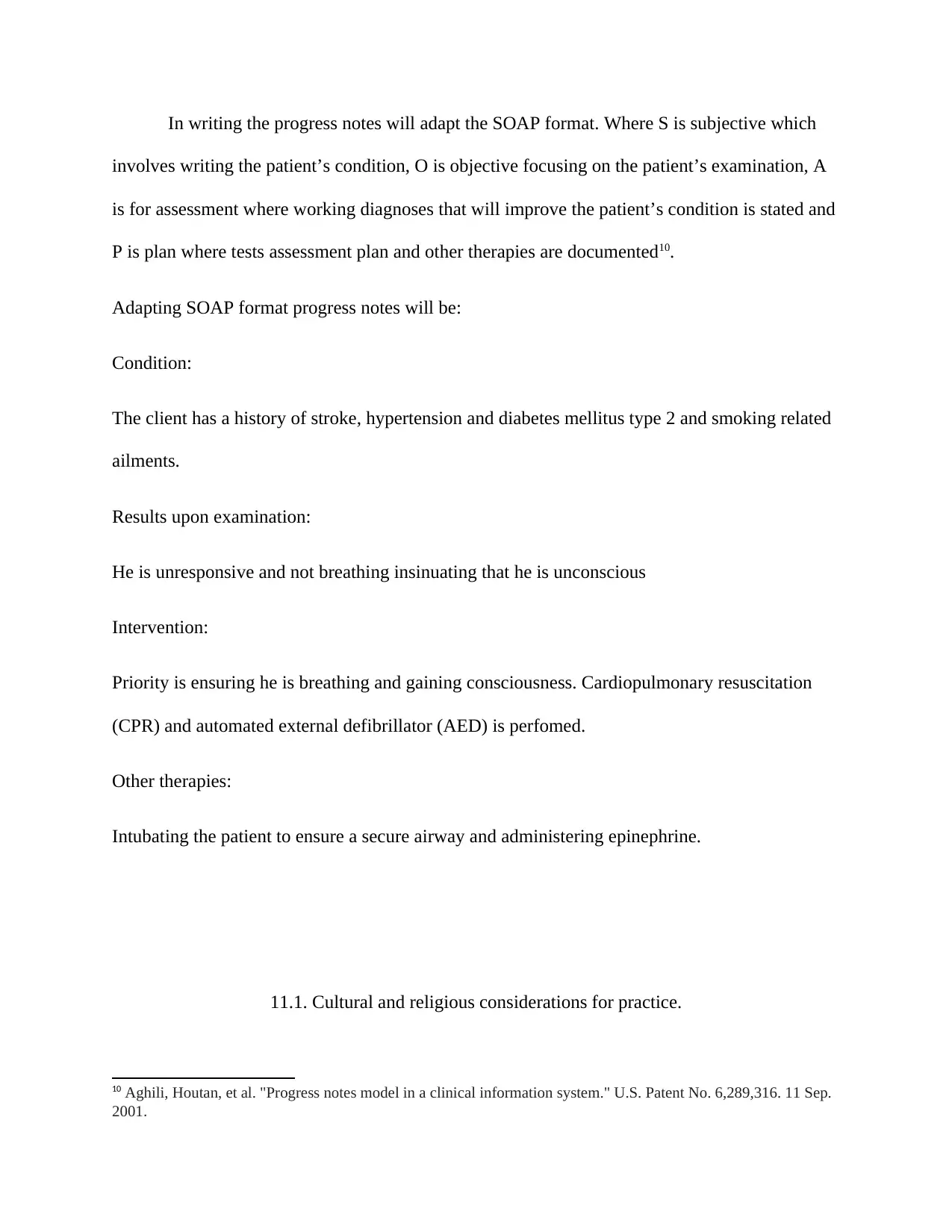
In writing the progress notes will adapt the SOAP format. Where S is subjective which
involves writing the patient’s condition, O is objective focusing on the patient’s examination, A
is for assessment where working diagnoses that will improve the patient’s condition is stated and
P is plan where tests assessment plan and other therapies are documented10.
Adapting SOAP format progress notes will be:
Condition:
The client has a history of stroke, hypertension and diabetes mellitus type 2 and smoking related
ailments.
Results upon examination:
He is unresponsive and not breathing insinuating that he is unconscious
Intervention:
Priority is ensuring he is breathing and gaining consciousness. Cardiopulmonary resuscitation
(CPR) and automated external defibrillator (AED) is perfomed.
Other therapies:
Intubating the patient to ensure a secure airway and administering epinephrine.
11.1. Cultural and religious considerations for practice.
10 Aghili, Houtan, et al. "Progress notes model in a clinical information system." U.S. Patent No. 6,289,316. 11 Sep.
2001.
involves writing the patient’s condition, O is objective focusing on the patient’s examination, A
is for assessment where working diagnoses that will improve the patient’s condition is stated and
P is plan where tests assessment plan and other therapies are documented10.
Adapting SOAP format progress notes will be:
Condition:
The client has a history of stroke, hypertension and diabetes mellitus type 2 and smoking related
ailments.
Results upon examination:
He is unresponsive and not breathing insinuating that he is unconscious
Intervention:
Priority is ensuring he is breathing and gaining consciousness. Cardiopulmonary resuscitation
(CPR) and automated external defibrillator (AED) is perfomed.
Other therapies:
Intubating the patient to ensure a secure airway and administering epinephrine.
11.1. Cultural and religious considerations for practice.
10 Aghili, Houtan, et al. "Progress notes model in a clinical information system." U.S. Patent No. 6,289,316. 11 Sep.
2001.
Paraphrase This Document
Need a fresh take? Get an instant paraphrase of this document with our AI Paraphraser

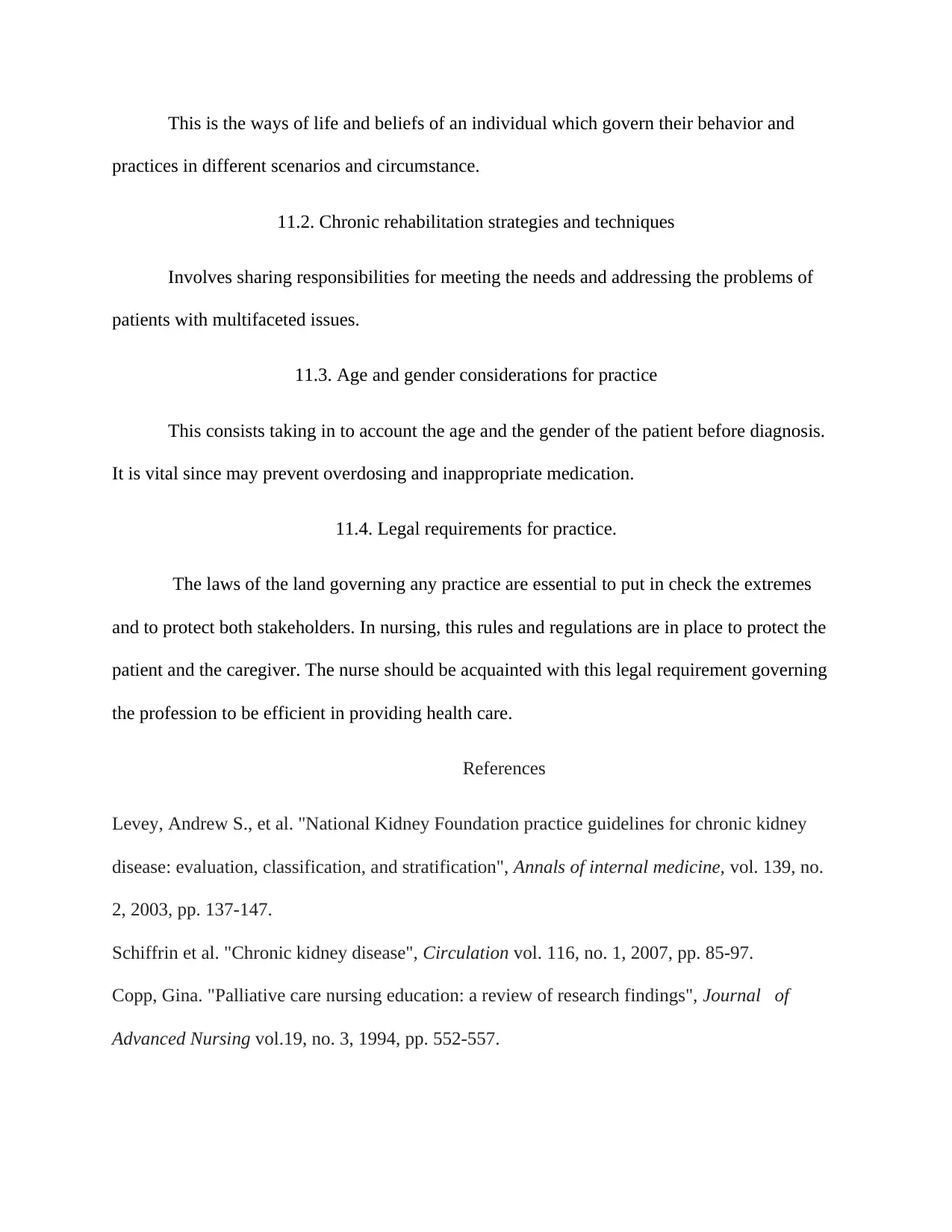
This is the ways of life and beliefs of an individual which govern their behavior and
practices in different scenarios and circumstance.
11.2. Chronic rehabilitation strategies and techniques
Involves sharing responsibilities for meeting the needs and addressing the problems of
patients with multifaceted issues.
11.3. Age and gender considerations for practice
This consists taking in to account the age and the gender of the patient before diagnosis.
It is vital since may prevent overdosing and inappropriate medication.
11.4. Legal requirements for practice.
The laws of the land governing any practice are essential to put in check the extremes
and to protect both stakeholders. In nursing, this rules and regulations are in place to protect the
patient and the caregiver. The nurse should be acquainted with this legal requirement governing
the profession to be efficient in providing health care.
References
Levey, Andrew S., et al. "National Kidney Foundation practice guidelines for chronic kidney
disease: evaluation, classification, and stratification", Annals of internal medicine, vol. 139, no.
2, 2003, pp. 137-147.
Schiffrin et al. "Chronic kidney disease", Circulation vol. 116, no. 1, 2007, pp. 85-97.
Copp, Gina. "Palliative care nursing education: a review of research findings", Journal of
Advanced Nursing vol.19, no. 3, 1994, pp. 552-557.
practices in different scenarios and circumstance.
11.2. Chronic rehabilitation strategies and techniques
Involves sharing responsibilities for meeting the needs and addressing the problems of
patients with multifaceted issues.
11.3. Age and gender considerations for practice
This consists taking in to account the age and the gender of the patient before diagnosis.
It is vital since may prevent overdosing and inappropriate medication.
11.4. Legal requirements for practice.
The laws of the land governing any practice are essential to put in check the extremes
and to protect both stakeholders. In nursing, this rules and regulations are in place to protect the
patient and the caregiver. The nurse should be acquainted with this legal requirement governing
the profession to be efficient in providing health care.
References
Levey, Andrew S., et al. "National Kidney Foundation practice guidelines for chronic kidney
disease: evaluation, classification, and stratification", Annals of internal medicine, vol. 139, no.
2, 2003, pp. 137-147.
Schiffrin et al. "Chronic kidney disease", Circulation vol. 116, no. 1, 2007, pp. 85-97.
Copp, Gina. "Palliative care nursing education: a review of research findings", Journal of
Advanced Nursing vol.19, no. 3, 1994, pp. 552-557.

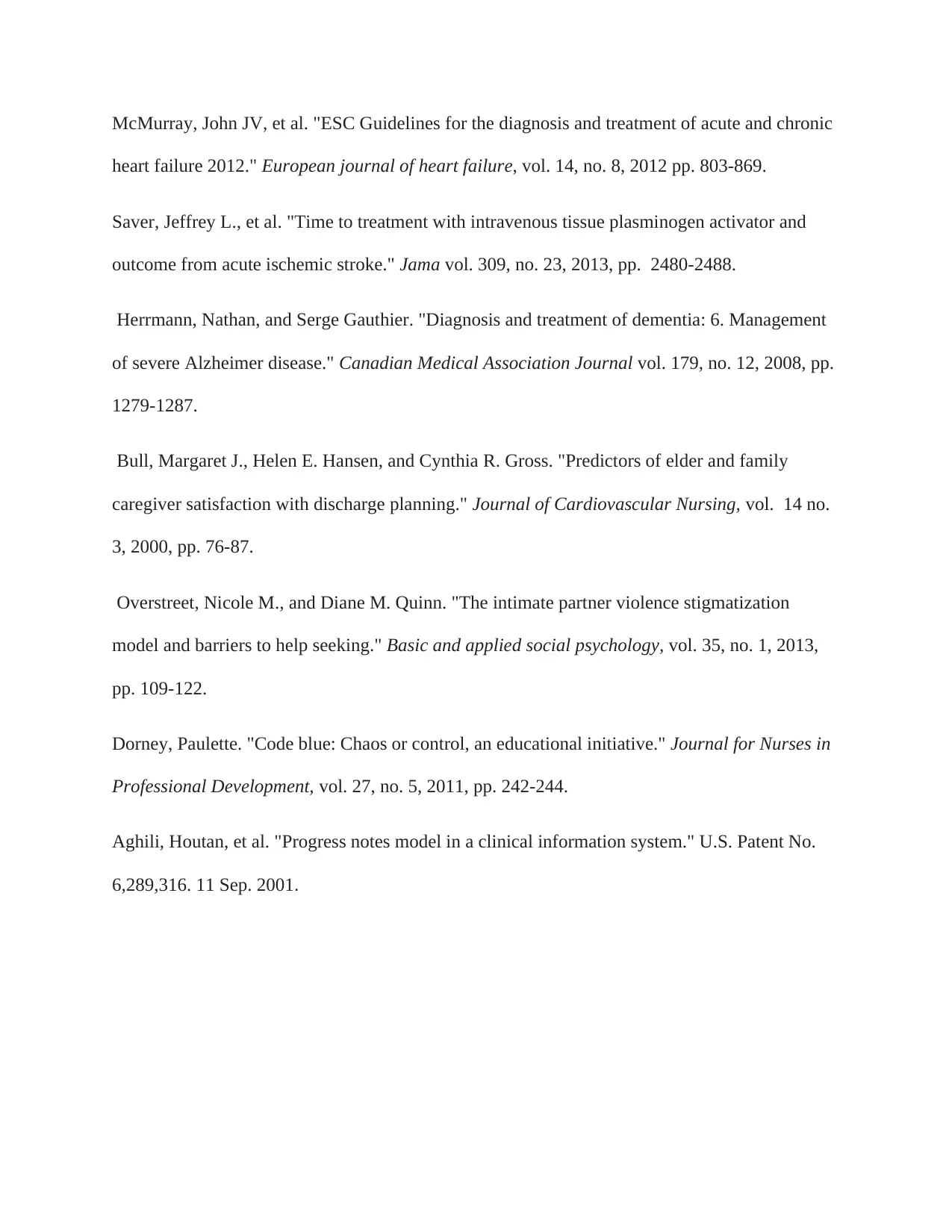
McMurray, John JV, et al. "ESC Guidelines for the diagnosis and treatment of acute and chronic
heart failure 2012." European journal of heart failure, vol. 14, no. 8, 2012 pp. 803-869.
Saver, Jeffrey L., et al. "Time to treatment with intravenous tissue plasminogen activator and
outcome from acute ischemic stroke." Jama vol. 309, no. 23, 2013, pp. 2480-2488.
Herrmann, Nathan, and Serge Gauthier. "Diagnosis and treatment of dementia: 6. Management
of severe Alzheimer disease." Canadian Medical Association Journal vol. 179, no. 12, 2008, pp.
1279-1287.
Bull, Margaret J., Helen E. Hansen, and Cynthia R. Gross. "Predictors of elder and family
caregiver satisfaction with discharge planning." Journal of Cardiovascular Nursing, vol. 14 no.
3, 2000, pp. 76-87.
Overstreet, Nicole M., and Diane M. Quinn. "The intimate partner violence stigmatization
model and barriers to help seeking." Basic and applied social psychology, vol. 35, no. 1, 2013,
pp. 109-122.
Dorney, Paulette. "Code blue: Chaos or control, an educational initiative." Journal for Nurses in
Professional Development, vol. 27, no. 5, 2011, pp. 242-244.
Aghili, Houtan, et al. "Progress notes model in a clinical information system." U.S. Patent No.
6,289,316. 11 Sep. 2001.
heart failure 2012." European journal of heart failure, vol. 14, no. 8, 2012 pp. 803-869.
Saver, Jeffrey L., et al. "Time to treatment with intravenous tissue plasminogen activator and
outcome from acute ischemic stroke." Jama vol. 309, no. 23, 2013, pp. 2480-2488.
Herrmann, Nathan, and Serge Gauthier. "Diagnosis and treatment of dementia: 6. Management
of severe Alzheimer disease." Canadian Medical Association Journal vol. 179, no. 12, 2008, pp.
1279-1287.
Bull, Margaret J., Helen E. Hansen, and Cynthia R. Gross. "Predictors of elder and family
caregiver satisfaction with discharge planning." Journal of Cardiovascular Nursing, vol. 14 no.
3, 2000, pp. 76-87.
Overstreet, Nicole M., and Diane M. Quinn. "The intimate partner violence stigmatization
model and barriers to help seeking." Basic and applied social psychology, vol. 35, no. 1, 2013,
pp. 109-122.
Dorney, Paulette. "Code blue: Chaos or control, an educational initiative." Journal for Nurses in
Professional Development, vol. 27, no. 5, 2011, pp. 242-244.
Aghili, Houtan, et al. "Progress notes model in a clinical information system." U.S. Patent No.
6,289,316. 11 Sep. 2001.
⊘ This is a preview!⊘
Do you want full access?
Subscribe today to unlock all pages.

Trusted by 1+ million students worldwide
1 out of 9
Related Documents
Your All-in-One AI-Powered Toolkit for Academic Success.
+13062052269
info@desklib.com
Available 24*7 on WhatsApp / Email
Unlock your academic potential
Copyright © 2020–2025 A2Z Services. All Rights Reserved. Developed and managed by ZUCOL.