CNA342: Child, Youth and Family Healthcare Clinical Scenario Report
VerifiedAdded on 2022/11/16
|9
|2365
|292
Report
AI Summary
This report provides a comprehensive analysis of a clinical scenario involving a 7-year-old child, Karam, who underwent surgery for appendicitis. It delves into the essential aspects of nursing care required for pediatric patients, emphasizing the importance of post-operative pain management, monitoring, and promoting the child's motivation for recovery. The report highlights the significance of effective communication between nurses, the child, and the family, particularly considering the family's recent migration and limited English proficiency. It underscores the application of family-centered care principles to build trust and facilitate open dialogue. The report also addresses the unique challenges of caring for a child refugee and recommends strategies to bridge communication gaps and ensure the child's well-being, promoting a holistic approach to healthcare that encompasses both the child's physical and emotional needs. The report emphasizes the need for nurses to adapt their approach based on the child's developmental stage and cultural background, ultimately contributing to the child's speedy recovery.
CLINICAL SCENARIO – WRITTEN REPORT
1
1
Paraphrase This Document
Need a fresh take? Get an instant paraphrase of this document with our AI Paraphraser

Executive Summary
The report aims to examine the various aspects of nursing care in the case of children. The
core concept of nursing has been brought out in the report. A present scenario has been
provided, and the entire report is based on the analysis of the scenario, and the various
inferences that can be drawn from the scenario have been analysed. The proper approach that
the nurse needs to take in dealing with the patient in the given scenario has been presented.
The recommendations to enhance the communication between the family of the patient and
the nurse are also provided. The concept of family-centred care is also discussed.
2
The report aims to examine the various aspects of nursing care in the case of children. The
core concept of nursing has been brought out in the report. A present scenario has been
provided, and the entire report is based on the analysis of the scenario, and the various
inferences that can be drawn from the scenario have been analysed. The proper approach that
the nurse needs to take in dealing with the patient in the given scenario has been presented.
The recommendations to enhance the communication between the family of the patient and
the nurse are also provided. The concept of family-centred care is also discussed.
2

Table of contents
1. Introduction............................................................................................................................3
2. Nursing care...........................................................................................................................3
3. Communication......................................................................................................................5
4. Conclusion..............................................................................................................................6
Reference list..............................................................................................................................8
3
1. Introduction............................................................................................................................3
2. Nursing care...........................................................................................................................3
3. Communication......................................................................................................................5
4. Conclusion..............................................................................................................................6
Reference list..............................................................................................................................8
3
⊘ This is a preview!⊘
Do you want full access?
Subscribe today to unlock all pages.

Trusted by 1+ million students worldwide

1. Introduction
Nursing is referred to as one of the noblest professions in the world. Nursing refers to the
taking care of individuals, families and communities in order to help them reach an optimal
health condition and a proper way of living. Taking care of patients is the key task of Nurses
as it is one of the integral parts of the healthcare sector. In the case of children, proper care is
necessary for the speedy recovery of the patient. Any wrong step on the part of the nurses can
lead to severe consequences. The communication between the patients and the nurses, too,
hold a key in the entire process.
2. Nursing care
The case of Karam requires proper Nursing care in order to aid in the rapid and successful
recovery of the child. The child was detected to be suffering from appendicitis and was
operated on as soon as the doctors detected the disease in the boy. The child was admitted to
the hospital with a 24-hour history of abdominal pain, nausea, vomiting and fever and upon
detection of appendicitis was directly taken for laparoscopic appendicectomy. The child has
been suffering from severe pain after the operation. The main job of the nurses, in this case, is
to take proper postoperative care of the child.
The nurses should keep an account of the pain that the child is suffering post-operation, with
the help of pain scale. As stated by Hockenberry and Wilson (2018), this should be checked
at regular half-hourly intervals or hourly intervals. Proper pain relief should be provided
based on the results of the tests that are being conducted at regular intervals. In case a drain
has been inserted in the body of the child, during the surgery, the nurses should make sure
that the output of the drain is recorded every day. In the words of Kaakinen et al. (2018), only
after the nurses are sure that the patient has reached minimal drainage, the drains can be
removed from the body.
4
Nursing is referred to as one of the noblest professions in the world. Nursing refers to the
taking care of individuals, families and communities in order to help them reach an optimal
health condition and a proper way of living. Taking care of patients is the key task of Nurses
as it is one of the integral parts of the healthcare sector. In the case of children, proper care is
necessary for the speedy recovery of the patient. Any wrong step on the part of the nurses can
lead to severe consequences. The communication between the patients and the nurses, too,
hold a key in the entire process.
2. Nursing care
The case of Karam requires proper Nursing care in order to aid in the rapid and successful
recovery of the child. The child was detected to be suffering from appendicitis and was
operated on as soon as the doctors detected the disease in the boy. The child was admitted to
the hospital with a 24-hour history of abdominal pain, nausea, vomiting and fever and upon
detection of appendicitis was directly taken for laparoscopic appendicectomy. The child has
been suffering from severe pain after the operation. The main job of the nurses, in this case, is
to take proper postoperative care of the child.
The nurses should keep an account of the pain that the child is suffering post-operation, with
the help of pain scale. As stated by Hockenberry and Wilson (2018), this should be checked
at regular half-hourly intervals or hourly intervals. Proper pain relief should be provided
based on the results of the tests that are being conducted at regular intervals. In case a drain
has been inserted in the body of the child, during the surgery, the nurses should make sure
that the output of the drain is recorded every day. In the words of Kaakinen et al. (2018), only
after the nurses are sure that the patient has reached minimal drainage, the drains can be
removed from the body.
4
Paraphrase This Document
Need a fresh take? Get an instant paraphrase of this document with our AI Paraphraser

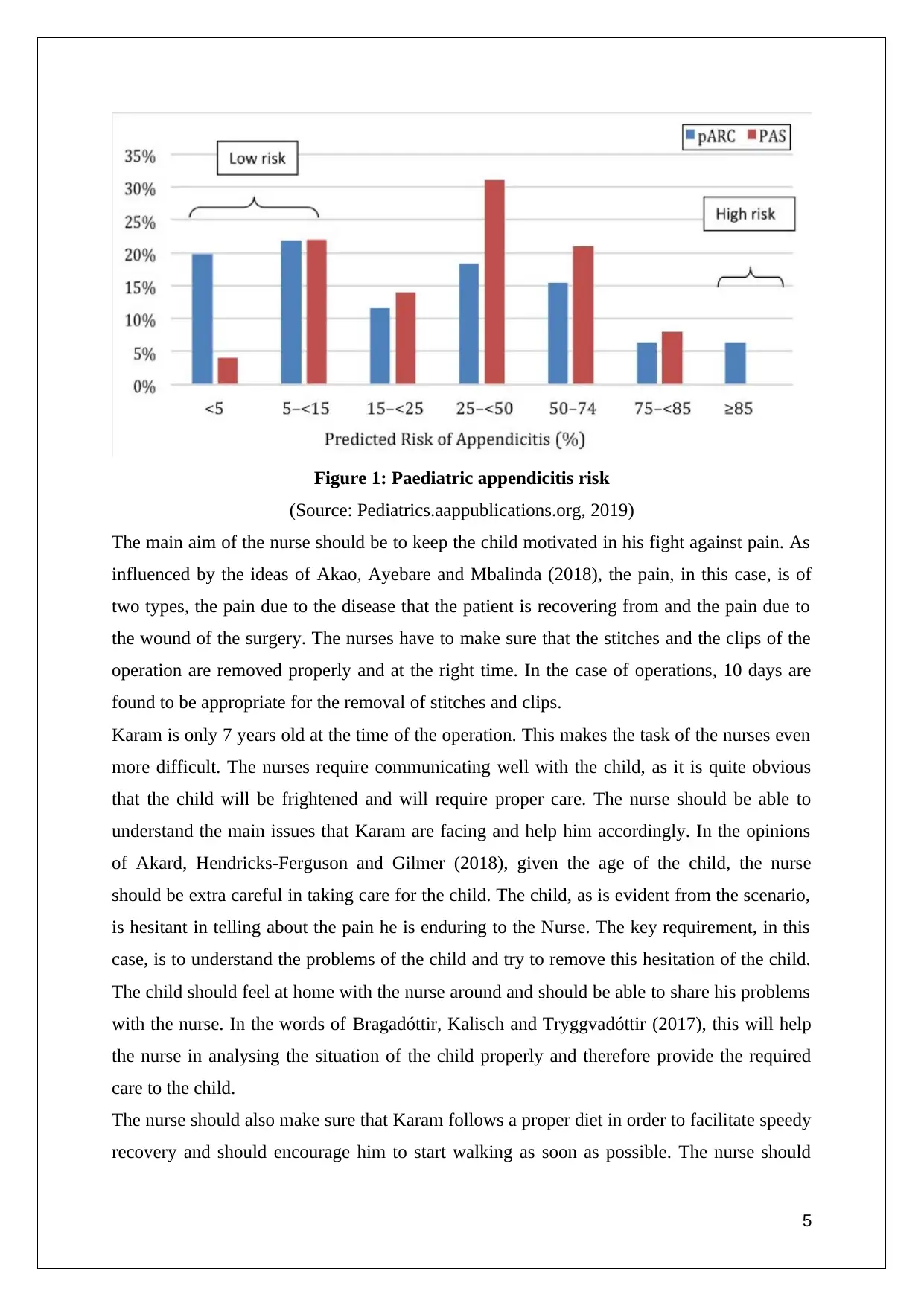
Figure 1: Paediatric appendicitis risk
(Source: Pediatrics.aappublications.org, 2019)
The main aim of the nurse should be to keep the child motivated in his fight against pain. As
influenced by the ideas of Akao, Ayebare and Mbalinda (2018), the pain, in this case, is of
two types, the pain due to the disease that the patient is recovering from and the pain due to
the wound of the surgery. The nurses have to make sure that the stitches and the clips of the
operation are removed properly and at the right time. In the case of operations, 10 days are
found to be appropriate for the removal of stitches and clips.
Karam is only 7 years old at the time of the operation. This makes the task of the nurses even
more difficult. The nurses require communicating well with the child, as it is quite obvious
that the child will be frightened and will require proper care. The nurse should be able to
understand the main issues that Karam are facing and help him accordingly. In the opinions
of Akard, Hendricks-Ferguson and Gilmer (2018), given the age of the child, the nurse
should be extra careful in taking care for the child. The child, as is evident from the scenario,
is hesitant in telling about the pain he is enduring to the Nurse. The key requirement, in this
case, is to understand the problems of the child and try to remove this hesitation of the child.
The child should feel at home with the nurse around and should be able to share his problems
with the nurse. In the words of Bragadóttir, Kalisch and Tryggvadóttir (2017), this will help
the nurse in analysing the situation of the child properly and therefore provide the required
care to the child.
The nurse should also make sure that Karam follows a proper diet in order to facilitate speedy
recovery and should encourage him to start walking as soon as possible. The nurse should
5
(Source: Pediatrics.aappublications.org, 2019)
The main aim of the nurse should be to keep the child motivated in his fight against pain. As
influenced by the ideas of Akao, Ayebare and Mbalinda (2018), the pain, in this case, is of
two types, the pain due to the disease that the patient is recovering from and the pain due to
the wound of the surgery. The nurses have to make sure that the stitches and the clips of the
operation are removed properly and at the right time. In the case of operations, 10 days are
found to be appropriate for the removal of stitches and clips.
Karam is only 7 years old at the time of the operation. This makes the task of the nurses even
more difficult. The nurses require communicating well with the child, as it is quite obvious
that the child will be frightened and will require proper care. The nurse should be able to
understand the main issues that Karam are facing and help him accordingly. In the opinions
of Akard, Hendricks-Ferguson and Gilmer (2018), given the age of the child, the nurse
should be extra careful in taking care for the child. The child, as is evident from the scenario,
is hesitant in telling about the pain he is enduring to the Nurse. The key requirement, in this
case, is to understand the problems of the child and try to remove this hesitation of the child.
The child should feel at home with the nurse around and should be able to share his problems
with the nurse. In the words of Bragadóttir, Kalisch and Tryggvadóttir (2017), this will help
the nurse in analysing the situation of the child properly and therefore provide the required
care to the child.
The nurse should also make sure that Karam follows a proper diet in order to facilitate speedy
recovery and should encourage him to start walking as soon as possible. The nurse should
5

also make sure that the parents of Karam understand the ways in which the pain of the child
can be managed once he is discharged from the hospital. The child should be given proper
medical attention even at home unless there is a complete recovery. The nurse must make
sure that she effectively guides the parents of Karam about the care needed to be taken post
appendicectomy and help them whenever they are in need of her. The main aim is to make
the parents understand the seriousness of the situation and compel them to take proper care of
the child. In the words of Cameranesi and Piotrowski (2018), the family of the child is also
required to provide moral support and motivation to the patient. This will help in enhancing
the will power of the child and allow him to recover faster. The child has the right to proper
care, and the nurse throughout should follow healthcare facilities and this, and there should
be efforts to apply a more family-centred approach to the entire scenario.
3. Communication
Communicating with Karen and his family, is a very complex issue that the nurse, as well as
the doctors, will face. This is sole because the family has just migrated from Syria to
Australia and have not yet settled in the new environment. As influenced by the ideas of
Edvardsson, Watt and Pearce (2017), it can be stated that the refugees are bound to feel
secluded in a foreign land, where they have just settled down. Moreover, the communication
with the parents of Karam is even tougher, given the fact that they have a very limited sense
of English. This makes communicating with them even more difficult. As stated by Kim et al.
(2017), children are bound to be frightened and low on confidence in the times of any
physical ailment. The scenario is even worse in the case of Karam, as he has seen his entire
family running away from their homeland and settling in this new land. The people, the
customs and the practices in Australia are completely new for Karam and under such
circumstances; the child will face a lot, of difficulties in effectively communicating with the
nurse and the doctors
Under the given conditions, it is the duty of the nurse in charge of Karam, to make efforts to
bridge the gap between Karam and the nurse. In the opinions of Lake et al. (2017), this can
only be done when the nurse can make Karam feel that he is at home in the hospital. The
nurse should make sure that her presence does not frighten Karam, and even in the absence of
his parents, Karam can interact with the nurse about the problems he is facing. The nurse
should assure the parents of the child that even in their absence; the child is being taken
proper care of. The confidence of the parents is the key to establishing effective
communication with Karam. In the words of Akard, Hendricks-Ferguson and Gilmer (2018),
the children are more dependent on parents and oblige to whatever they say. Once the nurse
6
can be managed once he is discharged from the hospital. The child should be given proper
medical attention even at home unless there is a complete recovery. The nurse must make
sure that she effectively guides the parents of Karam about the care needed to be taken post
appendicectomy and help them whenever they are in need of her. The main aim is to make
the parents understand the seriousness of the situation and compel them to take proper care of
the child. In the words of Cameranesi and Piotrowski (2018), the family of the child is also
required to provide moral support and motivation to the patient. This will help in enhancing
the will power of the child and allow him to recover faster. The child has the right to proper
care, and the nurse throughout should follow healthcare facilities and this, and there should
be efforts to apply a more family-centred approach to the entire scenario.
3. Communication
Communicating with Karen and his family, is a very complex issue that the nurse, as well as
the doctors, will face. This is sole because the family has just migrated from Syria to
Australia and have not yet settled in the new environment. As influenced by the ideas of
Edvardsson, Watt and Pearce (2017), it can be stated that the refugees are bound to feel
secluded in a foreign land, where they have just settled down. Moreover, the communication
with the parents of Karam is even tougher, given the fact that they have a very limited sense
of English. This makes communicating with them even more difficult. As stated by Kim et al.
(2017), children are bound to be frightened and low on confidence in the times of any
physical ailment. The scenario is even worse in the case of Karam, as he has seen his entire
family running away from their homeland and settling in this new land. The people, the
customs and the practices in Australia are completely new for Karam and under such
circumstances; the child will face a lot, of difficulties in effectively communicating with the
nurse and the doctors
Under the given conditions, it is the duty of the nurse in charge of Karam, to make efforts to
bridge the gap between Karam and the nurse. In the opinions of Lake et al. (2017), this can
only be done when the nurse can make Karam feel that he is at home in the hospital. The
nurse should make sure that her presence does not frighten Karam, and even in the absence of
his parents, Karam can interact with the nurse about the problems he is facing. The nurse
should assure the parents of the child that even in their absence; the child is being taken
proper care of. The confidence of the parents is the key to establishing effective
communication with Karam. In the words of Akard, Hendricks-Ferguson and Gilmer (2018),
the children are more dependent on parents and oblige to whatever they say. Once the nurse
6
⊘ This is a preview!⊘
Do you want full access?
Subscribe today to unlock all pages.

Trusted by 1+ million students worldwide

establishes healthy communication between the family and herself, it will not be a difficulty
in establishing healthy relations with the child.
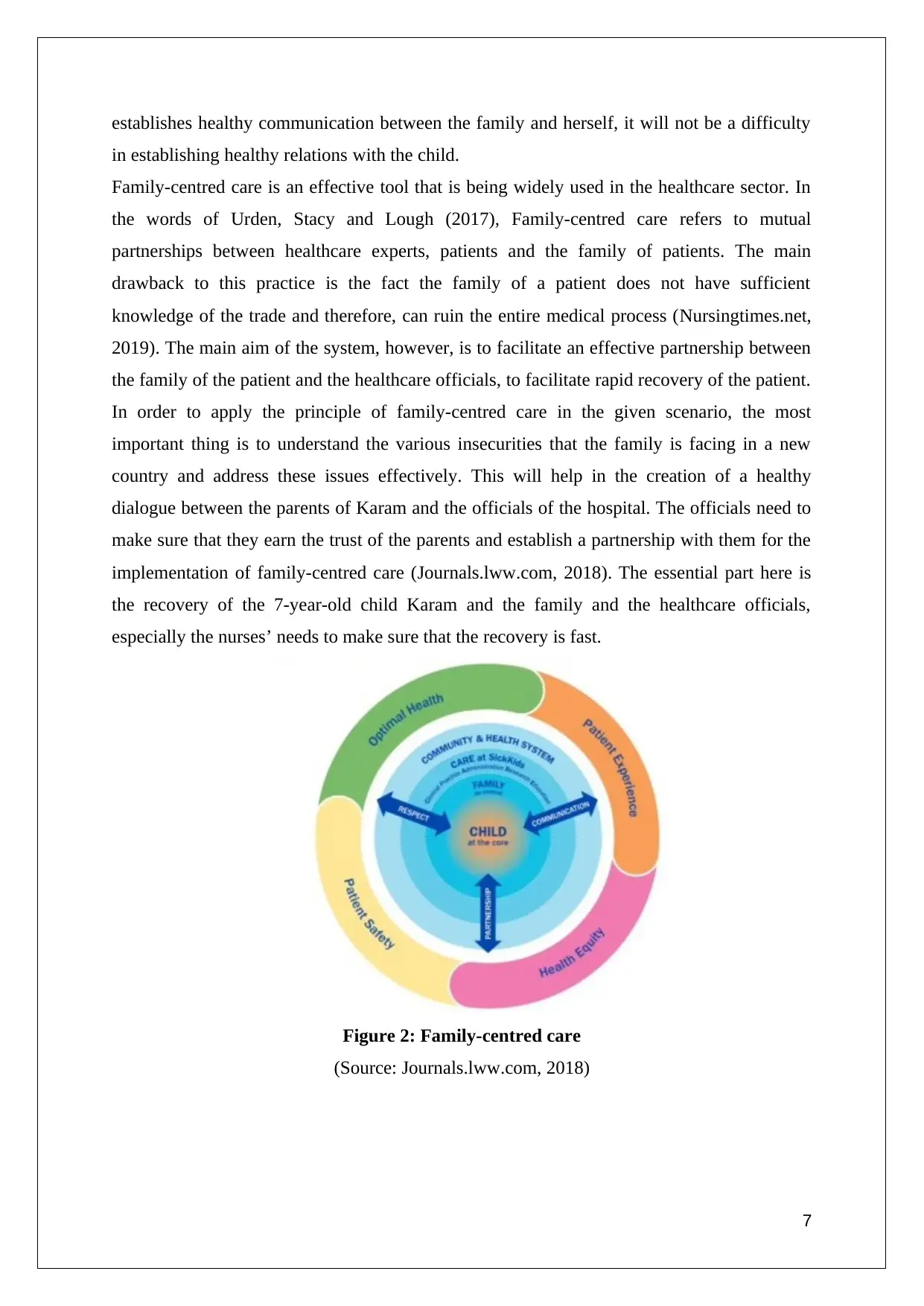
Family-centred care is an effective tool that is being widely used in the healthcare sector. In
the words of Urden, Stacy and Lough (2017), Family-centred care refers to mutual
partnerships between healthcare experts, patients and the family of patients. The main
drawback to this practice is the fact the family of a patient does not have sufficient
knowledge of the trade and therefore, can ruin the entire medical process (Nursingtimes.net,
2019). The main aim of the system, however, is to facilitate an effective partnership between
the family of the patient and the healthcare officials, to facilitate rapid recovery of the patient.
In order to apply the principle of family-centred care in the given scenario, the most
important thing is to understand the various insecurities that the family is facing in a new
country and address these issues effectively. This will help in the creation of a healthy
dialogue between the parents of Karam and the officials of the hospital. The officials need to
make sure that they earn the trust of the parents and establish a partnership with them for the
implementation of family-centred care (Journals.lww.com, 2018). The essential part here is
the recovery of the 7-year-old child Karam and the family and the healthcare officials,
especially the nurses’ needs to make sure that the recovery is fast.
Figure 2: Family-centred care
(Source: Journals.lww.com, 2018)
7
in establishing healthy relations with the child.
Family-centred care is an effective tool that is being widely used in the healthcare sector. In
the words of Urden, Stacy and Lough (2017), Family-centred care refers to mutual
partnerships between healthcare experts, patients and the family of patients. The main
drawback to this practice is the fact the family of a patient does not have sufficient
knowledge of the trade and therefore, can ruin the entire medical process (Nursingtimes.net,
2019). The main aim of the system, however, is to facilitate an effective partnership between
the family of the patient and the healthcare officials, to facilitate rapid recovery of the patient.
In order to apply the principle of family-centred care in the given scenario, the most
important thing is to understand the various insecurities that the family is facing in a new
country and address these issues effectively. This will help in the creation of a healthy
dialogue between the parents of Karam and the officials of the hospital. The officials need to
make sure that they earn the trust of the parents and establish a partnership with them for the
implementation of family-centred care (Journals.lww.com, 2018). The essential part here is
the recovery of the 7-year-old child Karam and the family and the healthcare officials,
especially the nurses’ needs to make sure that the recovery is fast.
Figure 2: Family-centred care
(Source: Journals.lww.com, 2018)
7
Paraphrase This Document
Need a fresh take? Get an instant paraphrase of this document with our AI Paraphraser

4. Conclusion
The healthcare sector is one of the key sectors that helps in the growth and development of
society. Healthcare in the case of children is a very complex process, filled with uncertainties
and difficulties for the officials of the sector. There is a requirement that the nurses can
communicate well with the children well and motivate them to fight the situation they are
facing. This is the key requirement in the care for children. The family of a child to plays an
essential role in this aspect, as they are the people, who are closer to the child and
communicate better with the child. Thus, there is a need for the family-centred approach to
healthcare, as it establishes a partnership between the family of the patients and the officials.
In the case of Karam, the scenario is highly different from normal scenarios, given the fact
that the child is a refugee from Syria, who has recently settled in Australia. This adds to the
fright of the child when he is diagnosed with appendicitis.
8
The healthcare sector is one of the key sectors that helps in the growth and development of
society. Healthcare in the case of children is a very complex process, filled with uncertainties
and difficulties for the officials of the sector. There is a requirement that the nurses can
communicate well with the children well and motivate them to fight the situation they are
facing. This is the key requirement in the care for children. The family of a child to plays an
essential role in this aspect, as they are the people, who are closer to the child and
communicate better with the child. Thus, there is a need for the family-centred approach to
healthcare, as it establishes a partnership between the family of the patients and the officials.
In the case of Karam, the scenario is highly different from normal scenarios, given the fact
that the child is a refugee from Syria, who has recently settled in Australia. This adds to the
fright of the child when he is diagnosed with appendicitis.
8

Reference list
Books
Hockenberry, M.J. and Wilson, D., (2018). Wong's nursing care of infants and children-E-
book. Elsevier Health Sciences.
Kaakinen, J.R., Coehlo, D.P., Steele, R. and Robinson, M., (2018). Family health care
nursing: Theory, practice, and research. FA Davis.
Urden, L.D., Stacy, K.M. and Lough, M.E., (2017). Critical care nursing: diagnosis and
management. Elsevier Health Sciences.
Journals
Akao, M.G., Ayebare, E. and Mbalinda, S., (2018). Improving Nursing Care for Children
Admitted in High Dependency Area in Acute Care Unit Mulago Hospital, Uganda.
Akard, T.F., Hendricks-Ferguson, V.L. and Gilmer, M.J., (2018). Pediatric palliative care
nursing. Annals of palliative medicine, 8(1), pp.S39-S48.
Bragadóttir, H., Kalisch, B.J. and Tryggvadóttir, G.B., (2017). Correlates and predictors of
missed nursing care in hospitals. Journal of clinical nursing, 26(11-12), pp.1524-1534.
Cameranesi, M. and Piotrowski, C.C., (2018). Journal of Nursing and Care.
Edvardsson, D., Watt, E. and Pearce, F., (2017). Patient experiences of caring and person‐
centredness are associated with perceived nursing care quality. Journal of advanced
nursing, 73(1), pp.217-227.
Kim, S.J., Shin, H., Lee, J., Kang, S. and Bartlett, R., (2017). A smartphone application to
educate undergraduate nursing students about providing care for infant airway
obstruction. Nurse education today, 48, pp.145-152.
Lake, E.T., de Cordova, P.B., Barton, S., Singh, S., Agosto, P.D., Ely, B., Roberts, K.E. and
Aiken, L.H., (2017). Missed nursing care in pediatrics. Hospital pediatrics, 7(7), pp.378-384.
Websites
Journals.lww.com (2018) Family centered care for children aged 0-12 years Available at:
https://journals.lww.com/jbisrir/Fulltext/2011/09161/Family_centred_care_for_hospitalised_
children_aged.23.aspx [Accessed on: 20.05.2019]
Nursingtimes.net (2019) Treatment and management of acute appendicitis Available at:
https://www.nursingtimes.net/clinical-archive/infection-control/treatment-and-management-
of-acute-appendicitis/201482.article [Accessed on: 20.05.2019]
Pediatrics.aappublications.org (2019) Pediatric appendicitis risks Available at:
https://pediatrics.aappublications.org/content/141/4/e20172699 [Accessed on: 20.05.2019]
9
Books
Hockenberry, M.J. and Wilson, D., (2018). Wong's nursing care of infants and children-E-
book. Elsevier Health Sciences.
Kaakinen, J.R., Coehlo, D.P., Steele, R. and Robinson, M., (2018). Family health care
nursing: Theory, practice, and research. FA Davis.
Urden, L.D., Stacy, K.M. and Lough, M.E., (2017). Critical care nursing: diagnosis and
management. Elsevier Health Sciences.
Journals
Akao, M.G., Ayebare, E. and Mbalinda, S., (2018). Improving Nursing Care for Children
Admitted in High Dependency Area in Acute Care Unit Mulago Hospital, Uganda.
Akard, T.F., Hendricks-Ferguson, V.L. and Gilmer, M.J., (2018). Pediatric palliative care
nursing. Annals of palliative medicine, 8(1), pp.S39-S48.
Bragadóttir, H., Kalisch, B.J. and Tryggvadóttir, G.B., (2017). Correlates and predictors of
missed nursing care in hospitals. Journal of clinical nursing, 26(11-12), pp.1524-1534.
Cameranesi, M. and Piotrowski, C.C., (2018). Journal of Nursing and Care.
Edvardsson, D., Watt, E. and Pearce, F., (2017). Patient experiences of caring and person‐
centredness are associated with perceived nursing care quality. Journal of advanced
nursing, 73(1), pp.217-227.
Kim, S.J., Shin, H., Lee, J., Kang, S. and Bartlett, R., (2017). A smartphone application to
educate undergraduate nursing students about providing care for infant airway
obstruction. Nurse education today, 48, pp.145-152.
Lake, E.T., de Cordova, P.B., Barton, S., Singh, S., Agosto, P.D., Ely, B., Roberts, K.E. and
Aiken, L.H., (2017). Missed nursing care in pediatrics. Hospital pediatrics, 7(7), pp.378-384.
Websites
Journals.lww.com (2018) Family centered care for children aged 0-12 years Available at:
https://journals.lww.com/jbisrir/Fulltext/2011/09161/Family_centred_care_for_hospitalised_
children_aged.23.aspx [Accessed on: 20.05.2019]
Nursingtimes.net (2019) Treatment and management of acute appendicitis Available at:
https://www.nursingtimes.net/clinical-archive/infection-control/treatment-and-management-
of-acute-appendicitis/201482.article [Accessed on: 20.05.2019]
Pediatrics.aappublications.org (2019) Pediatric appendicitis risks Available at:
https://pediatrics.aappublications.org/content/141/4/e20172699 [Accessed on: 20.05.2019]
9
⊘ This is a preview!⊘
Do you want full access?
Subscribe today to unlock all pages.

Trusted by 1+ million students worldwide
1 out of 9
Related Documents
Your All-in-One AI-Powered Toolkit for Academic Success.
+13062052269
info@desklib.com
Available 24*7 on WhatsApp / Email
Unlock your academic potential
Copyright © 2020–2026 A2Z Services. All Rights Reserved. Developed and managed by ZUCOL.