NURSING 6: University Nursing Competency Application Report

Verified

Added on  2022/11/25

|7
|1009
|218
Report
AI Summary
This report focuses on the application of core nursing competencies in practice, with a specific emphasis on geriatric care. It explores the importance of patient-centered care, interdisciplinary teamwork, evidence-based practice, quality improvement, and informatics. The report provides real-world examples of how these competencies are applied in a healthcare setting, particularly in fall prevention strategies for elderly patients. It also discusses methods to improve these competencies within a workplace, such as promoting patient empowerment, facilitating effective teamwork, and providing training to apply evidence-based practices. The document includes charts illustrating the application of the competencies and relevant references to support the information provided. The report highlights the importance of continuous improvement in nursing practice to ensure patient safety and improve the quality of care.
Document Page
Running head: NURSING
Nursing
Name of the student:
Name of the University:
Author’s note
tabler-icon-diamond-filled.svg

Paraphrase This Document

Need a fresh take? Get an instant paraphrase of this document with our AI Paraphraser
Document Page
1NURSING
Relation of competencies to nursing practice:
According to Knebel and Greiner (2003), the core competencies required for a New
Vision for Health Professions Education includes providing patient-centered care, working in
interdisciplinary team, adapting evidence-based practice, applying quality improvement and
utilize informatics. These five competencies are important to meet the expectations of daily
practice in current setting and apply clinical reasoning and critical thinking to judge patients.
These competences related to my nursing practice area because in my profession, providing
patient centered care is important. Hence, as I need to provide care to elderly patients with
diverse culture and value, patient centered competencies related to respect, coordination and
shared decision making helps me to establish therapeutic relationship with patient. In addition, in
the geriatric care setting, we need to work with multiprofessional team where active
communication and collaboration is critical for patient safety. This is relevant to the second
competencies from the list. In addition, we work to integrate best research evidence, apply
innovative technology and informatics for health care delivery and continuously monitor
standards of safety for patient. This is relevant with the other three competencies listed in the
book.
Application of one of the competencies in workplace:
One of the examples that depicts application of one of the five competencies of applying
quality improvement will be discussed in this section. As we work in a geriatric care setting, we
pay special emphasis on fall prevention and preventing risk of injuries for elderly clients.
Prevention of fall in elderly is important because to promote functional independence and
improve quality of life of patients. Hip fracture is a common injury sustained by elderly patient
Document Page
2NURSING
because of falling and the risk of falling in elderly is high because of age related causes such as
frailty, vision problem, medications, acute illness and poor balance (Jin, 2018). Hence, as we are
committed to the safety of our patient, we engage in fall risk assessment of each patient after
hospitalization. This involves conducting physical assessment of patient to identify any
conditions that lead to risk of falling. Based on such assessment, we apply special bands to
patients so that all involved medical teams are aware about the risk. Secondly, we also engage in
environment assessment of patient to ensure that bed railings, floors, pillows and washroom is
clean and free from any clutter that creates the risk of falling. Hence, this form of activities in my
nursing practice is relevant with the competencies such as identifying hazards in care. Fall
prevention intervention in our workplace helps to fulfill the competency of quality improvement
and evaluate quality of care in terms of organizational structure as well as patient needs.
Improving other competencies in workplace:
Apart from meeting quality improvement competencies, my workplace can emphasize on
meeting other competencies in the following ways:
1. To improve the competency related to patient-centered care skills, our workplace can
focus on establishing a process to maintain continuum of care and promote respect and
values of patient. Patient empowerment and patient education needs to be embraced so
that patients are engages and information sharing takes place across the continuum
(Fleming & Haney, 2013).
2. To promote effective interdisciplinary teamwork in the workplace, there is a need for
clinical leaders to take an active step in developing the vision of team work among all
team members and effectively implement tools such as SBAR and other tools to
Document Page
3NURSING
communicate patient’s information to all team members. This will help avoid any error
due to miscommunication.
3. The competency related to evidence based practice in the workplace can be improved by
providing nurses with trainings and resources to effectively apply evidence into practice.
4. Currently, our hospital use electronic health record (EHR)
to manage huge patient information. However, to improve the competency related to
utilizing informatics, it is necessary to train nurses and other staffs regarding the use of
these tools.
The following charts depict how I apply the core competencies in my nursing practice:
Competen
cies
Application
Patient
centered
care
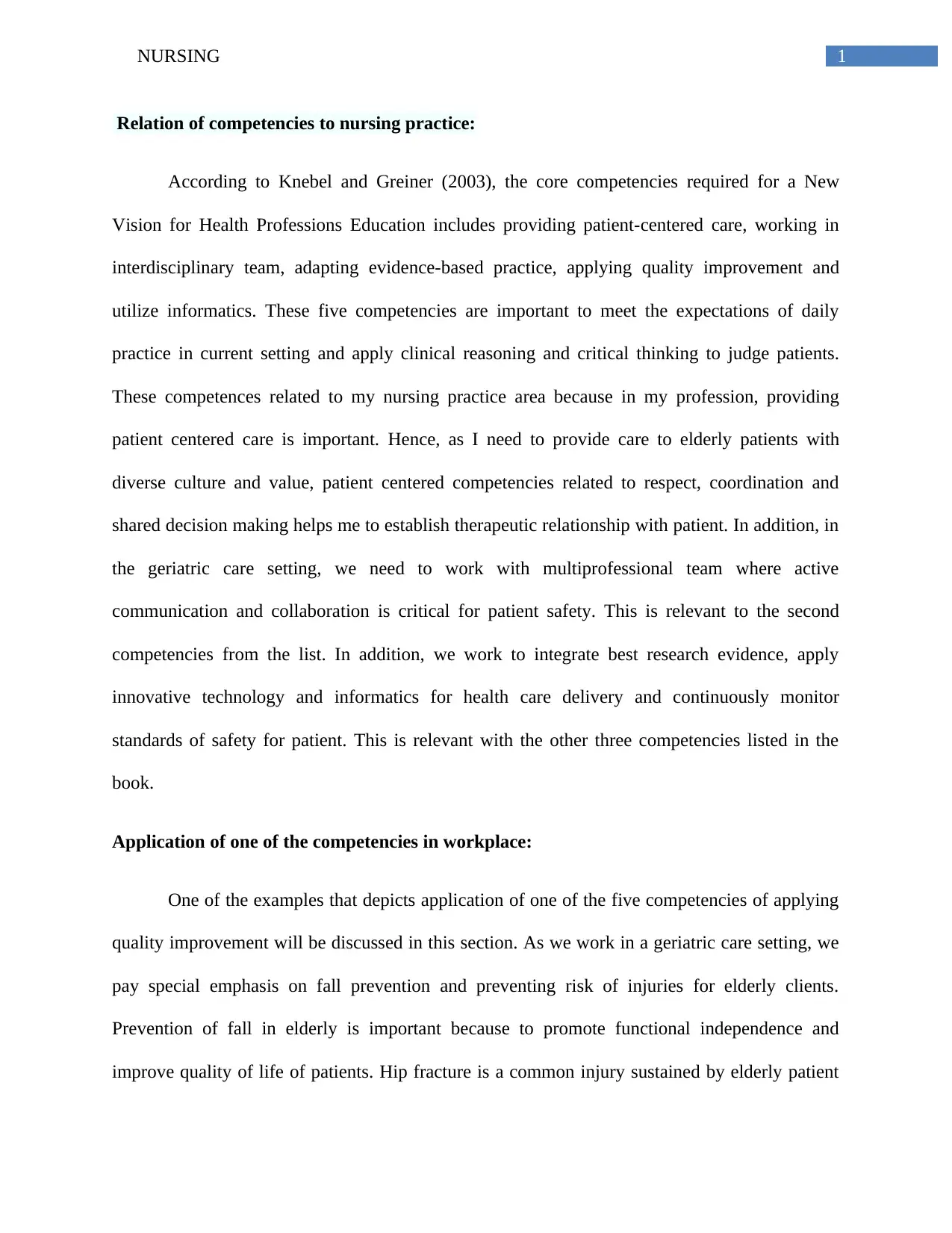
I use the skills of clear communication, active listening techniques and
taking feedback from patient to address patient needs. The figure below
demonstrates the steps I follow to engage in active listening with patients
Work in
interdiscipl
inary team.
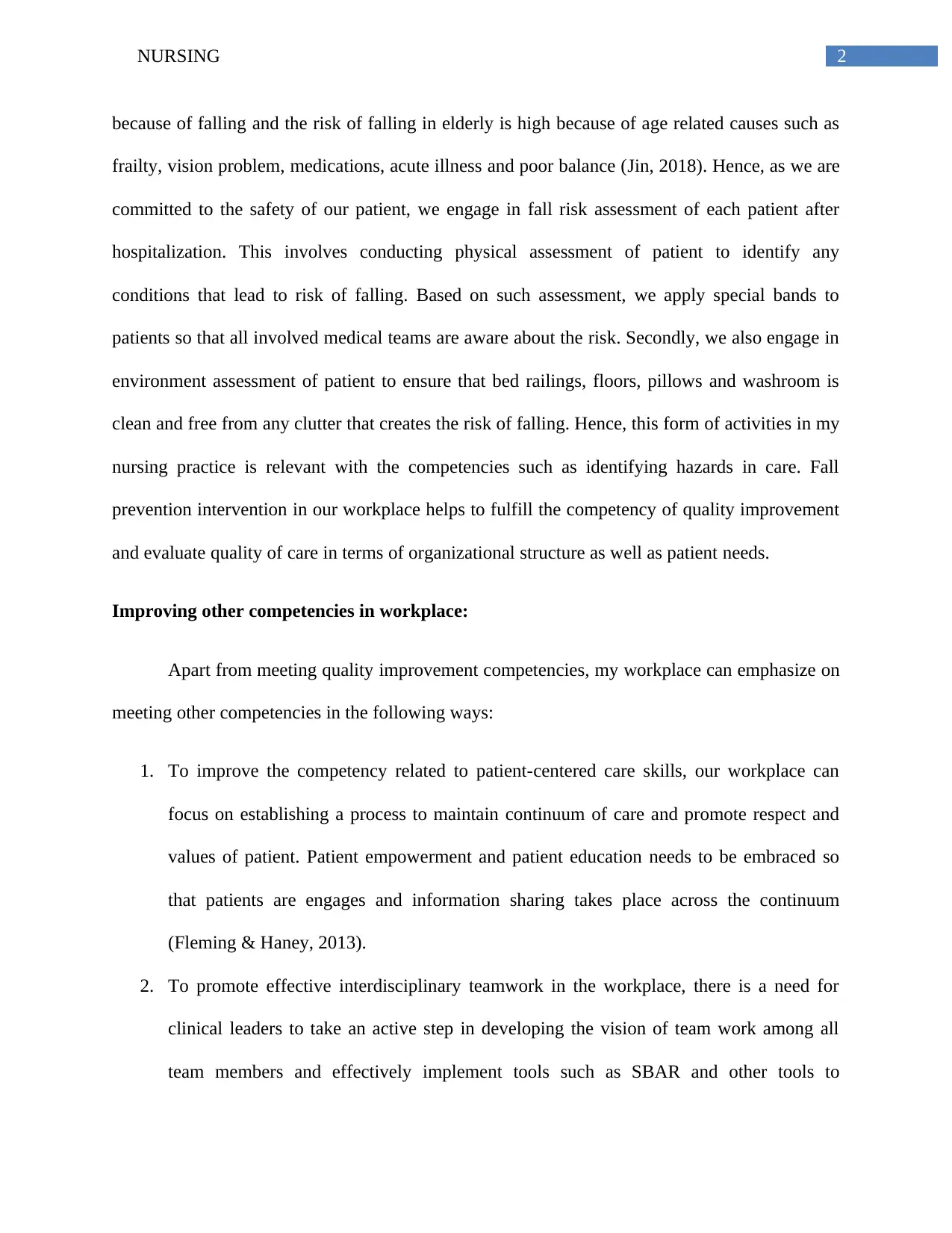
We have regular team huddles each day to collaborate with other team
members and coordinate daily care task. Figure 2. below shows in huddle
tabler-icon-diamond-filled.svg

Paraphrase This Document

Need a fresh take? Get an instant paraphrase of this document with our AI Paraphraser
Document Page
4NURSING
in progress.
Evidence
based
practice
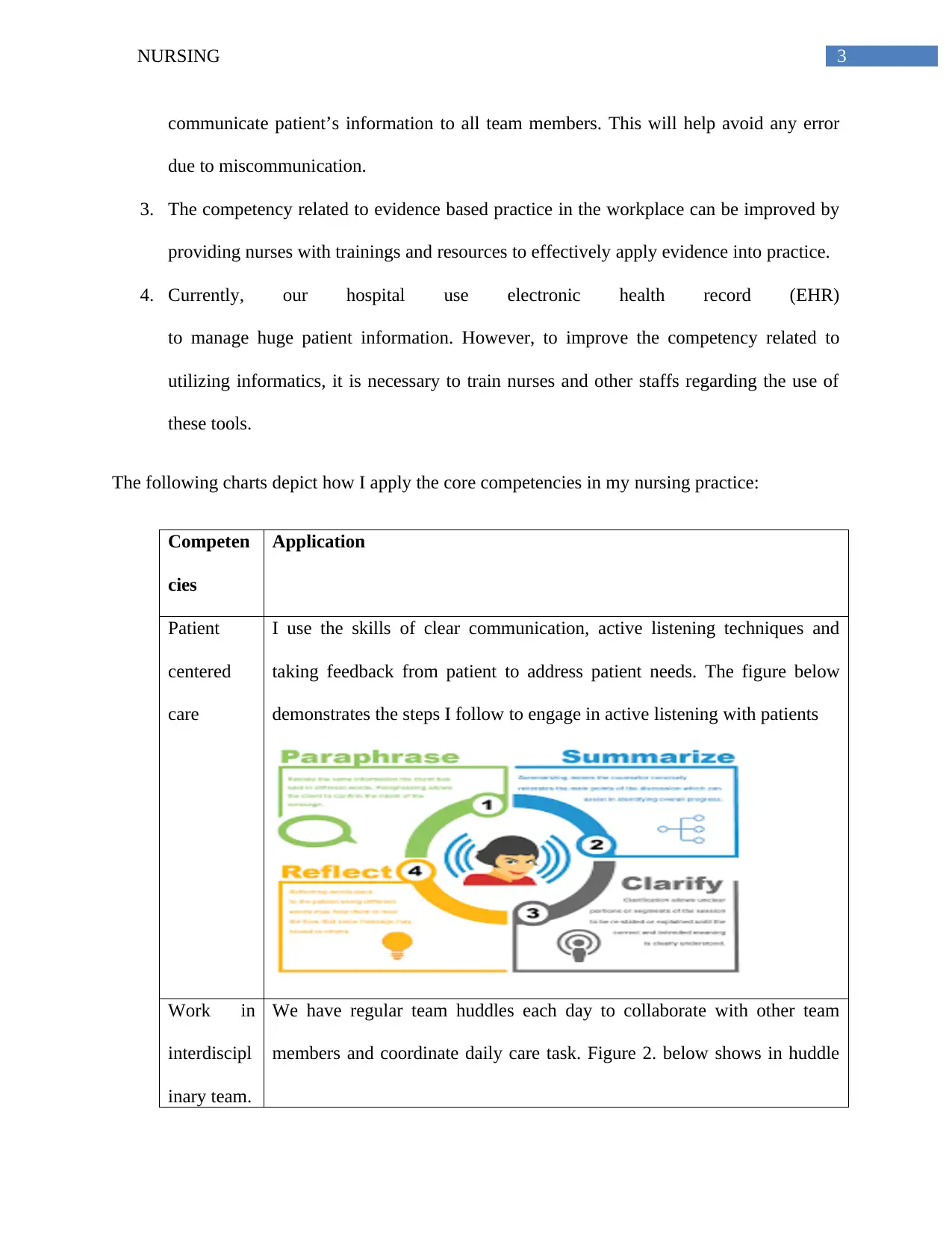
I access published resources when I find any patient problem to confusing
and use those evidence to improve quality of care. I follow the five basic
steps as mentioned in Figure 3 below.
Apply
quality
improveme
nt
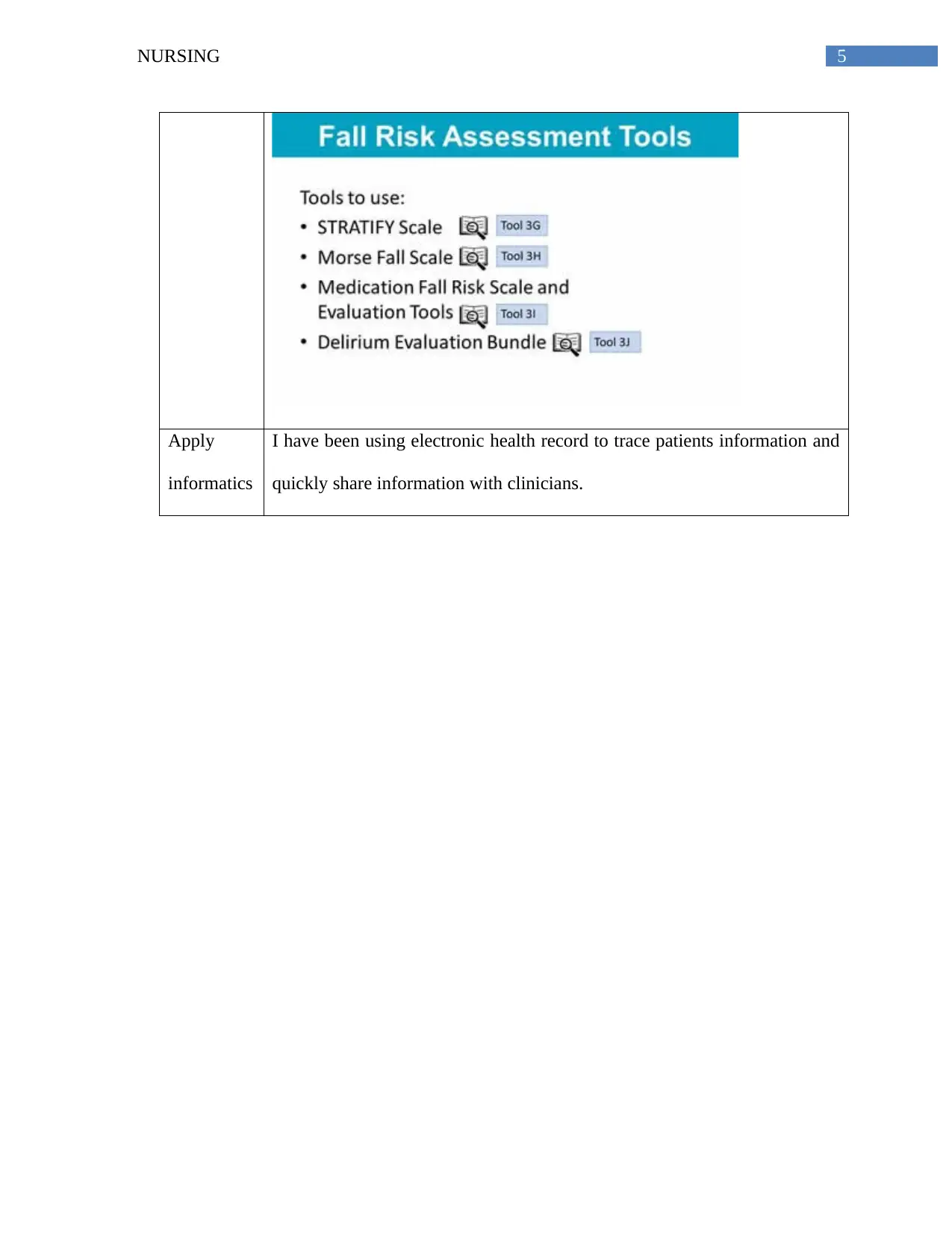
I use fall assessment tools to identify fall risk in elderly patients. The
following figure shows the tool that is commonly uses for fall risk
assessment.
Document Page
5NURSING
Apply
informatics
I have been using electronic health record to trace patients information and
quickly share information with clinicians.
Document Page
6NURSING
References:
Fleming, M. O., & Haney, T. T. (2013). An imperative: patient-centered care for our aging
population. The Ochsner Journal, 13(2), 190. Retrieved from:
https://www.ncbi.nlm.nih.gov/pmc/articles/PMC3684326/pdf/i1524-5012-13-2-190.pdf
Jin, J. (2018). Prevention of falls in older adults. Jama, 319(16), 1734-1734.
doi:10.1001/jama.2018.4396
Knebel, E., & Greiner, A. C. (Eds.). (2003). Health professions education: A bridge to quality.
National Academies Press.
chevron_up_icon
1 out of 7
circle_padding
hide_on_mobile
zoom_out_icon
[object Object]