Conflict Resolution Case Study: Analyzing Conflict Resolution Methods

Verified

Added on  2022/10/10

|4
|824
|70
Case Study
AI Summary
This case study examines a conflict between Kelly, a third-year undergraduate nursing student, and her preceptor, Jack, focusing on a disagreement regarding patient handover. The conflict arises when Kelly forgets crucial details, leading Jack to correct her in front of the staff. The assignment explores both informal and formal methods of conflict resolution. Informal methods discussed include collaboration, admitting mistakes, and avoiding the conflict. Formal methods involve mediation by a third party, such as the manager, who facilitates a discussion between the parties to find a resolution, without imposing a solution. The analysis references the Thomas Kilman conflict resolution model and emphasizes the importance of understanding different approaches to effectively manage workplace disputes.
Document Page
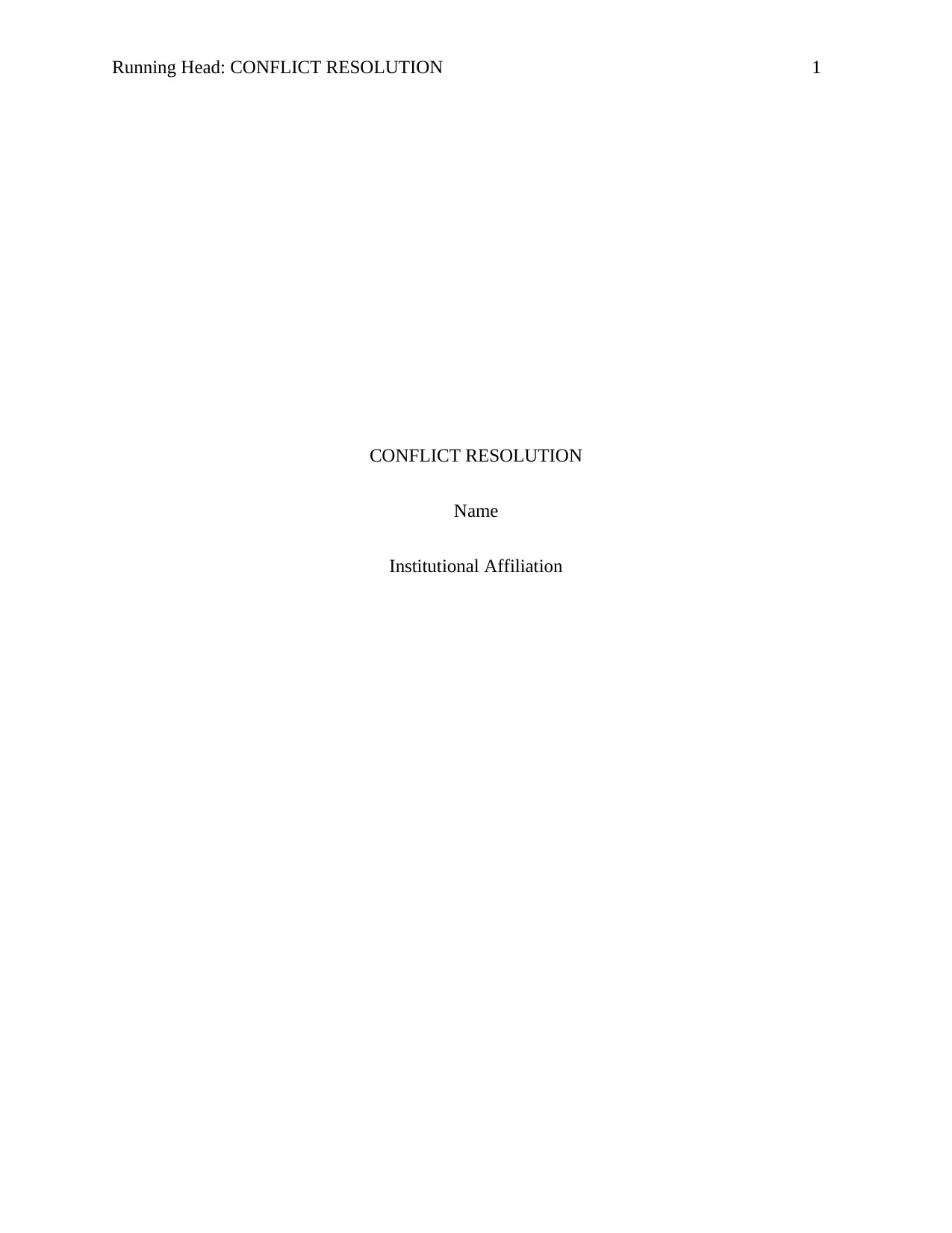
Running Head: CONFLICT RESOLUTION 1
CONFLICT RESOLUTION
Name
Institutional Affiliation
tabler-icon-diamond-filled.svg

Paraphrase This Document

Need a fresh take? Get an instant paraphrase of this document with our AI Paraphraser
Document Page
CONFLICT RESOLUTION 2
Conflict resolution
Conflict resolution serves as means of two or more parties that are disagreeing to find a
peaceful solution. The resolution can be done formally or informally as stipulated in the Thomas
Kilman conflict resolution model (Wolfe et al., 2018). In this particular case study, Kelly and her
preceptor, Jack, are having a disagreement regarding the handover of patients. As Kelly prepares
her handover, she forgets essential details about her patients that she is supposed to tell the
afternoon staff who are supposed to take over. As a result, Jack tells the staff crucial details
regarding the patients that Kelly left out earlier. Jack then pulls Kelly aside and advises her that
she needs to improve on her handover. Kelly gets upset and tries to justify her actions by telling
Jack that she only forgot to say two things. As a result of this altercation, a conflict, which needs
to be resolved, develops. This conflict occurs in day 3. In day 1 and 2, everything seems smooth
between Kelly and Jack; hence, there is no conflict.
Informal ways of resolving conflict
This conflict can be resolved in a variety of ways that are both formal and informal. First,
Kelly and Jack can collaborate in resolving the conflict. Kelly should calm down and try to
understand what Jack is telling her. She should also admit her mistake and apologize to Jack. On
the flip side, Jack should understand that anyone can make a mistake; therefore, Kelly is not
unique. He should also give her time to adapt to the new surroundings. If these two parties, Jack
and Kelly, can collaborate effectively, then this conflict will be resolved (Almost et al., 2016).
Avoiding is one of the best ways of resolving conflicts. It means withdrawing or ignoring
a conflict. If Jack had not told Kelly about her mistakes, Kelly would not have protested, and
therefore, no conflict would have ensued between them and thereby nothing to resolve. Also, if
Document Page
CONFLICT RESOLUTION 3
Kelly had remained mum or had responded happily to Jack’s word, no conflict would have
ensued, and therefore, there would be nothing to resolve. Avoidance has some limitations in that
an individual is unable to express his or her views accordingly (Dignath et al., 2015).
Formal ways of resolving conflict
Another way that this conflict can be resolved is through mediation by a third party
(McKenzie, 2015). Kelly writes an incident report and hands it over to John, the manager, and
explains to him what has transpired between her and her preceptor, Jack. The manager can
decide to summon both parties to his office and listen to them. The manager will be required to
give both Kelly and Jack an opportunity to present their side of the story without favoring
anyone. He should not make any decision or impose a solution regarding this issue. Jack and
Kelly should voluntarily agree on the way forward in resolving the conflict by themselves
without the input of John. For instance, Kelly can willingly admit that she was wrong and that
she will try as much as possible to avoid any altercations with Jack that may lead to a conflict in
the future. By doing this, Kelly would be using the accommodating method of resolving conflict.
The method has some disadvantages in that the dispute is not resolved fully.
Document Page
CONFLICT RESOLUTION 4
References
Almost, J., Wolff, A. C., Stewart‐Pyne, A., McCormick, L. G., Strachan, D., & D'souza, C.
(2016). Managing and mitigating conflict in healthcare teams: an integrative review.
Journal of advanced nursing, 72(7), 1490-1505.
Dignath, D., Kiesel, A., & Eder, A. B. (2015). Flexible conflict management: conflict avoidance
and conflict adjustment in reactive cognitive control. Journal of Experimental
Psychology: Learning, Memory, and Cognition, 41(4), 975.
McKenzie, D. M. (2015). The role of mediation in resolving workplace relationship conflict.
International journal of law and psychiatry, 39, 52-59.
Wolfe, A. D., Hoang, K. B., & Denniston, S. F. (2018). Teaching conflict resolution in medicine:
lessons from business, diplomacy, and theatre. MedEdPORTAL: the journal of teaching
and learning resources, 14.
chevron_up_icon
1 out of 4
circle_padding
hide_on_mobile
zoom_out_icon
[object Object]