NUR5004: Learning Contracts on Nursing Practice and Falls Prevention
VerifiedAdded on 2020/03/04
|10
|2709
|134
Homework Assignment
AI Summary
This document presents two learning contracts completed by a nursing student for the NUR5004 Contemporary Nursing Practice 4 course in 2017. The first learning contract focuses on hospital-acquired infections, detailing the student's learning goals, objectives (understanding causes, symptoms/diagnosis, and prevention/management), and the evidence used (books, e-books, journals, and research articles). The second learning contract centers on fall-related injuries and prevention in elderly patients, outlining learning objectives (causes, complications, and prevention/treatments) and supporting evidence. The contracts also include a section addressing NMBA (Nursing and Midwifery Board of Australia) standards, linking learning objectives to specific standards and outlining strategies for achieving them, such as critical thinking, therapeutic relationships, and safe practice. The student provides plans to achieve these goals, including research, analysis, and communication strategies, and references various resources to support their learning.
NUR5004 - 2017
Assessment task 1
Student Name: ________
Student Number: ___________
Learning contracts
Assessment task 1
Student Name: ________
Student Number: ___________
Learning contracts
Paraphrase This Document
Need a fresh take? Get an instant paraphrase of this document with our AI Paraphraser

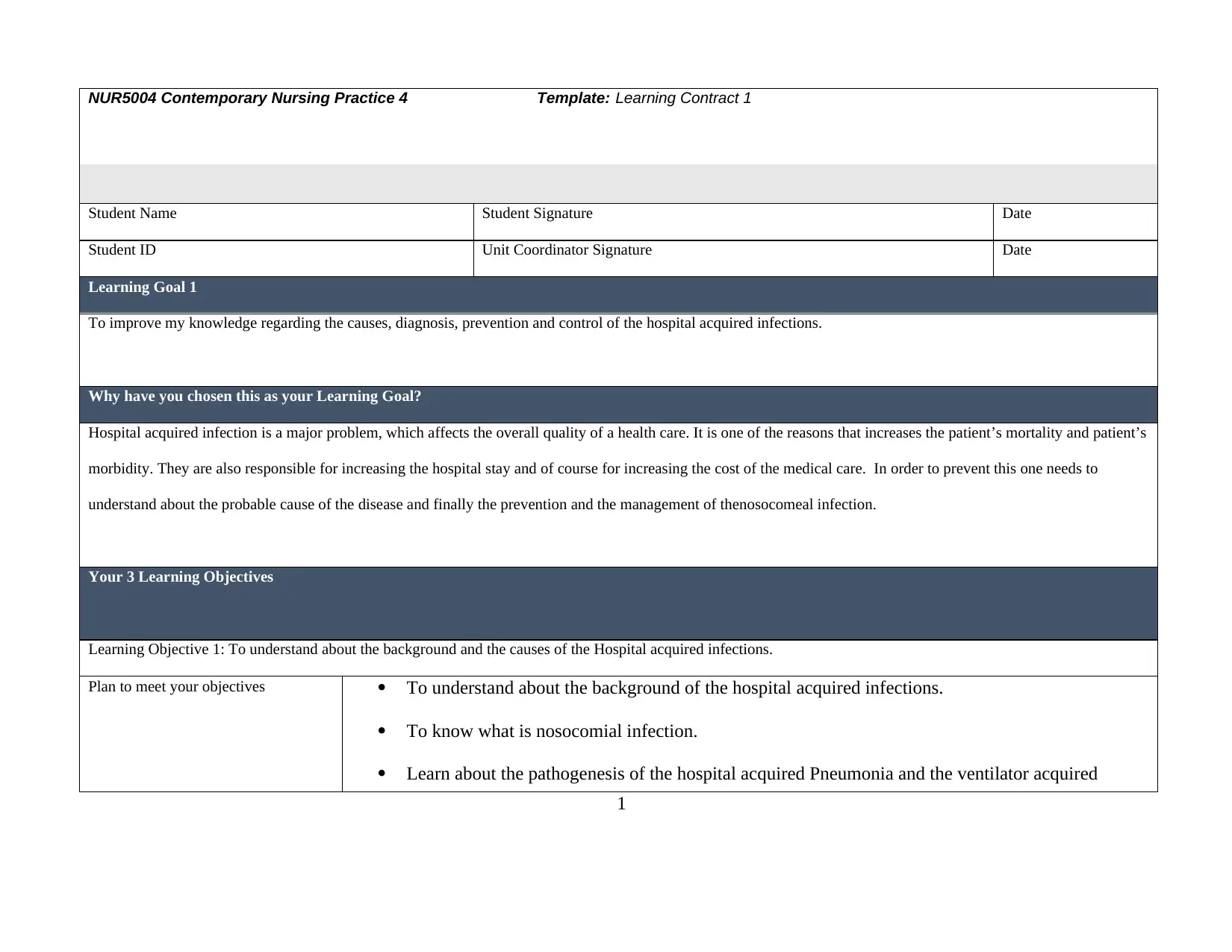
NUR5004 Contemporary Nursing Practice 4 Template: Learning Contract 1
Student Name Student Signature Date
Student ID Unit Coordinator Signature Date
Learning Goal 1
To improve my knowledge regarding the causes, diagnosis, prevention and control of the hospital acquired infections.
Why have you chosen this as your Learning Goal?
Hospital acquired infection is a major problem, which affects the overall quality of a health care. It is one of the reasons that increases the patient’s mortality and patient’s
morbidity. They are also responsible for increasing the hospital stay and of course for increasing the cost of the medical care. In order to prevent this one needs to
understand about the probable cause of the disease and finally the prevention and the management of thenosocomeal infection.
Your 3 Learning Objectives
Learning Objective 1: To understand about the background and the causes of the Hospital acquired infections.
Plan to meet your objectives To understand about the background of the hospital acquired infections.
To know what is nosocomial infection.
Learn about the pathogenesis of the hospital acquired Pneumonia and the ventilator acquired
1
Student Name Student Signature Date
Student ID Unit Coordinator Signature Date
Learning Goal 1
To improve my knowledge regarding the causes, diagnosis, prevention and control of the hospital acquired infections.
Why have you chosen this as your Learning Goal?
Hospital acquired infection is a major problem, which affects the overall quality of a health care. It is one of the reasons that increases the patient’s mortality and patient’s
morbidity. They are also responsible for increasing the hospital stay and of course for increasing the cost of the medical care. In order to prevent this one needs to
understand about the probable cause of the disease and finally the prevention and the management of thenosocomeal infection.
Your 3 Learning Objectives
Learning Objective 1: To understand about the background and the causes of the Hospital acquired infections.
Plan to meet your objectives To understand about the background of the hospital acquired infections.
To know what is nosocomial infection.
Learn about the pathogenesis of the hospital acquired Pneumonia and the ventilator acquired
1

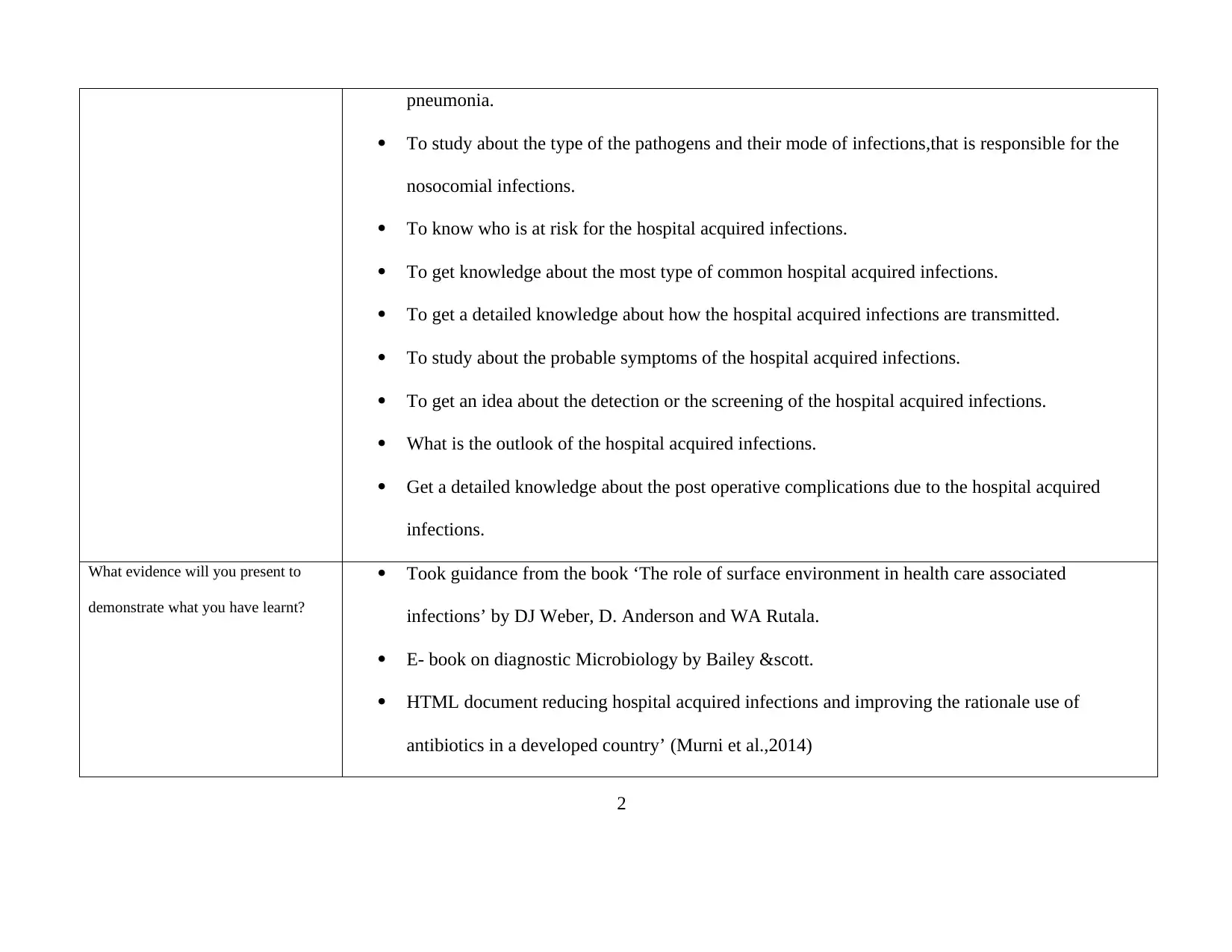
pneumonia.
To study about the type of the pathogens and their mode of infections,that is responsible for the
nosocomial infections.
To know who is at risk for the hospital acquired infections.
To get knowledge about the most type of common hospital acquired infections.
To get a detailed knowledge about how the hospital acquired infections are transmitted.
To study about the probable symptoms of the hospital acquired infections.
To get an idea about the detection or the screening of the hospital acquired infections.
What is the outlook of the hospital acquired infections.
Get a detailed knowledge about the post operative complications due to the hospital acquired
infections.
What evidence will you present to
demonstrate what you have learnt?
Took guidance from the book ‘The role of surface environment in health care associated
infections’ by DJ Weber, D. Anderson and WA Rutala.
E- book on diagnostic Microbiology by Bailey &scott.
HTML document reducing hospital acquired infections and improving the rationale use of
antibiotics in a developed country’ (Murni et al.,2014)
2
To study about the type of the pathogens and their mode of infections,that is responsible for the
nosocomial infections.
To know who is at risk for the hospital acquired infections.
To get knowledge about the most type of common hospital acquired infections.
To get a detailed knowledge about how the hospital acquired infections are transmitted.
To study about the probable symptoms of the hospital acquired infections.
To get an idea about the detection or the screening of the hospital acquired infections.
What is the outlook of the hospital acquired infections.
Get a detailed knowledge about the post operative complications due to the hospital acquired
infections.
What evidence will you present to
demonstrate what you have learnt?
Took guidance from the book ‘The role of surface environment in health care associated
infections’ by DJ Weber, D. Anderson and WA Rutala.
E- book on diagnostic Microbiology by Bailey &scott.
HTML document reducing hospital acquired infections and improving the rationale use of
antibiotics in a developed country’ (Murni et al.,2014)
2
⊘ This is a preview!⊘
Do you want full access?
Subscribe today to unlock all pages.

Trusted by 1+ million students worldwide

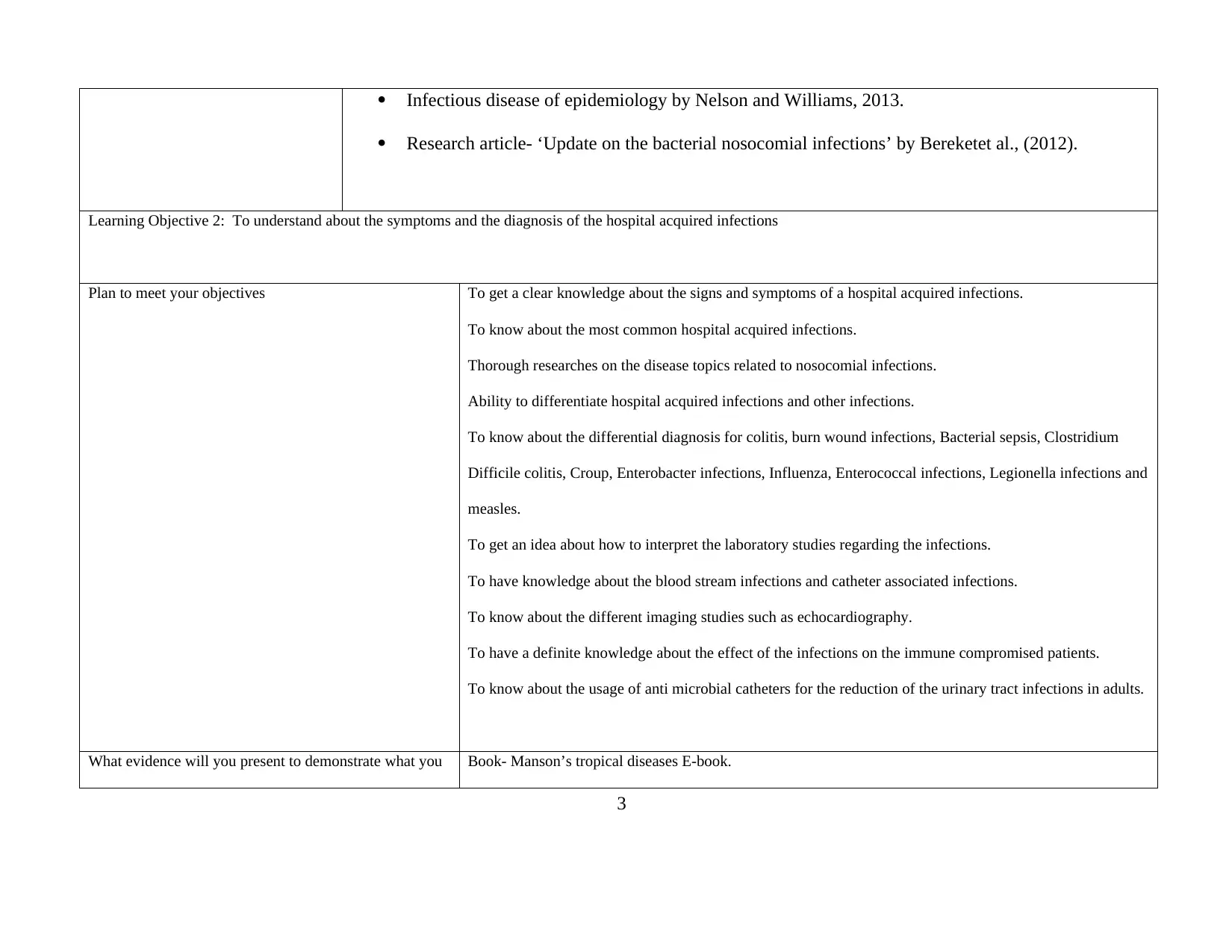
Infectious disease of epidemiology by Nelson and Williams, 2013.
Research article- ‘Update on the bacterial nosocomial infections’ by Bereketet al., (2012).
Learning Objective 2: To understand about the symptoms and the diagnosis of the hospital acquired infections
Plan to meet your objectives To get a clear knowledge about the signs and symptoms of a hospital acquired infections.
To know about the most common hospital acquired infections.
Thorough researches on the disease topics related to nosocomial infections.
Ability to differentiate hospital acquired infections and other infections.
To know about the differential diagnosis for colitis, burn wound infections, Bacterial sepsis, Clostridium
Difficile colitis, Croup, Enterobacter infections, Influenza, Enterococcal infections, Legionella infections and
measles.
To get an idea about how to interpret the laboratory studies regarding the infections.
To have knowledge about the blood stream infections and catheter associated infections.
To know about the different imaging studies such as echocardiography.
To have a definite knowledge about the effect of the infections on the immune compromised patients.
To know about the usage of anti microbial catheters for the reduction of the urinary tract infections in adults.
What evidence will you present to demonstrate what you Book- Manson’s tropical diseases E-book.
3
Research article- ‘Update on the bacterial nosocomial infections’ by Bereketet al., (2012).
Learning Objective 2: To understand about the symptoms and the diagnosis of the hospital acquired infections
Plan to meet your objectives To get a clear knowledge about the signs and symptoms of a hospital acquired infections.
To know about the most common hospital acquired infections.
Thorough researches on the disease topics related to nosocomial infections.
Ability to differentiate hospital acquired infections and other infections.
To know about the differential diagnosis for colitis, burn wound infections, Bacterial sepsis, Clostridium
Difficile colitis, Croup, Enterobacter infections, Influenza, Enterococcal infections, Legionella infections and
measles.
To get an idea about how to interpret the laboratory studies regarding the infections.
To have knowledge about the blood stream infections and catheter associated infections.
To know about the different imaging studies such as echocardiography.
To have a definite knowledge about the effect of the infections on the immune compromised patients.
To know about the usage of anti microbial catheters for the reduction of the urinary tract infections in adults.
What evidence will you present to demonstrate what you Book- Manson’s tropical diseases E-book.
3
Paraphrase This Document
Need a fresh take? Get an instant paraphrase of this document with our AI Paraphraser

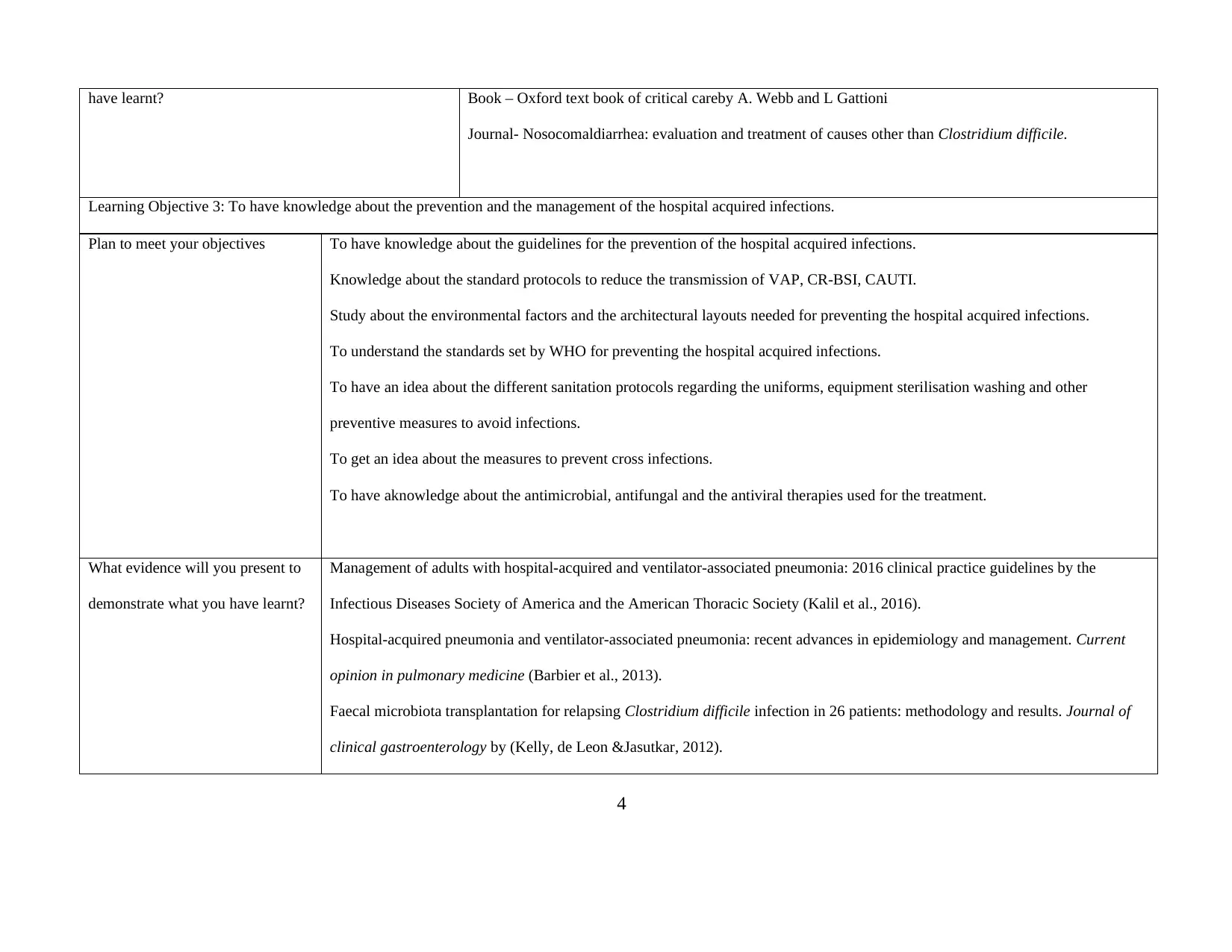
have learnt? Book – Oxford text book of critical careby A. Webb and L Gattioni
Journal- Nosocomaldiarrhea: evaluation and treatment of causes other than Clostridium difficile.
Learning Objective 3: To have knowledge about the prevention and the management of the hospital acquired infections.
Plan to meet your objectives To have knowledge about the guidelines for the prevention of the hospital acquired infections.
Knowledge about the standard protocols to reduce the transmission of VAP, CR-BSI, CAUTI.
Study about the environmental factors and the architectural layouts needed for preventing the hospital acquired infections.
To understand the standards set by WHO for preventing the hospital acquired infections.
To have an idea about the different sanitation protocols regarding the uniforms, equipment sterilisation washing and other
preventive measures to avoid infections.
To get an idea about the measures to prevent cross infections.
To have aknowledge about the antimicrobial, antifungal and the antiviral therapies used for the treatment.
What evidence will you present to
demonstrate what you have learnt?
Management of adults with hospital-acquired and ventilator-associated pneumonia: 2016 clinical practice guidelines by the
Infectious Diseases Society of America and the American Thoracic Society (Kalil et al., 2016).
Hospital-acquired pneumonia and ventilator-associated pneumonia: recent advances in epidemiology and management. Current
opinion in pulmonary medicine (Barbier et al., 2013).
Faecal microbiota transplantation for relapsing Clostridium difficile infection in 26 patients: methodology and results. Journal of
clinical gastroenterology by (Kelly, de Leon &Jasutkar, 2012).
4
Journal- Nosocomaldiarrhea: evaluation and treatment of causes other than Clostridium difficile.
Learning Objective 3: To have knowledge about the prevention and the management of the hospital acquired infections.
Plan to meet your objectives To have knowledge about the guidelines for the prevention of the hospital acquired infections.
Knowledge about the standard protocols to reduce the transmission of VAP, CR-BSI, CAUTI.
Study about the environmental factors and the architectural layouts needed for preventing the hospital acquired infections.
To understand the standards set by WHO for preventing the hospital acquired infections.
To have an idea about the different sanitation protocols regarding the uniforms, equipment sterilisation washing and other
preventive measures to avoid infections.
To get an idea about the measures to prevent cross infections.
To have aknowledge about the antimicrobial, antifungal and the antiviral therapies used for the treatment.
What evidence will you present to
demonstrate what you have learnt?
Management of adults with hospital-acquired and ventilator-associated pneumonia: 2016 clinical practice guidelines by the
Infectious Diseases Society of America and the American Thoracic Society (Kalil et al., 2016).
Hospital-acquired pneumonia and ventilator-associated pneumonia: recent advances in epidemiology and management. Current
opinion in pulmonary medicine (Barbier et al., 2013).
Faecal microbiota transplantation for relapsing Clostridium difficile infection in 26 patients: methodology and results. Journal of
clinical gastroenterology by (Kelly, de Leon &Jasutkar, 2012).
4

NUR5004 Contemporary Nursing Practice 4 Template: Learning Contract 1
Student Name Student Signature Date
Student ID Unit Coordinator Signature Date
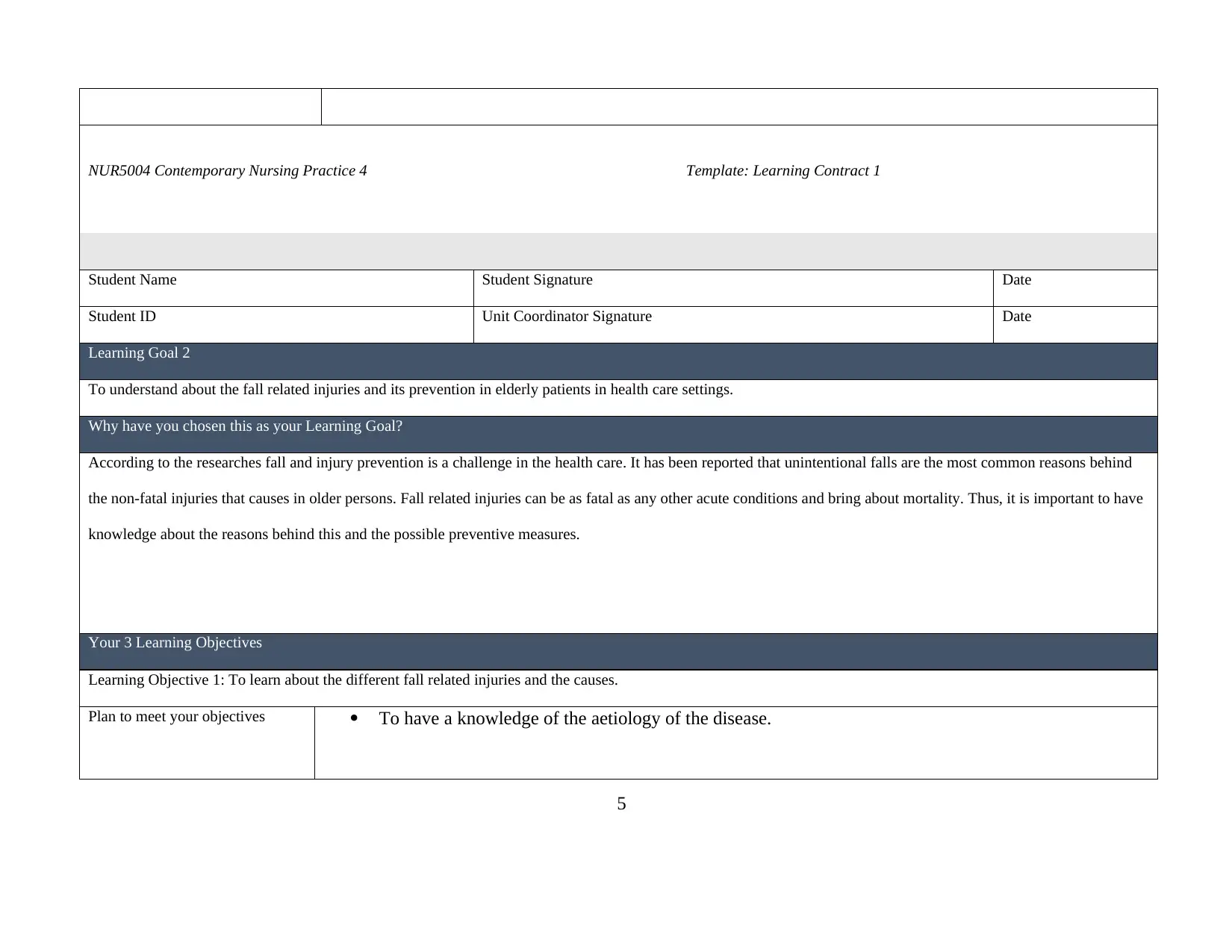
Learning Goal 2
To understand about the fall related injuries and its prevention in elderly patients in health care settings.
Why have you chosen this as your Learning Goal?
According to the researches fall and injury prevention is a challenge in the health care. It has been reported that unintentional falls are the most common reasons behind
the non-fatal injuries that causes in older persons. Fall related injuries can be as fatal as any other acute conditions and bring about mortality. Thus, it is important to have
knowledge about the reasons behind this and the possible preventive measures.
Your 3 Learning Objectives
Learning Objective 1: To learn about the different fall related injuries and the causes.
Plan to meet your objectives To have a knowledge of the aetiology of the disease.
5
Student Name Student Signature Date
Student ID Unit Coordinator Signature Date
Learning Goal 2
To understand about the fall related injuries and its prevention in elderly patients in health care settings.
Why have you chosen this as your Learning Goal?
According to the researches fall and injury prevention is a challenge in the health care. It has been reported that unintentional falls are the most common reasons behind
the non-fatal injuries that causes in older persons. Fall related injuries can be as fatal as any other acute conditions and bring about mortality. Thus, it is important to have
knowledge about the reasons behind this and the possible preventive measures.
Your 3 Learning Objectives
Learning Objective 1: To learn about the different fall related injuries and the causes.
Plan to meet your objectives To have a knowledge of the aetiology of the disease.
5
⊘ This is a preview!⊘
Do you want full access?
Subscribe today to unlock all pages.

Trusted by 1+ million students worldwide

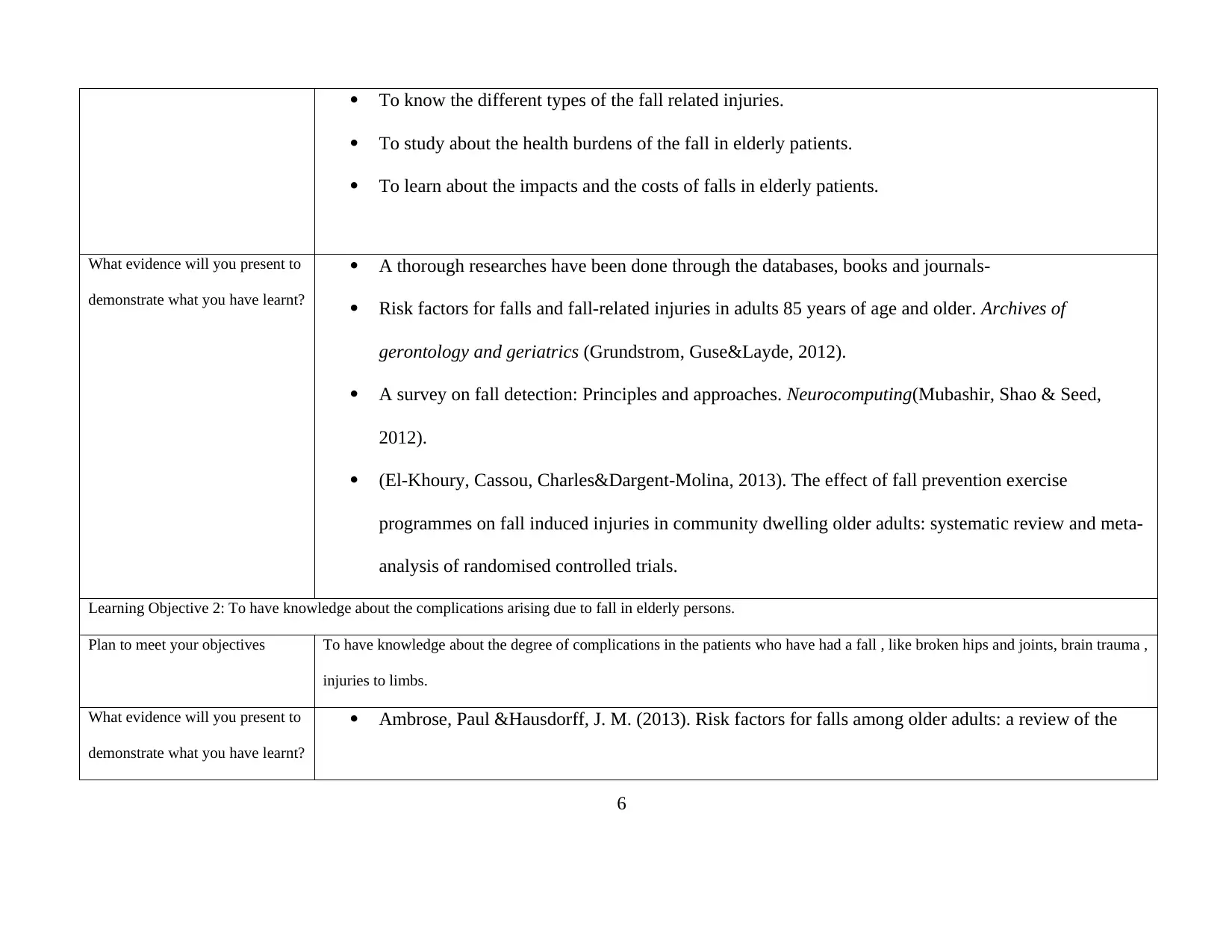
To know the different types of the fall related injuries.
To study about the health burdens of the fall in elderly patients.
To learn about the impacts and the costs of falls in elderly patients.
What evidence will you present to
demonstrate what you have learnt?
A thorough researches have been done through the databases, books and journals-
Risk factors for falls and fall-related injuries in adults 85 years of age and older. Archives of
gerontology and geriatrics (Grundstrom, Guse&Layde, 2012).
A survey on fall detection: Principles and approaches. Neurocomputing(Mubashir, Shao & Seed,
2012).
(El-Khoury, Cassou, Charles&Dargent-Molina, 2013). The effect of fall prevention exercise
programmes on fall induced injuries in community dwelling older adults: systematic review and meta-
analysis of randomised controlled trials.
Learning Objective 2: To have knowledge about the complications arising due to fall in elderly persons.
Plan to meet your objectives To have knowledge about the degree of complications in the patients who have had a fall , like broken hips and joints, brain trauma ,
injuries to limbs.
What evidence will you present to
demonstrate what you have learnt?
Ambrose, Paul &Hausdorff, J. M. (2013). Risk factors for falls among older adults: a review of the
6
To study about the health burdens of the fall in elderly patients.
To learn about the impacts and the costs of falls in elderly patients.
What evidence will you present to
demonstrate what you have learnt?
A thorough researches have been done through the databases, books and journals-
Risk factors for falls and fall-related injuries in adults 85 years of age and older. Archives of
gerontology and geriatrics (Grundstrom, Guse&Layde, 2012).
A survey on fall detection: Principles and approaches. Neurocomputing(Mubashir, Shao & Seed,
2012).
(El-Khoury, Cassou, Charles&Dargent-Molina, 2013). The effect of fall prevention exercise
programmes on fall induced injuries in community dwelling older adults: systematic review and meta-
analysis of randomised controlled trials.
Learning Objective 2: To have knowledge about the complications arising due to fall in elderly persons.
Plan to meet your objectives To have knowledge about the degree of complications in the patients who have had a fall , like broken hips and joints, brain trauma ,
injuries to limbs.
What evidence will you present to
demonstrate what you have learnt?
Ambrose, Paul &Hausdorff, J. M. (2013). Risk factors for falls among older adults: a review of the
6
Paraphrase This Document
Need a fresh take? Get an instant paraphrase of this document with our AI Paraphraser

literature. Maturitas.
(Grundstrom, Guse&Layde2012). Risk factors for falls and fall-related injuries in adults 85 years of
age and older. Archives of gerontology and geriatrics.
More books and journals and databases have been gone through.
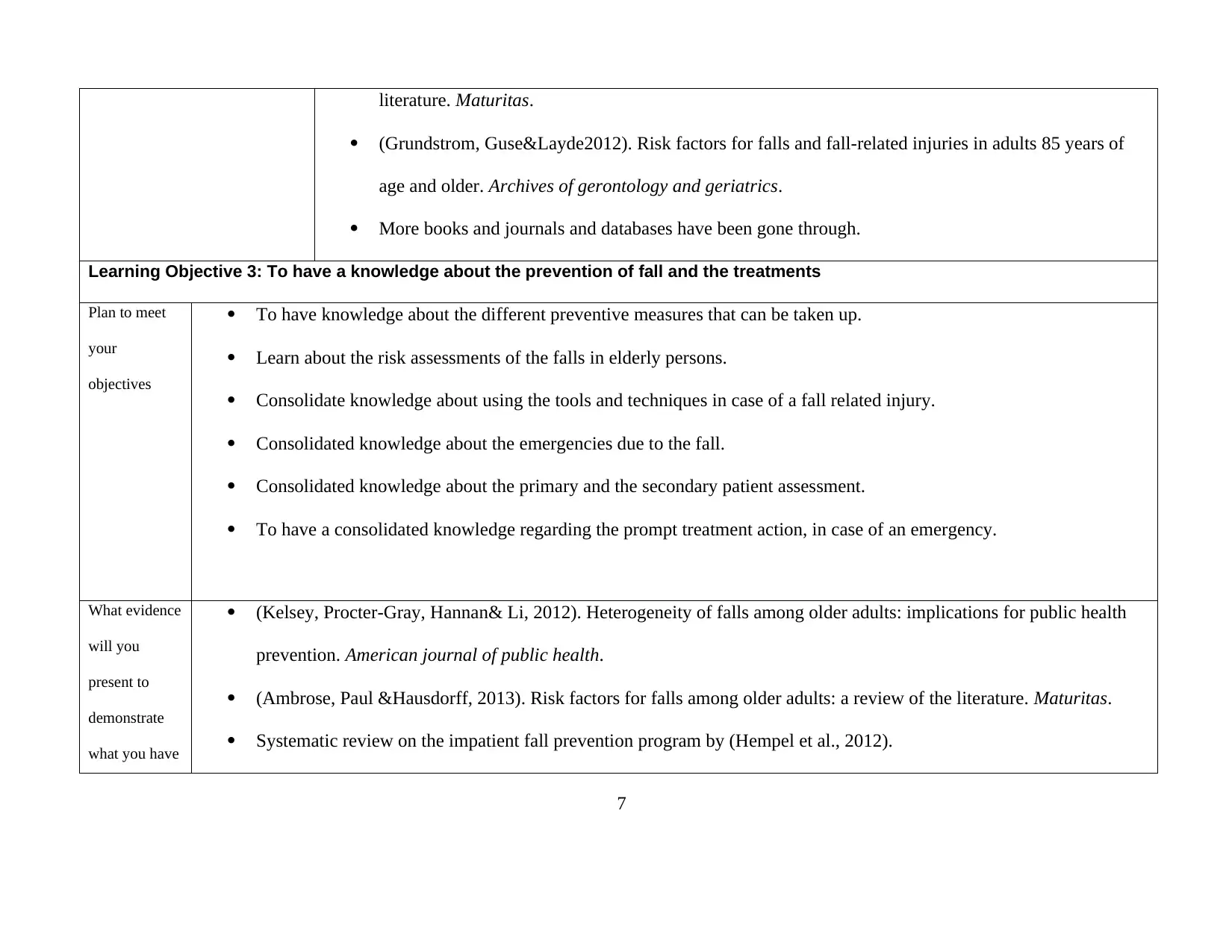
Learning Objective 3: To have a knowledge about the prevention of fall and the treatments
Plan to meet
your
objectives
To have knowledge about the different preventive measures that can be taken up.
Learn about the risk assessments of the falls in elderly persons.
Consolidate knowledge about using the tools and techniques in case of a fall related injury.
Consolidated knowledge about the emergencies due to the fall.
Consolidated knowledge about the primary and the secondary patient assessment.
To have a consolidated knowledge regarding the prompt treatment action, in case of an emergency.
What evidence
will you
present to
demonstrate
what you have
(Kelsey, Procter-Gray, Hannan& Li, 2012). Heterogeneity of falls among older adults: implications for public health
prevention. American journal of public health.
(Ambrose, Paul &Hausdorff, 2013). Risk factors for falls among older adults: a review of the literature. Maturitas.
Systematic review on the impatient fall prevention program by (Hempel et al., 2012).
7
(Grundstrom, Guse&Layde2012). Risk factors for falls and fall-related injuries in adults 85 years of
age and older. Archives of gerontology and geriatrics.
More books and journals and databases have been gone through.
Learning Objective 3: To have a knowledge about the prevention of fall and the treatments
Plan to meet
your
objectives
To have knowledge about the different preventive measures that can be taken up.
Learn about the risk assessments of the falls in elderly persons.
Consolidate knowledge about using the tools and techniques in case of a fall related injury.
Consolidated knowledge about the emergencies due to the fall.
Consolidated knowledge about the primary and the secondary patient assessment.
To have a consolidated knowledge regarding the prompt treatment action, in case of an emergency.
What evidence
will you
present to
demonstrate
what you have
(Kelsey, Procter-Gray, Hannan& Li, 2012). Heterogeneity of falls among older adults: implications for public health
prevention. American journal of public health.
(Ambrose, Paul &Hausdorff, 2013). Risk factors for falls among older adults: a review of the literature. Maturitas.
Systematic review on the impatient fall prevention program by (Hempel et al., 2012).
7

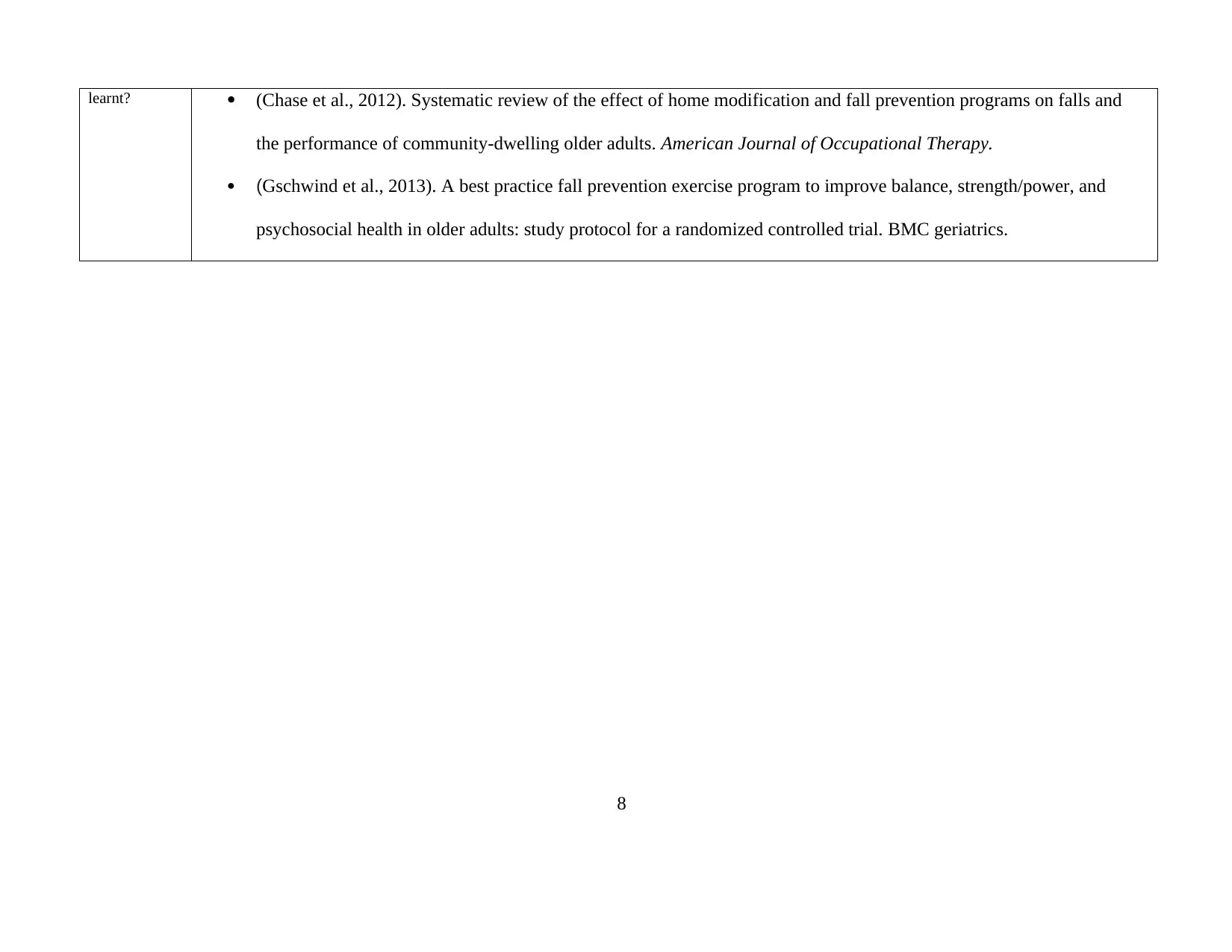
learnt? (Chase et al., 2012). Systematic review of the effect of home modification and fall prevention programs on falls and
the performance of community-dwelling older adults. American Journal of Occupational Therapy.
(Gschwind et al., 2013). A best practice fall prevention exercise program to improve balance, strength/power, and
psychosocial health in older adults: study protocol for a randomized controlled trial. BMC geriatrics.
8
the performance of community-dwelling older adults. American Journal of Occupational Therapy.
(Gschwind et al., 2013). A best practice fall prevention exercise program to improve balance, strength/power, and
psychosocial health in older adults: study protocol for a randomized controlled trial. BMC geriatrics.
8
⊘ This is a preview!⊘
Do you want full access?
Subscribe today to unlock all pages.

Trusted by 1+ million students worldwide

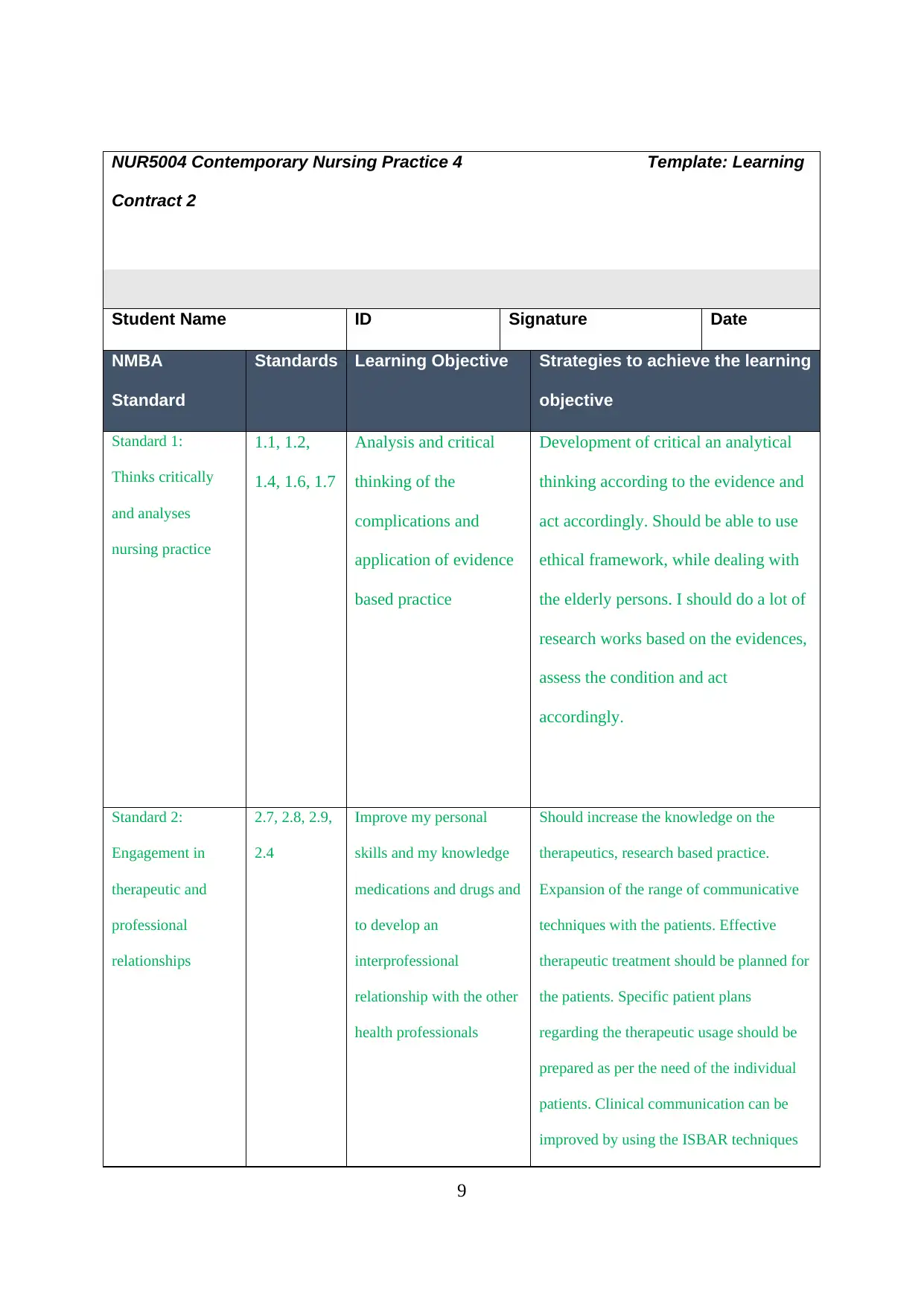
NUR5004 Contemporary Nursing Practice 4 Template: Learning
Contract 2
Student Name ID Signature Date
NMBA
Standard
Standards Learning Objective Strategies to achieve the learning
objective
Standard 1:
Thinks critically
and analyses
nursing practice
1.1, 1.2,
1.4, 1.6, 1.7
Analysis and critical
thinking of the
complications and
application of evidence
based practice
Development of critical an analytical
thinking according to the evidence and
act accordingly. Should be able to use
ethical framework, while dealing with
the elderly persons. I should do a lot of
research works based on the evidences,
assess the condition and act
accordingly.
Standard 2:
Engagement in
therapeutic and
professional
relationships
2.7, 2.8, 2.9,
2.4
Improve my personal
skills and my knowledge
medications and drugs and
to develop an
interprofessional
relationship with the other
health professionals
Should increase the knowledge on the
therapeutics, research based practice.
Expansion of the range of communicative
techniques with the patients. Effective
therapeutic treatment should be planned for
the patients. Specific patient plans
regarding the therapeutic usage should be
prepared as per the need of the individual
patients. Clinical communication can be
improved by using the ISBAR techniques
9
Contract 2
Student Name ID Signature Date
NMBA
Standard
Standards Learning Objective Strategies to achieve the learning
objective
Standard 1:
Thinks critically
and analyses
nursing practice
1.1, 1.2,
1.4, 1.6, 1.7
Analysis and critical
thinking of the
complications and
application of evidence
based practice
Development of critical an analytical
thinking according to the evidence and
act accordingly. Should be able to use
ethical framework, while dealing with
the elderly persons. I should do a lot of
research works based on the evidences,
assess the condition and act
accordingly.
Standard 2:
Engagement in
therapeutic and
professional
relationships
2.7, 2.8, 2.9,
2.4
Improve my personal
skills and my knowledge
medications and drugs and
to develop an
interprofessional
relationship with the other
health professionals
Should increase the knowledge on the
therapeutics, research based practice.
Expansion of the range of communicative
techniques with the patients. Effective
therapeutic treatment should be planned for
the patients. Specific patient plans
regarding the therapeutic usage should be
prepared as per the need of the individual
patients. Clinical communication can be
improved by using the ISBAR techniques
9
1 out of 10
Related Documents
Your All-in-One AI-Powered Toolkit for Academic Success.
+13062052269
info@desklib.com
Available 24*7 on WhatsApp / Email
Unlock your academic potential
Copyright © 2020–2025 A2Z Services. All Rights Reserved. Developed and managed by ZUCOL.