International Nursing: Challenges for Nurses in Emergency Departments

Verified

Added on  2020/01/23

|9
|2593
|263
Report
AI Summary
This report delves into the multifaceted challenges encountered by nurses who migrate internationally, with a specific focus on Australian registered nurses working in emergency departments in African countries. The introduction highlights the increasing trend of nurse migration due to globalization and global healthcare needs, emphasizing the cultural barriers, psychosocial aspects, and varying nursing practices across different regions. The discussion section addresses the need for nurses to adapt to new environments and provides an overview of the role of nurses in emergency departments, including the constraints of overcrowding, resource limitations, and increasing patient loads. The evidence section further explores the specific challenges faced by nurses in Africa, such as the lack of defined nursing roles, limited resources, and the prevalence of infectious diseases like HIV and TB. The report concludes by emphasizing the need for well-defined support systems and training for nurses, particularly in developing nations, to effectively address the challenges of international nurse migration and improve patient care. The report underscores the importance of addressing resource limitations, cultural and formal knowledge gaps, and cultural barriers to ensure successful integration and effective practice for these nurses.
Document Page
Running head: INTERNATIONAL NURSING 1
International Nursing
Student's Name:
Instructor's Name:
Date:
tabler-icon-diamond-filled.svg

Paraphrase This Document

Need a fresh take? Get an instant paraphrase of this document with our AI Paraphraser
Document Page
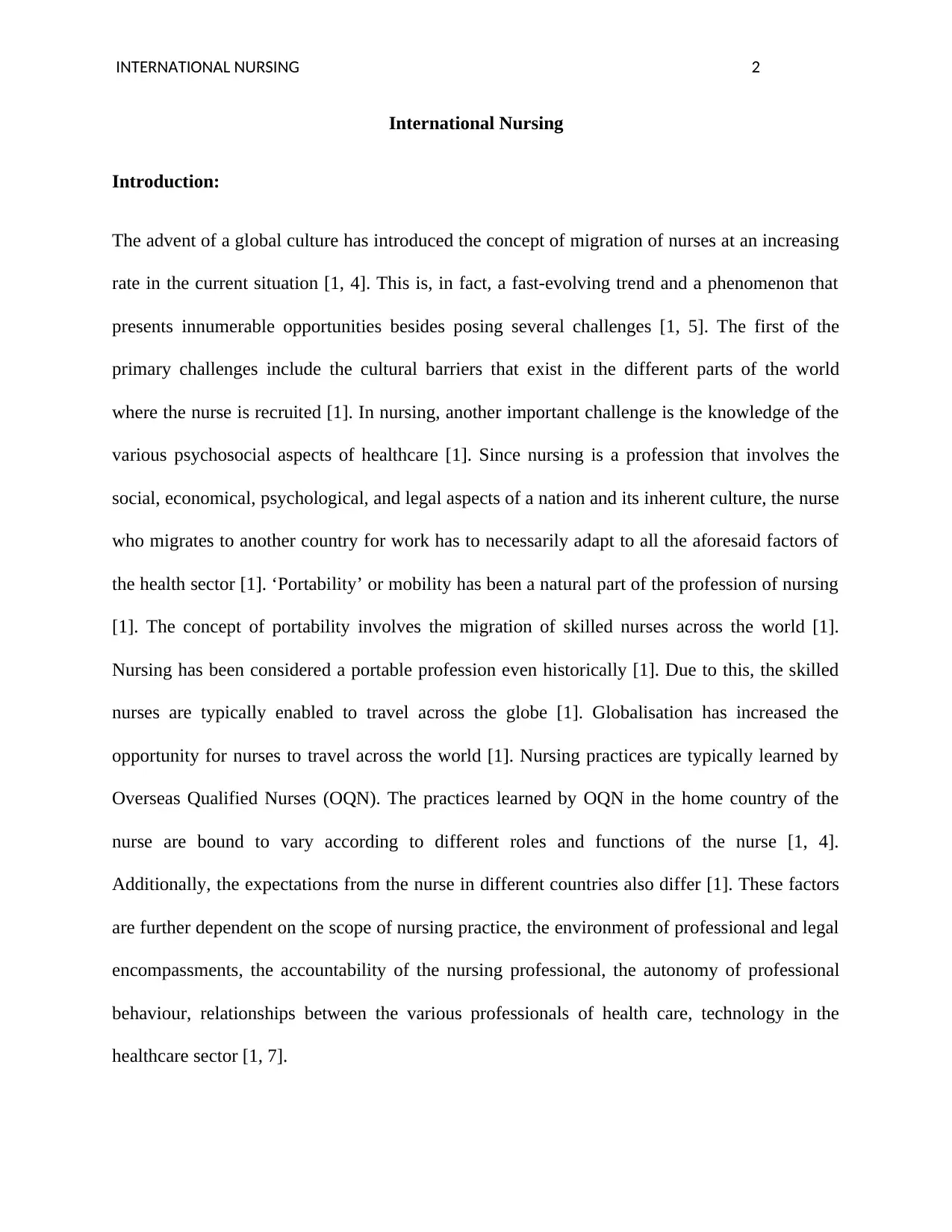
INTERNATIONAL NURSING 2
International Nursing
Introduction:
The advent of a global culture has introduced the concept of migration of nurses at an increasing
rate in the current situation [1, 4]. This is, in fact, a fast-evolving trend and a phenomenon that
presents innumerable opportunities besides posing several challenges [1, 5]. The first of the
primary challenges include the cultural barriers that exist in the different parts of the world
where the nurse is recruited [1]. In nursing, another important challenge is the knowledge of the
various psychosocial aspects of healthcare [1]. Since nursing is a profession that involves the
social, economical, psychological, and legal aspects of a nation and its inherent culture, the nurse
who migrates to another country for work has to necessarily adapt to all the aforesaid factors of
the health sector [1]. ‘Portability’ or mobility has been a natural part of the profession of nursing
[1]. The concept of portability involves the migration of skilled nurses across the world [1].
Nursing has been considered a portable profession even historically [1]. Due to this, the skilled
nurses are typically enabled to travel across the globe [1]. Globalisation has increased the
opportunity for nurses to travel across the world [1]. Nursing practices are typically learned by
Overseas Qualified Nurses (OQN). The practices learned by OQN in the home country of the
nurse are bound to vary according to different roles and functions of the nurse [1, 4].
Additionally, the expectations from the nurse in different countries also differ [1]. These factors
are further dependent on the scope of nursing practice, the environment of professional and legal
encompassments, the accountability of the nursing professional, the autonomy of professional
behaviour, relationships between the various professionals of health care, technology in the
healthcare sector [1, 7].
Document Page
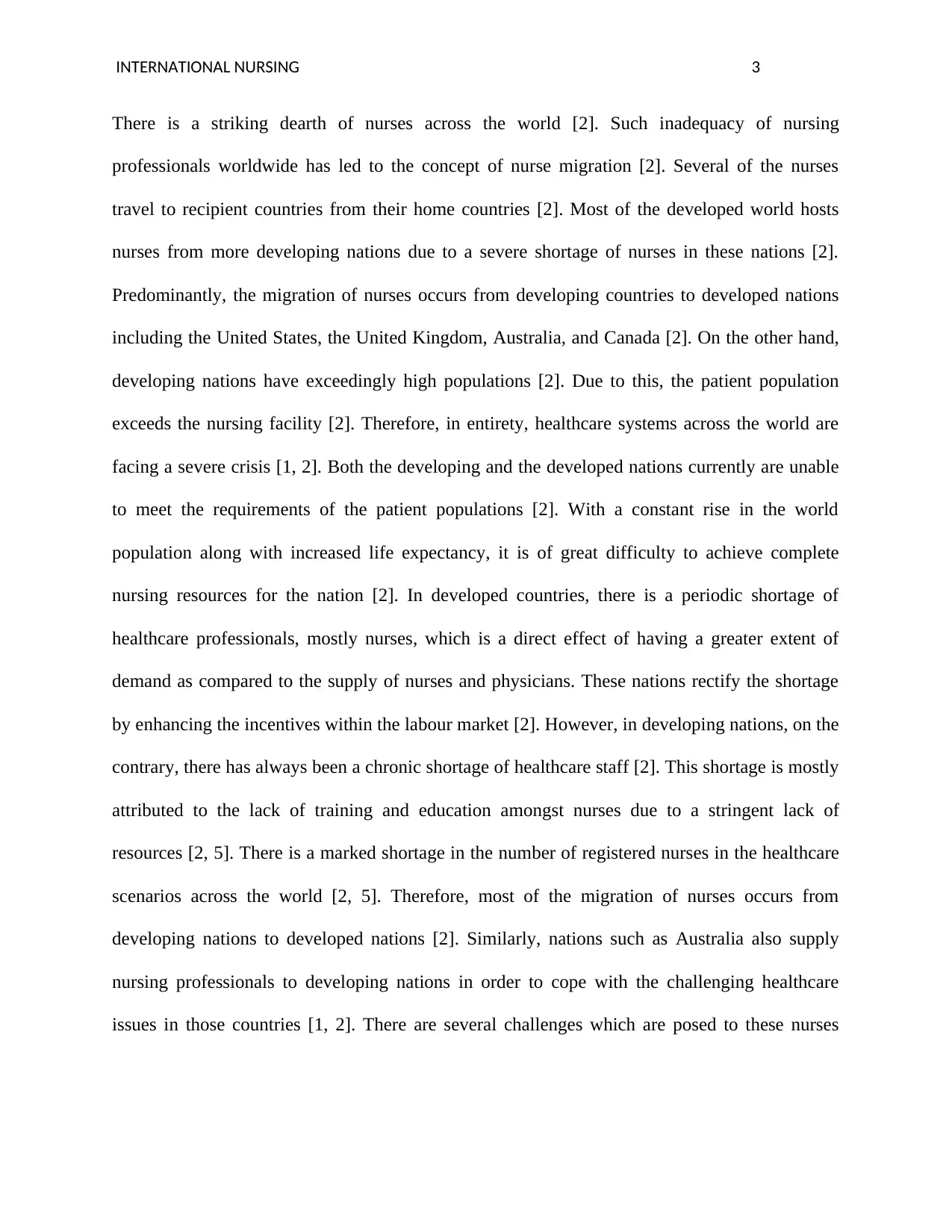
INTERNATIONAL NURSING 3
There is a striking dearth of nurses across the world [2]. Such inadequacy of nursing
professionals worldwide has led to the concept of nurse migration [2]. Several of the nurses
travel to recipient countries from their home countries [2]. Most of the developed world hosts
nurses from more developing nations due to a severe shortage of nurses in these nations [2].
Predominantly, the migration of nurses occurs from developing countries to developed nations
including the United States, the United Kingdom, Australia, and Canada [2]. On the other hand,
developing nations have exceedingly high populations [2]. Due to this, the patient population
exceeds the nursing facility [2]. Therefore, in entirety, healthcare systems across the world are
facing a severe crisis [1, 2]. Both the developing and the developed nations currently are unable
to meet the requirements of the patient populations [2]. With a constant rise in the world
population along with increased life expectancy, it is of great difficulty to achieve complete
nursing resources for the nation [2]. In developed countries, there is a periodic shortage of
healthcare professionals, mostly nurses, which is a direct effect of having a greater extent of
demand as compared to the supply of nurses and physicians. These nations rectify the shortage
by enhancing the incentives within the labour market [2]. However, in developing nations, on the
contrary, there has always been a chronic shortage of healthcare staff [2]. This shortage is mostly
attributed to the lack of training and education amongst nurses due to a stringent lack of
resources [2, 5]. There is a marked shortage in the number of registered nurses in the healthcare
scenarios across the world [2, 5]. Therefore, most of the migration of nurses occurs from
developing nations to developed nations [2]. Similarly, nations such as Australia also supply
nursing professionals to developing nations in order to cope with the challenging healthcare
issues in those countries [1, 2]. There are several challenges which are posed to these nurses
Document Page
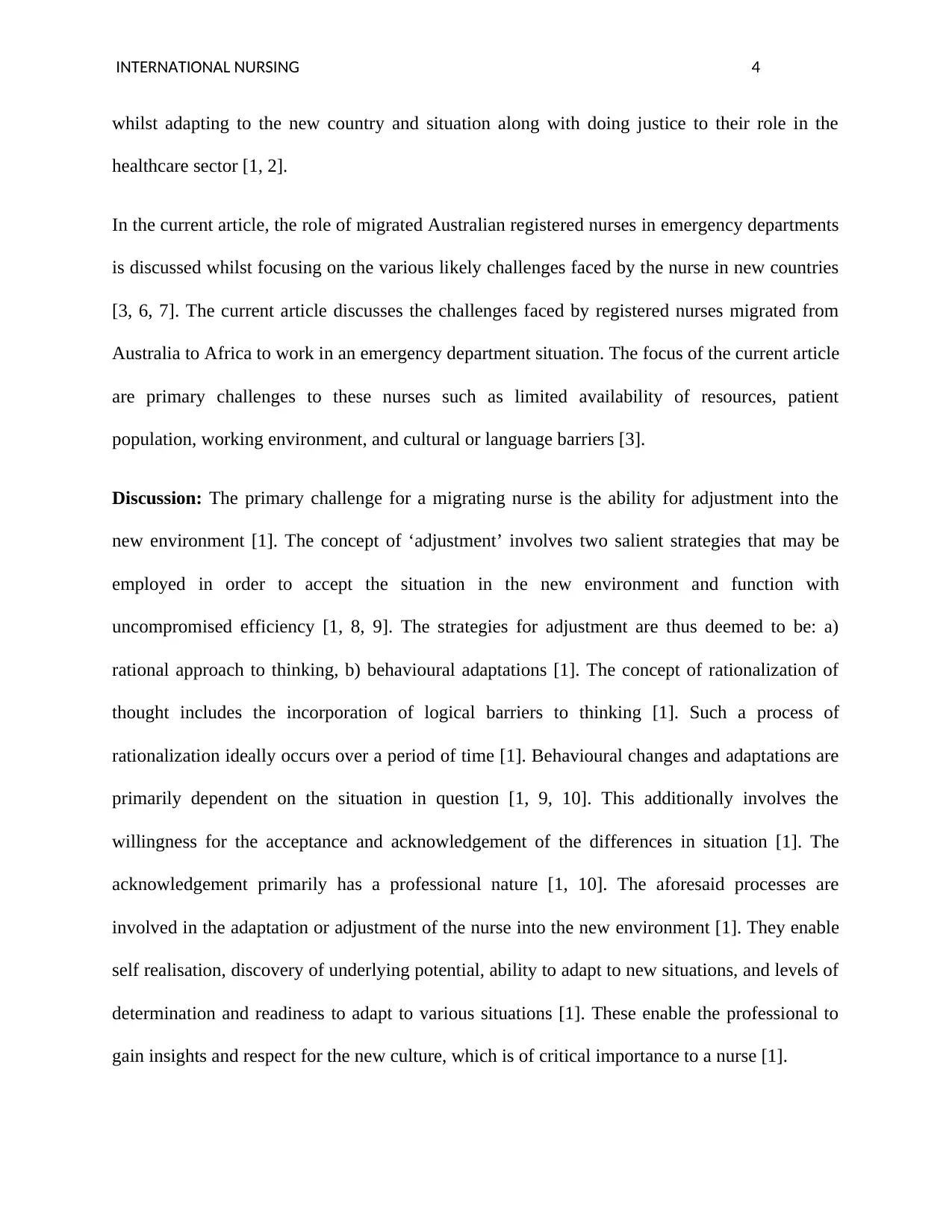
INTERNATIONAL NURSING 4
whilst adapting to the new country and situation along with doing justice to their role in the
healthcare sector [1, 2].
In the current article, the role of migrated Australian registered nurses in emergency departments
is discussed whilst focusing on the various likely challenges faced by the nurse in new countries
[3, 6, 7]. The current article discusses the challenges faced by registered nurses migrated from
Australia to Africa to work in an emergency department situation. The focus of the current article
are primary challenges to these nurses such as limited availability of resources, patient
population, working environment, and cultural or language barriers [3].
Discussion: The primary challenge for a migrating nurse is the ability for adjustment into the
new environment [1]. The concept of ‘adjustment’ involves two salient strategies that may be
employed in order to accept the situation in the new environment and function with
uncompromised efficiency [1, 8, 9]. The strategies for adjustment are thus deemed to be: a)
rational approach to thinking, b) behavioural adaptations [1]. The concept of rationalization of
thought includes the incorporation of logical barriers to thinking [1]. Such a process of
rationalization ideally occurs over a period of time [1]. Behavioural changes and adaptations are
primarily dependent on the situation in question [1, 9, 10]. This additionally involves the
willingness for the acceptance and acknowledgement of the differences in situation [1]. The
acknowledgement primarily has a professional nature [1, 10]. The aforesaid processes are
involved in the adaptation or adjustment of the nurse into the new environment [1]. They enable
self realisation, discovery of underlying potential, ability to adapt to new situations, and levels of
determination and readiness to adapt to various situations [1]. These enable the professional to
gain insights and respect for the new culture, which is of critical importance to a nurse [1].
tabler-icon-diamond-filled.svg

Paraphrase This Document

Need a fresh take? Get an instant paraphrase of this document with our AI Paraphraser
Document Page
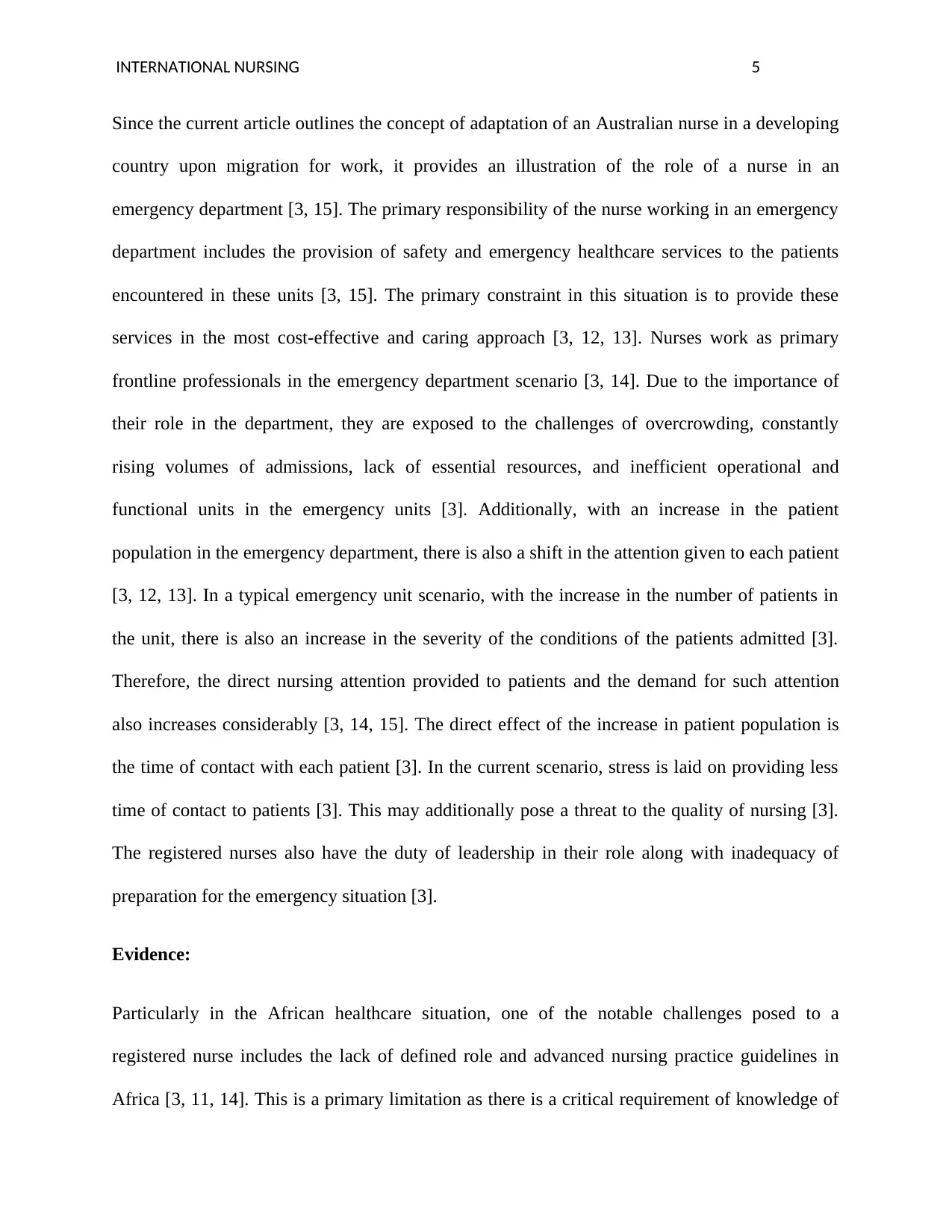
INTERNATIONAL NURSING 5
Since the current article outlines the concept of adaptation of an Australian nurse in a developing
country upon migration for work, it provides an illustration of the role of a nurse in an
emergency department [3, 15]. The primary responsibility of the nurse working in an emergency
department includes the provision of safety and emergency healthcare services to the patients
encountered in these units [3, 15]. The primary constraint in this situation is to provide these
services in the most cost-effective and caring approach [3, 12, 13]. Nurses work as primary
frontline professionals in the emergency department scenario [3, 14]. Due to the importance of
their role in the department, they are exposed to the challenges of overcrowding, constantly
rising volumes of admissions, lack of essential resources, and inefficient operational and
functional units in the emergency units [3]. Additionally, with an increase in the patient
population in the emergency department, there is also a shift in the attention given to each patient
[3, 12, 13]. In a typical emergency unit scenario, with the increase in the number of patients in
the unit, there is also an increase in the severity of the conditions of the patients admitted [3].
Therefore, the direct nursing attention provided to patients and the demand for such attention
also increases considerably [3, 14, 15]. The direct effect of the increase in patient population is
the time of contact with each patient [3]. In the current scenario, stress is laid on providing less
time of contact to patients [3]. This may additionally pose a threat to the quality of nursing [3].
The registered nurses also have the duty of leadership in their role along with inadequacy of
preparation for the emergency situation [3].
Evidence:
Particularly in the African healthcare situation, one of the notable challenges posed to a
registered nurse includes the lack of defined role and advanced nursing practice guidelines in
Africa [3, 11, 14]. This is a primary limitation as there is a critical requirement of knowledge of
Document Page
INTERNATIONAL NURSING 6
acute injuries and illnesses [3, 11, 14]. The training provided to the nurses that is required to
handle the emergency situations is limited and thus, several challenges are posed to under-trained
nurses [3, 14]. Providing nursing care to patients in Africa is particularly challenging due to the
common occurrence of infection with human immunodeficiency virus (HIV), Tuberculosis (TB),
or Acquired Immunodeficiency Syndrome (AIDS) [3]. These are particularly complex cases as
there are likely implications on the health of the nurses themselves [3]. Additionally, there is an
inadequacy of resources and stringent measures of hygiene [3]. These factors pose various
challenges to the nursing staff along with the likelihood of acquiring the infections themselves
due to disorganised care protocols [3]. This is particularly a major concern in cases where the
nurses are neither well-equipped nor well-trained for the care of patients with the afore-said
conditions [3, 8]. Most registered nurses in Africa have access to limited and inadequate
resources [3]. Additionally, they do not possess the necessary formal education required to
handle these cases effectively [3]. Therefore, for nurses migrating from Australia, where there is
an absence of a defined OQN, the situation is of additional complexity. Australian nurses
recruited in African healthcare sectors, especially in the emergency departments, face vital
challenges in functioning. The primary concern is the limitation of resources, lack of cultural and
formal knowledge, and cultural barriers.
Conclusion:
Immigration is a fast-emerging trend in the field of nursing. Especially in a developed nation
such as Australia, there is a critical need for a well-defined OQN. Several nurses migrate to
various parts of the world to provide nursing care in countries with increasing patient
populations. Due to the advent of globalization, there is a novel trend amongst Australian nurses
to migrate to developing nations such as Africa. The most common challenge posed to them is
Document Page
INTERNATIONAL NURSING 7
the limitation of resources and formal training to deal with the challenges of the healthcare
system prevalent in the recipient country.
tabler-icon-diamond-filled.svg

Paraphrase This Document

Need a fresh take? Get an instant paraphrase of this document with our AI Paraphraser
Document Page
INTERNATIONAL NURSING 8
References:
1. Stankiewicz, G., & O’Connor, A.M.M. (2014). Overseas qualified nurses in Australia:
Reflecting on the issue. Australian journal of advanced nursing, 31 (3), 32-38
2. Li, H., Nie, W., & Li, J. (2014). The benefits and caveats of international nurse migration.
International journal of nursing sciences, 1(3), 314-317
3. Atakro, C.A., Ninnoni, J.P., Adatara, P., Gross, J., & Agbavor, M. (2016). Qualitative Inquiry
into Challenges Experienced by Registered General Nurses in the Emergency Department: A
Study of Selected Hospitals in the Volta Region of Ghana. Emergency Medicine International,
vol. 2016, Article ID 6082105, 7 pages, 2016. doi:10.1155/2016/6082105
4. Lim, J., Bogossian, F. & Ahern, K. (2010), Stress and coping in Australian nurses: a
systematic review. International Nursing Review, 57, 22–31. doi:10.1111/j.1466-
7657.2009.00765.x
5. Xu, Y. (2010). Transitioning International Nurses: An Outlined Evidence-Based Program for
Acute Care Setting. Policy, Politics & Nursing Practice, 11(3), 202-213
6. Xu, Y. & He, F. (2012). Transition Programs for Internationally Educated Nurses: What Can
the United States Learn from the United Kingdom, Australia, and Canada? Nursing Economic,
30(4), 215-223
7. Yunxian, Z. (2010). The experience of China educated nurses working in Australia: A
symbolic interactionist perspective. School of Nursing and Midwifery, Faculty of Health and
Biomedical Innovation, Queensland University of Technology, Doctor of Philosophy Thesis,
Brisbane, Australia
Document Page
INTERNATIONAL NURSING 9
8. Higginbottom, G.M. (2011). The transitioning experiences of internationally educated nurses
into Canadian health care system: A focused ethnography. BioMed Central (BMC) Nursing, 10,
14
9. Terry, L.M., Carr, G. & Williams, L. (2013). The Effect of Fluency in English on the
Continuing Professional Development of Nurses Educated Overseas. The Journal of Continuing
Education in Nursing, 44(3), 137-144
10. Smith, C.D.A., Fisher, C. & Mercer, A. (2011). Rediscovering nursing: A study of overseas
nurses working in Western Australia. Nursing and Health Sciences, 13, 289-295
11. Holland, P., Allen, B.C. and Cooper, B.K. (2012). What Nurses Want: Analysis of the First
National Survey on Nurses’ Attitudes to Work and Working Conditions in Australia. Department
of Management, Monash University, February 2012
12. C. H. Chang, D. Harnod, & S. Shih, (2010). Research of patient's nursing care demand at
Emergency room. The Journal of Human Resource and Adult Learning, 6(2), 110–117.
13. Rezaei-Adaryani, M., Salsali, M. & Mohammadi, E. (2012). Nursing image: An evolutionary
concept analysis. Contemporary Nurse, 43(1), 81-89.
14. S. A. Bell, R. Oteng, R. Redman et al., (2014). Development of an emergency nursing
training curriculum in Ghana. International Emergency Nursing, 22(4), 202–207.
15. Toh, S.G., Ang, E. & Devi, M.K. (2012). Systematic review on the relationship between the
nursing shortage and job satisfaction, stress and burnout levels among nurses in
oncology/haematology settings. International Journal of Evidence-Based Healthcare, the Joanna
Briggs Institute, 10,126-141
chevron_up_icon
1 out of 9
circle_padding
hide_on_mobile
zoom_out_icon
[object Object]