Evidence-Based Nursing Report: Endemic Infections in Nursing Homes

Verified

Added on  2021/06/18

|4
|583
|25
Report
AI Summary
This nursing report focuses on endemic infections, specifically urinary tract infections (UTIs) and pneumonia, within nursing homes, highlighting their impact on patient readmissions and the challenges posed by antibiotic resistance. The report identifies the epidemiological nature of these infections as 'endemic,' emphasizing their sustained presence within a population due to person-to-person transmission. It discusses the implications of these infections, including increased morbidity and mortality, and the strain they place on healthcare resources. The report attributes the endemic nature of these infections to multi-drug resistant diseases, often hospital-acquired, making infection control difficult. The report underscores the importance of training healthcare professionals to effectively manage the complex needs of this vulnerable population and mitigate the spread of these infections. The report references key research that supports the arguments made.

Document Page
Running head: NURSING
Nursing
Name of student:
Name of university:
Author note:
tabler-icon-diamond-filled.svg

Paraphrase This Document

Need a fresh take? Get an instant paraphrase of this document with our AI Paraphraser
Document Page
1
NURSING
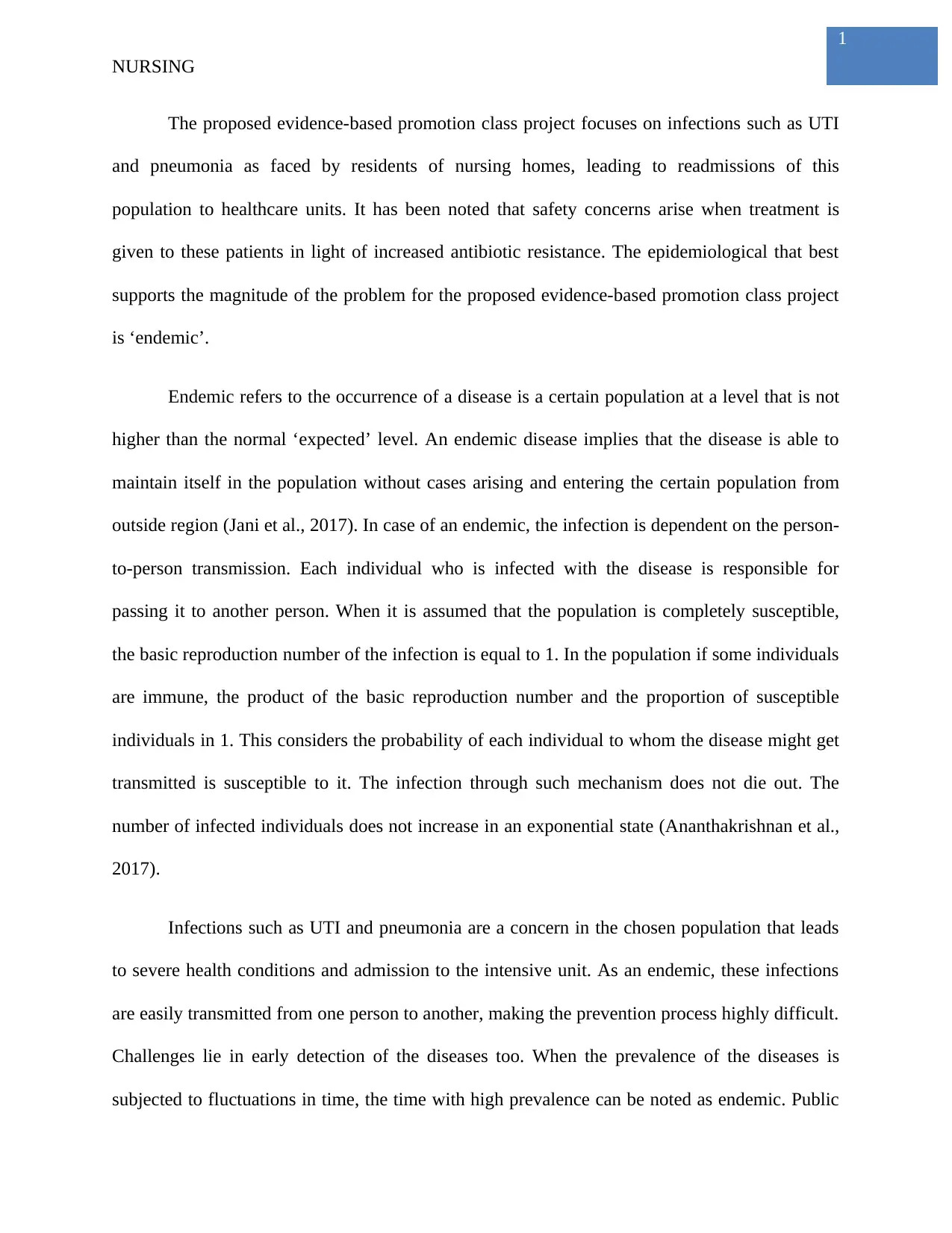
The proposed evidence-based promotion class project focuses on infections such as UTI
and pneumonia as faced by residents of nursing homes, leading to readmissions of this
population to healthcare units. It has been noted that safety concerns arise when treatment is
given to these patients in light of increased antibiotic resistance. The epidemiological that best
supports the magnitude of the problem for the proposed evidence-based promotion class project
is ‘endemic’.
Endemic refers to the occurrence of a disease is a certain population at a level that is not
higher than the normal ‘expected’ level. An endemic disease implies that the disease is able to
maintain itself in the population without cases arising and entering the certain population from
outside region (Jani et al., 2017). In case of an endemic, the infection is dependent on the person-
to-person transmission. Each individual who is infected with the disease is responsible for
passing it to another person. When it is assumed that the population is completely susceptible,
the basic reproduction number of the infection is equal to 1. In the population if some individuals
are immune, the product of the basic reproduction number and the proportion of susceptible
individuals in 1. This considers the probability of each individual to whom the disease might get
transmitted is susceptible to it. The infection through such mechanism does not die out. The
number of infected individuals does not increase in an exponential state (Ananthakrishnan et al.,
2017).
Infections such as UTI and pneumonia are a concern in the chosen population that leads
to severe health conditions and admission to the intensive unit. As an endemic, these infections
are easily transmitted from one person to another, making the prevention process highly difficult.
Challenges lie in early detection of the diseases too. When the prevalence of the diseases is
subjected to fluctuations in time, the time with high prevalence can be noted as endemic. Public
Document Page
2
NURSING
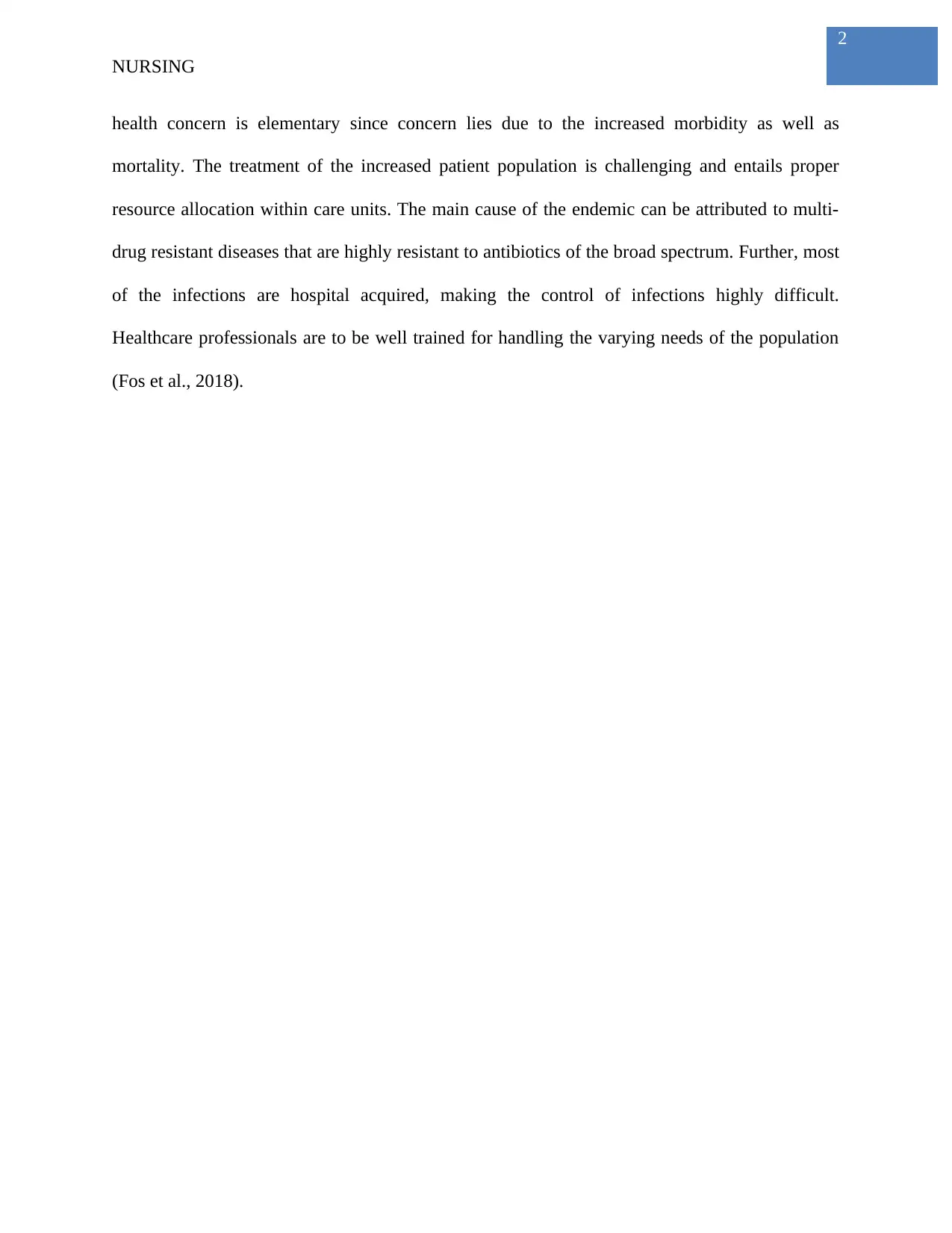
health concern is elementary since concern lies due to the increased morbidity as well as
mortality. The treatment of the increased patient population is challenging and entails proper
resource allocation within care units. The main cause of the endemic can be attributed to multi-
drug resistant diseases that are highly resistant to antibiotics of the broad spectrum. Further, most
of the infections are hospital acquired, making the control of infections highly difficult.
Healthcare professionals are to be well trained for handling the varying needs of the population
(Fos et al., 2018).
Document Page
3
NURSING
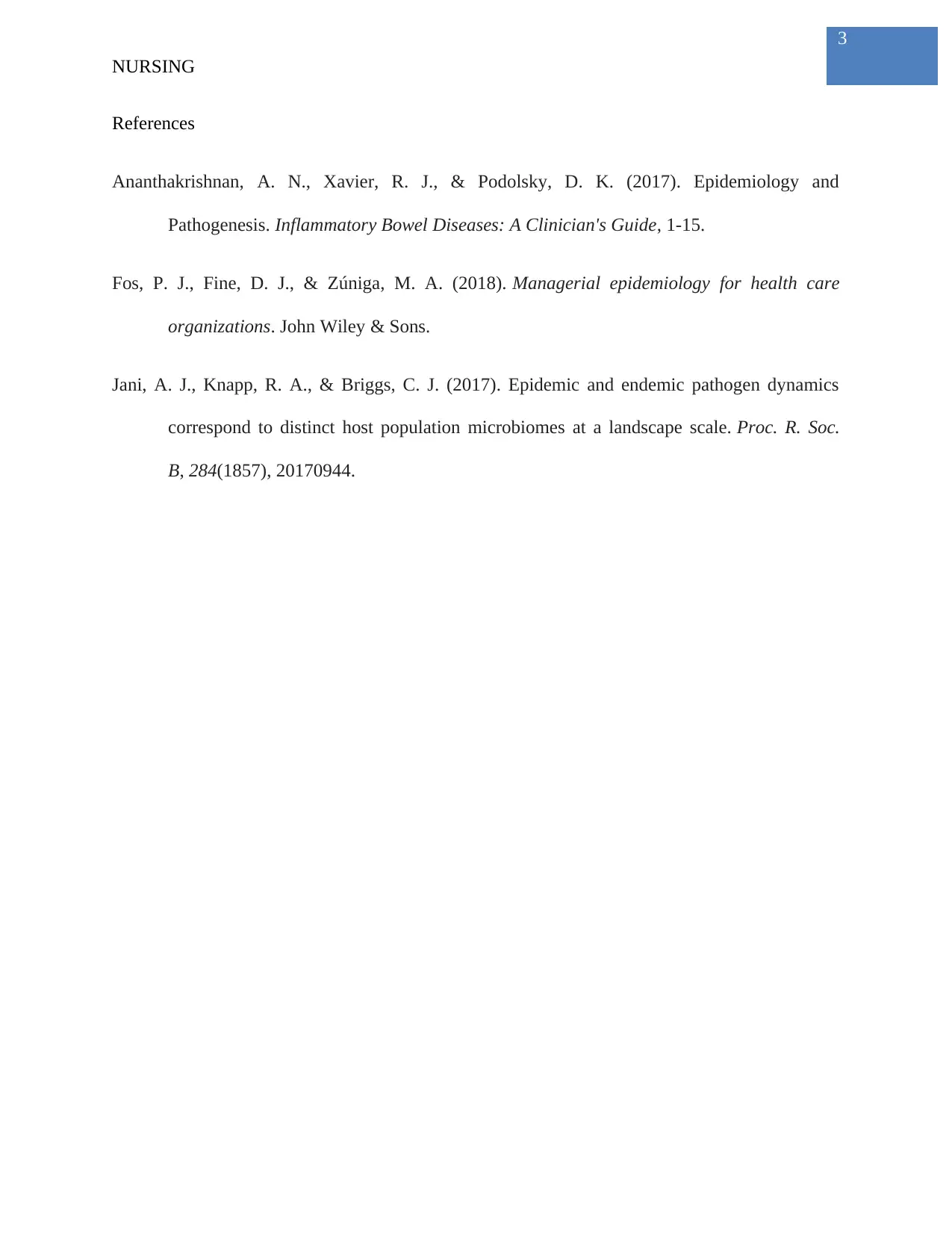
References
Ananthakrishnan, A. N., Xavier, R. J., & Podolsky, D. K. (2017). Epidemiology and
Pathogenesis. Inflammatory Bowel Diseases: A Clinician's Guide, 1-15.
Fos, P. J., Fine, D. J., & Zúniga, M. A. (2018). Managerial epidemiology for health care
organizations. John Wiley & Sons.
Jani, A. J., Knapp, R. A., & Briggs, C. J. (2017). Epidemic and endemic pathogen dynamics
correspond to distinct host population microbiomes at a landscape scale. Proc. R. Soc.
B, 284(1857), 20170944.
chevron_up_icon
1 out of 4
circle_padding
hide_on_mobile
zoom_out_icon
[object Object]