Nursing Homes vs. Home Care: Depression in Patients Aged 65+
VerifiedAdded on 2023/06/12
|11
|2851
|444
Report
AI Summary
This report investigates the effectiveness of sending patients aged 65 and above to nursing homes in reducing depression compared to those staying at home alone. It addresses the growing aging population and the increasing prevalence of depression among the elderly, highlighting the potential benefits of nursing homes in providing necessary care and support. The study aims to assess the quality of care in nursing homes, evaluate their impact on reducing depression, and explore the health implications of leaving depressed elderly individuals at home. Utilizing a quantitative evaluative methodology with a quasi-experimental research design, the study involves pre- and post-tests using the Geriatric Depression Scale in a Singaporean old age home. Data collection relies on face-to-face interviews and standardized assessments, with statistical analysis performed using SPSS to compare depression levels before and after the intervention. The research contributes to the limited literature on the effectiveness of nursing homes in managing depression among the elderly, offering insights into optimizing care strategies for this vulnerable population. Desklib provides access to similar past papers and solved assignments for students.
Running head: EFFECTIVENESS OF ELDELRY NURSING HOMES 1
What Is Effectiveness of Sending Patients Aged 65 Years and Above To Nursing
Homes in Reducing Depression Compared To Those Staying At Home Alone
Students Name
Institutional Affiliation
What Is Effectiveness of Sending Patients Aged 65 Years and Above To Nursing
Homes in Reducing Depression Compared To Those Staying At Home Alone
Students Name
Institutional Affiliation

Paraphrase This Document
Need a fresh take? Get an instant paraphrase of this document with our AI Paraphraser
EFFECTIVENESS OF ELDELRY NURSING HOMES 2
What Is Effectiveness of Sending Patients Aged 65 Years and Above To Nursing
Homes in Reducing Depression Compared To Those Staying At Home Alone?
The world population is aging leading to high proportion of elderly people compared to
the young ones. According to a study conducted by Jonsson et al. (2016), the population of the
world will include two-thirds of people aged 65 and over by 2025. Another study conducted by
Hafshjani & Abedi (2016) in Iran, predicted that by 2025, the population in the country would be
over 65 years. Aging is among the leading aspects of mental deterioration owing to the depletion
in brain cells with increasing years. In the words of Simning & Simons (2017), proper care of the
aged require assessment of the available means to cater for their needs with the aim to satisfy
their physical and mental states. Throughout the world, nursing homes have been imperative in
catering for depressed people aged 65 and over. According to Drageset et al. (2015), the
effectiveness of care given to elderly depends on the understanding of their condition by
caregivers. Indeed, it would be absurd to leave depressed elderly people at home alone because
they will not have an opportunity to receive due care for their problems. Sending depressed
elderly people to nursing homes over leaving the alone at home is effective in helping them
maintain good health and cherish quality life.
Objectives of the Study
This study aims to investigate the effectiveness of sending patients aged 65>years to
nursing homes in reducing depression compared to those staying at home alone. Other objectives
of the paper include:
i. To assess the quality of care given to persons aged 65> years in nursing homes
ii. To assess the effectiveness of sending elderly depressed people to nursing homes
iii. To assess the impact of sending elderly people to nursing homes on reducing depression
What Is Effectiveness of Sending Patients Aged 65 Years and Above To Nursing
Homes in Reducing Depression Compared To Those Staying At Home Alone?
The world population is aging leading to high proportion of elderly people compared to
the young ones. According to a study conducted by Jonsson et al. (2016), the population of the
world will include two-thirds of people aged 65 and over by 2025. Another study conducted by
Hafshjani & Abedi (2016) in Iran, predicted that by 2025, the population in the country would be
over 65 years. Aging is among the leading aspects of mental deterioration owing to the depletion
in brain cells with increasing years. In the words of Simning & Simons (2017), proper care of the
aged require assessment of the available means to cater for their needs with the aim to satisfy
their physical and mental states. Throughout the world, nursing homes have been imperative in
catering for depressed people aged 65 and over. According to Drageset et al. (2015), the
effectiveness of care given to elderly depends on the understanding of their condition by
caregivers. Indeed, it would be absurd to leave depressed elderly people at home alone because
they will not have an opportunity to receive due care for their problems. Sending depressed
elderly people to nursing homes over leaving the alone at home is effective in helping them
maintain good health and cherish quality life.
Objectives of the Study
This study aims to investigate the effectiveness of sending patients aged 65>years to
nursing homes in reducing depression compared to those staying at home alone. Other objectives
of the paper include:
i. To assess the quality of care given to persons aged 65> years in nursing homes
ii. To assess the effectiveness of sending elderly depressed people to nursing homes
iii. To assess the impact of sending elderly people to nursing homes on reducing depression
EFFECTIVENESS OF ELDELRY NURSING HOMES 3
Research Questions
This study will be guided by the following research questions;
i. What type of care does people aged 65 years and above receive at nursing homes?
ii. What is the impact of sending people aged 65 years and above suffering from depression
to nursing homes?
iii. Are there health implications of leaving depressed elderly at home alone?
iv. Do sending people aged 65 years and above to nursing homes help reduce depressions
compared to leaving them alone at home alone?
Background of the Study
Depression is among the most dangerous conditions affecting the elderly in the world
today. According to a study conducted by Jonsson et al. (2016), the condition affects 25% - 45%
of the elderly using home care facilities. The growing proportion of elderly in the society creates
a situation of the increasing challenge of depression in many countries. A study conducted by
Beard & Bloom (2015) concludes that people aged 65 years and above experience a fourfold rise
in more austere form of depression than younger people did. People in this bracket of age are
commonly undertreated for mental illnesses. A study conducted by Simning & Simons (2017)
found that only 23% of depressed elderly received antidepressant treatment, and only 15%
accessed sufficient management of the condition.
Notably, untreated or undertreated depression among people above 65 years is a critical
public health concern. The condition among the elderly leads to increased morbidity and
dependency of the elderly. Moreover, there is functional decline, reduced life quality, poor
observance to medical management, augmented demands of caregivers, amplified demand for
healthcare facilities and death. There are staggering costs of health care associated with
Research Questions
This study will be guided by the following research questions;
i. What type of care does people aged 65 years and above receive at nursing homes?
ii. What is the impact of sending people aged 65 years and above suffering from depression
to nursing homes?
iii. Are there health implications of leaving depressed elderly at home alone?
iv. Do sending people aged 65 years and above to nursing homes help reduce depressions
compared to leaving them alone at home alone?
Background of the Study
Depression is among the most dangerous conditions affecting the elderly in the world
today. According to a study conducted by Jonsson et al. (2016), the condition affects 25% - 45%
of the elderly using home care facilities. The growing proportion of elderly in the society creates
a situation of the increasing challenge of depression in many countries. A study conducted by
Beard & Bloom (2015) concludes that people aged 65 years and above experience a fourfold rise
in more austere form of depression than younger people did. People in this bracket of age are
commonly undertreated for mental illnesses. A study conducted by Simning & Simons (2017)
found that only 23% of depressed elderly received antidepressant treatment, and only 15%
accessed sufficient management of the condition.
Notably, untreated or undertreated depression among people above 65 years is a critical
public health concern. The condition among the elderly leads to increased morbidity and
dependency of the elderly. Moreover, there is functional decline, reduced life quality, poor
observance to medical management, augmented demands of caregivers, amplified demand for
healthcare facilities and death. There are staggering costs of health care associated with
⊘ This is a preview!⊘
Do you want full access?
Subscribe today to unlock all pages.

Trusted by 1+ million students worldwide
EFFECTIVENESS OF ELDELRY NURSING HOMES 4
depression (Oliver et al., 2014). The rising demand and strain of resources to manage depression
among the aged creates a condition of the need to know the most efficient method to manage the
condition.
The prevalence of depression among the aged in Singapore is worrying. According to
Subramaniam et al. (2016), 5.8% of the population in the country suffers from a particular type
of depression or mental illness. The management of the condition in the country has skyrocketed
in the last few years as the population of the elderly persons increases. In the words of Osborn et
al. (2014), elderly depressed individuals relying on personal support are at high risk of
misinformation leading to improved risks of the illness. The increased trend of depression among
individuals above 65 years elicits the need for critical assessment of the most effective method to
manage the condition. The health of the elderly affects the quality of life among their families
and the society. The future remains dull especially with the rising trend of the illness globally.
The dependency on home care services to manage depression among the aged appears in
vain. The future requires ardent means to address the concerns through institution of a system
that will oversee effective treatment of the disease among the elderly. Indeed, the little
documentation of the effectiveness of nursing homes for people living with depression begs
more research on the topic. A recent study by Gómez-Batiste et al. (2014), found that nursing
homes for the elderly people suffering from depression are effective in helping them recuperate
and reduce possibilities of the condition graduating into more severe diseases or even death.
Justification for the study
There exist scanty literature that elucidates about the effectiveness of nursing homes in
managing depression among the elderly. Notably, much of the literature focuses on the extent
and rising of the condition in the current society and how that affects resources meant to support
depression (Oliver et al., 2014). The rising demand and strain of resources to manage depression
among the aged creates a condition of the need to know the most efficient method to manage the
condition.
The prevalence of depression among the aged in Singapore is worrying. According to
Subramaniam et al. (2016), 5.8% of the population in the country suffers from a particular type
of depression or mental illness. The management of the condition in the country has skyrocketed
in the last few years as the population of the elderly persons increases. In the words of Osborn et
al. (2014), elderly depressed individuals relying on personal support are at high risk of
misinformation leading to improved risks of the illness. The increased trend of depression among
individuals above 65 years elicits the need for critical assessment of the most effective method to
manage the condition. The health of the elderly affects the quality of life among their families
and the society. The future remains dull especially with the rising trend of the illness globally.
The dependency on home care services to manage depression among the aged appears in
vain. The future requires ardent means to address the concerns through institution of a system
that will oversee effective treatment of the disease among the elderly. Indeed, the little
documentation of the effectiveness of nursing homes for people living with depression begs
more research on the topic. A recent study by Gómez-Batiste et al. (2014), found that nursing
homes for the elderly people suffering from depression are effective in helping them recuperate
and reduce possibilities of the condition graduating into more severe diseases or even death.
Justification for the study
There exist scanty literature that elucidates about the effectiveness of nursing homes in
managing depression among the elderly. Notably, much of the literature focuses on the extent
and rising of the condition in the current society and how that affects resources meant to support
Paraphrase This Document
Need a fresh take? Get an instant paraphrase of this document with our AI Paraphraser
EFFECTIVENESS OF ELDELRY NURSING HOMES 5
the health services. Indeed, the literature agrees that depression among the elderly is increasing
every day. The available evidence delves much into homecare services for the elderly leaving a
huge gap of exploration on treating depression through nursing homes. The rising trend and
strain of the depression and its effect on the patients and society require critical focus to underlie
the best management method of the condition among the elderly. Currently, studies focus on
collaborative nursing management programs for the condition. There is optimum evidence on the
treatment of the illness among elderly in nursing homes. Therefore, it is significant to delve into
the subjects and understand how engaging patients in nursing homes to reduce depression is
crucial. Thus, it is crucial to study the effectiveness of nursing homes in helping manage
depression among people aged 64 years and above compared to letting them stay at home alone.
Research Design
A Quantitative evaluative methodology will be used for the study to achieve the
objectives. A Quasi- experiential research design with one group for pre-test and post-test will
be used for this study. The research study will be conducted in a designated old age home in
particular city Singapore. In this study, the target population will consist of elderly, aged above
65 years. Taking into account the availability and proximity of subjects, convenience sampling
method will be used for selection of samples. This study will be comprised of 70 elderly of
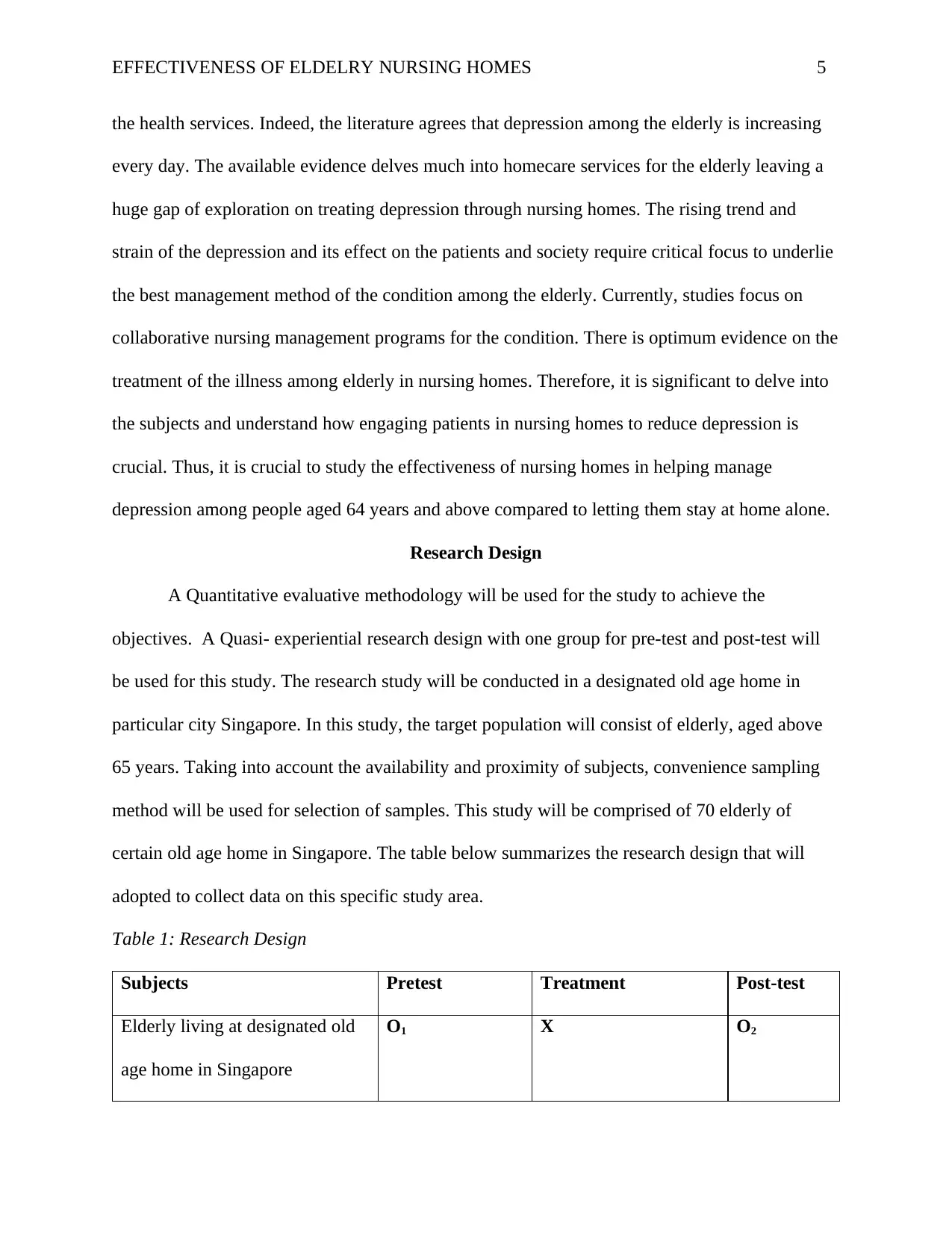
certain old age home in Singapore. The table below summarizes the research design that will
adopted to collect data on this specific study area.
Table 1: Research Design
Subjects Pretest Treatment Post-test
Elderly living at designated old
age home in Singapore
O1 X O2
the health services. Indeed, the literature agrees that depression among the elderly is increasing
every day. The available evidence delves much into homecare services for the elderly leaving a
huge gap of exploration on treating depression through nursing homes. The rising trend and
strain of the depression and its effect on the patients and society require critical focus to underlie
the best management method of the condition among the elderly. Currently, studies focus on
collaborative nursing management programs for the condition. There is optimum evidence on the
treatment of the illness among elderly in nursing homes. Therefore, it is significant to delve into
the subjects and understand how engaging patients in nursing homes to reduce depression is
crucial. Thus, it is crucial to study the effectiveness of nursing homes in helping manage
depression among people aged 64 years and above compared to letting them stay at home alone.
Research Design
A Quantitative evaluative methodology will be used for the study to achieve the
objectives. A Quasi- experiential research design with one group for pre-test and post-test will
be used for this study. The research study will be conducted in a designated old age home in
particular city Singapore. In this study, the target population will consist of elderly, aged above
65 years. Taking into account the availability and proximity of subjects, convenience sampling
method will be used for selection of samples. This study will be comprised of 70 elderly of
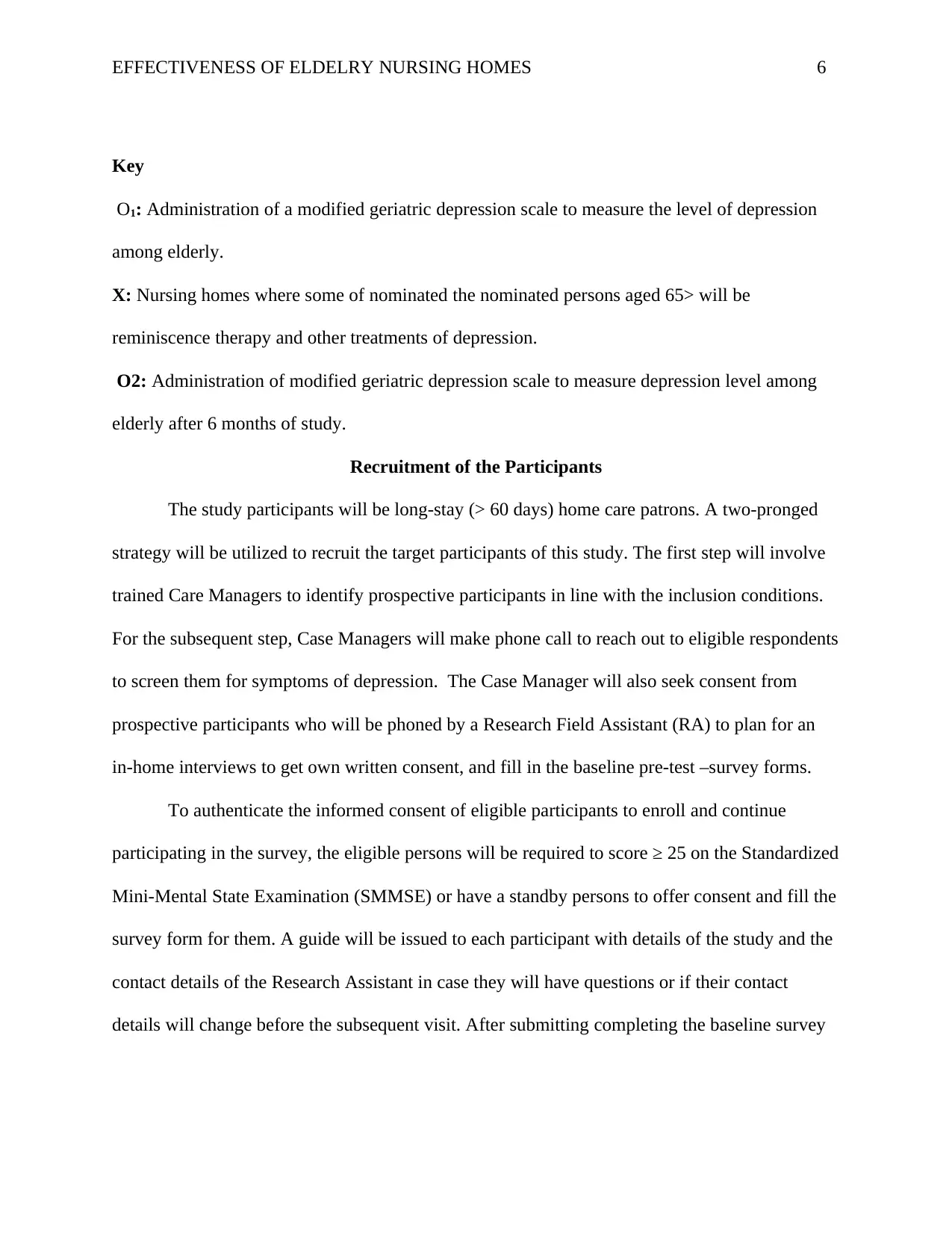
certain old age home in Singapore. The table below summarizes the research design that will
adopted to collect data on this specific study area.
Table 1: Research Design
Subjects Pretest Treatment Post-test
Elderly living at designated old
age home in Singapore
O1 X O2
EFFECTIVENESS OF ELDELRY NURSING HOMES 6
Key
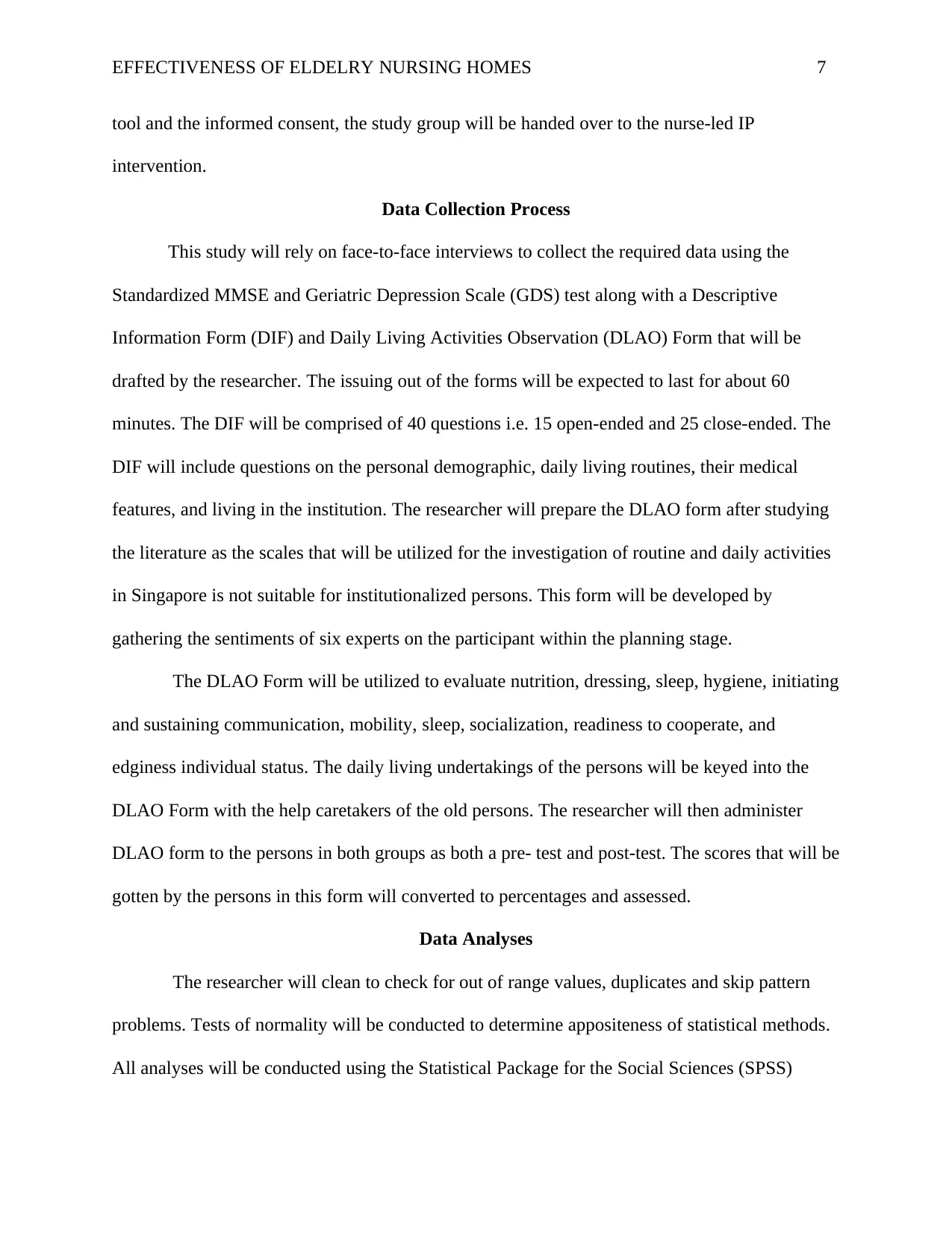
O1: Administration of a modified geriatric depression scale to measure the level of depression
among elderly.
X: Nursing homes where some of nominated the nominated persons aged 65> will be
reminiscence therapy and other treatments of depression.
O2: Administration of modified geriatric depression scale to measure depression level among
elderly after 6 months of study.
Recruitment of the Participants
The study participants will be long-stay (> 60 days) home care patrons. A two-pronged
strategy will be utilized to recruit the target participants of this study. The first step will involve
trained Care Managers to identify prospective participants in line with the inclusion conditions.
For the subsequent step, Case Managers will make phone call to reach out to eligible respondents
to screen them for symptoms of depression. The Case Manager will also seek consent from
prospective participants who will be phoned by a Research Field Assistant (RA) to plan for an
in-home interviews to get own written consent, and fill in the baseline pre-test –survey forms.
To authenticate the informed consent of eligible participants to enroll and continue
participating in the survey, the eligible persons will be required to score ≥ 25 on the Standardized
Mini-Mental State Examination (SMMSE) or have a standby persons to offer consent and fill the
survey form for them. A guide will be issued to each participant with details of the study and the
contact details of the Research Assistant in case they will have questions or if their contact
details will change before the subsequent visit. After submitting completing the baseline survey
Key
O1: Administration of a modified geriatric depression scale to measure the level of depression
among elderly.
X: Nursing homes where some of nominated the nominated persons aged 65> will be
reminiscence therapy and other treatments of depression.
O2: Administration of modified geriatric depression scale to measure depression level among
elderly after 6 months of study.
Recruitment of the Participants
The study participants will be long-stay (> 60 days) home care patrons. A two-pronged
strategy will be utilized to recruit the target participants of this study. The first step will involve
trained Care Managers to identify prospective participants in line with the inclusion conditions.
For the subsequent step, Case Managers will make phone call to reach out to eligible respondents
to screen them for symptoms of depression. The Case Manager will also seek consent from
prospective participants who will be phoned by a Research Field Assistant (RA) to plan for an
in-home interviews to get own written consent, and fill in the baseline pre-test –survey forms.
To authenticate the informed consent of eligible participants to enroll and continue
participating in the survey, the eligible persons will be required to score ≥ 25 on the Standardized
Mini-Mental State Examination (SMMSE) or have a standby persons to offer consent and fill the
survey form for them. A guide will be issued to each participant with details of the study and the
contact details of the Research Assistant in case they will have questions or if their contact
details will change before the subsequent visit. After submitting completing the baseline survey
⊘ This is a preview!⊘
Do you want full access?
Subscribe today to unlock all pages.
Trusted by 1+ million students worldwide
EFFECTIVENESS OF ELDELRY NURSING HOMES 7
tool and the informed consent, the study group will be handed over to the nurse-led IP
intervention.
Data Collection Process
This study will rely on face-to-face interviews to collect the required data using the
Standardized MMSE and Geriatric Depression Scale (GDS) test along with a Descriptive
Information Form (DIF) and Daily Living Activities Observation (DLAO) Form that will be
drafted by the researcher. The issuing out of the forms will be expected to last for about 60
minutes. The DIF will be comprised of 40 questions i.e. 15 open-ended and 25 close-ended. The
DIF will include questions on the personal demographic, daily living routines, their medical
features, and living in the institution. The researcher will prepare the DLAO form after studying
the literature as the scales that will be utilized for the investigation of routine and daily activities
in Singapore is not suitable for institutionalized persons. This form will be developed by
gathering the sentiments of six experts on the participant within the planning stage.
The DLAO Form will be utilized to evaluate nutrition, dressing, sleep, hygiene, initiating
and sustaining communication, mobility, sleep, socialization, readiness to cooperate, and
edginess individual status. The daily living undertakings of the persons will be keyed into the
DLAO Form with the help caretakers of the old persons. The researcher will then administer
DLAO form to the persons in both groups as both a pre- test and post-test. The scores that will be
gotten by the persons in this form will converted to percentages and assessed.
Data Analyses
The researcher will clean to check for out of range values, duplicates and skip pattern
problems. Tests of normality will be conducted to determine appositeness of statistical methods.
All analyses will be conducted using the Statistical Package for the Social Sciences (SPSS)
tool and the informed consent, the study group will be handed over to the nurse-led IP
intervention.
Data Collection Process
This study will rely on face-to-face interviews to collect the required data using the
Standardized MMSE and Geriatric Depression Scale (GDS) test along with a Descriptive
Information Form (DIF) and Daily Living Activities Observation (DLAO) Form that will be
drafted by the researcher. The issuing out of the forms will be expected to last for about 60
minutes. The DIF will be comprised of 40 questions i.e. 15 open-ended and 25 close-ended. The
DIF will include questions on the personal demographic, daily living routines, their medical
features, and living in the institution. The researcher will prepare the DLAO form after studying
the literature as the scales that will be utilized for the investigation of routine and daily activities
in Singapore is not suitable for institutionalized persons. This form will be developed by
gathering the sentiments of six experts on the participant within the planning stage.
The DLAO Form will be utilized to evaluate nutrition, dressing, sleep, hygiene, initiating
and sustaining communication, mobility, sleep, socialization, readiness to cooperate, and
edginess individual status. The daily living undertakings of the persons will be keyed into the
DLAO Form with the help caretakers of the old persons. The researcher will then administer
DLAO form to the persons in both groups as both a pre- test and post-test. The scores that will be
gotten by the persons in this form will converted to percentages and assessed.
Data Analyses
The researcher will clean to check for out of range values, duplicates and skip pattern
problems. Tests of normality will be conducted to determine appositeness of statistical methods.
All analyses will be conducted using the Statistical Package for the Social Sciences (SPSS)
Paraphrase This Document
Need a fresh take? Get an instant paraphrase of this document with our AI Paraphraser
EFFECTIVENESS OF ELDELRY NURSING HOMES 8
version 22. All statistical tests will be done using two-sided tests at the 0.05 significance level.
For all representations, the results will be expressed as effects, standard errors, 95% confidence
intervals (CI), corresponding two-sided and related p-values. Descriptive examination of
demographic characteristics will be represented percent (percent) for categorical variables and as
a mean standard deviation (SD) or median (minimum-maximum) for continuous variables.
Numerical variables will be summarized with mean and standard deviation and median
(minimum and maximum) values in data analysis. Categorical variables will be represented with
numbers and percentages. Before making the within-group and intergroup comparisons for
numerical variables, the parametric test rules (homogeneity of variance, normality, and
sphericity) will be checked.
The participants of this study will be compared with clients who are considered as
eligible for the study but will refuse to contribute on their alphanumeric features at baseline
using chi square for categorical variables and independent t-tests for continuous variables. The
existence of a difference between the control and intervention groups concerning categorical
variables will be studied using the chi-square test. The consequence of the demographic features
of the control and intervention groups on the scale scores will be assessed with the Mann-
Whitney U test. Intergroup differences and Within-time in terms of scale scores will be evaluated
with the variance analysis in measurements that will be repeating. Pairwise comparisons will be
executed with the Bonferroni test. The significance level that will be accepted in this study will
be P < .05. By contrasting and comparing the analyzed data, themes and sub-themes, patterns
and interrelationships will be revealed and a report of the findings of the study be generated.
Ethical Considerations
version 22. All statistical tests will be done using two-sided tests at the 0.05 significance level.
For all representations, the results will be expressed as effects, standard errors, 95% confidence
intervals (CI), corresponding two-sided and related p-values. Descriptive examination of
demographic characteristics will be represented percent (percent) for categorical variables and as
a mean standard deviation (SD) or median (minimum-maximum) for continuous variables.
Numerical variables will be summarized with mean and standard deviation and median
(minimum and maximum) values in data analysis. Categorical variables will be represented with
numbers and percentages. Before making the within-group and intergroup comparisons for
numerical variables, the parametric test rules (homogeneity of variance, normality, and
sphericity) will be checked.
The participants of this study will be compared with clients who are considered as
eligible for the study but will refuse to contribute on their alphanumeric features at baseline
using chi square for categorical variables and independent t-tests for continuous variables. The
existence of a difference between the control and intervention groups concerning categorical
variables will be studied using the chi-square test. The consequence of the demographic features
of the control and intervention groups on the scale scores will be assessed with the Mann-
Whitney U test. Intergroup differences and Within-time in terms of scale scores will be evaluated
with the variance analysis in measurements that will be repeating. Pairwise comparisons will be
executed with the Bonferroni test. The significance level that will be accepted in this study will
be P < .05. By contrasting and comparing the analyzed data, themes and sub-themes, patterns
and interrelationships will be revealed and a report of the findings of the study be generated.
Ethical Considerations
EFFECTIVENESS OF ELDELRY NURSING HOMES 9
The researcher will seek for administrative permission from the concerned government
authorities, school management and authorities of the chosen old age home before the data
collection process. The intention of this study will be clarified to the respondents and consent
will be gotten in written forms. The investigator will also assure the subjects confidentiality of
data collection.
References
Beard, H. P. J. R., & Bloom, D. E. (2015). Towards a comprehensive public health response to
population ageing. Lancet (London, England), 385(9968), 658.
The researcher will seek for administrative permission from the concerned government
authorities, school management and authorities of the chosen old age home before the data
collection process. The intention of this study will be clarified to the respondents and consent
will be gotten in written forms. The investigator will also assure the subjects confidentiality of
data collection.
References
Beard, H. P. J. R., & Bloom, D. E. (2015). Towards a comprehensive public health response to
population ageing. Lancet (London, England), 385(9968), 658.
⊘ This is a preview!⊘
Do you want full access?
Subscribe today to unlock all pages.
Trusted by 1+ million students worldwide
EFFECTIVENESS OF ELDELRY NURSING HOMES 10
Drageset, J., Dysvik, E., Espehaug, B., Natvig, G. K., & Furnes, B. (2015). Suffering and mental
health among older people living in nursing homes—a mixed-methods study. PeerJ, 3,
e1120.
Gómez-Batiste, X., Martínez-Muñoz, M., Blay, C., Amblàs, J., Vila, L., Costa, X., ... & Mitchell,
G. K. (2014). Prevalence and characteristics of patients with advanced chronic conditions
in need of palliative care in the general population: a cross-sectional study. Palliative
medicine, 28(4), 302-311.
Hafshjani, F. C., & Abedi, H. A. (2016). A Study of Families’ Experiences of Putting Their
Elders in Nursing Homes. International Journal of Medical Research and Health
Sciences, 5(11), 209-214.
Jonsson, U., Bertilsson, G., Allard, P., Gyllensvärd, H., Söderlund, A., Tham, A., & Andersson,
G. (2016). Psychological treatment of depression in people aged 65 years and over: a
systematic review of efficacy, safety, and cost-effectiveness. PloS one, 11(8), e0160859.
Oliver, D., Foot, C., & Humphries, R. (2014). Making our health and care systems fit for an
ageing population. King's Fund.
Osborn, R., Moulds, D., Squires, D., Doty, M. M., & Anderson, C. (2014). International survey
of older adults finds shortcomings in access, coordination, and patient-centered care.
Health Affairs, 33(12), 2247-2255.
Simning, A., & Simons, K. V. (2017). Treatment of depression in nursing home residents
without significant cognitive impairment: a systematic review. International
psychogeriatrics, 29(2), 209-226.
Drageset, J., Dysvik, E., Espehaug, B., Natvig, G. K., & Furnes, B. (2015). Suffering and mental
health among older people living in nursing homes—a mixed-methods study. PeerJ, 3,
e1120.
Gómez-Batiste, X., Martínez-Muñoz, M., Blay, C., Amblàs, J., Vila, L., Costa, X., ... & Mitchell,
G. K. (2014). Prevalence and characteristics of patients with advanced chronic conditions
in need of palliative care in the general population: a cross-sectional study. Palliative
medicine, 28(4), 302-311.
Hafshjani, F. C., & Abedi, H. A. (2016). A Study of Families’ Experiences of Putting Their
Elders in Nursing Homes. International Journal of Medical Research and Health
Sciences, 5(11), 209-214.
Jonsson, U., Bertilsson, G., Allard, P., Gyllensvärd, H., Söderlund, A., Tham, A., & Andersson,
G. (2016). Psychological treatment of depression in people aged 65 years and over: a
systematic review of efficacy, safety, and cost-effectiveness. PloS one, 11(8), e0160859.
Oliver, D., Foot, C., & Humphries, R. (2014). Making our health and care systems fit for an
ageing population. King's Fund.
Osborn, R., Moulds, D., Squires, D., Doty, M. M., & Anderson, C. (2014). International survey
of older adults finds shortcomings in access, coordination, and patient-centered care.
Health Affairs, 33(12), 2247-2255.
Simning, A., & Simons, K. V. (2017). Treatment of depression in nursing home residents
without significant cognitive impairment: a systematic review. International
psychogeriatrics, 29(2), 209-226.
Paraphrase This Document
Need a fresh take? Get an instant paraphrase of this document with our AI Paraphraser
EFFECTIVENESS OF ELDELRY NURSING HOMES 11
Subramaniam, M., Abdin, E., Sambasivam, R., Vaingankar, J. A., Picco, L., Pang, S., ... &
Chong, S. A. (2016). Prevalence of depression among older adults--results from the Well-
being of the Singapore Elderly study. Ann Acad Med Singapore, 45, 123-33.
Subramaniam, M., Abdin, E., Sambasivam, R., Vaingankar, J. A., Picco, L., Pang, S., ... &
Chong, S. A. (2016). Prevalence of depression among older adults--results from the Well-
being of the Singapore Elderly study. Ann Acad Med Singapore, 45, 123-33.

1 out of 11


Related Documents


Your All-in-One AI-Powered Toolkit for Academic Success.
+13062052269
info@desklib.com
Available 24*7 on WhatsApp / Email
![[object Object]](/_next/static/media/star-bottom.7253800d.svg)
Unlock your academic potential
Copyright © 2020–2026 A2Z Services. All Rights Reserved. Developed and managed by ZUCOL.