Registered Nurse: Scope of Practice, Legal, Ethical Obligations
VerifiedAdded on 2023/06/10
|10
|2179
|375
Report
AI Summary
This report defines the scope of practice for registered nurses, emphasizing the functions, roles, and responsibilities they are authorized to perform. It discusses legislation related to medication administration, including the Poisons and Therapeutic Goods Act 1966, the Medicines, Poisons, and Therapeutic Goods Act 2008, and the Therapeutic Goods Act 1989, and their impact on nursing care. The report also outlines the legal, professional, and ethical obligations of registered nurses when witnessing unsafe or unprofessional practice, referencing specific laws, ethical principles, and professional standards. It concludes by highlighting the importance of nurses adhering to these guidelines to ensure patient safety and quality care. This document is available on Desklib, a platform offering a range of study tools for students, including solved assignments and past papers.
Running Head: NURSING LAWS 0
Law in Nursing
Student details
[Pick the date]
Law in Nursing
Student details
[Pick the date]

Paraphrase This Document
Need a fresh take? Get an instant paraphrase of this document with our AI Paraphraser
NURSING LAWS 1
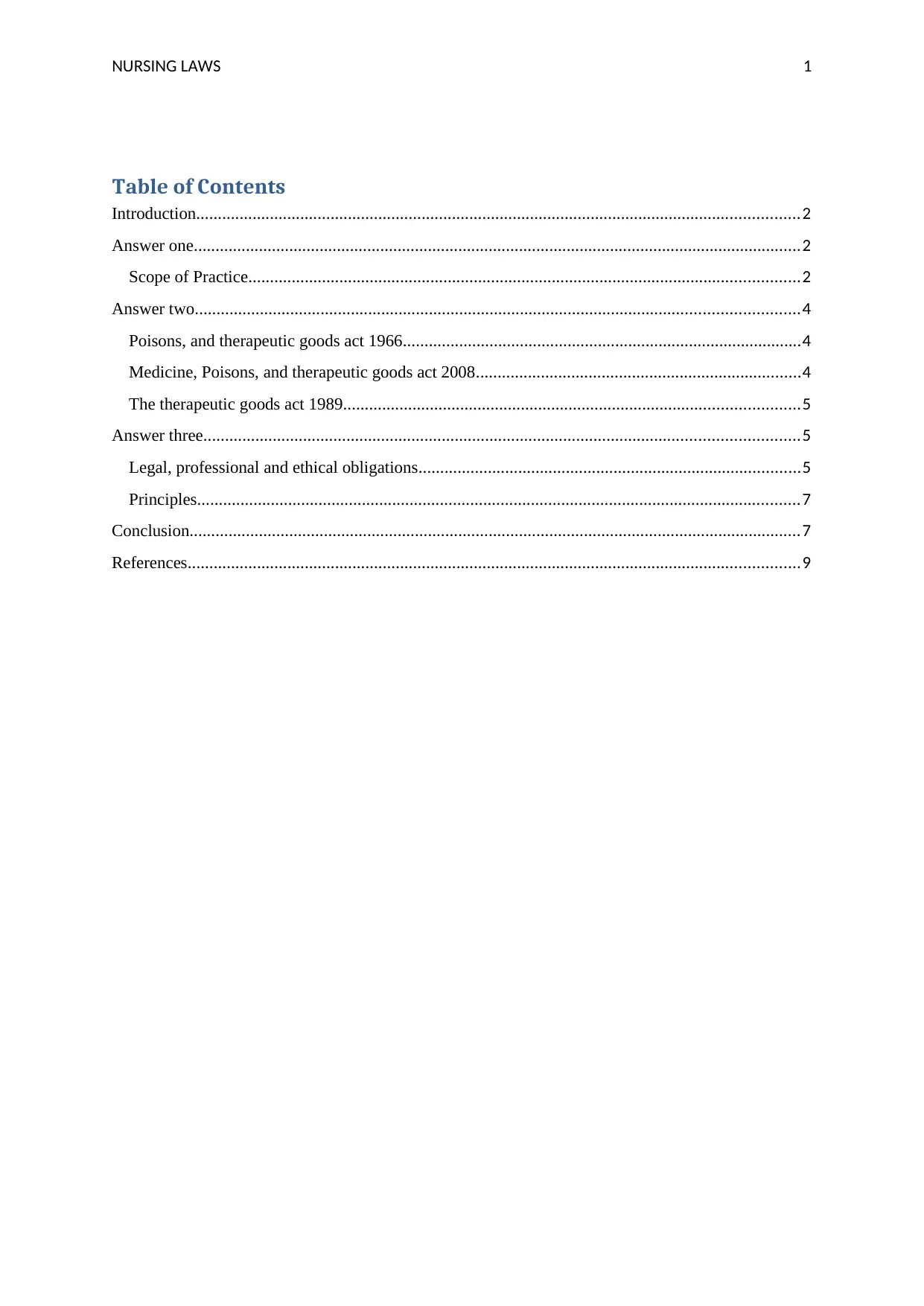
Table of Contents
Introduction...........................................................................................................................................2
Answer one............................................................................................................................................2
Scope of Practice...............................................................................................................................2
Answer two...........................................................................................................................................4
Poisons, and therapeutic goods act 1966............................................................................................4
Medicine, Poisons, and therapeutic goods act 2008...........................................................................4
The therapeutic goods act 1989.........................................................................................................5
Answer three.........................................................................................................................................5
Legal, professional and ethical obligations........................................................................................5
Principles...........................................................................................................................................7
Conclusion.............................................................................................................................................7
References.............................................................................................................................................9
Table of Contents
Introduction...........................................................................................................................................2
Answer one............................................................................................................................................2
Scope of Practice...............................................................................................................................2
Answer two...........................................................................................................................................4
Poisons, and therapeutic goods act 1966............................................................................................4
Medicine, Poisons, and therapeutic goods act 2008...........................................................................4
The therapeutic goods act 1989.........................................................................................................5
Answer three.........................................................................................................................................5
Legal, professional and ethical obligations........................................................................................5
Principles...........................................................................................................................................7
Conclusion.............................................................................................................................................7
References.............................................................................................................................................9
NURSING LAWS 2
Introduction
The scope of practice is defined as the functions, activities, roles, and responsibilities
which, the registered nurse are authorized to perform (American Nursing Association, 2009).
The scope of practice concept has been used in various sectors to conduct professional
regulation. The main purpose of the scope of practice is to provide the registered nurses with
guidance and support to deliver the good clinical care for the patient (Nursing and Midwifery
Board if Ireland, 2018). It describes that what type of nursing intervention or care registered
nurses are allowed to provide or perform. The rules and regulations set for the nurses are
different in every state of Australia. The main purpose of this report is to find out the laws,
obligation, and scope of practice related to nursing care. The consequences of working
outside the scope of practice, legislation related to the administrations of medication will be
discussed in this report. The impact of these legislations on nursing care and how the
registered nurse should react when they witness the unsafe or unethical practice will also be
mentioned.
Answer one
Scope of Practice
Definition
The scope of practice is the concept that various professionals from different sectors
use in a context of the professional regulation. It sets out the action procedure and processes
that the licensed or registered professional is legally allowed to perform.
The scope of the nursing practice is the range of functions, roles, activities and
responsibilities, which a nurse is competent, educated and legally authority to perform. The
Introduction
The scope of practice is defined as the functions, activities, roles, and responsibilities
which, the registered nurse are authorized to perform (American Nursing Association, 2009).
The scope of practice concept has been used in various sectors to conduct professional
regulation. The main purpose of the scope of practice is to provide the registered nurses with
guidance and support to deliver the good clinical care for the patient (Nursing and Midwifery
Board if Ireland, 2018). It describes that what type of nursing intervention or care registered
nurses are allowed to provide or perform. The rules and regulations set for the nurses are
different in every state of Australia. The main purpose of this report is to find out the laws,
obligation, and scope of practice related to nursing care. The consequences of working
outside the scope of practice, legislation related to the administrations of medication will be
discussed in this report. The impact of these legislations on nursing care and how the
registered nurse should react when they witness the unsafe or unethical practice will also be
mentioned.
Answer one
Scope of Practice
Definition
The scope of practice is the concept that various professionals from different sectors
use in a context of the professional regulation. It sets out the action procedure and processes
that the licensed or registered professional is legally allowed to perform.
The scope of the nursing practice is the range of functions, roles, activities and
responsibilities, which a nurse is competent, educated and legally authority to perform. The
⊘ This is a preview!⊘
Do you want full access?
Subscribe today to unlock all pages.

Trusted by 1+ million students worldwide
NURSING LAWS 3
broad scope the nursing practices describes all the roles and actions undertaken by a
registered nurse to deliver the full range of response and experience to illness and health. This
may include the health protection, health promotion, health restoration, health maintenance,
palliation, and rehabilitation. The scope of nursing practice is considered as the complex
practice but can become clear if describe some questions such as
Who: registered nurses comprising this question and have been titled, educated and
maintain the active licensure to perform nursing tasks.
What: nursing is the promotion, safety, and the optimization of abilities and health,
preventing illness and injury through diagnosis and treatment and advocacy in a patient
care.
Where: Wherever the patient required care
When: Whenever there is nursing knowledge required
Why: The nursing profession exists to achieve the positive patient outcomes.
Factors that influence the SoP of an individual nurse
The nurse's professional practice, educational preparation, and competence
National-international and local guidelines, evidence, and policies
The practice setting
Collaborative practice
Other factors like patient’s requirements, patient’s safety, and care outcomes.
The registered nurses are expected to work within their scope of practices. Working
outside the SoP is not legally allowed for registered nurses. The Nursing and Midwifery
Board of Australia (NMBA) provided notations ensure that the RN’s are not delivering care
outside their scope of practice. Examples of a registered nurse working outside their scope of
practice
broad scope the nursing practices describes all the roles and actions undertaken by a
registered nurse to deliver the full range of response and experience to illness and health. This
may include the health protection, health promotion, health restoration, health maintenance,
palliation, and rehabilitation. The scope of nursing practice is considered as the complex
practice but can become clear if describe some questions such as
Who: registered nurses comprising this question and have been titled, educated and
maintain the active licensure to perform nursing tasks.
What: nursing is the promotion, safety, and the optimization of abilities and health,
preventing illness and injury through diagnosis and treatment and advocacy in a patient
care.
Where: Wherever the patient required care
When: Whenever there is nursing knowledge required
Why: The nursing profession exists to achieve the positive patient outcomes.
Factors that influence the SoP of an individual nurse
The nurse's professional practice, educational preparation, and competence
National-international and local guidelines, evidence, and policies
The practice setting
Collaborative practice
Other factors like patient’s requirements, patient’s safety, and care outcomes.
The registered nurses are expected to work within their scope of practices. Working
outside the SoP is not legally allowed for registered nurses. The Nursing and Midwifery
Board of Australia (NMBA) provided notations ensure that the RN’s are not delivering care
outside their scope of practice. Examples of a registered nurse working outside their scope of
practice
Paraphrase This Document
Need a fresh take? Get an instant paraphrase of this document with our AI Paraphraser
NURSING LAWS 4
An inexperienced graduate registered nurse working in a laser hair removal clinics who
are not allowed by the local scope of practice authority. This considered as illegal and outside
the scope practice. Because the new registered nurse had no experience in their school or
institute to perform the task. He or she can only be allowed to work if they are hired by a
trained clinic having a certificate in laser hair removal (Registered Nursing, n.d)
Answer two
Poisons and therapeutic goods act 1966
This legislation is designed in a way to protect the welfare and health of the members
of the New South Wales community (Austlii, 2010). It applies some limitation on the use of
some potent medicines, poisons, and drugs by restricting their supply, prescription and
administration to the authorized and qualified person (NSW government, 2017).
Medicine, Poisons and therapeutic goods act 2008
According to this act, a person working in a hospital cannot administer a restricted
medicine to the patient in a hospital otherwise than on a direction of the authorized
practitioner. A person is not authorized to self-administer the prescribed prohibited substance
to other people (Australian Capital Territory, 2018). It can only be used for the purpose of
treatment that is prescribed by a physician or doctor, for treatment prescribed by the nurse,
midwife, optometrist, and podiatrist. Penalty unit set for this legislation is 20 units. This rule
may create problems for nurse practitioners to provide primary care in emergency cases.
This clause has some effects for the purposes of Drug misuse and trafficking Act 1985 (Jade,
2017).
An inexperienced graduate registered nurse working in a laser hair removal clinics who
are not allowed by the local scope of practice authority. This considered as illegal and outside
the scope practice. Because the new registered nurse had no experience in their school or
institute to perform the task. He or she can only be allowed to work if they are hired by a
trained clinic having a certificate in laser hair removal (Registered Nursing, n.d)
Answer two
Poisons and therapeutic goods act 1966
This legislation is designed in a way to protect the welfare and health of the members
of the New South Wales community (Austlii, 2010). It applies some limitation on the use of
some potent medicines, poisons, and drugs by restricting their supply, prescription and
administration to the authorized and qualified person (NSW government, 2017).
Medicine, Poisons and therapeutic goods act 2008
According to this act, a person working in a hospital cannot administer a restricted
medicine to the patient in a hospital otherwise than on a direction of the authorized
practitioner. A person is not authorized to self-administer the prescribed prohibited substance
to other people (Australian Capital Territory, 2018). It can only be used for the purpose of
treatment that is prescribed by a physician or doctor, for treatment prescribed by the nurse,
midwife, optometrist, and podiatrist. Penalty unit set for this legislation is 20 units. This rule
may create problems for nurse practitioners to provide primary care in emergency cases.
This clause has some effects for the purposes of Drug misuse and trafficking Act 1985 (Jade,
2017).
NURSING LAWS 5
The Therapeutic goods act 1989
The primary objective of this act is to control the quality, protection & efficacy, and
timely availability of the therapeutic goods that are exported from Australia, and used in
Australia. The act sets out some requirements for the inclusion of therapeutic goods in
Australia. These requirements are related to the advertisement, and the labeling and
appearance of the product (WHO (2011). This legislation gives the right to an individual to
have the decision about the medication prescribed to them. They can refuse the treatment or
medication that affects or harm them. This may create problem s for nurses providing health
care for the patient. Sometimes the patient may also reduce the medication or treatment that
are essential to achieving the health set for the diseased person (Pham & Rosemann, 2017).
Answer three
Legal, professional and ethical obligations
Nurses have become the most important part of any healthcare system. They are
responsible for delivering a protected and competent nursing care to the person’s health issue.
The registered nurses are aware of their duties and responsibility and to manage the
undertaking activities that are compromising the patients and co-worker’s safety. The
registered nurses should be familiar with the laws and regulations and ensure that they do not
take part in activities or practices that are restricted by those laws. Nurse witnessing the
illegals or unlawful conducts of other employees or colleagues, and they have obligation and
responsibility to report such activities to the appropriate authority.
Legal obligation
If there any error occurs either it affects the patient or not but create various problems
in the system the nurse have a legal and ethical obligation to disclose these risk to the
The Therapeutic goods act 1989
The primary objective of this act is to control the quality, protection & efficacy, and
timely availability of the therapeutic goods that are exported from Australia, and used in
Australia. The act sets out some requirements for the inclusion of therapeutic goods in
Australia. These requirements are related to the advertisement, and the labeling and
appearance of the product (WHO (2011). This legislation gives the right to an individual to
have the decision about the medication prescribed to them. They can refuse the treatment or
medication that affects or harm them. This may create problem s for nurses providing health
care for the patient. Sometimes the patient may also reduce the medication or treatment that
are essential to achieving the health set for the diseased person (Pham & Rosemann, 2017).
Answer three
Legal, professional and ethical obligations
Nurses have become the most important part of any healthcare system. They are
responsible for delivering a protected and competent nursing care to the person’s health issue.
The registered nurses are aware of their duties and responsibility and to manage the
undertaking activities that are compromising the patients and co-worker’s safety. The
registered nurses should be familiar with the laws and regulations and ensure that they do not
take part in activities or practices that are restricted by those laws. Nurse witnessing the
illegals or unlawful conducts of other employees or colleagues, and they have obligation and
responsibility to report such activities to the appropriate authority.
Legal obligation
If there any error occurs either it affects the patient or not but create various problems
in the system the nurse have a legal and ethical obligation to disclose these risk to the
⊘ This is a preview!⊘
Do you want full access?
Subscribe today to unlock all pages.
Trusted by 1+ million students worldwide
NURSING LAWS 6
concerning authority. Nurses can submit a written report to inform the issue causing a
problem for the system. Nurses have the legal responsibility to inform if any type of error
involves medication, medical device related and healthcare-acquired infection. In medication
errors case, if the errors have been made during the administration of medicine to the patient
by fellow nurses, can also be reported. The errors made by the nurses are more likely to be
reported that the errors occur at the time of prescription and distribution by physicians and
pharmacists (Australian health practitioner regulation agency, 2017).
Nurses have the legal and ethical obligations to maintain the privacy of the person
requiring or receiving nursing care. Nurses can restrict the use of a patient’s information
collected for the professional purpose only. Nursers, if necessary, can inform a person to
provide the competent care, if it is essential to disclose the data important for decision
making.
They can seek consent from the patient or their family members before disclosing the
information. Nurses can abstain from taking part in exploitation, misrepresentation, and
misinformation regarding the healthcare products and care.
Professional obligations
All the registered nurses must ensure the safety and competent nursing care to follow
the legislative framework govern nurses & midwives practice. This includes taking action to
make sure the safety. According to sections 38 and 39 of Health Practitioner Regulation
National Law (NSW), the country’s national board should develop standard, guidelines, and
codes to govern the nursing practice. Section 41 provides standards, guidelines, and codes.
According to this law, any registered nurse or midwife who does not follow the standard,
code, and guideline may be found guilty (Nursing and midwifery board of Australia, 2008).
concerning authority. Nurses can submit a written report to inform the issue causing a
problem for the system. Nurses have the legal responsibility to inform if any type of error
involves medication, medical device related and healthcare-acquired infection. In medication
errors case, if the errors have been made during the administration of medicine to the patient
by fellow nurses, can also be reported. The errors made by the nurses are more likely to be
reported that the errors occur at the time of prescription and distribution by physicians and
pharmacists (Australian health practitioner regulation agency, 2017).
Nurses have the legal and ethical obligations to maintain the privacy of the person
requiring or receiving nursing care. Nurses can restrict the use of a patient’s information
collected for the professional purpose only. Nursers, if necessary, can inform a person to
provide the competent care, if it is essential to disclose the data important for decision
making.
They can seek consent from the patient or their family members before disclosing the
information. Nurses can abstain from taking part in exploitation, misrepresentation, and
misinformation regarding the healthcare products and care.
Professional obligations
All the registered nurses must ensure the safety and competent nursing care to follow
the legislative framework govern nurses & midwives practice. This includes taking action to
make sure the safety. According to sections 38 and 39 of Health Practitioner Regulation
National Law (NSW), the country’s national board should develop standard, guidelines, and
codes to govern the nursing practice. Section 41 provides standards, guidelines, and codes.
According to this law, any registered nurse or midwife who does not follow the standard,
code, and guideline may be found guilty (Nursing and midwifery board of Australia, 2008).
Paraphrase This Document
Need a fresh take? Get an instant paraphrase of this document with our AI Paraphraser
NURSING LAWS 7
Principles
Principle one
When the aspect of healthcare is delegated, registered nurses and midwives make sure
the delegation should not neglect the safety of the quality of care
Principle two
The primary responsibility of registered nurses is to provide a safe and quality care. In
any circumstances, if that not followed, or any questionable observations found, the unethical
and unlawful practice should report to an appropriate person of the health care system or
organization. In case if the problem is not resolved by that person and continues to be
compromised, nurses should intervene themselves to safeguard the people and exhausting
internal processes, can notify other appropriate authority from a different organization
(NSWNMA, 2013).
Conclusion
The scope of practice is defined as the activity, function, roles, and responsibility
which a nurse is allowed to perform. The most important propose of this concept is to provide
the nurse's guidance and support so that they can perform good nursing practice for the safety
and health promotion of the patient. The rule made for the administrations of the drug to the
patient are poison and therapeutic act 1996 (New South Wales), medicine, poison and
therapeutic goods act (2008) and therapeutic goods act 1989. Main goal of these rules are to
provide safe and quality care to the patient. While nurses work under various rules and laws
they also have some right and responsibility to act when they find anything unprofessional
and unsafe happening in their working place, and these right allow them to report these issues
to the authorized person.
Principles
Principle one
When the aspect of healthcare is delegated, registered nurses and midwives make sure
the delegation should not neglect the safety of the quality of care
Principle two
The primary responsibility of registered nurses is to provide a safe and quality care. In
any circumstances, if that not followed, or any questionable observations found, the unethical
and unlawful practice should report to an appropriate person of the health care system or
organization. In case if the problem is not resolved by that person and continues to be
compromised, nurses should intervene themselves to safeguard the people and exhausting
internal processes, can notify other appropriate authority from a different organization
(NSWNMA, 2013).
Conclusion
The scope of practice is defined as the activity, function, roles, and responsibility
which a nurse is allowed to perform. The most important propose of this concept is to provide
the nurse's guidance and support so that they can perform good nursing practice for the safety
and health promotion of the patient. The rule made for the administrations of the drug to the
patient are poison and therapeutic act 1996 (New South Wales), medicine, poison and
therapeutic goods act (2008) and therapeutic goods act 1989. Main goal of these rules are to
provide safe and quality care to the patient. While nurses work under various rules and laws
they also have some right and responsibility to act when they find anything unprofessional
and unsafe happening in their working place, and these right allow them to report these issues
to the authorized person.
NURSING LAWS 8
References
American Nursing Association (2009). Nursing administration: scope and standard of
practice. Maryland, US: Nurses Books.
Austlii (2010). Poison and therapeutic goods act 1966. Retrieved from:
http://www7.austlii.edu.au/cgi-bin/viewdb/au/legis/nsw/consol_act/patga1966307/
Australian Capital Territory (2018). Medicines, poisons and therapeutic goods act 2008.
Retrieved from: http://www.legislation.act.gov.au/a/2008-26/current/pdf/2008-26.pdf
Barton, A. (2009). Patient safety and quality: An evidence‐based handbook for nurses. Aorn
Journal, 90(4), 601-602.
Jade (2017). Medicines, poisons and therapeutic goods act 2008. Retrieved from:
https://jade.io/j/?a=outline&id=403319
NSW government (2017). Legislation. Retrieved from:
http://www.health.nsw.gov.au/pharmaceutical/Pages/legislation.aspx
Nursing and Midwifery Board if Ireland (2018). The scope of Nursing and Midwifery
practice. Retrieved from: https://www.nmbi.ie/Standards-Guidance/Scope-of-
Practice.aspx
Pham, P. V., & Rosemann, A. (2017). Safety, ethics, and regulations. Berlin, Germany:
Springer.
Registered nursing (n. d.). Working as a registered nurse (RN). Retrieved From:
https://www.registerednursing.org/guide/working-rn/
WHO (2011). Therapeutic goods act 1989. Retrieved from:
http://apps.who.int/medicinedocs/documents/s18007en/s18007en.pdf
References
American Nursing Association (2009). Nursing administration: scope and standard of
practice. Maryland, US: Nurses Books.
Austlii (2010). Poison and therapeutic goods act 1966. Retrieved from:
http://www7.austlii.edu.au/cgi-bin/viewdb/au/legis/nsw/consol_act/patga1966307/
Australian Capital Territory (2018). Medicines, poisons and therapeutic goods act 2008.
Retrieved from: http://www.legislation.act.gov.au/a/2008-26/current/pdf/2008-26.pdf
Barton, A. (2009). Patient safety and quality: An evidence‐based handbook for nurses. Aorn
Journal, 90(4), 601-602.
Jade (2017). Medicines, poisons and therapeutic goods act 2008. Retrieved from:
https://jade.io/j/?a=outline&id=403319
NSW government (2017). Legislation. Retrieved from:
http://www.health.nsw.gov.au/pharmaceutical/Pages/legislation.aspx
Nursing and Midwifery Board if Ireland (2018). The scope of Nursing and Midwifery
practice. Retrieved from: https://www.nmbi.ie/Standards-Guidance/Scope-of-
Practice.aspx
Pham, P. V., & Rosemann, A. (2017). Safety, ethics, and regulations. Berlin, Germany:
Springer.
Registered nursing (n. d.). Working as a registered nurse (RN). Retrieved From:
https://www.registerednursing.org/guide/working-rn/
WHO (2011). Therapeutic goods act 1989. Retrieved from:
http://apps.who.int/medicinedocs/documents/s18007en/s18007en.pdf
⊘ This is a preview!⊘
Do you want full access?
Subscribe today to unlock all pages.
Trusted by 1+ million students worldwide
NURSING LAWS 9
Nursing and midwifery board of Australia (2008). Code of professional conduct for nurses in
Australia. Retrieved from: file:///C:/Users/System04088/Downloads/6_New-Code-of-
Professional-Conduct-for-Nurses-August-2008-1-%20 (4).PDF
Australian health practitioner regulation agency (2017). Mandatory reporting. Retrieved
from: https://www.ahpra.gov.au/notifications/make-a-complaint/mandatory-
notifications.aspx
NSWNMA (2013). Safe patient care and nursing obligation Dl final. Retrieved from:
http://www.nswnma.asn.au/wp-content/uploads/2013/07/Safe-Patient-Care-and-Nurse-
Professional-Obligation-DL-FINAL.pdf
Nursing and midwifery board of Australia (2008). Code of professional conduct for nurses in
Australia. Retrieved from: file:///C:/Users/System04088/Downloads/6_New-Code-of-
Professional-Conduct-for-Nurses-August-2008-1-%20 (4).PDF
Australian health practitioner regulation agency (2017). Mandatory reporting. Retrieved
from: https://www.ahpra.gov.au/notifications/make-a-complaint/mandatory-
notifications.aspx
NSWNMA (2013). Safe patient care and nursing obligation Dl final. Retrieved from:
http://www.nswnma.asn.au/wp-content/uploads/2013/07/Safe-Patient-Care-and-Nurse-
Professional-Obligation-DL-FINAL.pdf

1 out of 10


Related Documents


Your All-in-One AI-Powered Toolkit for Academic Success.
+13062052269
info@desklib.com
Available 24*7 on WhatsApp / Email
![[object Object]](/_next/static/media/star-bottom.7253800d.svg)
Unlock your academic potential
Copyright © 2020–2026 A2Z Services. All Rights Reserved. Developed and managed by ZUCOL.