NSB305 Leading & Learning: Resolving Conflicts in Nursing Delegation

Verified

Added on  2023/06/07

|7
|1804
|287
Report
AI Summary
This report analyzes conflict resolution in nursing practice, focusing on conflicts arising from task delegation. It highlights the impact of unresolved conflicts, such as increased stress, clinical errors, communication breakdown, and reduced employee satisfaction. The report proposes three realistic strategies for beginner registered nurses to address these conflicts: using best practice policies like the 'Five Rights of Delegation,' improving communication strategies through feedback and team meetings, and identifying and managing the source of the conflict through effective monitoring and evaluation. The conclusion emphasizes the importance of conflict management in maintaining team performance and productivity in nursing, advocating for proactive measures to mitigate conflicts related to task delegation.
Document Page
Running head: BUILDING PROFESSIONAL CAPACITY
Leading and Learning
-Building Professional Capacity
Name of the Student
Name of the University
Author Note
tabler-icon-diamond-filled.svg

Paraphrase This Document

Need a fresh take? Get an instant paraphrase of this document with our AI Paraphraser
Document Page
1BUILDING PROFESSIONAL CAPACITY
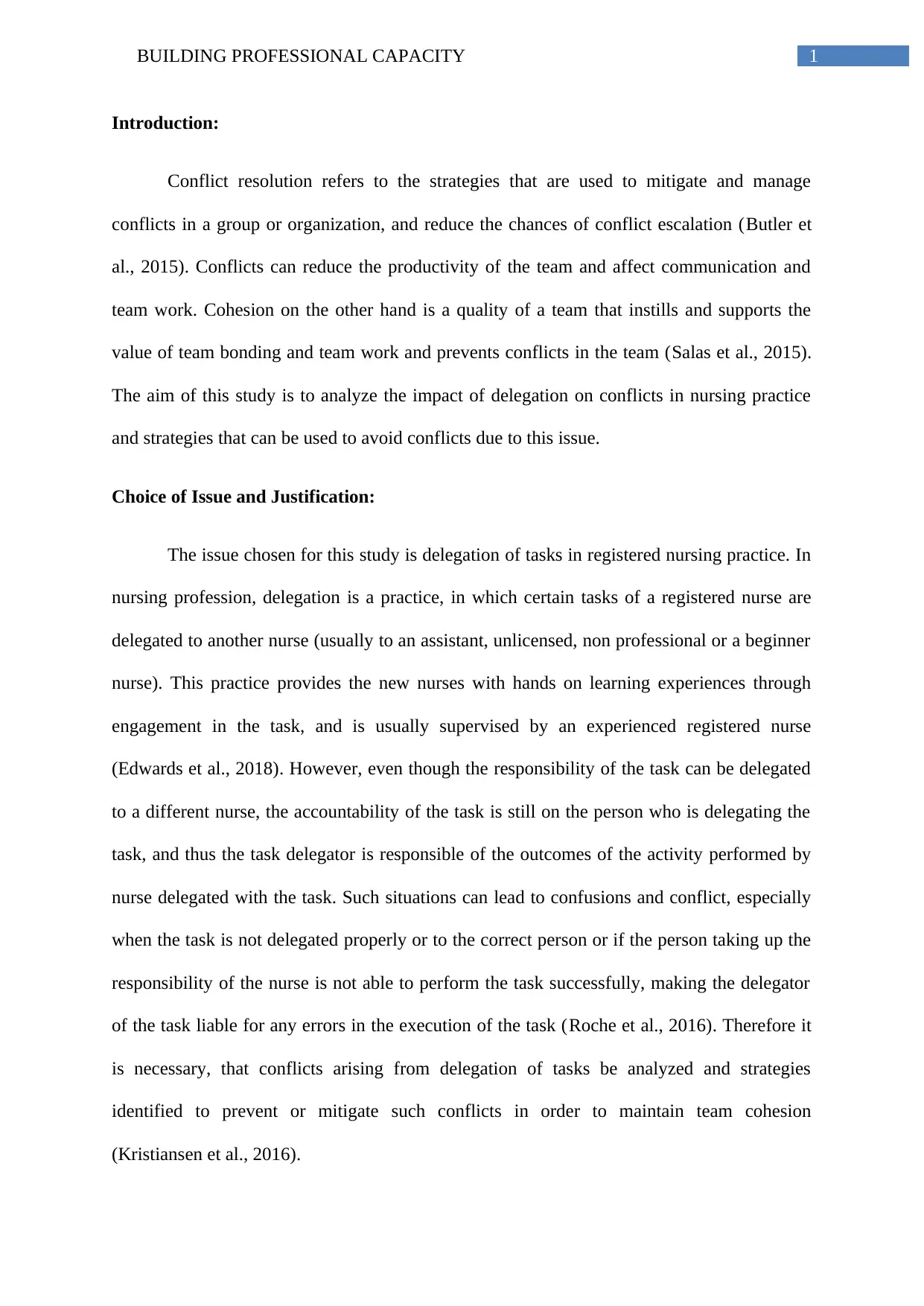
Introduction:
Conflict resolution refers to the strategies that are used to mitigate and manage
conflicts in a group or organization, and reduce the chances of conflict escalation (Butler et
al., 2015). Conflicts can reduce the productivity of the team and affect communication and
team work. Cohesion on the other hand is a quality of a team that instills and supports the
value of team bonding and team work and prevents conflicts in the team (Salas et al., 2015).
The aim of this study is to analyze the impact of delegation on conflicts in nursing practice
and strategies that can be used to avoid conflicts due to this issue.
Choice of Issue and Justification:
The issue chosen for this study is delegation of tasks in registered nursing practice. In
nursing profession, delegation is a practice, in which certain tasks of a registered nurse are
delegated to another nurse (usually to an assistant, unlicensed, non professional or a beginner
nurse). This practice provides the new nurses with hands on learning experiences through
engagement in the task, and is usually supervised by an experienced registered nurse
(Edwards et al., 2018). However, even though the responsibility of the task can be delegated
to a different nurse, the accountability of the task is still on the person who is delegating the
task, and thus the task delegator is responsible of the outcomes of the activity performed by
nurse delegated with the task. Such situations can lead to confusions and conflict, especially
when the task is not delegated properly or to the correct person or if the person taking up the
responsibility of the nurse is not able to perform the task successfully, making the delegator
of the task liable for any errors in the execution of the task (Roche et al., 2016). Therefore it
is necessary, that conflicts arising from delegation of tasks be analyzed and strategies
identified to prevent or mitigate such conflicts in order to maintain team cohesion
(Kristiansen et al., 2016).
Document Page
2BUILDING PROFESSIONAL CAPACITY
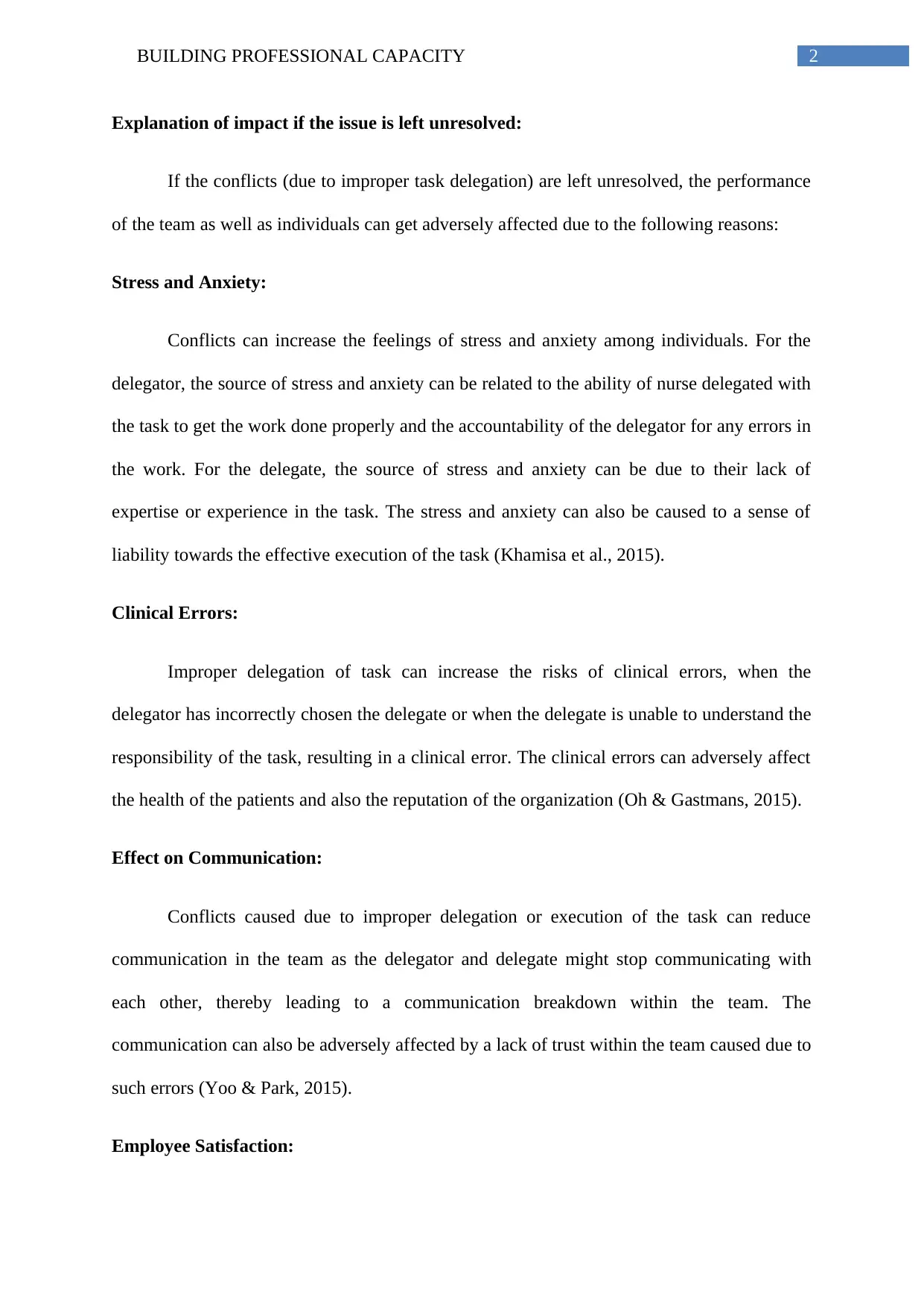
Explanation of impact if the issue is left unresolved:
If the conflicts (due to improper task delegation) are left unresolved, the performance
of the team as well as individuals can get adversely affected due to the following reasons:
Stress and Anxiety:
Conflicts can increase the feelings of stress and anxiety among individuals. For the
delegator, the source of stress and anxiety can be related to the ability of nurse delegated with
the task to get the work done properly and the accountability of the delegator for any errors in
the work. For the delegate, the source of stress and anxiety can be due to their lack of
expertise or experience in the task. The stress and anxiety can also be caused to a sense of
liability towards the effective execution of the task (Khamisa et al., 2015).
Clinical Errors:
Improper delegation of task can increase the risks of clinical errors, when the
delegator has incorrectly chosen the delegate or when the delegate is unable to understand the
responsibility of the task, resulting in a clinical error. The clinical errors can adversely affect
the health of the patients and also the reputation of the organization (Oh & Gastmans, 2015).
Effect on Communication:
Conflicts caused due to improper delegation or execution of the task can reduce
communication in the team as the delegator and delegate might stop communicating with
each other, thereby leading to a communication breakdown within the team. The
communication can also be adversely affected by a lack of trust within the team caused due to
such errors (Yoo & Park, 2015).
Employee Satisfaction:
Document Page
3BUILDING PROFESSIONAL CAPACITY
Due to increase in stress and anxiety and with a breakdown in communication in the
team, the levels of job satisfaction of the nurses can be significantly affected, and can lead to
reduced retention or increased attrition in the team. Furthermore, clinical errors can also
affect the performance of the team and individual nurses further affecting their job
satisfaction (AlAzzam et al., 2017).
Discussion of 3 realistic strategies:
Three important strategies that a beginner registered nurse can use to address conflicts
caused due to task delegation includes:
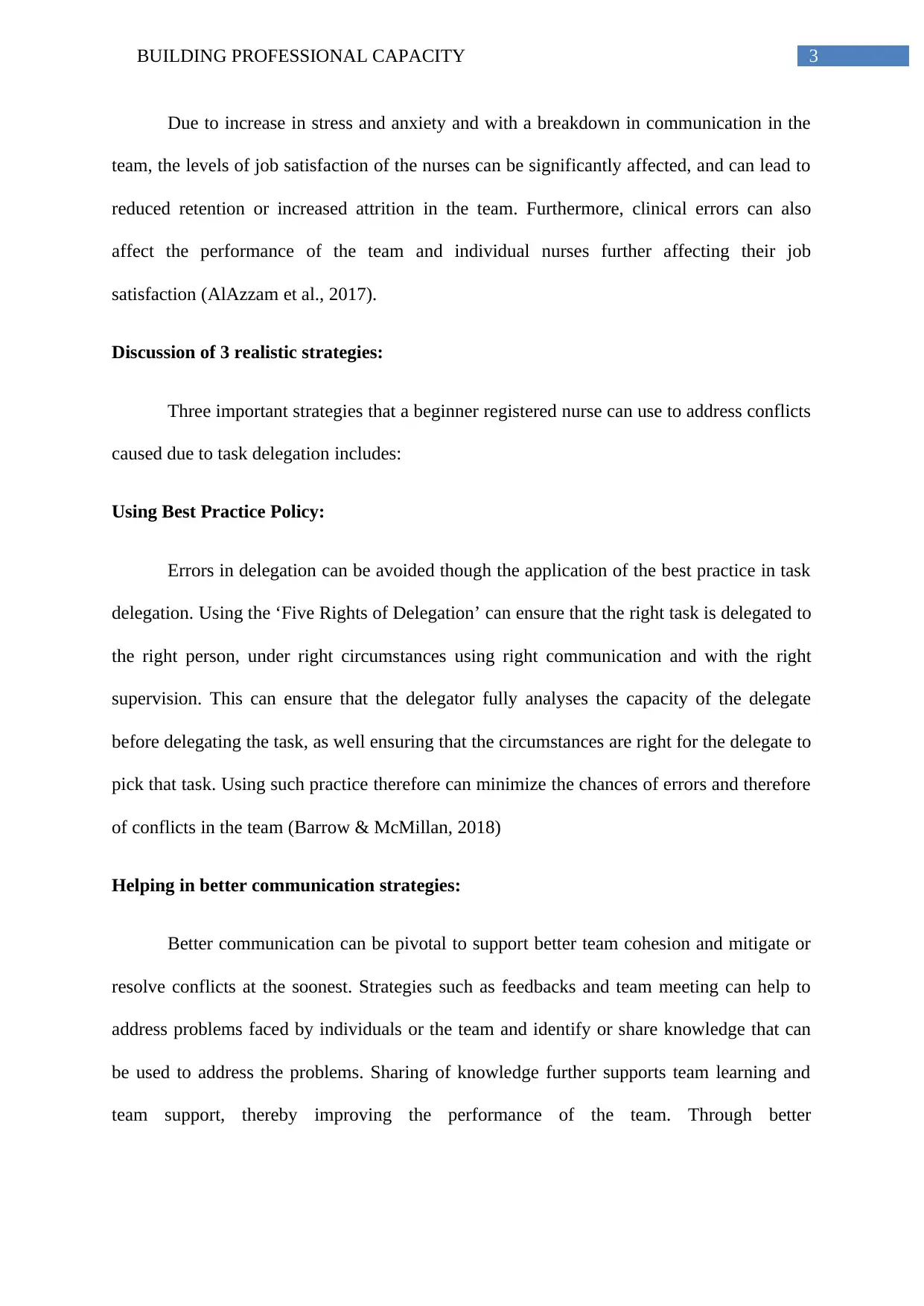
Using Best Practice Policy:
Errors in delegation can be avoided though the application of the best practice in task
delegation. Using the ‘Five Rights of Delegation’ can ensure that the right task is delegated to
the right person, under right circumstances using right communication and with the right
supervision. This can ensure that the delegator fully analyses the capacity of the delegate
before delegating the task, as well ensuring that the circumstances are right for the delegate to
pick that task. Using such practice therefore can minimize the chances of errors and therefore
of conflicts in the team (Barrow & McMillan, 2018)
Helping in better communication strategies:
Better communication can be pivotal to support better team cohesion and mitigate or
resolve conflicts at the soonest. Strategies such as feedbacks and team meeting can help to
address problems faced by individuals or the team and identify or share knowledge that can
be used to address the problems. Sharing of knowledge further supports team learning and
team support, thereby improving the performance of the team. Through better
tabler-icon-diamond-filled.svg

Paraphrase This Document

Need a fresh take? Get an instant paraphrase of this document with our AI Paraphraser
Document Page
4BUILDING PROFESSIONAL CAPACITY
communication, the challenges faced by the nurses while delegating or picking up a task from
another nurse can be discussed to identify best solutions to the problems (Lee et al., 2014).
Identifying and managing the source of the conflict:
The conflicts are mostly caused due to errors while delegating or executing the task.
Identifying the error in such circumstances and resolving such errors can help to reduce the
stress and anxiety faced by the delegator and delegate, and can therefore be strategic to
resolve the conflict in the team. Effective strategies for monitoring and evaluation of the
delegation and execution of the task can help to identify the error and thus find solution to fix
those errors (Butler et al., 2015).
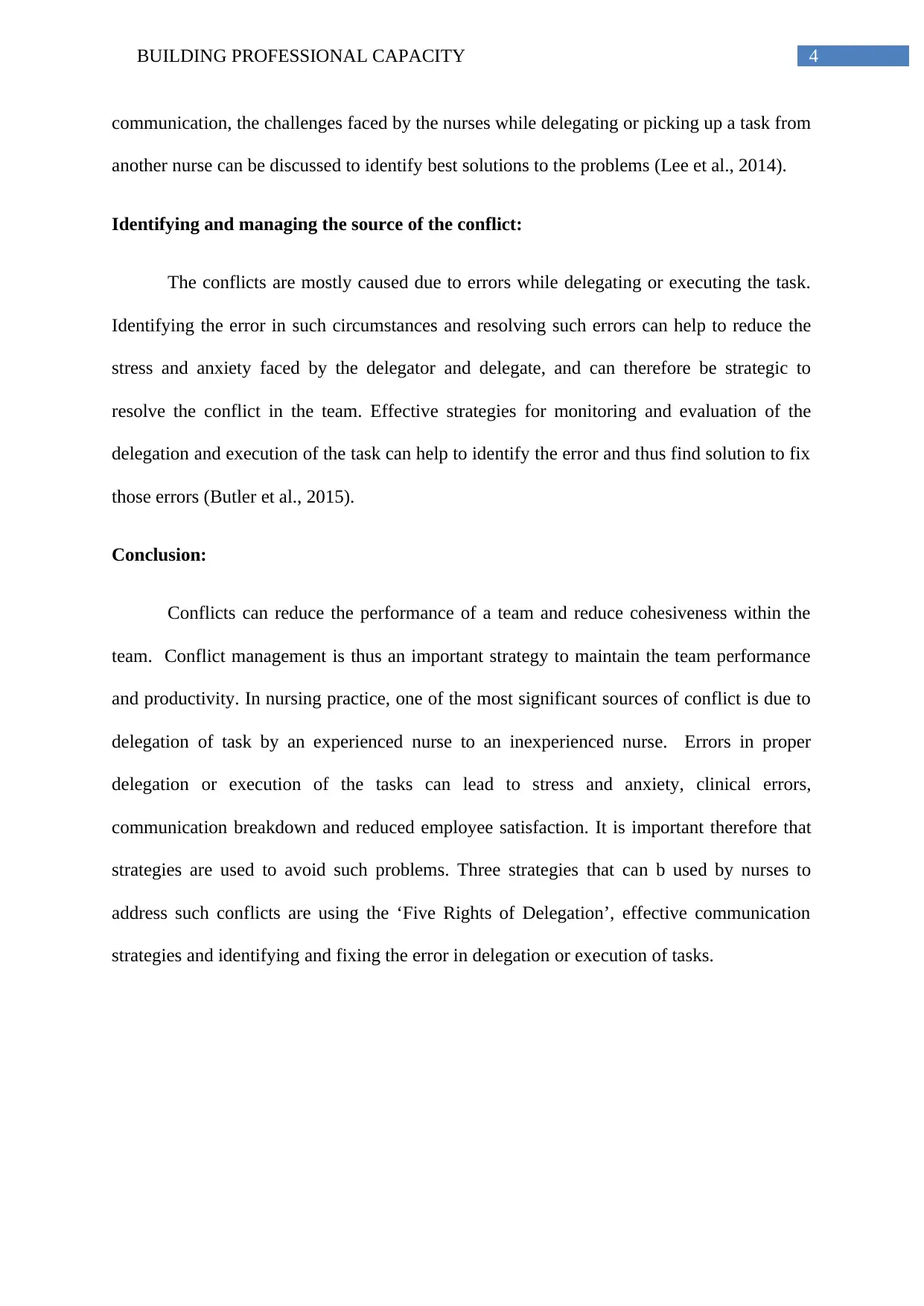
Conclusion:
Conflicts can reduce the performance of a team and reduce cohesiveness within the
team. Conflict management is thus an important strategy to maintain the team performance
and productivity. In nursing practice, one of the most significant sources of conflict is due to
delegation of task by an experienced nurse to an inexperienced nurse. Errors in proper
delegation or execution of the tasks can lead to stress and anxiety, clinical errors,
communication breakdown and reduced employee satisfaction. It is important therefore that
strategies are used to avoid such problems. Three strategies that can b used by nurses to
address such conflicts are using the ‘Five Rights of Delegation’, effective communication
strategies and identifying and fixing the error in delegation or execution of tasks.
Document Page
5BUILDING PROFESSIONAL CAPACITY
References:
AlAzzam, M., AbuAlRub, R. F., & Nazzal, A. H. (2017, October). The relationship between
work–family conflict and job satisfaction among hospital nurses. In Nursing forum
(Vol. 52, No. 4, pp. 278-288).
Barrow, J. M., & McMillan, J. (2018). Nursing, Five Rights of Delegation. In StatPearls
[Internet]. StatPearls Publishing.
Butler, J. R. A., Young, J. C., McMyn, I. A. G., Leyshon, B., Graham, I. M., Walker, I., ... &
Warburton, C. (2015). Evaluating adaptive co-management as conservation conflict
resolution: learning from seals and salmon. Journal of environmental management,
160, 212-225.
Edwards, S. T., Helfrich, C. D., Grembowski, D., Hulen, E., Clinton, W. L., Wood, G. B., ...
& Stewart, G. (2018). Task Delegation and Burnout Trade-offs Among Primary Care
Providers and Nurses in Veterans Affairs Patient Aligned Care Teams (VA PACTs).
The Journal of the American Board of Family Medicine, 31(1), 83-93.
Khamisa, N., Oldenburg, B., Peltzer, K., & Ilic, D. (2015). Work related stress, burnout, job
satisfaction and general health of nurses. International journal of environmental
research and public health, 12(1), 652-666.
Kristiansen, M., Westeren, K. I., Obstfelder, A., & Lotherington, A. T. (2016). Coping with
increased managerial tasks: tensions and dilemmas in nursing leadership. Journal of
Research in Nursing, 21(7), 492-502.
Lee, T. L., Gelfand, M. J., & Kashima, Y. (2014). The serial reproduction of conflict: Third
parties escalate conflict through communication biases. Journal of Experimental
Social Psychology, 54, 68-72.
Document Page
6BUILDING PROFESSIONAL CAPACITY
Oh, Y., & Gastmans, C. (2015). Moral distress experienced by nurses: a quantitative
literature review. Nursing Ethics, 22(1), 15-31.
Roche, M. A., Duffield, C., Friedman, S., Dimitrelis, S., & Rowbotham, S. (2016). Regulated
and unregulated nurses in the acute hospital setting: Tasks performed, delayed or not
completed. Journal of clinical nursing, 25(1-2), 153-162.
Salas, E., Grossman, R., Hughes, A. M., & Coultas, C. W. (2015). Measuring team cohesion:
Observations from the science. Human factors, 57(3), 365-374.
Yoo, M. S., & Park, H. R. (2015). Effects of casebased learning on communication skills,
problemsolving ability, and learning motivation in nursing students. Nursing &
health sciences, 17(2), 166-172.
chevron_up_icon
1 out of 7
circle_padding
hide_on_mobile
zoom_out_icon
[object Object]