Case Study: Nursing Legislation & Decision-Making in Queensland

Verified

Added on  2023/06/03

|4
|1043
|298
Case Study
AI Summary
This case study examines the legal and ethical responsibilities of a registered nurse in the emergency department of a tertiary hospital in Queensland during a hypothetical zombie outbreak in 2019. The scenario requires the nurse to consider risks to themselves, patients, and the wider community, focusing on ethical and legal requirements discussed throughout the course. Key considerations include workplace health and safety, the obligation to attend work, infection prevention, and presenteeism. The nurse must adhere to professional standards and codes, making critical decisions based on the National Decision Making Framework, the Health Rights Commission Act 1991, the Health Quality and Complaints Act 2006, and the Nursing Act and Nursing regulation 2005. The case study also addresses the ethical dilemma of patient isolation, balancing duty of care with patient and family needs, and the potential need for end-of-life decisions due to the highly contagious and aggressive nature of the fictional 'Solanum' virus. The nurse is expected to implement a family-centered approach, communicating with clinicians and patient families to ensure overall safety and well-being.
Document Page
Running head: NURSING LEGISLATION AND DECISION-MAKING
NURSING LEGISLATION AND DECISION-MAKING
Name of Student:
Name of the University:
Author note:
tabler-icon-diamond-filled.svg

Paraphrase This Document

Need a fresh take? Get an instant paraphrase of this document with our AI Paraphraser
Document Page
1NURSING LEGISLATION AND DECISION-MAKING
Response to Question 1
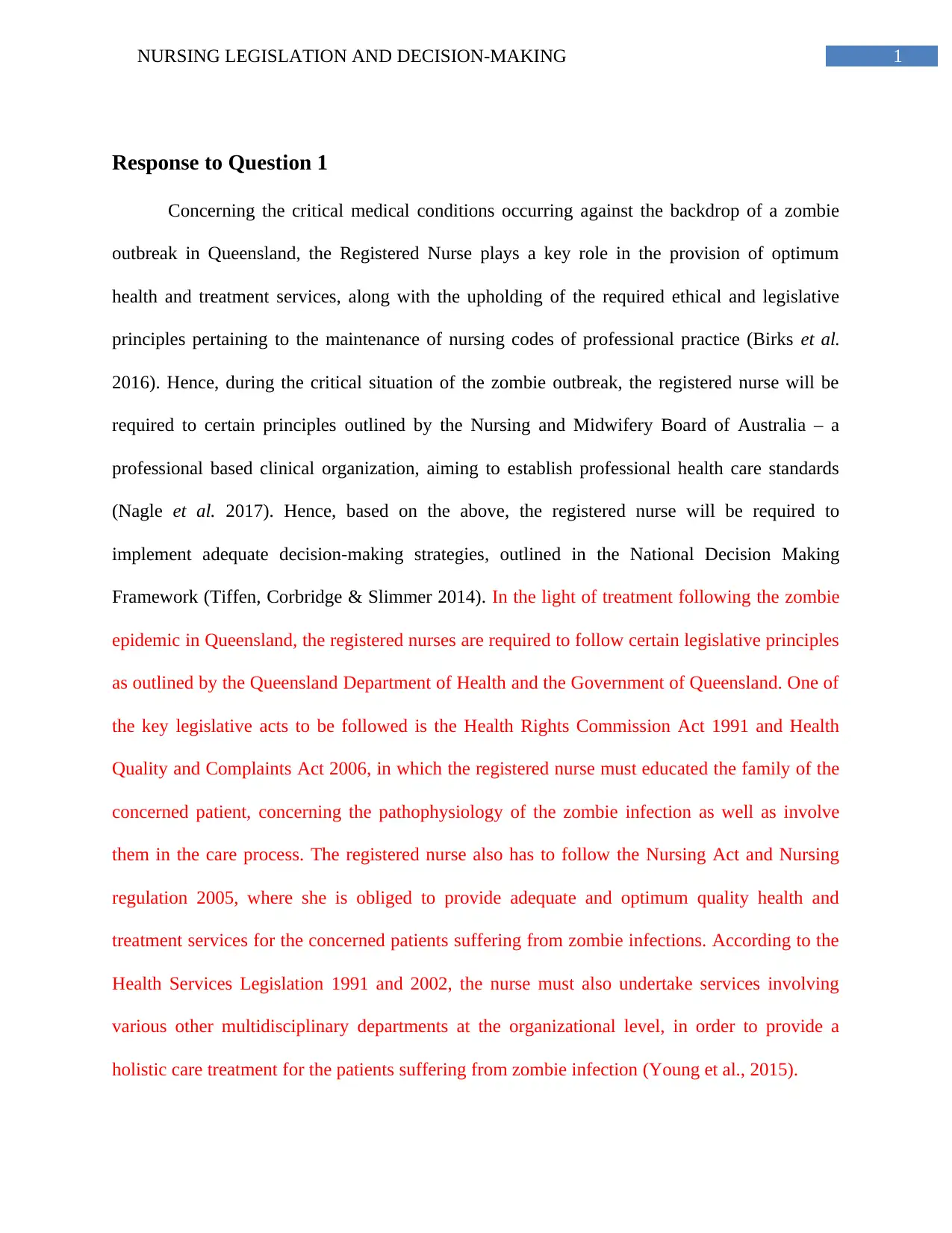
Concerning the critical medical conditions occurring against the backdrop of a zombie
outbreak in Queensland, the Registered Nurse plays a key role in the provision of optimum
health and treatment services, along with the upholding of the required ethical and legislative
principles pertaining to the maintenance of nursing codes of professional practice (Birks et al.
2016). Hence, during the critical situation of the zombie outbreak, the registered nurse will be
required to certain principles outlined by the Nursing and Midwifery Board of Australia – a
professional based clinical organization, aiming to establish professional health care standards
(Nagle et al. 2017). Hence, based on the above, the registered nurse will be required to
implement adequate decision-making strategies, outlined in the National Decision Making
Framework (Tiffen, Corbridge & Slimmer 2014). In the light of treatment following the zombie
epidemic in Queensland, the registered nurses are required to follow certain legislative principles
as outlined by the Queensland Department of Health and the Government of Queensland. One of
the key legislative acts to be followed is the Health Rights Commission Act 1991 and Health
Quality and Complaints Act 2006, in which the registered nurse must educated the family of the
concerned patient, concerning the pathophysiology of the zombie infection as well as involve
them in the care process. The registered nurse also has to follow the Nursing Act and Nursing
regulation 2005, where she is obliged to provide adequate and optimum quality health and
treatment services for the concerned patients suffering from zombie infections. According to the
Health Services Legislation 1991 and 2002, the nurse must also undertake services involving
various other multidisciplinary departments at the organizational level, in order to provide a
holistic care treatment for the patients suffering from zombie infection (Young et al., 2015).
Document Page
2NURSING LEGISLATION AND DECISION-MAKING
Response to Question 2
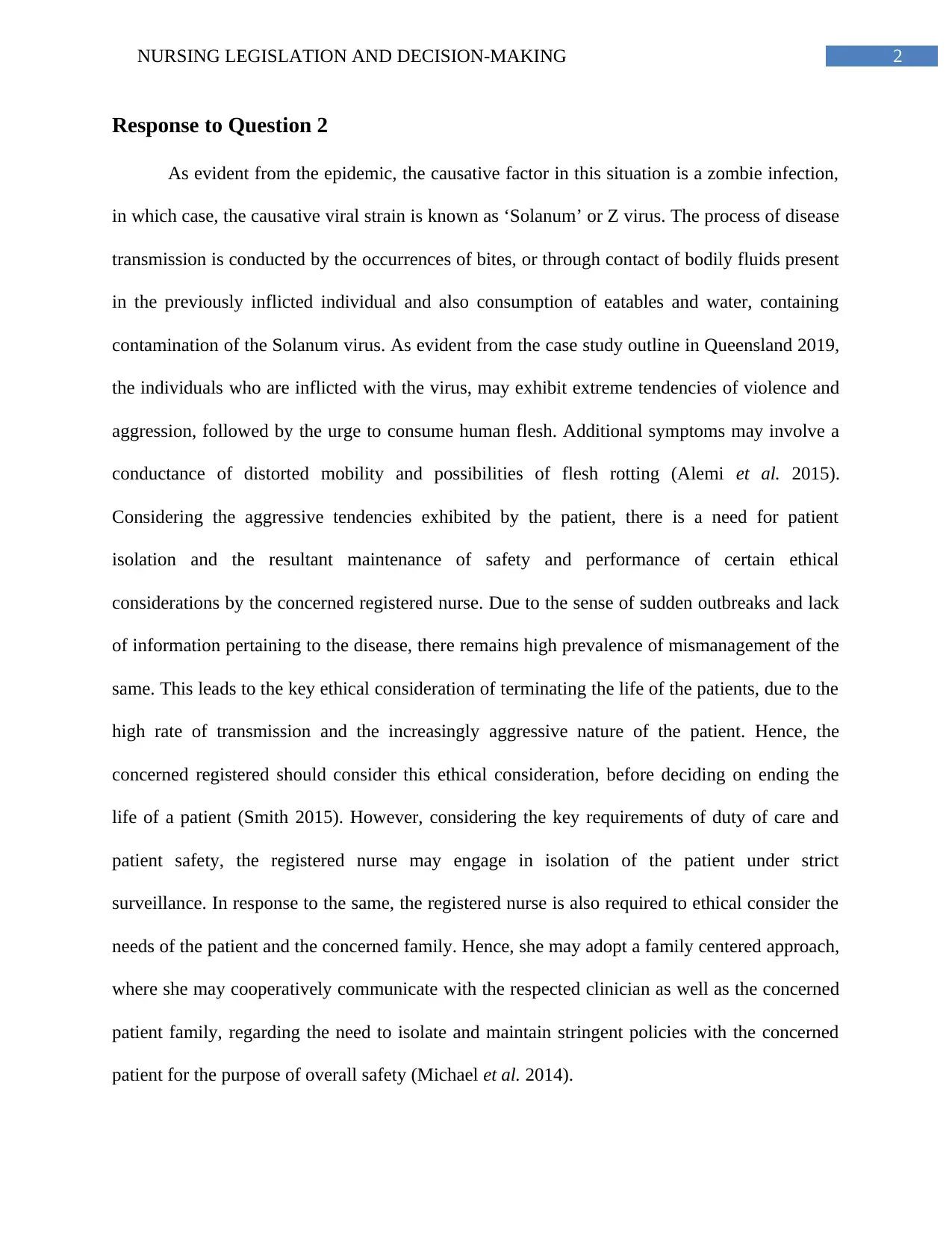
As evident from the epidemic, the causative factor in this situation is a zombie infection,
in which case, the causative viral strain is known as ‘Solanum’ or Z virus. The process of disease
transmission is conducted by the occurrences of bites, or through contact of bodily fluids present
in the previously inflicted individual and also consumption of eatables and water, containing
contamination of the Solanum virus. As evident from the case study outline in Queensland 2019,
the individuals who are inflicted with the virus, may exhibit extreme tendencies of violence and
aggression, followed by the urge to consume human flesh. Additional symptoms may involve a
conductance of distorted mobility and possibilities of flesh rotting (Alemi et al. 2015).
Considering the aggressive tendencies exhibited by the patient, there is a need for patient
isolation and the resultant maintenance of safety and performance of certain ethical
considerations by the concerned registered nurse. Due to the sense of sudden outbreaks and lack
of information pertaining to the disease, there remains high prevalence of mismanagement of the
same. This leads to the key ethical consideration of terminating the life of the patients, due to the
high rate of transmission and the increasingly aggressive nature of the patient. Hence, the
concerned registered should consider this ethical consideration, before deciding on ending the
life of a patient (Smith 2015). However, considering the key requirements of duty of care and
patient safety, the registered nurse may engage in isolation of the patient under strict
surveillance. In response to the same, the registered nurse is also required to ethical consider the
needs of the patient and the concerned family. Hence, she may adopt a family centered approach,
where she may cooperatively communicate with the respected clinician as well as the concerned
patient family, regarding the need to isolate and maintain stringent policies with the concerned
patient for the purpose of overall safety (Michael et al. 2014).
Document Page
3NURSING LEGISLATION AND DECISION-MAKING
References
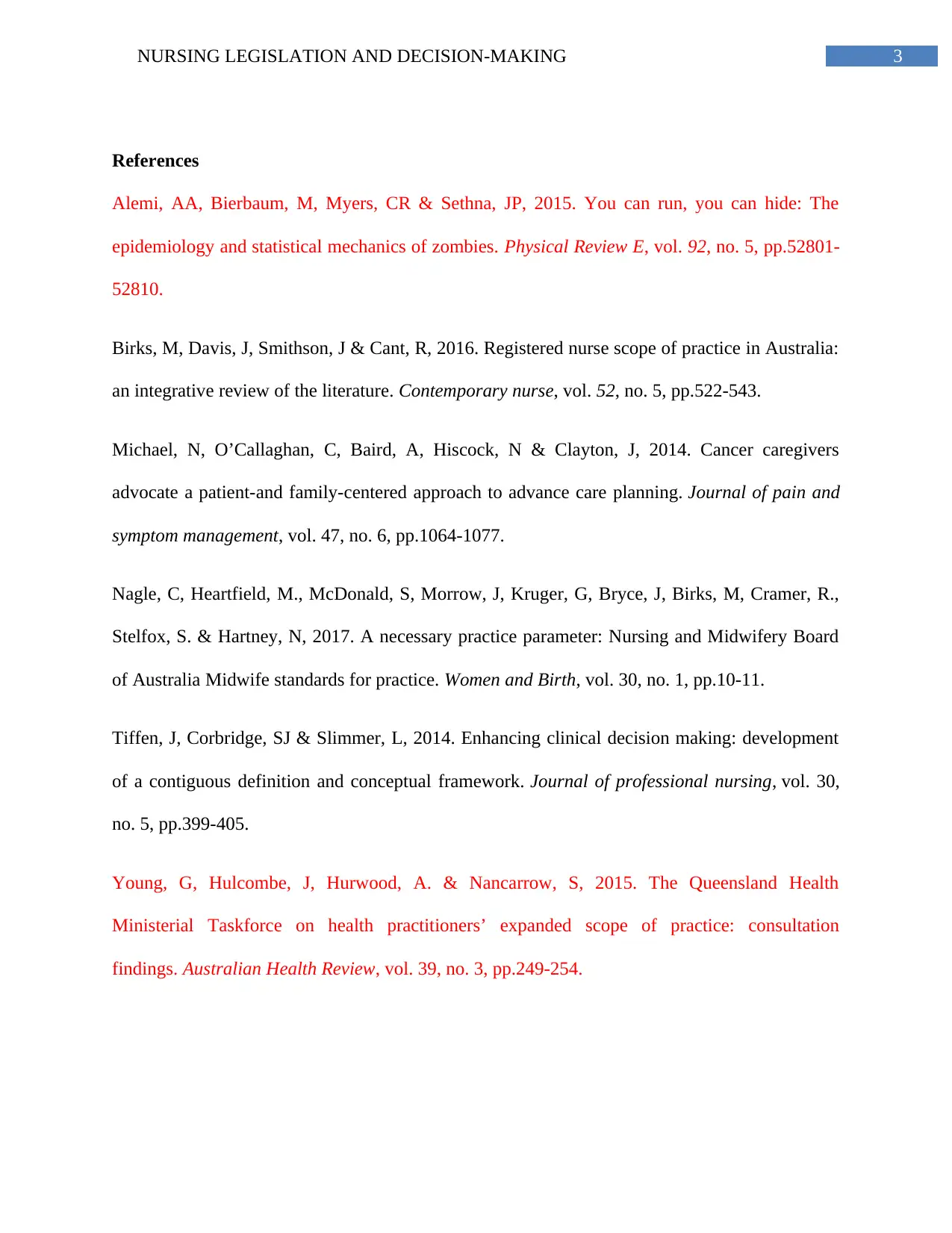
Alemi, AA, Bierbaum, M, Myers, CR & Sethna, JP, 2015. You can run, you can hide: The
epidemiology and statistical mechanics of zombies. Physical Review E, vol. 92, no. 5, pp.52801-
52810.
Birks, M, Davis, J, Smithson, J & Cant, R, 2016. Registered nurse scope of practice in Australia:
an integrative review of the literature. Contemporary nurse, vol. 52, no. 5, pp.522-543.
Michael, N, O’Callaghan, C, Baird, A, Hiscock, N & Clayton, J, 2014. Cancer caregivers
advocate a patient-and family-centered approach to advance care planning. Journal of pain and
symptom management, vol. 47, no. 6, pp.1064-1077.
Nagle, C, Heartfield, M., McDonald, S, Morrow, J, Kruger, G, Bryce, J, Birks, M, Cramer, R.,
Stelfox, S. & Hartney, N, 2017. A necessary practice parameter: Nursing and Midwifery Board
of Australia Midwife standards for practice. Women and Birth, vol. 30, no. 1, pp.10-11.
Tiffen, J, Corbridge, SJ & Slimmer, L, 2014. Enhancing clinical decision making: development
of a contiguous definition and conceptual framework. Journal of professional nursing, vol. 30,
no. 5, pp.399-405.
Young, G, Hulcombe, J, Hurwood, A. & Nancarrow, S, 2015. The Queensland Health
Ministerial Taskforce on health practitioners’ expanded scope of practice: consultation
findings. Australian Health Review, vol. 39, no. 3, pp.249-254.
chevron_up_icon
1 out of 4
circle_padding
hide_on_mobile
zoom_out_icon
[object Object]