Risks, Barriers and Ethical Concerns: Medication Errors in Nursing
VerifiedAdded on 2022/08/09
|18
|5280
|210
Report
AI Summary
This report critically analyzes medication errors in nursing, identifying various risks, barriers, and ethical concerns associated with medication administration. It explores manual, organizational, ethical, and theoretical factors contributing to these errors, including poor communication, workload, inadequate training, and breaches of ethical standards. The report also discusses the Swiss cheese model in relation to error prevention. It examines the impact of medication errors on patient outcomes, including increased mortality rates, prolonged hospital stays, and increased costs of care. Furthermore, the report investigates the barriers to resolving medication errors, such as insufficient knowledge of pharmaceuticals, inadequate staffing, and conflicts within healthcare teams. The report also highlights the importance of timely and proper reporting of medication errors and offers recommendations to improve patient safety and healthcare quality. The report aims to provide a comprehensive understanding of medication errors, emphasizing the need for enhanced awareness, improved communication, and the implementation of preventive measures within healthcare settings.
Running Head: Nursing
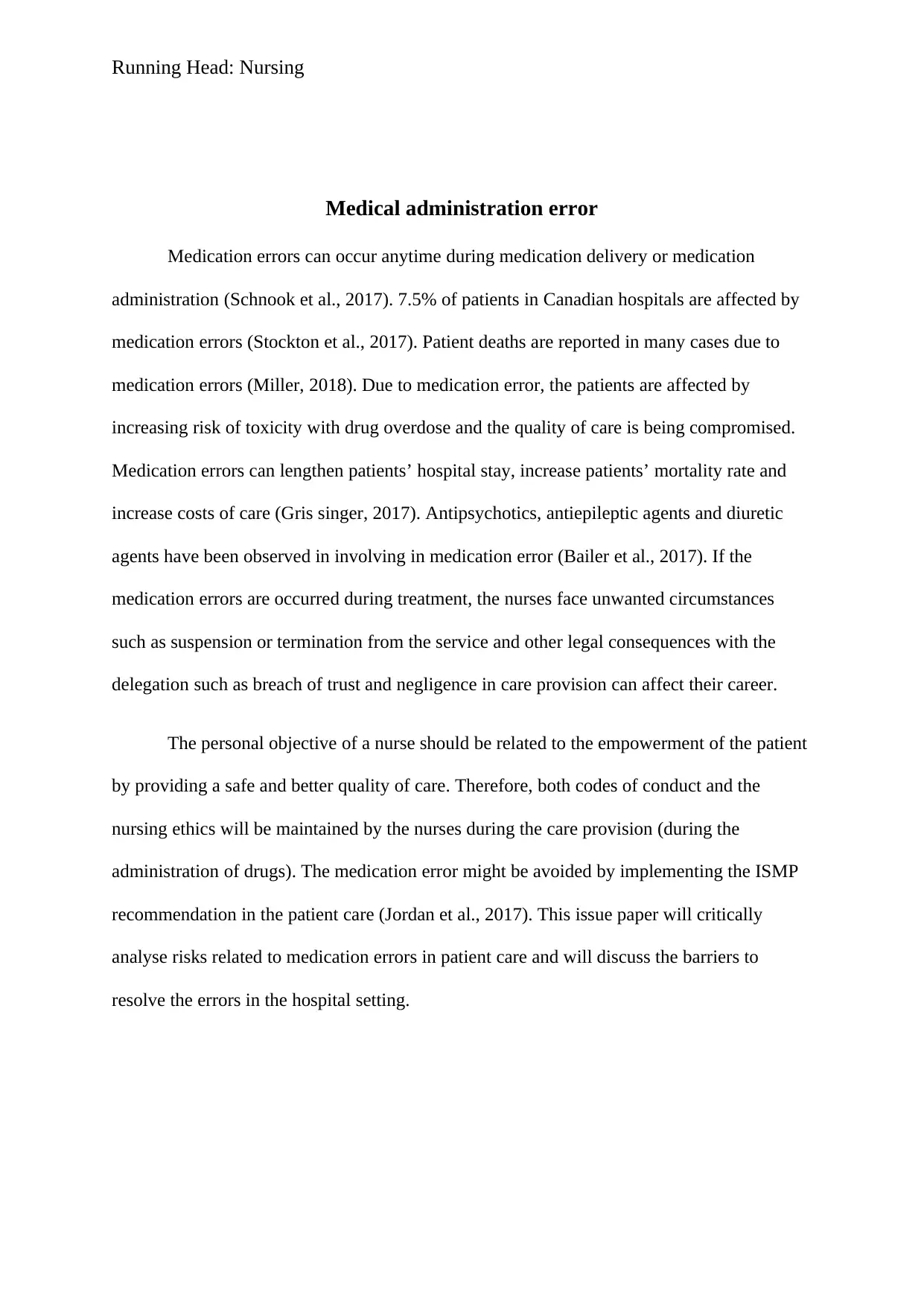
Medical administration error
Medication errors can occur anytime during medication delivery or medication
administration (Schnook et al., 2017). 7.5% of patients in Canadian hospitals are affected by
medication errors (Stockton et al., 2017). Patient deaths are reported in many cases due to
medication errors (Miller, 2018). Due to medication error, the patients are affected by
increasing risk of toxicity with drug overdose and the quality of care is being compromised.
Medication errors can lengthen patients’ hospital stay, increase patients’ mortality rate and
increase costs of care (Gris singer, 2017). Antipsychotics, antiepileptic agents and diuretic
agents have been observed in involving in medication error (Bailer et al., 2017). If the
medication errors are occurred during treatment, the nurses face unwanted circumstances
such as suspension or termination from the service and other legal consequences with the
delegation such as breach of trust and negligence in care provision can affect their career.
The personal objective of a nurse should be related to the empowerment of the patient
by providing a safe and better quality of care. Therefore, both codes of conduct and the
nursing ethics will be maintained by the nurses during the care provision (during the
administration of drugs). The medication error might be avoided by implementing the ISMP
recommendation in the patient care (Jordan et al., 2017). This issue paper will critically
analyse risks related to medication errors in patient care and will discuss the barriers to
resolve the errors in the hospital setting.
Medical administration error
Medication errors can occur anytime during medication delivery or medication
administration (Schnook et al., 2017). 7.5% of patients in Canadian hospitals are affected by
medication errors (Stockton et al., 2017). Patient deaths are reported in many cases due to
medication errors (Miller, 2018). Due to medication error, the patients are affected by
increasing risk of toxicity with drug overdose and the quality of care is being compromised.
Medication errors can lengthen patients’ hospital stay, increase patients’ mortality rate and
increase costs of care (Gris singer, 2017). Antipsychotics, antiepileptic agents and diuretic
agents have been observed in involving in medication error (Bailer et al., 2017). If the
medication errors are occurred during treatment, the nurses face unwanted circumstances
such as suspension or termination from the service and other legal consequences with the
delegation such as breach of trust and negligence in care provision can affect their career.
The personal objective of a nurse should be related to the empowerment of the patient
by providing a safe and better quality of care. Therefore, both codes of conduct and the
nursing ethics will be maintained by the nurses during the care provision (during the
administration of drugs). The medication error might be avoided by implementing the ISMP
recommendation in the patient care (Jordan et al., 2017). This issue paper will critically
analyse risks related to medication errors in patient care and will discuss the barriers to
resolve the errors in the hospital setting.

Paraphrase This Document
Need a fresh take? Get an instant paraphrase of this document with our AI Paraphraser
1
Medication Error
Discussion
Overview
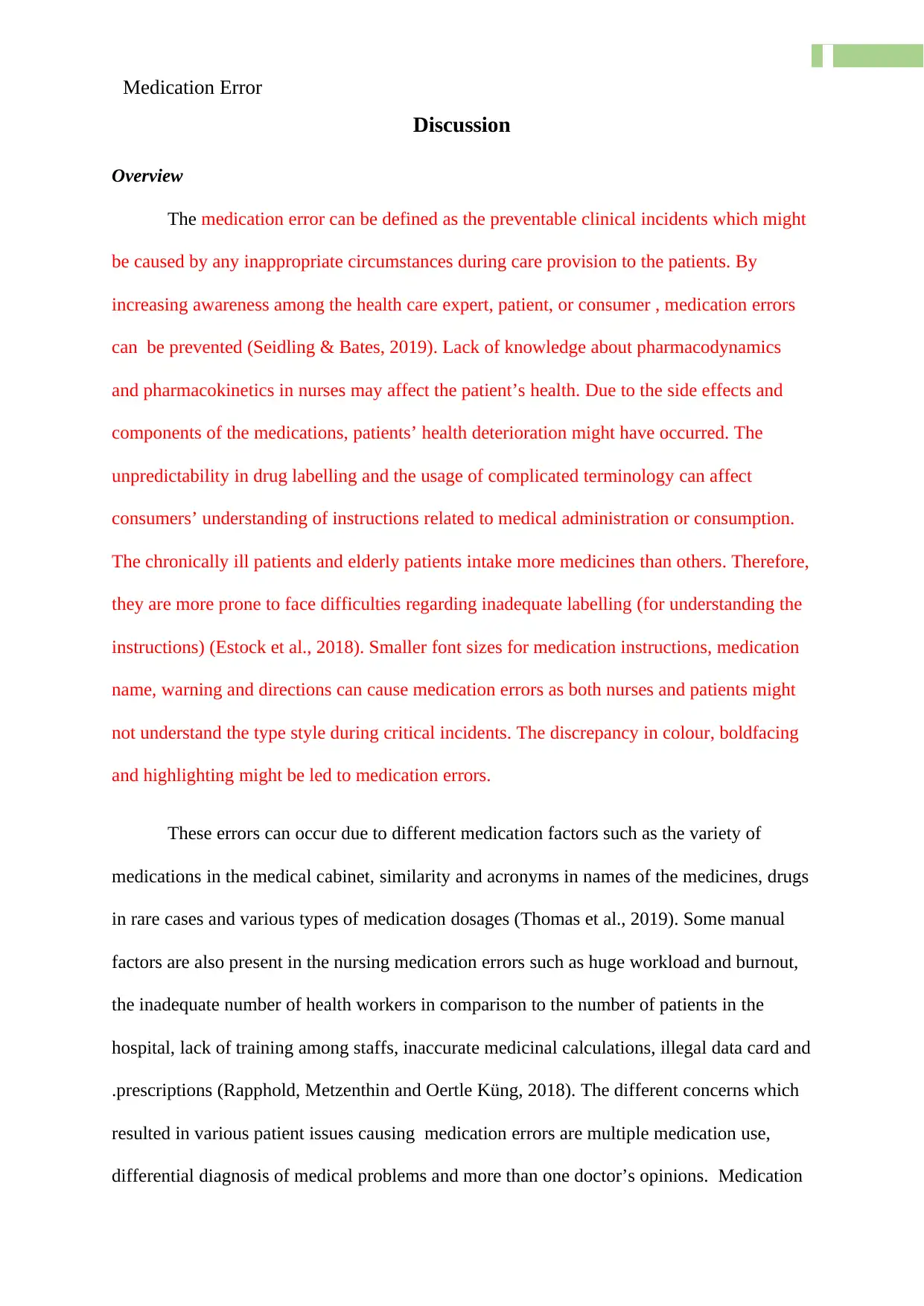
The medication error can be defined as the preventable clinical incidents which might
be caused by any inappropriate circumstances during care provision to the patients. By
increasing awareness among the health care expert, patient, or consumer , medication errors
can be prevented (Seidling & Bates, 2019). Lack of knowledge about pharmacodynamics
and pharmacokinetics in nurses may affect the patient’s health. Due to the side effects and
components of the medications, patients’ health deterioration might have occurred. The
unpredictability in drug labelling and the usage of complicated terminology can affect
consumers’ understanding of instructions related to medical administration or consumption.
The chronically ill patients and elderly patients intake more medicines than others. Therefore,
they are more prone to face difficulties regarding inadequate labelling (for understanding the
instructions) (Estock et al., 2018). Smaller font sizes for medication instructions, medication
name, warning and directions can cause medication errors as both nurses and patients might
not understand the type style during critical incidents. The discrepancy in colour, boldfacing
and highlighting might be led to medication errors.
These errors can occur due to different medication factors such as the variety of
medications in the medical cabinet, similarity and acronyms in names of the medicines, drugs
in rare cases and various types of medication dosages (Thomas et al., 2019). Some manual
factors are also present in the nursing medication errors such as huge workload and burnout,
the inadequate number of health workers in comparison to the number of patients in the
hospital, lack of training among staffs, inaccurate medicinal calculations, illegal data card and
.prescriptions (Rapphold, Metzenthin and Oertle Küng, 2018). The different concerns which
resulted in various patient issues causing medication errors are multiple medication use,
differential diagnosis of medical problems and more than one doctor’s opinions. Medication
Medication Error
Discussion
Overview
The medication error can be defined as the preventable clinical incidents which might
be caused by any inappropriate circumstances during care provision to the patients. By
increasing awareness among the health care expert, patient, or consumer , medication errors
can be prevented (Seidling & Bates, 2019). Lack of knowledge about pharmacodynamics
and pharmacokinetics in nurses may affect the patient’s health. Due to the side effects and
components of the medications, patients’ health deterioration might have occurred. The
unpredictability in drug labelling and the usage of complicated terminology can affect
consumers’ understanding of instructions related to medical administration or consumption.
The chronically ill patients and elderly patients intake more medicines than others. Therefore,
they are more prone to face difficulties regarding inadequate labelling (for understanding the
instructions) (Estock et al., 2018). Smaller font sizes for medication instructions, medication
name, warning and directions can cause medication errors as both nurses and patients might
not understand the type style during critical incidents. The discrepancy in colour, boldfacing
and highlighting might be led to medication errors.
These errors can occur due to different medication factors such as the variety of
medications in the medical cabinet, similarity and acronyms in names of the medicines, drugs
in rare cases and various types of medication dosages (Thomas et al., 2019). Some manual
factors are also present in the nursing medication errors such as huge workload and burnout,
the inadequate number of health workers in comparison to the number of patients in the
hospital, lack of training among staffs, inaccurate medicinal calculations, illegal data card and
.prescriptions (Rapphold, Metzenthin and Oertle Küng, 2018). The different concerns which
resulted in various patient issues causing medication errors are multiple medication use,
differential diagnosis of medical problems and more than one doctor’s opinions. Medication
2
Medication Error
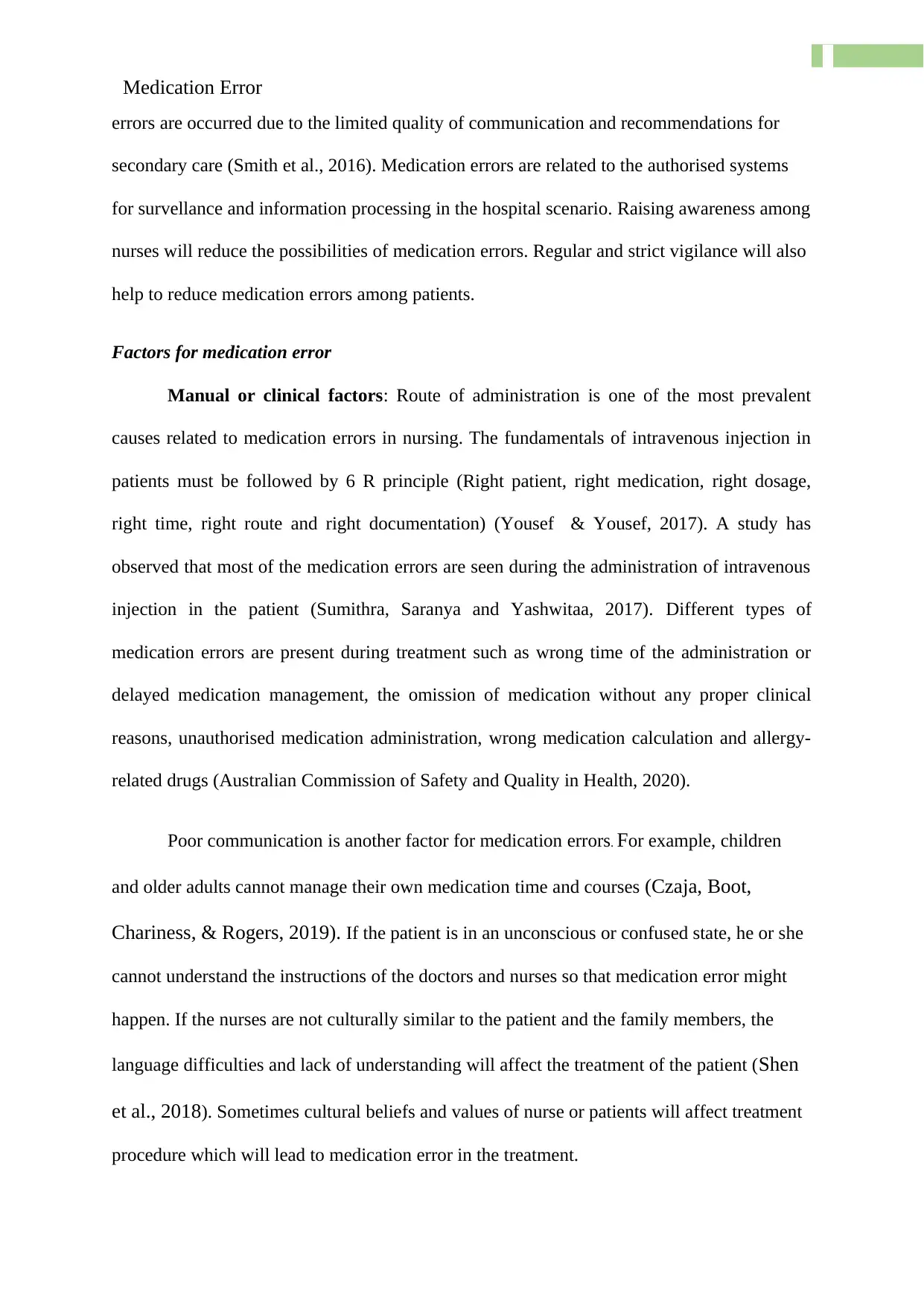
errors are occurred due to the limited quality of communication and recommendations for
secondary care (Smith et al., 2016). Medication errors are related to the authorised systems
for survellance and information processing in the hospital scenario. Raising awareness among
nurses will reduce the possibilities of medication errors. Regular and strict vigilance will also
help to reduce medication errors among patients.
Factors for medication error
Manual or clinical factors: Route of administration is one of the most prevalent
causes related to medication errors in nursing. The fundamentals of intravenous injection in
patients must be followed by 6 R principle (Right patient, right medication, right dosage,
right time, right route and right documentation) (Yousef & Yousef, 2017). A study has
observed that most of the medication errors are seen during the administration of intravenous
injection in the patient (Sumithra, Saranya and Yashwitaa, 2017). Different types of
medication errors are present during treatment such as wrong time of the administration or
delayed medication management, the omission of medication without any proper clinical
reasons, unauthorised medication administration, wrong medication calculation and allergy-
related drugs (Australian Commission of Safety and Quality in Health, 2020).
Poor communication is another factor for medication errors. For example, children
and older adults cannot manage their own medication time and courses (Czaja, Boot,
Chariness, & Rogers, 2019). If the patient is in an unconscious or confused state, he or she
cannot understand the instructions of the doctors and nurses so that medication error might
happen. If the nurses are not culturally similar to the patient and the family members, the
language difficulties and lack of understanding will affect the treatment of the patient (Shen
et al., 2018). Sometimes cultural beliefs and values of nurse or patients will affect treatment
procedure which will lead to medication error in the treatment.
Medication Error
errors are occurred due to the limited quality of communication and recommendations for
secondary care (Smith et al., 2016). Medication errors are related to the authorised systems
for survellance and information processing in the hospital scenario. Raising awareness among
nurses will reduce the possibilities of medication errors. Regular and strict vigilance will also
help to reduce medication errors among patients.
Factors for medication error
Manual or clinical factors: Route of administration is one of the most prevalent
causes related to medication errors in nursing. The fundamentals of intravenous injection in
patients must be followed by 6 R principle (Right patient, right medication, right dosage,
right time, right route and right documentation) (Yousef & Yousef, 2017). A study has
observed that most of the medication errors are seen during the administration of intravenous
injection in the patient (Sumithra, Saranya and Yashwitaa, 2017). Different types of
medication errors are present during treatment such as wrong time of the administration or
delayed medication management, the omission of medication without any proper clinical
reasons, unauthorised medication administration, wrong medication calculation and allergy-
related drugs (Australian Commission of Safety and Quality in Health, 2020).
Poor communication is another factor for medication errors. For example, children
and older adults cannot manage their own medication time and courses (Czaja, Boot,
Chariness, & Rogers, 2019). If the patient is in an unconscious or confused state, he or she
cannot understand the instructions of the doctors and nurses so that medication error might
happen. If the nurses are not culturally similar to the patient and the family members, the
language difficulties and lack of understanding will affect the treatment of the patient (Shen
et al., 2018). Sometimes cultural beliefs and values of nurse or patients will affect treatment
procedure which will lead to medication error in the treatment.
⊘ This is a preview!⊘
Do you want full access?
Subscribe today to unlock all pages.

Trusted by 1+ million students worldwide
3
Medication Error
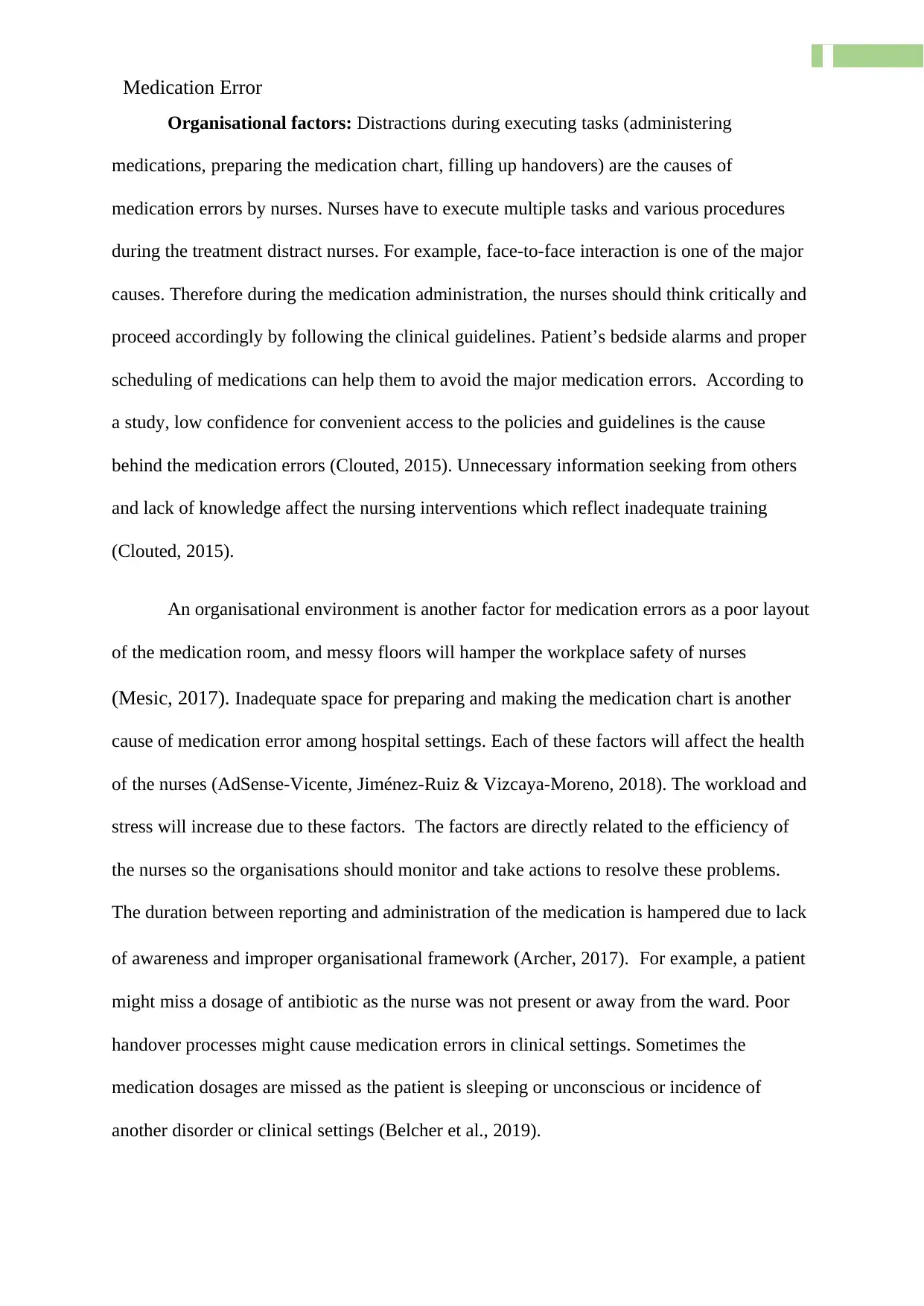
Organisational factors: Distractions during executing tasks (administering
medications, preparing the medication chart, filling up handovers) are the causes of
medication errors by nurses. Nurses have to execute multiple tasks and various procedures
during the treatment distract nurses. For example, face-to-face interaction is one of the major
causes. Therefore during the medication administration, the nurses should think critically and
proceed accordingly by following the clinical guidelines. Patient’s bedside alarms and proper
scheduling of medications can help them to avoid the major medication errors. According to
a study, low confidence for convenient access to the policies and guidelines is the cause
behind the medication errors (Clouted, 2015). Unnecessary information seeking from others
and lack of knowledge affect the nursing interventions which reflect inadequate training
(Clouted, 2015).
An organisational environment is another factor for medication errors as a poor layout
of the medication room, and messy floors will hamper the workplace safety of nurses
(Mesic, 2017). Inadequate space for preparing and making the medication chart is another
cause of medication error among hospital settings. Each of these factors will affect the health
of the nurses (AdSense-Vicente, Jiménez-Ruiz & Vizcaya-Moreno, 2018). The workload and
stress will increase due to these factors. The factors are directly related to the efficiency of
the nurses so the organisations should monitor and take actions to resolve these problems.
The duration between reporting and administration of the medication is hampered due to lack
of awareness and improper organisational framework (Archer, 2017). For example, a patient
might miss a dosage of antibiotic as the nurse was not present or away from the ward. Poor
handover processes might cause medication errors in clinical settings. Sometimes the
medication dosages are missed as the patient is sleeping or unconscious or incidence of
another disorder or clinical settings (Belcher et al., 2019).
Medication Error
Organisational factors: Distractions during executing tasks (administering
medications, preparing the medication chart, filling up handovers) are the causes of
medication errors by nurses. Nurses have to execute multiple tasks and various procedures
during the treatment distract nurses. For example, face-to-face interaction is one of the major
causes. Therefore during the medication administration, the nurses should think critically and
proceed accordingly by following the clinical guidelines. Patient’s bedside alarms and proper
scheduling of medications can help them to avoid the major medication errors. According to
a study, low confidence for convenient access to the policies and guidelines is the cause
behind the medication errors (Clouted, 2015). Unnecessary information seeking from others
and lack of knowledge affect the nursing interventions which reflect inadequate training
(Clouted, 2015).
An organisational environment is another factor for medication errors as a poor layout
of the medication room, and messy floors will hamper the workplace safety of nurses
(Mesic, 2017). Inadequate space for preparing and making the medication chart is another
cause of medication error among hospital settings. Each of these factors will affect the health
of the nurses (AdSense-Vicente, Jiménez-Ruiz & Vizcaya-Moreno, 2018). The workload and
stress will increase due to these factors. The factors are directly related to the efficiency of
the nurses so the organisations should monitor and take actions to resolve these problems.
The duration between reporting and administration of the medication is hampered due to lack
of awareness and improper organisational framework (Archer, 2017). For example, a patient
might miss a dosage of antibiotic as the nurse was not present or away from the ward. Poor
handover processes might cause medication errors in clinical settings. Sometimes the
medication dosages are missed as the patient is sleeping or unconscious or incidence of
another disorder or clinical settings (Belcher et al., 2019).
Paraphrase This Document
Need a fresh take? Get an instant paraphrase of this document with our AI Paraphraser
4
Medication Error
Overdose is one of the most common errors in nursing medication (Colgan &
Reynolds, 2019). Analgesics, antibiotics, anticoagulation, cardiovascular and
chemotherapeutic agents are some of the most prevalent medicines which are reported under
the errors of overdose during therapeutic practice (Kabana & Wazaify, 2017). NSAIDs are
reported to be overused by the patients for limited health awareness; this type of medication
error occurs due to extended usage and overdose (World Health Organisation., 2020).
Communication can reduce medication error in nursing and patient treatment (Manias et al.,
2019).
Medication errors might be occurred due to inadequate information about medicines
among the patients as well (Borland & Bentsen, 2017). The patient should need correct
attribution and differentiation between the error, side effect and therapeutic action of the
medicines. A study has shown that hospital patients are more inclined to the medication error
for adherence to drugs (Sheikh et al., 2017). This type of error is among critically ill patients,
patients with multiple diagnosed condition and the patient who must intake various
medication as per the treatment. Different pharmacological components will lead to multiple
toxicities in a patient’s body and drug-drug interactions (Ferdousi, Safdari & Omidi, 2017).
Analgesics and antibiotics are the most commonly used drugs which are responsible for
medication errors in maximum cases.
Ethical factors: Breaching of healthcare and business ethics contribute to the
medication error. Healthcare ethics are breached when the nurses show negligence or do not
show professional competency during the administration of medicines. Additionally, they
sometimes do not maintain proper communication with the patient (Rubio-Navarro et al.,
2019). Vendor choosing is one of the most critical factors for medication safety. Only the
vendors who maintain business ethics be chosen. If a company who does not support all the
laws and the competencies of FDA or IOM, healthcare institutions should not collaborate
Medication Error
Overdose is one of the most common errors in nursing medication (Colgan &
Reynolds, 2019). Analgesics, antibiotics, anticoagulation, cardiovascular and
chemotherapeutic agents are some of the most prevalent medicines which are reported under
the errors of overdose during therapeutic practice (Kabana & Wazaify, 2017). NSAIDs are
reported to be overused by the patients for limited health awareness; this type of medication
error occurs due to extended usage and overdose (World Health Organisation., 2020).
Communication can reduce medication error in nursing and patient treatment (Manias et al.,
2019).
Medication errors might be occurred due to inadequate information about medicines
among the patients as well (Borland & Bentsen, 2017). The patient should need correct
attribution and differentiation between the error, side effect and therapeutic action of the
medicines. A study has shown that hospital patients are more inclined to the medication error
for adherence to drugs (Sheikh et al., 2017). This type of error is among critically ill patients,
patients with multiple diagnosed condition and the patient who must intake various
medication as per the treatment. Different pharmacological components will lead to multiple
toxicities in a patient’s body and drug-drug interactions (Ferdousi, Safdari & Omidi, 2017).
Analgesics and antibiotics are the most commonly used drugs which are responsible for
medication errors in maximum cases.
Ethical factors: Breaching of healthcare and business ethics contribute to the
medication error. Healthcare ethics are breached when the nurses show negligence or do not
show professional competency during the administration of medicines. Additionally, they
sometimes do not maintain proper communication with the patient (Rubio-Navarro et al.,
2019). Vendor choosing is one of the most critical factors for medication safety. Only the
vendors who maintain business ethics be chosen. If a company who does not support all the
laws and the competencies of FDA or IOM, healthcare institutions should not collaborate
5
Medication Error
with them. Healthcare workers should avoid recommending a specific company. If poor
vendors if pharmaceutical companies are not avoided, incidents like NCEE meningitis
outbreak (2012) will happen again (Carpenter et al., 2017). Negligence towards the duties and
professional responsibilities will cause damages and proximate causes.
Theoretical factors: Active errors happen at the sharp end of care with emergency
effect and are generally uncertain. Possible errors are system shortages underlined in the
blunted end of care. Complex medical procedures will often have manifold ‘‘layers’’ of
cautious barriers (Shams, 2017). Swiss cheese theory of error might be applied to the
medication error in the healthcare sectors. According to this model, a sequence of barriers is
in terms to avoid threats from triggering injury to individuals. However, every barrier, for
example, system alarms, administrative controls, surgeons, nurses. The model has its own
unintentional and arbitrary weaknesses, or gaps, just like Swiss cheese.
Improved care and better patient safety will need prompt and accurate medication
error reporting. Timely and proper reporting the medication errors can reduce complications
regarding medication error. Timely reporting of medication errors are depended on the
nurses’ readiness and promptness towards the situation with honesty and commitment to the
profession. The hesitancy related to “reporting the errors” is related to fear of loss of status or
perceived ineffectiveness (Vrbnjak et al., 2016). The nurses do not report the medication
errors to others as they feel that the patients will negatively anticipate them. As there is a lack
of standardization of error reporting, the fear of reprisal from management and exposure to
the malpractice of the standards in the nursing ward is present among thee nurses ( Lofgren et
al.,2019).
Medication Error
with them. Healthcare workers should avoid recommending a specific company. If poor
vendors if pharmaceutical companies are not avoided, incidents like NCEE meningitis
outbreak (2012) will happen again (Carpenter et al., 2017). Negligence towards the duties and
professional responsibilities will cause damages and proximate causes.
Theoretical factors: Active errors happen at the sharp end of care with emergency
effect and are generally uncertain. Possible errors are system shortages underlined in the
blunted end of care. Complex medical procedures will often have manifold ‘‘layers’’ of
cautious barriers (Shams, 2017). Swiss cheese theory of error might be applied to the
medication error in the healthcare sectors. According to this model, a sequence of barriers is
in terms to avoid threats from triggering injury to individuals. However, every barrier, for
example, system alarms, administrative controls, surgeons, nurses. The model has its own
unintentional and arbitrary weaknesses, or gaps, just like Swiss cheese.
Improved care and better patient safety will need prompt and accurate medication
error reporting. Timely and proper reporting the medication errors can reduce complications
regarding medication error. Timely reporting of medication errors are depended on the
nurses’ readiness and promptness towards the situation with honesty and commitment to the
profession. The hesitancy related to “reporting the errors” is related to fear of loss of status or
perceived ineffectiveness (Vrbnjak et al., 2016). The nurses do not report the medication
errors to others as they feel that the patients will negatively anticipate them. As there is a lack
of standardization of error reporting, the fear of reprisal from management and exposure to
the malpractice of the standards in the nursing ward is present among thee nurses ( Lofgren et
al.,2019).
⊘ This is a preview!⊘
Do you want full access?
Subscribe today to unlock all pages.
Trusted by 1+ million students worldwide
6
Medication Error
Barriers
Barriers of resolving medication errors are inadequate knowledge of pharmaceuticals
and medicines among the nurses. Insufficient staffs can be other barriers during the
implementation of medications in the patient as they might feel overloaded by a huge
workload (Ibrahim et al., 2018). In the workplace, various employees from various social and
cultural background work in a team and amongst the nurses coming from different
backgrounds. In essence, there can be conflicts on the basis of the values, relationships, and
due to various personality clashes as well. Role conflicts and task conflicts are always
significantly implicated in the development of the barriers in the workplace. Negative
perception, a negative attitude about each other and even certain social stigmas has been
shown to affect the peer-relationships and patient-nurse relationships in the workplace that
lead to the causation of the medication administration errors. The proportion between
numbers of nurses in comparison to the number of the patient should be maintained to avoid
the circumstances related to nursing burnouts in the healthcare industry. Physicians who are
at the first line of treatment should prescribe the proper medication to a patient, and due to
lack of knowledge and surveillance over the healthcare professionals, the medication errors
can occur among the patients. Evaluation or assessment methods should be increased in a
way so that the current information must be provided to the nurses, and appropriate
medication choices are made by doctors. In some cases, the medication errors are not
reported as the experienced medical professionals are afraid of accepting the fact they have
made some mistakes. Factors such as impatience, anger, personal beliefs and values are
reasons behind the false complaints of patients.
On the other side, critical medicines are not appropriately labelled. The acronyms and
the labels are different as naming, labelling and packaging are unknown to the nurses (Bailey,
2016). Confusion related to poor handwriting can lead to wrong administration of medication
Medication Error
Barriers
Barriers of resolving medication errors are inadequate knowledge of pharmaceuticals
and medicines among the nurses. Insufficient staffs can be other barriers during the
implementation of medications in the patient as they might feel overloaded by a huge
workload (Ibrahim et al., 2018). In the workplace, various employees from various social and
cultural background work in a team and amongst the nurses coming from different
backgrounds. In essence, there can be conflicts on the basis of the values, relationships, and
due to various personality clashes as well. Role conflicts and task conflicts are always
significantly implicated in the development of the barriers in the workplace. Negative
perception, a negative attitude about each other and even certain social stigmas has been
shown to affect the peer-relationships and patient-nurse relationships in the workplace that
lead to the causation of the medication administration errors. The proportion between
numbers of nurses in comparison to the number of the patient should be maintained to avoid
the circumstances related to nursing burnouts in the healthcare industry. Physicians who are
at the first line of treatment should prescribe the proper medication to a patient, and due to
lack of knowledge and surveillance over the healthcare professionals, the medication errors
can occur among the patients. Evaluation or assessment methods should be increased in a
way so that the current information must be provided to the nurses, and appropriate
medication choices are made by doctors. In some cases, the medication errors are not
reported as the experienced medical professionals are afraid of accepting the fact they have
made some mistakes. Factors such as impatience, anger, personal beliefs and values are
reasons behind the false complaints of patients.
On the other side, critical medicines are not appropriately labelled. The acronyms and
the labels are different as naming, labelling and packaging are unknown to the nurses (Bailey,
2016). Confusion related to poor handwriting can lead to wrong administration of medication
Paraphrase This Document
Need a fresh take? Get an instant paraphrase of this document with our AI Paraphraser
7
Medication Error
and pharmacy-related errors. According to a study; illegibility of clinicians’ handwriting
makes difficulties to staffs to decipher, and this can lead to a high threat to patient safety and
treatment quality (Brits et al., 2017).
Patients might be unable to give proper information about them to the professionals.
Therefore the doctors and nurses cannot predict the outcomes of medications after
administration. These types of errors are usually observed in the emergency admissions and
critical conditions due to lack of knowledge(regarding premedical histories) of the client or
the family member. The health informatics and dysfunctions in electrical databases might be
a barrier as the medical reports of patients and administration of medications are not same
always (Amato et al., 2017). Computerised systems and informatics influence medication
errors among nurses. Difficulties in generating the first prescriptions and lack of accuracy in
the patients’ record can influence nursing medication errors during the practice (Amato et
al.,2017). Inaccurate design is one of the major causes in administering wrong medication
inpatients as the computer-generated systems can present an imperfect plan for treatment as
guidelines and protocols.
Possible resolution strategies
Possible resolutions for the medication errors are improving the quality of care and
evidence based practice by the nurses. The hospital authority must conduct a medication
safety self-assessment, medical reconciliation, high alert medication safety. It is essential to
audit the performance of the nurses in order to help them comply with medication
administration instruction and evidence based practices. It is highly essential that the more
policies regarding peer-support and supervision by the seniors should be incorporated in the
policy framework. In addition, staff development sessions for positive communication,
positive interaction, and to improve the knowledge and skills of the nurses is critical. The
high alert medication safety must include methods for harm prevention, identification of the
Medication Error
and pharmacy-related errors. According to a study; illegibility of clinicians’ handwriting
makes difficulties to staffs to decipher, and this can lead to a high threat to patient safety and
treatment quality (Brits et al., 2017).
Patients might be unable to give proper information about them to the professionals.
Therefore the doctors and nurses cannot predict the outcomes of medications after
administration. These types of errors are usually observed in the emergency admissions and
critical conditions due to lack of knowledge(regarding premedical histories) of the client or
the family member. The health informatics and dysfunctions in electrical databases might be
a barrier as the medical reports of patients and administration of medications are not same
always (Amato et al., 2017). Computerised systems and informatics influence medication
errors among nurses. Difficulties in generating the first prescriptions and lack of accuracy in
the patients’ record can influence nursing medication errors during the practice (Amato et
al.,2017). Inaccurate design is one of the major causes in administering wrong medication
inpatients as the computer-generated systems can present an imperfect plan for treatment as
guidelines and protocols.
Possible resolution strategies
Possible resolutions for the medication errors are improving the quality of care and
evidence based practice by the nurses. The hospital authority must conduct a medication
safety self-assessment, medical reconciliation, high alert medication safety. It is essential to
audit the performance of the nurses in order to help them comply with medication
administration instruction and evidence based practices. It is highly essential that the more
policies regarding peer-support and supervision by the seniors should be incorporated in the
policy framework. In addition, staff development sessions for positive communication,
positive interaction, and to improve the knowledge and skills of the nurses is critical. The
high alert medication safety must include methods for harm prevention, identification of the
8
Medication Error
errors, mitigation of harms (Hospital Harm Improvement Resource Medication Incidents.,
2020). There are some better resources (for example Canadian Incident Analysis Framework,
CPSI Patient Safety and Incident Management Toolkit, ISMP framework) to review the
clinical systems in a healthcare set up (Masse, 2018). The potential solutions for reducing the
medication errors are medication appraisals and settlement, automatic information systems,
education and multi-component interventions. According to the World Health Organization,
medication review and reconciliation are essential for establishing and documenting the
errors (World Health Organization, 2020). The automated systems improve medical treatment
in primary care and hospital setting. The computerized provider order entry with the
decisions support, which is useful in reducing medication errors. The inappropriate
medications are sorted by automated machines by signalling (Amato et al., 2017). The
hospital authority will arrange an electronic database to monitor nursing staffs and healthcare
workers. Therefore, they can help the nurses with proper scheduling of medication and
preparation of better medication chart. The hospital authorities should give immunity or
protection in terms of the legal actions (Le Blond, et al. 2018) Therefore; the nurses would
report the medication error promptly to the hospital authority.
The nursing leaders and supervisors should help them in obeying rules and standards.
The policies and standards should be taught to the nurses in the training sessions. Education
should be improved in the training sessions as the compliances are the most important factors
of clinical treatment (Scalier et al., 2018). The risk management should be improved in the
hospitals by focusing on explanatory loss after an error rather than on preventing error before
it can occur.
Complex interventions with the therapeutic and clinical approach will help the
physicians and the nurses to avoid medication errors. Better and appropriate clinical handover
Medication Error
errors, mitigation of harms (Hospital Harm Improvement Resource Medication Incidents.,
2020). There are some better resources (for example Canadian Incident Analysis Framework,
CPSI Patient Safety and Incident Management Toolkit, ISMP framework) to review the
clinical systems in a healthcare set up (Masse, 2018). The potential solutions for reducing the
medication errors are medication appraisals and settlement, automatic information systems,
education and multi-component interventions. According to the World Health Organization,
medication review and reconciliation are essential for establishing and documenting the
errors (World Health Organization, 2020). The automated systems improve medical treatment
in primary care and hospital setting. The computerized provider order entry with the
decisions support, which is useful in reducing medication errors. The inappropriate
medications are sorted by automated machines by signalling (Amato et al., 2017). The
hospital authority will arrange an electronic database to monitor nursing staffs and healthcare
workers. Therefore, they can help the nurses with proper scheduling of medication and
preparation of better medication chart. The hospital authorities should give immunity or
protection in terms of the legal actions (Le Blond, et al. 2018) Therefore; the nurses would
report the medication error promptly to the hospital authority.
The nursing leaders and supervisors should help them in obeying rules and standards.
The policies and standards should be taught to the nurses in the training sessions. Education
should be improved in the training sessions as the compliances are the most important factors
of clinical treatment (Scalier et al., 2018). The risk management should be improved in the
hospitals by focusing on explanatory loss after an error rather than on preventing error before
it can occur.
Complex interventions with the therapeutic and clinical approach will help the
physicians and the nurses to avoid medication errors. Better and appropriate clinical handover
⊘ This is a preview!⊘
Do you want full access?
Subscribe today to unlock all pages.
Trusted by 1+ million students worldwide
9
Medication Error
among the nurses will help to reduce medication error as per a study. Medication errors can
be avoided by involvements of physicians, nurses and other multidisciplinary team members
(physiotherapists, physical therapists and occupational therapist) (Marv nova & Henkel,
2018). Interdisciplinary team members can avoid medication errors by the help their
involvement and monitoring in administering medications.
Conclusion
The essay concludes that medication errors are one of the most common incidents that
happen in the health care industry. To resolve medication errors in nursing, the factors must
be addressed and analysed in a proper way. Proper training of nurses can help the nurses to
remove the pre-assumptions and ethical dilemmas during the treatment. The essay has also
focused on the recommendation and associated frameworks to resolve the problems related to
medication errors.
Medication Error
among the nurses will help to reduce medication error as per a study. Medication errors can
be avoided by involvements of physicians, nurses and other multidisciplinary team members
(physiotherapists, physical therapists and occupational therapist) (Marv nova & Henkel,
2018). Interdisciplinary team members can avoid medication errors by the help their
involvement and monitoring in administering medications.
Conclusion
The essay concludes that medication errors are one of the most common incidents that
happen in the health care industry. To resolve medication errors in nursing, the factors must
be addressed and analysed in a proper way. Proper training of nurses can help the nurses to
remove the pre-assumptions and ethical dilemmas during the treatment. The essay has also
focused on the recommendation and associated frameworks to resolve the problems related to
medication errors.
Paraphrase This Document
Need a fresh take? Get an instant paraphrase of this document with our AI Paraphraser
10
Medication Error
References
AdSense-Vicente, J., Jiménez-Ruiz, I., & Vizcaya-Moreno, M. F. (2018). Medication errors
involving nursing students: A systematic review. Nurse educator, 43(5), E1-E5
retrieved from:.https://journals.lww.com/nurseeducatoronline/Abstract/2018/09000/
Medication_Errors_Involving_Nursing_Students__A.20.aspx.doi:.https://doi.org/
10.1109/SP.2018.00019
Amato, M. G., Salazar, A., Hickman, T. T. T., Quist, A. J., Volk, L. A., Wright, A., ... &
Adelman, J. (2017). Computerized prescriber order entry–related patient safety
reports: analysis of 2522 medication errors. Journal of the American Medical
Informatics Association, 24(2), 316-322.doi: https://doi.org/10.1093/jamia/ocw125
apps.who.int. (2020). Medication Errors. Retrieved 13 March 2020, from
https://apps.who.int/iris/bitstream/handle/10665/252274/9789241511643-
eng.pdf;jsessionid=DD7B776F25CF1011E723FA728475682E?sequence
Archer, S., Hull, L., Souk up, T., Mayer, E., Athanasios, T., Sedalia, N., & Dari, A. (2017).
Development of a theoretical framework of factors affecting patient safety incident
reporting: a theoretical review of the literature. BMJ open, 7(12). Doi:
http://dx.doi.org/10.1136/bmjopen-2017-017155
Bailer, M., Johannes Sen, S. I., Levy, R. H., Peruke, E., Tomson, T., & White, H. S. (2017).
Progress report on new antiepileptic drugs: a summary of the Thirteenth Eliot
Conference on New Antiepileptic Drugs and Devices (EILAT
XIII). Epilepsies, 58(2), 181-221. doi: 10.1111/epi.13634
Bailey, C. (2016). Investigating the Role of Labelling and Packaging on Medication Error.
Retrieved from: http://researcharchive.vuw.ac.nz/handle/10063/5464
Medication Error
References
AdSense-Vicente, J., Jiménez-Ruiz, I., & Vizcaya-Moreno, M. F. (2018). Medication errors
involving nursing students: A systematic review. Nurse educator, 43(5), E1-E5
retrieved from:.https://journals.lww.com/nurseeducatoronline/Abstract/2018/09000/
Medication_Errors_Involving_Nursing_Students__A.20.aspx.doi:.https://doi.org/
10.1109/SP.2018.00019
Amato, M. G., Salazar, A., Hickman, T. T. T., Quist, A. J., Volk, L. A., Wright, A., ... &
Adelman, J. (2017). Computerized prescriber order entry–related patient safety
reports: analysis of 2522 medication errors. Journal of the American Medical
Informatics Association, 24(2), 316-322.doi: https://doi.org/10.1093/jamia/ocw125
apps.who.int. (2020). Medication Errors. Retrieved 13 March 2020, from
https://apps.who.int/iris/bitstream/handle/10665/252274/9789241511643-
eng.pdf;jsessionid=DD7B776F25CF1011E723FA728475682E?sequence
Archer, S., Hull, L., Souk up, T., Mayer, E., Athanasios, T., Sedalia, N., & Dari, A. (2017).
Development of a theoretical framework of factors affecting patient safety incident
reporting: a theoretical review of the literature. BMJ open, 7(12). Doi:
http://dx.doi.org/10.1136/bmjopen-2017-017155
Bailer, M., Johannes Sen, S. I., Levy, R. H., Peruke, E., Tomson, T., & White, H. S. (2017).
Progress report on new antiepileptic drugs: a summary of the Thirteenth Eliot
Conference on New Antiepileptic Drugs and Devices (EILAT
XIII). Epilepsies, 58(2), 181-221. doi: 10.1111/epi.13634
Bailey, C. (2016). Investigating the Role of Labelling and Packaging on Medication Error.
Retrieved from: http://researcharchive.vuw.ac.nz/handle/10063/5464
11
Medication Error
Belcher, A. M., Cole, T. O., Greenblatt, A. D., Hoag, S. W., Epstein, D. H., Wagner, M., ... &
Welsh, C. J. (2019). Open-label dose-extending placebos for opioid use disorder: a
protocol for a randomised controlled clinical trial with methadone treatment. BMJ
open, 9(6), e026604.doi: http://dx.doi.org/10.1136/bmjopen-2018-026604
Borland, A., & Bentsen, S. B. (2017). Medication errors in home care: a qualitative focus
group study. Journal of clinical nursing, 26(21-22), 3734-3741.doi:
https://doi.org/10.1111/jocn.13745
Brits, H., Botha, A., Niksch, L., Turbulence, R., Venter, K., & J’ouvert, G. (2017). Illegible
handwriting and other prescription errors on prescriptions at National District
Hospital, Bloemfontein. South African Family Practice, 59(1), 52-55.DOI:
https://doi.org/10.1080/20786190.2016.1254932
Cana, S. J., Boot, W. R., Chariness, N., & Rogers, W. A. (2019). Designing for older adults:
Principles and creative human factors approaches. CRC press. Retrieved
from:https://books.google.co.in/books?
hl=en&lr=&id=PuiIDwAAQBAJ&oi=fnd&pg=PP1&dq=Poor+communication+is+an
other+factor+for+medication+errors+
Carpenter, D., Gonzalez, D., Retsch-Bogart, G., Sleath, B., & Wilfond, B. (2017).
Methodological and ethical issues in pediatric medication safety
research. Pediatrics, 140(3), e20170195. https://doi.org/10.1542/peds.2017-
0195
Clouted, L. (2015). Reducing medication errors in nursing practice. Cancer Nursing Practice,
14(1).retrieved from:
https://www.researchgate.net/publication/270966132_Reducing_medication_errors_in
_nursing_practice
Medication Error
Belcher, A. M., Cole, T. O., Greenblatt, A. D., Hoag, S. W., Epstein, D. H., Wagner, M., ... &
Welsh, C. J. (2019). Open-label dose-extending placebos for opioid use disorder: a
protocol for a randomised controlled clinical trial with methadone treatment. BMJ
open, 9(6), e026604.doi: http://dx.doi.org/10.1136/bmjopen-2018-026604
Borland, A., & Bentsen, S. B. (2017). Medication errors in home care: a qualitative focus
group study. Journal of clinical nursing, 26(21-22), 3734-3741.doi:
https://doi.org/10.1111/jocn.13745
Brits, H., Botha, A., Niksch, L., Turbulence, R., Venter, K., & J’ouvert, G. (2017). Illegible
handwriting and other prescription errors on prescriptions at National District
Hospital, Bloemfontein. South African Family Practice, 59(1), 52-55.DOI:
https://doi.org/10.1080/20786190.2016.1254932
Cana, S. J., Boot, W. R., Chariness, N., & Rogers, W. A. (2019). Designing for older adults:
Principles and creative human factors approaches. CRC press. Retrieved
from:https://books.google.co.in/books?
hl=en&lr=&id=PuiIDwAAQBAJ&oi=fnd&pg=PP1&dq=Poor+communication+is+an
other+factor+for+medication+errors+
Carpenter, D., Gonzalez, D., Retsch-Bogart, G., Sleath, B., & Wilfond, B. (2017).
Methodological and ethical issues in pediatric medication safety
research. Pediatrics, 140(3), e20170195. https://doi.org/10.1542/peds.2017-
0195
Clouted, L. (2015). Reducing medication errors in nursing practice. Cancer Nursing Practice,
14(1).retrieved from:
https://www.researchgate.net/publication/270966132_Reducing_medication_errors_in
_nursing_practice
⊘ This is a preview!⊘
Do you want full access?
Subscribe today to unlock all pages.
Trusted by 1+ million students worldwide

1 out of 18


Related Documents


Your All-in-One AI-Powered Toolkit for Academic Success.
+13062052269
info@desklib.com
Available 24*7 on WhatsApp / Email
![[object Object]](/_next/static/media/star-bottom.7253800d.svg)
Unlock your academic potential
Copyright © 2020–2026 A2Z Services. All Rights Reserved. Developed and managed by ZUCOL.