Central Queensland Institute Nursing Project: Physical Health Status

Verified

Added on  2020/07/23

|28
|4185
|201
Homework Assignment
AI Summary
This document presents a detailed solution to a nursing project designed for enrolled nursing students. The project encompasses several key sections, including an overview of the special senses, detailing their purpose, sensory inputs, and common disorders such as those affecting the retina, optic disc, and lens. It also explores the endocrine system, covering hormone action, the effects of aging, and definitions of conditions like hypopituitarism and hyperthyroidism. Furthermore, the assignment delves into the composition and function of blood, including haemostasis and blood groups, as well as the cardiovascular system, detailing the heart's structure, conduction system, and cardiac cycle, along with the lymphatic system and body defenses, outlining their functions and related concepts. The assignment includes labeled diagrams, definitions, and explanations of various medical terms and concepts.
Document Page
(Enrolled/Division 2 Nursing)
Confirm physical health status
Project 2 of 2
V2 2017
tabler-icon-diamond-filled.svg

Paraphrase This Document

Need a fresh take? Get an instant paraphrase of this document with our AI Paraphraser
Document Page
Part 2 of 2
The aim of this workbook is to give the student a basic understanding of
the human body and how it works. This will enable you to be able to
“speak the same language” in the profession you have chosen.
Throughout this book you will be asked to:
Label diagrams
Explain how each system works
Describe the anatomy and physiology of each system
Define words
Follow the marking criteria sheet and In Text Reference your answers
e.g. There are two body cavities and they are the Dorsal body cavity and
the Ventral body cavity. (Marieb 2012, p 17)
Circle any Multiple Choice answers
Neat labelling of diagrams
Original Writer/Designer – Lead Institute /Marcia Petrie
Date Written - July 2005
Reviewed – Colleen Reeve / Marcia Petrie / Darryl Clare
Date Reviewed – January 2017
Copyright – Central Queensland Institute of TAFE
V2 2017
Document Page
Section 8
Special Senses
8.1 What is the purpose of the special senses. Name these senses and give an example of
their sensory input.
Special senses are considered as the senses that helps the human body in realizing what is
happening around them and can respond to them. Special senses are categoris
ed as vision, hearing and balance, smell and taste. Their specific sense organs are eyes, ears, nose,
skin and nose.
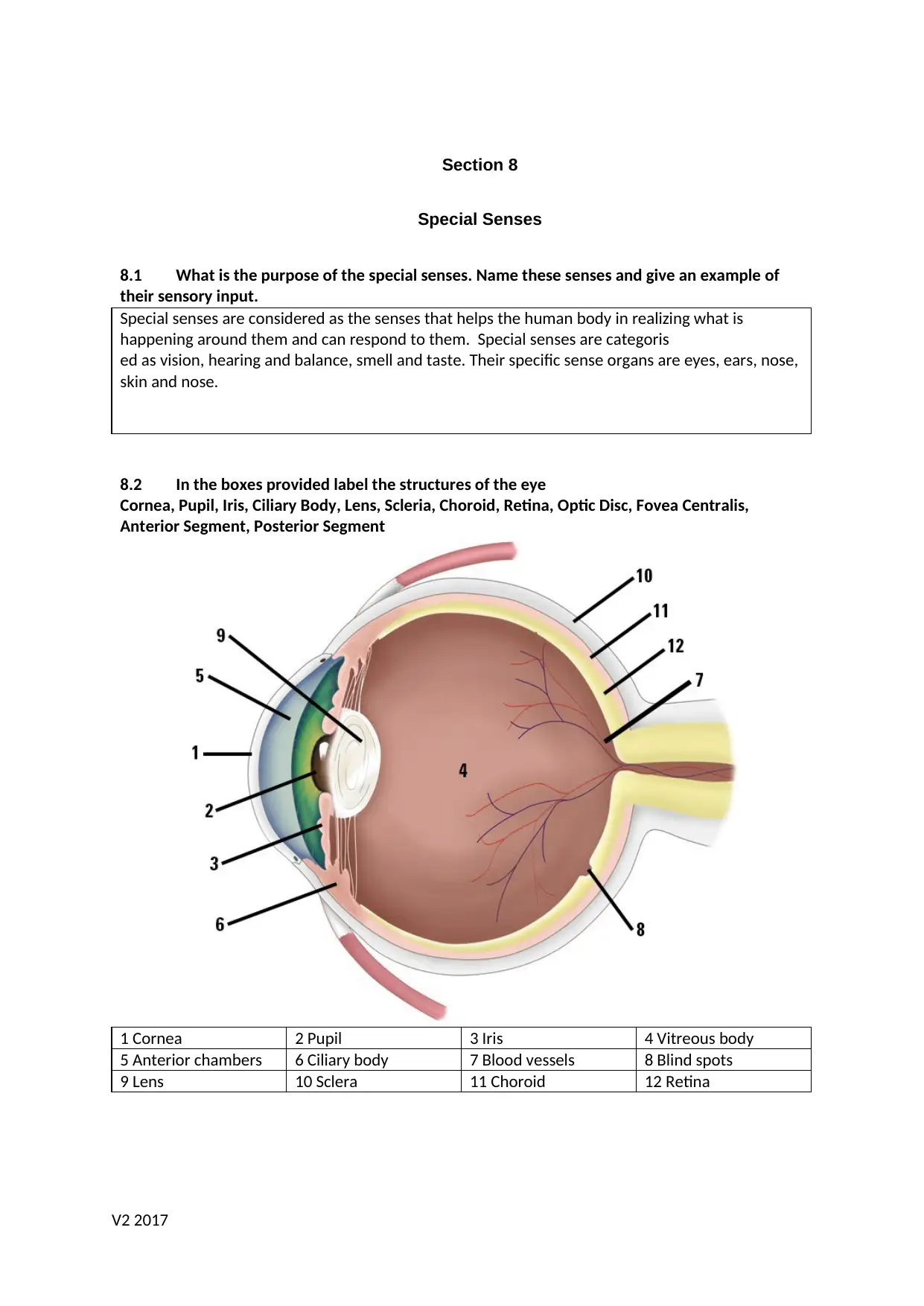
8.2 In the boxes provided label the structures of the eye
Cornea, Pupil, Iris, Ciliary Body, Lens, Scleria, Choroid, Retina, Optic Disc, Fovea Centralis,
Anterior Segment, Posterior Segment
1 Cornea 2 Pupil 3 Iris 4 Vitreous body
5 Anterior chambers 6 Ciliary body 7 Blood vessels 8 Blind spots
9 Lens 10 Sclera 11 Choroid 12 Retina
V2 2017
Document Page
8.3 Describe light refraction.
Refraction is considered as the bending of light when it is being transferred from one state of
medium to the other. When the light travels from a fast medium to a lower one, the light ray gets
bend towards the normal within the two mediums.
8.4 Identify the common disorders of the retina, optic disc, and lens of the eye.
Some very common disorders of the following are :
Retina: Macular degeneration, Retinoblastoma, macular pucker etc.
Optic disk: Optic Nerve disorders, Papilledema, Toxic Amblyopia etc.
Lens: Allergic astigmatism, myopia, hypermetropia etc.
8.5 What would cause colour blindness, and state the potential impact of having this
condition.
Colour blindness is caused by the deficiency of light sensitive cells in the retina, which are
considered as cones. The basic impact of this diseases is that the person is unable to distinguish
between different colors.
8.6 Explain the specific health care services provided to meet the health care needs of
clients with disorders of the special senses.
If the person has a disorder with the vision, they have to make use of the lens or spectacles of the
required number.
8.7 When is the first hearing test performed? Who can perform this test?
There are two popular tests of hearing that are Otoacoustic Emissions (OAE) and
Automated Auditory Brainstem Response (AABR) which needs to performed before
leaving hospital.
The tests are performed by trained hearing screeners, specially trained & enrolled nurses
and midwives.
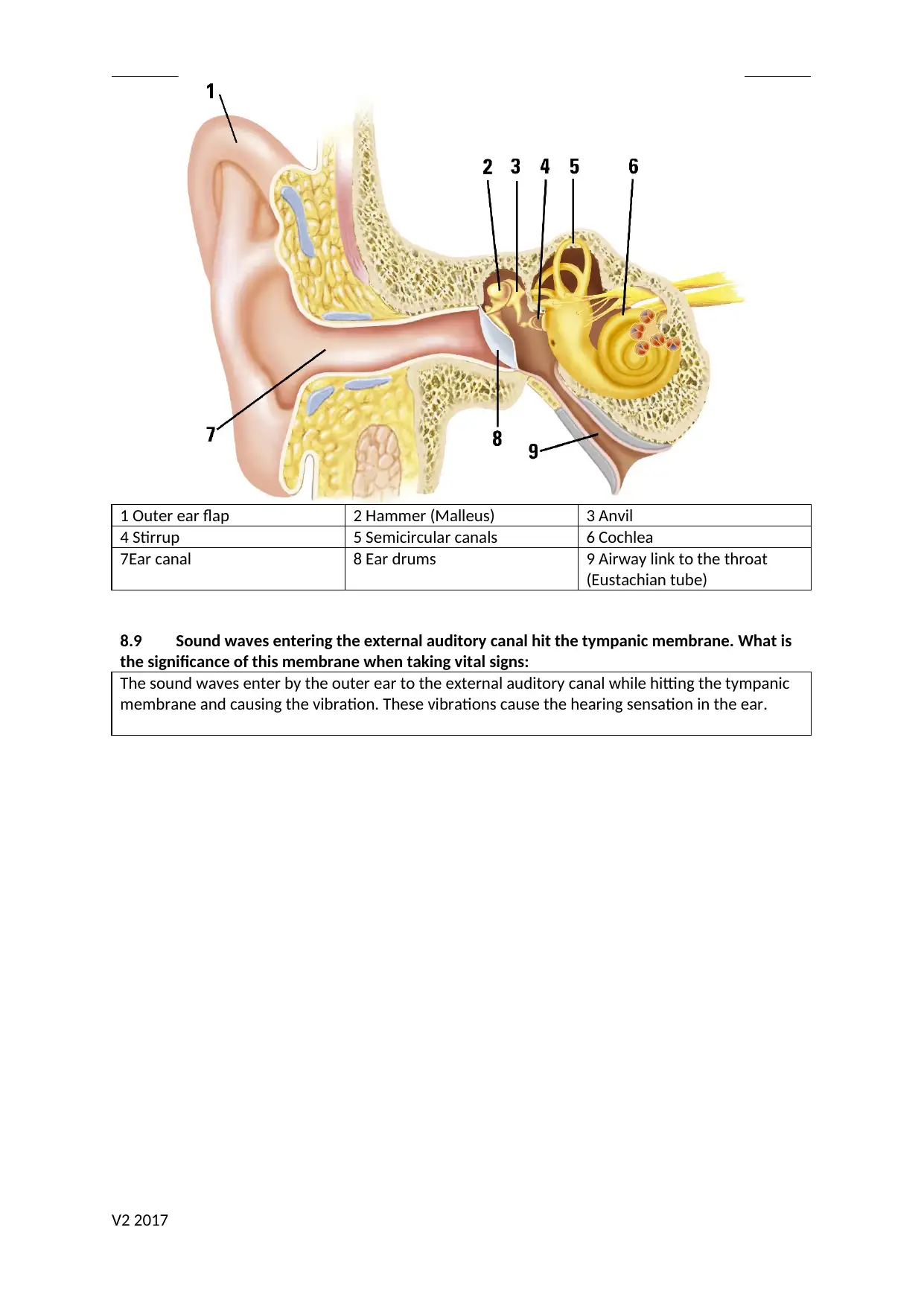
8.8 Label the ear by using the box provided
Pinna, External Canal, Pharyngotympanic Tube, Cochlea, Semicircular canals, Tympanic
Membrane, Malleus, Incus, Stapes.
V2 2017
tabler-icon-diamond-filled.svg

Paraphrase This Document

Need a fresh take? Get an instant paraphrase of this document with our AI Paraphraser
Document Page
1 Outer ear flap 2 Hammer (Malleus) 3 Anvil
4 Stirrup 5 Semicircular canals 6 Cochlea
7Ear canal 8 Ear drums 9 Airway link to the throat
(Eustachian tube)
8.9 Sound waves entering the external auditory canal hit the tympanic membrane. What is
the significance of this membrane when taking vital signs:
The sound waves enter by the outer ear to the external auditory canal while hitting the tympanic
membrane and causing the vibration. These vibrations cause the hearing sensation in the ear.
V2 2017
Document Page
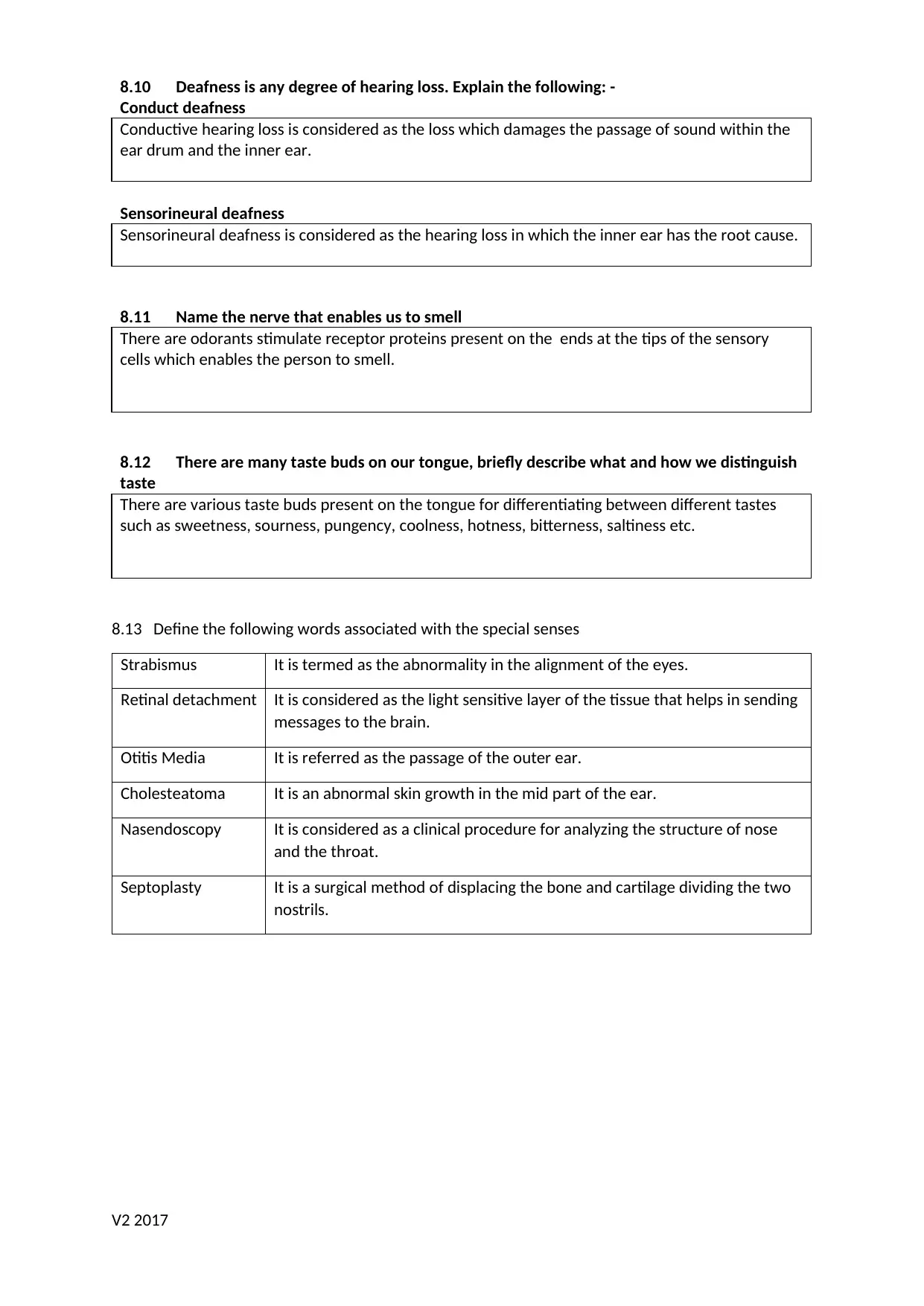
8.10 Deafness is any degree of hearing loss. Explain the following: -
Conduct deafness
Conductive hearing loss is considered as the loss which damages the passage of sound within the
ear drum and the inner ear.
Sensorineural deafness
Sensorineural deafness is considered as the hearing loss in which the inner ear has the root cause.
8.11 Name the nerve that enables us to smell
There are odorants stimulate receptor proteins present on the ends at the tips of the sensory
cells which enables the person to smell.
8.12 There are many taste buds on our tongue, briefly describe what and how we distinguish
taste
There are various taste buds present on the tongue for differentiating between different tastes
such as sweetness, sourness, pungency, coolness, hotness, bitterness, saltiness etc.
8.13 Define the following words associated with the special senses
Strabismus It is termed as the abnormality in the alignment of the eyes.
Retinal detachment It is considered as the light sensitive layer of the tissue that helps in sending
messages to the brain.
Otitis Media It is referred as the passage of the outer ear.
Cholesteatoma It is an abnormal skin growth in the mid part of the ear.
Nasendoscopy It is considered as a clinical procedure for analyzing the structure of nose
and the throat.
Septoplasty It is a surgical method of displacing the bone and cartilage dividing the two
nostrils.
V2 2017
Document Page
Section 9
The Endocrine System
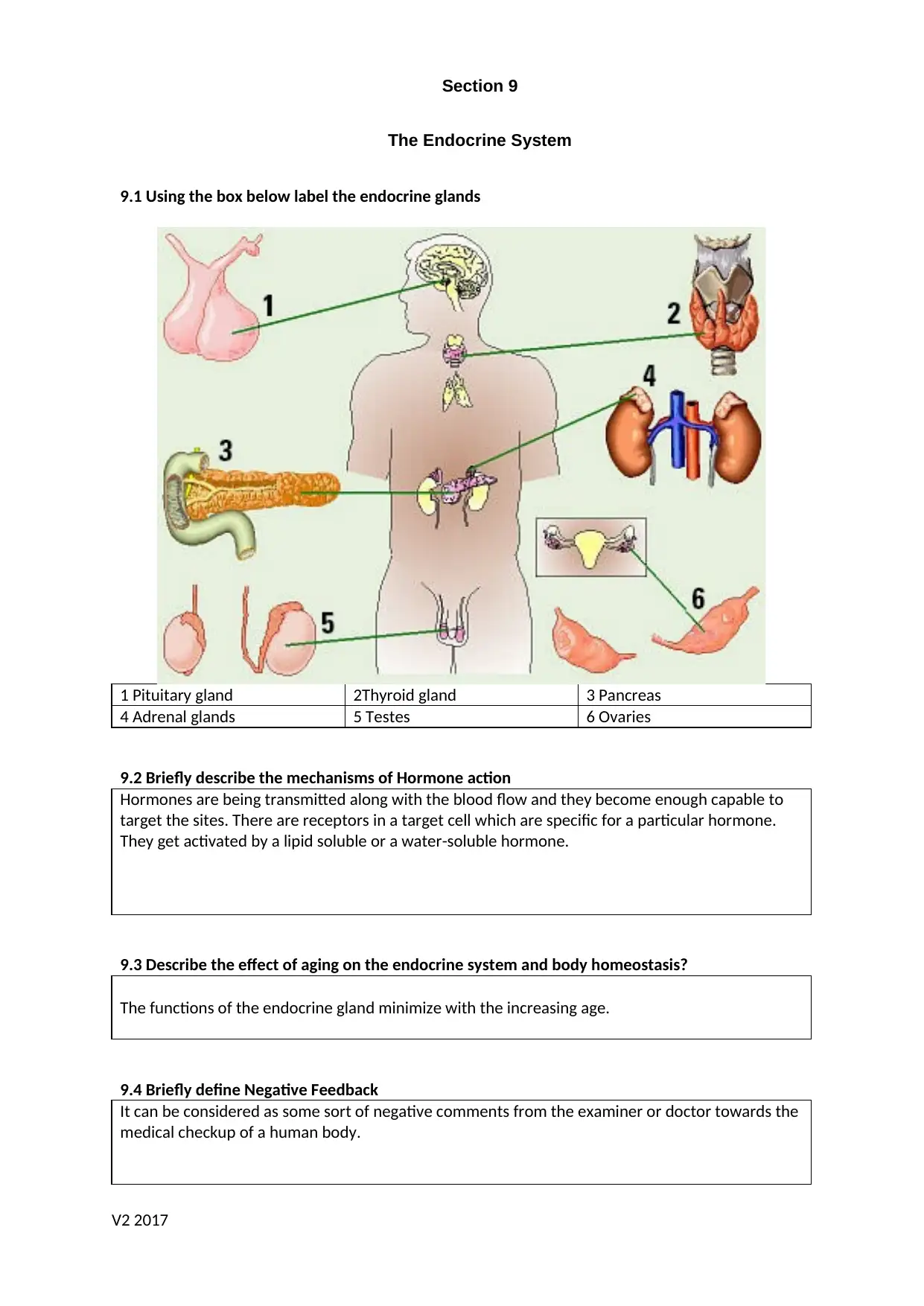
9.1 Using the box below label the endocrine glands
1 Pituitary gland 2Thyroid gland 3 Pancreas
4 Adrenal glands 5 Testes 6 Ovaries
9.2 Briefly describe the mechanisms of Hormone action
Hormones are being transmitted along with the blood flow and they become enough capable to
target the sites. There are receptors in a target cell which are specific for a particular hormone.
They get activated by a lipid soluble or a water-soluble hormone.
9.3 Describe the effect of aging on the endocrine system and body homeostasis?
The functions of the endocrine gland minimize with the increasing age.
9.4 Briefly define Negative Feedback
It can be considered as some sort of negative comments from the examiner or doctor towards the
medical checkup of a human body.
V2 2017
tabler-icon-diamond-filled.svg

Paraphrase This Document

Need a fresh take? Get an instant paraphrase of this document with our AI Paraphraser
Document Page
9.5 Find the word for the following meanings
Hypopituitarism Associated with overactivity of the anterior pituitary gland causing
enlargement of the face jaw hands and feet
GHD (Growth
Hormone
Deficiency)
Hypo secretion of the growth hormone results in underdeveloped bone
structure therefore person is of short stature
Hyperactive
Thyroid
(Hyperthyroidism)
This condition increases the metabolic rate of cells resulting in thyrotoxin
symptoms such as sweating, weight loss rapid pulse and warm moist skin.
Thyroid Surgery A total removal of the thyroid as a result of hyperthyroidism or thyroid
cancer is called?
Section 10
Blood
10.1 In depth discuss the Composition of Blood and briefly describe the formation and the
longevity of blood
The composition of blood involves the cell, its fragments and plasma. About 8% of the weight of
human body, blood is responsible for that. Formation and longevity of the blood is referred to
haemopoiesis, which makes the blood cells.
10.2 Briefly describe Haemostasis
Haemostasis is considered as the stopping of bleeding. It may be either by general
vasoconstruction or by an abnormal obstruction.
10.3 Briefly discuss one disorder of haemostasis?
A very basic disorder of haemostasis can be considered as Hemo philia. It does not let the body to
manage the ability of the body of controlling the clotting of blood.
10.4 What are the names and functions of the White Blood Cells
Different types of WBCs are discussed as under:
Monocytes - They helps in breaking down the bacteria count.
Neutrophils - It helps in killing and then digesting the bacteria.
Basophils - It sounds an alarm when any infection or agent tries to enter in the blood.
Lymphocytes - They fight with the bacteria and viruses.
Eosinophils - They damages the parasites thoroughly.
V2 2017
Document Page
10.5 Although whole blood transfusion can save lives, people have different blood groups.
Name these groups and why some blood types are not compatible?
There are various blood groups which involves Blood Group A, B, O and AB. Some blood groups
are not compatible with each other
10.6 What are the risk factors associated with the potential seriousness of Blood
Transfusion? Discuss in depth the organisational requirement with your Scope of practice in
relation to this.
Hives
Itching
Fever
V2 2017
Document Page
10.7 Write the meanings and a medical term of the word elements below
Combining form Meaning Medical term
Eryth/o Red Erythrocyte
Haem/o Blood Hemocyte
Home/o Similar to Homeostasis
Phleb/o vein Phlebotomy
Thromb/o Clotting of blood Thrombo
Section 11
The Cardiovascular System
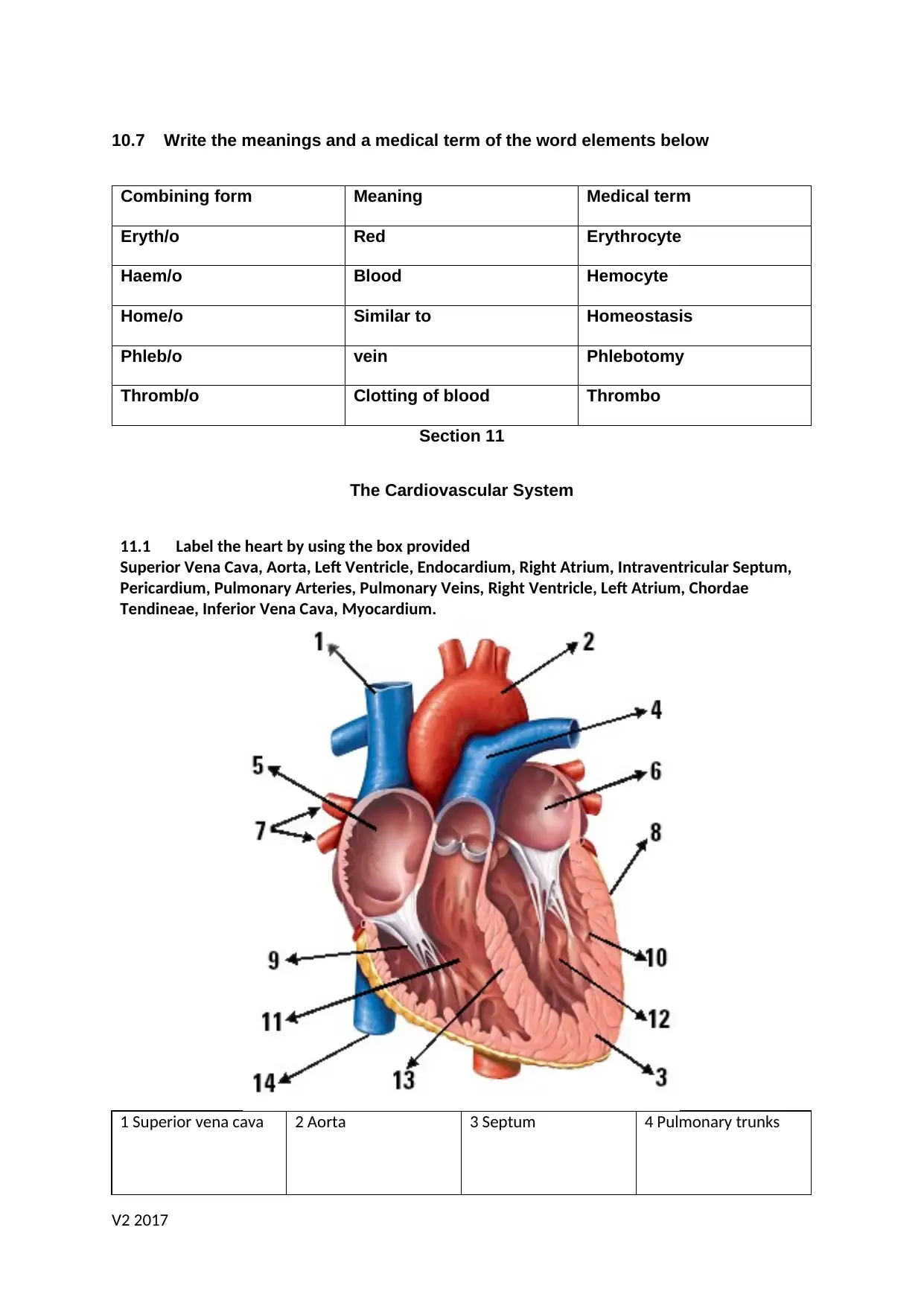
11.1 Label the heart by using the box provided
Superior Vena Cava, Aorta, Left Ventricle, Endocardium, Right Atrium, Intraventricular Septum,
Pericardium, Pulmonary Arteries, Pulmonary Veins, Right Ventricle, Left Atrium, Chordae
Tendineae, Inferior Vena Cava, Myocardium.
1 Superior vena cava 2 Aorta 3 Septum 4 Pulmonary trunks
V2 2017
tabler-icon-diamond-filled.svg

Paraphrase This Document

Need a fresh take? Get an instant paraphrase of this document with our AI Paraphraser
Document Page
5 Right atria 6 Left atria 7 Right pulmonary
veins
8.
9 Chordae tendineae 10 Left ventricles 11 Right ventricles 12 Atrioventricular
valves
13 Septum 14 Inferior vena cava
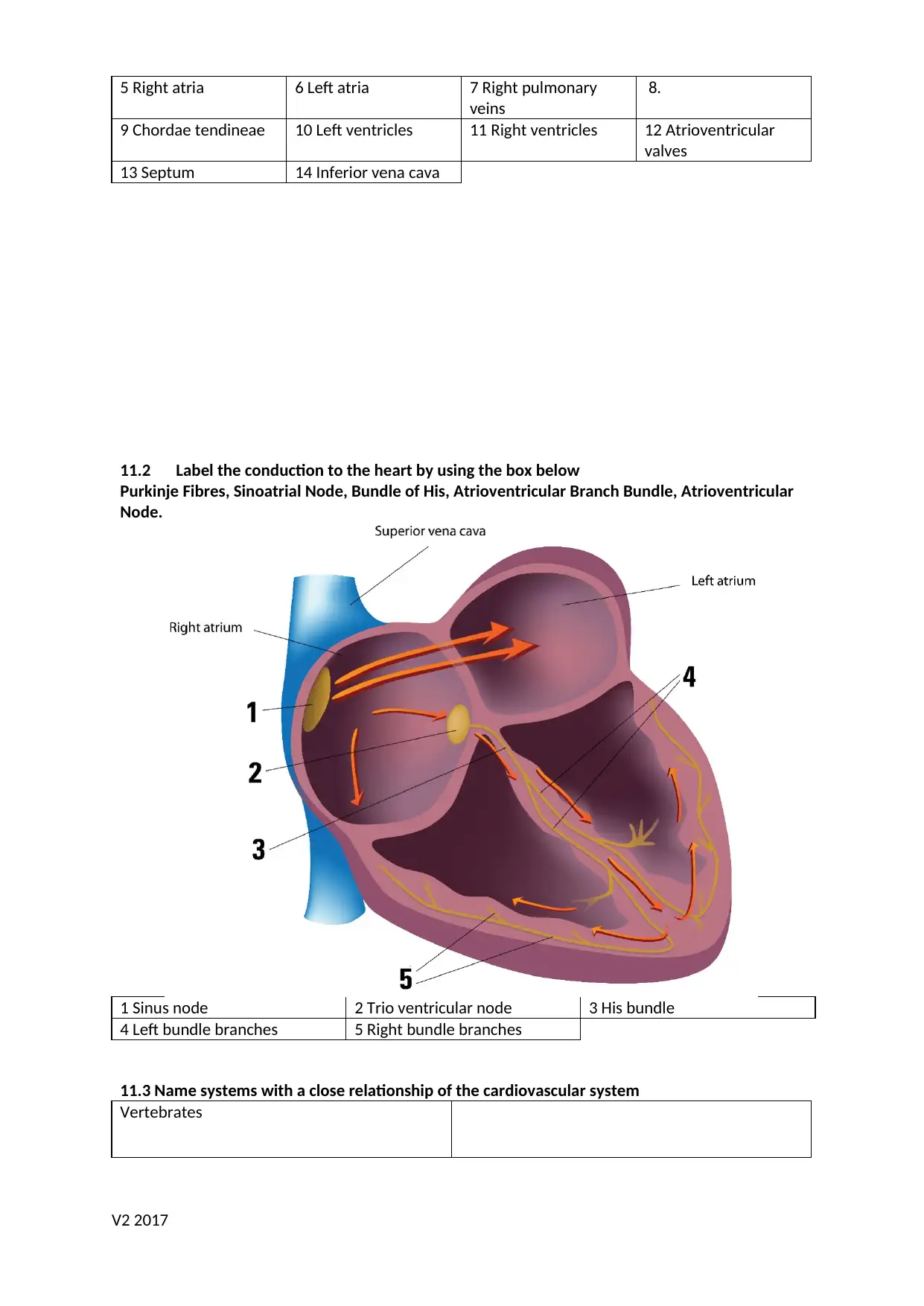
11.2 Label the conduction to the heart by using the box below
Purkinje Fibres, Sinoatrial Node, Bundle of His, Atrioventricular Branch Bundle, Atrioventricular
Node.
1 Sinus node 2 Trio ventricular node 3 His bundle
4 Left bundle branches 5 Right bundle branches
11.3 Name systems with a close relationship of the cardiovascular system
Vertebrates
V2 2017
Document Page
conduction to the heart
11.4 Briefly define
Electrocardiogram
Electrocardiogram is considered as a process for recording and representing the heartbeat of an
individual by means of electrocardiography.
Bradycardia
It is categorized as a term for people who have a slow pulse rate.
Tachycardia
It is considered as a process for rapid rates of the pulse.
11.5 Explain the Cardiac cycle
It is considered as a combination of various events occurring at the time of beating of heart.
11.6 Explain Cardiac output
It is the amount of blood which the heart pumps per minute.
V2 2017
chevron_up_icon
1 out of 28
circle_padding
hide_on_mobile
zoom_out_icon
[object Object]