Comprehensive Nursing Case Study: Hip Pain Assessment & Management
VerifiedAdded on 2023/04/10
|22
|4690
|317
Case Study
AI Summary
This case study presents a 50-year-old female patient admitted to the emergency department with increasing left hip pain. The patient's history includes a horse-riding accident, obstructed labor, intravenous drug use, depression, and recent weight gain attributed to menopause. The report outlines a comprehensive health assessment plan, including data collection, aged care assessment, and consideration of cultural, psychosocial, and emotional factors influencing the patient's pain experience. Gait analysis, palpation, neurologic assessment, and medical imaging are discussed as crucial diagnostic tools. Red flags are identified based on the patient's history and presenting symptoms, leading to a differential diagnosis and prioritized problem list. A detailed plan of care is developed, incorporating pain management strategies and addressing the patient's physical and emotional needs. The case study concludes with a reflection on the nursing process and its application to this patient's unique situation, emphasizing the importance of holistic care and evidence-based practice.

Running head: CASE STUDY
Extended nursing practice
Name of the Student
Name of the University
Author note
Extended nursing practice
Name of the Student
Name of the University
Author note

Paraphrase This Document
Need a fresh take? Get an instant paraphrase of this document with our AI Paraphraser
1CASE STUDY
Executive summary
Hip pain has been identified as a common complaint that occurs due to several factors and
the precise location of the pain provides necessary clues about the presenting complaints.
Often caused due to diseases or traumatic experiences, hip pain is also known as referred
pain. The report discussed a case study of a patient who had been suffering from hip pain
that reduced her mobility and resulted in her admission to the emergency department. The
report further discussed the different health assessments that will be conducted upon the
patient, followed by development of a comprehensive nursing care plan, in alignment with
the scope of practice and competency standards.
Executive summary
Hip pain has been identified as a common complaint that occurs due to several factors and
the precise location of the pain provides necessary clues about the presenting complaints.
Often caused due to diseases or traumatic experiences, hip pain is also known as referred
pain. The report discussed a case study of a patient who had been suffering from hip pain
that reduced her mobility and resulted in her admission to the emergency department. The
report further discussed the different health assessments that will be conducted upon the
patient, followed by development of a comprehensive nursing care plan, in alignment with
the scope of practice and competency standards.
2CASE STUDY
Table of Contents
Introduction...............................................................................................................................3
Health assessment.....................................................................................................................3
Data collection.......................................................................................................................5
Aged care assessment............................................................................................................6
Cultural, psychosocial, and emotional factors.......................................................................6
Gait analysis...........................................................................................................................7
Palpation................................................................................................................................8
Neurologic assessment..........................................................................................................8
Medical imaging.....................................................................................................................9
Red flags.....................................................................................................................................9
Differential diagnosis...............................................................................................................10
Problem prioritisation..............................................................................................................12
Plan of care...............................................................................................................................12
Reflection.................................................................................................................................16
Conclusion................................................................................................................................16
References................................................................................................................................17
Table of Contents
Introduction...............................................................................................................................3
Health assessment.....................................................................................................................3
Data collection.......................................................................................................................5
Aged care assessment............................................................................................................6
Cultural, psychosocial, and emotional factors.......................................................................6
Gait analysis...........................................................................................................................7
Palpation................................................................................................................................8
Neurologic assessment..........................................................................................................8
Medical imaging.....................................................................................................................9
Red flags.....................................................................................................................................9
Differential diagnosis...............................................................................................................10
Problem prioritisation..............................................................................................................12
Plan of care...............................................................................................................................12
Reflection.................................................................................................................................16
Conclusion................................................................................................................................16
References................................................................................................................................17
⊘ This is a preview!⊘
Do you want full access?
Subscribe today to unlock all pages.

Trusted by 1+ million students worldwide
3CASE STUDY
Introduction
Adult speciality practitioners are responsible for specialising in comprehensive and
continuing healthcare services for adult patients, across the span of their lifetime, beginning
from adolescents till old age (Alligood 2017). In addition, the nursing professionals also have
the duty of delivering advanced care services that are able to restore the health status of
their clients, while preventing the onset of further medical complications, and navigating
the patients and their family members across the health settings, in a swiftly altering
environment. This essay will elaborate on a case study involving a female patient who had
been admitted to the emergency department, following an episode of increasing pain in the
left hip. The essay will further elucidate the health history, assessment, differential
diagnosis, and management of the patient condition, followed by a reflective practice.
Health assessment
Health assessments form a crucial aspect of plan of health care and facilitate the
identification of particular needs and preferences of patients, while recognising how the
needs will be addressed by the skilled nursing facility. According to Tabloski (2014)
conduction of a comprehensive health assessment is vital for evaluating the health status
and presenting complaints of a patient and typically involves physical examination, after
collecting adequate data on patient health history. An analysis of the case scenario suggests
that the patient X (pseudonym) had been admitted to the emergency department, after she
reported pain in the left hip that resulted in sleep disruption. She belongs to the African
ethnic community and also reported a history of accident due to horse riding in her young
age, which was followed by suspicion of pelvic trauma. In addition, her health history also
contained experiences of obstructed labour during the first pregnancy that eventually
Introduction
Adult speciality practitioners are responsible for specialising in comprehensive and
continuing healthcare services for adult patients, across the span of their lifetime, beginning
from adolescents till old age (Alligood 2017). In addition, the nursing professionals also have
the duty of delivering advanced care services that are able to restore the health status of
their clients, while preventing the onset of further medical complications, and navigating
the patients and their family members across the health settings, in a swiftly altering
environment. This essay will elaborate on a case study involving a female patient who had
been admitted to the emergency department, following an episode of increasing pain in the
left hip. The essay will further elucidate the health history, assessment, differential
diagnosis, and management of the patient condition, followed by a reflective practice.
Health assessment
Health assessments form a crucial aspect of plan of health care and facilitate the
identification of particular needs and preferences of patients, while recognising how the
needs will be addressed by the skilled nursing facility. According to Tabloski (2014)
conduction of a comprehensive health assessment is vital for evaluating the health status
and presenting complaints of a patient and typically involves physical examination, after
collecting adequate data on patient health history. An analysis of the case scenario suggests
that the patient X (pseudonym) had been admitted to the emergency department, after she
reported pain in the left hip that resulted in sleep disruption. She belongs to the African
ethnic community and also reported a history of accident due to horse riding in her young
age, which was followed by suspicion of pelvic trauma. In addition, her health history also
contained experiences of obstructed labour during the first pregnancy that eventually
Paraphrase This Document
Need a fresh take? Get an instant paraphrase of this document with our AI Paraphraser
4CASE STUDY
resulted in a caesarean section. Nonetheless, her child did not survive after birth. Upon
further enquiring it was found that X reported being affected with depression in young age,
and also had been an intravenous drug user. Presenting complaints also included sudden
increase in weight that is likely to be a cause of menopause, which in turn has made it
difficult for her to move freely. Other signs and symptoms encompass fatigue, listless,
difficulty in ambulating, sleeping disturbances, and loss of appetite. Taking into
consideration the health scenario of the patient X, conducting a general health assessment
will help in establishing the position of the patient on the health continuum and will also act
in the form of a framework for treating the person.
Owing to the fact that hip pain is a prevalent and disabling disorder that distresses
patients belonging to all age groups, there is a need to conduct an assessment. Some of the
most common conditions that result in the onset and development of hip pain encompass
trochanteric and gluteus medius bursitis, and femur fractures, and osteoarthritis (Dickenson
et al. 2016). There is mounting evidence for the fact that increasing age narrows down the
differential diagnosis related to hip pain. It has been found that in adolescent and
prepubescent patients, presence of congenital deformities in the femoroacetabular joint,
epiphyseal or apophyseal injuries, and avulsion fractures should be taken into consideration.
Furthermore, hip pain can also be accredited as a result of musculotendinous strain,
contusion, ligamentous sprain, or bursitis (Guanche 2015). In addition, hip pain in skeletally
mature individuals, such as the patient X is a direct manifestation of fractures and
osteoarthritis. Owing to the fact that X had suffered from an injury that had been suspected
to lead to break of the bony structures present in the pelvis, such as the hip bones, tailbone,
or the sacrum, it might have exacerbated her condition and resulted in the presenting
complaints of hip pain.
resulted in a caesarean section. Nonetheless, her child did not survive after birth. Upon
further enquiring it was found that X reported being affected with depression in young age,
and also had been an intravenous drug user. Presenting complaints also included sudden
increase in weight that is likely to be a cause of menopause, which in turn has made it
difficult for her to move freely. Other signs and symptoms encompass fatigue, listless,
difficulty in ambulating, sleeping disturbances, and loss of appetite. Taking into
consideration the health scenario of the patient X, conducting a general health assessment
will help in establishing the position of the patient on the health continuum and will also act
in the form of a framework for treating the person.
Owing to the fact that hip pain is a prevalent and disabling disorder that distresses
patients belonging to all age groups, there is a need to conduct an assessment. Some of the
most common conditions that result in the onset and development of hip pain encompass
trochanteric and gluteus medius bursitis, and femur fractures, and osteoarthritis (Dickenson
et al. 2016). There is mounting evidence for the fact that increasing age narrows down the
differential diagnosis related to hip pain. It has been found that in adolescent and
prepubescent patients, presence of congenital deformities in the femoroacetabular joint,
epiphyseal or apophyseal injuries, and avulsion fractures should be taken into consideration.
Furthermore, hip pain can also be accredited as a result of musculotendinous strain,
contusion, ligamentous sprain, or bursitis (Guanche 2015). In addition, hip pain in skeletally
mature individuals, such as the patient X is a direct manifestation of fractures and
osteoarthritis. Owing to the fact that X had suffered from an injury that had been suspected
to lead to break of the bony structures present in the pelvis, such as the hip bones, tailbone,
or the sacrum, it might have exacerbated her condition and resulted in the presenting
complaints of hip pain.
5CASE STUDY
Data collection
Owing to the fact that health history helps in the collection of subjective information
from the affected patients and their family members, the initial step of subjective
examination comprises of patient interview. This will help in obtaining a clear description of
the presenting complaints. Obtaining information on health history will also assist in
development of a hypothesis, related to the mechanism of hip injury, type of anatomical
structures that have been injured and the extent of damage (Forbes and Watt 2015). With
the aim of collaboratively creating a plan that promotes the health and helps in averting the
chronic health ailments, X will be enquired about presence of any inciting activity or
antecedent trauma that exacerbates or decreases the hip pain, in addition to their time of
onset. Questions associated with hip function would include ease of getting out and in of
vehicles, putting on shoes, walking, running, or moving up the stairs would also facilitate
gaining an insight of the severity of pain she is currently suffering from. In addition, location
of the pain would also act informative, owing to the fact that hip pain has been found to
most often localize to three major anatomic areas namely, the groin and anterior hip,
buttock and posterior hip, and the lateral hip.
Furthermore, information on the previous medical history of X, in addition to her
family and social history is also significant as it will help in ruling out hereditary
conditions. Time and again it has been stated that people subjected to chronic substance
abuse often report reduced bone density, when compared to individuals without any
striking history of substance use disorder. Hence, the fact that X was an intravenous drug
user in her teenage years, might act as a contributing factor to the current health scenario
(Remeniuk et al. 2015). Furthermore, diseases that involve hip pain such as, osteoarthritis,
Data collection
Owing to the fact that health history helps in the collection of subjective information
from the affected patients and their family members, the initial step of subjective
examination comprises of patient interview. This will help in obtaining a clear description of
the presenting complaints. Obtaining information on health history will also assist in
development of a hypothesis, related to the mechanism of hip injury, type of anatomical
structures that have been injured and the extent of damage (Forbes and Watt 2015). With
the aim of collaboratively creating a plan that promotes the health and helps in averting the
chronic health ailments, X will be enquired about presence of any inciting activity or
antecedent trauma that exacerbates or decreases the hip pain, in addition to their time of
onset. Questions associated with hip function would include ease of getting out and in of
vehicles, putting on shoes, walking, running, or moving up the stairs would also facilitate
gaining an insight of the severity of pain she is currently suffering from. In addition, location
of the pain would also act informative, owing to the fact that hip pain has been found to
most often localize to three major anatomic areas namely, the groin and anterior hip,
buttock and posterior hip, and the lateral hip.
Furthermore, information on the previous medical history of X, in addition to her
family and social history is also significant as it will help in ruling out hereditary
conditions. Time and again it has been stated that people subjected to chronic substance
abuse often report reduced bone density, when compared to individuals without any
striking history of substance use disorder. Hence, the fact that X was an intravenous drug
user in her teenage years, might act as a contributing factor to the current health scenario
(Remeniuk et al. 2015). Furthermore, diseases that involve hip pain such as, osteoarthritis,
⊘ This is a preview!⊘
Do you want full access?
Subscribe today to unlock all pages.
Trusted by 1+ million students worldwide
6CASE STUDY
and hip dysplasia have been accredited to the impact of environmental and genetic factors,
thus calling for the need of a subjective examination related to family history (Tsezou 2014).
Aged care assessment
An important aspect of this case scenario would be to conduct an aged care
assessment (ACAT). Commonly conducted by Aged Care Assessment Teams, this assessment
is primarily required for an individual who calls for approval for healthcare services that are
funded by the government such as, aged care home, nursing home, residential aged care,
respite care, and transition care. The primary aim of the ACAT would focus on conducting a
comprehensive assessment of the medical, physical, cultural, psychosocial, restorative and
social dimensions of the preferences and needs of the patient. The patient will also be
classified into priority category 1 due to the fact that she is at an increased risk of falls, and
there remains a high likelihood of her failing to care for herself due to change in her physical
status.
Cultural, psychosocial, and emotional factors
Culture has often been directly associated to the expression of pain owing to the fact
that the social values and upbringing create an influence on the manner the person is
experiencing pain, and its intensity, nature and duration (Napier et al. 2014). While some
cultures embolden the manifestation of pain, especially the Middle East and southern
Mediterranean cultures, others suppress pain expression. Some of the major cultural factors
that might be accredited to the pain experience of X include pain language, pain expression,
and social roles, lay medications for pain, and prospects and insights about the clinical care
system (Al Harthy‐ et al. 2016). Furthermore, expectations about the interventions that will
be delivered, and painful stimuli might have also created profound influences on the brain
and hip dysplasia have been accredited to the impact of environmental and genetic factors,
thus calling for the need of a subjective examination related to family history (Tsezou 2014).
Aged care assessment
An important aspect of this case scenario would be to conduct an aged care
assessment (ACAT). Commonly conducted by Aged Care Assessment Teams, this assessment
is primarily required for an individual who calls for approval for healthcare services that are
funded by the government such as, aged care home, nursing home, residential aged care,
respite care, and transition care. The primary aim of the ACAT would focus on conducting a
comprehensive assessment of the medical, physical, cultural, psychosocial, restorative and
social dimensions of the preferences and needs of the patient. The patient will also be
classified into priority category 1 due to the fact that she is at an increased risk of falls, and
there remains a high likelihood of her failing to care for herself due to change in her physical
status.
Cultural, psychosocial, and emotional factors
Culture has often been directly associated to the expression of pain owing to the fact
that the social values and upbringing create an influence on the manner the person is
experiencing pain, and its intensity, nature and duration (Napier et al. 2014). While some
cultures embolden the manifestation of pain, especially the Middle East and southern
Mediterranean cultures, others suppress pain expression. Some of the major cultural factors
that might be accredited to the pain experience of X include pain language, pain expression,
and social roles, lay medications for pain, and prospects and insights about the clinical care
system (Al Harthy‐ et al. 2016). Furthermore, expectations about the interventions that will
be delivered, and painful stimuli might have also created profound influences on the brain
Paraphrase This Document
Need a fresh take? Get an instant paraphrase of this document with our AI Paraphraser
7CASE STUDY
and behavioural indicators of pain perception. Gender role can also be cited as an essential
psychosocial factor that governed the pain episode. This can be accredited to the fact that
psychosocial processes that encompass early-life experience to strain and pain coping helps
in explaining sex differences in pain (Hashmi and Davis 2014). It has also been found that
women are more sensitive and perceptive to pain, in comparison to their male counterparts,
thus providing evidence for the pain severity experienced by X. In addition, although the
patient might consider her pain in the form of a sensory event, her pain-related sensations
might have resulted in behaviours that she might have not realized being communicated to
others.
Gait analysis
Upon completion of the subjective interview, the patient X would be subjected to
objective examination. Gait analysis would encompass observing the patient while she
walks, in order to assess for antalgic gait features or limp. The modified Trendelenburg
test will also form an essential aspect of the assessment that will help in determining
presence of any hip dysfunction in the patient. Presence of positive test will provide
evidence for presence of weakness in the abductor muscles and the hip, which in turn can
be allied with numerous hip abnormalities include osteoarthritis, rheumatic arthritis, and
congenital hip dislocation (Cassidy et al. 2014). X will be administered pain Visual Analogue
Scale (VAS) that consists of straight line containing endpoints that help to define extreme
pain limits (most severe or no pain at all) (Boonstra et al. 2014). X will be asked to mark the
level of pain between the endpoints, which in turn would facilitate development of an
accurate care plan. Bone deformities would also be evaluated based on assessments that
focus on weight bearing, balance and posture. This will be followed by conduction of the
FABER test (Flexion, ABduction, and External Rotation) that will help in evaluating the hip
and behavioural indicators of pain perception. Gender role can also be cited as an essential
psychosocial factor that governed the pain episode. This can be accredited to the fact that
psychosocial processes that encompass early-life experience to strain and pain coping helps
in explaining sex differences in pain (Hashmi and Davis 2014). It has also been found that
women are more sensitive and perceptive to pain, in comparison to their male counterparts,
thus providing evidence for the pain severity experienced by X. In addition, although the
patient might consider her pain in the form of a sensory event, her pain-related sensations
might have resulted in behaviours that she might have not realized being communicated to
others.
Gait analysis
Upon completion of the subjective interview, the patient X would be subjected to
objective examination. Gait analysis would encompass observing the patient while she
walks, in order to assess for antalgic gait features or limp. The modified Trendelenburg
test will also form an essential aspect of the assessment that will help in determining
presence of any hip dysfunction in the patient. Presence of positive test will provide
evidence for presence of weakness in the abductor muscles and the hip, which in turn can
be allied with numerous hip abnormalities include osteoarthritis, rheumatic arthritis, and
congenital hip dislocation (Cassidy et al. 2014). X will be administered pain Visual Analogue
Scale (VAS) that consists of straight line containing endpoints that help to define extreme
pain limits (most severe or no pain at all) (Boonstra et al. 2014). X will be asked to mark the
level of pain between the endpoints, which in turn would facilitate development of an
accurate care plan. Bone deformities would also be evaluated based on assessments that
focus on weight bearing, balance and posture. This will be followed by conduction of the
FABER test (Flexion, ABduction, and External Rotation) that will help in evaluating the hip
8CASE STUDY
joint pathology, by having the affected leg being flexed, with the thigh being externally
rotated and abducted (Bagwell et al. 2016). Owing to the fact that X reports difficulty in
walking due to the painful hip, a positive FABER test would indicate severe pain in the groin
or buttock. Other assessments would encompass the log roll test, and the FADIR test,
respectively. The passive motion FADIR (flexion, adduction, and internal rotation)
examination will also help in the diagnosis of hip impingement where X is expected to feel
severe pain during step 3 of the assessment that would involve moving the lower calf and
foot away from the abdomen, while keeping the knee at its position (Wilson and Furukawa
2014). Assessing for bone deformities and alignment would also encompass detecting
colour alterations on the skin due to inflammation, bruising, rash, and infection, In addition,
X will be thoroughly examined for skin changes like wounds, swelling, and scarring.
Palpation
Palpation refers to the procedure of using the hands for evaluating the body, and
forms a crucial aspect of physical examination owing to the fact the sense of tough is
imperative in determine problems below the skin surface (Karrasch and Lynch 2014). Taking
into consideration the fact that the hip joint is comparatively unreachable by palpation, the
procedure will permit access to additional possible causes of pain in the zone. The hip will
be palpated for tenderness with the use of middle and index fingers in the anterior hip joint,
anterior superior iliac spine, greater trochanter, posterior superior iliac spine, and gluteus
muscle.
Neurologic assessment
Manual muscle testing will form an essential aspect of neurologic assessment,
whereby the strength of the muscle that surround the hip joint namely, the hip extensors,
joint pathology, by having the affected leg being flexed, with the thigh being externally
rotated and abducted (Bagwell et al. 2016). Owing to the fact that X reports difficulty in
walking due to the painful hip, a positive FABER test would indicate severe pain in the groin
or buttock. Other assessments would encompass the log roll test, and the FADIR test,
respectively. The passive motion FADIR (flexion, adduction, and internal rotation)
examination will also help in the diagnosis of hip impingement where X is expected to feel
severe pain during step 3 of the assessment that would involve moving the lower calf and
foot away from the abdomen, while keeping the knee at its position (Wilson and Furukawa
2014). Assessing for bone deformities and alignment would also encompass detecting
colour alterations on the skin due to inflammation, bruising, rash, and infection, In addition,
X will be thoroughly examined for skin changes like wounds, swelling, and scarring.
Palpation
Palpation refers to the procedure of using the hands for evaluating the body, and
forms a crucial aspect of physical examination owing to the fact the sense of tough is
imperative in determine problems below the skin surface (Karrasch and Lynch 2014). Taking
into consideration the fact that the hip joint is comparatively unreachable by palpation, the
procedure will permit access to additional possible causes of pain in the zone. The hip will
be palpated for tenderness with the use of middle and index fingers in the anterior hip joint,
anterior superior iliac spine, greater trochanter, posterior superior iliac spine, and gluteus
muscle.
Neurologic assessment
Manual muscle testing will form an essential aspect of neurologic assessment,
whereby the strength of the muscle that surround the hip joint namely, the hip extensors,
⊘ This is a preview!⊘
Do you want full access?
Subscribe today to unlock all pages.
Trusted by 1+ million students worldwide
9CASE STUDY
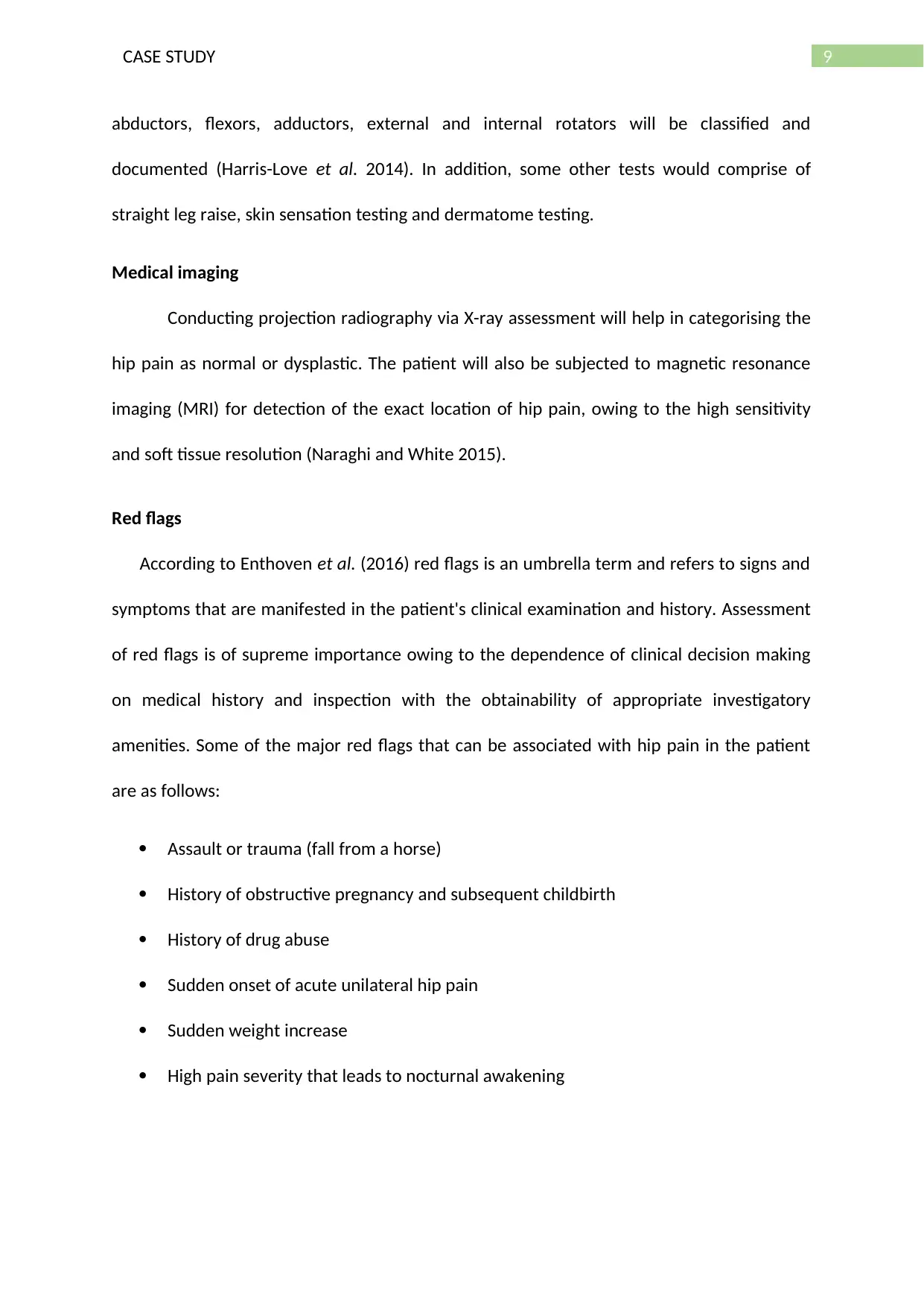
abductors, flexors, adductors, external and internal rotators will be classified and
documented (Harris-Love et al. 2014). In addition, some other tests would comprise of
straight leg raise, skin sensation testing and dermatome testing.
Medical imaging
Conducting projection radiography via X-ray assessment will help in categorising the
hip pain as normal or dysplastic. The patient will also be subjected to magnetic resonance
imaging (MRI) for detection of the exact location of hip pain, owing to the high sensitivity
and soft tissue resolution (Naraghi and White 2015).
Red flags
According to Enthoven et al. (2016) red flags is an umbrella term and refers to signs and
symptoms that are manifested in the patient's clinical examination and history. Assessment
of red flags is of supreme importance owing to the dependence of clinical decision making
on medical history and inspection with the obtainability of appropriate investigatory
amenities. Some of the major red flags that can be associated with hip pain in the patient
are as follows:
Assault or trauma (fall from a horse)
History of obstructive pregnancy and subsequent childbirth
History of drug abuse
Sudden onset of acute unilateral hip pain
Sudden weight increase
High pain severity that leads to nocturnal awakening
abductors, flexors, adductors, external and internal rotators will be classified and
documented (Harris-Love et al. 2014). In addition, some other tests would comprise of
straight leg raise, skin sensation testing and dermatome testing.
Medical imaging
Conducting projection radiography via X-ray assessment will help in categorising the
hip pain as normal or dysplastic. The patient will also be subjected to magnetic resonance
imaging (MRI) for detection of the exact location of hip pain, owing to the high sensitivity
and soft tissue resolution (Naraghi and White 2015).
Red flags
According to Enthoven et al. (2016) red flags is an umbrella term and refers to signs and
symptoms that are manifested in the patient's clinical examination and history. Assessment
of red flags is of supreme importance owing to the dependence of clinical decision making
on medical history and inspection with the obtainability of appropriate investigatory
amenities. Some of the major red flags that can be associated with hip pain in the patient
are as follows:
Assault or trauma (fall from a horse)
History of obstructive pregnancy and subsequent childbirth
History of drug abuse
Sudden onset of acute unilateral hip pain
Sudden weight increase
High pain severity that leads to nocturnal awakening
Paraphrase This Document
Need a fresh take? Get an instant paraphrase of this document with our AI Paraphraser
10CASE STUDY
Differential diagnosis
Differential diagnosis refers to the process of differentiating a specific disease or
illness from other health conditions that manifest similar signs and symptoms. Hence, a
differential diagnosis procedure encompasses a systematic diagnostic process that facilitates
identification of the disease entity, in the presence of multiple alternatives. Groin or
anterior hip pain suggest the involvement of the hip joint and the pain is often localised by
the patient cupping anterolateral hip with forefinger and the thumb in the form of the
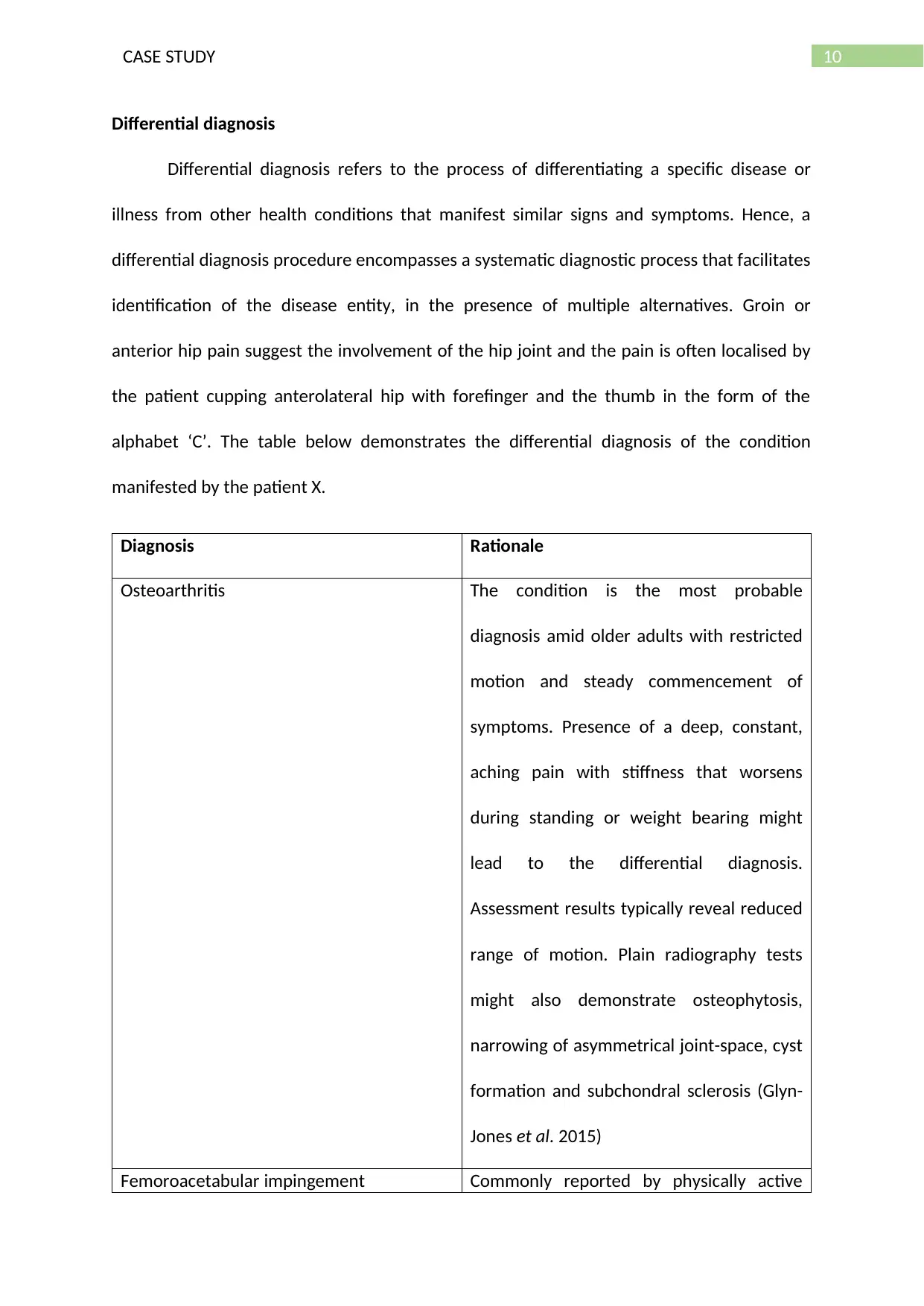
alphabet ‘C’. The table below demonstrates the differential diagnosis of the condition
manifested by the patient X.
Diagnosis Rationale
Osteoarthritis The condition is the most probable
diagnosis amid older adults with restricted
motion and steady commencement of
symptoms. Presence of a deep, constant,
aching pain with stiffness that worsens
during standing or weight bearing might
lead to the differential diagnosis.
Assessment results typically reveal reduced
range of motion. Plain radiography tests
might also demonstrate osteophytosis,
narrowing of asymmetrical joint-space, cyst
formation and subchondral sclerosis (Glyn-
Jones et al. 2015)
Femoroacetabular impingement Commonly reported by physically active
Differential diagnosis
Differential diagnosis refers to the process of differentiating a specific disease or
illness from other health conditions that manifest similar signs and symptoms. Hence, a
differential diagnosis procedure encompasses a systematic diagnostic process that facilitates
identification of the disease entity, in the presence of multiple alternatives. Groin or
anterior hip pain suggest the involvement of the hip joint and the pain is often localised by
the patient cupping anterolateral hip with forefinger and the thumb in the form of the
alphabet ‘C’. The table below demonstrates the differential diagnosis of the condition
manifested by the patient X.
Diagnosis Rationale
Osteoarthritis The condition is the most probable
diagnosis amid older adults with restricted
motion and steady commencement of
symptoms. Presence of a deep, constant,
aching pain with stiffness that worsens
during standing or weight bearing might
lead to the differential diagnosis.
Assessment results typically reveal reduced
range of motion. Plain radiography tests
might also demonstrate osteophytosis,
narrowing of asymmetrical joint-space, cyst
formation and subchondral sclerosis (Glyn-
Jones et al. 2015)
Femoroacetabular impingement Commonly reported by physically active
11CASE STUDY
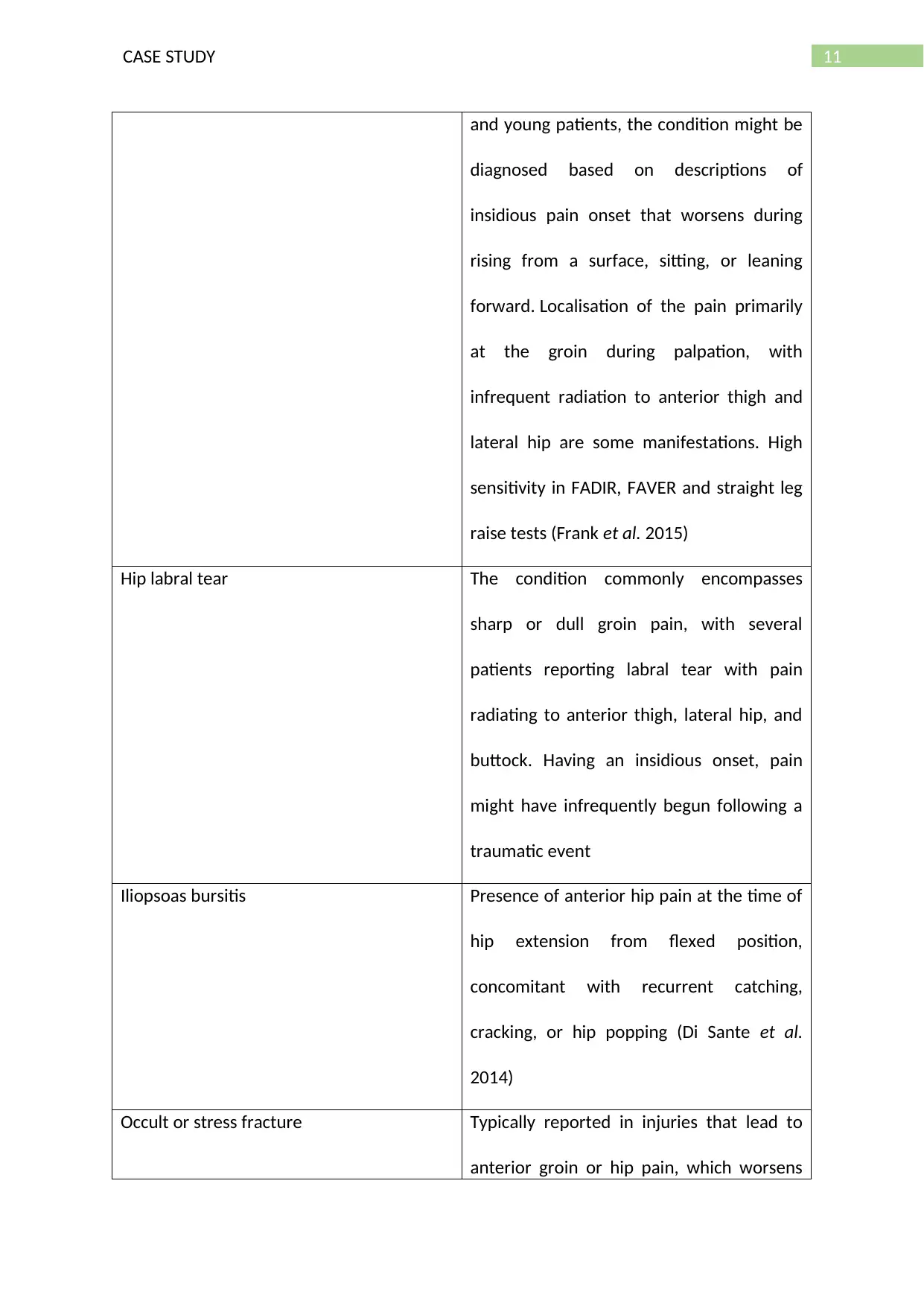
and young patients, the condition might be
diagnosed based on descriptions of
insidious pain onset that worsens during
rising from a surface, sitting, or leaning
forward. Localisation of the pain primarily
at the groin during palpation, with
infrequent radiation to anterior thigh and
lateral hip are some manifestations. High
sensitivity in FADIR, FAVER and straight leg
raise tests (Frank et al. 2015)
Hip labral tear The condition commonly encompasses
sharp or dull groin pain, with several
patients reporting labral tear with pain
radiating to anterior thigh, lateral hip, and
buttock. Having an insidious onset, pain
might have infrequently begun following a
traumatic event
Iliopsoas bursitis Presence of anterior hip pain at the time of
hip extension from flexed position,
concomitant with recurrent catching,
cracking, or hip popping (Di Sante et al.
2014)
Occult or stress fracture Typically reported in injuries that lead to
anterior groin or hip pain, which worsens
and young patients, the condition might be
diagnosed based on descriptions of
insidious pain onset that worsens during
rising from a surface, sitting, or leaning
forward. Localisation of the pain primarily
at the groin during palpation, with
infrequent radiation to anterior thigh and
lateral hip are some manifestations. High
sensitivity in FADIR, FAVER and straight leg
raise tests (Frank et al. 2015)
Hip labral tear The condition commonly encompasses
sharp or dull groin pain, with several
patients reporting labral tear with pain
radiating to anterior thigh, lateral hip, and
buttock. Having an insidious onset, pain
might have infrequently begun following a
traumatic event
Iliopsoas bursitis Presence of anterior hip pain at the time of
hip extension from flexed position,
concomitant with recurrent catching,
cracking, or hip popping (Di Sante et al.
2014)
Occult or stress fracture Typically reported in injuries that lead to
anterior groin or hip pain, which worsens
⊘ This is a preview!⊘
Do you want full access?
Subscribe today to unlock all pages.
Trusted by 1+ million students worldwide

1 out of 22


Related Documents


Your All-in-One AI-Powered Toolkit for Academic Success.
+13062052269
info@desklib.com
Available 24*7 on WhatsApp / Email
![[object Object]](/_next/static/media/star-bottom.7253800d.svg)
Unlock your academic potential
Copyright © 2020–2026 A2Z Services. All Rights Reserved. Developed and managed by ZUCOL.