Nursing Preceptor Program Integration in Healthcare Analysis Report
VerifiedAdded on 2022/08/14
|9
|1979
|20
Report
AI Summary
This report delves into the critical importance of integrating nursing preceptor programs within healthcare organizations. It addresses the challenges of talent shortages and the difficulties faced by newly registered nurses in adjusting to their roles, often leading to burnout and understaffing. The report provides a comprehensive overview of preceptorship as an effective strategy for facilitating clinical practice and developing essential nursing attributes, including personal, clinical, and communication skills. It highlights the program's positive impact on improving nursing students' competency, confidence, and clinical knowledge, leading to reduced turnover rates, medication errors, and adverse events. The report also discusses the rationale for such programs, citing the high attrition rates of new graduate nurses and the cost-effectiveness of residency programs. Furthermore, it examines structured models for integrating preceptorship, emphasizing the positive correlation between preceptorship and nursing interns' clinical experience, performance, and essential skills. The report concludes by underscoring the significant influence of preceptorship on nursing students' abilities to work with real patients, bridging the gap between classroom learning and clinical practice and guiding nurses toward achievable goals.
Running Head: NURSING PRECEPTOR PROGRAM INTEGRATED INTO HEALTHCARE
NURSING PRECEPTOR PROGRAM INTEGRATED INTO HEALTHCARE
Name of the Student:
Name of the University:
Author Note:
NURSING PRECEPTOR PROGRAM INTEGRATED INTO HEALTHCARE
Name of the Student:
Name of the University:
Author Note:
Paraphrase This Document
Need a fresh take? Get an instant paraphrase of this document with our AI Paraphraser

1NURSING PRECEPTOR PROGRAM INTEGRATED INTO HEALTHCARE
Table of Contents
Introduction:....................................................................................................................................2
Discussion:.......................................................................................................................................2
Background of the Preceptorship Program:.................................................................................2
Rationale for the program:...........................................................................................................3
Structured model for the Incorporation of Nursing Preceptorship:.............................................5
Conclusion:......................................................................................................................................5
References:......................................................................................................................................7
Table of Contents
Introduction:....................................................................................................................................2
Discussion:.......................................................................................................................................2
Background of the Preceptorship Program:.................................................................................2
Rationale for the program:...........................................................................................................3
Structured model for the Incorporation of Nursing Preceptorship:.............................................5
Conclusion:......................................................................................................................................5
References:......................................................................................................................................7

2NURSING PRECEPTOR PROGRAM INTEGRATED INTO HEALTHCARE
Introduction:
In the recent times, there have been immense talent shortages that generally are found to
be one of the prime reasons for jeopardizing healthcare organization’s ability to provide optimal
care to the patients. As per reports, over half of nurses in the U.S report face the issue of
adjusting to the new job as soon as they start their tenure of being a registered nurse. The nurses
also are seen to be complaining of being overworked, which eventually burn them out leading to
the arising of the issue of the health organizations being understaffed. The aim of the paper is to
establish to project the importance of integrating nursing preceptorship program (Rambod, Sharif
& Khademian, 2018) in the healthcare organizations. The essay below provides a wider outlook
on the need to include receptorship program in the nursing training to help and make the nurses
become accustomed (Piccinini et al, 2018) to their new job as a registered nurse.
Discussion:
Background of the Preceptorship Program:
Preceptorship is considered as an effective strategy, which helps in facilitating clinical
practice in the healthcare training programs such as nursing. The program mainly helps in
developing the attributes of nursing, which includes the development of personal, clinical and
communicational skills. Additionally, the preceptorship program (Rambod, Sharif & Khademian,
2018) also helps in helping the nursing students to improve their competency and the confidence
regarding their work. The nursing students are also tested based on their clinical knowledge,
which in turn helps in the turnover rate amongst the newly recruited nurses and the related costs
with respect to the preceptorship program also reduced. Moreover, the medication errors were
found to be occurring lesser in number as well as there was a gradual decrease in the incident
Introduction:
In the recent times, there have been immense talent shortages that generally are found to
be one of the prime reasons for jeopardizing healthcare organization’s ability to provide optimal
care to the patients. As per reports, over half of nurses in the U.S report face the issue of
adjusting to the new job as soon as they start their tenure of being a registered nurse. The nurses
also are seen to be complaining of being overworked, which eventually burn them out leading to
the arising of the issue of the health organizations being understaffed. The aim of the paper is to
establish to project the importance of integrating nursing preceptorship program (Rambod, Sharif
& Khademian, 2018) in the healthcare organizations. The essay below provides a wider outlook
on the need to include receptorship program in the nursing training to help and make the nurses
become accustomed (Piccinini et al, 2018) to their new job as a registered nurse.
Discussion:
Background of the Preceptorship Program:
Preceptorship is considered as an effective strategy, which helps in facilitating clinical
practice in the healthcare training programs such as nursing. The program mainly helps in
developing the attributes of nursing, which includes the development of personal, clinical and
communicational skills. Additionally, the preceptorship program (Rambod, Sharif & Khademian,
2018) also helps in helping the nursing students to improve their competency and the confidence
regarding their work. The nursing students are also tested based on their clinical knowledge,
which in turn helps in the turnover rate amongst the newly recruited nurses and the related costs
with respect to the preceptorship program also reduced. Moreover, the medication errors were
found to be occurring lesser in number as well as there was a gradual decrease in the incident
⊘ This is a preview!⊘
Do you want full access?
Subscribe today to unlock all pages.

Trusted by 1+ million students worldwide

3NURSING PRECEPTOR PROGRAM INTEGRATED INTO HEALTHCARE
rate of adverse set of faults and events. The program was seen to be one of the most successful
training program, which helped in improving the experiences of the newly joined registered
nurses and helped them achieve the desirable outcomes such as skills like clinical
thinking(Nielsen, Lasater & Stock, 2016), improving self-efficacy and practicing various
opportunities. The trait, which helps in improving the self-efficacy was observed to be associated
with the progress and achievement in the job, increase in satisfaction while performing the job
along with the steady intention of the nurses to stay in the profession. The program aims to make
the nurses more competent in the clinical settings along with developing their acceptance skills
of handling any challenging role. The nurses are observed that post attending the preceptorship
program; they happen to become more self-efficient and preferred to handle more difficult tasks
that needed better critical thinking abilities to be incorporated while working on the case.
Although, very limited number of studies had been conducted to check on the effect of the
incorporation of the preceptorship program but the researchers believe that with the change in the
curriculum for the nurses and encouraging them with motivation might help the nurses to
become more self-efficient. Self efficacy makes the nurses be more confident as well as
competent to deal with any kind of nursing situation. Surveys state that nurses with the highest
sufficiency and self efficacy are the ones most likely to have better decision making skills and
achieve ultimate goals. Results found that nursing students who undertook the preceptorship
system recorded higher than 80 percent of the predicted performance in overall percentile rank of
learning efficiency.
Rationale for the program:
According to (Van Camp & Chappy, 2017), the review determines that the new graduate
nurses are the maximum ones who leave the profession as fast they join the profession. The
rate of adverse set of faults and events. The program was seen to be one of the most successful
training program, which helped in improving the experiences of the newly joined registered
nurses and helped them achieve the desirable outcomes such as skills like clinical
thinking(Nielsen, Lasater & Stock, 2016), improving self-efficacy and practicing various
opportunities. The trait, which helps in improving the self-efficacy was observed to be associated
with the progress and achievement in the job, increase in satisfaction while performing the job
along with the steady intention of the nurses to stay in the profession. The program aims to make
the nurses more competent in the clinical settings along with developing their acceptance skills
of handling any challenging role. The nurses are observed that post attending the preceptorship
program; they happen to become more self-efficient and preferred to handle more difficult tasks
that needed better critical thinking abilities to be incorporated while working on the case.
Although, very limited number of studies had been conducted to check on the effect of the
incorporation of the preceptorship program but the researchers believe that with the change in the
curriculum for the nurses and encouraging them with motivation might help the nurses to
become more self-efficient. Self efficacy makes the nurses be more confident as well as
competent to deal with any kind of nursing situation. Surveys state that nurses with the highest
sufficiency and self efficacy are the ones most likely to have better decision making skills and
achieve ultimate goals. Results found that nursing students who undertook the preceptorship
system recorded higher than 80 percent of the predicted performance in overall percentile rank of
learning efficiency.
Rationale for the program:
According to (Van Camp & Chappy, 2017), the review determines that the new graduate
nurses are the maximum ones who leave the profession as fast they join the profession. The
Paraphrase This Document
Need a fresh take? Get an instant paraphrase of this document with our AI Paraphraser

4NURSING PRECEPTOR PROGRAM INTEGRATED INTO HEALTHCARE
paper also suggests that the profit margin appears to be costly, particularly in the speciality
settings. Residency services for nurses are utilized to attract recent students and aid with their
adjustment to clinical practice. The aim of the comprehensive research study was to analyze
newly graduated nurse residency programs, retention rates, relative quality of the patients, and
make suggestions for preoperative settings execution. Nursing participants in the Residency have
viewed the internship as advantageous. It is further observed in the study that the residency
programs differ in education programs and duration, thereby it becomes difficult to compare
outcomes effectively. Moreover, the findings suggest higher retention rates for fresh graduates
taking part in training programs and that residency applicants were more pleased with their
induction than those not taking part in residency programmes.
The paper by (Senyk & Staffileno,2017), states that low preceptor attrition and cost-
effectiveness requirements in a fast-changing healthcare world demand creative strategies for the
development and maintenance of nurse preceptors (Nash & Flowers, 2018). A quality
improvement project was introduced in the research paper, which merged many conclusive
proof-based solutions to integrate conventional mechanisms and schemes with modern
administrative objectives and cost containment initiatives in the report. The results at the end of
the framework examined in the report claim that the corresponding method of preceptor growth
has reduced costs and simplified procedures. It also demonstrated better interaction with
instruction and preceptors, and expanded incentives for networking, appreciation and schooling.
(Schuelke & Barnason, 2017) describes and discusses about the interventions used by the
nurse preceptors in order to help the newly joined nurses to develop their critical thinking skill
and use them to apply while taking decisions and handling a complicated case. The respective
review paper was studied as a structured review, which culminated in 602 citations with nine
paper also suggests that the profit margin appears to be costly, particularly in the speciality
settings. Residency services for nurses are utilized to attract recent students and aid with their
adjustment to clinical practice. The aim of the comprehensive research study was to analyze
newly graduated nurse residency programs, retention rates, relative quality of the patients, and
make suggestions for preoperative settings execution. Nursing participants in the Residency have
viewed the internship as advantageous. It is further observed in the study that the residency
programs differ in education programs and duration, thereby it becomes difficult to compare
outcomes effectively. Moreover, the findings suggest higher retention rates for fresh graduates
taking part in training programs and that residency applicants were more pleased with their
induction than those not taking part in residency programmes.
The paper by (Senyk & Staffileno,2017), states that low preceptor attrition and cost-
effectiveness requirements in a fast-changing healthcare world demand creative strategies for the
development and maintenance of nurse preceptors (Nash & Flowers, 2018). A quality
improvement project was introduced in the research paper, which merged many conclusive
proof-based solutions to integrate conventional mechanisms and schemes with modern
administrative objectives and cost containment initiatives in the report. The results at the end of
the framework examined in the report claim that the corresponding method of preceptor growth
has reduced costs and simplified procedures. It also demonstrated better interaction with
instruction and preceptors, and expanded incentives for networking, appreciation and schooling.
(Schuelke & Barnason, 2017) describes and discusses about the interventions used by the
nurse preceptors in order to help the newly joined nurses to develop their critical thinking skill
and use them to apply while taking decisions and handling a complicated case. The respective
review paper was studied as a structured review, which culminated in 602 citations with nine

5NURSING PRECEPTOR PROGRAM INTEGRATED INTO HEALTHCARE
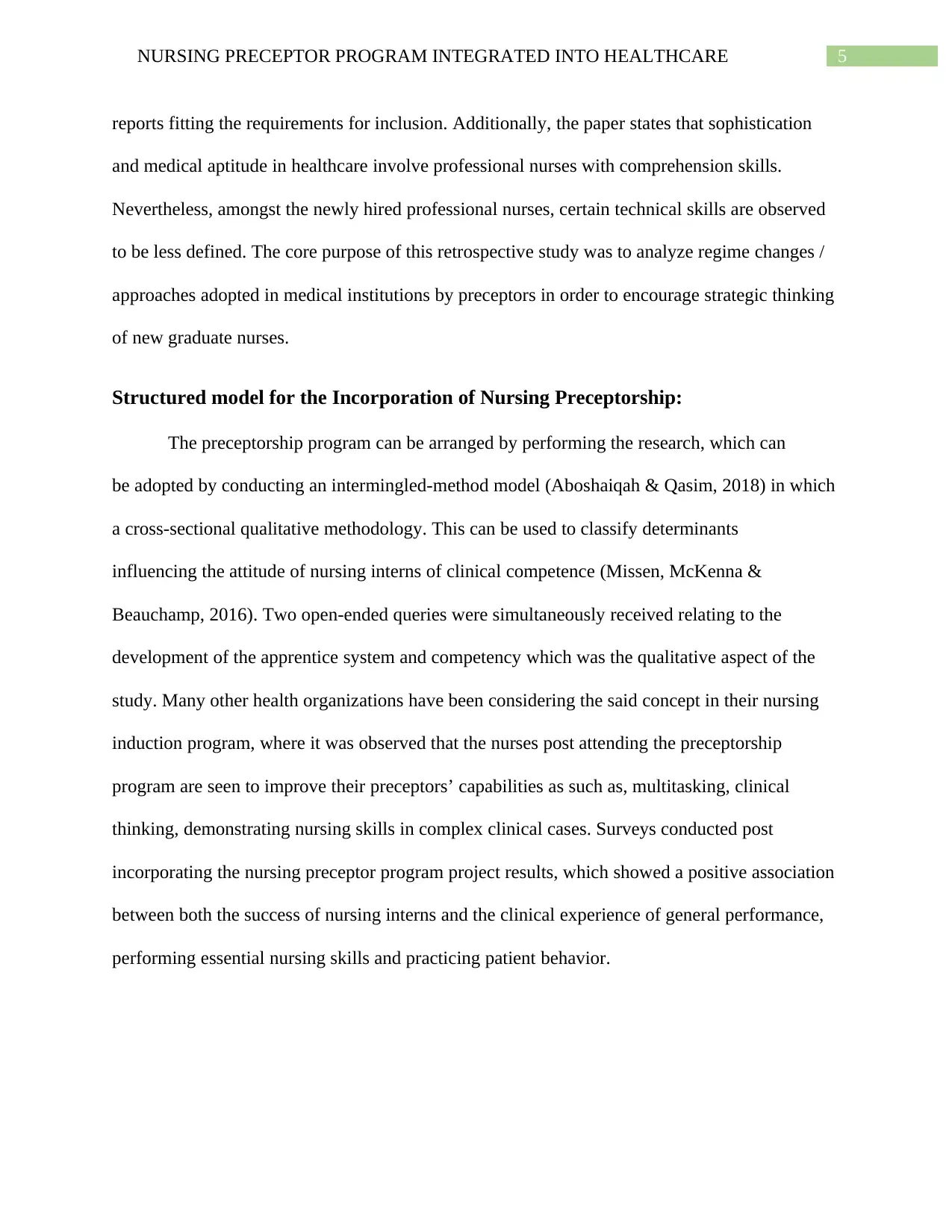
reports fitting the requirements for inclusion. Additionally, the paper states that sophistication
and medical aptitude in healthcare involve professional nurses with comprehension skills.
Nevertheless, amongst the newly hired professional nurses, certain technical skills are observed
to be less defined. The core purpose of this retrospective study was to analyze regime changes /
approaches adopted in medical institutions by preceptors in order to encourage strategic thinking
of new graduate nurses.
Structured model for the Incorporation of Nursing Preceptorship:
The preceptorship program can be arranged by performing the research, which can
be adopted by conducting an intermingled-method model (Aboshaiqah & Qasim, 2018) in which
a cross-sectional qualitative methodology. This can be used to classify determinants
influencing the attitude of nursing interns of clinical competence (Missen, McKenna &
Beauchamp, 2016). Two open-ended queries were simultaneously received relating to the
development of the apprentice system and competency which was the qualitative aspect of the
study. Many other health organizations have been considering the said concept in their nursing
induction program, where it was observed that the nurses post attending the preceptorship
program are seen to improve their preceptors’ capabilities as such as, multitasking, clinical
thinking, demonstrating nursing skills in complex clinical cases. Surveys conducted post
incorporating the nursing preceptor program project results, which showed a positive association
between both the success of nursing interns and the clinical experience of general performance,
performing essential nursing skills and practicing patient behavior.
reports fitting the requirements for inclusion. Additionally, the paper states that sophistication
and medical aptitude in healthcare involve professional nurses with comprehension skills.
Nevertheless, amongst the newly hired professional nurses, certain technical skills are observed
to be less defined. The core purpose of this retrospective study was to analyze regime changes /
approaches adopted in medical institutions by preceptors in order to encourage strategic thinking
of new graduate nurses.
Structured model for the Incorporation of Nursing Preceptorship:
The preceptorship program can be arranged by performing the research, which can
be adopted by conducting an intermingled-method model (Aboshaiqah & Qasim, 2018) in which
a cross-sectional qualitative methodology. This can be used to classify determinants
influencing the attitude of nursing interns of clinical competence (Missen, McKenna &
Beauchamp, 2016). Two open-ended queries were simultaneously received relating to the
development of the apprentice system and competency which was the qualitative aspect of the
study. Many other health organizations have been considering the said concept in their nursing
induction program, where it was observed that the nurses post attending the preceptorship
program are seen to improve their preceptors’ capabilities as such as, multitasking, clinical
thinking, demonstrating nursing skills in complex clinical cases. Surveys conducted post
incorporating the nursing preceptor program project results, which showed a positive association
between both the success of nursing interns and the clinical experience of general performance,
performing essential nursing skills and practicing patient behavior.
⊘ This is a preview!⊘
Do you want full access?
Subscribe today to unlock all pages.

Trusted by 1+ million students worldwide

6NURSING PRECEPTOR PROGRAM INTEGRATED INTO HEALTHCARE
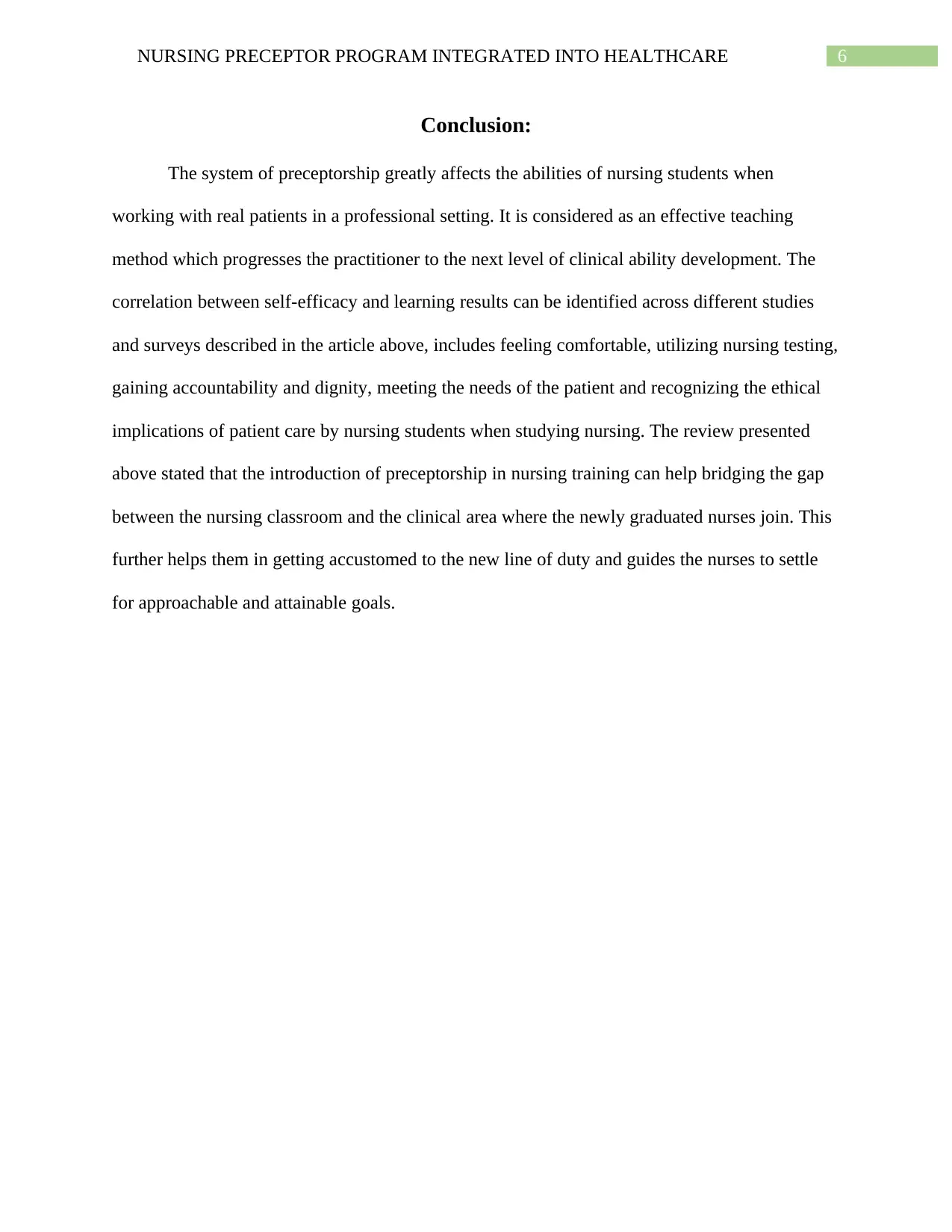
Conclusion:
The system of preceptorship greatly affects the abilities of nursing students when
working with real patients in a professional setting. It is considered as an effective teaching
method which progresses the practitioner to the next level of clinical ability development. The
correlation between self-efficacy and learning results can be identified across different studies
and surveys described in the article above, includes feeling comfortable, utilizing nursing testing,
gaining accountability and dignity, meeting the needs of the patient and recognizing the ethical
implications of patient care by nursing students when studying nursing. The review presented
above stated that the introduction of preceptorship in nursing training can help bridging the gap
between the nursing classroom and the clinical area where the newly graduated nurses join. This
further helps them in getting accustomed to the new line of duty and guides the nurses to settle
for approachable and attainable goals.
Conclusion:
The system of preceptorship greatly affects the abilities of nursing students when
working with real patients in a professional setting. It is considered as an effective teaching
method which progresses the practitioner to the next level of clinical ability development. The
correlation between self-efficacy and learning results can be identified across different studies
and surveys described in the article above, includes feeling comfortable, utilizing nursing testing,
gaining accountability and dignity, meeting the needs of the patient and recognizing the ethical
implications of patient care by nursing students when studying nursing. The review presented
above stated that the introduction of preceptorship in nursing training can help bridging the gap
between the nursing classroom and the clinical area where the newly graduated nurses join. This
further helps them in getting accustomed to the new line of duty and guides the nurses to settle
for approachable and attainable goals.
Paraphrase This Document
Need a fresh take? Get an instant paraphrase of this document with our AI Paraphraser

7NURSING PRECEPTOR PROGRAM INTEGRATED INTO HEALTHCARE
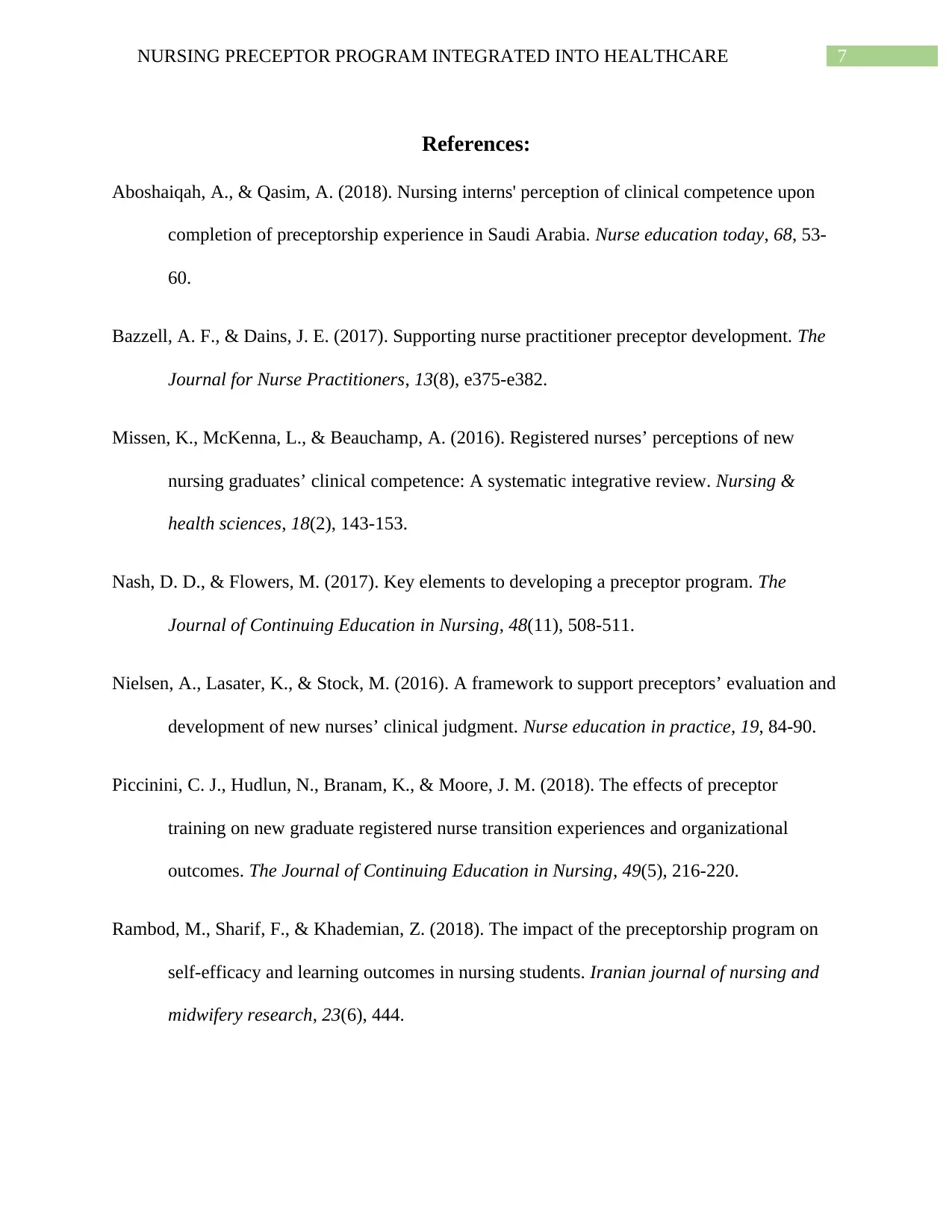
References:
Aboshaiqah, A., & Qasim, A. (2018). Nursing interns' perception of clinical competence upon
completion of preceptorship experience in Saudi Arabia. Nurse education today, 68, 53-
60.
Bazzell, A. F., & Dains, J. E. (2017). Supporting nurse practitioner preceptor development. The
Journal for Nurse Practitioners, 13(8), e375-e382.
Missen, K., McKenna, L., & Beauchamp, A. (2016). Registered nurses’ perceptions of new
nursing graduates’ clinical competence: A systematic integrative review. Nursing &
health sciences, 18(2), 143-153.
Nash, D. D., & Flowers, M. (2017). Key elements to developing a preceptor program. The
Journal of Continuing Education in Nursing, 48(11), 508-511.
Nielsen, A., Lasater, K., & Stock, M. (2016). A framework to support preceptors’ evaluation and
development of new nurses’ clinical judgment. Nurse education in practice, 19, 84-90.
Piccinini, C. J., Hudlun, N., Branam, K., & Moore, J. M. (2018). The effects of preceptor
training on new graduate registered nurse transition experiences and organizational
outcomes. The Journal of Continuing Education in Nursing, 49(5), 216-220.
Rambod, M., Sharif, F., & Khademian, Z. (2018). The impact of the preceptorship program on
self-efficacy and learning outcomes in nursing students. Iranian journal of nursing and
midwifery research, 23(6), 444.
References:
Aboshaiqah, A., & Qasim, A. (2018). Nursing interns' perception of clinical competence upon
completion of preceptorship experience in Saudi Arabia. Nurse education today, 68, 53-
60.
Bazzell, A. F., & Dains, J. E. (2017). Supporting nurse practitioner preceptor development. The
Journal for Nurse Practitioners, 13(8), e375-e382.
Missen, K., McKenna, L., & Beauchamp, A. (2016). Registered nurses’ perceptions of new
nursing graduates’ clinical competence: A systematic integrative review. Nursing &
health sciences, 18(2), 143-153.
Nash, D. D., & Flowers, M. (2017). Key elements to developing a preceptor program. The
Journal of Continuing Education in Nursing, 48(11), 508-511.
Nielsen, A., Lasater, K., & Stock, M. (2016). A framework to support preceptors’ evaluation and
development of new nurses’ clinical judgment. Nurse education in practice, 19, 84-90.
Piccinini, C. J., Hudlun, N., Branam, K., & Moore, J. M. (2018). The effects of preceptor
training on new graduate registered nurse transition experiences and organizational
outcomes. The Journal of Continuing Education in Nursing, 49(5), 216-220.
Rambod, M., Sharif, F., & Khademian, Z. (2018). The impact of the preceptorship program on
self-efficacy and learning outcomes in nursing students. Iranian journal of nursing and
midwifery research, 23(6), 444.

8NURSING PRECEPTOR PROGRAM INTEGRATED INTO HEALTHCARE
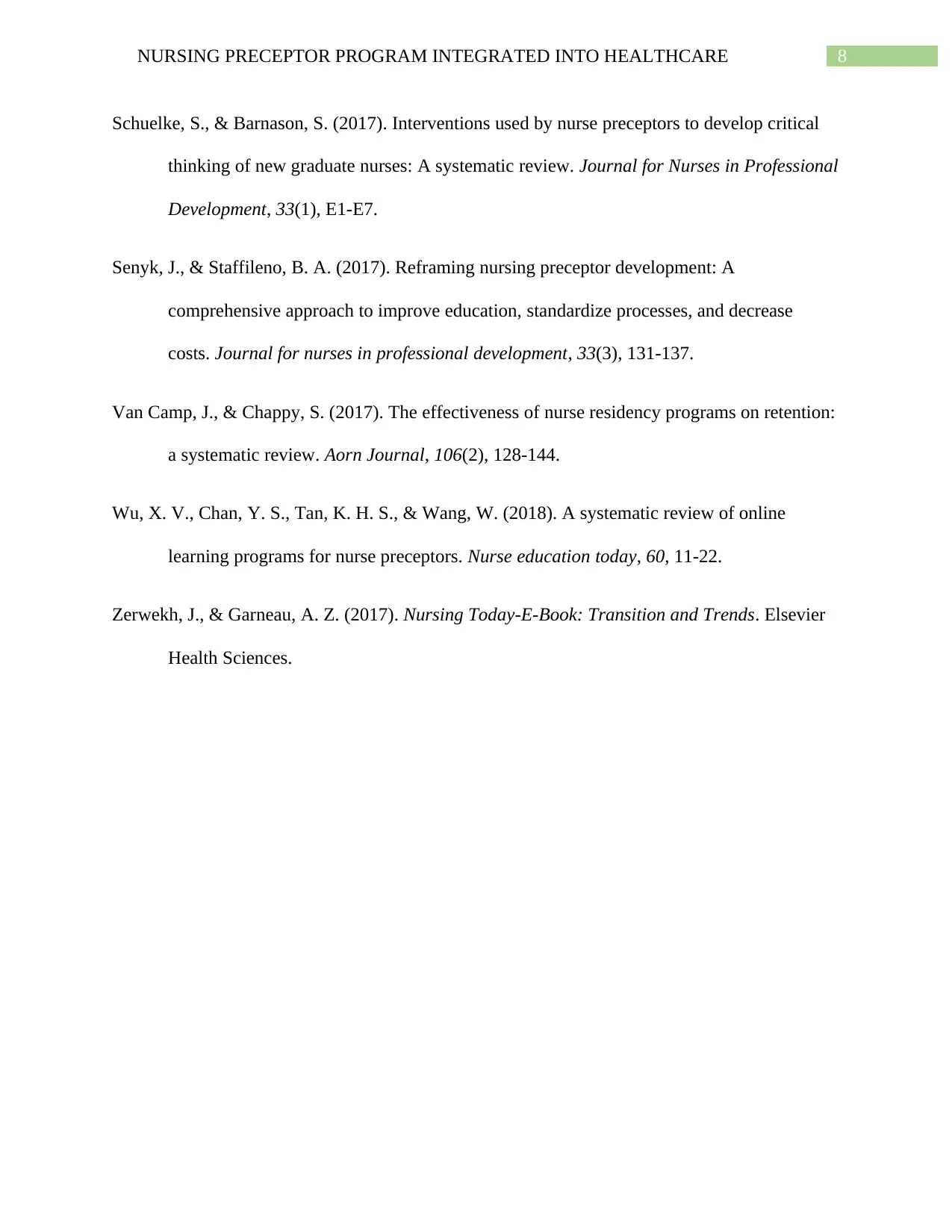
Schuelke, S., & Barnason, S. (2017). Interventions used by nurse preceptors to develop critical
thinking of new graduate nurses: A systematic review. Journal for Nurses in Professional
Development, 33(1), E1-E7.
Senyk, J., & Staffileno, B. A. (2017). Reframing nursing preceptor development: A
comprehensive approach to improve education, standardize processes, and decrease
costs. Journal for nurses in professional development, 33(3), 131-137.
Van Camp, J., & Chappy, S. (2017). The effectiveness of nurse residency programs on retention:
a systematic review. Aorn Journal, 106(2), 128-144.
Wu, X. V., Chan, Y. S., Tan, K. H. S., & Wang, W. (2018). A systematic review of online
learning programs for nurse preceptors. Nurse education today, 60, 11-22.
Zerwekh, J., & Garneau, A. Z. (2017). Nursing Today-E-Book: Transition and Trends. Elsevier
Health Sciences.
Schuelke, S., & Barnason, S. (2017). Interventions used by nurse preceptors to develop critical
thinking of new graduate nurses: A systematic review. Journal for Nurses in Professional
Development, 33(1), E1-E7.
Senyk, J., & Staffileno, B. A. (2017). Reframing nursing preceptor development: A
comprehensive approach to improve education, standardize processes, and decrease
costs. Journal for nurses in professional development, 33(3), 131-137.
Van Camp, J., & Chappy, S. (2017). The effectiveness of nurse residency programs on retention:
a systematic review. Aorn Journal, 106(2), 128-144.
Wu, X. V., Chan, Y. S., Tan, K. H. S., & Wang, W. (2018). A systematic review of online
learning programs for nurse preceptors. Nurse education today, 60, 11-22.
Zerwekh, J., & Garneau, A. Z. (2017). Nursing Today-E-Book: Transition and Trends. Elsevier
Health Sciences.
⊘ This is a preview!⊘
Do you want full access?
Subscribe today to unlock all pages.

Trusted by 1+ million students worldwide
1 out of 9
Related Documents
Your All-in-One AI-Powered Toolkit for Academic Success.
+13062052269
info@desklib.com
Available 24*7 on WhatsApp / Email
Unlock your academic potential
Copyright © 2020–2025 A2Z Services. All Rights Reserved. Developed and managed by ZUCOL.