Nursing as a Profession: Standards, Ethics, and Practice

Verified

Added on  2023/01/10

|5
|1089
|98
Essay
AI Summary
This essay delves into the characteristics that qualify nursing as a profession, emphasizing the required training and formal qualifications. It examines how nursing empowers practitioners with skills acquired through higher education, allowing them to serve individuals and the nation based on established standards. The essay highlights the educational system, registration processes, and examinations that nurses must pass to be considered competent. It also explores the common values, ethics, and code of conduct within the nursing profession, including the importance of care, compassion, and respect for patients. The conclusion reinforces that nursing meets all the criteria of a profession, from education and ethical guidelines to the freedom to practice and serve. This essay provides a comprehensive overview of nursing's professional standards, ethical practices, and practical applications within the healthcare system.
Document Page
Running Head: NURSING AS A PROFESSION 1
Student Name:
Professor:
Course:
Date:
tabler-icon-diamond-filled.svg

Paraphrase This Document

Need a fresh take? Get an instant paraphrase of this document with our AI Paraphraser
Document Page
Running Head: NURSING AS A PROFESSION 2
Nursing as a Profession
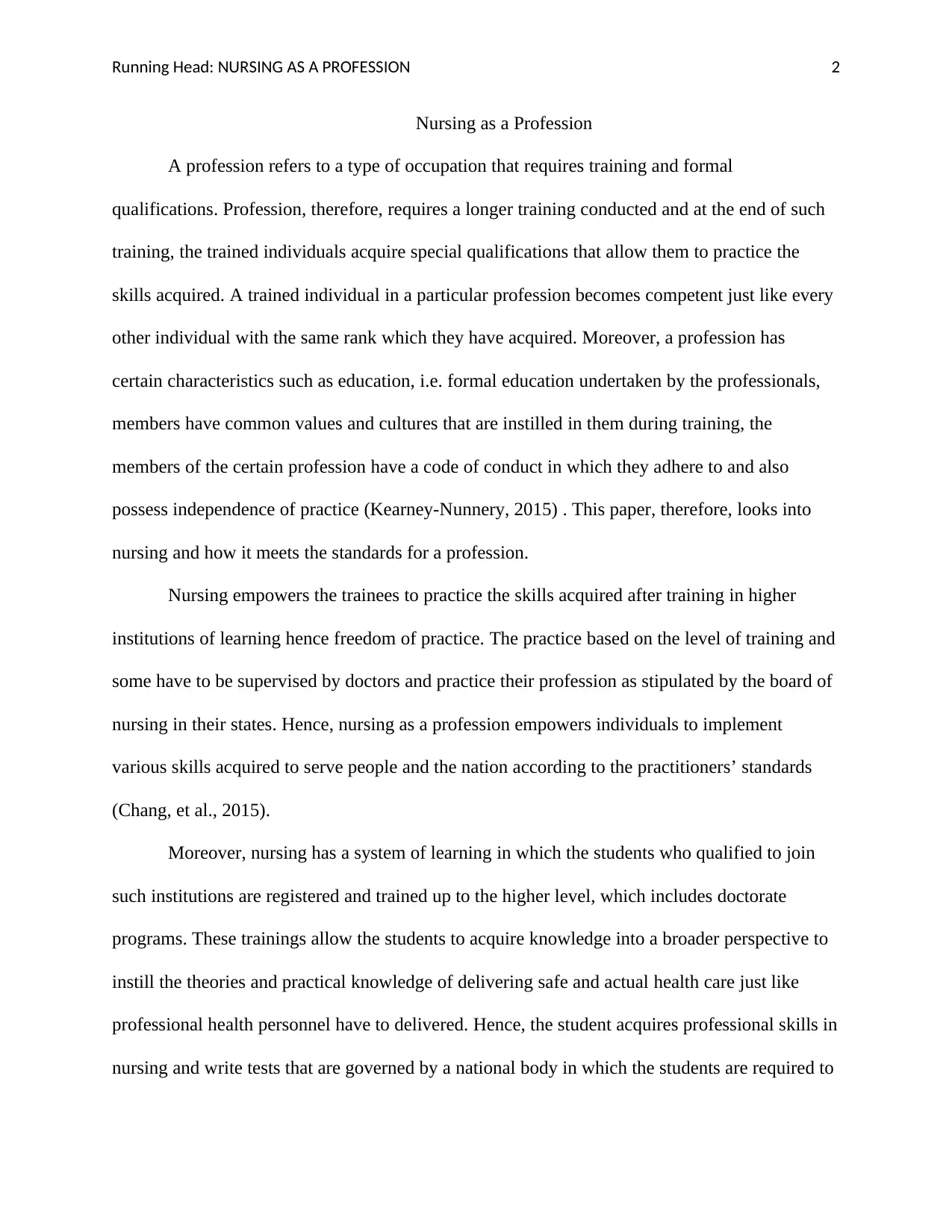
A profession refers to a type of occupation that requires training and formal
qualifications. Profession, therefore, requires a longer training conducted and at the end of such
training, the trained individuals acquire special qualifications that allow them to practice the
skills acquired. A trained individual in a particular profession becomes competent just like every
other individual with the same rank which they have acquired. Moreover, a profession has
certain characteristics such as education, i.e. formal education undertaken by the professionals,
members have common values and cultures that are instilled in them during training, the
members of the certain profession have a code of conduct in which they adhere to and also
possess independence of practice (Kearney-Nunnery, 2015) . This paper, therefore, looks into
nursing and how it meets the standards for a profession.
Nursing empowers the trainees to practice the skills acquired after training in higher
institutions of learning hence freedom of practice. The practice based on the level of training and
some have to be supervised by doctors and practice their profession as stipulated by the board of
nursing in their states. Hence, nursing as a profession empowers individuals to implement
various skills acquired to serve people and the nation according to the practitioners’ standards
(Chang, et al., 2015).
Moreover, nursing has a system of learning in which the students who qualified to join
such institutions are registered and trained up to the higher level, which includes doctorate
programs. These trainings allow the students to acquire knowledge into a broader perspective to
instill the theories and practical knowledge of delivering safe and actual health care just like
professional health personnel have to delivered. Hence, the student acquires professional skills in
nursing and write tests that are governed by a national body in which the students are required to
Document Page
Running Head: NURSING AS A PROFESSION 3
pass such exams to be considered worthy of completing their nursing education program
successfully before embarking on the field to practice the skills learnt (Laplante & Ostendorf,
2017) . If an individual fail to meet the required grades in such exams, then they are denied the
chance to practice nursing in any health institution hence a profession standard must be attained
to be offered the mandate to practice.
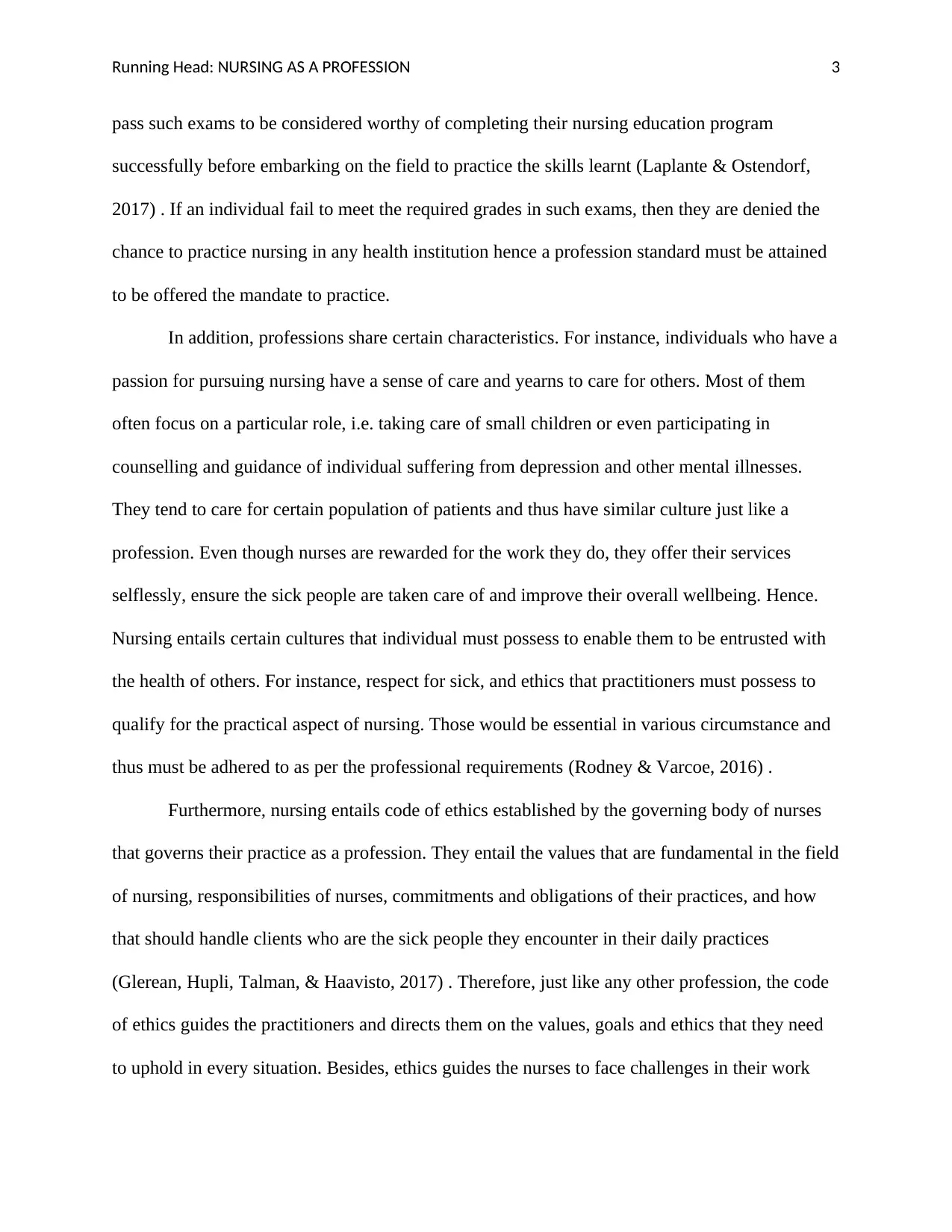
In addition, professions share certain characteristics. For instance, individuals who have a
passion for pursuing nursing have a sense of care and yearns to care for others. Most of them
often focus on a particular role, i.e. taking care of small children or even participating in
counselling and guidance of individual suffering from depression and other mental illnesses.
They tend to care for certain population of patients and thus have similar culture just like a
profession. Even though nurses are rewarded for the work they do, they offer their services
selflessly, ensure the sick people are taken care of and improve their overall wellbeing. Hence.
Nursing entails certain cultures that individual must possess to enable them to be entrusted with
the health of others. For instance, respect for sick, and ethics that practitioners must possess to
qualify for the practical aspect of nursing. Those would be essential in various circumstance and
thus must be adhered to as per the professional requirements (Rodney & Varcoe, 2016) .
Furthermore, nursing entails code of ethics established by the governing body of nurses
that governs their practice as a profession. They entail the values that are fundamental in the field
of nursing, responsibilities of nurses, commitments and obligations of their practices, and how
that should handle clients who are the sick people they encounter in their daily practices
(Glerean, Hupli, Talman, & Haavisto, 2017) . Therefore, just like any other profession, the code
of ethics guides the practitioners and directs them on the values, goals and ethics that they need
to uphold in every situation. Besides, ethics guides the nurses to face challenges in their work
Document Page
Running Head: NURSING AS A PROFESSION 4
and the entire patient population that seems to be complicated. Moreover, any nurse who goes
against the code of ethics is held responsible for their actions and thus, ethics assists in ensuring
safety for the patients (Alghamdi & Urden, 2016) .
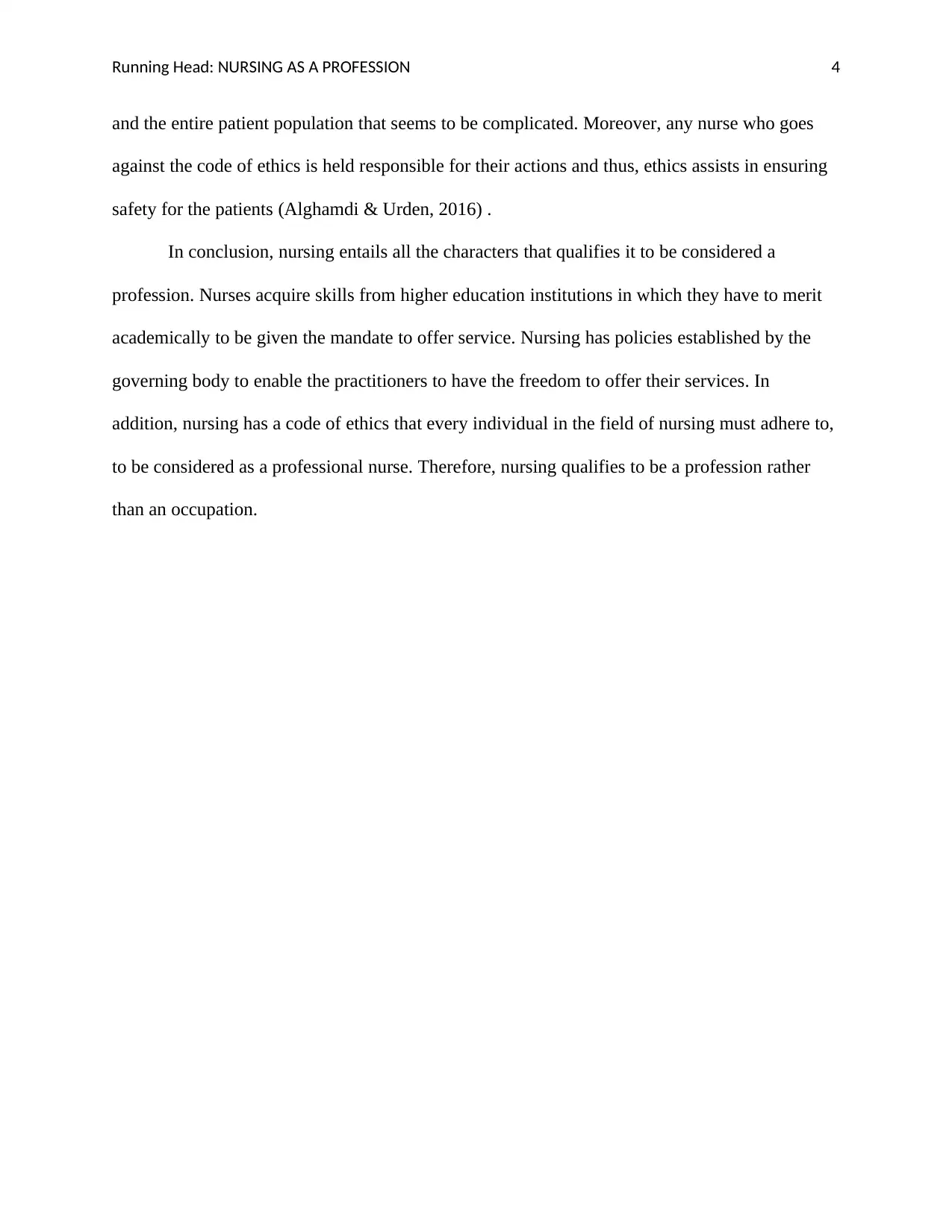
In conclusion, nursing entails all the characters that qualifies it to be considered a
profession. Nurses acquire skills from higher education institutions in which they have to merit
academically to be given the mandate to offer service. Nursing has policies established by the
governing body to enable the practitioners to have the freedom to offer their services. In
addition, nursing has a code of ethics that every individual in the field of nursing must adhere to,
to be considered as a professional nurse. Therefore, nursing qualifies to be a profession rather
than an occupation.
tabler-icon-diamond-filled.svg

Paraphrase This Document

Need a fresh take? Get an instant paraphrase of this document with our AI Paraphraser
Document Page
Running Head: NURSING AS A PROFESSION 5
References
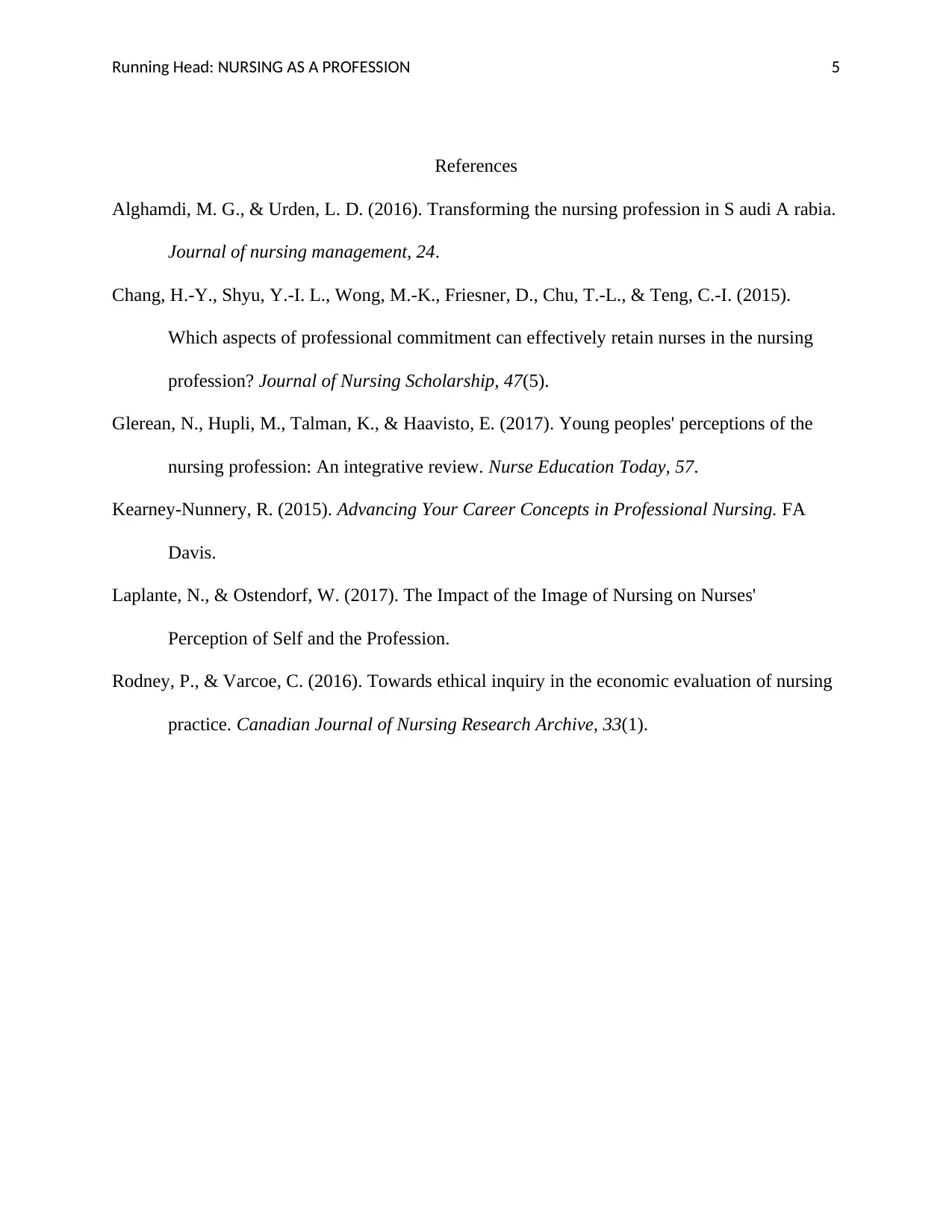
Alghamdi, M. G., & Urden, L. D. (2016). Transforming the nursing profession in S audi A rabia.
Journal of nursing management, 24.
Chang, H.-Y., Shyu, Y.-I. L., Wong, M.-K., Friesner, D., Chu, T.-L., & Teng, C.-I. (2015).
Which aspects of professional commitment can effectively retain nurses in the nursing
profession? Journal of Nursing Scholarship, 47(5).
Glerean, N., Hupli, M., Talman, K., & Haavisto, E. (2017). Young peoples' perceptions of the
nursing profession: An integrative review. Nurse Education Today, 57.
Kearney-Nunnery, R. (2015). Advancing Your Career Concepts in Professional Nursing. FA
Davis.
Laplante, N., & Ostendorf, W. (2017). The Impact of the Image of Nursing on Nurses'
Perception of Self and the Profession.
Rodney, P., & Varcoe, C. (2016). Towards ethical inquiry in the economic evaluation of nursing
practice. Canadian Journal of Nursing Research Archive, 33(1).
chevron_up_icon
1 out of 5
circle_padding
hide_on_mobile
zoom_out_icon
[object Object]