Nursing Oral Presentation: Charlie Mullagh Communication Analysis

Verified

Added on  2023/06/04

|5
|1216
|163
Presentation
AI Summary
This oral presentation analyzes a nursing progress note focusing on the communication strategies employed by a nurse in the care of Charlie Mullagh, an elderly Aboriginal patient transitioning to an aged care facility. The presentation examines the effectiveness of verbal and nonverbal communication in conveying the patient's condition, particularly considering the grief and loss associated with the patient's situation. The presenter identifies the strengths and weaknesses of the communication methods used in the progress notes, focusing on the integration of the grief and loss framework. The presentation highlights the importance of both verbal and nonverbal cues in assessing the patient's well-being and advocates for a more comprehensive approach to communication in nursing practice, emphasizing the need to consider nonverbal aspects like body language, tone of voice, and speech patterns to gain a deeper understanding of the patient's emotional state. The presentation concludes with a reflection on the learning experience and the potential to apply the knowledge gained in future practice, particularly in identifying the needs of elderly patients experiencing grief and loss.
Document Page
Running head: ORAL TRANSCRIPT
Oral transcript
Name of the student:
Name of the university:
Author note:
tabler-icon-diamond-filled.svg

Paraphrase This Document

Need a fresh take? Get an instant paraphrase of this document with our AI Paraphraser
Document Page
1
ORAL TRANSCRIPT
Introduction slide:
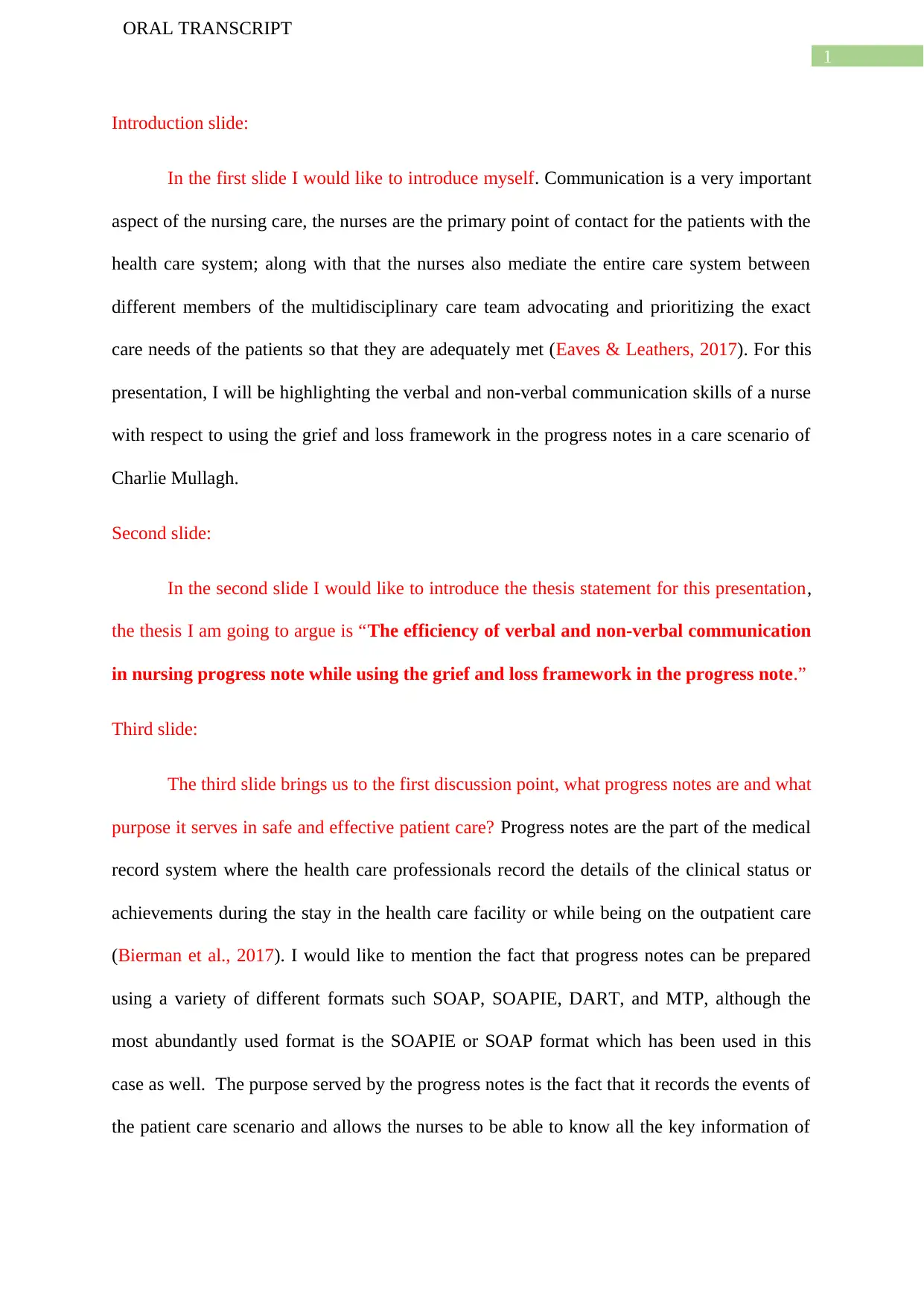
In the first slide I would like to introduce myself. Communication is a very important
aspect of the nursing care, the nurses are the primary point of contact for the patients with the
health care system; along with that the nurses also mediate the entire care system between
different members of the multidisciplinary care team advocating and prioritizing the exact
care needs of the patients so that they are adequately met (Eaves & Leathers, 2017). For this
presentation, I will be highlighting the verbal and non-verbal communication skills of a nurse
with respect to using the grief and loss framework in the progress notes in a care scenario of
Charlie Mullagh.
Second slide:
In the second slide I would like to introduce the thesis statement for this presentation,
the thesis I am going to argue is “The efficiency of verbal and non-verbal communication
in nursing progress note while using the grief and loss framework in the progress note.”
Third slide:
The third slide brings us to the first discussion point, what progress notes are and what
purpose it serves in safe and effective patient care? Progress notes are the part of the medical
record system where the health care professionals record the details of the clinical status or
achievements during the stay in the health care facility or while being on the outpatient care
(Bierman et al., 2017). I would like to mention the fact that progress notes can be prepared
using a variety of different formats such SOAP, SOAPIE, DART, and MTP, although the
most abundantly used format is the SOAPIE or SOAP format which has been used in this
case as well. The purpose served by the progress notes is the fact that it records the events of
the patient care scenario and allows the nurses to be able to know all the key information of
Document Page
2
ORAL TRANSCRIPT
the patient beforehand that accelerates care intervention planning and implementation along
with eliminating the probability of errors (Barnlund, 2017).
Fourth slide:
Next slide will help me illustrate the care scenario of Charlie who is a 72 year old
aboriginal who was about to transition to the aged care facility as a resident as his town had
been evacuated. The grief and loss associated with being evacuated from a town that he had
been living in from birth is a huge burden on the psyche of the elderly patients. Grief and loss
is a very common aspect of care on the aged care scenarios and hence, it is very important for
the aspects of grief and loss to be sensitively included in the care approach taken for such
patients and the grief and loss communication framework allows the health care professionals
to be able to address the aspects of grief and loss effectively in the care planning (Kourkouta
& Papathanasiou, 2014).
Fifth slide:
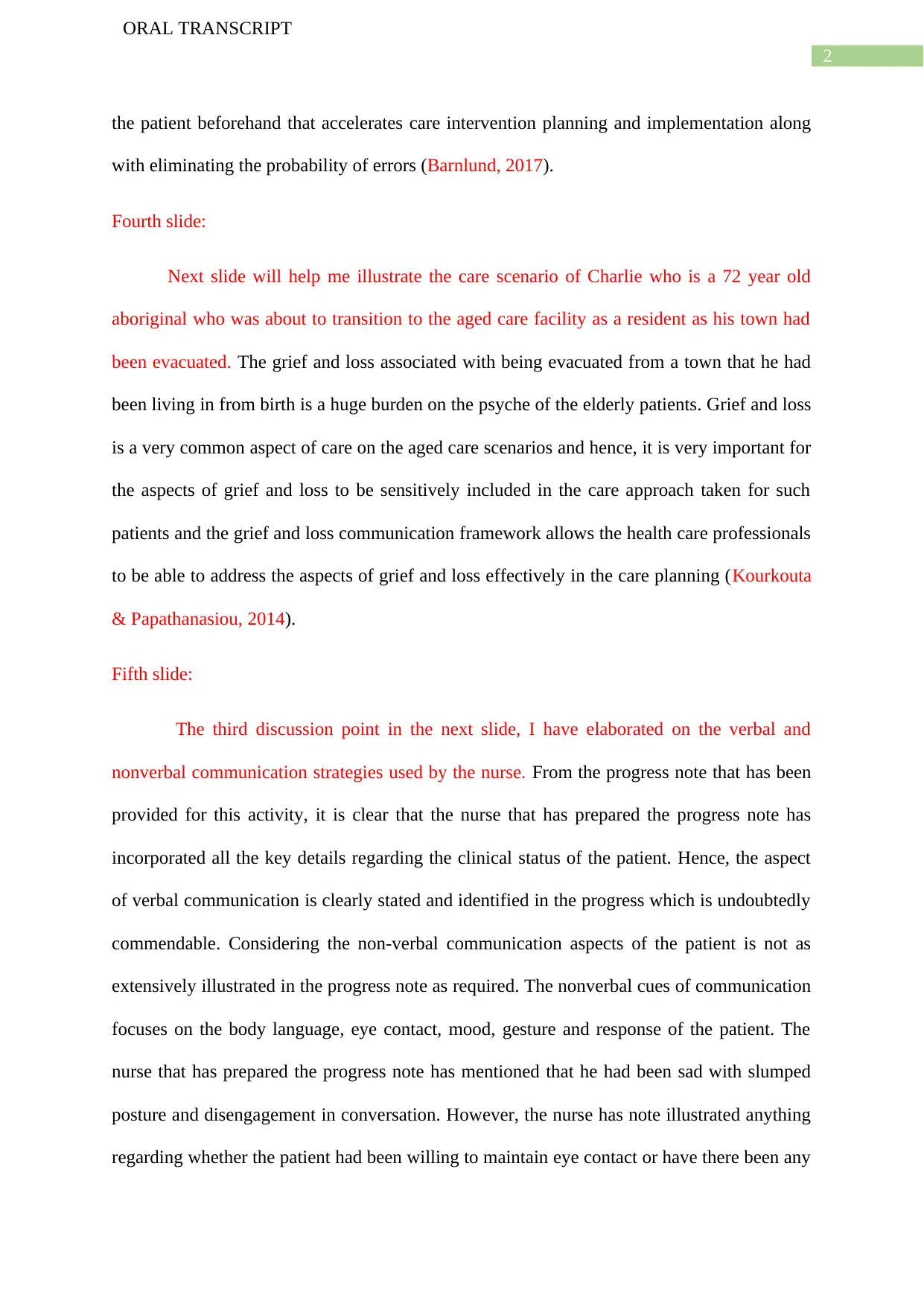
The third discussion point in the next slide, I have elaborated on the verbal and
nonverbal communication strategies used by the nurse. From the progress note that has been
provided for this activity, it is clear that the nurse that has prepared the progress note has
incorporated all the key details regarding the clinical status of the patient. Hence, the aspect
of verbal communication is clearly stated and identified in the progress which is undoubtedly
commendable. Considering the non-verbal communication aspects of the patient is not as
extensively illustrated in the progress note as required. The nonverbal cues of communication
focuses on the body language, eye contact, mood, gesture and response of the patient. The
nurse that has prepared the progress note has mentioned that he had been sad with slumped
posture and disengagement in conversation. However, the nurse has note illustrated anything
regarding whether the patient had been willing to maintain eye contact or have there been any
Document Page
3
ORAL TRANSCRIPT
considerable gestures that indicated the present mood of the patient as well (Walter &
McCoyd, 2015).
Sixth slide:
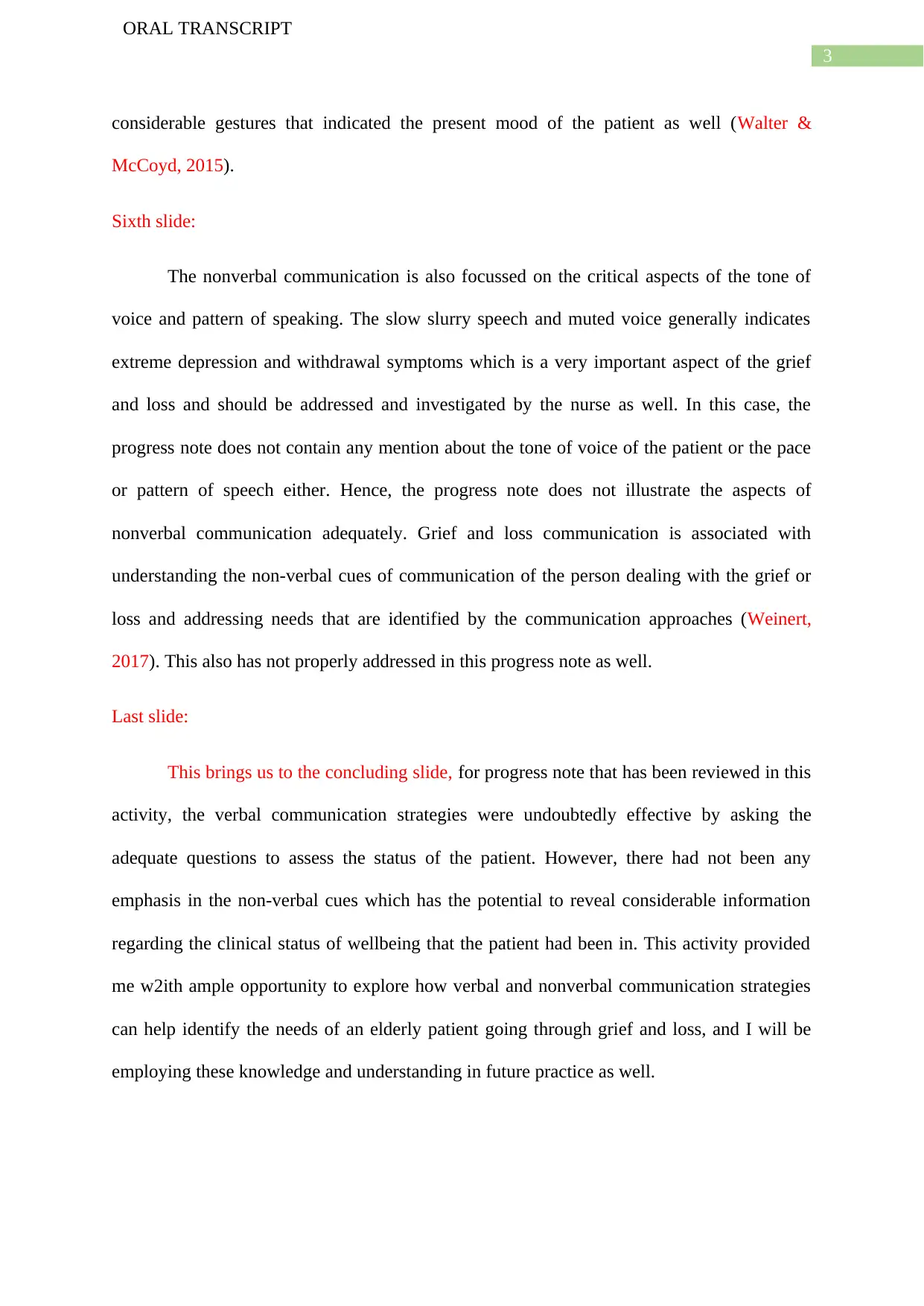
The nonverbal communication is also focussed on the critical aspects of the tone of
voice and pattern of speaking. The slow slurry speech and muted voice generally indicates
extreme depression and withdrawal symptoms which is a very important aspect of the grief
and loss and should be addressed and investigated by the nurse as well. In this case, the
progress note does not contain any mention about the tone of voice of the patient or the pace
or pattern of speech either. Hence, the progress note does not illustrate the aspects of
nonverbal communication adequately. Grief and loss communication is associated with
understanding the non-verbal cues of communication of the person dealing with the grief or
loss and addressing needs that are identified by the communication approaches (Weinert,
2017). This also has not properly addressed in this progress note as well.
Last slide:
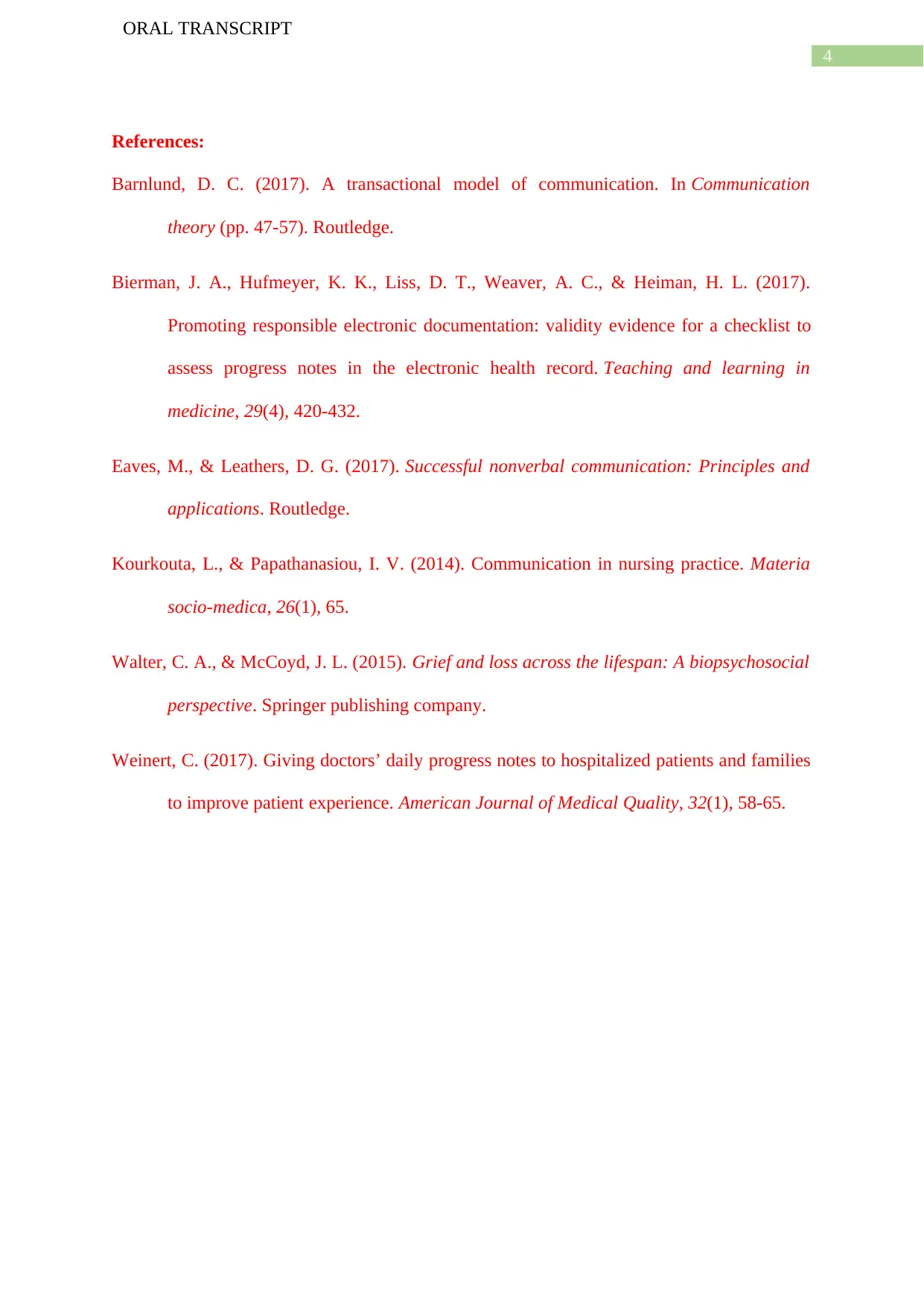
This brings us to the concluding slide, for progress note that has been reviewed in this
activity, the verbal communication strategies were undoubtedly effective by asking the
adequate questions to assess the status of the patient. However, there had not been any
emphasis in the non-verbal cues which has the potential to reveal considerable information
regarding the clinical status of wellbeing that the patient had been in. This activity provided
me w2ith ample opportunity to explore how verbal and nonverbal communication strategies
can help identify the needs of an elderly patient going through grief and loss, and I will be
employing these knowledge and understanding in future practice as well.
tabler-icon-diamond-filled.svg

Paraphrase This Document

Need a fresh take? Get an instant paraphrase of this document with our AI Paraphraser
Document Page
4
ORAL TRANSCRIPT
References:
Barnlund, D. C. (2017). A transactional model of communication. In Communication
theory (pp. 47-57). Routledge.
Bierman, J. A., Hufmeyer, K. K., Liss, D. T., Weaver, A. C., & Heiman, H. L. (2017).
Promoting responsible electronic documentation: validity evidence for a checklist to
assess progress notes in the electronic health record. Teaching and learning in
medicine, 29(4), 420-432.
Eaves, M., & Leathers, D. G. (2017). Successful nonverbal communication: Principles and
applications. Routledge.
Kourkouta, L., & Papathanasiou, I. V. (2014). Communication in nursing practice. Materia
socio-medica, 26(1), 65.
Walter, C. A., & McCoyd, J. L. (2015). Grief and loss across the lifespan: A biopsychosocial
perspective. Springer publishing company.
Weinert, C. (2017). Giving doctors’ daily progress notes to hospitalized patients and families
to improve patient experience. American Journal of Medical Quality, 32(1), 58-65.
chevron_up_icon
1 out of 5
circle_padding
hide_on_mobile
zoom_out_icon
[object Object]