Nursing Research: Economic Evaluation of Healthcare Methods

Verified

Added on  2020/04/21

|3
|361
|116
Report
AI Summary
This report explores the intersection of nursing research and healthcare economics, emphasizing the importance of research methods in evaluating the economic impact of healthcare practices. It highlights how both qualitative and quantitative research methods contribute to understanding cost-effectiveness and informing decisions. The report underscores the significance of economic evidence in nursing, emphasizing the need for skilled practitioners who can assess and manage costs to improve patient care. It references the influence of research on healthcare delivery, encouraging the application of research findings to enhance the quality of services. Ultimately, this report advocates for the value of grading research to ensure economic accountability and facilitate progressive advancements in healthcare.

Document Page
Running Head: NURSING RESEARCH 1
Nursing Research
Name
Institution
tabler-icon-diamond-filled.svg

Paraphrase This Document

Need a fresh take? Get an instant paraphrase of this document with our AI Paraphraser
Document Page
NURSING RESEARCH 2
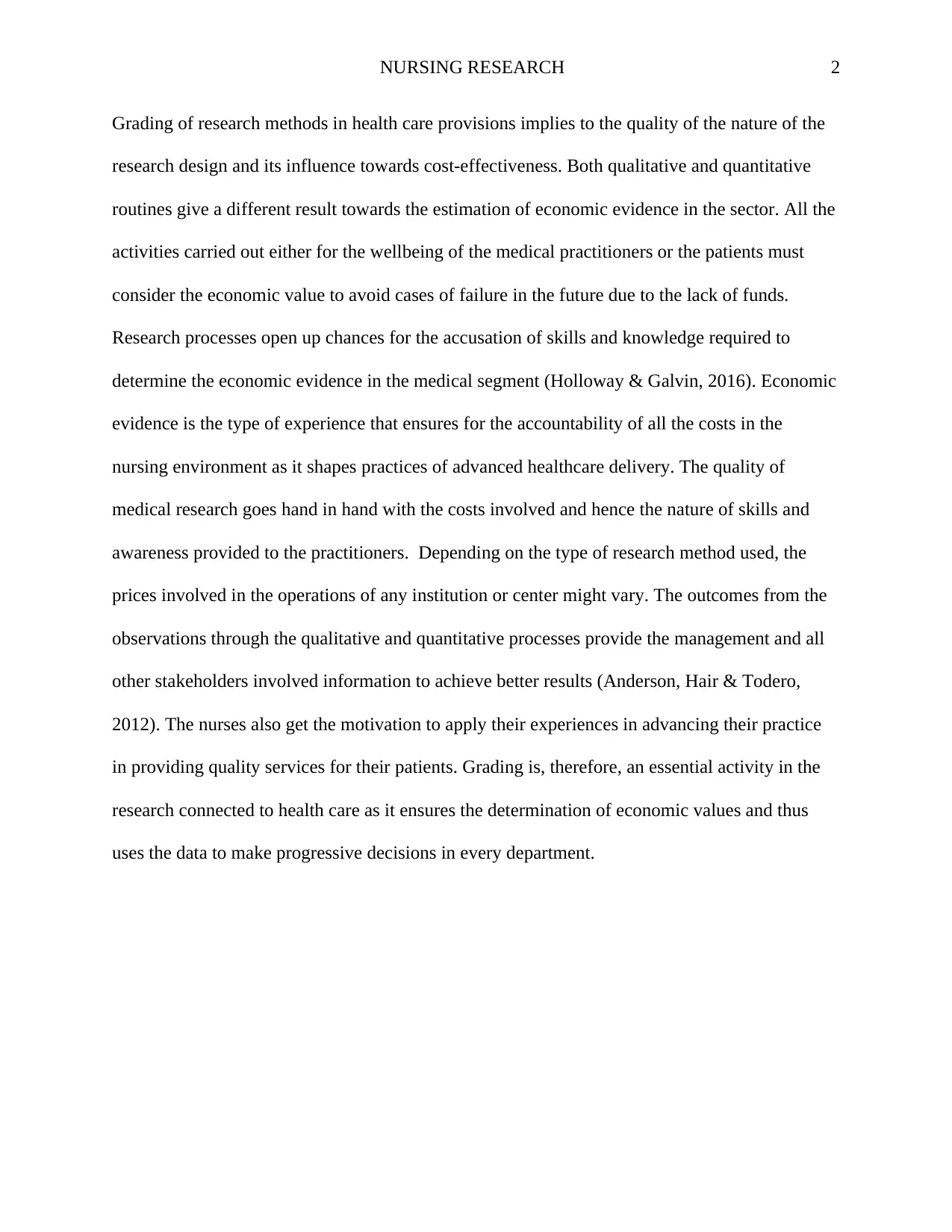
Grading of research methods in health care provisions implies to the quality of the nature of the
research design and its influence towards cost-effectiveness. Both qualitative and quantitative
routines give a different result towards the estimation of economic evidence in the sector. All the
activities carried out either for the wellbeing of the medical practitioners or the patients must
consider the economic value to avoid cases of failure in the future due to the lack of funds.
Research processes open up chances for the accusation of skills and knowledge required to
determine the economic evidence in the medical segment (Holloway & Galvin, 2016). Economic
evidence is the type of experience that ensures for the accountability of all the costs in the
nursing environment as it shapes practices of advanced healthcare delivery. The quality of
medical research goes hand in hand with the costs involved and hence the nature of skills and
awareness provided to the practitioners. Depending on the type of research method used, the
prices involved in the operations of any institution or center might vary. The outcomes from the
observations through the qualitative and quantitative processes provide the management and all
other stakeholders involved information to achieve better results (Anderson, Hair & Todero,
2012). The nurses also get the motivation to apply their experiences in advancing their practice
in providing quality services for their patients. Grading is, therefore, an essential activity in the
research connected to health care as it ensures the determination of economic values and thus
uses the data to make progressive decisions in every department.
Document Page
NURSING RESEARCH 3
References
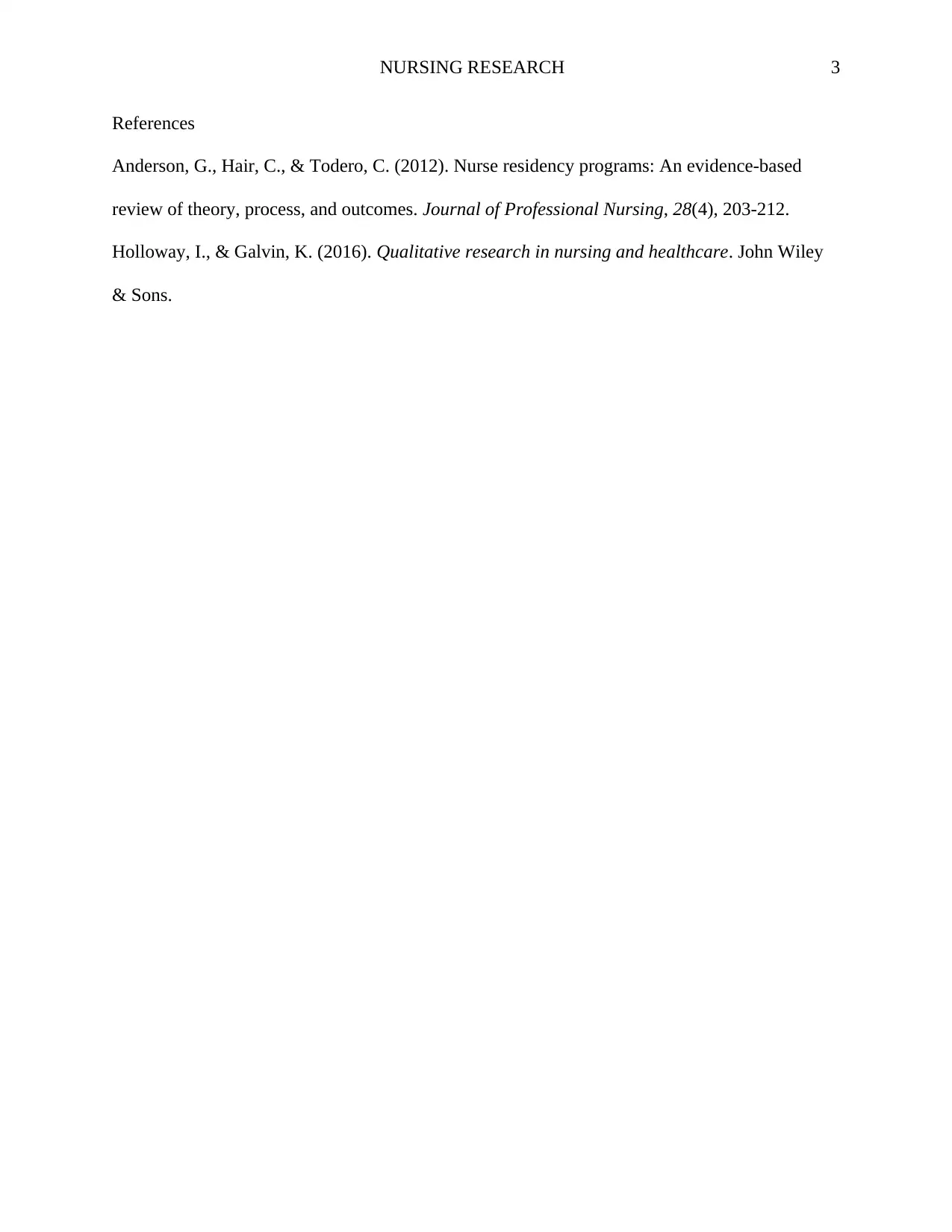
Anderson, G., Hair, C., & Todero, C. (2012). Nurse residency programs: An evidence-based
review of theory, process, and outcomes. Journal of Professional Nursing, 28(4), 203-212.
Holloway, I., & Galvin, K. (2016). Qualitative research in nursing and healthcare. John Wiley
& Sons.
chevron_up_icon
1 out of 3
circle_padding
hide_on_mobile
zoom_out_icon
[object Object]