Nursing Research Project: Capella University, Nursing Research, Part 1
VerifiedAdded on 2023/06/09
|9
|2381
|164
Project
AI Summary
This nursing research project delves into the effectiveness of high-fidelity simulation in developing non-technical skills among nursing students. The project begins with a problem statement, outlining the need for improved health promotion and quality of life through enhanced nursing practices. The target population includes nursing students at Capella University, along with professional nurses and educators, all within a healthcare setting in Minnesota. The intervention focuses on communication, teamwork, and training as crucial elements in fostering non-technical skills. The project then compares these approaches, highlighting the benefits of effective communication, teamwork, and comprehensive training programs. The initial outcome draft suggests that high-fidelity simulation programs can positively influence the development of non-technical skills. The project also includes a detailed literature review, analyzing current evidence on simulation use, evaluating resources, and synthesizing findings. The analysis considers the development of non-technical skills like communication, leadership, and teamwork, and the role of simulations in improving interpersonal skills and decision-making. The project examines the implications of simulation in nursing education, including the incorporation of physiological responses and the strengthening of educational strategies to improve student learning outcomes. The project concludes with references from various scholarly sources.
Nursing Research Project
Paraphrase This Document
Need a fresh take? Get an instant paraphrase of this document with our AI Paraphraser

Table of Contents
Part 1: Problem Statement.....................................................................................................................2
Need Statement..................................................................................................................................2
Population and Setting.......................................................................................................................2
Intervention Overview.......................................................................................................................2
Comparison of Approaches...............................................................................................................3
Initial Outcome Draft.........................................................................................................................3
Time Estimate....................................................................................................................................3
Part 2: Literature Review.......................................................................................................................4
Analysis of Current Evidence............................................................................................................4
Evaluation and Synthesis of Resources.............................................................................................5
References.............................................................................................................................................6
1 | P a g e
Part 1: Problem Statement.....................................................................................................................2
Need Statement..................................................................................................................................2
Population and Setting.......................................................................................................................2
Intervention Overview.......................................................................................................................2
Comparison of Approaches...............................................................................................................3
Initial Outcome Draft.........................................................................................................................3
Time Estimate....................................................................................................................................3
Part 2: Literature Review.......................................................................................................................4
Analysis of Current Evidence............................................................................................................4
Evaluation and Synthesis of Resources.............................................................................................5
References.............................................................................................................................................6
1 | P a g e

Part 1: Problem Statement
Need Statement
The importance of health promotion is increasingly growing within the different societies
across the globe. The health promotion helps in improving the quality of life of the
population in the communities. The high fidelity simulation method is currently used in the
nursing practice to develop non-technical skills of the nurses. It is important to examine the
health promotion activities and their effectiveness and recognize the process by which
prevention can be established effectively to improve the quality of life. The education of the
population about the health promotion is important with the effective management plan
(Ackermann, Kenny & Walker, 2007).
Population and Setting
The population is an important aspect of the research work and according to the need of the
research issues, the target population uses to be selected. For this particular research, the
population of nursing students is considered, who is studying at the Capella University of
Minnesota. These populations are targeted because they are learning to use the high fidelity
simulation method in the nursing practice. Moreover, it supports than in developing their
non-technical skills in nursing practices. Apart from the nursing students, the professional
nurses and the nursing teachers are also considered for the research in order to understand,
whether the high fidelity simulation method in the most effective method for the development
of non-technical skills in nursing. In the healthcare setting at Minnesota, the target population
for the study will be organized (Anderson, Linden, Allen & Gibbs, 2009).
Intervention Overview
There are various intervention programs can be used to develop the critical thinking
capabilities of the nursing students. The communication, teamwork, and training are the most
crucial intervention programs that help in importing the non-technical skills of the nursing
students. The communication is considered as the most effective factor that supports in
developing the skills of high fidelity simulation method of the student of nursing practice.
The teamwork is also an important intervention as it supports in developing the high fidelity
simulation technique among the nursing students (Bligh & Bleakley, 2006). The training
supports the students in developing high fidelity simulation skills that support them in their
nursing practice.
2 | P a g e
Need Statement
The importance of health promotion is increasingly growing within the different societies
across the globe. The health promotion helps in improving the quality of life of the
population in the communities. The high fidelity simulation method is currently used in the
nursing practice to develop non-technical skills of the nurses. It is important to examine the
health promotion activities and their effectiveness and recognize the process by which
prevention can be established effectively to improve the quality of life. The education of the
population about the health promotion is important with the effective management plan
(Ackermann, Kenny & Walker, 2007).
Population and Setting
The population is an important aspect of the research work and according to the need of the
research issues, the target population uses to be selected. For this particular research, the
population of nursing students is considered, who is studying at the Capella University of
Minnesota. These populations are targeted because they are learning to use the high fidelity
simulation method in the nursing practice. Moreover, it supports than in developing their
non-technical skills in nursing practices. Apart from the nursing students, the professional
nurses and the nursing teachers are also considered for the research in order to understand,
whether the high fidelity simulation method in the most effective method for the development
of non-technical skills in nursing. In the healthcare setting at Minnesota, the target population
for the study will be organized (Anderson, Linden, Allen & Gibbs, 2009).
Intervention Overview
There are various intervention programs can be used to develop the critical thinking
capabilities of the nursing students. The communication, teamwork, and training are the most
crucial intervention programs that help in importing the non-technical skills of the nursing
students. The communication is considered as the most effective factor that supports in
developing the skills of high fidelity simulation method of the student of nursing practice.
The teamwork is also an important intervention as it supports in developing the high fidelity
simulation technique among the nursing students (Bligh & Bleakley, 2006). The training
supports the students in developing high fidelity simulation skills that support them in their
nursing practice.
2 | P a g e
⊘ This is a preview!⊘
Do you want full access?
Subscribe today to unlock all pages.

Trusted by 1+ million students worldwide

Comparison of Approaches
The communication is effective as it helps in transmitting the knowledge and acumens among
the students of nursing. The teachers, as well as the professional nurses, can also be able to
deliver effective knowledge to the nursing students by effective means of communication.
The teamwork is also an effective means of developing the high fidelity simulation technique
among the students of nursing practices. The teamwork helps the nursing students in working
in the team within the team dynamics that support them in improving the technical as well as
non-technical skills. The team members help the students in improving their high fidelity
simulation techniques (Boss, Hutton, Donohue & Arnold, 2009).
The training is also significant for the nursing students as with effective training programs
supports the students in understanding the high fidelity simulation techniques and acquiring
the knowledge and skills regarding high fidelity simulation technique.
Initial Outcome Draft
The high fidelity simulation programs have a significant impact on the development of the
non-technical skills in the nursing students. It is depicted to be generating the negative
physiological signs. In addition to this, the simulation is depicted to be requiring an
environment which is depicted to be reflecting the psychological fidelity. It is also reflected
the degree to which the trainee is perceiving the simulation which is unbelievable in nature.
The nursing students may not take it serious since the mistakes are not present on the real
consequences of the patient safety. These are the initial outcomes draft as determined in this
study,
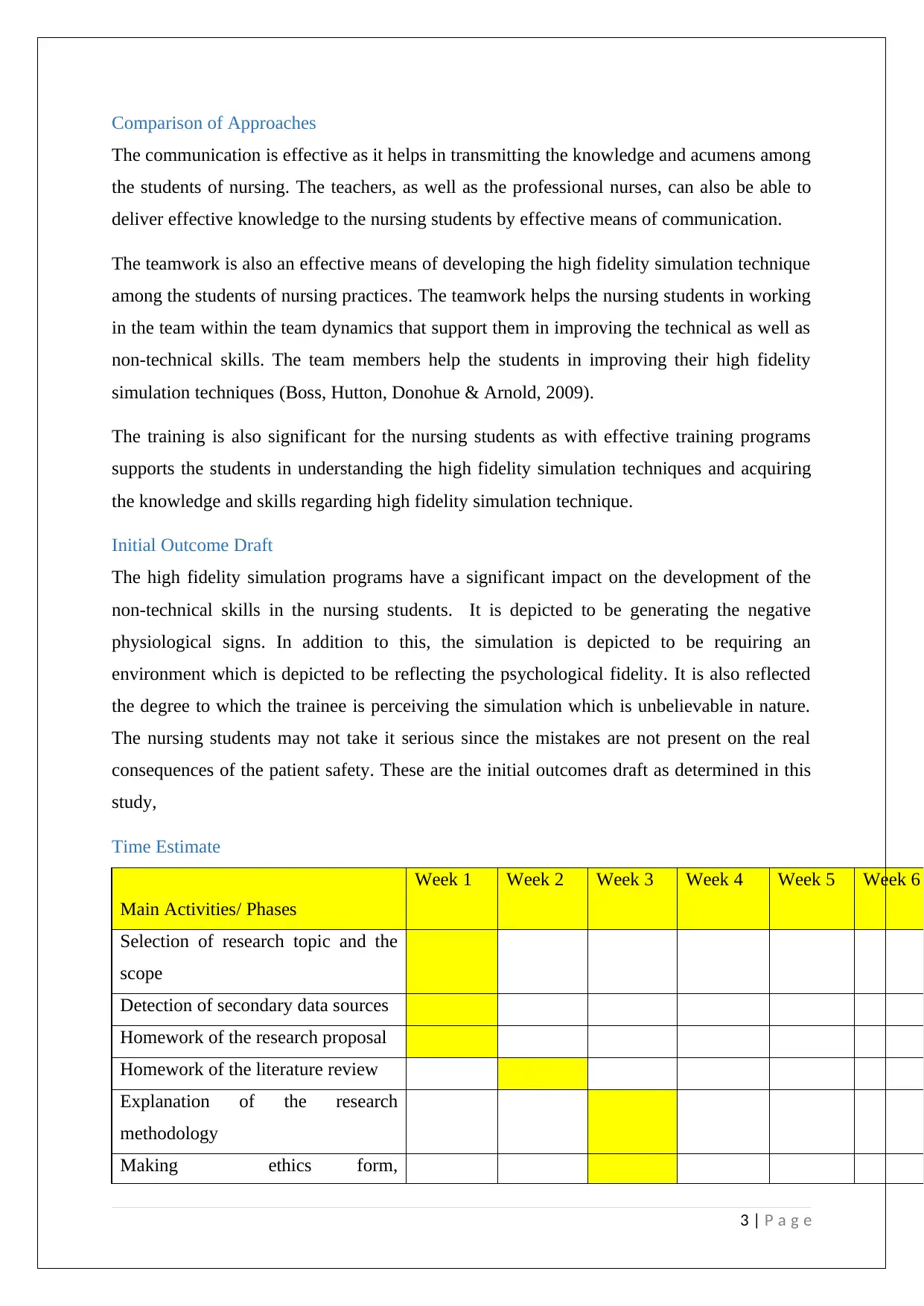
Time Estimate
Main Activities/ Phases
Week 1 Week 2 Week 3 Week 4 Week 5 Week 6
Selection of research topic and the
scope
Detection of secondary data sources
Homework of the research proposal
Homework of the literature review
Explanation of the research
methodology
Making ethics form,
3 | P a g e
The communication is effective as it helps in transmitting the knowledge and acumens among
the students of nursing. The teachers, as well as the professional nurses, can also be able to
deliver effective knowledge to the nursing students by effective means of communication.
The teamwork is also an effective means of developing the high fidelity simulation technique
among the students of nursing practices. The teamwork helps the nursing students in working
in the team within the team dynamics that support them in improving the technical as well as
non-technical skills. The team members help the students in improving their high fidelity
simulation techniques (Boss, Hutton, Donohue & Arnold, 2009).
The training is also significant for the nursing students as with effective training programs
supports the students in understanding the high fidelity simulation techniques and acquiring
the knowledge and skills regarding high fidelity simulation technique.
Initial Outcome Draft
The high fidelity simulation programs have a significant impact on the development of the
non-technical skills in the nursing students. It is depicted to be generating the negative
physiological signs. In addition to this, the simulation is depicted to be requiring an
environment which is depicted to be reflecting the psychological fidelity. It is also reflected
the degree to which the trainee is perceiving the simulation which is unbelievable in nature.
The nursing students may not take it serious since the mistakes are not present on the real
consequences of the patient safety. These are the initial outcomes draft as determined in this
study,
Time Estimate
Main Activities/ Phases
Week 1 Week 2 Week 3 Week 4 Week 5 Week 6
Selection of research topic and the
scope
Detection of secondary data sources
Homework of the research proposal
Homework of the literature review
Explanation of the research
methodology
Making ethics form,
3 | P a g e
Paraphrase This Document
Need a fresh take? Get an instant paraphrase of this document with our AI Paraphraser

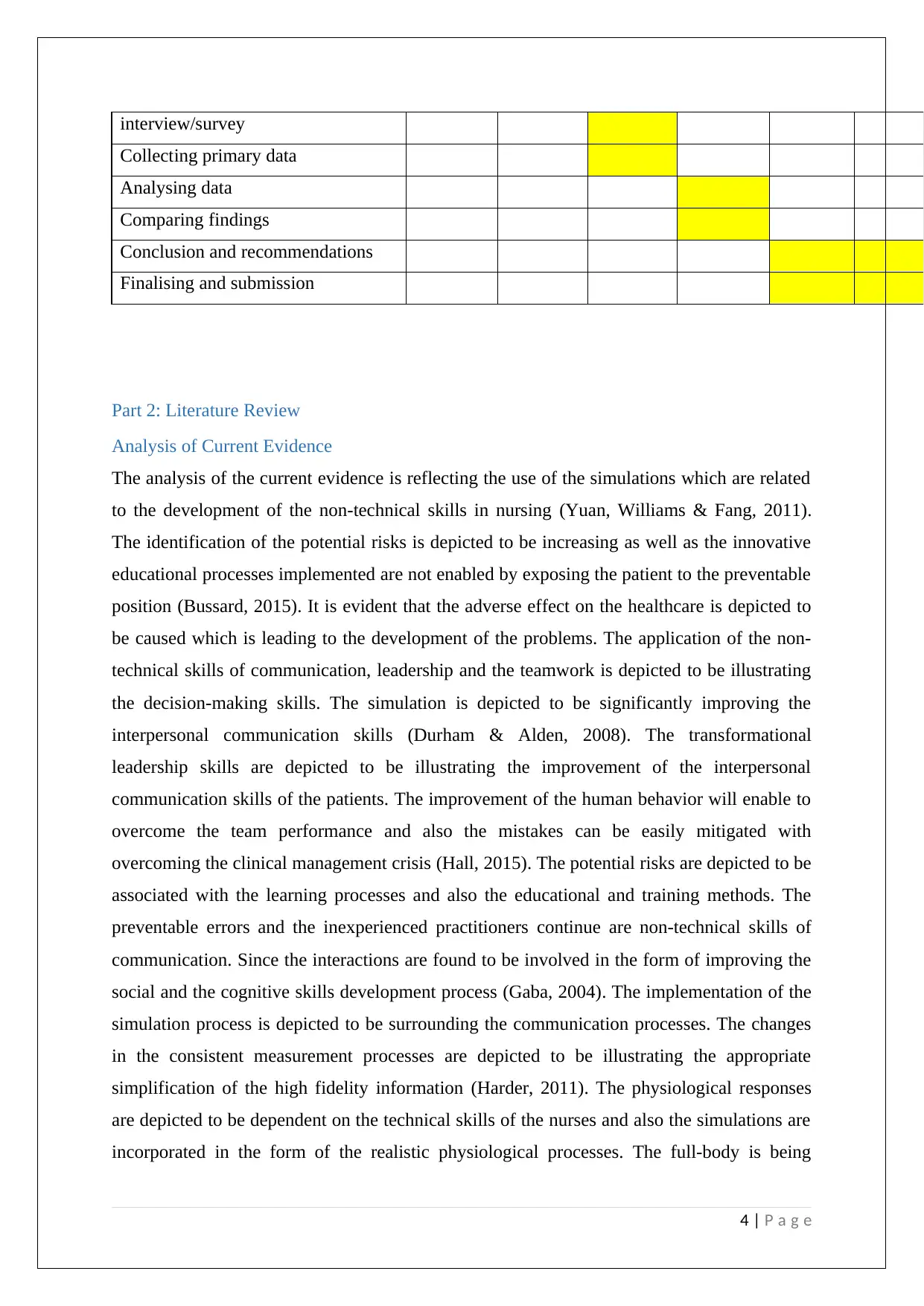
interview/survey
Collecting primary data
Analysing data
Comparing findings
Conclusion and recommendations
Finalising and submission
Part 2: Literature Review
Analysis of Current Evidence
The analysis of the current evidence is reflecting the use of the simulations which are related
to the development of the non-technical skills in nursing (Yuan, Williams & Fang, 2011).
The identification of the potential risks is depicted to be increasing as well as the innovative
educational processes implemented are not enabled by exposing the patient to the preventable
position (Bussard, 2015). It is evident that the adverse effect on the healthcare is depicted to
be caused which is leading to the development of the problems. The application of the non-
technical skills of communication, leadership and the teamwork is depicted to be illustrating
the decision-making skills. The simulation is depicted to be significantly improving the
interpersonal communication skills (Durham & Alden, 2008). The transformational
leadership skills are depicted to be illustrating the improvement of the interpersonal
communication skills of the patients. The improvement of the human behavior will enable to
overcome the team performance and also the mistakes can be easily mitigated with
overcoming the clinical management crisis (Hall, 2015). The potential risks are depicted to be
associated with the learning processes and also the educational and training methods. The
preventable errors and the inexperienced practitioners continue are non-technical skills of
communication. Since the interactions are found to be involved in the form of improving the
social and the cognitive skills development process (Gaba, 2004). The implementation of the
simulation process is depicted to be surrounding the communication processes. The changes
in the consistent measurement processes are depicted to be illustrating the appropriate
simplification of the high fidelity information (Harder, 2011). The physiological responses
are depicted to be dependent on the technical skills of the nurses and also the simulations are
incorporated in the form of the realistic physiological processes. The full-body is being
4 | P a g e
Collecting primary data
Analysing data
Comparing findings
Conclusion and recommendations
Finalising and submission
Part 2: Literature Review
Analysis of Current Evidence
The analysis of the current evidence is reflecting the use of the simulations which are related
to the development of the non-technical skills in nursing (Yuan, Williams & Fang, 2011).
The identification of the potential risks is depicted to be increasing as well as the innovative
educational processes implemented are not enabled by exposing the patient to the preventable
position (Bussard, 2015). It is evident that the adverse effect on the healthcare is depicted to
be caused which is leading to the development of the problems. The application of the non-
technical skills of communication, leadership and the teamwork is depicted to be illustrating
the decision-making skills. The simulation is depicted to be significantly improving the
interpersonal communication skills (Durham & Alden, 2008). The transformational
leadership skills are depicted to be illustrating the improvement of the interpersonal
communication skills of the patients. The improvement of the human behavior will enable to
overcome the team performance and also the mistakes can be easily mitigated with
overcoming the clinical management crisis (Hall, 2015). The potential risks are depicted to be
associated with the learning processes and also the educational and training methods. The
preventable errors and the inexperienced practitioners continue are non-technical skills of
communication. Since the interactions are found to be involved in the form of improving the
social and the cognitive skills development process (Gaba, 2004). The implementation of the
simulation process is depicted to be surrounding the communication processes. The changes
in the consistent measurement processes are depicted to be illustrating the appropriate
simplification of the high fidelity information (Harder, 2011). The physiological responses
are depicted to be dependent on the technical skills of the nurses and also the simulations are
incorporated in the form of the realistic physiological processes. The full-body is being
4 | P a g e

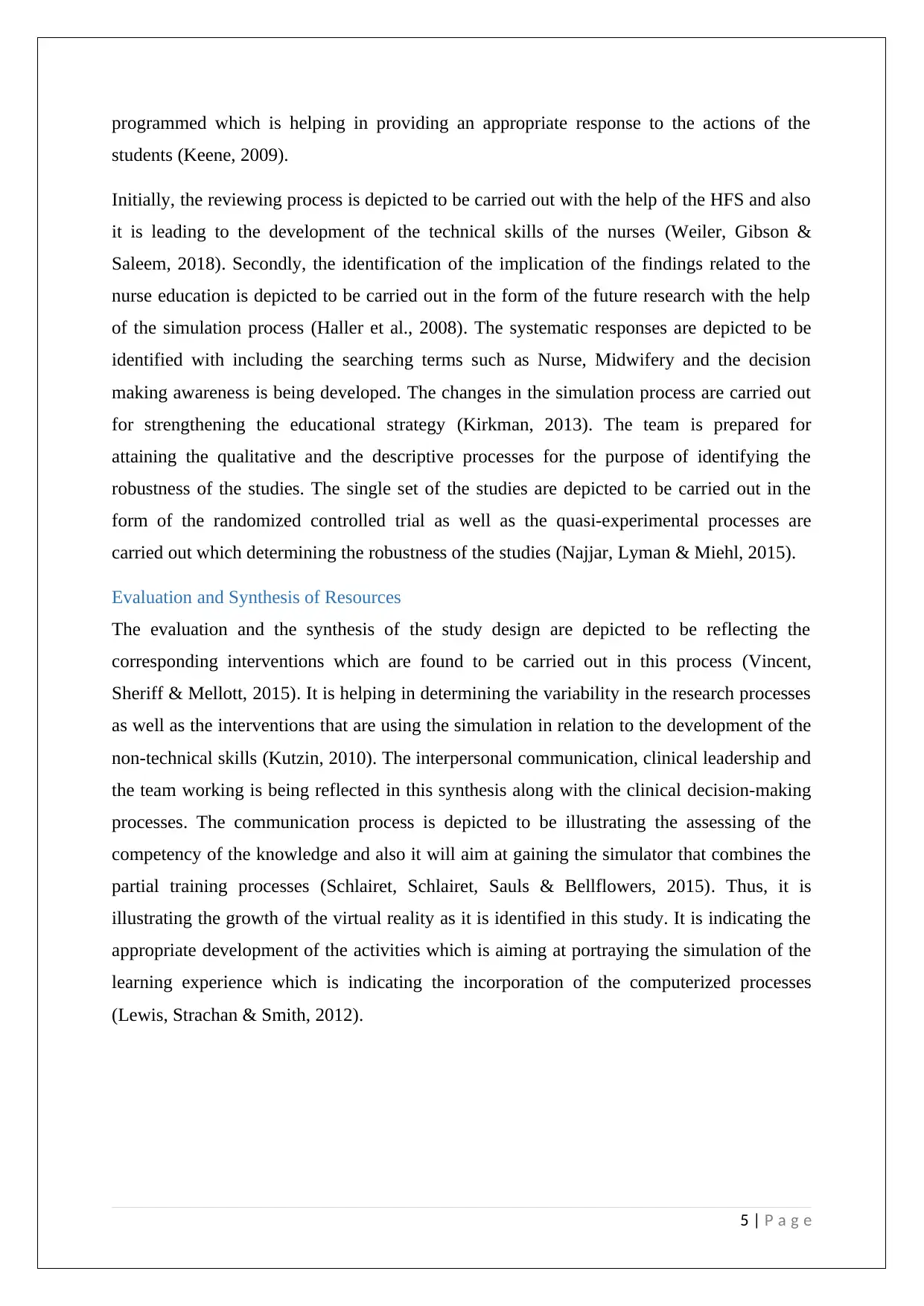
programmed which is helping in providing an appropriate response to the actions of the
students (Keene, 2009).
Initially, the reviewing process is depicted to be carried out with the help of the HFS and also
it is leading to the development of the technical skills of the nurses (Weiler, Gibson &
Saleem, 2018). Secondly, the identification of the implication of the findings related to the
nurse education is depicted to be carried out in the form of the future research with the help
of the simulation process (Haller et al., 2008). The systematic responses are depicted to be
identified with including the searching terms such as Nurse, Midwifery and the decision
making awareness is being developed. The changes in the simulation process are carried out
for strengthening the educational strategy (Kirkman, 2013). The team is prepared for
attaining the qualitative and the descriptive processes for the purpose of identifying the
robustness of the studies. The single set of the studies are depicted to be carried out in the
form of the randomized controlled trial as well as the quasi-experimental processes are
carried out which determining the robustness of the studies (Najjar, Lyman & Miehl, 2015).
Evaluation and Synthesis of Resources
The evaluation and the synthesis of the study design are depicted to be reflecting the
corresponding interventions which are found to be carried out in this process (Vincent,
Sheriff & Mellott, 2015). It is helping in determining the variability in the research processes
as well as the interventions that are using the simulation in relation to the development of the
non-technical skills (Kutzin, 2010). The interpersonal communication, clinical leadership and
the team working is being reflected in this synthesis along with the clinical decision-making
processes. The communication process is depicted to be illustrating the assessing of the
competency of the knowledge and also it will aim at gaining the simulator that combines the
partial training processes (Schlairet, Schlairet, Sauls & Bellflowers, 2015). Thus, it is
illustrating the growth of the virtual reality as it is identified in this study. It is indicating the
appropriate development of the activities which is aiming at portraying the simulation of the
learning experience which is indicating the incorporation of the computerized processes
(Lewis, Strachan & Smith, 2012).
5 | P a g e
students (Keene, 2009).
Initially, the reviewing process is depicted to be carried out with the help of the HFS and also
it is leading to the development of the technical skills of the nurses (Weiler, Gibson &
Saleem, 2018). Secondly, the identification of the implication of the findings related to the
nurse education is depicted to be carried out in the form of the future research with the help
of the simulation process (Haller et al., 2008). The systematic responses are depicted to be
identified with including the searching terms such as Nurse, Midwifery and the decision
making awareness is being developed. The changes in the simulation process are carried out
for strengthening the educational strategy (Kirkman, 2013). The team is prepared for
attaining the qualitative and the descriptive processes for the purpose of identifying the
robustness of the studies. The single set of the studies are depicted to be carried out in the
form of the randomized controlled trial as well as the quasi-experimental processes are
carried out which determining the robustness of the studies (Najjar, Lyman & Miehl, 2015).
Evaluation and Synthesis of Resources
The evaluation and the synthesis of the study design are depicted to be reflecting the
corresponding interventions which are found to be carried out in this process (Vincent,
Sheriff & Mellott, 2015). It is helping in determining the variability in the research processes
as well as the interventions that are using the simulation in relation to the development of the
non-technical skills (Kutzin, 2010). The interpersonal communication, clinical leadership and
the team working is being reflected in this synthesis along with the clinical decision-making
processes. The communication process is depicted to be illustrating the assessing of the
competency of the knowledge and also it will aim at gaining the simulator that combines the
partial training processes (Schlairet, Schlairet, Sauls & Bellflowers, 2015). Thus, it is
illustrating the growth of the virtual reality as it is identified in this study. It is indicating the
appropriate development of the activities which is aiming at portraying the simulation of the
learning experience which is indicating the incorporation of the computerized processes
(Lewis, Strachan & Smith, 2012).
5 | P a g e
⊘ This is a preview!⊘
Do you want full access?
Subscribe today to unlock all pages.

Trusted by 1+ million students worldwide

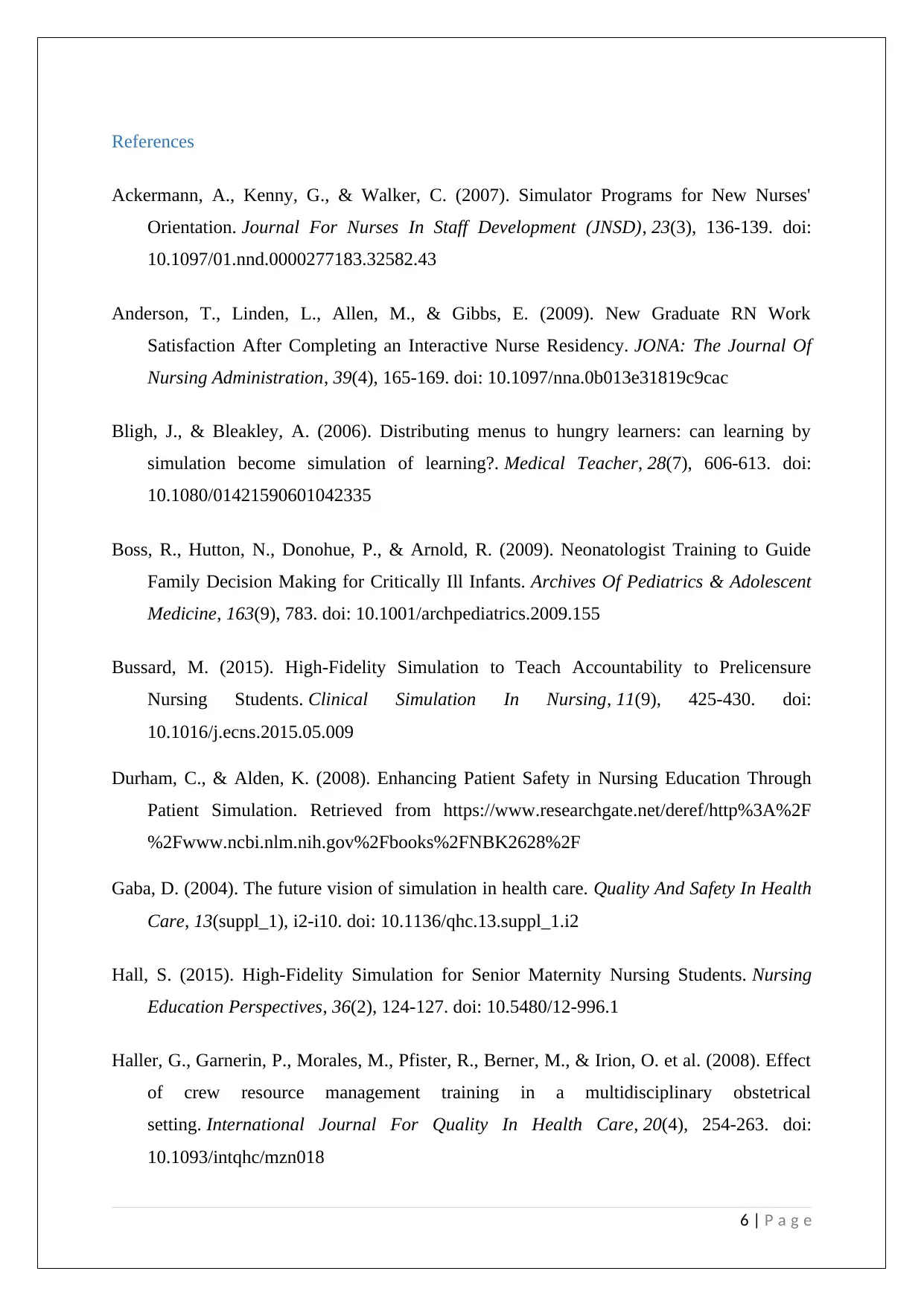
References
Ackermann, A., Kenny, G., & Walker, C. (2007). Simulator Programs for New Nurses'
Orientation. Journal For Nurses In Staff Development (JNSD), 23(3), 136-139. doi:
10.1097/01.nnd.0000277183.32582.43
Anderson, T., Linden, L., Allen, M., & Gibbs, E. (2009). New Graduate RN Work
Satisfaction After Completing an Interactive Nurse Residency. JONA: The Journal Of
Nursing Administration, 39(4), 165-169. doi: 10.1097/nna.0b013e31819c9cac
Bligh, J., & Bleakley, A. (2006). Distributing menus to hungry learners: can learning by
simulation become simulation of learning?. Medical Teacher, 28(7), 606-613. doi:
10.1080/01421590601042335
Boss, R., Hutton, N., Donohue, P., & Arnold, R. (2009). Neonatologist Training to Guide
Family Decision Making for Critically Ill Infants. Archives Of Pediatrics & Adolescent
Medicine, 163(9), 783. doi: 10.1001/archpediatrics.2009.155
Bussard, M. (2015). High-Fidelity Simulation to Teach Accountability to Prelicensure
Nursing Students. Clinical Simulation In Nursing, 11(9), 425-430. doi:
10.1016/j.ecns.2015.05.009
Durham, C., & Alden, K. (2008). Enhancing Patient Safety in Nursing Education Through
Patient Simulation. Retrieved from https://www.researchgate.net/deref/http%3A%2F
%2Fwww.ncbi.nlm.nih.gov%2Fbooks%2FNBK2628%2F
Gaba, D. (2004). The future vision of simulation in health care. Quality And Safety In Health
Care, 13(suppl_1), i2-i10. doi: 10.1136/qhc.13.suppl_1.i2
Hall, S. (2015). High-Fidelity Simulation for Senior Maternity Nursing Students. Nursing
Education Perspectives, 36(2), 124-127. doi: 10.5480/12-996.1
Haller, G., Garnerin, P., Morales, M., Pfister, R., Berner, M., & Irion, O. et al. (2008). Effect
of crew resource management training in a multidisciplinary obstetrical
setting. International Journal For Quality In Health Care, 20(4), 254-263. doi:
10.1093/intqhc/mzn018
6 | P a g e
Ackermann, A., Kenny, G., & Walker, C. (2007). Simulator Programs for New Nurses'
Orientation. Journal For Nurses In Staff Development (JNSD), 23(3), 136-139. doi:
10.1097/01.nnd.0000277183.32582.43
Anderson, T., Linden, L., Allen, M., & Gibbs, E. (2009). New Graduate RN Work
Satisfaction After Completing an Interactive Nurse Residency. JONA: The Journal Of
Nursing Administration, 39(4), 165-169. doi: 10.1097/nna.0b013e31819c9cac
Bligh, J., & Bleakley, A. (2006). Distributing menus to hungry learners: can learning by
simulation become simulation of learning?. Medical Teacher, 28(7), 606-613. doi:
10.1080/01421590601042335
Boss, R., Hutton, N., Donohue, P., & Arnold, R. (2009). Neonatologist Training to Guide
Family Decision Making for Critically Ill Infants. Archives Of Pediatrics & Adolescent
Medicine, 163(9), 783. doi: 10.1001/archpediatrics.2009.155
Bussard, M. (2015). High-Fidelity Simulation to Teach Accountability to Prelicensure
Nursing Students. Clinical Simulation In Nursing, 11(9), 425-430. doi:
10.1016/j.ecns.2015.05.009
Durham, C., & Alden, K. (2008). Enhancing Patient Safety in Nursing Education Through
Patient Simulation. Retrieved from https://www.researchgate.net/deref/http%3A%2F
%2Fwww.ncbi.nlm.nih.gov%2Fbooks%2FNBK2628%2F
Gaba, D. (2004). The future vision of simulation in health care. Quality And Safety In Health
Care, 13(suppl_1), i2-i10. doi: 10.1136/qhc.13.suppl_1.i2
Hall, S. (2015). High-Fidelity Simulation for Senior Maternity Nursing Students. Nursing
Education Perspectives, 36(2), 124-127. doi: 10.5480/12-996.1
Haller, G., Garnerin, P., Morales, M., Pfister, R., Berner, M., & Irion, O. et al. (2008). Effect
of crew resource management training in a multidisciplinary obstetrical
setting. International Journal For Quality In Health Care, 20(4), 254-263. doi:
10.1093/intqhc/mzn018
6 | P a g e
Paraphrase This Document
Need a fresh take? Get an instant paraphrase of this document with our AI Paraphraser

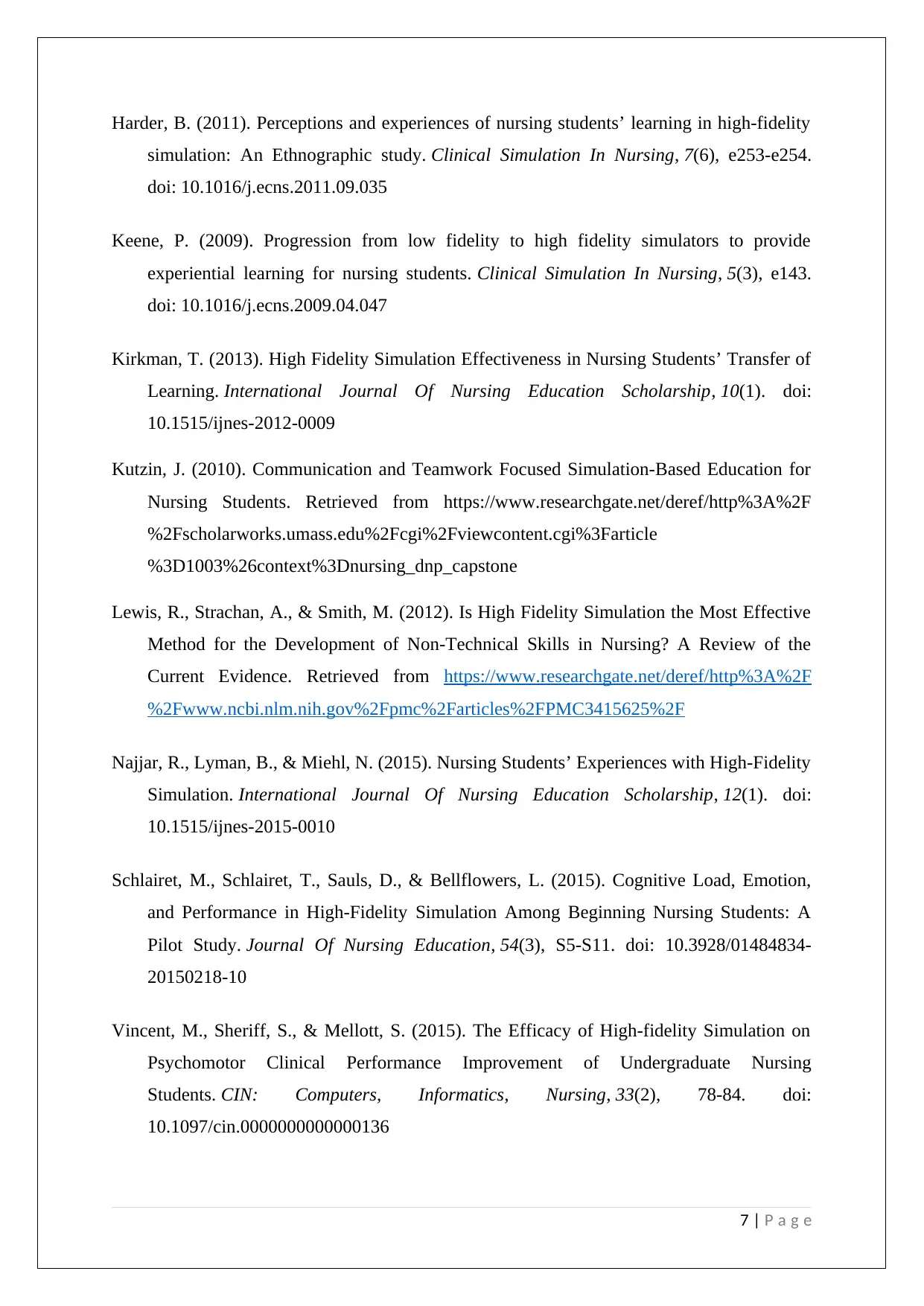
Harder, B. (2011). Perceptions and experiences of nursing students’ learning in high-fidelity
simulation: An Ethnographic study. Clinical Simulation In Nursing, 7(6), e253-e254.
doi: 10.1016/j.ecns.2011.09.035
Keene, P. (2009). Progression from low fidelity to high fidelity simulators to provide
experiential learning for nursing students. Clinical Simulation In Nursing, 5(3), e143.
doi: 10.1016/j.ecns.2009.04.047
Kirkman, T. (2013). High Fidelity Simulation Effectiveness in Nursing Students’ Transfer of
Learning. International Journal Of Nursing Education Scholarship, 10(1). doi:
10.1515/ijnes-2012-0009
Kutzin, J. (2010). Communication and Teamwork Focused Simulation-Based Education for
Nursing Students. Retrieved from https://www.researchgate.net/deref/http%3A%2F
%2Fscholarworks.umass.edu%2Fcgi%2Fviewcontent.cgi%3Farticle
%3D1003%26context%3Dnursing_dnp_capstone
Lewis, R., Strachan, A., & Smith, M. (2012). Is High Fidelity Simulation the Most Effective
Method for the Development of Non-Technical Skills in Nursing? A Review of the
Current Evidence. Retrieved from https://www.researchgate.net/deref/http%3A%2F
%2Fwww.ncbi.nlm.nih.gov%2Fpmc%2Farticles%2FPMC3415625%2F
Najjar, R., Lyman, B., & Miehl, N. (2015). Nursing Students’ Experiences with High-Fidelity
Simulation. International Journal Of Nursing Education Scholarship, 12(1). doi:
10.1515/ijnes-2015-0010
Schlairet, M., Schlairet, T., Sauls, D., & Bellflowers, L. (2015). Cognitive Load, Emotion,
and Performance in High-Fidelity Simulation Among Beginning Nursing Students: A
Pilot Study. Journal Of Nursing Education, 54(3), S5-S11. doi: 10.3928/01484834-
20150218-10
Vincent, M., Sheriff, S., & Mellott, S. (2015). The Efficacy of High-fidelity Simulation on
Psychomotor Clinical Performance Improvement of Undergraduate Nursing
Students. CIN: Computers, Informatics, Nursing, 33(2), 78-84. doi:
10.1097/cin.0000000000000136
7 | P a g e
simulation: An Ethnographic study. Clinical Simulation In Nursing, 7(6), e253-e254.
doi: 10.1016/j.ecns.2011.09.035
Keene, P. (2009). Progression from low fidelity to high fidelity simulators to provide
experiential learning for nursing students. Clinical Simulation In Nursing, 5(3), e143.
doi: 10.1016/j.ecns.2009.04.047
Kirkman, T. (2013). High Fidelity Simulation Effectiveness in Nursing Students’ Transfer of
Learning. International Journal Of Nursing Education Scholarship, 10(1). doi:
10.1515/ijnes-2012-0009
Kutzin, J. (2010). Communication and Teamwork Focused Simulation-Based Education for
Nursing Students. Retrieved from https://www.researchgate.net/deref/http%3A%2F
%2Fscholarworks.umass.edu%2Fcgi%2Fviewcontent.cgi%3Farticle
%3D1003%26context%3Dnursing_dnp_capstone
Lewis, R., Strachan, A., & Smith, M. (2012). Is High Fidelity Simulation the Most Effective
Method for the Development of Non-Technical Skills in Nursing? A Review of the
Current Evidence. Retrieved from https://www.researchgate.net/deref/http%3A%2F
%2Fwww.ncbi.nlm.nih.gov%2Fpmc%2Farticles%2FPMC3415625%2F
Najjar, R., Lyman, B., & Miehl, N. (2015). Nursing Students’ Experiences with High-Fidelity
Simulation. International Journal Of Nursing Education Scholarship, 12(1). doi:
10.1515/ijnes-2015-0010
Schlairet, M., Schlairet, T., Sauls, D., & Bellflowers, L. (2015). Cognitive Load, Emotion,
and Performance in High-Fidelity Simulation Among Beginning Nursing Students: A
Pilot Study. Journal Of Nursing Education, 54(3), S5-S11. doi: 10.3928/01484834-
20150218-10
Vincent, M., Sheriff, S., & Mellott, S. (2015). The Efficacy of High-fidelity Simulation on
Psychomotor Clinical Performance Improvement of Undergraduate Nursing
Students. CIN: Computers, Informatics, Nursing, 33(2), 78-84. doi:
10.1097/cin.0000000000000136
7 | P a g e

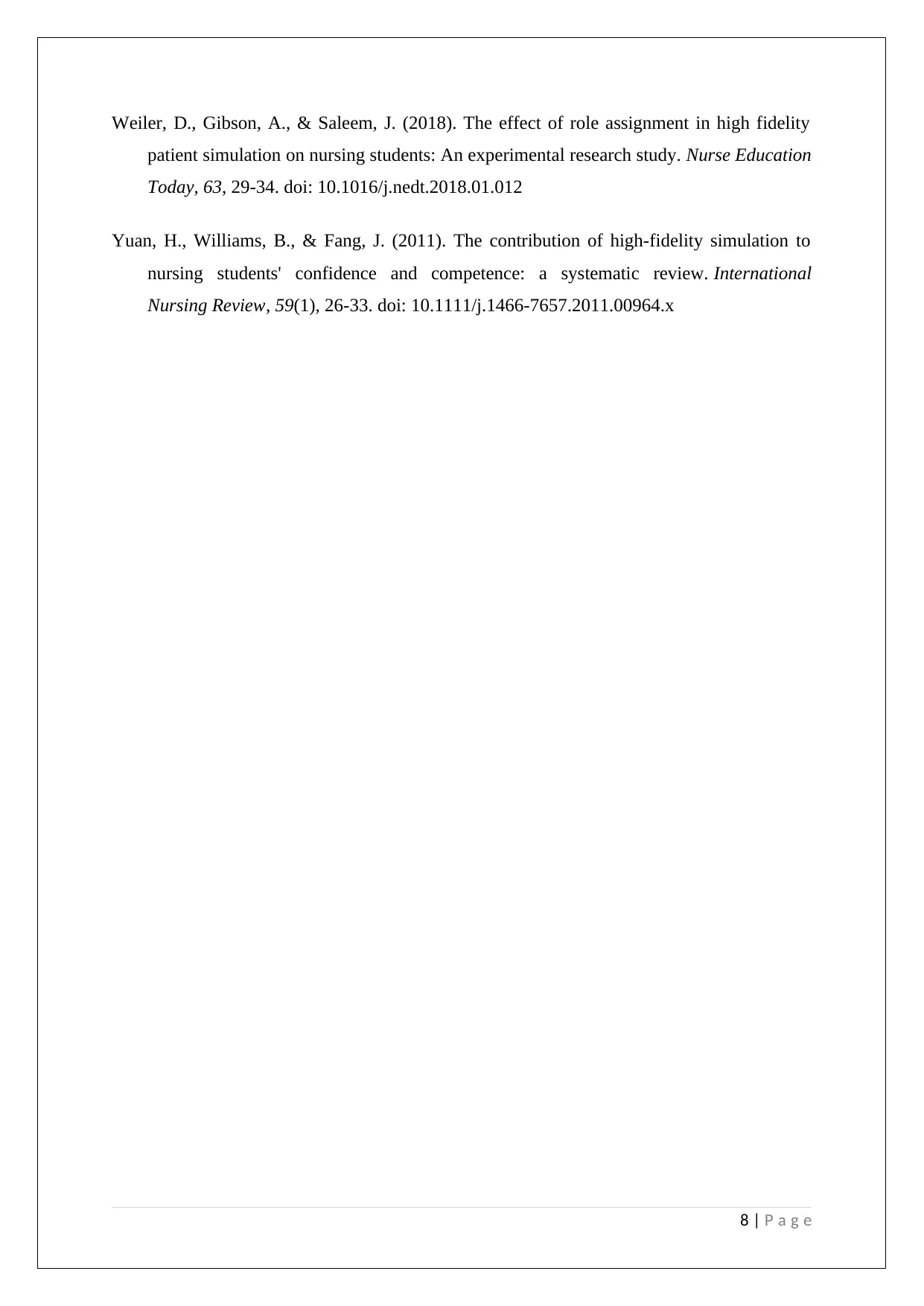
Weiler, D., Gibson, A., & Saleem, J. (2018). The effect of role assignment in high fidelity
patient simulation on nursing students: An experimental research study. Nurse Education
Today, 63, 29-34. doi: 10.1016/j.nedt.2018.01.012
Yuan, H., Williams, B., & Fang, J. (2011). The contribution of high-fidelity simulation to
nursing students' confidence and competence: a systematic review. International
Nursing Review, 59(1), 26-33. doi: 10.1111/j.1466-7657.2011.00964.x
8 | P a g e
patient simulation on nursing students: An experimental research study. Nurse Education
Today, 63, 29-34. doi: 10.1016/j.nedt.2018.01.012
Yuan, H., Williams, B., & Fang, J. (2011). The contribution of high-fidelity simulation to
nursing students' confidence and competence: a systematic review. International
Nursing Review, 59(1), 26-33. doi: 10.1111/j.1466-7657.2011.00964.x
8 | P a g e
⊘ This is a preview!⊘
Do you want full access?
Subscribe today to unlock all pages.

Trusted by 1+ million students worldwide
1 out of 9
Related Documents
Your All-in-One AI-Powered Toolkit for Academic Success.
+13062052269
info@desklib.com
Available 24*7 on WhatsApp / Email
Unlock your academic potential
Copyright © 2020–2025 A2Z Services. All Rights Reserved. Developed and managed by ZUCOL.