Nursing Research: Design Methods, Statistics, and Article Review
VerifiedAdded on 2023/06/12
|20
|4263
|341
Homework Assignment
AI Summary
This assignment focuses on the analysis of research design methods used in nursing studies. It includes a review of descriptive and inferential statistics, common mistakes in research, and the steps of a study plan. The assignment features critical assessments of research articles, examining the aims, research questions, methodologies, and statistical analyses employed. Specifically, it evaluates articles using Pearson’s correlation coefficient and Spearman’s Rho, and explores the application of the Chi-Square test. The document also covers data cleaning procedures and the importance of assumptions, limitations, and delimitations in research. Furthermore, the assignment provides SPSS exercises to reinforce the practical application of statistical concepts in nursing research. Desklib provides a platform to access this and many other solved assignments to aid students in their learning.
Running head: DESIGN METHODS ANALYSIS IN NURSING
DESIGN METHODS ANALYSIS IN NURSING
Name of Student
Name of University
Author Note
DESIGN METHODS ANALYSIS IN NURSING
Name of Student
Name of University
Author Note

Paraphrase This Document
Need a fresh take? Get an instant paraphrase of this document with our AI Paraphraser
2DESIGN METHODS ANALYSIS IN NURSING
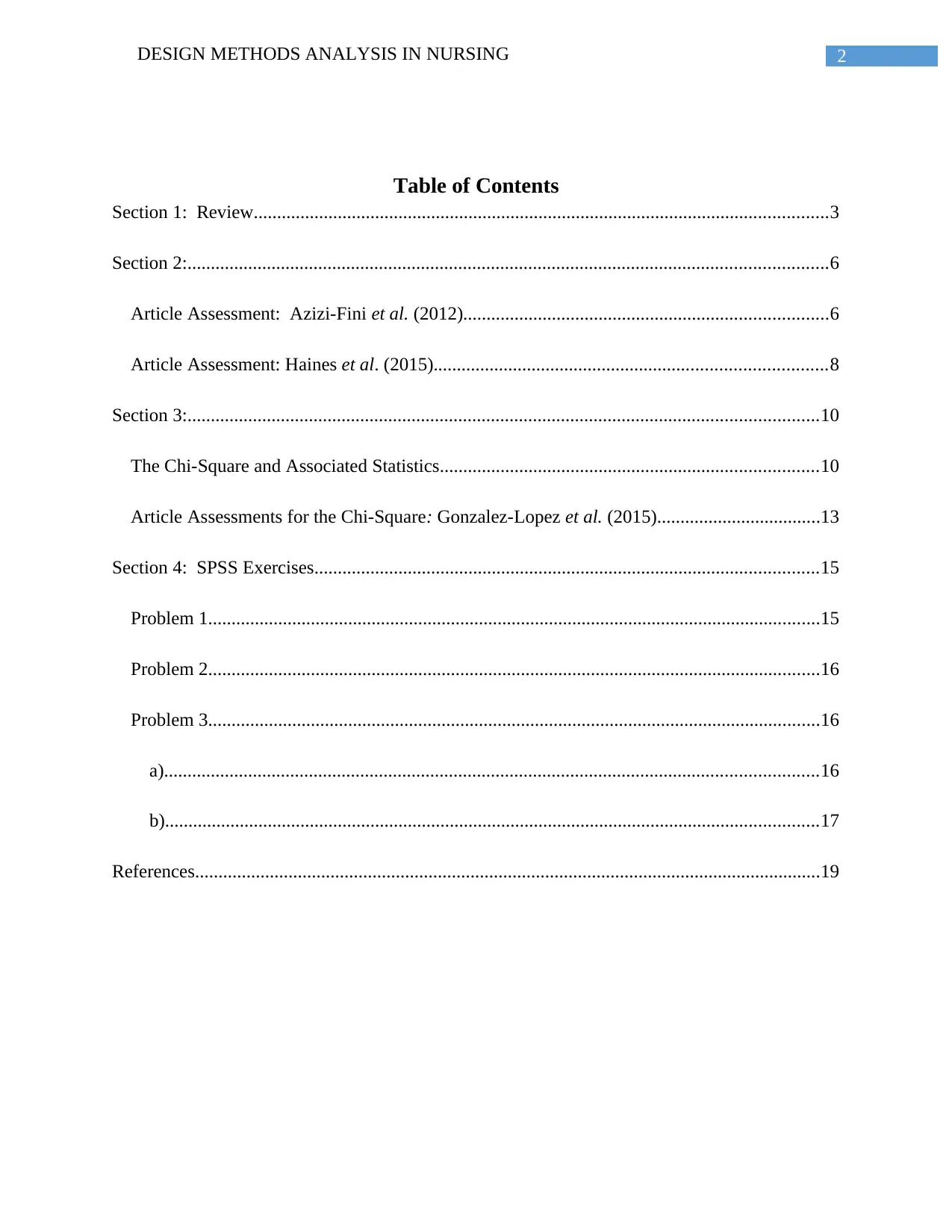
Table of Contents
Section 1: Review...........................................................................................................................3
Section 2:.........................................................................................................................................6
Article Assessment: Azizi-Fini et al. (2012)..............................................................................6
Article Assessment: Haines et al. (2015)....................................................................................8
Section 3:.......................................................................................................................................10
The Chi-Square and Associated Statistics.................................................................................10
Article Assessments for the Chi-Square: Gonzalez-Lopez et al. (2015)...................................13
Section 4: SPSS Exercises............................................................................................................15
Problem 1...................................................................................................................................15
Problem 2...................................................................................................................................16
Problem 3...................................................................................................................................16
a)............................................................................................................................................16
b)............................................................................................................................................17
References......................................................................................................................................19
Table of Contents
Section 1: Review...........................................................................................................................3
Section 2:.........................................................................................................................................6
Article Assessment: Azizi-Fini et al. (2012)..............................................................................6
Article Assessment: Haines et al. (2015)....................................................................................8
Section 3:.......................................................................................................................................10
The Chi-Square and Associated Statistics.................................................................................10
Article Assessments for the Chi-Square: Gonzalez-Lopez et al. (2015)...................................13
Section 4: SPSS Exercises............................................................................................................15
Problem 1...................................................................................................................................15
Problem 2...................................................................................................................................16
Problem 3...................................................................................................................................16
a)............................................................................................................................................16
b)............................................................................................................................................17
References......................................................................................................................................19
3DESIGN METHODS ANALYSIS IN NURSING
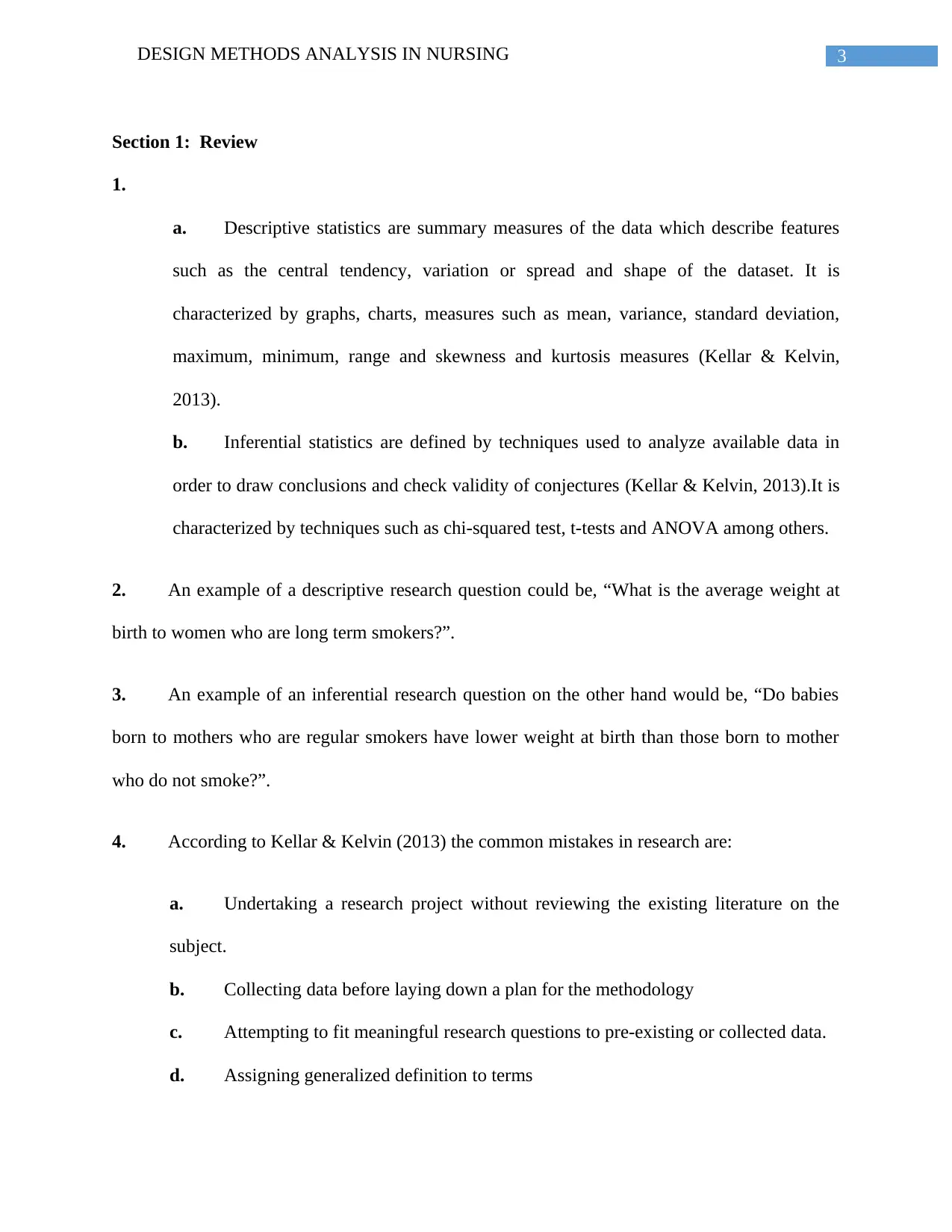
Section 1: Review
1.
a. Descriptive statistics are summary measures of the data which describe features
such as the central tendency, variation or spread and shape of the dataset. It is
characterized by graphs, charts, measures such as mean, variance, standard deviation,
maximum, minimum, range and skewness and kurtosis measures (Kellar & Kelvin,
2013).
b. Inferential statistics are defined by techniques used to analyze available data in
order to draw conclusions and check validity of conjectures (Kellar & Kelvin, 2013).It is
characterized by techniques such as chi-squared test, t-tests and ANOVA among others.
2. An example of a descriptive research question could be, “What is the average weight at
birth to women who are long term smokers?”.
3. An example of an inferential research question on the other hand would be, “Do babies
born to mothers who are regular smokers have lower weight at birth than those born to mother
who do not smoke?”.
4. According to Kellar & Kelvin (2013) the common mistakes in research are:
a. Undertaking a research project without reviewing the existing literature on the
subject.
b. Collecting data before laying down a plan for the methodology
c. Attempting to fit meaningful research questions to pre-existing or collected data.
d. Assigning generalized definition to terms
Section 1: Review
1.
a. Descriptive statistics are summary measures of the data which describe features
such as the central tendency, variation or spread and shape of the dataset. It is
characterized by graphs, charts, measures such as mean, variance, standard deviation,
maximum, minimum, range and skewness and kurtosis measures (Kellar & Kelvin,
2013).
b. Inferential statistics are defined by techniques used to analyze available data in
order to draw conclusions and check validity of conjectures (Kellar & Kelvin, 2013).It is
characterized by techniques such as chi-squared test, t-tests and ANOVA among others.
2. An example of a descriptive research question could be, “What is the average weight at
birth to women who are long term smokers?”.
3. An example of an inferential research question on the other hand would be, “Do babies
born to mothers who are regular smokers have lower weight at birth than those born to mother
who do not smoke?”.
4. According to Kellar & Kelvin (2013) the common mistakes in research are:
a. Undertaking a research project without reviewing the existing literature on the
subject.
b. Collecting data before laying down a plan for the methodology
c. Attempting to fit meaningful research questions to pre-existing or collected data.
d. Assigning generalized definition to terms
⊘ This is a preview!⊘
Do you want full access?
Subscribe today to unlock all pages.

Trusted by 1+ million students worldwide
4DESIGN METHODS ANALYSIS IN NURSING
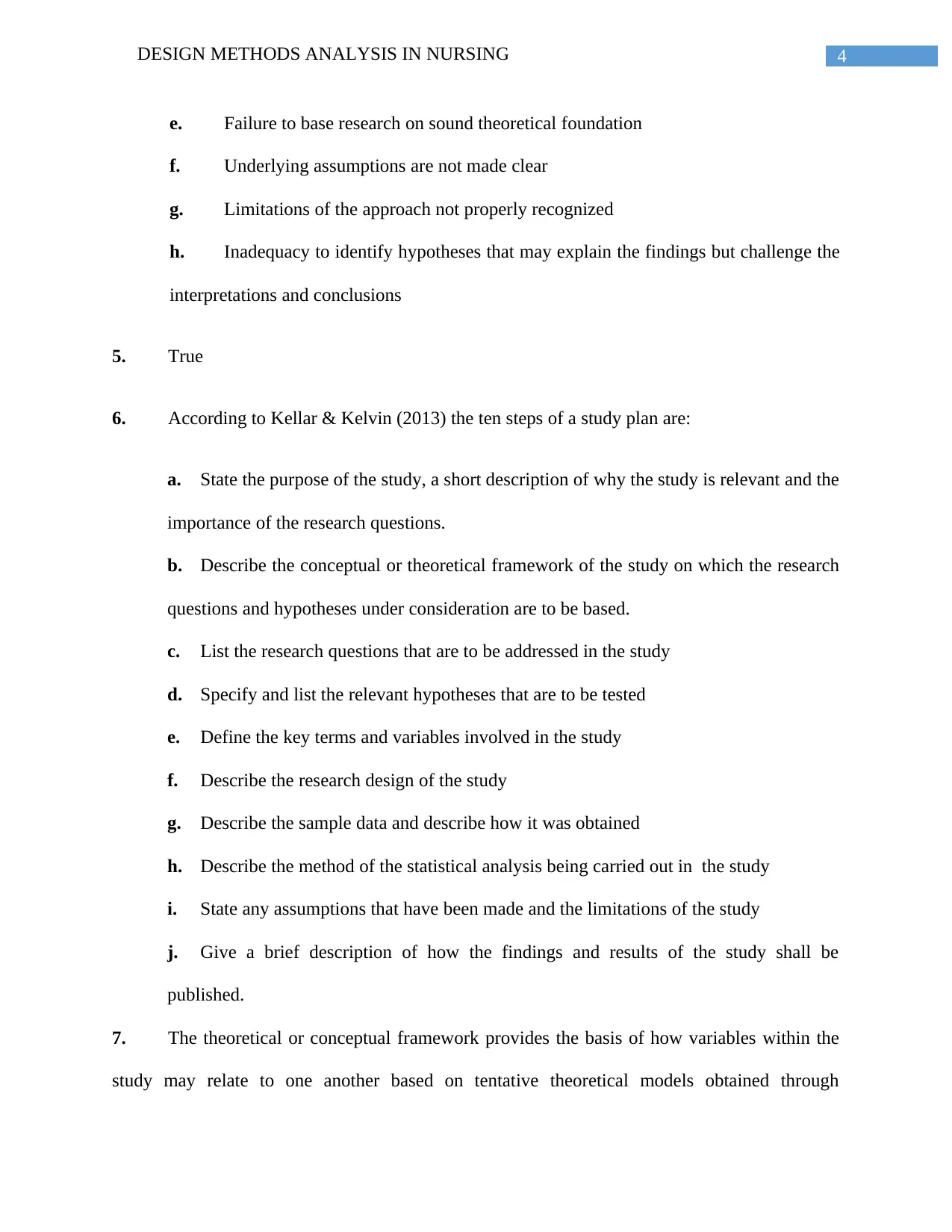
e. Failure to base research on sound theoretical foundation
f. Underlying assumptions are not made clear
g. Limitations of the approach not properly recognized
h. Inadequacy to identify hypotheses that may explain the findings but challenge the
interpretations and conclusions
5. True
6. According to Kellar & Kelvin (2013) the ten steps of a study plan are:
a. State the purpose of the study, a short description of why the study is relevant and the
importance of the research questions.
b. Describe the conceptual or theoretical framework of the study on which the research
questions and hypotheses under consideration are to be based.
c. List the research questions that are to be addressed in the study
d. Specify and list the relevant hypotheses that are to be tested
e. Define the key terms and variables involved in the study
f. Describe the research design of the study
g. Describe the sample data and describe how it was obtained
h. Describe the method of the statistical analysis being carried out in the study
i. State any assumptions that have been made and the limitations of the study
j. Give a brief description of how the findings and results of the study shall be
published.
7. The theoretical or conceptual framework provides the basis of how variables within the
study may relate to one another based on tentative theoretical models obtained through
e. Failure to base research on sound theoretical foundation
f. Underlying assumptions are not made clear
g. Limitations of the approach not properly recognized
h. Inadequacy to identify hypotheses that may explain the findings but challenge the
interpretations and conclusions
5. True
6. According to Kellar & Kelvin (2013) the ten steps of a study plan are:
a. State the purpose of the study, a short description of why the study is relevant and the
importance of the research questions.
b. Describe the conceptual or theoretical framework of the study on which the research
questions and hypotheses under consideration are to be based.
c. List the research questions that are to be addressed in the study
d. Specify and list the relevant hypotheses that are to be tested
e. Define the key terms and variables involved in the study
f. Describe the research design of the study
g. Describe the sample data and describe how it was obtained
h. Describe the method of the statistical analysis being carried out in the study
i. State any assumptions that have been made and the limitations of the study
j. Give a brief description of how the findings and results of the study shall be
published.
7. The theoretical or conceptual framework provides the basis of how variables within the
study may relate to one another based on tentative theoretical models obtained through
Paraphrase This Document
Need a fresh take? Get an instant paraphrase of this document with our AI Paraphraser
5DESIGN METHODS ANALYSIS IN NURSING
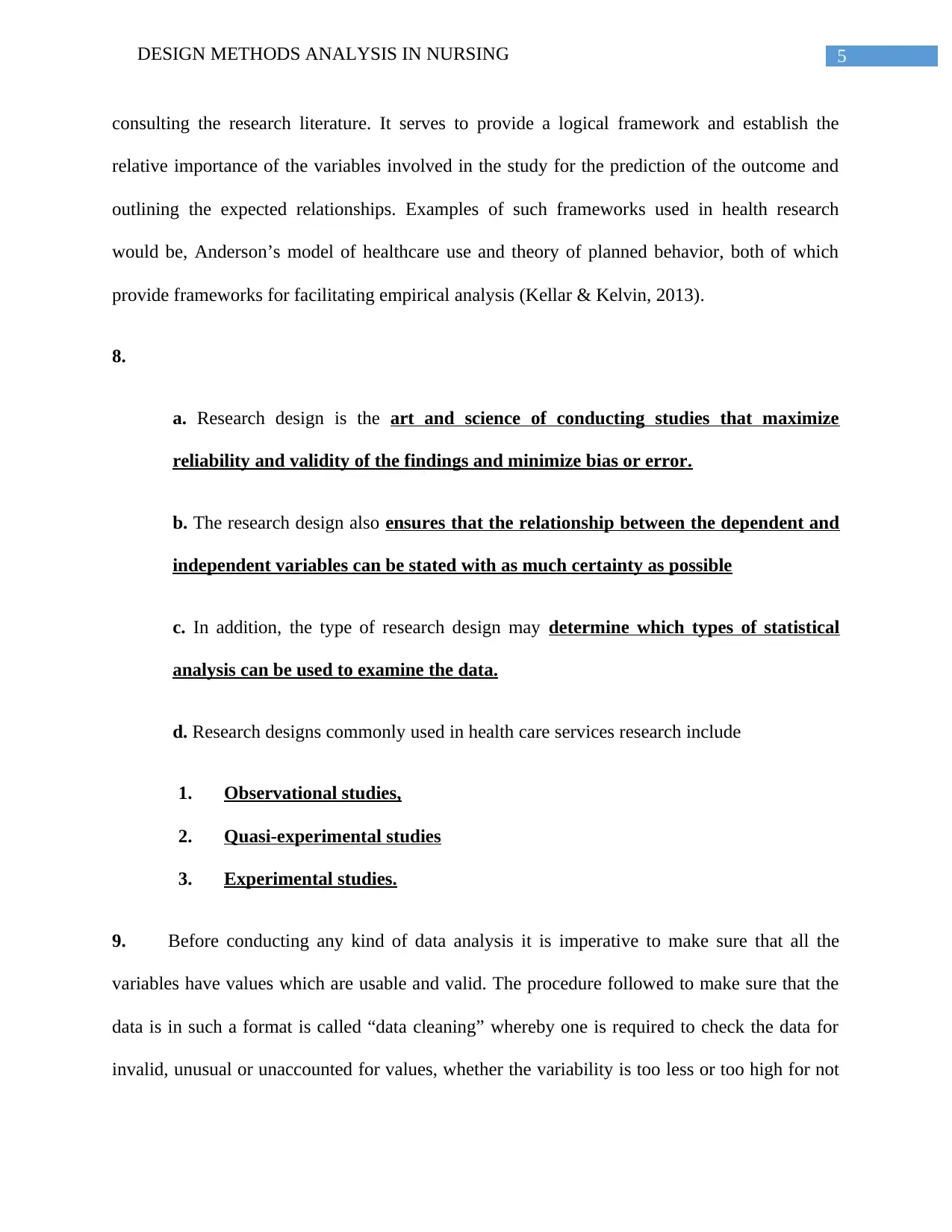
consulting the research literature. It serves to provide a logical framework and establish the
relative importance of the variables involved in the study for the prediction of the outcome and
outlining the expected relationships. Examples of such frameworks used in health research
would be, Anderson’s model of healthcare use and theory of planned behavior, both of which
provide frameworks for facilitating empirical analysis (Kellar & Kelvin, 2013).
8.
a. Research design is the art and science of conducting studies that maximize
reliability and validity of the findings and minimize bias or error.
b. The research design also ensures that the relationship between the dependent and
independent variables can be stated with as much certainty as possible
c. In addition, the type of research design may determine which types of statistical
analysis can be used to examine the data.
d. Research designs commonly used in health care services research include
1. Observational studies,
2. Quasi-experimental studies
3. Experimental studies.
9. Before conducting any kind of data analysis it is imperative to make sure that all the
variables have values which are usable and valid. The procedure followed to make sure that the
data is in such a format is called “data cleaning” whereby one is required to check the data for
invalid, unusual or unaccounted for values, whether the variability is too less or too high for not
consulting the research literature. It serves to provide a logical framework and establish the
relative importance of the variables involved in the study for the prediction of the outcome and
outlining the expected relationships. Examples of such frameworks used in health research
would be, Anderson’s model of healthcare use and theory of planned behavior, both of which
provide frameworks for facilitating empirical analysis (Kellar & Kelvin, 2013).
8.
a. Research design is the art and science of conducting studies that maximize
reliability and validity of the findings and minimize bias or error.
b. The research design also ensures that the relationship between the dependent and
independent variables can be stated with as much certainty as possible
c. In addition, the type of research design may determine which types of statistical
analysis can be used to examine the data.
d. Research designs commonly used in health care services research include
1. Observational studies,
2. Quasi-experimental studies
3. Experimental studies.
9. Before conducting any kind of data analysis it is imperative to make sure that all the
variables have values which are usable and valid. The procedure followed to make sure that the
data is in such a format is called “data cleaning” whereby one is required to check the data for
invalid, unusual or unaccounted for values, whether the variability is too less or too high for not
6DESIGN METHODS ANALYSIS IN NURSING
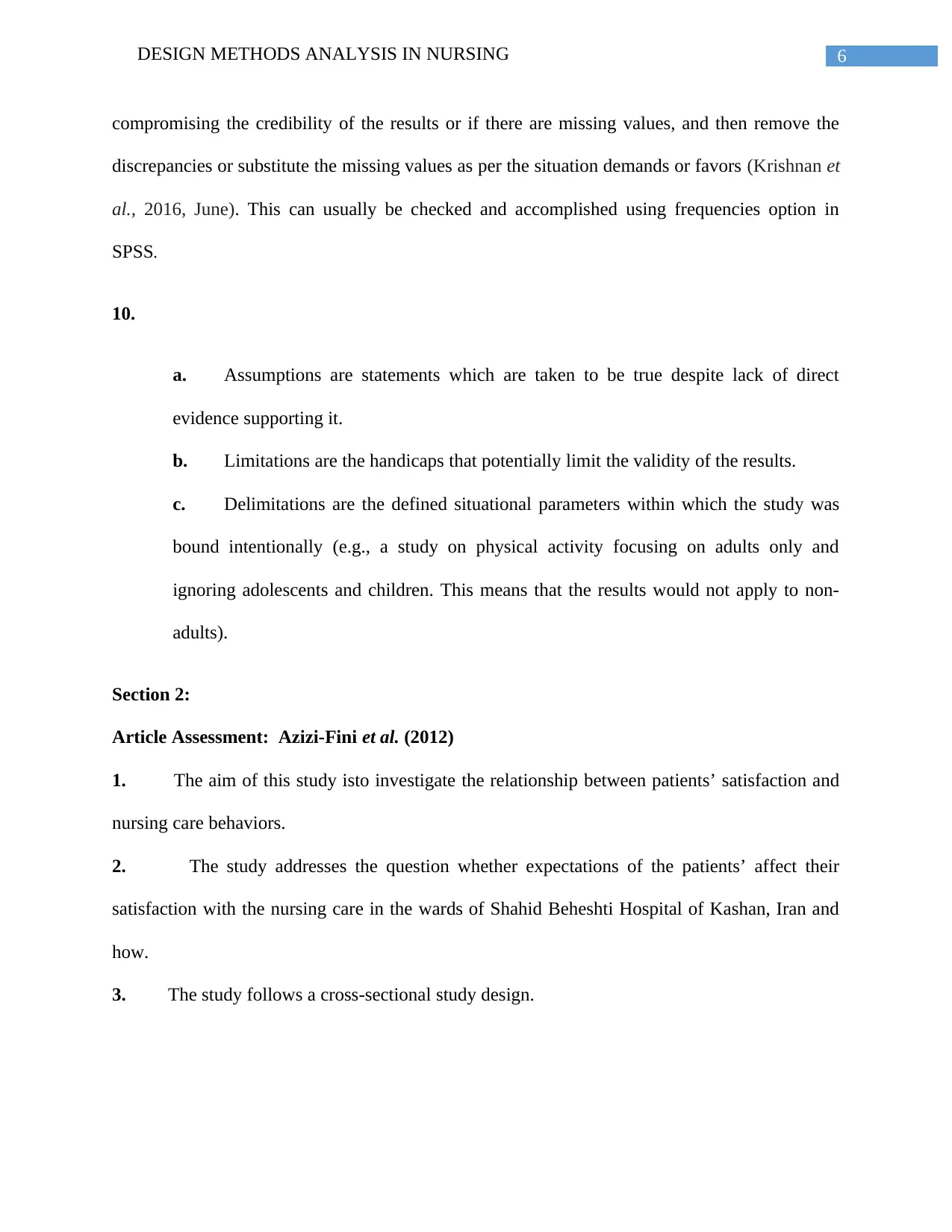
compromising the credibility of the results or if there are missing values, and then remove the
discrepancies or substitute the missing values as per the situation demands or favors (Krishnan et
al., 2016, June). This can usually be checked and accomplished using frequencies option in
SPSS.
10.
a. Assumptions are statements which are taken to be true despite lack of direct
evidence supporting it.
b. Limitations are the handicaps that potentially limit the validity of the results.
c. Delimitations are the defined situational parameters within which the study was
bound intentionally (e.g., a study on physical activity focusing on adults only and
ignoring adolescents and children. This means that the results would not apply to non-
adults).
Section 2:
Article Assessment: Azizi-Fini et al. (2012)
1. The aim of this study isto investigate the relationship between patients’ satisfaction and
nursing care behaviors.
2. The study addresses the question whether expectations of the patients’ affect their
satisfaction with the nursing care in the wards of Shahid Beheshti Hospital of Kashan, Iran and
how.
3. The study follows a cross-sectional study design.
compromising the credibility of the results or if there are missing values, and then remove the
discrepancies or substitute the missing values as per the situation demands or favors (Krishnan et
al., 2016, June). This can usually be checked and accomplished using frequencies option in
SPSS.
10.
a. Assumptions are statements which are taken to be true despite lack of direct
evidence supporting it.
b. Limitations are the handicaps that potentially limit the validity of the results.
c. Delimitations are the defined situational parameters within which the study was
bound intentionally (e.g., a study on physical activity focusing on adults only and
ignoring adolescents and children. This means that the results would not apply to non-
adults).
Section 2:
Article Assessment: Azizi-Fini et al. (2012)
1. The aim of this study isto investigate the relationship between patients’ satisfaction and
nursing care behaviors.
2. The study addresses the question whether expectations of the patients’ affect their
satisfaction with the nursing care in the wards of Shahid Beheshti Hospital of Kashan, Iran and
how.
3. The study follows a cross-sectional study design.
⊘ This is a preview!⊘
Do you want full access?
Subscribe today to unlock all pages.
Trusted by 1+ million students worldwide
7DESIGN METHODS ANALYSIS IN NURSING
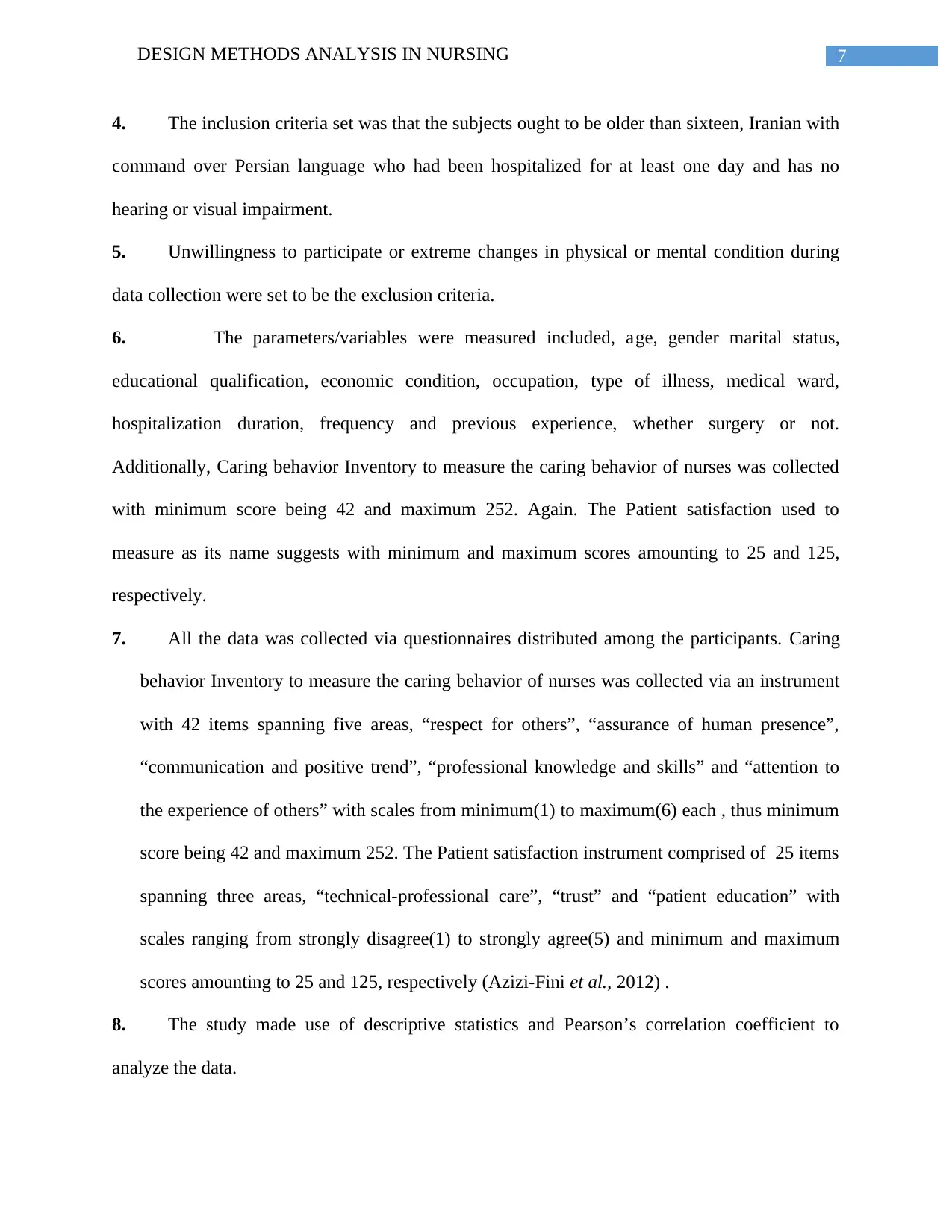
4. The inclusion criteria set was that the subjects ought to be older than sixteen, Iranian with
command over Persian language who had been hospitalized for at least one day and has no
hearing or visual impairment.
5. Unwillingness to participate or extreme changes in physical or mental condition during
data collection were set to be the exclusion criteria.
6. The parameters/variables were measured included, age, gender marital status,
educational qualification, economic condition, occupation, type of illness, medical ward,
hospitalization duration, frequency and previous experience, whether surgery or not.
Additionally, Caring behavior Inventory to measure the caring behavior of nurses was collected
with minimum score being 42 and maximum 252. Again. The Patient satisfaction used to
measure as its name suggests with minimum and maximum scores amounting to 25 and 125,
respectively.
7. All the data was collected via questionnaires distributed among the participants. Caring
behavior Inventory to measure the caring behavior of nurses was collected via an instrument
with 42 items spanning five areas, “respect for others”, “assurance of human presence”,
“communication and positive trend”, “professional knowledge and skills” and “attention to
the experience of others” with scales from minimum(1) to maximum(6) each , thus minimum
score being 42 and maximum 252. The Patient satisfaction instrument comprised of 25 items
spanning three areas, “technical-professional care”, “trust” and “patient education” with
scales ranging from strongly disagree(1) to strongly agree(5) and minimum and maximum
scores amounting to 25 and 125, respectively (Azizi-Fini et al., 2012) .
8. The study made use of descriptive statistics and Pearson’s correlation coefficient to
analyze the data.
4. The inclusion criteria set was that the subjects ought to be older than sixteen, Iranian with
command over Persian language who had been hospitalized for at least one day and has no
hearing or visual impairment.
5. Unwillingness to participate or extreme changes in physical or mental condition during
data collection were set to be the exclusion criteria.
6. The parameters/variables were measured included, age, gender marital status,
educational qualification, economic condition, occupation, type of illness, medical ward,
hospitalization duration, frequency and previous experience, whether surgery or not.
Additionally, Caring behavior Inventory to measure the caring behavior of nurses was collected
with minimum score being 42 and maximum 252. Again. The Patient satisfaction used to
measure as its name suggests with minimum and maximum scores amounting to 25 and 125,
respectively.
7. All the data was collected via questionnaires distributed among the participants. Caring
behavior Inventory to measure the caring behavior of nurses was collected via an instrument
with 42 items spanning five areas, “respect for others”, “assurance of human presence”,
“communication and positive trend”, “professional knowledge and skills” and “attention to
the experience of others” with scales from minimum(1) to maximum(6) each , thus minimum
score being 42 and maximum 252. The Patient satisfaction instrument comprised of 25 items
spanning three areas, “technical-professional care”, “trust” and “patient education” with
scales ranging from strongly disagree(1) to strongly agree(5) and minimum and maximum
scores amounting to 25 and 125, respectively (Azizi-Fini et al., 2012) .
8. The study made use of descriptive statistics and Pearson’s correlation coefficient to
analyze the data.
Paraphrase This Document
Need a fresh take? Get an instant paraphrase of this document with our AI Paraphraser

8DESIGN METHODS ANALYSIS IN NURSING
9. Ho : There exists no relationship between the patients’ satisfaction caring behaviors of nurses.
HA : There exists a relationship between the patients’ satisfaction caring behaviors of nurses.
10. The a-level that was used in the study is 0.001., that is, 1% .
11. The study found significant correlation between patient satisfaction and caring behavior
of nurses (Azizi-Fini et al., 2012). It has direct positive relationship and improving nursing
environment could positively improve patient satisfaction.
12. The study is broadly exploratory and does not take into account any other factors that
could have had an impact on the variability of patient satisfaction scores or how variation in
caring behavior could explain variation in patient satisfaction.
13. The study gives an excellent insight about the tentative relationship of the two variables
under consideration and invokes the curiosity about how the variation in caring behavior could
affect patient satisfaction.
Article Assessment: Haines et al. (2015).
1. The aim of the study compare the information gathered from the instrument, Fear of Birth
Scale (FOBS) with the WDEQ-A instrument on the cohort of Australian pregnant women.
2. The research being addressed in this study is whether more simple instruments, such as
the 2 item FOBS could work just as well as the more elaborate, 33 item WDEQ-A, in measuring
women’s fear of child birth.
3. The study makes use of data from a large Australian randomized control trial study,
designed to test the effectiveness of a psycho-education intervention to diminish fear of child
birth among its participants
9. Ho : There exists no relationship between the patients’ satisfaction caring behaviors of nurses.
HA : There exists a relationship between the patients’ satisfaction caring behaviors of nurses.
10. The a-level that was used in the study is 0.001., that is, 1% .
11. The study found significant correlation between patient satisfaction and caring behavior
of nurses (Azizi-Fini et al., 2012). It has direct positive relationship and improving nursing
environment could positively improve patient satisfaction.
12. The study is broadly exploratory and does not take into account any other factors that
could have had an impact on the variability of patient satisfaction scores or how variation in
caring behavior could explain variation in patient satisfaction.
13. The study gives an excellent insight about the tentative relationship of the two variables
under consideration and invokes the curiosity about how the variation in caring behavior could
affect patient satisfaction.
Article Assessment: Haines et al. (2015).
1. The aim of the study compare the information gathered from the instrument, Fear of Birth
Scale (FOBS) with the WDEQ-A instrument on the cohort of Australian pregnant women.
2. The research being addressed in this study is whether more simple instruments, such as
the 2 item FOBS could work just as well as the more elaborate, 33 item WDEQ-A, in measuring
women’s fear of child birth.
3. The study makes use of data from a large Australian randomized control trial study,
designed to test the effectiveness of a psycho-education intervention to diminish fear of child
birth among its participants
9DESIGN METHODS ANALYSIS IN NURSING
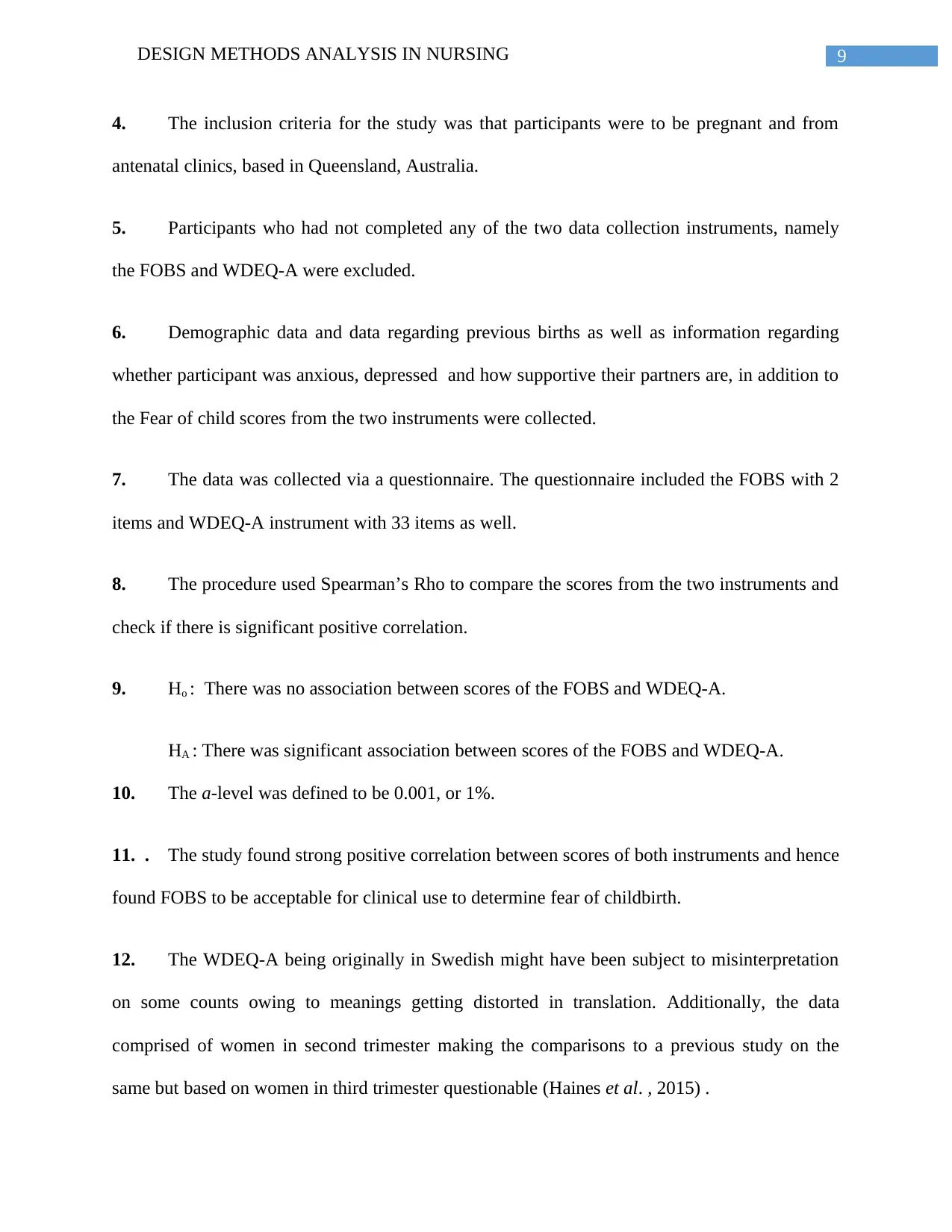
4. The inclusion criteria for the study was that participants were to be pregnant and from
antenatal clinics, based in Queensland, Australia.
5. Participants who had not completed any of the two data collection instruments, namely
the FOBS and WDEQ-A were excluded.
6. Demographic data and data regarding previous births as well as information regarding
whether participant was anxious, depressed and how supportive their partners are, in addition to
the Fear of child scores from the two instruments were collected.
7. The data was collected via a questionnaire. The questionnaire included the FOBS with 2
items and WDEQ-A instrument with 33 items as well.
8. The procedure used Spearman’s Rho to compare the scores from the two instruments and
check if there is significant positive correlation.
9. Ho : There was no association between scores of the FOBS and WDEQ-A.
HA : There was significant association between scores of the FOBS and WDEQ-A.
10. The a-level was defined to be 0.001, or 1%.
11. . The study found strong positive correlation between scores of both instruments and hence
found FOBS to be acceptable for clinical use to determine fear of childbirth.
12. The WDEQ-A being originally in Swedish might have been subject to misinterpretation
on some counts owing to meanings getting distorted in translation. Additionally, the data
comprised of women in second trimester making the comparisons to a previous study on the
same but based on women in third trimester questionable (Haines et al. , 2015) .
4. The inclusion criteria for the study was that participants were to be pregnant and from
antenatal clinics, based in Queensland, Australia.
5. Participants who had not completed any of the two data collection instruments, namely
the FOBS and WDEQ-A were excluded.
6. Demographic data and data regarding previous births as well as information regarding
whether participant was anxious, depressed and how supportive their partners are, in addition to
the Fear of child scores from the two instruments were collected.
7. The data was collected via a questionnaire. The questionnaire included the FOBS with 2
items and WDEQ-A instrument with 33 items as well.
8. The procedure used Spearman’s Rho to compare the scores from the two instruments and
check if there is significant positive correlation.
9. Ho : There was no association between scores of the FOBS and WDEQ-A.
HA : There was significant association between scores of the FOBS and WDEQ-A.
10. The a-level was defined to be 0.001, or 1%.
11. . The study found strong positive correlation between scores of both instruments and hence
found FOBS to be acceptable for clinical use to determine fear of childbirth.
12. The WDEQ-A being originally in Swedish might have been subject to misinterpretation
on some counts owing to meanings getting distorted in translation. Additionally, the data
comprised of women in second trimester making the comparisons to a previous study on the
same but based on women in third trimester questionable (Haines et al. , 2015) .
⊘ This is a preview!⊘
Do you want full access?
Subscribe today to unlock all pages.
Trusted by 1+ million students worldwide
10DESIGN METHODS ANALYSIS IN NURSING
13. The study demonstrates how spearman’s rank correlation could be used to validate
performance of data collection instruments. The study paves way for application of the same to
gauge instruments having to deal with other situations, such as depression.
Section 3:
The Chi-Square and Associated Statistics
1. True
2. The choice between these tests depends on several factors, including the relationship of
the two variables to each other.
3. When the two variables are independent of each other, one of three statistics is most
commonly used: a chi-square statistic, a chi-square statistics with a Yates’ correction, or a
Fisher’s exact test.
4. When the two variables are not independent of each other (e.g., two measures on the
same person or on paired subjects), then the McNemar test is used.
5. True
6. Assumptions of Chi-square test as per Kellar & Kelvin (2013):
a. The sample data is constituted by independent and randomly selected participants.
b. Two independent variables are to be compared
c. Variables are of ordinal or nominal scale with limited number of categories.
13. The study demonstrates how spearman’s rank correlation could be used to validate
performance of data collection instruments. The study paves way for application of the same to
gauge instruments having to deal with other situations, such as depression.
Section 3:
The Chi-Square and Associated Statistics
1. True
2. The choice between these tests depends on several factors, including the relationship of
the two variables to each other.
3. When the two variables are independent of each other, one of three statistics is most
commonly used: a chi-square statistic, a chi-square statistics with a Yates’ correction, or a
Fisher’s exact test.
4. When the two variables are not independent of each other (e.g., two measures on the
same person or on paired subjects), then the McNemar test is used.
5. True
6. Assumptions of Chi-square test as per Kellar & Kelvin (2013):
a. The sample data is constituted by independent and randomly selected participants.
b. Two independent variables are to be compared
c. Variables are of ordinal or nominal scale with limited number of categories.
Paraphrase This Document
Need a fresh take? Get an instant paraphrase of this document with our AI Paraphraser

11DESIGN METHODS ANALYSIS IN NURSING
d. Table is 2 X 2 with expected cell frequencies being at least 10.
e. Yates continuity correction used when cell frequencies are between 5 and 9
f. Fisher’s exact test used when cell frequencies less than 5
g. No more than 20% of cells should have cell frequency less than 5 in 2 X 2, otherwise use
Fisher’s exact test.
h. No cells exist with frequency 0
7. Assumptions in a McNemar test as per Kellar & Kelvin (2013):
a. Data is constituted by paired or matched samples
b. Two variables involved
c. Variables represent the paired data
d. Cell size is sufficient
8. An example of Chi-squared test could be comparison of test scores of a group of children
who underwent a particular routine with another group who did not, to determine whether such a
routine has an effect on their scores. This is because numbers would be fairly large.
9. An example of fisher’s exact test could be comparison a group of lung cancer patients
who underwent a particular treatment with another group who did not, to determine whether the
treatment had a positive effect. This is because numbers would be fairly small.
d. Table is 2 X 2 with expected cell frequencies being at least 10.
e. Yates continuity correction used when cell frequencies are between 5 and 9
f. Fisher’s exact test used when cell frequencies less than 5
g. No more than 20% of cells should have cell frequency less than 5 in 2 X 2, otherwise use
Fisher’s exact test.
h. No cells exist with frequency 0
7. Assumptions in a McNemar test as per Kellar & Kelvin (2013):
a. Data is constituted by paired or matched samples
b. Two variables involved
c. Variables represent the paired data
d. Cell size is sufficient
8. An example of Chi-squared test could be comparison of test scores of a group of children
who underwent a particular routine with another group who did not, to determine whether such a
routine has an effect on their scores. This is because numbers would be fairly large.
9. An example of fisher’s exact test could be comparison a group of lung cancer patients
who underwent a particular treatment with another group who did not, to determine whether the
treatment had a positive effect. This is because numbers would be fairly small.
12DESIGN METHODS ANALYSIS IN NURSING
10. Testing the consistency of answers by an interviewee, answering the same questions in
different situations, would serve as an example of a research question concerning McNemar’s
test.
11. Assumptions underlying the chi-square test as per Kellar & Kelvin (2013):
a. The data are in form of counts.
b. The sample size is adequate.
c. The variables are independent of each other.
12. 6 steps for computing a Chi-Square Statistic as per Kellar & Kelvin (2013):
a. Declare the null and alternate hypotheses
b. Define level of significance, determine the degrees of freedom and critical value for
chi-squared statistic.
c. Check whether assumptions are met or not
d. Compute cross tabulation table, relevant probabilities and unadjusted odds ratio
e. Compute the Chi square statistic from expected frequencies and deviation from them
for each cell
f. Determine whether statistically significant and hence make conclusion
13. The McNemar test is like the chi squared test, except it is used to test the statistical
significance of changes of two paired or non-independent measures of variables which are
dichotomous or takes only two values ( for example, yes or no). Multiple measures, on paired
variables, which may represent before test and after test metrics for multiple participants or trials
or observations from a matched control study.
10. Testing the consistency of answers by an interviewee, answering the same questions in
different situations, would serve as an example of a research question concerning McNemar’s
test.
11. Assumptions underlying the chi-square test as per Kellar & Kelvin (2013):
a. The data are in form of counts.
b. The sample size is adequate.
c. The variables are independent of each other.
12. 6 steps for computing a Chi-Square Statistic as per Kellar & Kelvin (2013):
a. Declare the null and alternate hypotheses
b. Define level of significance, determine the degrees of freedom and critical value for
chi-squared statistic.
c. Check whether assumptions are met or not
d. Compute cross tabulation table, relevant probabilities and unadjusted odds ratio
e. Compute the Chi square statistic from expected frequencies and deviation from them
for each cell
f. Determine whether statistically significant and hence make conclusion
13. The McNemar test is like the chi squared test, except it is used to test the statistical
significance of changes of two paired or non-independent measures of variables which are
dichotomous or takes only two values ( for example, yes or no). Multiple measures, on paired
variables, which may represent before test and after test metrics for multiple participants or trials
or observations from a matched control study.
⊘ This is a preview!⊘
Do you want full access?
Subscribe today to unlock all pages.
Trusted by 1+ million students worldwide

1 out of 20


Related Documents


Your All-in-One AI-Powered Toolkit for Academic Success.
+13062052269
info@desklib.com
Available 24*7 on WhatsApp / Email
![[object Object]](/_next/static/media/star-bottom.7253800d.svg)
Unlock your academic potential
Copyright © 2020–2026 A2Z Services. All Rights Reserved. Developed and managed by ZUCOL.