Clinical Errors and Prevention Strategies for Registered Nurses

Verified

Added on  2022/11/11

|1
|758
|254
Report
AI Summary
This report analyzes the case of a 75-year-old man, Wilfred Dockrill, admitted to the hospital with an asthma exacerbation and sensory deficits (deafness and poor vision), making him highly susceptible to clinical errors. The report identifies three primary clinical errors: errors in taking histories, errors in diagnosis, and errors in pharmacological interventions, detailing the potential consequences of each. It references relevant literature, including studies on communication and patient safety. The report then proposes four strategies to prevent these errors, including involving family members in the history-taking process, incorporating family and healthcare professionals in assessments, using written instructions, and utilizing sign language or alternative communication methods. The report emphasizes the importance of communication strategies to enhance patient safety and improve the quality of nursing care.
Document Page
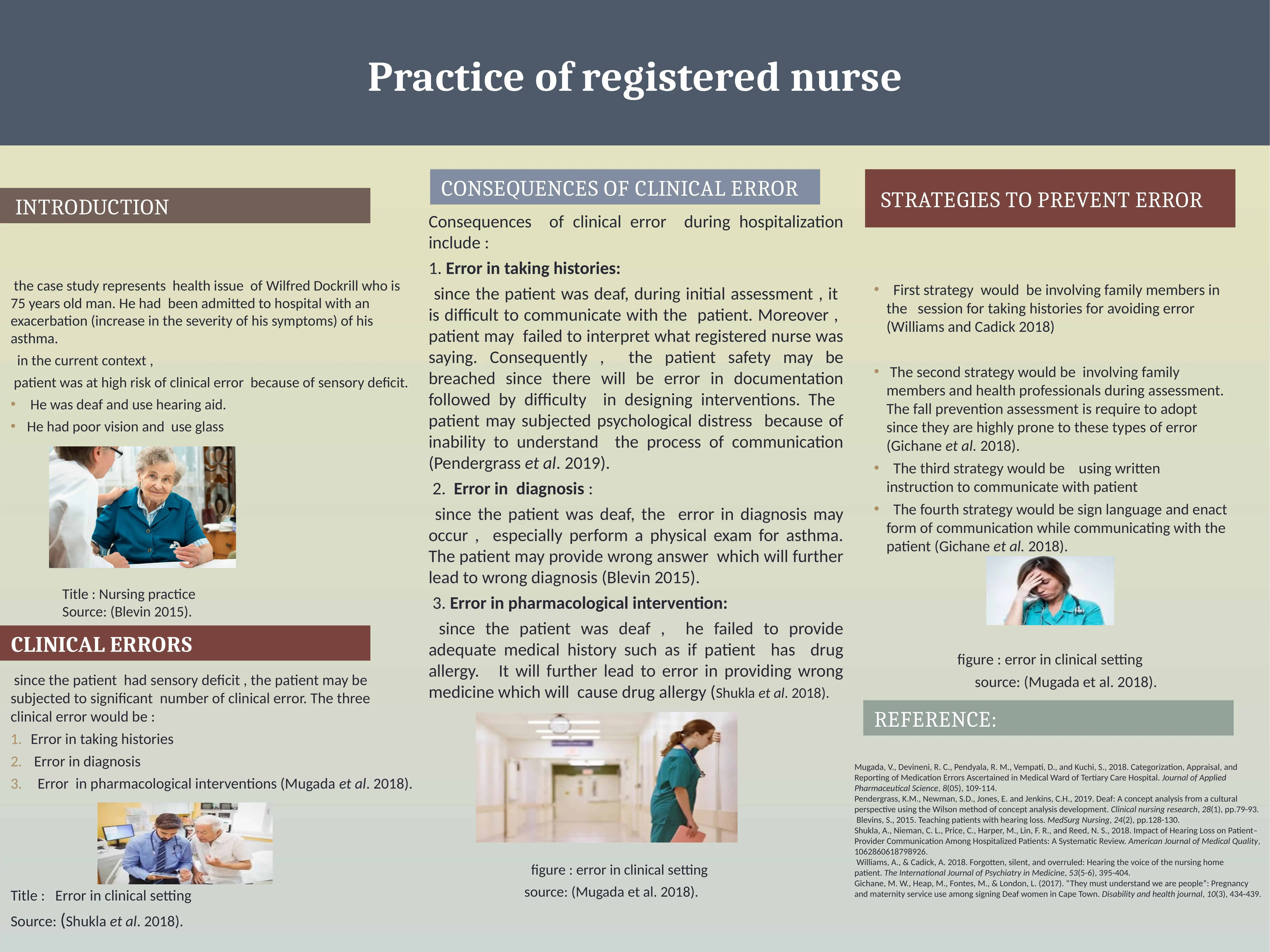
Practice of registered nurse
INTRODUCTION CONSEQUENCES OF CLINICAL ERROR
Consequences of clinical error during hospitalization
include :
1. Error in taking histories:
since the patient was deaf, during initial assessment , it
is difficult to communicate with the patient. Moreover ,
patient may failed to interpret what registered nurse was
saying. Consequently , the patient safety may be
breached since there will be error in documentation
followed by difficulty in designing interventions. The
patient may subjected psychological distress because of
inability to understand the process of communication
(Pendergrass et al. 2019).
2. Error in diagnosis :
since the patient was deaf, the error in diagnosis may
occur , especially perform a physical exam for asthma.
The patient may provide wrong answer which will further
lead to wrong diagnosis (Blevin 2015).
3. Error in pharmacological intervention:
since the patient was deaf , he failed to provide
adequate medical history such as if patient has drug
allergy. It will further lead to error in providing wrong
medicine which will cause drug allergy (Shukla et al. 2018).
figure : error in clinical setting
source: (Mugada et al. 2018).
the case study represents health issue of Wilfred Dockrill who is
75 years old man. He had been admitted to hospital with an
exacerbation (increase in the severity of his symptoms) of his
asthma.
in the current context ,
patient was at high risk of clinical error because of sensory deficit.
He was deaf and use hearing aid.
He had poor vision and use glass
CLINICAL ERRORS
since the patient had sensory deficit , the patient may be
subjected to significant number of clinical error. The three
clinical error would be :
1. Error in taking histories
2. Error in diagnosis
3. Error in pharmacological interventions (Mugada et al. 2018).
Title : Error in clinical setting
Source: (Shukla et al. 2018).
STRATEGIES TO PREVENT ERROR
REFERENCE:
First strategy would be involving family members in
the session for taking histories for avoiding error
(Williams and Cadick 2018)
The second strategy would be involving family
members and health professionals during assessment.
The fall prevention assessment is require to adopt
since they are highly prone to these types of error
(Gichane et al. 2018).
The third strategy would be using written
instruction to communicate with patient
The fourth strategy would be sign language and enact
form of communication while communicating with the
patient (Gichane et al. 2018).
figure : error in clinical setting
source: (Mugada et al. 2018).
Title : Nursing practice
Source: (Blevin 2015).
Mugada, V., Devineni, R. C., Pendyala, R. M., Vempati, D., and Kuchi, S., 2018. Categorization, Appraisal, and
Reporting of Medication Errors Ascertained in Medical Ward of Tertiary Care Hospital. Journal of Applied
Pharmaceutical Science, 8(05), 109-114.
Pendergrass, K.M., Newman, S.D., Jones, E. and Jenkins, C.H., 2019. Deaf: A concept analysis from a cultural
perspective using the Wilson method of concept analysis development. Clinical nursing research, 28(1), pp.79-93.
Blevins, S., 2015. Teaching patients with hearing loss. MedSurg Nursing, 24(2), pp.128-130.
Shukla, A., Nieman, C. L., Price, C., Harper, M., Lin, F. R., and Reed, N. S., 2018. Impact of Hearing Loss on Patient–
Provider Communication Among Hospitalized Patients: A Systematic Review. American Journal of Medical Quality,
1062860618798926.
Williams, A., & Cadick, A. 2018. Forgotten, silent, and overruled: Hearing the voice of the nursing home
patient. The International Journal of Psychiatry in Medicine, 53(5-6), 395-404.
Gichane, M. W., Heap, M., Fontes, M., & London, L. (2017). “They must understand we are people”: Pregnancy
and maternity service use among signing Deaf women in Cape Town. Disability and health journal, 10(3), 434-439.
tabler-icon-diamond-filled.svg

Paraphrase This Document

Need a fresh take? Get an instant paraphrase of this document with our AI Paraphraser
[object Object]