Registered Nurses Strategies for Chronic Disease Management
VerifiedAdded on 2022/10/04
|9
|2341
|14
Project
AI Summary
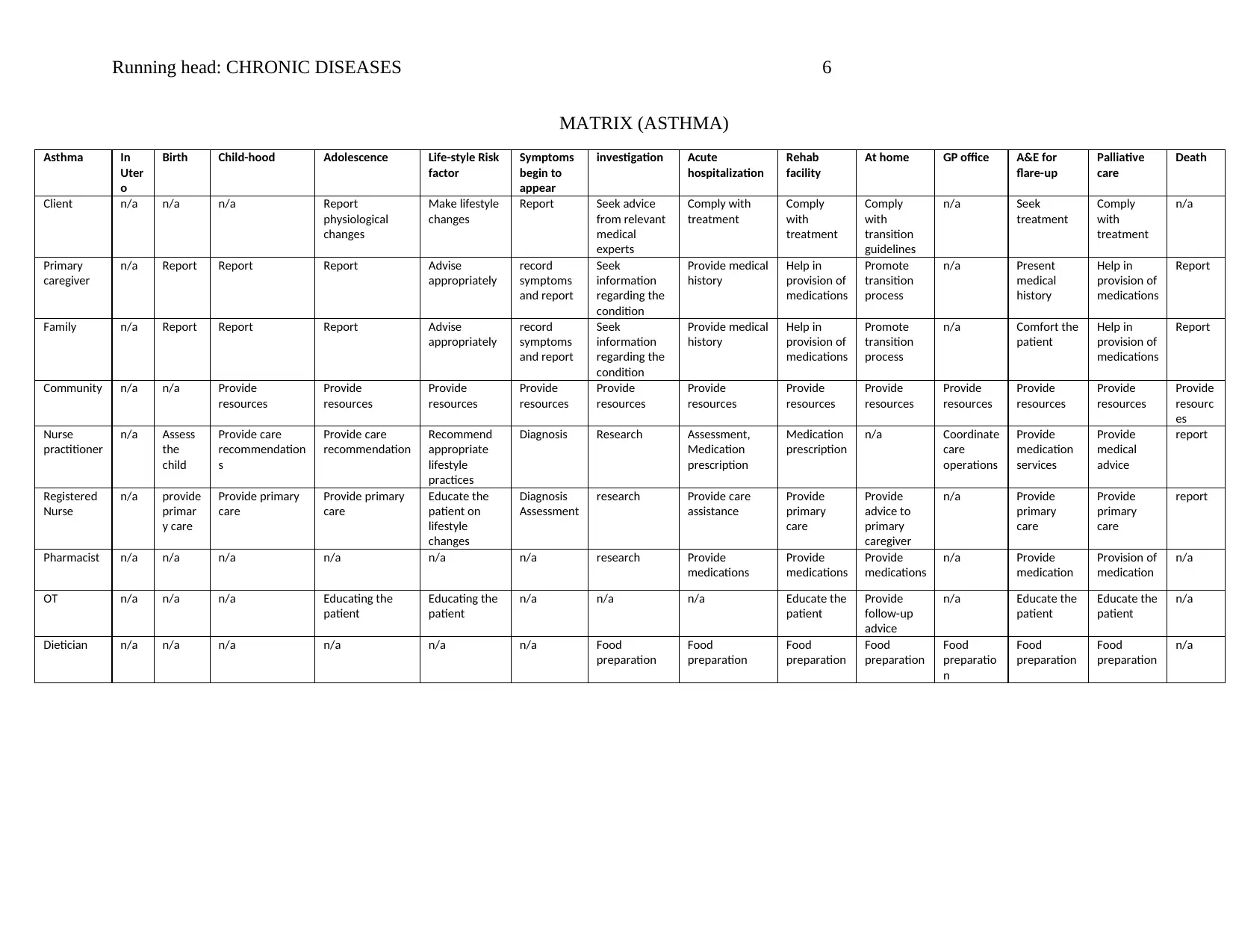
This assignment delves into the multifaceted role of registered nurses in managing patients with chronic diseases, emphasizing strategies to improve patient outcomes and streamline healthcare delivery. It explores the significance of registered nurses in coordinating care, educating patients, and promoting patient-centeredness, including the use of information and communication technology. The assignment further examines the application of rehabilitation principles to maintain and restore function, highlighting the objectives and components of effective rehabilitation programs. It also addresses the importance of supportive responses from nurses and the need for seamless transitions between healthcare settings to address the complex needs of patients with chronic conditions. The asthma matrix provides a practical framework for understanding the roles of various healthcare professionals and patients across different stages of the disease, from in utero to palliative care, and outlines the responsibilities and interventions required at each stage. The assignment uses multiple references to support the findings.

Running head: CHRONIC DISEASES 1
Chronic Diseases
Student’s Name
Institutional Affiliation
Chronic Diseases
Student’s Name
Institutional Affiliation

Paraphrase This Document
Need a fresh take? Get an instant paraphrase of this document with our AI Paraphraser
CHRONIC DISEASES 2
Chronic Diseases
Strategies Employed By Registered Nurses in the Management of Patients with A Wide
Range of Chronic Diseases
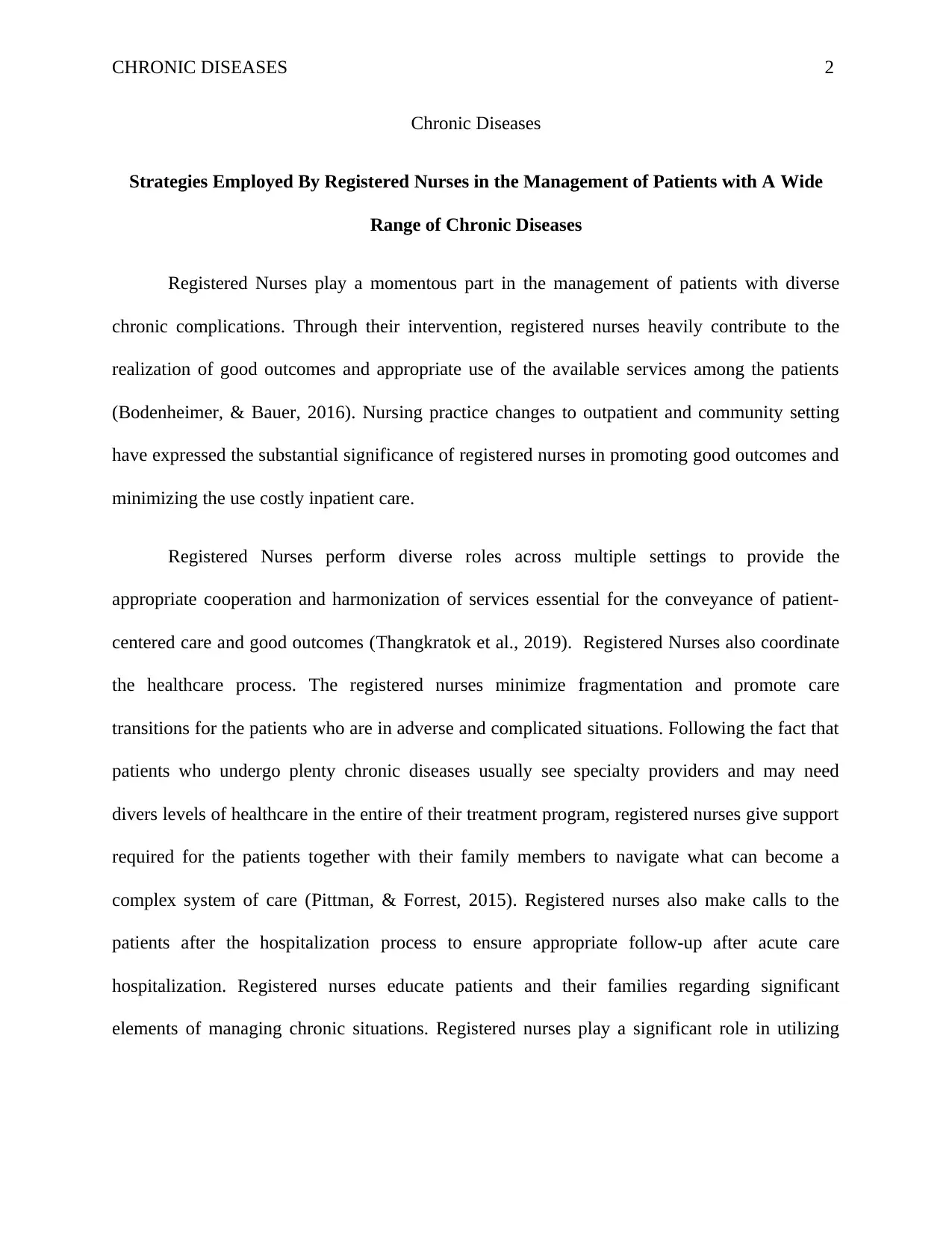
Registered Nurses play a momentous part in the management of patients with diverse
chronic complications. Through their intervention, registered nurses heavily contribute to the
realization of good outcomes and appropriate use of the available services among the patients
(Bodenheimer, & Bauer, 2016). Nursing practice changes to outpatient and community setting
have expressed the substantial significance of registered nurses in promoting good outcomes and
minimizing the use costly inpatient care.
Registered Nurses perform diverse roles across multiple settings to provide the
appropriate cooperation and harmonization of services essential for the conveyance of patient-
centered care and good outcomes (Thangkratok et al., 2019). Registered Nurses also coordinate
the healthcare process. The registered nurses minimize fragmentation and promote care
transitions for the patients who are in adverse and complicated situations. Following the fact that
patients who undergo plenty chronic diseases usually see specialty providers and may need
divers levels of healthcare in the entire of their treatment program, registered nurses give support
required for the patients together with their family members to navigate what can become a
complex system of care (Pittman, & Forrest, 2015). Registered nurses also make calls to the
patients after the hospitalization process to ensure appropriate follow-up after acute care
hospitalization. Registered nurses educate patients and their families regarding significant
elements of managing chronic situations. Registered nurses play a significant role in utilizing
Chronic Diseases
Strategies Employed By Registered Nurses in the Management of Patients with A Wide
Range of Chronic Diseases
Registered Nurses play a momentous part in the management of patients with diverse
chronic complications. Through their intervention, registered nurses heavily contribute to the
realization of good outcomes and appropriate use of the available services among the patients
(Bodenheimer, & Bauer, 2016). Nursing practice changes to outpatient and community setting
have expressed the substantial significance of registered nurses in promoting good outcomes and
minimizing the use costly inpatient care.
Registered Nurses perform diverse roles across multiple settings to provide the
appropriate cooperation and harmonization of services essential for the conveyance of patient-
centered care and good outcomes (Thangkratok et al., 2019). Registered Nurses also coordinate
the healthcare process. The registered nurses minimize fragmentation and promote care
transitions for the patients who are in adverse and complicated situations. Following the fact that
patients who undergo plenty chronic diseases usually see specialty providers and may need
divers levels of healthcare in the entire of their treatment program, registered nurses give support
required for the patients together with their family members to navigate what can become a
complex system of care (Pittman, & Forrest, 2015). Registered nurses also make calls to the
patients after the hospitalization process to ensure appropriate follow-up after acute care
hospitalization. Registered nurses educate patients and their families regarding significant
elements of managing chronic situations. Registered nurses play a significant role in utilizing
CHRONIC DISEASES 3
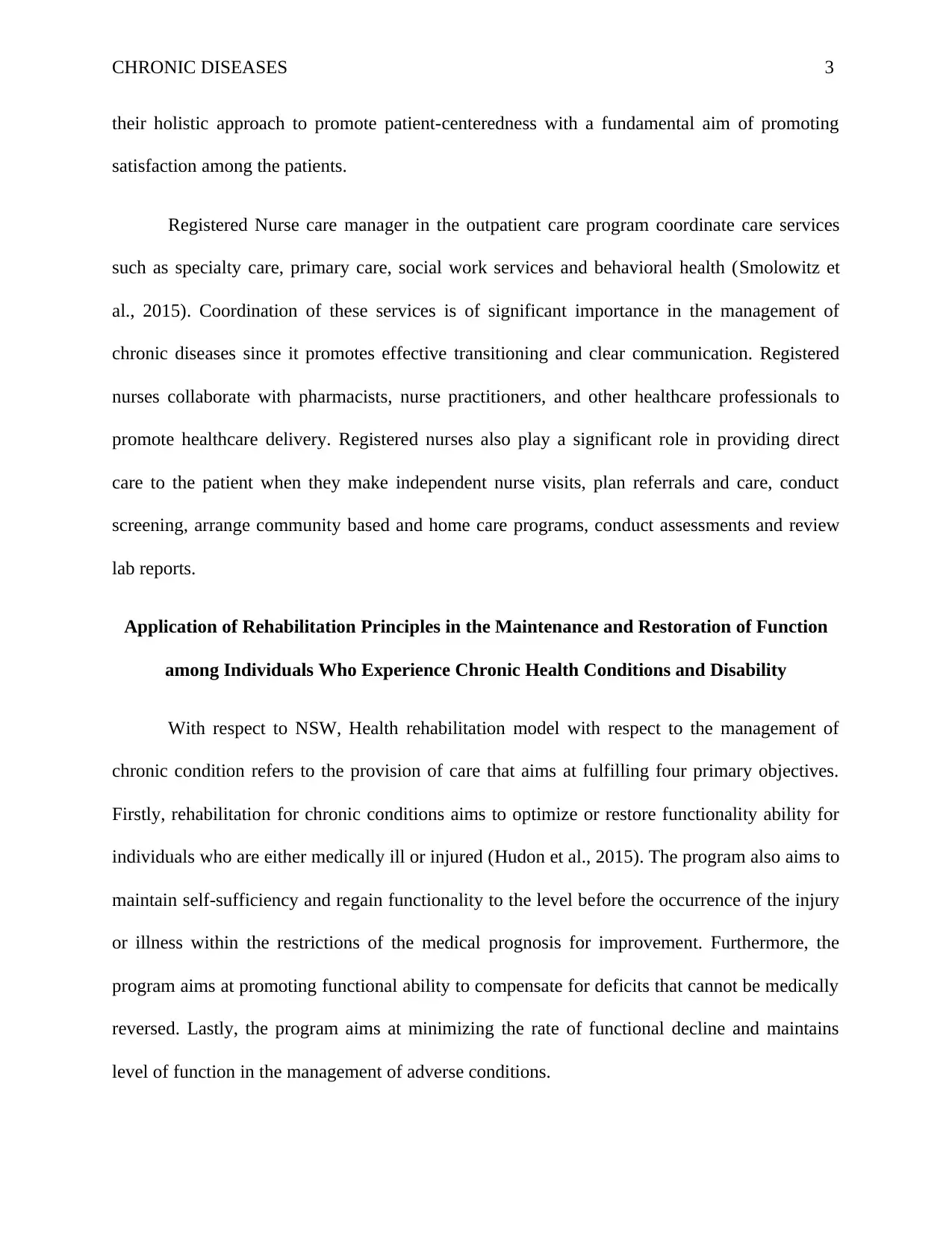
their holistic approach to promote patient-centeredness with a fundamental aim of promoting
satisfaction among the patients.
Registered Nurse care manager in the outpatient care program coordinate care services
such as specialty care, primary care, social work services and behavioral health (Smolowitz et
al., 2015). Coordination of these services is of significant importance in the management of
chronic diseases since it promotes effective transitioning and clear communication. Registered
nurses collaborate with pharmacists, nurse practitioners, and other healthcare professionals to
promote healthcare delivery. Registered nurses also play a significant role in providing direct
care to the patient when they make independent nurse visits, plan referrals and care, conduct
screening, arrange community based and home care programs, conduct assessments and review
lab reports.
Application of Rehabilitation Principles in the Maintenance and Restoration of Function
among Individuals Who Experience Chronic Health Conditions and Disability
With respect to NSW, Health rehabilitation model with respect to the management of
chronic condition refers to the provision of care that aims at fulfilling four primary objectives.
Firstly, rehabilitation for chronic conditions aims to optimize or restore functionality ability for
individuals who are either medically ill or injured (Hudon et al., 2015). The program also aims to
maintain self-sufficiency and regain functionality to the level before the occurrence of the injury
or illness within the restrictions of the medical prognosis for improvement. Furthermore, the
program aims at promoting functional ability to compensate for deficits that cannot be medically
reversed. Lastly, the program aims at minimizing the rate of functional decline and maintains
level of function in the management of adverse conditions.
their holistic approach to promote patient-centeredness with a fundamental aim of promoting
satisfaction among the patients.
Registered Nurse care manager in the outpatient care program coordinate care services
such as specialty care, primary care, social work services and behavioral health (Smolowitz et
al., 2015). Coordination of these services is of significant importance in the management of
chronic diseases since it promotes effective transitioning and clear communication. Registered
nurses collaborate with pharmacists, nurse practitioners, and other healthcare professionals to
promote healthcare delivery. Registered nurses also play a significant role in providing direct
care to the patient when they make independent nurse visits, plan referrals and care, conduct
screening, arrange community based and home care programs, conduct assessments and review
lab reports.
Application of Rehabilitation Principles in the Maintenance and Restoration of Function
among Individuals Who Experience Chronic Health Conditions and Disability
With respect to NSW, Health rehabilitation model with respect to the management of
chronic condition refers to the provision of care that aims at fulfilling four primary objectives.
Firstly, rehabilitation for chronic conditions aims to optimize or restore functionality ability for
individuals who are either medically ill or injured (Hudon et al., 2015). The program also aims to
maintain self-sufficiency and regain functionality to the level before the occurrence of the injury
or illness within the restrictions of the medical prognosis for improvement. Furthermore, the
program aims at promoting functional ability to compensate for deficits that cannot be medically
reversed. Lastly, the program aims at minimizing the rate of functional decline and maintains
level of function in the management of adverse conditions.
⊘ This is a preview!⊘
Do you want full access?
Subscribe today to unlock all pages.

Trusted by 1+ million students worldwide
CHRONIC DISEASES 4
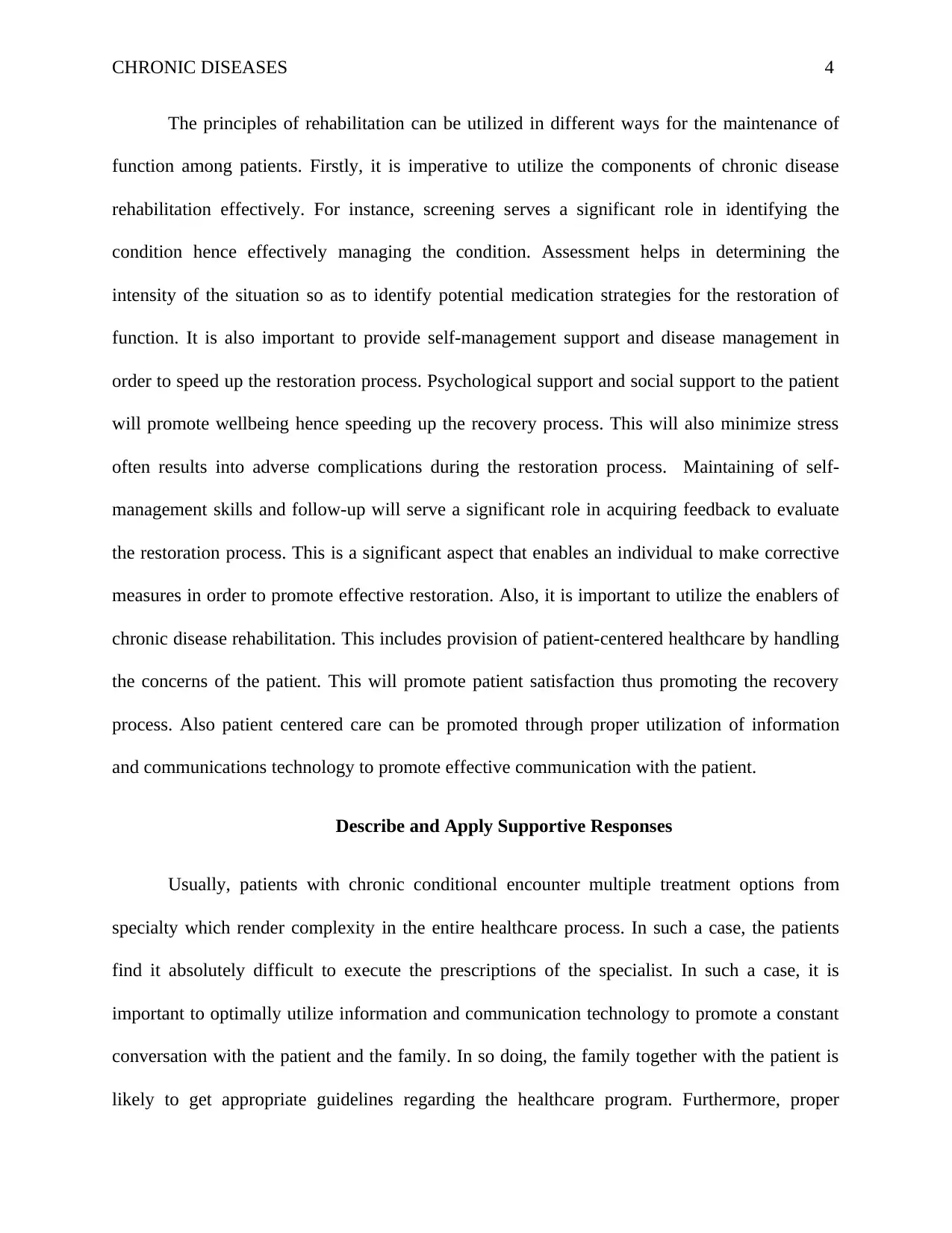
The principles of rehabilitation can be utilized in different ways for the maintenance of
function among patients. Firstly, it is imperative to utilize the components of chronic disease
rehabilitation effectively. For instance, screening serves a significant role in identifying the
condition hence effectively managing the condition. Assessment helps in determining the
intensity of the situation so as to identify potential medication strategies for the restoration of
function. It is also important to provide self-management support and disease management in
order to speed up the restoration process. Psychological support and social support to the patient
will promote wellbeing hence speeding up the recovery process. This will also minimize stress
often results into adverse complications during the restoration process. Maintaining of self-
management skills and follow-up will serve a significant role in acquiring feedback to evaluate
the restoration process. This is a significant aspect that enables an individual to make corrective
measures in order to promote effective restoration. Also, it is important to utilize the enablers of
chronic disease rehabilitation. This includes provision of patient-centered healthcare by handling
the concerns of the patient. This will promote patient satisfaction thus promoting the recovery
process. Also patient centered care can be promoted through proper utilization of information
and communications technology to promote effective communication with the patient.
Describe and Apply Supportive Responses
Usually, patients with chronic conditional encounter multiple treatment options from
specialty which render complexity in the entire healthcare process. In such a case, the patients
find it absolutely difficult to execute the prescriptions of the specialist. In such a case, it is
important to optimally utilize information and communication technology to promote a constant
conversation with the patient and the family. In so doing, the family together with the patient is
likely to get appropriate guidelines regarding the healthcare program. Furthermore, proper
The principles of rehabilitation can be utilized in different ways for the maintenance of
function among patients. Firstly, it is imperative to utilize the components of chronic disease
rehabilitation effectively. For instance, screening serves a significant role in identifying the
condition hence effectively managing the condition. Assessment helps in determining the
intensity of the situation so as to identify potential medication strategies for the restoration of
function. It is also important to provide self-management support and disease management in
order to speed up the restoration process. Psychological support and social support to the patient
will promote wellbeing hence speeding up the recovery process. This will also minimize stress
often results into adverse complications during the restoration process. Maintaining of self-
management skills and follow-up will serve a significant role in acquiring feedback to evaluate
the restoration process. This is a significant aspect that enables an individual to make corrective
measures in order to promote effective restoration. Also, it is important to utilize the enablers of
chronic disease rehabilitation. This includes provision of patient-centered healthcare by handling
the concerns of the patient. This will promote patient satisfaction thus promoting the recovery
process. Also patient centered care can be promoted through proper utilization of information
and communications technology to promote effective communication with the patient.
Describe and Apply Supportive Responses
Usually, patients with chronic conditional encounter multiple treatment options from
specialty which render complexity in the entire healthcare process. In such a case, the patients
find it absolutely difficult to execute the prescriptions of the specialist. In such a case, it is
important to optimally utilize information and communication technology to promote a constant
conversation with the patient and the family. In so doing, the family together with the patient is
likely to get appropriate guidelines regarding the healthcare program. Furthermore, proper
Paraphrase This Document
Need a fresh take? Get an instant paraphrase of this document with our AI Paraphraser
CHRONIC DISEASES 5
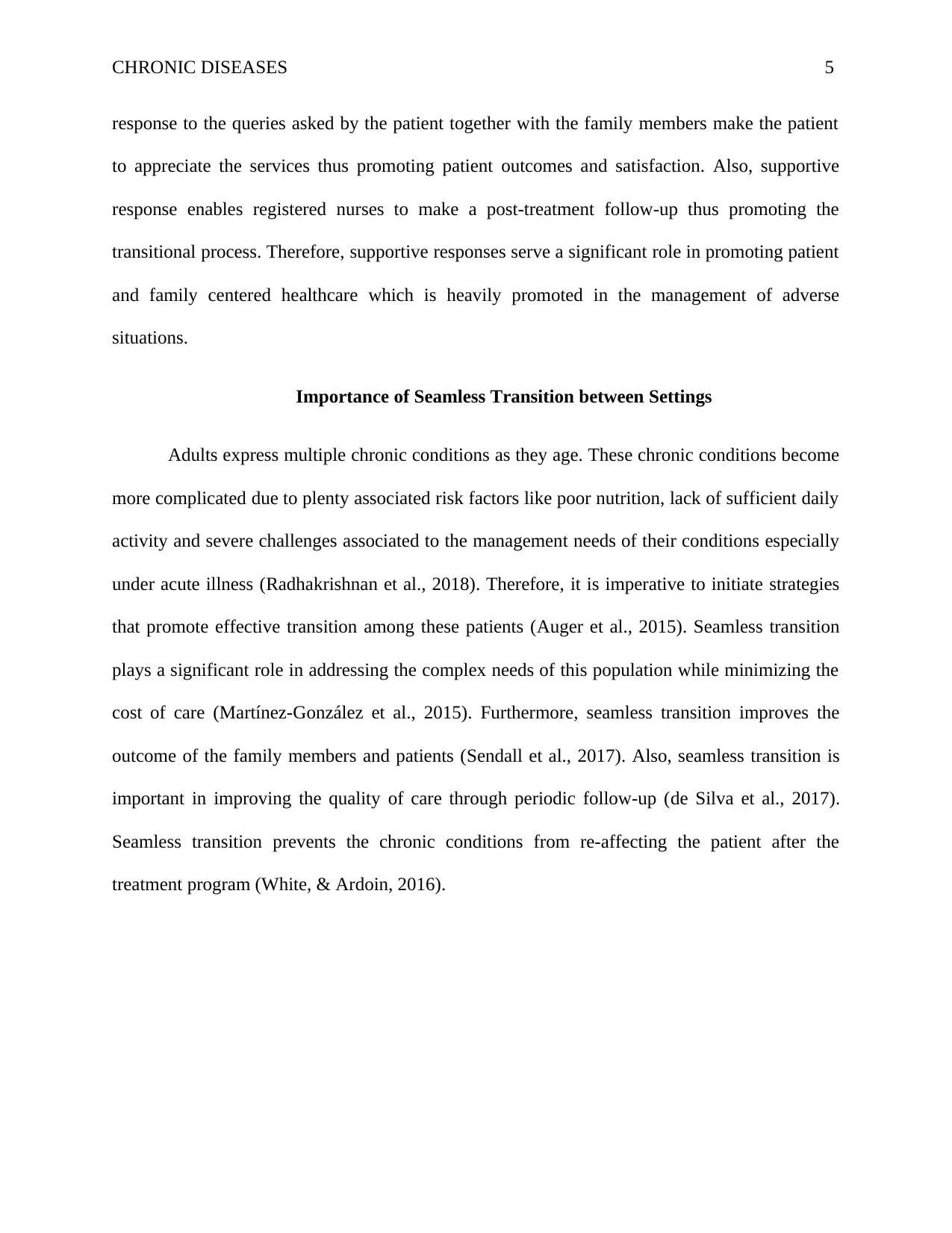
response to the queries asked by the patient together with the family members make the patient
to appreciate the services thus promoting patient outcomes and satisfaction. Also, supportive
response enables registered nurses to make a post-treatment follow-up thus promoting the
transitional process. Therefore, supportive responses serve a significant role in promoting patient
and family centered healthcare which is heavily promoted in the management of adverse
situations.
Importance of Seamless Transition between Settings
Adults express multiple chronic conditions as they age. These chronic conditions become
more complicated due to plenty associated risk factors like poor nutrition, lack of sufficient daily
activity and severe challenges associated to the management needs of their conditions especially
under acute illness (Radhakrishnan et al., 2018). Therefore, it is imperative to initiate strategies
that promote effective transition among these patients (Auger et al., 2015). Seamless transition
plays a significant role in addressing the complex needs of this population while minimizing the
cost of care (Martínez-González et al., 2015). Furthermore, seamless transition improves the
outcome of the family members and patients (Sendall et al., 2017). Also, seamless transition is
important in improving the quality of care through periodic follow-up (de Silva et al., 2017).
Seamless transition prevents the chronic conditions from re-affecting the patient after the
treatment program (White, & Ardoin, 2016).
response to the queries asked by the patient together with the family members make the patient
to appreciate the services thus promoting patient outcomes and satisfaction. Also, supportive
response enables registered nurses to make a post-treatment follow-up thus promoting the
transitional process. Therefore, supportive responses serve a significant role in promoting patient
and family centered healthcare which is heavily promoted in the management of adverse
situations.
Importance of Seamless Transition between Settings
Adults express multiple chronic conditions as they age. These chronic conditions become
more complicated due to plenty associated risk factors like poor nutrition, lack of sufficient daily
activity and severe challenges associated to the management needs of their conditions especially
under acute illness (Radhakrishnan et al., 2018). Therefore, it is imperative to initiate strategies
that promote effective transition among these patients (Auger et al., 2015). Seamless transition
plays a significant role in addressing the complex needs of this population while minimizing the
cost of care (Martínez-González et al., 2015). Furthermore, seamless transition improves the
outcome of the family members and patients (Sendall et al., 2017). Also, seamless transition is
important in improving the quality of care through periodic follow-up (de Silva et al., 2017).
Seamless transition prevents the chronic conditions from re-affecting the patient after the
treatment program (White, & Ardoin, 2016).
Running head: CHRONIC DISEASES 6
MATRIX (ASTHMA)
Asthma In
Uter
o
Birth Child-hood Adolescence Life-style Risk
factor
Symptoms
begin to
appear
investigation Acute
hospitalization
Rehab
facility
At home GP office A&E for
flare-up
Palliative
care
Death
Client n/a n/a n/a Report
physiological
changes
Make lifestyle
changes
Report Seek advice
from relevant
medical
experts
Comply with
treatment
Comply
with
treatment
Comply
with
transition
guidelines
n/a Seek
treatment
Comply
with
treatment
n/a
Primary
caregiver
n/a Report Report Report Advise
appropriately
record
symptoms
and report
Seek
information
regarding the
condition
Provide medical
history
Help in
provision of
medications
Promote
transition
process
n/a Present
medical
history
Help in
provision of
medications
Report
Family n/a Report Report Report Advise
appropriately
record
symptoms
and report
Seek
information
regarding the
condition
Provide medical
history
Help in
provision of
medications
Promote
transition
process
n/a Comfort the
patient
Help in
provision of
medications
Report
Community n/a n/a Provide
resources
Provide
resources
Provide
resources
Provide
resources
Provide
resources
Provide
resources
Provide
resources
Provide
resources
Provide
resources
Provide
resources
Provide
resources
Provide
resourc
es
Nurse
practitioner
n/a Assess
the
child
Provide care
recommendation
s
Provide care
recommendation
Recommend
appropriate
lifestyle
practices
Diagnosis Research Assessment,
Medication
prescription
Medication
prescription
n/a Coordinate
care
operations
Provide
medication
services
Provide
medical
advice
report
Registered
Nurse
n/a provide
primar
y care
Provide primary
care
Provide primary
care
Educate the
patient on
lifestyle
changes
Diagnosis
Assessment
research Provide care
assistance
Provide
primary
care
Provide
advice to
primary
caregiver
n/a Provide
primary
care
Provide
primary
care
report
Pharmacist n/a n/a n/a n/a n/a n/a research Provide
medications
Provide
medications
Provide
medications
n/a Provide
medication
Provision of
medication
n/a
OT n/a n/a n/a Educating the
patient
Educating the
patient
n/a n/a n/a Educate the
patient
Provide
follow-up
advice
n/a Educate the
patient
Educate the
patient
n/a
Dietician n/a n/a n/a n/a n/a n/a Food
preparation
Food
preparation
Food
preparation
Food
preparation
Food
preparatio
n
Food
preparation
Food
preparation
n/a
MATRIX (ASTHMA)
Asthma In
Uter
o
Birth Child-hood Adolescence Life-style Risk
factor
Symptoms
begin to
appear
investigation Acute
hospitalization
Rehab
facility
At home GP office A&E for
flare-up
Palliative
care
Death
Client n/a n/a n/a Report
physiological
changes
Make lifestyle
changes
Report Seek advice
from relevant
medical
experts
Comply with
treatment
Comply
with
treatment
Comply
with
transition
guidelines
n/a Seek
treatment
Comply
with
treatment
n/a
Primary
caregiver
n/a Report Report Report Advise
appropriately
record
symptoms
and report
Seek
information
regarding the
condition
Provide medical
history
Help in
provision of
medications
Promote
transition
process
n/a Present
medical
history
Help in
provision of
medications
Report
Family n/a Report Report Report Advise
appropriately
record
symptoms
and report
Seek
information
regarding the
condition
Provide medical
history
Help in
provision of
medications
Promote
transition
process
n/a Comfort the
patient
Help in
provision of
medications
Report
Community n/a n/a Provide
resources
Provide
resources
Provide
resources
Provide
resources
Provide
resources
Provide
resources
Provide
resources
Provide
resources
Provide
resources
Provide
resources
Provide
resources
Provide
resourc
es
Nurse
practitioner
n/a Assess
the
child
Provide care
recommendation
s
Provide care
recommendation
Recommend
appropriate
lifestyle
practices
Diagnosis Research Assessment,
Medication
prescription
Medication
prescription
n/a Coordinate
care
operations
Provide
medication
services
Provide
medical
advice
report
Registered
Nurse
n/a provide
primar
y care
Provide primary
care
Provide primary
care
Educate the
patient on
lifestyle
changes
Diagnosis
Assessment
research Provide care
assistance
Provide
primary
care
Provide
advice to
primary
caregiver
n/a Provide
primary
care
Provide
primary
care
report
Pharmacist n/a n/a n/a n/a n/a n/a research Provide
medications
Provide
medications
Provide
medications
n/a Provide
medication
Provision of
medication
n/a
OT n/a n/a n/a Educating the
patient
Educating the
patient
n/a n/a n/a Educate the
patient
Provide
follow-up
advice
n/a Educate the
patient
Educate the
patient
n/a
Dietician n/a n/a n/a n/a n/a n/a Food
preparation
Food
preparation
Food
preparation
Food
preparation
Food
preparatio
n
Food
preparation
Food
preparation
n/a
⊘ This is a preview!⊘
Do you want full access?
Subscribe today to unlock all pages.
Trusted by 1+ million students worldwide
Running head: CHRONIC DISEASES 7
References
Auger, K. A., Simon, T. D., Cooperberg, D., Gay, J., Kuo, D. Z., Saysana, M., ... & Coghlin, D.
(2015). Summary of STARNet: seamless transitions and (re) admissions
network. Pediatrics, 135(1), 164-175.
Bodenheimer, T., & Bauer, L. (2016). Rethinking the primary care workforce—an expanded role
for nurses. New England journal of medicine, 375(11), 1015-1017.
Coughlan, C., McGeorge, E., Fawcett, M., Smith, A., Slade, C., Thompson, N., ... & Klaber, R.
(2019). G38 (P) The asthma big room: improving childhood asthma management.
de Silva, P. S., & Fishman, L. N. (2017). The Transition of the Gastrointestinal Patient from
Pediatric to Adult Care. Pediatric Clinics, 64(3), 707-720.
Erwin, K., Martin, M. A., Flippin, T., Norell, S., Shadlyn, A., Yang, J., ... & Margellos-Anast, H.
(2016). Engaging stakeholders to design a comparative effectiveness trial in children with
uncontrolled asthma. Journal of comparative effectiveness research, 5(1), 17-30.
Hudon, C., Chouinard, M. C., Diadiou, F., Lambert, M., & Bouliane, D. (2015). Case
management in primary care for frequent users of health care services with chronic
diseases: a qualitative study of patient and family experience. The Annals of Family
Medicine, 13(6), 523-528.
Martínez-González, N. A., Rosemann, T., Tandjung, R., & Djalali, S. (2015). The effect of
physician-nurse substitution in primary care in chronic diseases: a systematic
review. Swiss medical weekly, 145(0506).
Mossialos, E., Courtin, E., Naci, H., Benrimoj, S., Bouvy, M., Farris, K., ... & Sketris, I. (2015).
From “retailers” to health care providers: transforming the role of community
pharmacists in chronic disease management. Health policy, 119(5), 628-639.
References
Auger, K. A., Simon, T. D., Cooperberg, D., Gay, J., Kuo, D. Z., Saysana, M., ... & Coghlin, D.
(2015). Summary of STARNet: seamless transitions and (re) admissions
network. Pediatrics, 135(1), 164-175.
Bodenheimer, T., & Bauer, L. (2016). Rethinking the primary care workforce—an expanded role
for nurses. New England journal of medicine, 375(11), 1015-1017.
Coughlan, C., McGeorge, E., Fawcett, M., Smith, A., Slade, C., Thompson, N., ... & Klaber, R.
(2019). G38 (P) The asthma big room: improving childhood asthma management.
de Silva, P. S., & Fishman, L. N. (2017). The Transition of the Gastrointestinal Patient from
Pediatric to Adult Care. Pediatric Clinics, 64(3), 707-720.
Erwin, K., Martin, M. A., Flippin, T., Norell, S., Shadlyn, A., Yang, J., ... & Margellos-Anast, H.
(2016). Engaging stakeholders to design a comparative effectiveness trial in children with
uncontrolled asthma. Journal of comparative effectiveness research, 5(1), 17-30.
Hudon, C., Chouinard, M. C., Diadiou, F., Lambert, M., & Bouliane, D. (2015). Case
management in primary care for frequent users of health care services with chronic
diseases: a qualitative study of patient and family experience. The Annals of Family
Medicine, 13(6), 523-528.
Martínez-González, N. A., Rosemann, T., Tandjung, R., & Djalali, S. (2015). The effect of
physician-nurse substitution in primary care in chronic diseases: a systematic
review. Swiss medical weekly, 145(0506).
Mossialos, E., Courtin, E., Naci, H., Benrimoj, S., Bouvy, M., Farris, K., ... & Sketris, I. (2015).
From “retailers” to health care providers: transforming the role of community
pharmacists in chronic disease management. Health policy, 119(5), 628-639.
Paraphrase This Document
Need a fresh take? Get an instant paraphrase of this document with our AI Paraphraser
CHRONIC DISEASES 8
Peláez, S., Bacon, S. L., Lacoste, G., & Lavoie, K. L. (2016). How can adherence to asthma
medication be enhanced? Triangulation of key asthma stakeholders' perspectives. Journal
of Asthma, 53(10), 1076-1084.
Pittman, P., & Forrest, E. (2015). The changing roles of registered nurses in Pioneer Accountable
Care Organizations. Nursing outlook, 63(5), 554-565.
Radhakrishnan, K., Jones, T. L., Weems, D., Knight, T. W., & Rice, W. H. (2018). Seamless
transitions: achieving patient safety through communication and collaboration. Journal of
patient safety, 14(1), e3-e5.
Riley, I., Pleasants, R. A., Crabtree, D., Riebel, S., Svetkey, L., Que, L. G., ... & Boulware, L. E.
(2019). AdheRence to Inhaled Corticosteroids in Asthma (ARICA): Intervention
Development. In D22. REAL WORLD MEDICATION USE IN PULMONARY
DISEASES (pp. A5939-A5939). American Thoracic Society.
Sendall, M., McCosker, L., Crossley, K., & Bonner, A. (2017). A structured review of chronic
care model components supporting transition between healthcare service delivery types
for older people with multiple chronic diseases. Health Information Management
Journal, 46(2), 58-68.
Smolowitz, J., Speakman, E., Wojnar, D., Whelan, E. M., Ulrich, S., Hayes, C., & Wood, L.
(2015). Role of the registered nurse in primary health care: meeting health care needs in
the 21st century. Nursing Outlook, 63(2), 130-136.
Thangkratok, P., Vararuk, A., Silawan, T., & Piaseu, N. (2019). Role of nurses in implementing
chronic care model in subdistrict health promoting hospital. Science, Engineering and
Health Studies (FORMER NAME" SILPAKORN UNIVERSITY SCIENCE AND
TECHNOLOGY JOURNAL"), 83-92.
Peláez, S., Bacon, S. L., Lacoste, G., & Lavoie, K. L. (2016). How can adherence to asthma
medication be enhanced? Triangulation of key asthma stakeholders' perspectives. Journal
of Asthma, 53(10), 1076-1084.
Pittman, P., & Forrest, E. (2015). The changing roles of registered nurses in Pioneer Accountable
Care Organizations. Nursing outlook, 63(5), 554-565.
Radhakrishnan, K., Jones, T. L., Weems, D., Knight, T. W., & Rice, W. H. (2018). Seamless
transitions: achieving patient safety through communication and collaboration. Journal of
patient safety, 14(1), e3-e5.
Riley, I., Pleasants, R. A., Crabtree, D., Riebel, S., Svetkey, L., Que, L. G., ... & Boulware, L. E.
(2019). AdheRence to Inhaled Corticosteroids in Asthma (ARICA): Intervention
Development. In D22. REAL WORLD MEDICATION USE IN PULMONARY
DISEASES (pp. A5939-A5939). American Thoracic Society.
Sendall, M., McCosker, L., Crossley, K., & Bonner, A. (2017). A structured review of chronic
care model components supporting transition between healthcare service delivery types
for older people with multiple chronic diseases. Health Information Management
Journal, 46(2), 58-68.
Smolowitz, J., Speakman, E., Wojnar, D., Whelan, E. M., Ulrich, S., Hayes, C., & Wood, L.
(2015). Role of the registered nurse in primary health care: meeting health care needs in
the 21st century. Nursing Outlook, 63(2), 130-136.
Thangkratok, P., Vararuk, A., Silawan, T., & Piaseu, N. (2019). Role of nurses in implementing
chronic care model in subdistrict health promoting hospital. Science, Engineering and
Health Studies (FORMER NAME" SILPAKORN UNIVERSITY SCIENCE AND
TECHNOLOGY JOURNAL"), 83-92.
CHRONIC DISEASES 9
Watkins, K., Fisher, C., Misaghian, J., Schneider, C. R., & Clifford, R. (2016). A qualitative
evaluation of the implementation of guidelines and a support tool for asthma management
in primary care. Asthma research and practice, 2(1), 8.
White, P. H., & Ardoin, S. (2016). Transitioning wisely: improving the connection from
pediatric to adult health care. Arthritis & Rheumatology, 68(4), 789-794.
Watkins, K., Fisher, C., Misaghian, J., Schneider, C. R., & Clifford, R. (2016). A qualitative
evaluation of the implementation of guidelines and a support tool for asthma management
in primary care. Asthma research and practice, 2(1), 8.
White, P. H., & Ardoin, S. (2016). Transitioning wisely: improving the connection from
pediatric to adult health care. Arthritis & Rheumatology, 68(4), 789-794.
⊘ This is a preview!⊘
Do you want full access?
Subscribe today to unlock all pages.
Trusted by 1+ million students worldwide

1 out of 9


Related Documents


Your All-in-One AI-Powered Toolkit for Academic Success.
+13062052269
info@desklib.com
Available 24*7 on WhatsApp / Email
![[object Object]](/_next/static/media/star-bottom.7253800d.svg)
Unlock your academic potential
Copyright © 2020–2026 A2Z Services. All Rights Reserved. Developed and managed by ZUCOL.