Nursing Education: Technology Gap Assessment - University

Verified

Added on  2023/06/11

|7
|1502
|177
Report
AI Summary
This report presents a technology gap assessment in nursing education at the University of Missouri. It highlights the university's commitment to using modern technology in nursing education for teaching, assessment, and student progress monitoring. The report recommends improvements, including purchasing new technologies and repairing existing equipment. The benefits of technology use are tracked using metrics such as effectiveness, efficiency, acceptance, and productivity, aligned with the university's mission and values. A SWOT analysis identifies strengths, weaknesses, opportunities, and threats related to technology use, emphasizing the importance of adapting to technological advancements to enhance the learning experience and prepare students for clinical practice. The report also suggests the use of highly trained staff and faculty to mentor and coach the students. The university is aiming at adaptive, personalized and progressive learning process.
Document Page
Running head: NURSING EDUCATION 1
Nursing Education
Name
Institution
tabler-icon-diamond-filled.svg

Paraphrase This Document

Need a fresh take? Get an instant paraphrase of this document with our AI Paraphraser
Document Page
NURSING EDUCATION 2
Nursing Education
Report to the Executive Team
As a leader of the nursing education team, I would like to begin this report by pointing
out that the University of Missouri has been embracing the use of modern technology in the
delivery of education services to the nurses. The nurses have also been using technology in their
day-to-day endeavors. As an organization, we have always been committed to the delivery of
exceptionally high-quality educational services to our nurses. The main reason for doing that is
that we always look forward to generating a pool of competent nurses whom the public can trust
with the life. That is why the university has been adopting a policy of progressiveness and
adaptability to modern technological developments in the field of nursing and health care in
general.
Currently, the university uses modern Information and Communication Technology
(ICT) to teach, assess, track, and monitor the progress of the nursing students. All these are done
using computers, internet, sophisticated software, and applications specially designed and
developed for the teaching and learning processes in the institution. Despite prioritizing the use
of modern technologies in the training of our learners, I would like to say without any fear of
contradiction, that it is a high time the management of the University of Missouri improves its
technology. In my recommendation, the management should consider making appropriate
changes to its technology. The first change that should be implemented is the purchasing of new
technologies and availing them for use by the instructors and learners. The argument behind this
proposal is that there are new technologies that have not been acquired by the institution.
However, in order to achieve its goal of being a progressive and adaptable institution, the
Document Page
NURSING EDUCATION 3
management must ensure that it has all the latest innovations (Button, Harrington & Belan,
2014). Apart from acquiring new technologies, the management should take the necessary
measures to repair all the equipments that are currently out of order, but can still be useful as
long as they are not obsolete. All these changes should be introduced because they can be of
great contribution in the propelling the university to the next levels.
The senior management of the University of Missouri must consider making such
changes in its system because it needs to have state-of-the-art equipments. Such changes should
be done because they would get rid of the obsolete equipments, and avail new technologies that
will be relied upon to improve the quality of educational services delivered to the learners. The
benefits of technology use can be tracked by using appropriate metrics such as effectiveness,
efficiency, acceptance of the equipments, and the quality of productivity (Billings & Halstead,
2015). Meaning, the overall success of the new technology should be pegged on the changes in
the output. However, to get that information, data should be collected using appropriate
instruments such as surveys.
The mission of the University of Missouri is to be the Missouri’s only public research
and doctoral-level institution, is to discover, disseminate, preserve, and apply knowledge. The
university promotes learning by its students and lifelong learning by Missouri’s citizens, fosters
innovation to support economic development, and advances the health, cultural, and social
interests of the people of Missouri, the nation, and the world. The data collected should be
aligned with the institution’s visions, missions, outcomes, and values because they should be
implemented based on certain standard objectives set in line with the university’s internal
policies. However, to improve the quality of data gathered, the data-collection process should be
professionally handled (Mastrian, McGonigle, Mahan & Bixler, 2011). This implies that it should be
Document Page
NURSING EDUCATION 4
collected by a team of qualified personnel who have a sound knowledge on data collection. The
data-collection instruments should be valid and reliable. At the same time, the data-collection
process should not be biased but be objective because it is the only way through which accurate
data can be generated (Billings & Halstead, 2015). If all these are done as proposed, the
management will manage to collect valid data that can be relied upon to understand the status of
technology as well as come up with well-thought decisions on the right kind of improvements to
make.
Gap Analysis
The use of technology in the University of Missouri has been done, but perfectly as it
ought to. Meaning, despite the efforts made, there are still a few weak areas that can be improved
if appropriate measures are taken. Having said this, it is worth noting that the gap analysis in the
company’s use of technology can be done by applying the SWOT analysis. SWOT is an acronym
for strengths, weaknesses, opportunities, and threats. In order to optimally and effectively utilize
modern technology in training its learners, it must be equipped with the necessary information on
the strengths, weaknesses, opportunities, and threats that revolve around its usage.
In this institution, technology has been identified as one of the most important strategies
that must be adopted whenever possible. In order to teach the learners, the organization has been
relying on modern technological innovations that can enable it to effectively discharge this role.
The learners are taught using technology because it can improve their learning experience as well
as expose them to the various technological innovations that they will use once they begin their
nursing practice (Thomas, 2015). This is a clear proof that adaptability to modern technologies
tabler-icon-diamond-filled.svg

Paraphrase This Document

Need a fresh take? Get an instant paraphrase of this document with our AI Paraphraser
Document Page
NURSING EDUCATION 5
can be fruitful to the learners since it gives them the exposure that they require at all times. Each
of the available technology knowledge is offered by a team of highly-trained and experienced
staff that has a sound knowledge of modern innovations hence can be used as resourceful
mentors and coaches.
Currently, the University of Missouri uses technologies which are aimed at adaptive,
personalized, and progressive learning process. The strengths of this technology are that it has
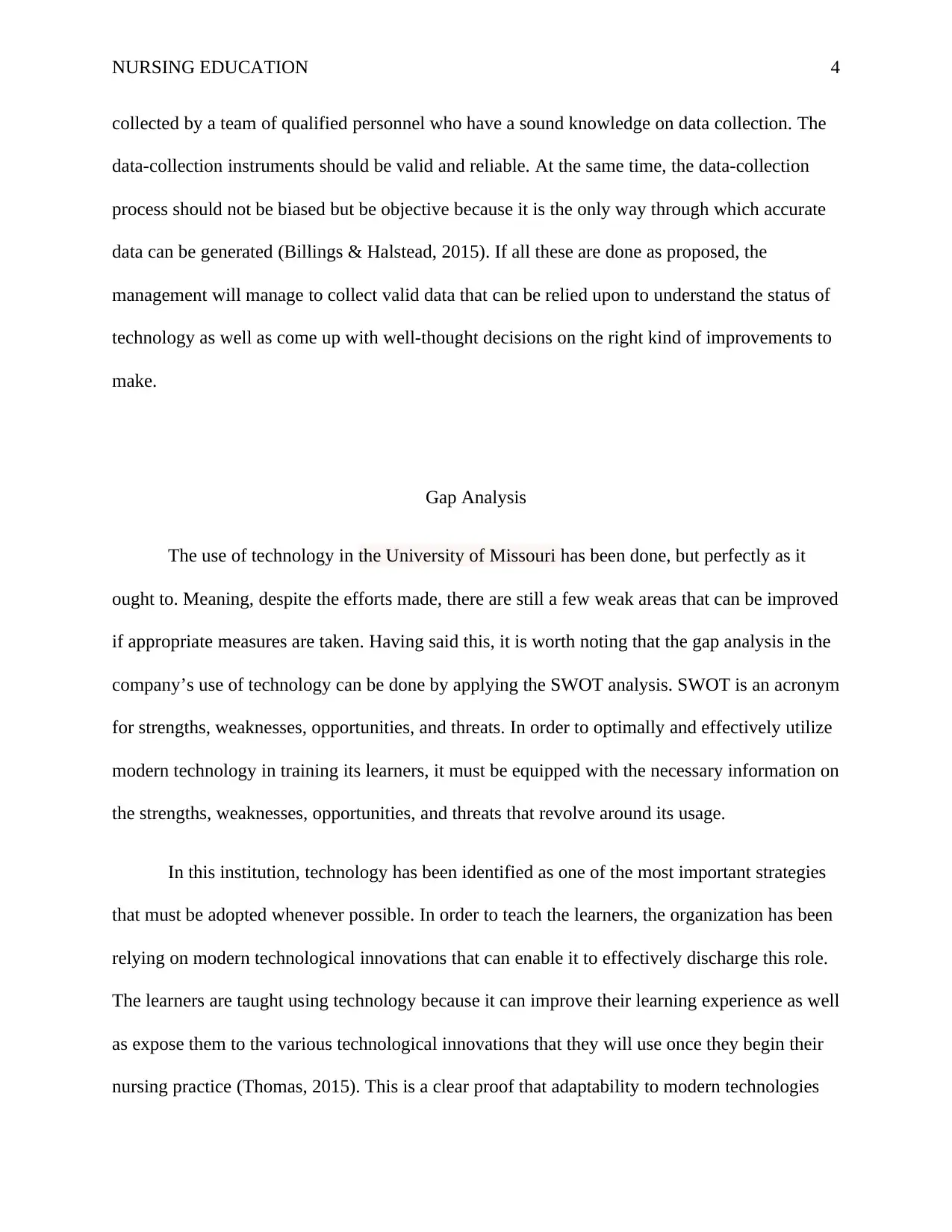
been availed and supported by the management which has been providing the required financial
assistance. The weaknesses are that there are issues with the supply, repair and continued
replacement of worn out equipments. However, the university has opportunities to increase
funding, student enrolment, faculties, and adopt more technologies as much as it can. However,
the threats that might bar the organization from effectively utilizing technology are budget
constraints and the speedy pace of technological progression that requires high adaptability
(Iwasiw, Goldenberg & Andrusyszyn, 2014). These are the issues that surround the application
of modern technology in the organization. Despite the hurdles that stand on its way, the
institution still has high chances of using modern trends in technology to improve its teaching
and learning process and be in a position of leading a positive impact on its learners (Mastrian,
McGonigle, Mahan & Bixler, 2011). It is the only way through which the learners can acquaint
themselves with the knowledge, practices, and skills that they require as far as clinical
technology is concerned.
Document Page
NURSING EDUCATION 6
References
Billings, D. M., & Halstead, J. A. (2015). Teaching in Nursing-E-Book: A Guide for Faculty.
New York: Elsevier Health Sciences.
Button, D., Harrington, A., & Belan, I. (2014). E-learning & information communication
technology (ICT) in nursing education: A review of the literature. Nurse Education
Today, 34(10), 1311-1323.
Iwasiw, C. L., Goldenberg, D., & Andrusyszyn, M. A. (2014). Curriculum development in
nursing education.Barlington: Jones & Bartlett Publishers.
Mastrian, K. G., McGonigle, D., Mahan, W. L., & Bixler, B. (2011). Integrating technology in nursing education: Tools
for the knowledge era. Sudbury, MA: Jones and Bartlett.
Thomas, P. A. (2015). Curriculum development for medical education: a six-step approach.
Baltimore: JHU Press.
Document Page
NURSING EDUCATION 7
Appendices
Appendix 1: SWOT Analysis Table
chevron_up_icon
1 out of 7
circle_padding
hide_on_mobile
zoom_out_icon
[object Object]