Nursing as Health Advocacy: Advocating for Veteran Healthcare Needs

Verified

Added on  2023/04/20

|5
|1304
|368
Discussion Board Post
AI Summary
This discussion post examines the role of nurses as health advocates, particularly focusing on the healthcare needs of returning veterans and their families. The student analyzes two articles: "On being a good nurse: Reflections on the past and preparing for the future" and "War, its aftermath, and U.S. health policy: Toward a comprehensive health program for America's military personnel, veterans, and their families." The post identifies physical and mental health challenges faced by veterans, including homelessness and suicide rates, and emphasizes the importance of nurses developing advocacy skills. These skills include assessing patient needs, communication, education, providing insurance information, and demonstrating compassion. The student argues that an integrated approach involving patients, nurses, and the healthcare sector is essential for effectively addressing veterans' needs. The student highlights the significance of nurses in protecting veterans' rights and addressing their concerns, ultimately aiming to improve the quality of healthcare for this population.
Document Page
Running head: NURSING AS HEALTH ADVOCACY
Nursing as Health Advocacy
Name of the student
Name of the university
Author note
tabler-icon-diamond-filled.svg

Paraphrase This Document

Need a fresh take? Get an instant paraphrase of this document with our AI Paraphraser
Document Page
1NURSING AS HEALTH ADVOCACY
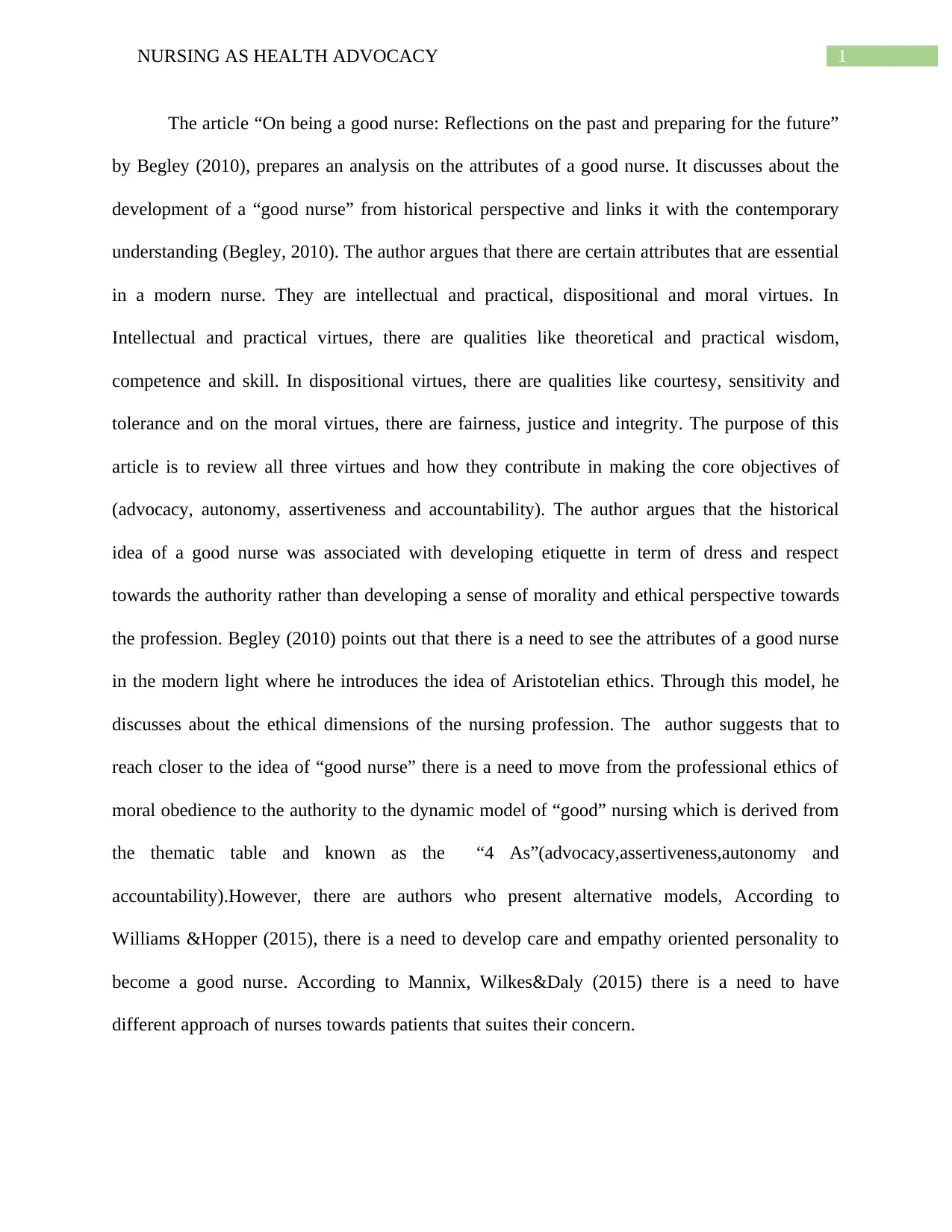
The article “On being a good nurse: Reflections on the past and preparing for the future”
by Begley (2010), prepares an analysis on the attributes of a good nurse. It discusses about the
development of a “good nurse” from historical perspective and links it with the contemporary
understanding (Begley, 2010). The author argues that there are certain attributes that are essential
in a modern nurse. They are intellectual and practical, dispositional and moral virtues. In
Intellectual and practical virtues, there are qualities like theoretical and practical wisdom,
competence and skill. In dispositional virtues, there are qualities like courtesy, sensitivity and
tolerance and on the moral virtues, there are fairness, justice and integrity. The purpose of this
article is to review all three virtues and how they contribute in making the core objectives of
(advocacy, autonomy, assertiveness and accountability). The author argues that the historical
idea of a good nurse was associated with developing etiquette in term of dress and respect
towards the authority rather than developing a sense of morality and ethical perspective towards
the profession. Begley (2010) points out that there is a need to see the attributes of a good nurse
in the modern light where he introduces the idea of Aristotelian ethics. Through this model, he
discusses about the ethical dimensions of the nursing profession. The author suggests that to
reach closer to the idea of “good nurse” there is a need to move from the professional ethics of
moral obedience to the authority to the dynamic model of “good” nursing which is derived from
the thematic table and known as the “4 As”(advocacy,assertiveness,autonomy and
accountability).However, there are authors who present alternative models, According to
Williams &Hopper (2015), there is a need to develop care and empathy oriented personality to
become a good nurse. According to Mannix, Wilkes&Daly (2015) there is a need to have
different approach of nurses towards patients that suites their concern.
Document Page
2NURSING AS HEALTH ADVOCACY
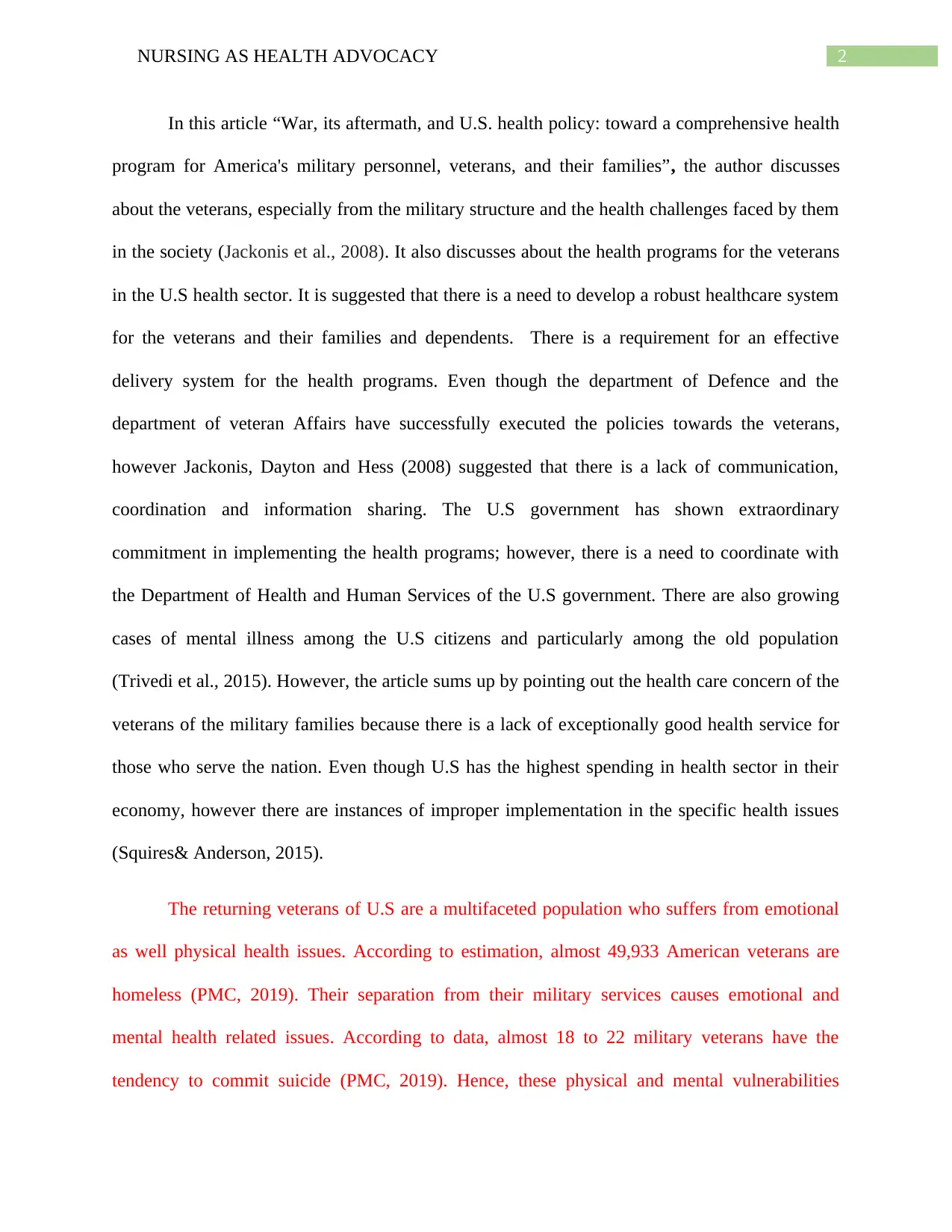
In this article “War, its aftermath, and U.S. health policy: toward a comprehensive health
program for America's military personnel, veterans, and their families”, the author discusses
about the veterans, especially from the military structure and the health challenges faced by them
in the society (Jackonis et al., 2008). It also discusses about the health programs for the veterans
in the U.S health sector. It is suggested that there is a need to develop a robust healthcare system
for the veterans and their families and dependents. There is a requirement for an effective
delivery system for the health programs. Even though the department of Defence and the
department of veteran Affairs have successfully executed the policies towards the veterans,
however Jackonis, Dayton and Hess (2008) suggested that there is a lack of communication,
coordination and information sharing. The U.S government has shown extraordinary
commitment in implementing the health programs; however, there is a need to coordinate with
the Department of Health and Human Services of the U.S government. There are also growing
cases of mental illness among the U.S citizens and particularly among the old population
(Trivedi et al., 2015). However, the article sums up by pointing out the health care concern of the
veterans of the military families because there is a lack of exceptionally good health service for
those who serve the nation. Even though U.S has the highest spending in health sector in their
economy, however there are instances of improper implementation in the specific health issues
(Squires& Anderson, 2015).
The returning veterans of U.S are a multifaceted population who suffers from emotional
as well physical health issues. According to estimation, almost 49,933 American veterans are
homeless (PMC, 2019). Their separation from their military services causes emotional and
mental health related issues. According to data, almost 18 to 22 military veterans have the
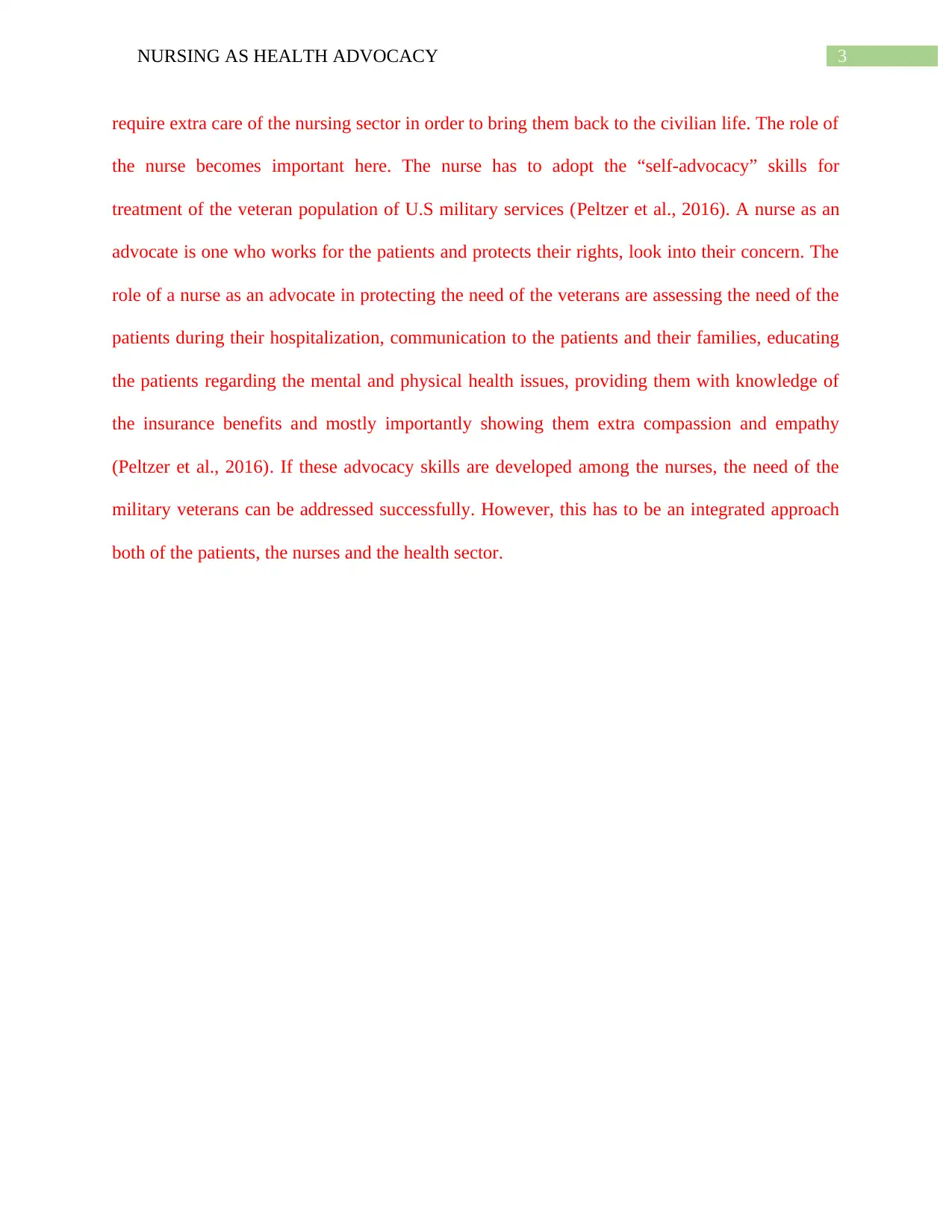
tendency to commit suicide (PMC, 2019). Hence, these physical and mental vulnerabilities
Document Page
3NURSING AS HEALTH ADVOCACY
require extra care of the nursing sector in order to bring them back to the civilian life. The role of
the nurse becomes important here. The nurse has to adopt the “self-advocacy” skills for
treatment of the veteran population of U.S military services (Peltzer et al., 2016). A nurse as an
advocate is one who works for the patients and protects their rights, look into their concern. The
role of a nurse as an advocate in protecting the need of the veterans are assessing the need of the
patients during their hospitalization, communication to the patients and their families, educating
the patients regarding the mental and physical health issues, providing them with knowledge of
the insurance benefits and mostly importantly showing them extra compassion and empathy
(Peltzer et al., 2016). If these advocacy skills are developed among the nurses, the need of the
military veterans can be addressed successfully. However, this has to be an integrated approach
both of the patients, the nurses and the health sector.
tabler-icon-diamond-filled.svg

Paraphrase This Document

Need a fresh take? Get an instant paraphrase of this document with our AI Paraphraser
Document Page
4NURSING AS HEALTH ADVOCACY
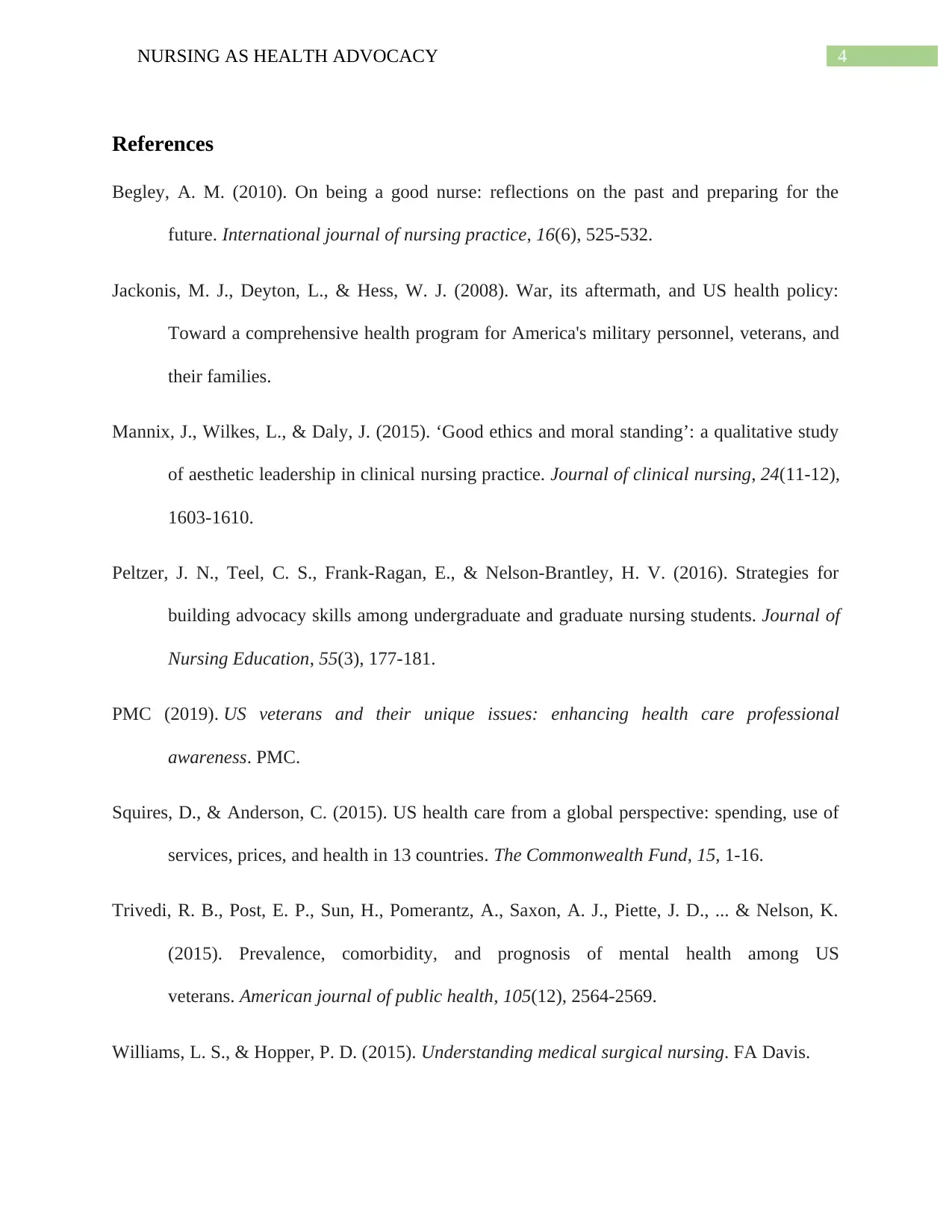
References
Begley, A. M. (2010). On being a good nurse: reflections on the past and preparing for the
future. International journal of nursing practice, 16(6), 525-532.
Jackonis, M. J., Deyton, L., & Hess, W. J. (2008). War, its aftermath, and US health policy:
Toward a comprehensive health program for America's military personnel, veterans, and
their families.
Mannix, J., Wilkes, L., & Daly, J. (2015). ‘Good ethics and moral standing’: a qualitative study
of aesthetic leadership in clinical nursing practice. Journal of clinical nursing, 24(11-12),
1603-1610.
Peltzer, J. N., Teel, C. S., Frank-Ragan, E., & Nelson-Brantley, H. V. (2016). Strategies for
building advocacy skills among undergraduate and graduate nursing students. Journal of
Nursing Education, 55(3), 177-181.
PMC (2019). US veterans and their unique issues: enhancing health care professional
awareness. PMC.
Squires, D., & Anderson, C. (2015). US health care from a global perspective: spending, use of
services, prices, and health in 13 countries. The Commonwealth Fund, 15, 1-16.
Trivedi, R. B., Post, E. P., Sun, H., Pomerantz, A., Saxon, A. J., Piette, J. D., ... & Nelson, K.
(2015). Prevalence, comorbidity, and prognosis of mental health among US
veterans. American journal of public health, 105(12), 2564-2569.
Williams, L. S., & Hopper, P. D. (2015). Understanding medical surgical nursing. FA Davis.
chevron_up_icon
1 out of 5
circle_padding
hide_on_mobile
zoom_out_icon
[object Object]