HLTENN006 Diploma of Nursing: Apply Wound Management Principles
VerifiedAdded on 2023/04/25
|33
|8070
|307
Homework Assignment
AI Summary
This assignment comprises a knowledge test on the principles of wound management within a nursing context. It includes definitions of key terms such as asepsis, aseptic technique, and various types of wounds (venous, arterial, mixed, discharging, malignant, neuropathic, infected, burns, fistulas, sinuses, and skin grafts). The assignment also covers factors contributing to pressure ulcer development, phases of healing, intrinsic and extrinsic factors inhibiting healing, and key considerations for wound assessment. Furthermore, it discusses the physical and psychological impacts of wounds on clients, carers, and families, and explores holistic care in the community setting for individuals with complex wounds, including referral options and the importance of nutrition and wound care techniques. Finally, it identifies potential complications of wound healing and references the National Safety and Quality Health Service Standards.
Nursing 1
Nursing
Student’s Name
Student’s Number
University
Module Code
Module Name
Date
Nursing
Student’s Name
Student’s Number
University
Module Code
Module Name
Date

Paraphrase This Document
Need a fresh take? Get an instant paraphrase of this document with our AI Paraphraser
Nursing 2
HLT54115 Diploma of Nursing
HLTENN006 Apply principles of wound management in the clinical environment
Knowledge Test Student Copy
2
Australia Institute of Business and Technology Version 1.2- June 2016
© Succeed Pty Ltd
HLT54115 Diploma of Nursing
HLTENN006 Apply principles of wound management in the clinical environment
Knowledge Test Student Copy
2
Australia Institute of Business and Technology Version 1.2- June 2016
© Succeed Pty Ltd
Nursing 3
Instructions to students
You are required to be assessed as competent in all questions on this knowledge Test. If you
do not achieve competence in all questions, please see your trainer for additional assistance
before making another attempt at the knowledge test.
3
Australia Institute of Business and Technology Version 1.2- June 2016
© Succeed Pty Ltd
Instructions to students
You are required to be assessed as competent in all questions on this knowledge Test. If you
do not achieve competence in all questions, please see your trainer for additional assistance
before making another attempt at the knowledge test.
3
Australia Institute of Business and Technology Version 1.2- June 2016
© Succeed Pty Ltd
⊘ This is a preview!⊘
Do you want full access?
Subscribe today to unlock all pages.

Trusted by 1+ million students worldwide
Nursing 4
The following websites may assist with this assessment
http://www.awma.com.au/home
http://www.smith-nephew.com/australia/about-us/what-we-do/advanced-wound-
management/
http://www.smith-nephew.com/australia/about-us/what-we-do/advanced-wound-
management/
http://www.health.wa.gov.au/woundswest/education/
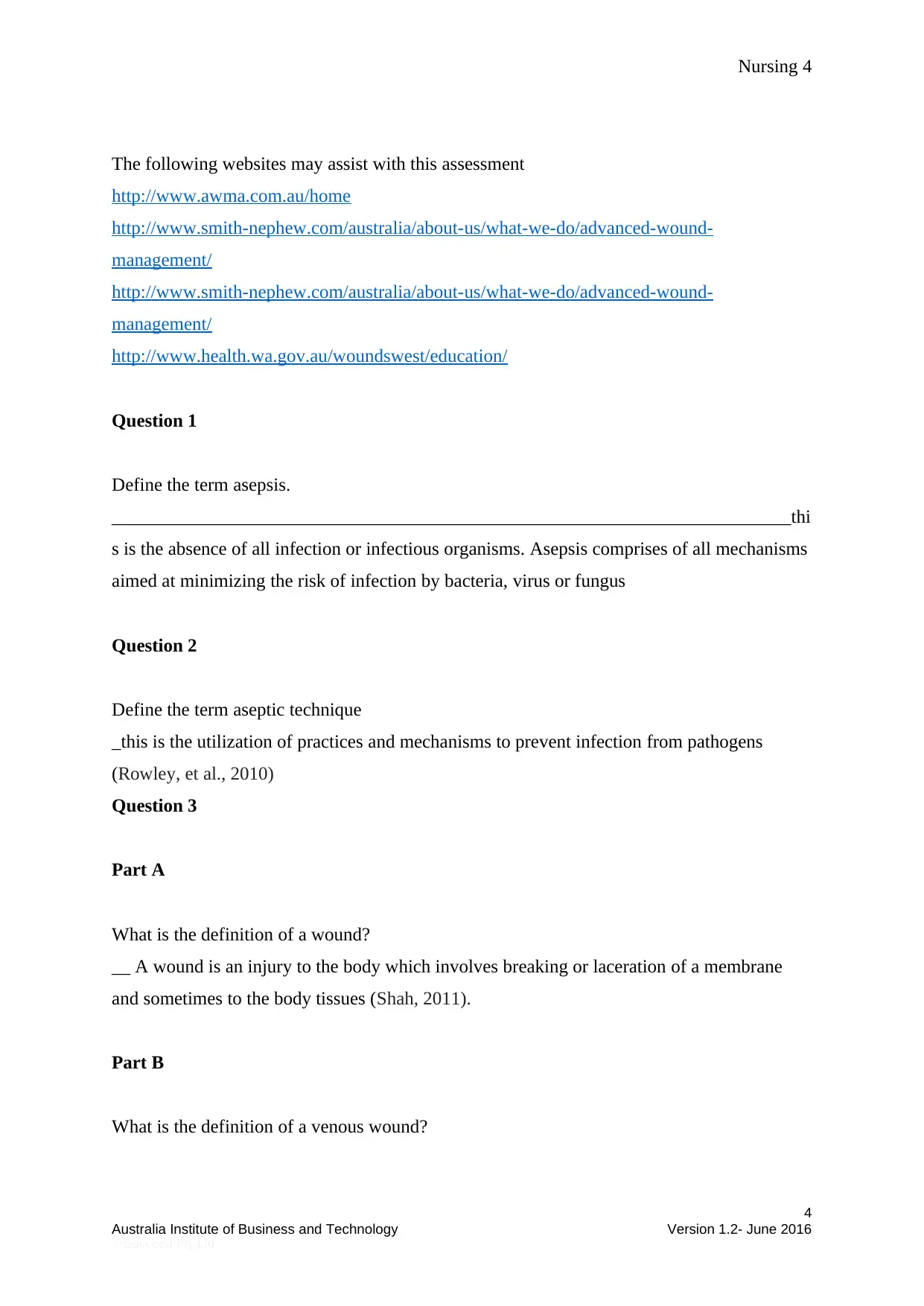
Question 1
Define the term asepsis.
_________________________________________________________________________thi
s is the absence of all infection or infectious organisms. Asepsis comprises of all mechanisms
aimed at minimizing the risk of infection by bacteria, virus or fungus
Question 2
Define the term aseptic technique
_this is the utilization of practices and mechanisms to prevent infection from pathogens
(Rowley, et al., 2010)
Question 3
Part A
What is the definition of a wound?
__ A wound is an injury to the body which involves breaking or laceration of a membrane
and sometimes to the body tissues (Shah, 2011).
Part B
What is the definition of a venous wound?
4
Australia Institute of Business and Technology Version 1.2- June 2016
© Succeed Pty Ltd
The following websites may assist with this assessment
http://www.awma.com.au/home
http://www.smith-nephew.com/australia/about-us/what-we-do/advanced-wound-
management/
http://www.smith-nephew.com/australia/about-us/what-we-do/advanced-wound-
management/
http://www.health.wa.gov.au/woundswest/education/
Question 1
Define the term asepsis.
_________________________________________________________________________thi
s is the absence of all infection or infectious organisms. Asepsis comprises of all mechanisms
aimed at minimizing the risk of infection by bacteria, virus or fungus
Question 2
Define the term aseptic technique
_this is the utilization of practices and mechanisms to prevent infection from pathogens
(Rowley, et al., 2010)
Question 3
Part A
What is the definition of a wound?
__ A wound is an injury to the body which involves breaking or laceration of a membrane
and sometimes to the body tissues (Shah, 2011).
Part B
What is the definition of a venous wound?
4
Australia Institute of Business and Technology Version 1.2- June 2016
© Succeed Pty Ltd
Paraphrase This Document
Need a fresh take? Get an instant paraphrase of this document with our AI Paraphraser
Nursing 5
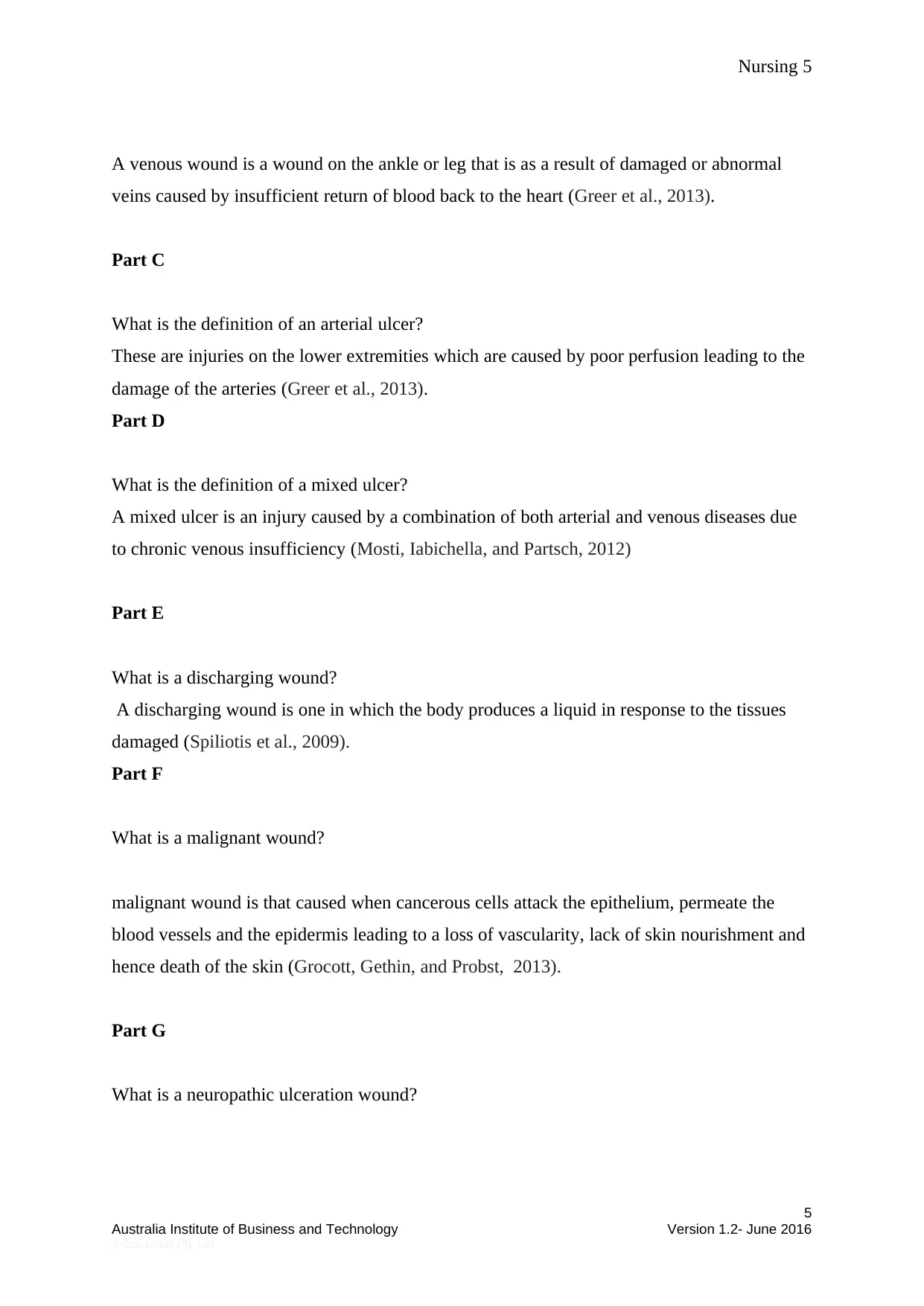
A venous wound is a wound on the ankle or leg that is as a result of damaged or abnormal
veins caused by insufficient return of blood back to the heart (Greer et al., 2013).
Part C
What is the definition of an arterial ulcer?
These are injuries on the lower extremities which are caused by poor perfusion leading to the
damage of the arteries (Greer et al., 2013).
Part D
What is the definition of a mixed ulcer?
A mixed ulcer is an injury caused by a combination of both arterial and venous diseases due
to chronic venous insufficiency (Mosti, Iabichella, and Partsch, 2012)
Part E
What is a discharging wound?
A discharging wound is one in which the body produces a liquid in response to the tissues
damaged (Spiliotis et al., 2009).
Part F
What is a malignant wound?
malignant wound is that caused when cancerous cells attack the epithelium, permeate the
blood vessels and the epidermis leading to a loss of vascularity, lack of skin nourishment and
hence death of the skin (Grocott, Gethin, and Probst, 2013).
Part G
What is a neuropathic ulceration wound?
5
Australia Institute of Business and Technology Version 1.2- June 2016
© Succeed Pty Ltd
A venous wound is a wound on the ankle or leg that is as a result of damaged or abnormal
veins caused by insufficient return of blood back to the heart (Greer et al., 2013).
Part C
What is the definition of an arterial ulcer?
These are injuries on the lower extremities which are caused by poor perfusion leading to the
damage of the arteries (Greer et al., 2013).
Part D
What is the definition of a mixed ulcer?
A mixed ulcer is an injury caused by a combination of both arterial and venous diseases due
to chronic venous insufficiency (Mosti, Iabichella, and Partsch, 2012)
Part E
What is a discharging wound?
A discharging wound is one in which the body produces a liquid in response to the tissues
damaged (Spiliotis et al., 2009).
Part F
What is a malignant wound?
malignant wound is that caused when cancerous cells attack the epithelium, permeate the
blood vessels and the epidermis leading to a loss of vascularity, lack of skin nourishment and
hence death of the skin (Grocott, Gethin, and Probst, 2013).
Part G
What is a neuropathic ulceration wound?
5
Australia Institute of Business and Technology Version 1.2- June 2016
© Succeed Pty Ltd
Nursing 6
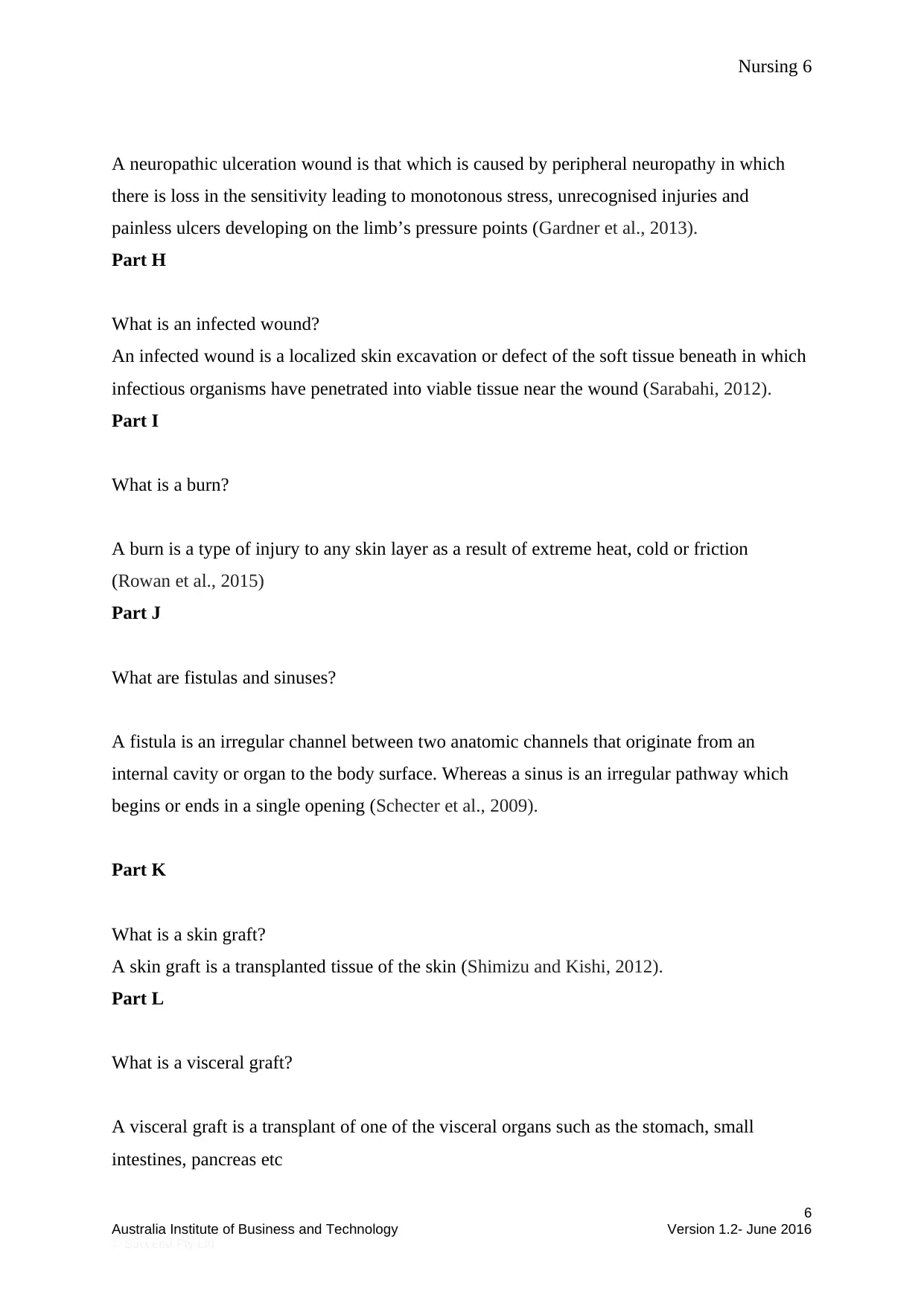
A neuropathic ulceration wound is that which is caused by peripheral neuropathy in which
there is loss in the sensitivity leading to monotonous stress, unrecognised injuries and
painless ulcers developing on the limb’s pressure points (Gardner et al., 2013).
Part H
What is an infected wound?
An infected wound is a localized skin excavation or defect of the soft tissue beneath in which
infectious organisms have penetrated into viable tissue near the wound (Sarabahi, 2012).
Part I
What is a burn?
A burn is a type of injury to any skin layer as a result of extreme heat, cold or friction
(Rowan et al., 2015)
Part J
What are fistulas and sinuses?
A fistula is an irregular channel between two anatomic channels that originate from an
internal cavity or organ to the body surface. Whereas a sinus is an irregular pathway which
begins or ends in a single opening (Schecter et al., 2009).
Part K
What is a skin graft?
A skin graft is a transplanted tissue of the skin (Shimizu and Kishi, 2012).
Part L
What is a visceral graft?
A visceral graft is a transplant of one of the visceral organs such as the stomach, small
intestines, pancreas etc
6
Australia Institute of Business and Technology Version 1.2- June 2016
© Succeed Pty Ltd
A neuropathic ulceration wound is that which is caused by peripheral neuropathy in which
there is loss in the sensitivity leading to monotonous stress, unrecognised injuries and
painless ulcers developing on the limb’s pressure points (Gardner et al., 2013).
Part H
What is an infected wound?
An infected wound is a localized skin excavation or defect of the soft tissue beneath in which
infectious organisms have penetrated into viable tissue near the wound (Sarabahi, 2012).
Part I
What is a burn?
A burn is a type of injury to any skin layer as a result of extreme heat, cold or friction
(Rowan et al., 2015)
Part J
What are fistulas and sinuses?
A fistula is an irregular channel between two anatomic channels that originate from an
internal cavity or organ to the body surface. Whereas a sinus is an irregular pathway which
begins or ends in a single opening (Schecter et al., 2009).
Part K
What is a skin graft?
A skin graft is a transplanted tissue of the skin (Shimizu and Kishi, 2012).
Part L
What is a visceral graft?
A visceral graft is a transplant of one of the visceral organs such as the stomach, small
intestines, pancreas etc
6
Australia Institute of Business and Technology Version 1.2- June 2016
© Succeed Pty Ltd
⊘ This is a preview!⊘
Do you want full access?
Subscribe today to unlock all pages.
Trusted by 1+ million students worldwide
Nursing 7
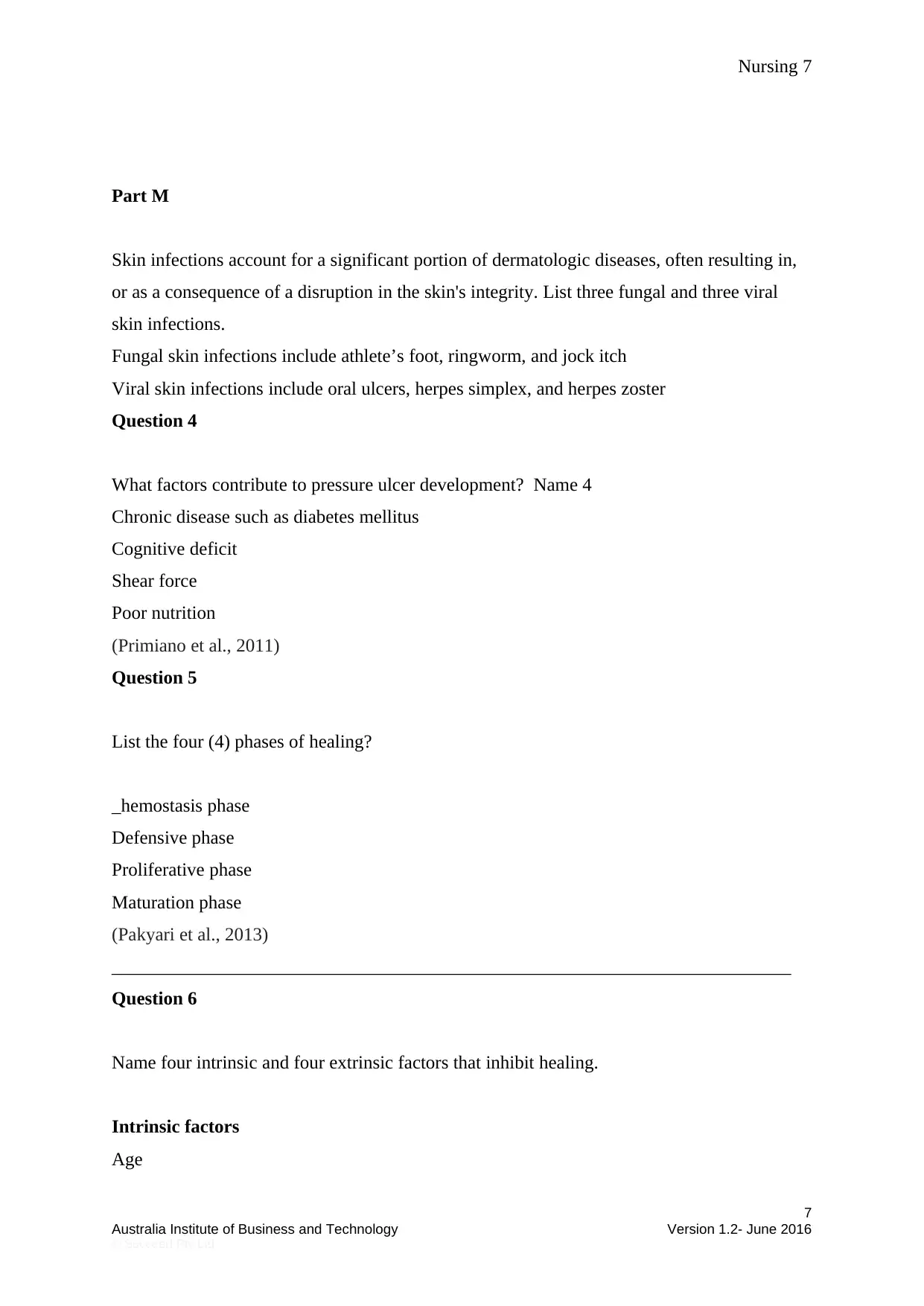
Part M
Skin infections account for a significant portion of dermatologic diseases, often resulting in,
or as a consequence of a disruption in the skin's integrity. List three fungal and three viral
skin infections.
Fungal skin infections include athlete’s foot, ringworm, and jock itch
Viral skin infections include oral ulcers, herpes simplex, and herpes zoster
Question 4
What factors contribute to pressure ulcer development? Name 4
Chronic disease such as diabetes mellitus
Cognitive deficit
Shear force
Poor nutrition
(Primiano et al., 2011)
Question 5
List the four (4) phases of healing?
_hemostasis phase
Defensive phase
Proliferative phase
Maturation phase
(Pakyari et al., 2013)
_________________________________________________________________________
Question 6
Name four intrinsic and four extrinsic factors that inhibit healing.
Intrinsic factors
Age
7
Australia Institute of Business and Technology Version 1.2- June 2016
© Succeed Pty Ltd
Part M
Skin infections account for a significant portion of dermatologic diseases, often resulting in,
or as a consequence of a disruption in the skin's integrity. List three fungal and three viral
skin infections.
Fungal skin infections include athlete’s foot, ringworm, and jock itch
Viral skin infections include oral ulcers, herpes simplex, and herpes zoster
Question 4
What factors contribute to pressure ulcer development? Name 4
Chronic disease such as diabetes mellitus
Cognitive deficit
Shear force
Poor nutrition
(Primiano et al., 2011)
Question 5
List the four (4) phases of healing?
_hemostasis phase
Defensive phase
Proliferative phase
Maturation phase
(Pakyari et al., 2013)
_________________________________________________________________________
Question 6
Name four intrinsic and four extrinsic factors that inhibit healing.
Intrinsic factors
Age
7
Australia Institute of Business and Technology Version 1.2- June 2016
© Succeed Pty Ltd
Paraphrase This Document
Need a fresh take? Get an instant paraphrase of this document with our AI Paraphraser
Nursing 8
Suppressed immune system
Diabetes mellitus
Skin with reduce sensation
Extrinsic factors
Stress
Smoking
Poor nutrition
Medication
(Wild et al., 2010)
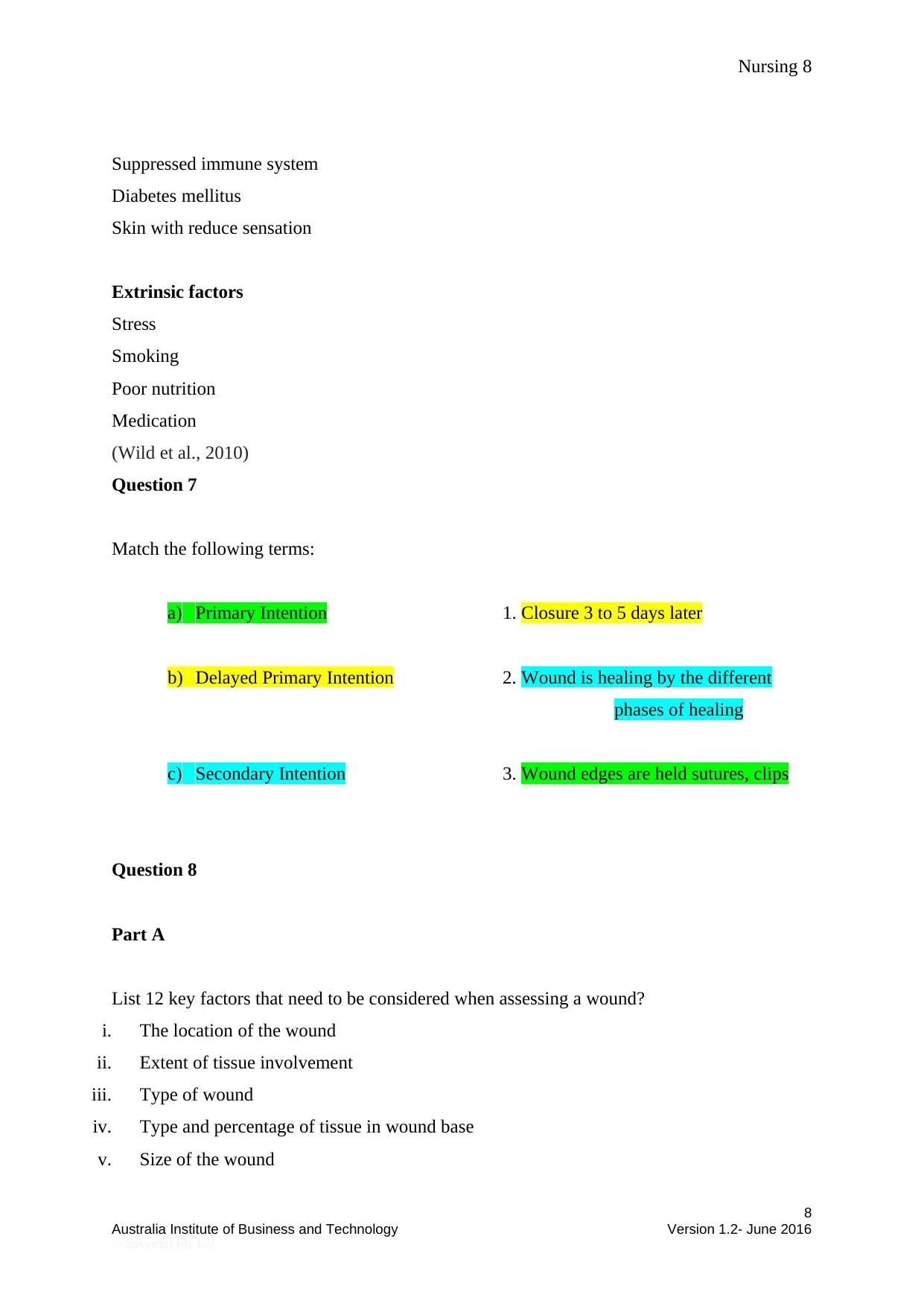
Question 7
Match the following terms:
a) Primary Intention 1. Closure 3 to 5 days later
b) Delayed Primary Intention 2. Wound is healing by the different
phases of healing
c) Secondary Intention 3. Wound edges are held sutures, clips
Question 8
Part A
List 12 key factors that need to be considered when assessing a wound?
i. The location of the wound
ii. Extent of tissue involvement
iii. Type of wound
iv. Type and percentage of tissue in wound base
v. Size of the wound
8
Australia Institute of Business and Technology Version 1.2- June 2016
© Succeed Pty Ltd
Suppressed immune system
Diabetes mellitus
Skin with reduce sensation
Extrinsic factors
Stress
Smoking
Poor nutrition
Medication
(Wild et al., 2010)
Question 7
Match the following terms:
a) Primary Intention 1. Closure 3 to 5 days later
b) Delayed Primary Intention 2. Wound is healing by the different
phases of healing
c) Secondary Intention 3. Wound edges are held sutures, clips
Question 8
Part A
List 12 key factors that need to be considered when assessing a wound?
i. The location of the wound
ii. Extent of tissue involvement
iii. Type of wound
iv. Type and percentage of tissue in wound base
v. Size of the wound
8
Australia Institute of Business and Technology Version 1.2- June 2016
© Succeed Pty Ltd
Nursing 9
vi. Edge of the wound
vii. Wound bed
viii. Depth of the wound
ix. Wound exudate
x. Presence of odour
xi. The peri-wound area
xii. Pain
(Sibbald et al., 2011)
Part B
Discuss the physical and psychological impacts of wounds on clients, carers and families
The physical effects of wound include pain, infections and the inability to perform routine
duties. Chronic wound can be very painful. Such pain can minimize ones mobility and
activity level, more so when there is intense pain during movement. Morbidity as a result of
wounds can lead to potential complications. Physical pain also affects the family and carers
who have to spend time and resources for healing. Infections can worsen the state of the
wound and even take an extensive time to heal as the body is aimed at fighting the infection
instead of healing. If not treated in time, wound infections can spread to other body organs
and can lead to amputation of the infected organ in extreme situations. Wounds can also
cause impairment in the daily activities such as showering and going to work. This
significantly affects the family who have to devote more time and resources to the patient.
The psychological issues caused by wound infection affects the patient in several ways. A
chronic wound may produce an odour or continued discharge which can be embarrassing and
stressful to the individual. As a result the infected person can withdraw from the family and
social events, and such isolation is likely to cause loneliness and low self-esteem. Studies
have also indicated that people with chronic wound infections are more prone to mental
health disorders in addition to anxiety and depression caused by social isolation, alterations in
body images and poor quality life. The carers and family are also affected by the odour which
makes them uncomfortable since they cannot do away with the patient. The carers and close
family members are also at risk of infection when taking care of the wounded individual. An
9
Australia Institute of Business and Technology Version 1.2- June 2016
© Succeed Pty Ltd
vi. Edge of the wound
vii. Wound bed
viii. Depth of the wound
ix. Wound exudate
x. Presence of odour
xi. The peri-wound area
xii. Pain
(Sibbald et al., 2011)
Part B
Discuss the physical and psychological impacts of wounds on clients, carers and families
The physical effects of wound include pain, infections and the inability to perform routine
duties. Chronic wound can be very painful. Such pain can minimize ones mobility and
activity level, more so when there is intense pain during movement. Morbidity as a result of
wounds can lead to potential complications. Physical pain also affects the family and carers
who have to spend time and resources for healing. Infections can worsen the state of the
wound and even take an extensive time to heal as the body is aimed at fighting the infection
instead of healing. If not treated in time, wound infections can spread to other body organs
and can lead to amputation of the infected organ in extreme situations. Wounds can also
cause impairment in the daily activities such as showering and going to work. This
significantly affects the family who have to devote more time and resources to the patient.
The psychological issues caused by wound infection affects the patient in several ways. A
chronic wound may produce an odour or continued discharge which can be embarrassing and
stressful to the individual. As a result the infected person can withdraw from the family and
social events, and such isolation is likely to cause loneliness and low self-esteem. Studies
have also indicated that people with chronic wound infections are more prone to mental
health disorders in addition to anxiety and depression caused by social isolation, alterations in
body images and poor quality life. The carers and family are also affected by the odour which
makes them uncomfortable since they cannot do away with the patient. The carers and close
family members are also at risk of infection when taking care of the wounded individual. An
9
Australia Institute of Business and Technology Version 1.2- June 2016
© Succeed Pty Ltd
⊘ This is a preview!⊘
Do you want full access?
Subscribe today to unlock all pages.
Trusted by 1+ million students worldwide
Nursing 10
aspect that might cause them to shy away from providing the necessary care and attention
(Gorecki et al., 2009).
Part C
The following website may assist with this question
http://www.awma.com.au/publications/2011_standards_for_wound_management_v2.pdf
Primary Health Care aims to promote health, prevent disease and injury and reduce health
inequalities within the Australian and global populations. The focus is moved away from
treatment and cure of disease within secondary and tertiary health settings such as hospitals
and refocused towards removing the cause of disease and injury from the community and
individual. Strategies are based on individual and local community participation in
identification of strengths and health issues and health priorities.
Central to Primary Health Care is empowerment of individuals and communities in health
promotion and disease prevention. How would you provide holistic care in the community
setting for a person with a complex wound?
You are working in the community setting and your evaluation of a wound is that it is not
healing and is infected. Who could you refer the client or the client’s family to? How would
you explain to the family the importance of nutrition, wound care techniques and infection
control?
The provision of holistic care in the community for the individual with complex wound will
involve the consideration of a number of factors. The first step is to ascertain the history of
the patient with regard to medication because the healing of the complex wound might be
slowed by illnesses such as diabetes (Ousey and Cook, 2011). The next step is to carry out
pain assessment with a specific focus on dressing changes. Central to wound infection is pain
assessment because uncontrolled pain can lead to morbidity and psychological stress which
can further impede the healing process.
The nutritional status of the patient will also be assessed because a balanced diet and enough
intake of fluid is significant for healing. In case there is evidence of poor nutrition, the patient
can then be referred to a dietician for additional examination and intervention. The wound
10
Australia Institute of Business and Technology Version 1.2- June 2016
© Succeed Pty Ltd
aspect that might cause them to shy away from providing the necessary care and attention
(Gorecki et al., 2009).
Part C
The following website may assist with this question
http://www.awma.com.au/publications/2011_standards_for_wound_management_v2.pdf
Primary Health Care aims to promote health, prevent disease and injury and reduce health
inequalities within the Australian and global populations. The focus is moved away from
treatment and cure of disease within secondary and tertiary health settings such as hospitals
and refocused towards removing the cause of disease and injury from the community and
individual. Strategies are based on individual and local community participation in
identification of strengths and health issues and health priorities.
Central to Primary Health Care is empowerment of individuals and communities in health
promotion and disease prevention. How would you provide holistic care in the community
setting for a person with a complex wound?
You are working in the community setting and your evaluation of a wound is that it is not
healing and is infected. Who could you refer the client or the client’s family to? How would
you explain to the family the importance of nutrition, wound care techniques and infection
control?
The provision of holistic care in the community for the individual with complex wound will
involve the consideration of a number of factors. The first step is to ascertain the history of
the patient with regard to medication because the healing of the complex wound might be
slowed by illnesses such as diabetes (Ousey and Cook, 2011). The next step is to carry out
pain assessment with a specific focus on dressing changes. Central to wound infection is pain
assessment because uncontrolled pain can lead to morbidity and psychological stress which
can further impede the healing process.
The nutritional status of the patient will also be assessed because a balanced diet and enough
intake of fluid is significant for healing. In case there is evidence of poor nutrition, the patient
can then be referred to a dietician for additional examination and intervention. The wound
10
Australia Institute of Business and Technology Version 1.2- June 2016
© Succeed Pty Ltd
Paraphrase This Document
Need a fresh take? Get an instant paraphrase of this document with our AI Paraphraser
Nursing 11
size will also be measured to determine the level of healing (Halim, Khoo, and Saad, 2012).
Since, it is a community setting basic measures such as the use of a tape measure, tracing or
digital photography can be used to assess the progress of the wound and documented.
The wound bed assessment will also be carried out to provide important information on
wound aetiology, process and progression of healing. The healing progress will also be
ascertained by examining the wound color and peri wound area of the wound bed (Ousey and
Cook, 2011). This can be facilitated by the use of colour charts to demonstrate the clinical
appearance of wounds. Wound exudate will also be observed to help in determining the
condition of the wound bed.
Referring the patient will depend on the factor inhibiting wound healing process. If the
patient has chronic illnesses that inhibit wound healing such as diabetes, then in would refer
him/her to medical professional for in-depth evaluation to ascertain the best intervention such
as therapeutic intervention.
If the cause is found to be poor nutrition, then I will refer the patient to a dietician. if the
patient behaviours such as smoking and drinking is found to be the cause, then I will refer
him to a medical counsellor.
Poor nutrition leads to insufficient nutrients for the body to foster wound healing. Wound
infections increase the protein and caloric needs of the patient. Insufficient calories due to
poor nutrition causes the body to synthesize proteins for energy, which further drains the
body of its healing capacity.
Wound care techniques are important because they prevent further infection and facilitate
wound healing process. This can be done by just looking at the odor, drainage, and color of
the wound to ascertain its healing progress. This is important because if the wound is not
addressed at initial stages, it can worsen and lead to amputation in extreme situations.
Part D
List five complications of wound healing
Infection
Tissue necrosis and gangrene
Osteomyelitis
11
Australia Institute of Business and Technology Version 1.2- June 2016
© Succeed Pty Ltd
size will also be measured to determine the level of healing (Halim, Khoo, and Saad, 2012).
Since, it is a community setting basic measures such as the use of a tape measure, tracing or
digital photography can be used to assess the progress of the wound and documented.
The wound bed assessment will also be carried out to provide important information on
wound aetiology, process and progression of healing. The healing progress will also be
ascertained by examining the wound color and peri wound area of the wound bed (Ousey and
Cook, 2011). This can be facilitated by the use of colour charts to demonstrate the clinical
appearance of wounds. Wound exudate will also be observed to help in determining the
condition of the wound bed.
Referring the patient will depend on the factor inhibiting wound healing process. If the
patient has chronic illnesses that inhibit wound healing such as diabetes, then in would refer
him/her to medical professional for in-depth evaluation to ascertain the best intervention such
as therapeutic intervention.
If the cause is found to be poor nutrition, then I will refer the patient to a dietician. if the
patient behaviours such as smoking and drinking is found to be the cause, then I will refer
him to a medical counsellor.
Poor nutrition leads to insufficient nutrients for the body to foster wound healing. Wound
infections increase the protein and caloric needs of the patient. Insufficient calories due to
poor nutrition causes the body to synthesize proteins for energy, which further drains the
body of its healing capacity.
Wound care techniques are important because they prevent further infection and facilitate
wound healing process. This can be done by just looking at the odor, drainage, and color of
the wound to ascertain its healing progress. This is important because if the wound is not
addressed at initial stages, it can worsen and lead to amputation in extreme situations.
Part D
List five complications of wound healing
Infection
Tissue necrosis and gangrene
Osteomyelitis
11
Australia Institute of Business and Technology Version 1.2- June 2016
© Succeed Pty Ltd
Nursing 12
Peri wound dermatitis
Hematomas
(Guo and DiPietro, 2010)
Part E
The National Safety and Quality Health Service Standards provide a nationally consistent and
uniform set of measures of safety and quality for application across a wide variety of health
care services. Standard 3 outlines the systems and strategies to prevent infection of clients
within the healthcare system and to manage infections effectively when they occur to
minimise the consequences. Consider the organisations policies and procedures for wound
care. Discuss the wound management strategies and techniques in the facility, include the
following in your answer
Wound cleansing techniques
Wound cleansing is the process of eradicating surface contaminate, bacteria and the remains
of former dressings from the surface of the wound and the skin environs (Atiyeh, Dibo and
Hayek, 2009). Wounds should be cleaned in situations where there is contamination or
infection of the exudate (Cutting, 2010). Proper cleansing will eliminate all infectious micro-
organisms and prevent any additional damage. The Aseptic non-touch techniques is the most
preferred one and it involves precautions applied during clinical procedures to prevent further
infections from the clinician, instrument or surrounding.
Wound measurement
Wound measurement is a vital aspect of wound care. Wound measurement should involve
two and three dimensional assessments. Two-dimensional measures involve the use of tape
measure to determine the length and breadth in millimetres. If the wound edges are not
uniform, then its circumference is determined especially for chronic wounds. Digital
photography can also be used in which photos are taken at different levels of wound healing
process. In three dimensional measures, the depth of the wound is ascertained using a
dampened cotton tip applicator.
Clinical photography
12
Australia Institute of Business and Technology Version 1.2- June 2016
© Succeed Pty Ltd
Peri wound dermatitis
Hematomas
(Guo and DiPietro, 2010)
Part E
The National Safety and Quality Health Service Standards provide a nationally consistent and
uniform set of measures of safety and quality for application across a wide variety of health
care services. Standard 3 outlines the systems and strategies to prevent infection of clients
within the healthcare system and to manage infections effectively when they occur to
minimise the consequences. Consider the organisations policies and procedures for wound
care. Discuss the wound management strategies and techniques in the facility, include the
following in your answer
Wound cleansing techniques
Wound cleansing is the process of eradicating surface contaminate, bacteria and the remains
of former dressings from the surface of the wound and the skin environs (Atiyeh, Dibo and
Hayek, 2009). Wounds should be cleaned in situations where there is contamination or
infection of the exudate (Cutting, 2010). Proper cleansing will eliminate all infectious micro-
organisms and prevent any additional damage. The Aseptic non-touch techniques is the most
preferred one and it involves precautions applied during clinical procedures to prevent further
infections from the clinician, instrument or surrounding.
Wound measurement
Wound measurement is a vital aspect of wound care. Wound measurement should involve
two and three dimensional assessments. Two-dimensional measures involve the use of tape
measure to determine the length and breadth in millimetres. If the wound edges are not
uniform, then its circumference is determined especially for chronic wounds. Digital
photography can also be used in which photos are taken at different levels of wound healing
process. In three dimensional measures, the depth of the wound is ascertained using a
dampened cotton tip applicator.
Clinical photography
12
Australia Institute of Business and Technology Version 1.2- June 2016
© Succeed Pty Ltd
⊘ This is a preview!⊘
Do you want full access?
Subscribe today to unlock all pages.
Trusted by 1+ million students worldwide

1 out of 33


Your All-in-One AI-Powered Toolkit for Academic Success.
+13062052269
info@desklib.com
Available 24*7 on WhatsApp / Email
![[object Object]](/_next/static/media/star-bottom.7253800d.svg)
Unlock your academic potential
Copyright © 2020–2026 A2Z Services. All Rights Reserved. Developed and managed by ZUCOL.