Case Study: Supply Chain Vulnerabilities in California's Nut Industry

Verified

Added on  2023/06/12

|4
|732
|362
Case Study
AI Summary
This case study provides an analysis of the nut supply chain in California, beginning with the farmers and tracing the path through unions, processors, brokers, distributors, retailers, and ultimately, consumers. It identifies several vulnerabilities within this supply chain, including the absence of regulatory oversight, over-reliance on subcontracted transport agents, the presence of a black market, lack of verification of transport companies, an overabundance of middlemen, lenient punitive mechanisms for theft, and the absence of a coding system for tracing nuts. These vulnerabilities are exploited by criminal elements, leading to significant theft and disruption within the industry. The analysis highlights the need for improved security measures and regulatory oversight to protect the California nut industry.
Document Page
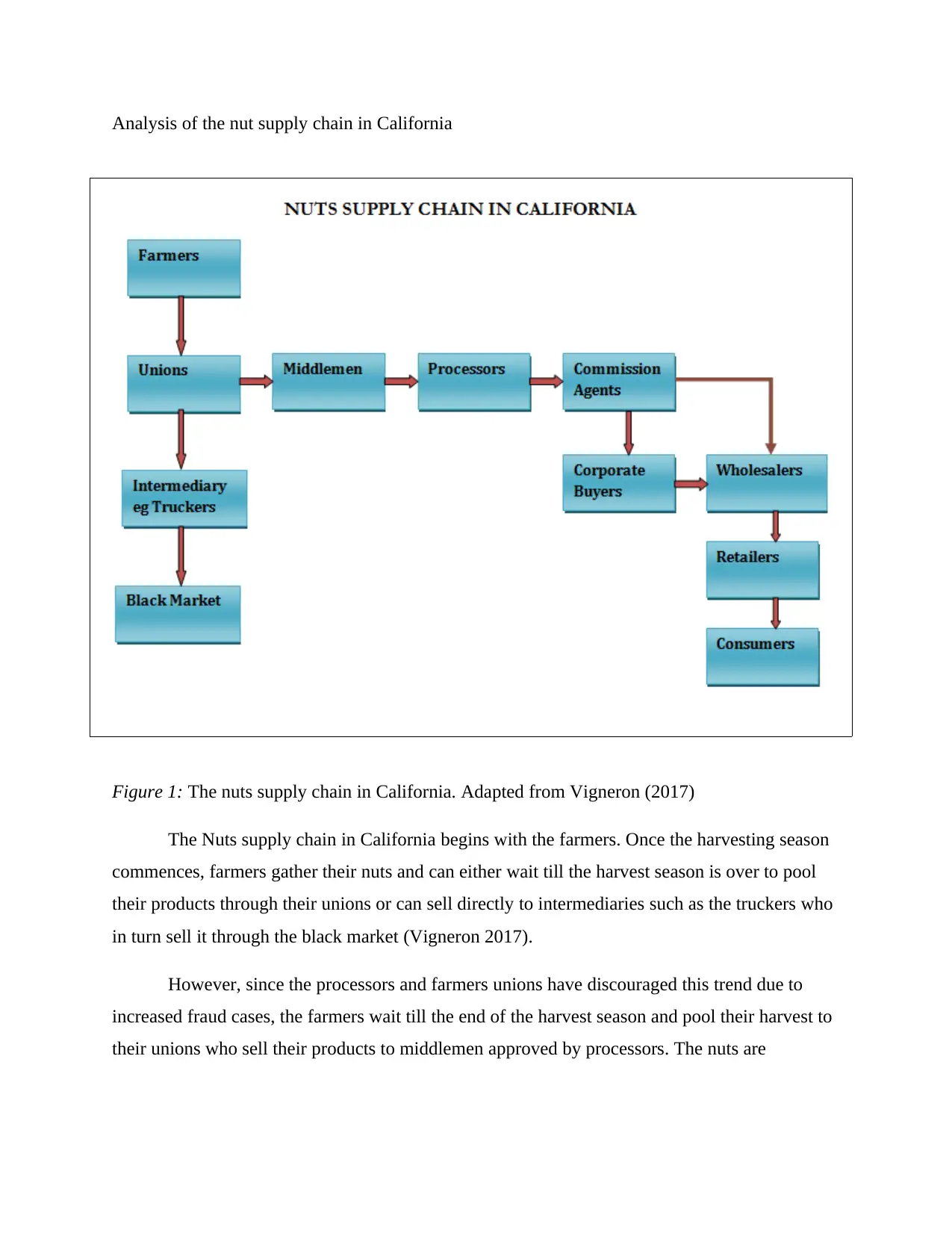
Analysis of the nut supply chain in California
Figure 1: The nuts supply chain in California. Adapted from Vigneron (2017)
The Nuts supply chain in California begins with the farmers. Once the harvesting season
commences, farmers gather their nuts and can either wait till the harvest season is over to pool
their products through their unions or can sell directly to intermediaries such as the truckers who
in turn sell it through the black market (Vigneron 2017).
However, since the processors and farmers unions have discouraged this trend due to
increased fraud cases, the farmers wait till the end of the harvest season and pool their harvest to
their unions who sell their products to middlemen approved by processors. The nuts are
tabler-icon-diamond-filled.svg

Paraphrase This Document

Need a fresh take? Get an instant paraphrase of this document with our AI Paraphraser
Document Page
delivered to processors who in turn process the nuts and deliver them through transport
companies to commission agents or brokers (Tait 2016).
The brokers then have the option of supplying the nuts to distributors who can be
corporate buyers or general wholesalers. They can be either within the USA or Canada. The
corporate buyers may add value to the nuts to make other products which are also eventually
turned to wholesalers. The wholesalers then supply the nuts and nuts by-products to retailers who
eventually sell to consumers (Vigneron 2017).
Vulnerabilities in the California Nut Industry Supply Chain
There are numerous vulnerabilities in this supply chain. To begin with, the supply chain
has no regulators to vet the companies conducting transportation or the middlemen buying the
products from the farmers or those transporting nuts from the processors. For this reason,
criminal elements have exploited this weakness to swindle the processors and farmers
(Associated Press 2016).
Secondly, the supply chain is over-dependent on subcontracted transport agents with
unverifiable backgrounds instead of authorized freight handlers who can be responsible for
losses if and when they occur (Mohan & Winton 2016).
Thirdly, the supply chain is riddled with a black market which fuels demand for the nuts
hence creating dis-equilibrium in the market forces that determine the demand and supply. This
means cartels can commit a felony in the nuts industry to enjoy the economic benefits of
supplying a black market (Vigneron 2017).
Fourthly, the brokers or commission agents who arrange for product shipping and
distribution do not check the authenticity of the transport companies clearing the nuts shipment
from the ports. This creates a security loophole that has been exploited by criminals (Vigneron
2017).
The supply chain has also been invaded by too many middlemen, brokers, and indenters
who displace the formal channels of communication between the farmers, processors, and
wholesalers.
Document Page
Moreover, the punitive mechanisms for theft crimes within the nut supply chain are very
light. For this reason, the motivation to commit a crime within the nut supply chain is unabated
since theft crimes involving nuts are regarded as petty (Tait 2016).
Finally, there is no mechanism to code the nuts as is done to other products to trace their
origin and movement. Even when stolen, it becomes quite difficult to prove the same because
nuts are consumable products which lead to no evidence (Vigneron 2017).
Document Page
References
Associated Press (2016). How international gangs pose as truckers to steal nuts worth millions.
[online] Mail Online. Available at: http://www.dailymail.co.uk/news/article-3539168/Thieves-
targeting-California-almonds-walnuts.html [Accessed 19 Apr. 2018].
Mohan, G. and Winton, R. (2016). In sophisticated shell game, thieves hit Central Valley nut
growers. [online] Los Angeles Times. Available at: http://www.latimes.com/business/la-fi-nut-
theft-20160414-story.html [Accessed 19 Apr. 2018].
Tait, R. (2016). High-tech criminals hit California with a spate of nut thefts. [online] The
Telegraph. Available at: https://www.telegraph.co.uk/news/2016/04/18/high-tech-criminals-hit-
california-with-a spate-of-nut-thefts/ [Accessed 19 Apr. 2018].
Vigneron, P. (2017). The Curious Case of the Disappearing Nuts. [online] Outside Online.
Available at: https://www.outsideonline.com/2186526/nut-job [Accessed 19 Apr. 2018].
chevron_up_icon
1 out of 4
circle_padding
hide_on_mobile
zoom_out_icon
[object Object]