Comprehensive Food Nutrition Report: Teenage Athlete Dietary Needs
VerifiedAdded on 2020/05/11
|9
|2056
|257
Report
AI Summary
This report focuses on the nutritional requirements of teenage athletes, emphasizing the importance of balanced diets for optimal growth, development, and sports performance. It highlights the significance of macronutrients, micronutrients, and fluid intake, along with the crucial role of timing meals and snacks before, during, and after physical activity. The report analyzes a sample menu, identifying areas for improvement and suggesting adjustments to meet the high-energy demands of teenage athletes. It emphasizes the need for adequate calorie intake, particularly carbohydrates, and proposes snack options to supplement energy levels, especially for those with limited whole grain consumption. The report also provides guidance on the timing of snacks to maximize nutrient absorption and utilization, offering examples of pre- and post-exercise snack choices. Ultimately, the report underscores the impact of proper nutrition on enhancing performance, reducing injury risk, and promoting overall health and well-being in young athletes.
Running head: FOOD NUTRITION
FOOD NUTRITION
[Author Name(s), First M. Last, Omit Titles and Degrees]
[Institutional Affiliation(s)]
FOOD NUTRITION
[Author Name(s), First M. Last, Omit Titles and Degrees]
[Institutional Affiliation(s)]
Paraphrase This Document
Need a fresh take? Get an instant paraphrase of this document with our AI Paraphraser

2
FOOD NUTRITION
Food is fuel. Nutrition is a very fundamental aspect of the performance of an athlete in
sports besides enhancing optimal growth and development. Fluids, micronutrients and
macronutrients in their right proportions are vital in the provision of energy meant for growth
and activity (Rau, 2012). It is for this reason that young athlete finds it necessary to learn what,
when and how to drink and eat before, during and after an activity. It would make limited value
if any of out unhealthy fats and unnecessary sugars into the body of a teenage athlete. The
building of the muscles and provision of enough energy are among the priorities of nutrients that
a teenage needs during sports activities or even when engaging in the practice for the same.
If anything, a teenage athlete needs the power to enhance in quick and strong moves as
well as the necessary endurance that would enable him practice and manage to play the game
successfully. Besides the nutritional needs of the athlete, it is also of equal importance to
understand how to eat. This revolves around when is it appropriate to take which nutrients
(Castle, 2015). This is classified as either before and after an activity. Whereas other nutrients
may be best taken before an activity, others would need to be taken after the activity in order to
achieve the best of their needs. Teen athletes are found to require more calories in their diet than
any other nutrients provided (DeBruyne, 2010).
It is estimated that a teenage male athlete requires to the tune of about 3500 calories per
day while the female counterpart requires approximately 2600 calories each day of her activities.
It is for this reason that the need of carbohydrates in the diet of a teenage athlete takes the lead
among the other nutritional foods. A teenage athlete requires full storage of carbohydrates before
an activity. The calories should be stored in the muscles and thus acting as the powerhouse of the
body (Mueller, 2013).
FOOD NUTRITION
Food is fuel. Nutrition is a very fundamental aspect of the performance of an athlete in
sports besides enhancing optimal growth and development. Fluids, micronutrients and
macronutrients in their right proportions are vital in the provision of energy meant for growth
and activity (Rau, 2012). It is for this reason that young athlete finds it necessary to learn what,
when and how to drink and eat before, during and after an activity. It would make limited value
if any of out unhealthy fats and unnecessary sugars into the body of a teenage athlete. The
building of the muscles and provision of enough energy are among the priorities of nutrients that
a teenage needs during sports activities or even when engaging in the practice for the same.
If anything, a teenage athlete needs the power to enhance in quick and strong moves as
well as the necessary endurance that would enable him practice and manage to play the game
successfully. Besides the nutritional needs of the athlete, it is also of equal importance to
understand how to eat. This revolves around when is it appropriate to take which nutrients
(Castle, 2015). This is classified as either before and after an activity. Whereas other nutrients
may be best taken before an activity, others would need to be taken after the activity in order to
achieve the best of their needs. Teen athletes are found to require more calories in their diet than
any other nutrients provided (DeBruyne, 2010).
It is estimated that a teenage male athlete requires to the tune of about 3500 calories per
day while the female counterpart requires approximately 2600 calories each day of her activities.
It is for this reason that the need of carbohydrates in the diet of a teenage athlete takes the lead
among the other nutritional foods. A teenage athlete requires full storage of carbohydrates before
an activity. The calories should be stored in the muscles and thus acting as the powerhouse of the
body (Mueller, 2013).

3
FOOD NUTRITION
The basic nutrition provided to teenagers aid in growth, scholastic achievement,
achievement of good health as well as in the provision of the required energy. Sports nutrition
facilitates the performance of an athlete by reducing fatigue and the risk of contracting diseases
as well as injury. Still, sports nutrition aims at optimization of training and enhancing faster
recovery. It is important for the athlete to learn how to create a balance between energy intake
and energy expenditure to avoid possible chances of energy deficit or surpluses (Whitley, 2011).
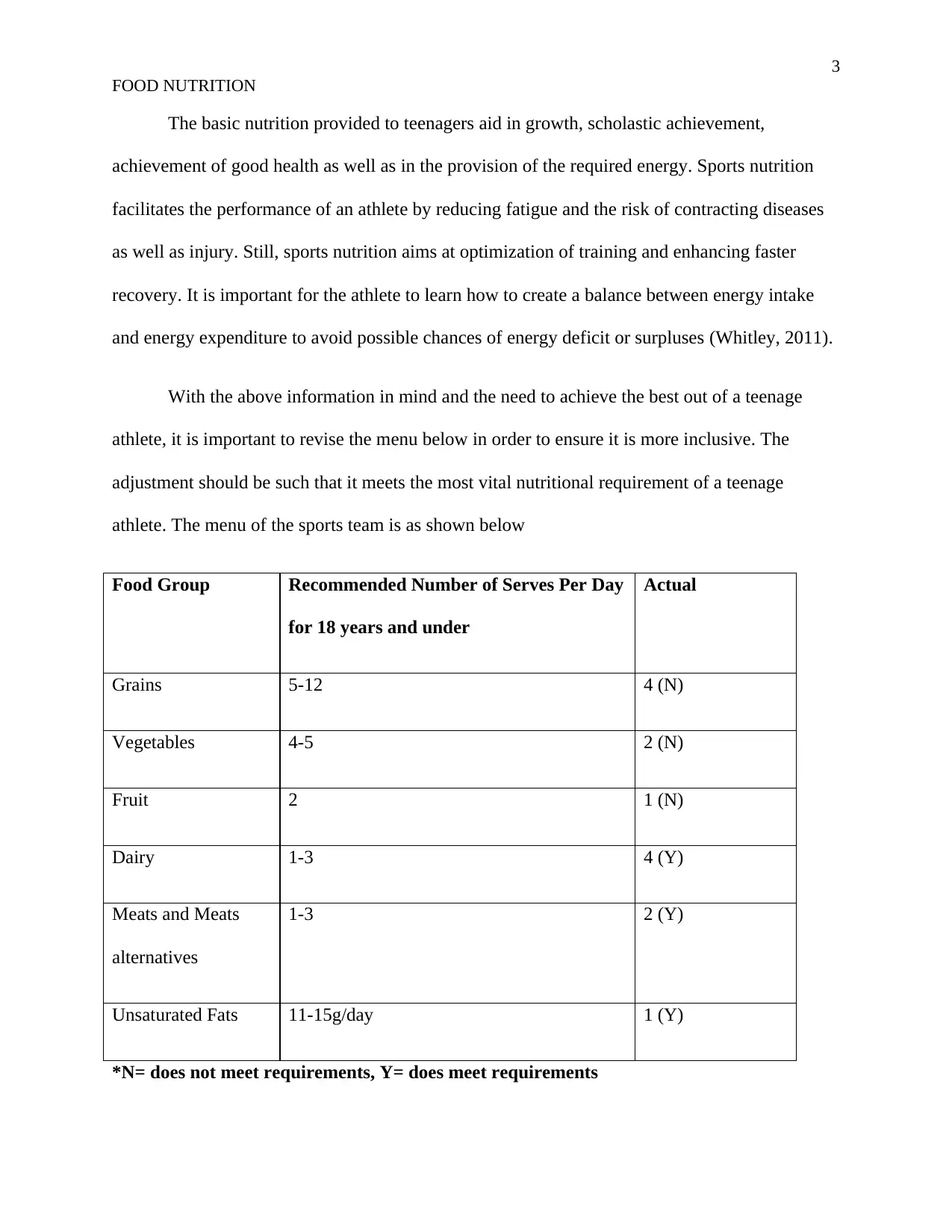
With the above information in mind and the need to achieve the best out of a teenage
athlete, it is important to revise the menu below in order to ensure it is more inclusive. The
adjustment should be such that it meets the most vital nutritional requirement of a teenage
athlete. The menu of the sports team is as shown below
Food Group Recommended Number of Serves Per Day
for 18 years and under
Actual
Grains 5-12 4 (N)
Vegetables 4-5 2 (N)
Fruit 2 1 (N)
Dairy 1-3 4 (Y)
Meats and Meats
alternatives
1-3 2 (Y)
Unsaturated Fats 11-15g/day 1 (Y)
*N= does not meet requirements, Y= does meet requirements
FOOD NUTRITION
The basic nutrition provided to teenagers aid in growth, scholastic achievement,
achievement of good health as well as in the provision of the required energy. Sports nutrition
facilitates the performance of an athlete by reducing fatigue and the risk of contracting diseases
as well as injury. Still, sports nutrition aims at optimization of training and enhancing faster
recovery. It is important for the athlete to learn how to create a balance between energy intake
and energy expenditure to avoid possible chances of energy deficit or surpluses (Whitley, 2011).
With the above information in mind and the need to achieve the best out of a teenage
athlete, it is important to revise the menu below in order to ensure it is more inclusive. The
adjustment should be such that it meets the most vital nutritional requirement of a teenage
athlete. The menu of the sports team is as shown below
Food Group Recommended Number of Serves Per Day
for 18 years and under
Actual
Grains 5-12 4 (N)
Vegetables 4-5 2 (N)
Fruit 2 1 (N)
Dairy 1-3 4 (Y)
Meats and Meats
alternatives
1-3 2 (Y)
Unsaturated Fats 11-15g/day 1 (Y)
*N= does not meet requirements, Y= does meet requirements
⊘ This is a preview!⊘
Do you want full access?
Subscribe today to unlock all pages.

Trusted by 1+ million students worldwide

4
FOOD NUTRITION
Food Group Recommended Minimum Number of
Choices for 18 years and under
Actual
Grains 2 2 (Y)
Vegetables 2 1 (N)
Fruit 2 1 (N)
Dairy 2 2 (Y)
Meats and Meats
alternatives
2 2 (Y)
Unsaturated Fats 1 1 (Y)
*N= does not meet requirements, Y= does meet requirements
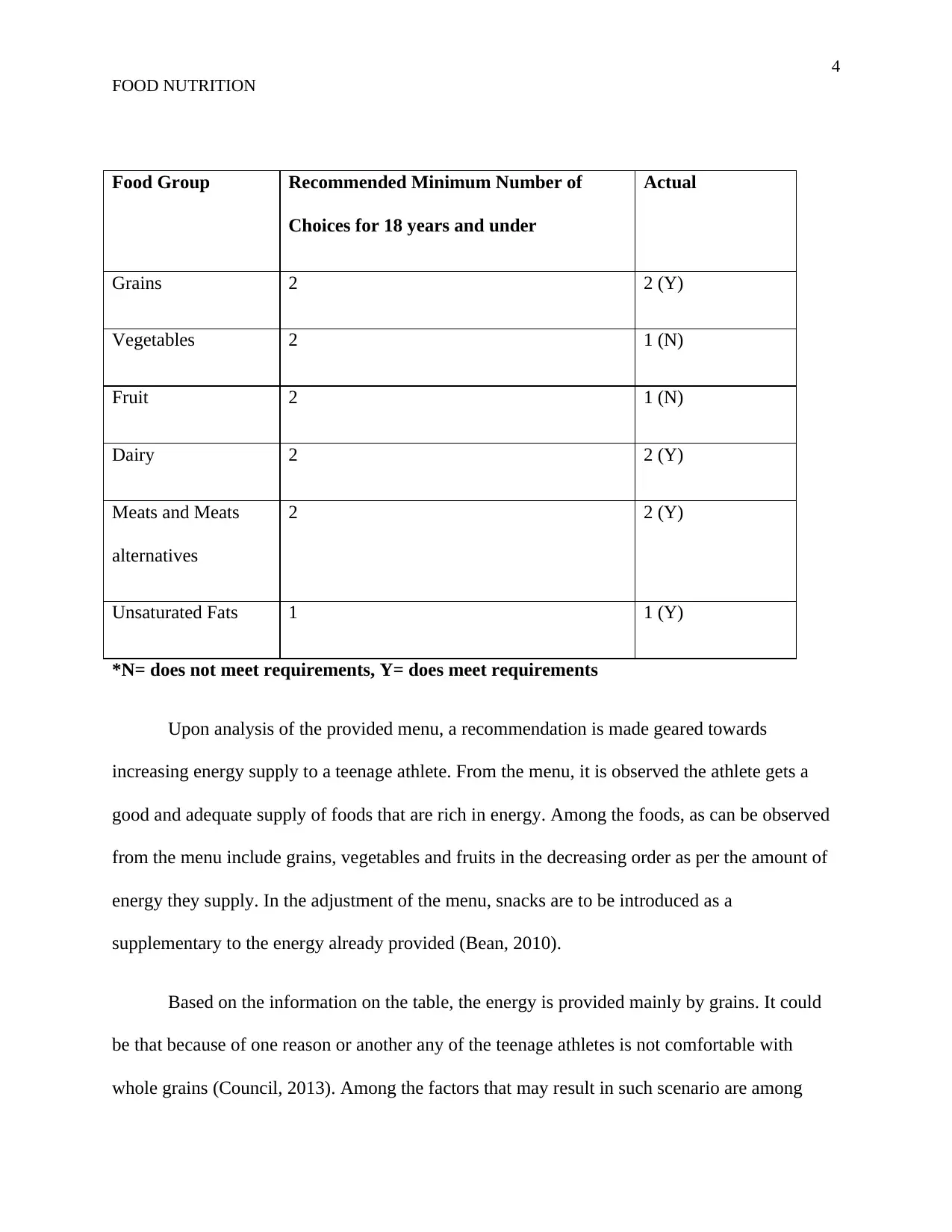
Upon analysis of the provided menu, a recommendation is made geared towards
increasing energy supply to a teenage athlete. From the menu, it is observed the athlete gets a
good and adequate supply of foods that are rich in energy. Among the foods, as can be observed
from the menu include grains, vegetables and fruits in the decreasing order as per the amount of
energy they supply. In the adjustment of the menu, snacks are to be introduced as a
supplementary to the energy already provided (Bean, 2010).
Based on the information on the table, the energy is provided mainly by grains. It could
be that because of one reason or another any of the teenage athletes is not comfortable with
whole grains (Council, 2013). Among the factors that may result in such scenario are among
FOOD NUTRITION
Food Group Recommended Minimum Number of
Choices for 18 years and under
Actual
Grains 2 2 (Y)
Vegetables 2 1 (N)
Fruit 2 1 (N)
Dairy 2 2 (Y)
Meats and Meats
alternatives
2 2 (Y)
Unsaturated Fats 1 1 (Y)
*N= does not meet requirements, Y= does meet requirements
Upon analysis of the provided menu, a recommendation is made geared towards
increasing energy supply to a teenage athlete. From the menu, it is observed the athlete gets a
good and adequate supply of foods that are rich in energy. Among the foods, as can be observed
from the menu include grains, vegetables and fruits in the decreasing order as per the amount of
energy they supply. In the adjustment of the menu, snacks are to be introduced as a
supplementary to the energy already provided (Bean, 2010).
Based on the information on the table, the energy is provided mainly by grains. It could
be that because of one reason or another any of the teenage athletes is not comfortable with
whole grains (Council, 2013). Among the factors that may result in such scenario are among
Paraphrase This Document
Need a fresh take? Get an instant paraphrase of this document with our AI Paraphraser

5
FOOD NUTRITION
them the background of the teenage athlete and how he is brought up in line with the diet
common to him. This would mean such a teenage athlete would be gaining very little as far as
the supply of adequate energy is concerned despite the vast number of serves of the grain as
provided in the menu. This thus makes it significant to have an alternative of grain to ensure that
the menu is all-inclusive and meets the expectations of each of the teenage athletes (Whitney,
2018).
This would depend on the calorie coefficient of the snacks. Information on when to take
which snacks help to ensure optimization of the nutrients available in the snacks. Taking of
snacks rich in carbohydrates is most beneficial when done two or three hours before activity.
Some of the snacks that can be taken before an exercise include toast, jacket potato with beans,
chicken with rice and salad.
After an exercise, a teenage athlete would need to restore the energy lost as well as
maintain the mass of the muscles (NHMRC, 2013). This also calls for the supply of energy to the
body. Taking snacks rich in carbohydrates and proteins would help in the restoration of the lost
energy and maintain the mass of the body muscles. An example of such a snack would be mixed
fruit salad with Greek yoghurt that has been topped with mixed seeds and nuts. Alternatively,
taking skimmed milk may provide an excellent option of regaining the lost energy after an
exercise (Rau, 2012). In order to have the best from snacks taken after an exercise, the snacks
should be taken not later than one hour after the meal.
Snacks for teenage athletes can be derived from various nutrients in various proportions.
Fruits and vegetable are such one source of healthy snacks. In as much as fruits and vegetables
do not yield as many calories, a combination of these nutrients with sources of proteins and
FOOD NUTRITION
them the background of the teenage athlete and how he is brought up in line with the diet
common to him. This would mean such a teenage athlete would be gaining very little as far as
the supply of adequate energy is concerned despite the vast number of serves of the grain as
provided in the menu. This thus makes it significant to have an alternative of grain to ensure that
the menu is all-inclusive and meets the expectations of each of the teenage athletes (Whitney,
2018).
This would depend on the calorie coefficient of the snacks. Information on when to take
which snacks help to ensure optimization of the nutrients available in the snacks. Taking of
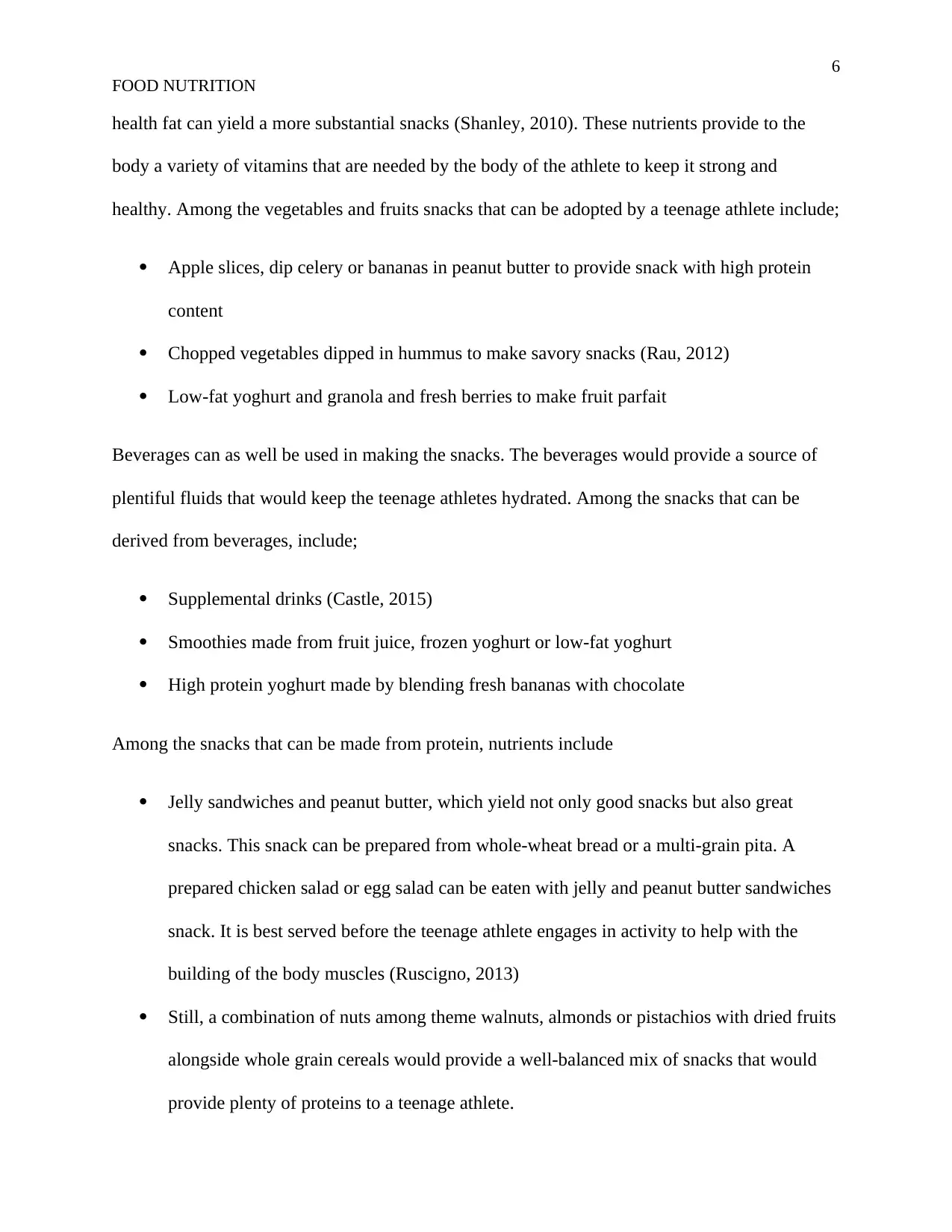
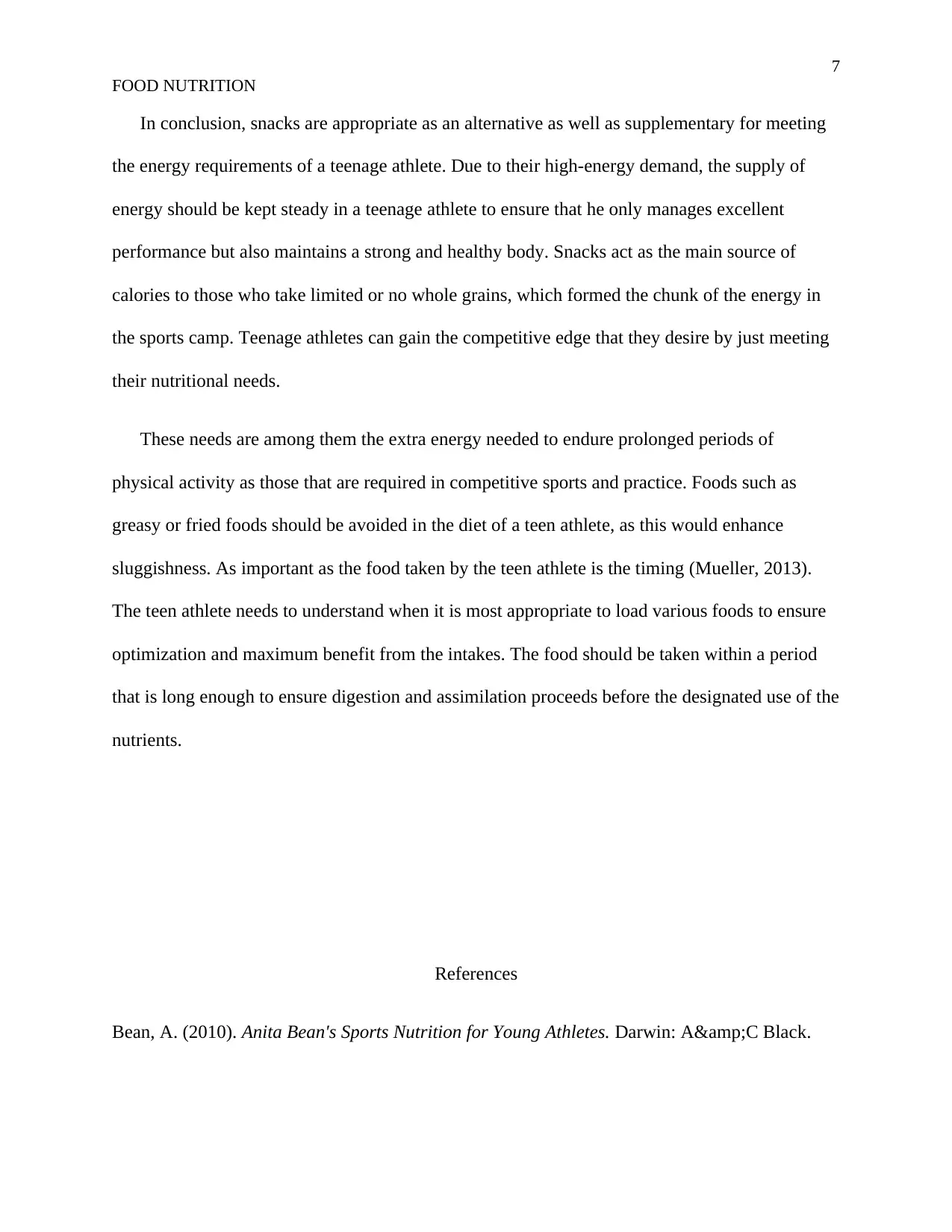
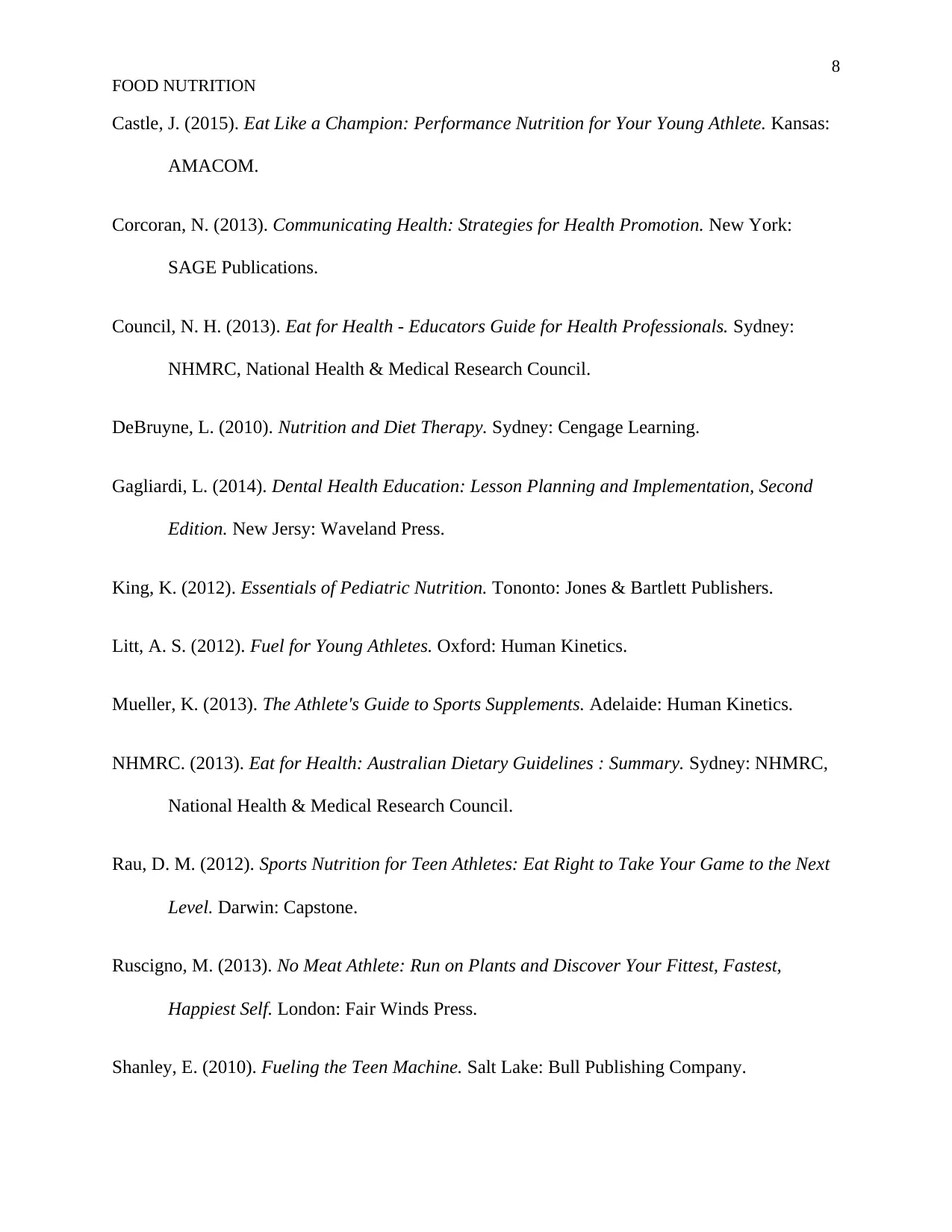
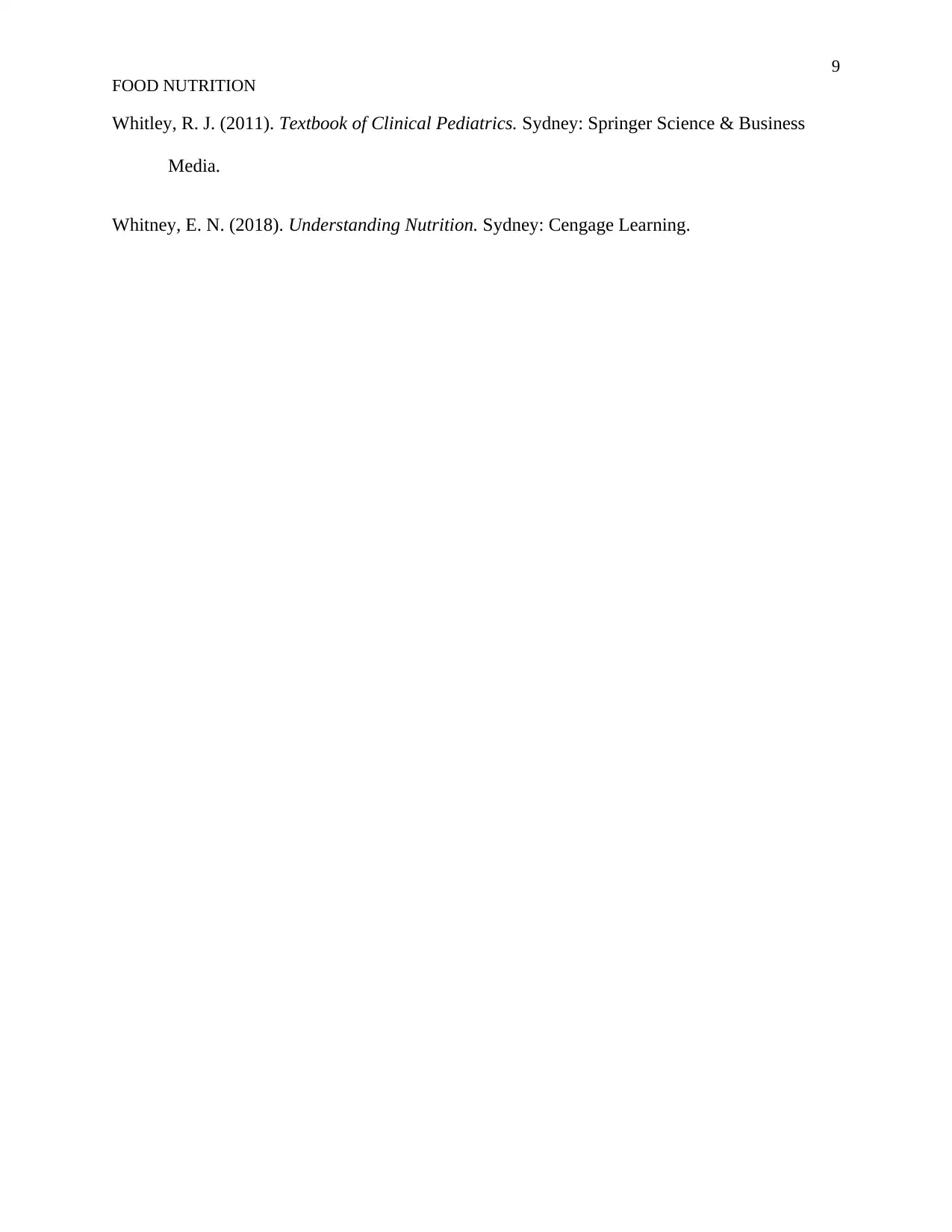
snacks rich in carbohydrates is most beneficial when done two or three hours before activity.
Some of the snacks that can be taken before an exercise include toast, jacket potato with beans,
chicken with rice and salad.
After an exercise, a teenage athlete would need to restore the energy lost as well as
maintain the mass of the muscles (NHMRC, 2013). This also calls for the supply of energy to the
body. Taking snacks rich in carbohydrates and proteins would help in the restoration of the lost
energy and maintain the mass of the body muscles. An example of such a snack would be mixed
fruit salad with Greek yoghurt that has been topped with mixed seeds and nuts. Alternatively,
taking skimmed milk may provide an excellent option of regaining the lost energy after an
exercise (Rau, 2012). In order to have the best from snacks taken after an exercise, the snacks
should be taken not later than one hour after the meal.
Snacks for teenage athletes can be derived from various nutrients in various proportions.
Fruits and vegetable are such one source of healthy snacks. In as much as fruits and vegetables
do not yield as many calories, a combination of these nutrients with sources of proteins and

6
FOOD NUTRITION
health fat can yield a more substantial snacks (Shanley, 2010). These nutrients provide to the
body a variety of vitamins that are needed by the body of the athlete to keep it strong and
healthy. Among the vegetables and fruits snacks that can be adopted by a teenage athlete include;
Apple slices, dip celery or bananas in peanut butter to provide snack with high protein
content
Chopped vegetables dipped in hummus to make savory snacks (Rau, 2012)
Low-fat yoghurt and granola and fresh berries to make fruit parfait
Beverages can as well be used in making the snacks. The beverages would provide a source of
plentiful fluids that would keep the teenage athletes hydrated. Among the snacks that can be
derived from beverages, include;
Supplemental drinks (Castle, 2015)
Smoothies made from fruit juice, frozen yoghurt or low-fat yoghurt
High protein yoghurt made by blending fresh bananas with chocolate
Among the snacks that can be made from protein, nutrients include
Jelly sandwiches and peanut butter, which yield not only good snacks but also great
snacks. This snack can be prepared from whole-wheat bread or a multi-grain pita. A
prepared chicken salad or egg salad can be eaten with jelly and peanut butter sandwiches
snack. It is best served before the teenage athlete engages in activity to help with the
building of the body muscles (Ruscigno, 2013)
Still, a combination of nuts among theme walnuts, almonds or pistachios with dried fruits
alongside whole grain cereals would provide a well-balanced mix of snacks that would
provide plenty of proteins to a teenage athlete.
FOOD NUTRITION
health fat can yield a more substantial snacks (Shanley, 2010). These nutrients provide to the
body a variety of vitamins that are needed by the body of the athlete to keep it strong and
healthy. Among the vegetables and fruits snacks that can be adopted by a teenage athlete include;
Apple slices, dip celery or bananas in peanut butter to provide snack with high protein
content
Chopped vegetables dipped in hummus to make savory snacks (Rau, 2012)
Low-fat yoghurt and granola and fresh berries to make fruit parfait
Beverages can as well be used in making the snacks. The beverages would provide a source of
plentiful fluids that would keep the teenage athletes hydrated. Among the snacks that can be
derived from beverages, include;
Supplemental drinks (Castle, 2015)
Smoothies made from fruit juice, frozen yoghurt or low-fat yoghurt
High protein yoghurt made by blending fresh bananas with chocolate
Among the snacks that can be made from protein, nutrients include
Jelly sandwiches and peanut butter, which yield not only good snacks but also great
snacks. This snack can be prepared from whole-wheat bread or a multi-grain pita. A
prepared chicken salad or egg salad can be eaten with jelly and peanut butter sandwiches
snack. It is best served before the teenage athlete engages in activity to help with the
building of the body muscles (Ruscigno, 2013)
Still, a combination of nuts among theme walnuts, almonds or pistachios with dried fruits
alongside whole grain cereals would provide a well-balanced mix of snacks that would
provide plenty of proteins to a teenage athlete.
⊘ This is a preview!⊘
Do you want full access?
Subscribe today to unlock all pages.

Trusted by 1+ million students worldwide

7
FOOD NUTRITION
In conclusion, snacks are appropriate as an alternative as well as supplementary for meeting
the energy requirements of a teenage athlete. Due to their high-energy demand, the supply of
energy should be kept steady in a teenage athlete to ensure that he only manages excellent
performance but also maintains a strong and healthy body. Snacks act as the main source of
calories to those who take limited or no whole grains, which formed the chunk of the energy in
the sports camp. Teenage athletes can gain the competitive edge that they desire by just meeting
their nutritional needs.
These needs are among them the extra energy needed to endure prolonged periods of
physical activity as those that are required in competitive sports and practice. Foods such as
greasy or fried foods should be avoided in the diet of a teen athlete, as this would enhance
sluggishness. As important as the food taken by the teen athlete is the timing (Mueller, 2013).
The teen athlete needs to understand when it is most appropriate to load various foods to ensure
optimization and maximum benefit from the intakes. The food should be taken within a period
that is long enough to ensure digestion and assimilation proceeds before the designated use of the
nutrients.
References
Bean, A. (2010). Anita Bean's Sports Nutrition for Young Athletes. Darwin: A&C Black.
FOOD NUTRITION
In conclusion, snacks are appropriate as an alternative as well as supplementary for meeting
the energy requirements of a teenage athlete. Due to their high-energy demand, the supply of
energy should be kept steady in a teenage athlete to ensure that he only manages excellent
performance but also maintains a strong and healthy body. Snacks act as the main source of
calories to those who take limited or no whole grains, which formed the chunk of the energy in
the sports camp. Teenage athletes can gain the competitive edge that they desire by just meeting
their nutritional needs.
These needs are among them the extra energy needed to endure prolonged periods of
physical activity as those that are required in competitive sports and practice. Foods such as
greasy or fried foods should be avoided in the diet of a teen athlete, as this would enhance
sluggishness. As important as the food taken by the teen athlete is the timing (Mueller, 2013).
The teen athlete needs to understand when it is most appropriate to load various foods to ensure
optimization and maximum benefit from the intakes. The food should be taken within a period
that is long enough to ensure digestion and assimilation proceeds before the designated use of the
nutrients.
References
Bean, A. (2010). Anita Bean's Sports Nutrition for Young Athletes. Darwin: A&C Black.
Paraphrase This Document
Need a fresh take? Get an instant paraphrase of this document with our AI Paraphraser

8
FOOD NUTRITION
Castle, J. (2015). Eat Like a Champion: Performance Nutrition for Your Young Athlete. Kansas:
AMACOM.
Corcoran, N. (2013). Communicating Health: Strategies for Health Promotion. New York:
SAGE Publications.
Council, N. H. (2013). Eat for Health - Educators Guide for Health Professionals. Sydney:
NHMRC, National Health & Medical Research Council.
DeBruyne, L. (2010). Nutrition and Diet Therapy. Sydney: Cengage Learning.
Gagliardi, L. (2014). Dental Health Education: Lesson Planning and Implementation, Second
Edition. New Jersy: Waveland Press.
King, K. (2012). Essentials of Pediatric Nutrition. Tononto: Jones & Bartlett Publishers.
Litt, A. S. (2012). Fuel for Young Athletes. Oxford: Human Kinetics.
Mueller, K. (2013). The Athlete's Guide to Sports Supplements. Adelaide: Human Kinetics.
NHMRC. (2013). Eat for Health: Australian Dietary Guidelines : Summary. Sydney: NHMRC,
National Health & Medical Research Council.
Rau, D. M. (2012). Sports Nutrition for Teen Athletes: Eat Right to Take Your Game to the Next
Level. Darwin: Capstone.
Ruscigno, M. (2013). No Meat Athlete: Run on Plants and Discover Your Fittest, Fastest,
Happiest Self. London: Fair Winds Press.
Shanley, E. (2010). Fueling the Teen Machine. Salt Lake: Bull Publishing Company.
FOOD NUTRITION
Castle, J. (2015). Eat Like a Champion: Performance Nutrition for Your Young Athlete. Kansas:
AMACOM.
Corcoran, N. (2013). Communicating Health: Strategies for Health Promotion. New York:
SAGE Publications.
Council, N. H. (2013). Eat for Health - Educators Guide for Health Professionals. Sydney:
NHMRC, National Health & Medical Research Council.
DeBruyne, L. (2010). Nutrition and Diet Therapy. Sydney: Cengage Learning.
Gagliardi, L. (2014). Dental Health Education: Lesson Planning and Implementation, Second
Edition. New Jersy: Waveland Press.
King, K. (2012). Essentials of Pediatric Nutrition. Tononto: Jones & Bartlett Publishers.
Litt, A. S. (2012). Fuel for Young Athletes. Oxford: Human Kinetics.
Mueller, K. (2013). The Athlete's Guide to Sports Supplements. Adelaide: Human Kinetics.
NHMRC. (2013). Eat for Health: Australian Dietary Guidelines : Summary. Sydney: NHMRC,
National Health & Medical Research Council.
Rau, D. M. (2012). Sports Nutrition for Teen Athletes: Eat Right to Take Your Game to the Next
Level. Darwin: Capstone.
Ruscigno, M. (2013). No Meat Athlete: Run on Plants and Discover Your Fittest, Fastest,
Happiest Self. London: Fair Winds Press.
Shanley, E. (2010). Fueling the Teen Machine. Salt Lake: Bull Publishing Company.

9
FOOD NUTRITION
Whitley, R. J. (2011). Textbook of Clinical Pediatrics. Sydney: Springer Science & Business
Media.
Whitney, E. N. (2018). Understanding Nutrition. Sydney: Cengage Learning.
FOOD NUTRITION
Whitley, R. J. (2011). Textbook of Clinical Pediatrics. Sydney: Springer Science & Business
Media.
Whitney, E. N. (2018). Understanding Nutrition. Sydney: Cengage Learning.
⊘ This is a preview!⊘
Do you want full access?
Subscribe today to unlock all pages.

Trusted by 1+ million students worldwide
1 out of 9
Related Documents
Your All-in-One AI-Powered Toolkit for Academic Success.
+13062052269
info@desklib.com
Available 24*7 on WhatsApp / Email
Unlock your academic potential
Copyright © 2020–2025 A2Z Services. All Rights Reserved. Developed and managed by ZUCOL.