Nutritional Evaluation and Dietary Analysis Report for Weight Loss
VerifiedAdded on 2020/06/05
|9
|2509
|192
Report
AI Summary
This report presents a nutritional evaluation and dietary analysis for a 55-year-old man named Phil, who aims to reduce his body fat percentage from 29% to 20%. The report begins with an introduction to nutritional assessment methods, including anthropometry, biochemical, clinical, and dietary methods. It then focuses on Phil's current diet, exercise routine, and calorie needs. A detailed meal plan is provided, outlining breakfast, lunch, dinner, and snack options for each day of the week, emphasizing fruits, vegetables, and lean protein sources while minimizing calorie and fat intake. The report also analyzes the calorie and sugar content of various fruits and discusses the importance of dairy products and water intake. It compares Phil's current diet to government dietary recommendations, highlighting areas for improvement, such as fat, carbohydrate, and fiber intake, as well as alcohol and salt consumption. The report concludes with a summary of the findings and recommendations for Phil to achieve his weight loss goals through dietary modifications and increased physical activity.
Nutritional evaluation and dietary
analysis report
analysis report
Paraphrase This Document
Need a fresh take? Get an instant paraphrase of this document with our AI Paraphraser

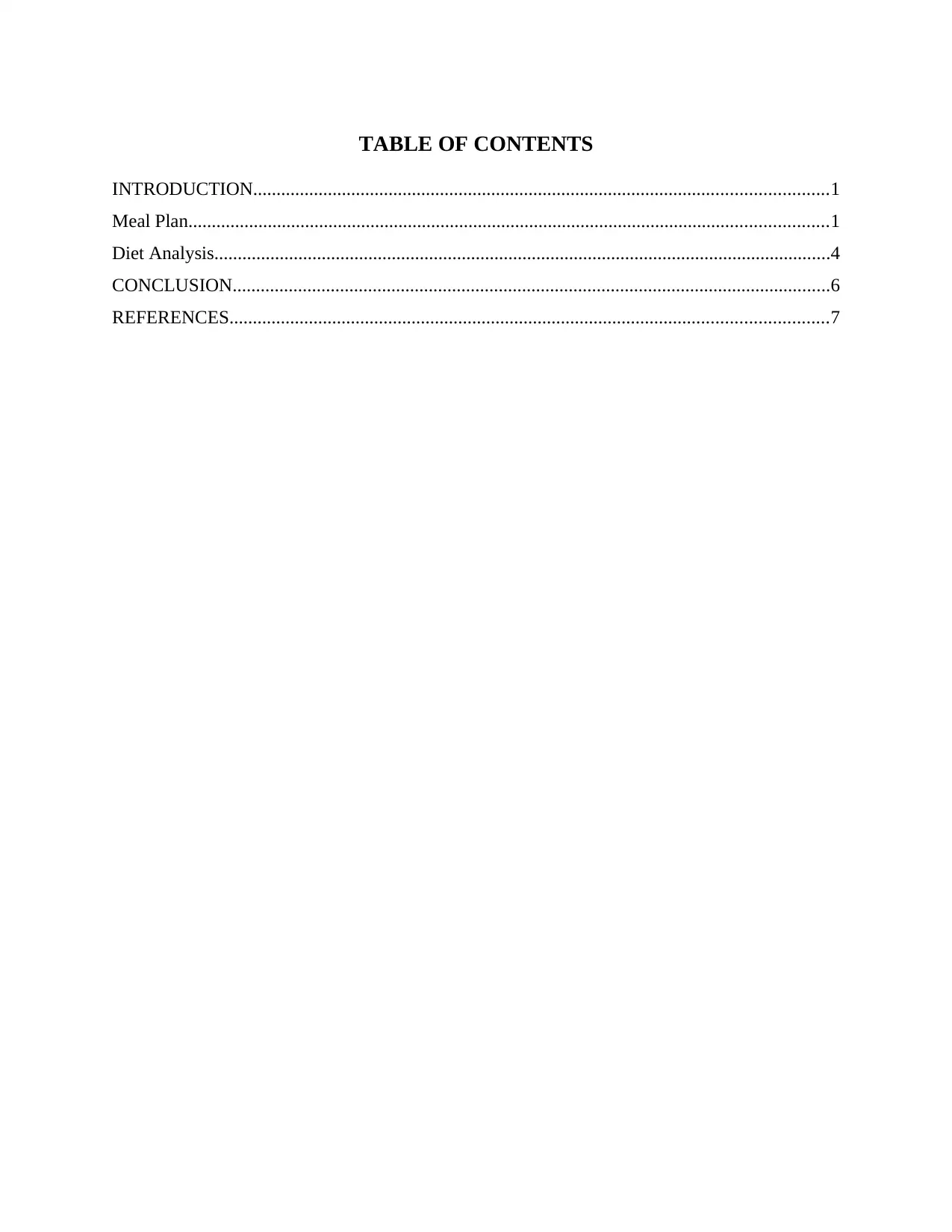
TABLE OF CONTENTS
INTRODUCTION...........................................................................................................................1
Meal Plan.........................................................................................................................................1
Diet Analysis....................................................................................................................................4
CONCLUSION................................................................................................................................6
REFERENCES................................................................................................................................7
INTRODUCTION...........................................................................................................................1
Meal Plan.........................................................................................................................................1
Diet Analysis....................................................................................................................................4
CONCLUSION................................................................................................................................6
REFERENCES................................................................................................................................7

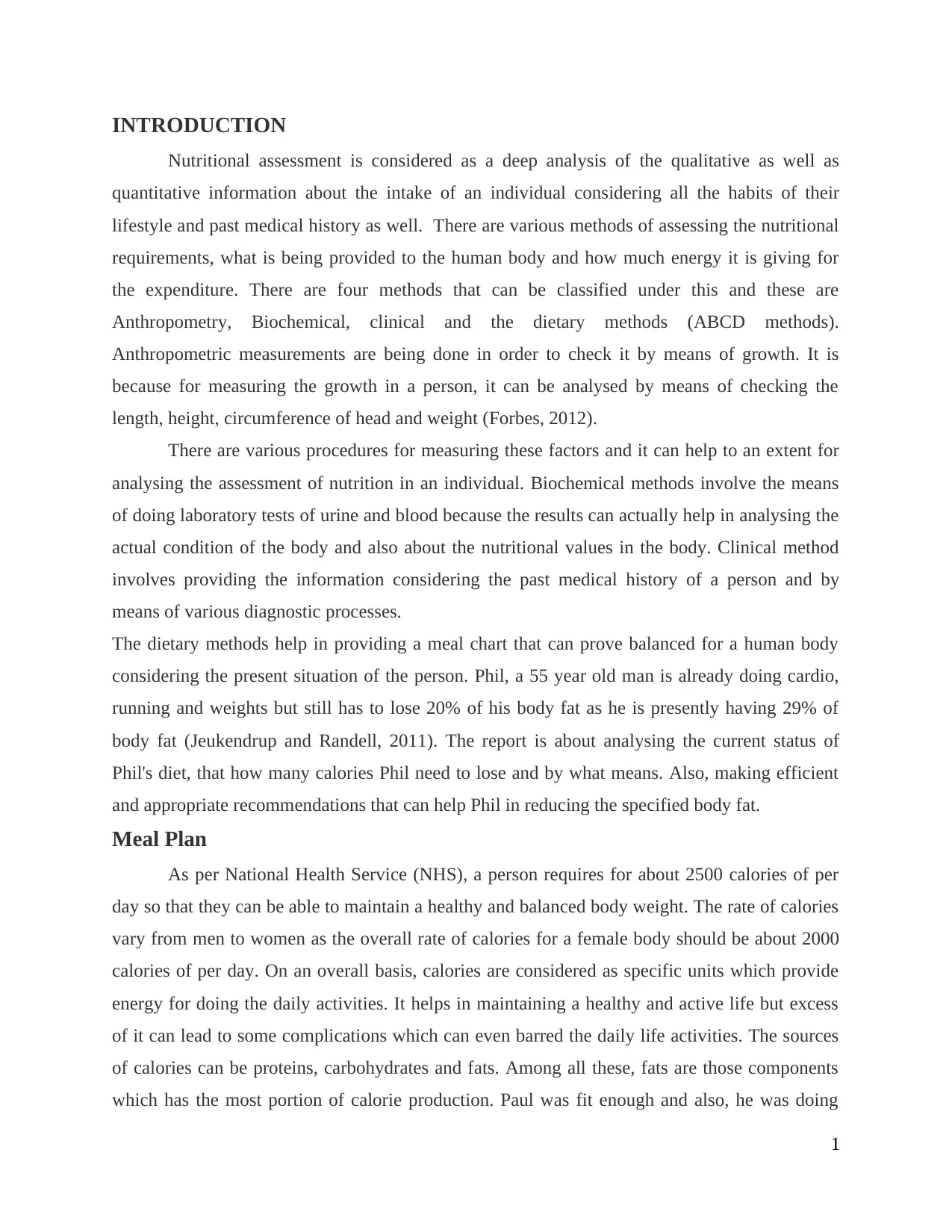
INTRODUCTION
Nutritional assessment is considered as a deep analysis of the qualitative as well as
quantitative information about the intake of an individual considering all the habits of their
lifestyle and past medical history as well. There are various methods of assessing the nutritional
requirements, what is being provided to the human body and how much energy it is giving for
the expenditure. There are four methods that can be classified under this and these are
Anthropometry, Biochemical, clinical and the dietary methods (ABCD methods).
Anthropometric measurements are being done in order to check it by means of growth. It is
because for measuring the growth in a person, it can be analysed by means of checking the
length, height, circumference of head and weight (Forbes, 2012).
There are various procedures for measuring these factors and it can help to an extent for
analysing the assessment of nutrition in an individual. Biochemical methods involve the means
of doing laboratory tests of urine and blood because the results can actually help in analysing the
actual condition of the body and also about the nutritional values in the body. Clinical method
involves providing the information considering the past medical history of a person and by
means of various diagnostic processes.
The dietary methods help in providing a meal chart that can prove balanced for a human body
considering the present situation of the person. Phil, a 55 year old man is already doing cardio,
running and weights but still has to lose 20% of his body fat as he is presently having 29% of
body fat (Jeukendrup and Randell, 2011). The report is about analysing the current status of
Phil's diet, that how many calories Phil need to lose and by what means. Also, making efficient
and appropriate recommendations that can help Phil in reducing the specified body fat.
Meal Plan
As per National Health Service (NHS), a person requires for about 2500 calories of per
day so that they can be able to maintain a healthy and balanced body weight. The rate of calories
vary from men to women as the overall rate of calories for a female body should be about 2000
calories of per day. On an overall basis, calories are considered as specific units which provide
energy for doing the daily activities. It helps in maintaining a healthy and active life but excess
of it can lead to some complications which can even barred the daily life activities. The sources
of calories can be proteins, carbohydrates and fats. Among all these, fats are those components
which has the most portion of calorie production. Paul was fit enough and also, he was doing
1
Nutritional assessment is considered as a deep analysis of the qualitative as well as
quantitative information about the intake of an individual considering all the habits of their
lifestyle and past medical history as well. There are various methods of assessing the nutritional
requirements, what is being provided to the human body and how much energy it is giving for
the expenditure. There are four methods that can be classified under this and these are
Anthropometry, Biochemical, clinical and the dietary methods (ABCD methods).
Anthropometric measurements are being done in order to check it by means of growth. It is
because for measuring the growth in a person, it can be analysed by means of checking the
length, height, circumference of head and weight (Forbes, 2012).
There are various procedures for measuring these factors and it can help to an extent for
analysing the assessment of nutrition in an individual. Biochemical methods involve the means
of doing laboratory tests of urine and blood because the results can actually help in analysing the
actual condition of the body and also about the nutritional values in the body. Clinical method
involves providing the information considering the past medical history of a person and by
means of various diagnostic processes.
The dietary methods help in providing a meal chart that can prove balanced for a human body
considering the present situation of the person. Phil, a 55 year old man is already doing cardio,
running and weights but still has to lose 20% of his body fat as he is presently having 29% of
body fat (Jeukendrup and Randell, 2011). The report is about analysing the current status of
Phil's diet, that how many calories Phil need to lose and by what means. Also, making efficient
and appropriate recommendations that can help Phil in reducing the specified body fat.
Meal Plan
As per National Health Service (NHS), a person requires for about 2500 calories of per
day so that they can be able to maintain a healthy and balanced body weight. The rate of calories
vary from men to women as the overall rate of calories for a female body should be about 2000
calories of per day. On an overall basis, calories are considered as specific units which provide
energy for doing the daily activities. It helps in maintaining a healthy and active life but excess
of it can lead to some complications which can even barred the daily life activities. The sources
of calories can be proteins, carbohydrates and fats. Among all these, fats are those components
which has the most portion of calorie production. Paul was fit enough and also, he was doing
1
⊘ This is a preview!⊘
Do you want full access?
Subscribe today to unlock all pages.

Trusted by 1+ million students worldwide

exercises, cardio, running for about three times in a week to stay fit and healthy. So, he has to
include a diet less rich in calories so that he can lose up to 20% of his body fat. Macro nutrients
are those nutrients that are essential for the growth and managing the functioning of the body.
These are required in larger amount in a human body because it helps in maintaining the daily
life activities of a person. There are various means by which Phil can cut down to 20% of body
fat and the activities includes increasing the rate of workout as now he is doing exercises, cardio
etc. for three times in a week, so he can increase that amount of time. Not immediately, but it
will help in minimizing some amount of fat from his body. Also, after involving this and various
other activities like changes in meal plan and intake of food items that consists of fewer fats and
calories can help. Also, Phil can focus on avoiding fast food items and have meal that is being
prepared at home because it is healthy as well as balanced. Also, Phil can make use of stairs,
instead of using any vehicles. It is because using stairs can help in movement of the legs, which
further helps in burning calories. So, by these means, Phil can try to reduce the calories and after
a few times, he will be able to lose about 20 % of the body fat. His current weight is 78.2 kg
which is efficient and appropriate enough according to his age and his height is about 176 cm.
But presently, he has a body fat of 29% and he has to lose to about 20 %, that is about 2 kg's
from his body weight. So, a proper meal plan consisting of food less rich in calories and fats can
help Paul in losing to 20% of the body fat.
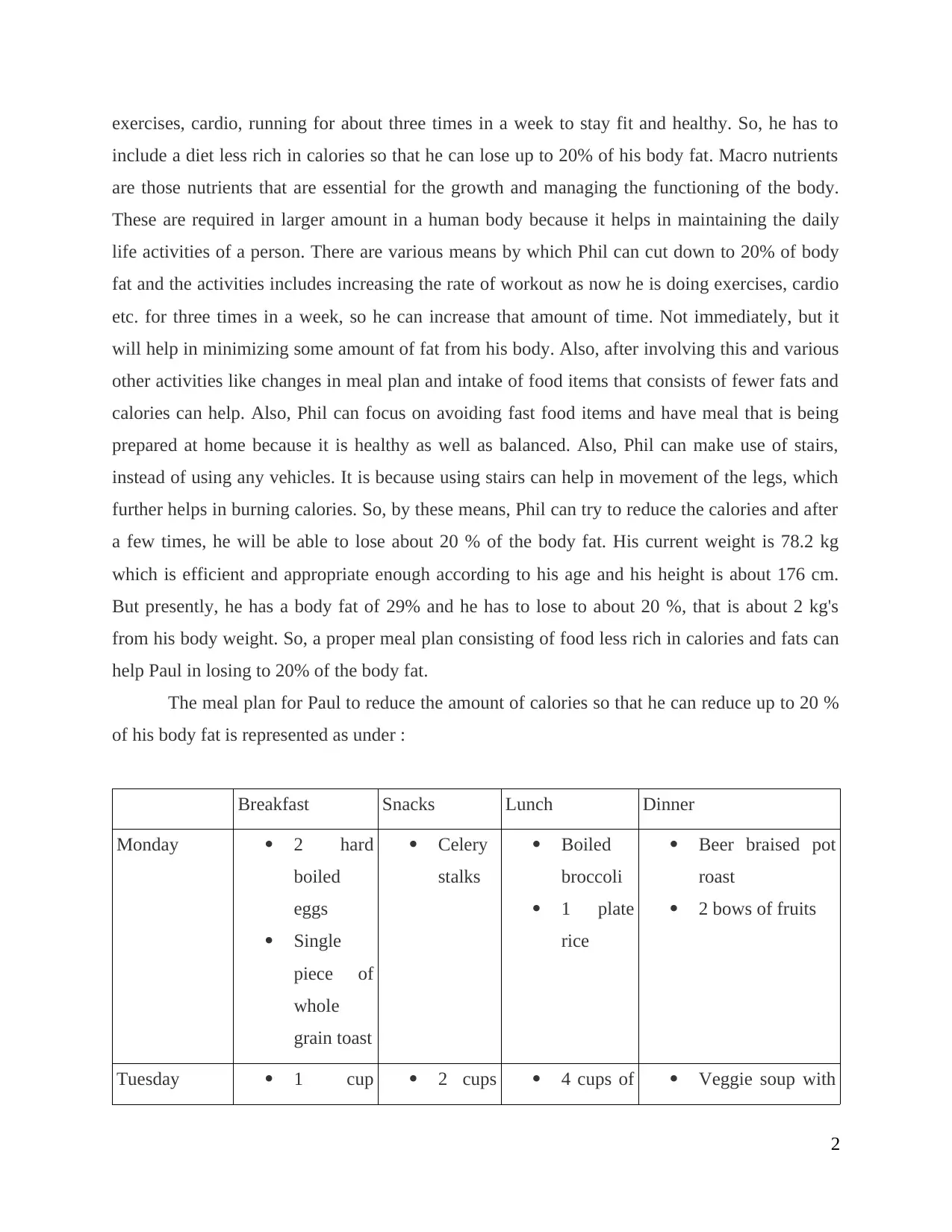
The meal plan for Paul to reduce the amount of calories so that he can reduce up to 20 %
of his body fat is represented as under :
Breakfast Snacks Lunch Dinner
Monday 2 hard
boiled
eggs
Single
piece of
whole
grain toast
Celery
stalks
Boiled
broccoli
1 plate
rice
Beer braised pot
roast
2 bows of fruits
Tuesday 1 cup 2 cups 4 cups of Veggie soup with
2
include a diet less rich in calories so that he can lose up to 20% of his body fat. Macro nutrients
are those nutrients that are essential for the growth and managing the functioning of the body.
These are required in larger amount in a human body because it helps in maintaining the daily
life activities of a person. There are various means by which Phil can cut down to 20% of body
fat and the activities includes increasing the rate of workout as now he is doing exercises, cardio
etc. for three times in a week, so he can increase that amount of time. Not immediately, but it
will help in minimizing some amount of fat from his body. Also, after involving this and various
other activities like changes in meal plan and intake of food items that consists of fewer fats and
calories can help. Also, Phil can focus on avoiding fast food items and have meal that is being
prepared at home because it is healthy as well as balanced. Also, Phil can make use of stairs,
instead of using any vehicles. It is because using stairs can help in movement of the legs, which
further helps in burning calories. So, by these means, Phil can try to reduce the calories and after
a few times, he will be able to lose about 20 % of the body fat. His current weight is 78.2 kg
which is efficient and appropriate enough according to his age and his height is about 176 cm.
But presently, he has a body fat of 29% and he has to lose to about 20 %, that is about 2 kg's
from his body weight. So, a proper meal plan consisting of food less rich in calories and fats can
help Paul in losing to 20% of the body fat.
The meal plan for Paul to reduce the amount of calories so that he can reduce up to 20 %
of his body fat is represented as under :
Breakfast Snacks Lunch Dinner
Monday 2 hard
boiled
eggs
Single
piece of
whole
grain toast
Celery
stalks
Boiled
broccoli
1 plate
rice
Beer braised pot
roast
2 bows of fruits
Tuesday 1 cup 2 cups 4 cups of Veggie soup with
2
Paraphrase This Document
Need a fresh take? Get an instant paraphrase of this document with our AI Paraphraser

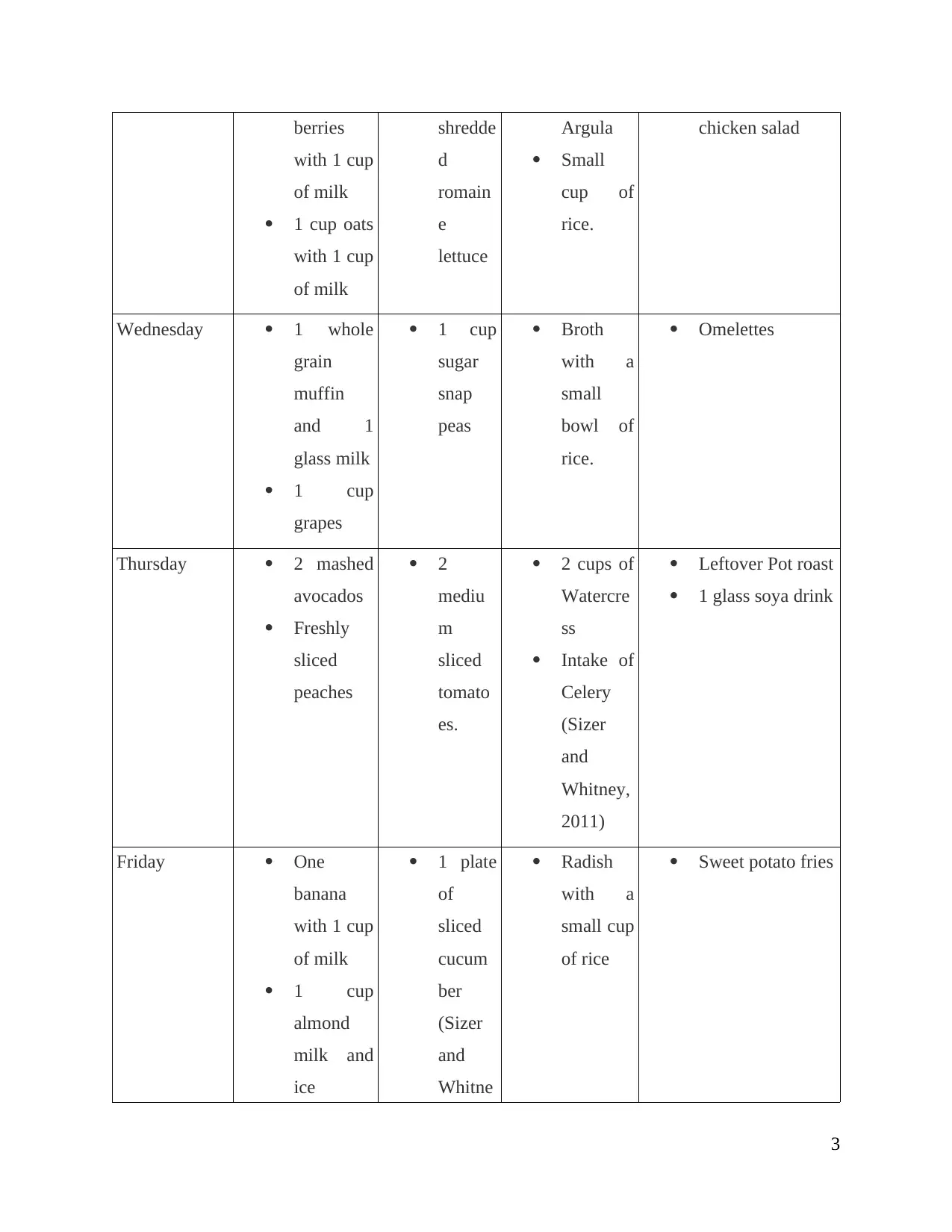
berries
with 1 cup
of milk
1 cup oats
with 1 cup
of milk
shredde
d
romain
e
lettuce
Argula
Small
cup of
rice.
chicken salad
Wednesday 1 whole
grain
muffin
and 1
glass milk
1 cup
grapes
1 cup
sugar
snap
peas
Broth
with a
small
bowl of
rice.
Omelettes
Thursday 2 mashed
avocados
Freshly
sliced
peaches
2
mediu
m
sliced
tomato
es.
2 cups of
Watercre
ss
Intake of
Celery
(Sizer
and
Whitney,
2011)
Leftover Pot roast
1 glass soya drink
Friday One
banana
with 1 cup
of milk
1 cup
almond
milk and
ice
1 plate
of
sliced
cucum
ber
(Sizer
and
Whitne
Radish
with a
small cup
of rice
Sweet potato fries
3
with 1 cup
of milk
1 cup oats
with 1 cup
of milk
shredde
d
romain
e
lettuce
Argula
Small
cup of
rice.
chicken salad
Wednesday 1 whole
grain
muffin
and 1
glass milk
1 cup
grapes
1 cup
sugar
snap
peas
Broth
with a
small
bowl of
rice.
Omelettes
Thursday 2 mashed
avocados
Freshly
sliced
peaches
2
mediu
m
sliced
tomato
es.
2 cups of
Watercre
ss
Intake of
Celery
(Sizer
and
Whitney,
2011)
Leftover Pot roast
1 glass soya drink
Friday One
banana
with 1 cup
of milk
1 cup
almond
milk and
ice
1 plate
of
sliced
cucum
ber
(Sizer
and
Whitne
Radish
with a
small cup
of rice
Sweet potato fries
3

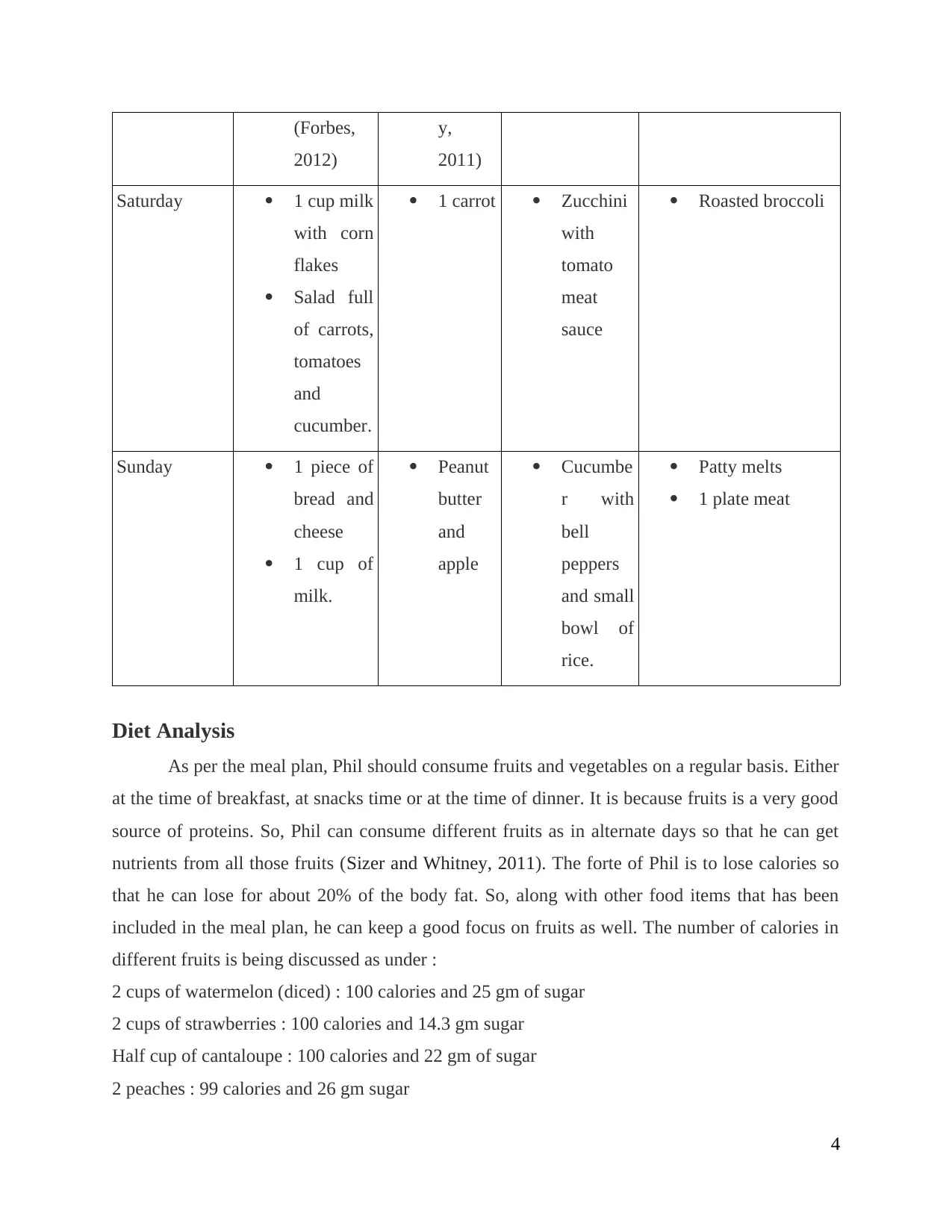
(Forbes,
2012)
y,
2011)
Saturday 1 cup milk
with corn
flakes
Salad full
of carrots,
tomatoes
and
cucumber.
1 carrot Zucchini
with
tomato
meat
sauce
Roasted broccoli
Sunday 1 piece of
bread and
cheese
1 cup of
milk.
Peanut
butter
and
apple
Cucumbe
r with
bell
peppers
and small
bowl of
rice.
Patty melts
1 plate meat
Diet Analysis
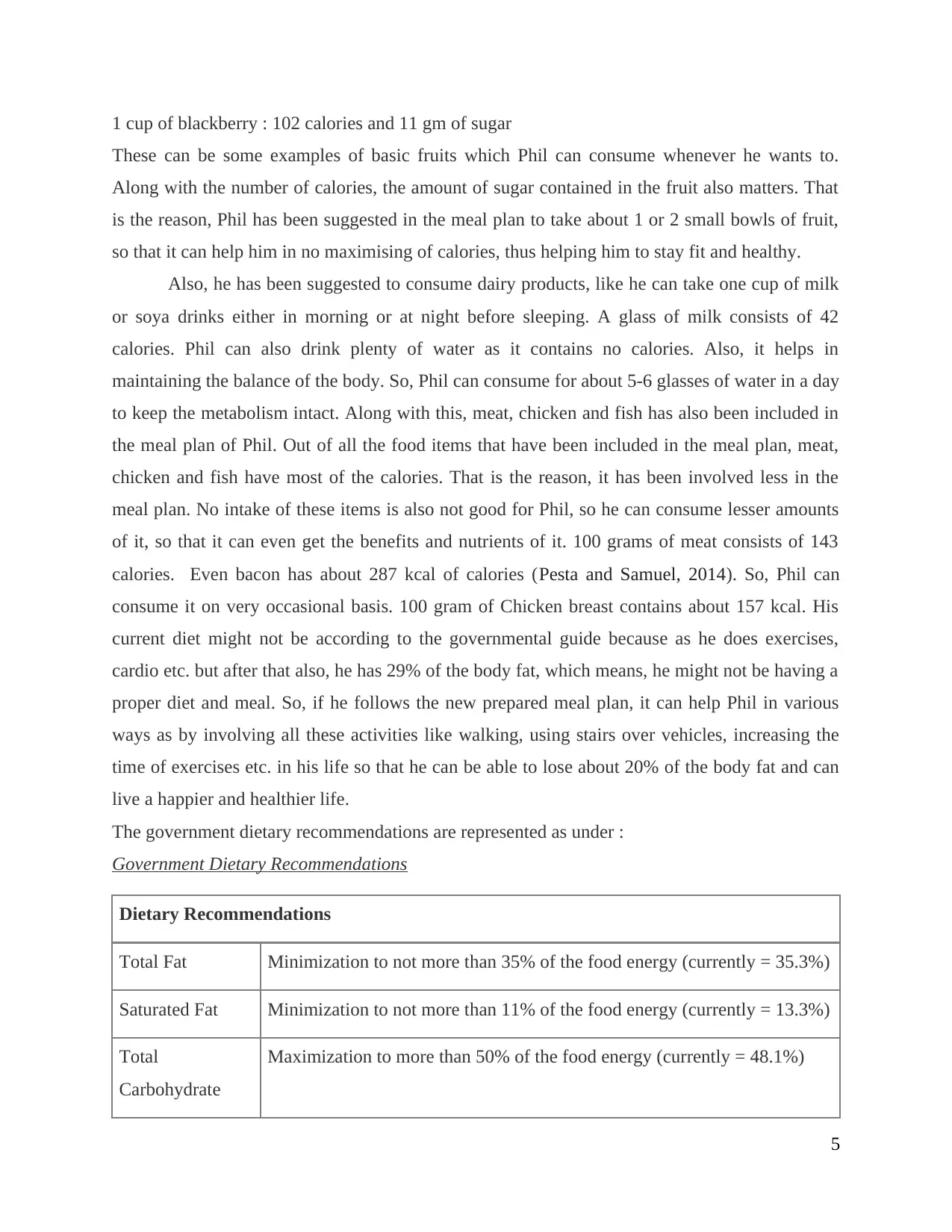
As per the meal plan, Phil should consume fruits and vegetables on a regular basis. Either
at the time of breakfast, at snacks time or at the time of dinner. It is because fruits is a very good
source of proteins. So, Phil can consume different fruits as in alternate days so that he can get
nutrients from all those fruits (Sizer and Whitney, 2011). The forte of Phil is to lose calories so
that he can lose for about 20% of the body fat. So, along with other food items that has been
included in the meal plan, he can keep a good focus on fruits as well. The number of calories in
different fruits is being discussed as under :
2 cups of watermelon (diced) : 100 calories and 25 gm of sugar
2 cups of strawberries : 100 calories and 14.3 gm sugar
Half cup of cantaloupe : 100 calories and 22 gm of sugar
2 peaches : 99 calories and 26 gm sugar
4
2012)
y,
2011)
Saturday 1 cup milk
with corn
flakes
Salad full
of carrots,
tomatoes
and
cucumber.
1 carrot Zucchini
with
tomato
meat
sauce
Roasted broccoli
Sunday 1 piece of
bread and
cheese
1 cup of
milk.
Peanut
butter
and
apple
Cucumbe
r with
bell
peppers
and small
bowl of
rice.
Patty melts
1 plate meat
Diet Analysis
As per the meal plan, Phil should consume fruits and vegetables on a regular basis. Either
at the time of breakfast, at snacks time or at the time of dinner. It is because fruits is a very good
source of proteins. So, Phil can consume different fruits as in alternate days so that he can get
nutrients from all those fruits (Sizer and Whitney, 2011). The forte of Phil is to lose calories so
that he can lose for about 20% of the body fat. So, along with other food items that has been
included in the meal plan, he can keep a good focus on fruits as well. The number of calories in
different fruits is being discussed as under :
2 cups of watermelon (diced) : 100 calories and 25 gm of sugar
2 cups of strawberries : 100 calories and 14.3 gm sugar
Half cup of cantaloupe : 100 calories and 22 gm of sugar
2 peaches : 99 calories and 26 gm sugar
4
⊘ This is a preview!⊘
Do you want full access?
Subscribe today to unlock all pages.

Trusted by 1+ million students worldwide

1 cup of blackberry : 102 calories and 11 gm of sugar
These can be some examples of basic fruits which Phil can consume whenever he wants to.
Along with the number of calories, the amount of sugar contained in the fruit also matters. That
is the reason, Phil has been suggested in the meal plan to take about 1 or 2 small bowls of fruit,
so that it can help him in no maximising of calories, thus helping him to stay fit and healthy.
Also, he has been suggested to consume dairy products, like he can take one cup of milk
or soya drinks either in morning or at night before sleeping. A glass of milk consists of 42
calories. Phil can also drink plenty of water as it contains no calories. Also, it helps in
maintaining the balance of the body. So, Phil can consume for about 5-6 glasses of water in a day
to keep the metabolism intact. Along with this, meat, chicken and fish has also been included in
the meal plan of Phil. Out of all the food items that have been included in the meal plan, meat,
chicken and fish have most of the calories. That is the reason, it has been involved less in the
meal plan. No intake of these items is also not good for Phil, so he can consume lesser amounts
of it, so that it can even get the benefits and nutrients of it. 100 grams of meat consists of 143
calories. Even bacon has about 287 kcal of calories (Pesta and Samuel, 2014). So, Phil can
consume it on very occasional basis. 100 gram of Chicken breast contains about 157 kcal. His
current diet might not be according to the governmental guide because as he does exercises,
cardio etc. but after that also, he has 29% of the body fat, which means, he might not be having a
proper diet and meal. So, if he follows the new prepared meal plan, it can help Phil in various
ways as by involving all these activities like walking, using stairs over vehicles, increasing the
time of exercises etc. in his life so that he can be able to lose about 20% of the body fat and can
live a happier and healthier life.
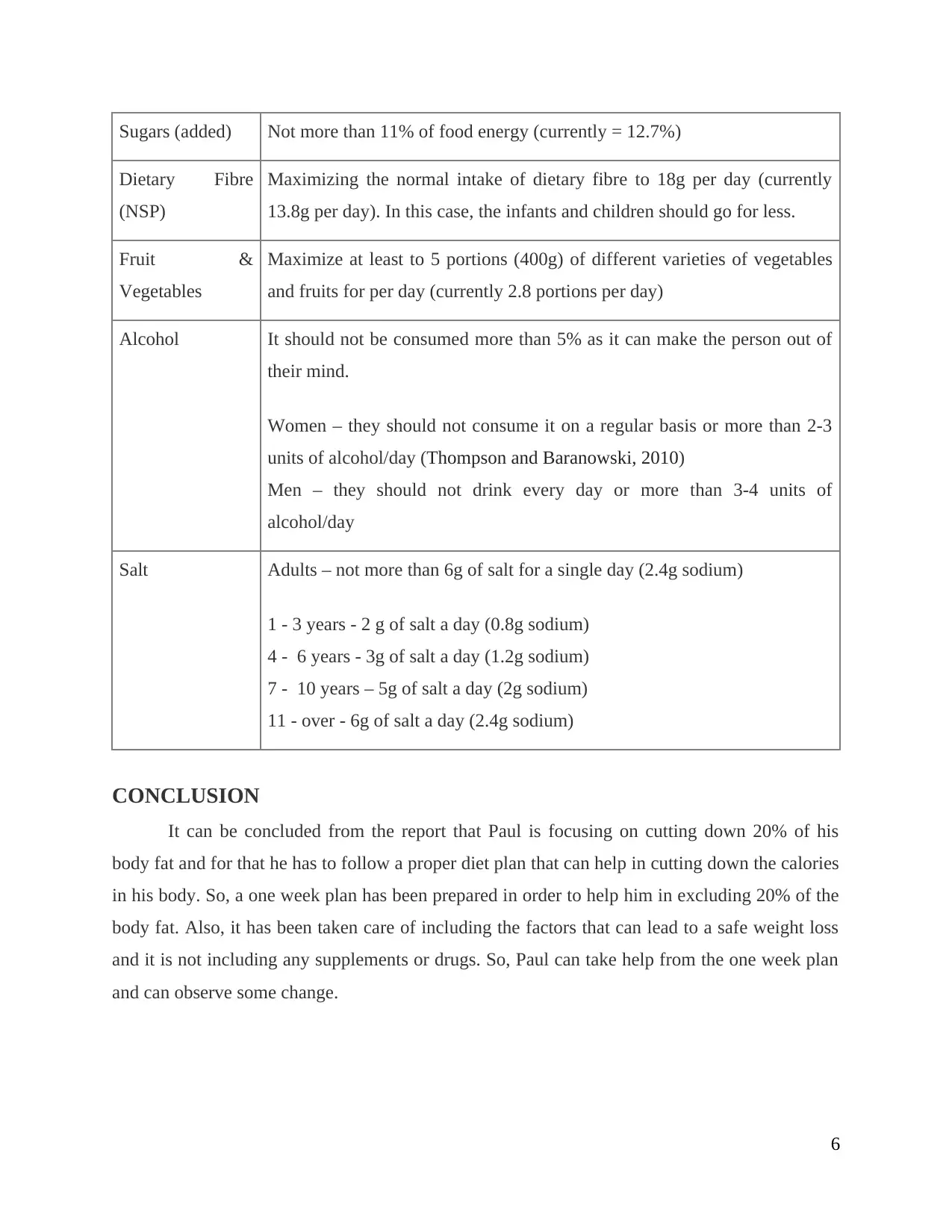
The government dietary recommendations are represented as under :
Government Dietary Recommendations
Dietary Recommendations
Total Fat Minimization to not more than 35% of the food energy (currently = 35.3%)
Saturated Fat Minimization to not more than 11% of the food energy (currently = 13.3%)
Total
Carbohydrate
Maximization to more than 50% of the food energy (currently = 48.1%)
5
These can be some examples of basic fruits which Phil can consume whenever he wants to.
Along with the number of calories, the amount of sugar contained in the fruit also matters. That
is the reason, Phil has been suggested in the meal plan to take about 1 or 2 small bowls of fruit,
so that it can help him in no maximising of calories, thus helping him to stay fit and healthy.
Also, he has been suggested to consume dairy products, like he can take one cup of milk
or soya drinks either in morning or at night before sleeping. A glass of milk consists of 42
calories. Phil can also drink plenty of water as it contains no calories. Also, it helps in
maintaining the balance of the body. So, Phil can consume for about 5-6 glasses of water in a day
to keep the metabolism intact. Along with this, meat, chicken and fish has also been included in
the meal plan of Phil. Out of all the food items that have been included in the meal plan, meat,
chicken and fish have most of the calories. That is the reason, it has been involved less in the
meal plan. No intake of these items is also not good for Phil, so he can consume lesser amounts
of it, so that it can even get the benefits and nutrients of it. 100 grams of meat consists of 143
calories. Even bacon has about 287 kcal of calories (Pesta and Samuel, 2014). So, Phil can
consume it on very occasional basis. 100 gram of Chicken breast contains about 157 kcal. His
current diet might not be according to the governmental guide because as he does exercises,
cardio etc. but after that also, he has 29% of the body fat, which means, he might not be having a
proper diet and meal. So, if he follows the new prepared meal plan, it can help Phil in various
ways as by involving all these activities like walking, using stairs over vehicles, increasing the
time of exercises etc. in his life so that he can be able to lose about 20% of the body fat and can
live a happier and healthier life.
The government dietary recommendations are represented as under :
Government Dietary Recommendations
Dietary Recommendations
Total Fat Minimization to not more than 35% of the food energy (currently = 35.3%)
Saturated Fat Minimization to not more than 11% of the food energy (currently = 13.3%)
Total
Carbohydrate
Maximization to more than 50% of the food energy (currently = 48.1%)
5
Paraphrase This Document
Need a fresh take? Get an instant paraphrase of this document with our AI Paraphraser

Sugars (added) Not more than 11% of food energy (currently = 12.7%)
Dietary Fibre
(NSP)
Maximizing the normal intake of dietary fibre to 18g per day (currently
13.8g per day). In this case, the infants and children should go for less.
Fruit &
Vegetables
Maximize at least to 5 portions (400g) of different varieties of vegetables
and fruits for per day (currently 2.8 portions per day)
Alcohol It should not be consumed more than 5% as it can make the person out of
their mind.
Women – they should not consume it on a regular basis or more than 2-3
units of alcohol/day (Thompson and Baranowski, 2010)
Men – they should not drink every day or more than 3-4 units of
alcohol/day
Salt Adults – not more than 6g of salt for a single day (2.4g sodium)
1 - 3 years - 2 g of salt a day (0.8g sodium)
4 - 6 years - 3g of salt a day (1.2g sodium)
7 - 10 years – 5g of salt a day (2g sodium)
11 - over - 6g of salt a day (2.4g sodium)
CONCLUSION
It can be concluded from the report that Paul is focusing on cutting down 20% of his
body fat and for that he has to follow a proper diet plan that can help in cutting down the calories
in his body. So, a one week plan has been prepared in order to help him in excluding 20% of the
body fat. Also, it has been taken care of including the factors that can lead to a safe weight loss
and it is not including any supplements or drugs. So, Paul can take help from the one week plan
and can observe some change.
6
Dietary Fibre
(NSP)
Maximizing the normal intake of dietary fibre to 18g per day (currently
13.8g per day). In this case, the infants and children should go for less.
Fruit &
Vegetables
Maximize at least to 5 portions (400g) of different varieties of vegetables
and fruits for per day (currently 2.8 portions per day)
Alcohol It should not be consumed more than 5% as it can make the person out of
their mind.
Women – they should not consume it on a regular basis or more than 2-3
units of alcohol/day (Thompson and Baranowski, 2010)
Men – they should not drink every day or more than 3-4 units of
alcohol/day
Salt Adults – not more than 6g of salt for a single day (2.4g sodium)
1 - 3 years - 2 g of salt a day (0.8g sodium)
4 - 6 years - 3g of salt a day (1.2g sodium)
7 - 10 years – 5g of salt a day (2g sodium)
11 - over - 6g of salt a day (2.4g sodium)
CONCLUSION
It can be concluded from the report that Paul is focusing on cutting down 20% of his
body fat and for that he has to follow a proper diet plan that can help in cutting down the calories
in his body. So, a one week plan has been prepared in order to help him in excluding 20% of the
body fat. Also, it has been taken care of including the factors that can lead to a safe weight loss
and it is not including any supplements or drugs. So, Paul can take help from the one week plan
and can observe some change.
6

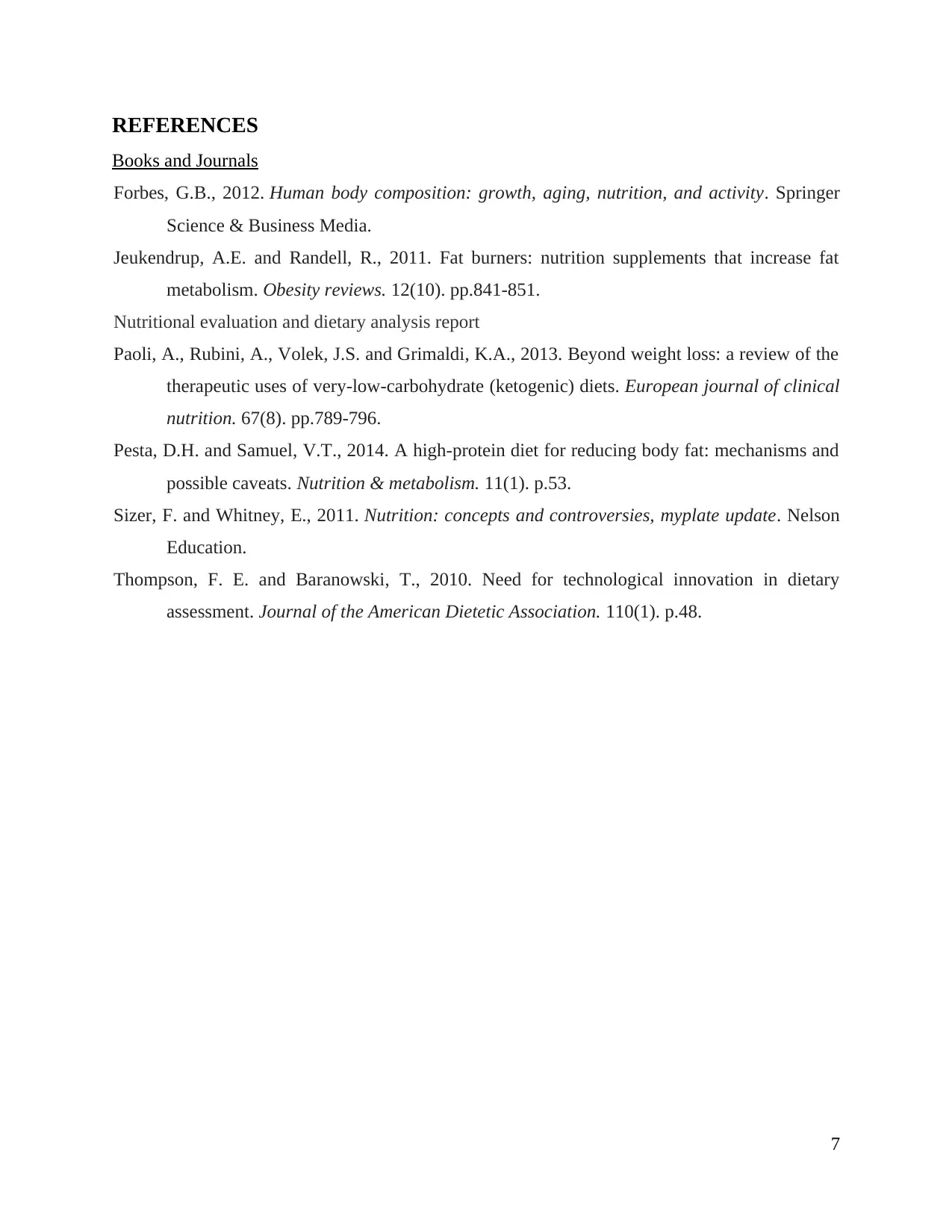
REFERENCES
Books and Journals
Forbes, G.B., 2012. Human body composition: growth, aging, nutrition, and activity. Springer
Science & Business Media.
Jeukendrup, A.E. and Randell, R., 2011. Fat burners: nutrition supplements that increase fat
metabolism. Obesity reviews. 12(10). pp.841-851.
Nutritional evaluation and dietary analysis report
Paoli, A., Rubini, A., Volek, J.S. and Grimaldi, K.A., 2013. Beyond weight loss: a review of the
therapeutic uses of very-low-carbohydrate (ketogenic) diets. European journal of clinical
nutrition. 67(8). pp.789-796.
Pesta, D.H. and Samuel, V.T., 2014. A high-protein diet for reducing body fat: mechanisms and
possible caveats. Nutrition & metabolism. 11(1). p.53.
Sizer, F. and Whitney, E., 2011. Nutrition: concepts and controversies, myplate update. Nelson
Education.
Thompson, F. E. and Baranowski, T., 2010. Need for technological innovation in dietary
assessment. Journal of the American Dietetic Association. 110(1). p.48.
7
Books and Journals
Forbes, G.B., 2012. Human body composition: growth, aging, nutrition, and activity. Springer
Science & Business Media.
Jeukendrup, A.E. and Randell, R., 2011. Fat burners: nutrition supplements that increase fat
metabolism. Obesity reviews. 12(10). pp.841-851.
Nutritional evaluation and dietary analysis report
Paoli, A., Rubini, A., Volek, J.S. and Grimaldi, K.A., 2013. Beyond weight loss: a review of the
therapeutic uses of very-low-carbohydrate (ketogenic) diets. European journal of clinical
nutrition. 67(8). pp.789-796.
Pesta, D.H. and Samuel, V.T., 2014. A high-protein diet for reducing body fat: mechanisms and
possible caveats. Nutrition & metabolism. 11(1). p.53.
Sizer, F. and Whitney, E., 2011. Nutrition: concepts and controversies, myplate update. Nelson
Education.
Thompson, F. E. and Baranowski, T., 2010. Need for technological innovation in dietary
assessment. Journal of the American Dietetic Association. 110(1). p.48.
7
⊘ This is a preview!⊘
Do you want full access?
Subscribe today to unlock all pages.

Trusted by 1+ million students worldwide
1 out of 9
Related Documents
Your All-in-One AI-Powered Toolkit for Academic Success.
+13062052269
info@desklib.com
Available 24*7 on WhatsApp / Email
Unlock your academic potential
Copyright © 2020–2026 A2Z Services. All Rights Reserved. Developed and managed by ZUCOL.