Comprehensive Analysis: New Zealand Healthcare System and Job Market
VerifiedAdded on 2023/02/01
|6
|1482
|50
Essay
AI Summary
This essay provides a comprehensive overview of the New Zealand healthcare system. It begins by outlining the system's structure, emphasizing the roles of the Ministry of Health and District Health Boards (DHBs) and highlighting its single-payer model funded by government subsidies. The essay then explores the primary and secondary healthcare sectors, providing examples of organizations within each. It further discusses the challenges of nurse turnover rates and the resulting impact on patient care. The essay also addresses the job opportunities available within the healthcare sector, particularly the shortage of skilled professionals, and the ongoing demand for specialists and nurses. It concludes by emphasizing the importance of training and development in facilitating effective recruitment within the New Zealand health system, ultimately ensuring the delivery of effective care services to the population. References from various research papers support the arguments made in the essay.
Running Head: HEALTHCARE
0
Healthcare
4/24/2019
0
Healthcare
4/24/2019
Paraphrase This Document
Need a fresh take? Get an instant paraphrase of this document with our AI Paraphraser

HEALTHCARE
1
The essay brings about the discussion on the topic, ‘New Zealand health-care system’
and the various other related aspects of health facilities to the individuals. The healthcare
services in the country provided through the complex network of people and organisations.
Each unit or health facility has their role in providing best care or services to the people
within region (Stokes et al., 2018). The discussion will include the assessment of the structure
of healthcare system, along with some suitable examples of primary and secondary sector. In
the later part of the essay, communication skills, and the availability of job-opportunities
within healthcare sector will be discussed.
New Zealand residents and some other work visa holders get benefit from the public
health system, which is free or low cost services, i.e. from the major contribution of
government subsidies. Now, discussing the structure of the New-Zealand healthcare system,
Ministry of Health is responsible for the oversight and funding of the twenty-district health
boards (DHBs). It has found through the research that New Zealand has single payer
healthcare system, which means that the government pays for the health services with the tax
money. These perform the responsibility of meeting the health care standards and organising
better care services (Hemingway, 2016).
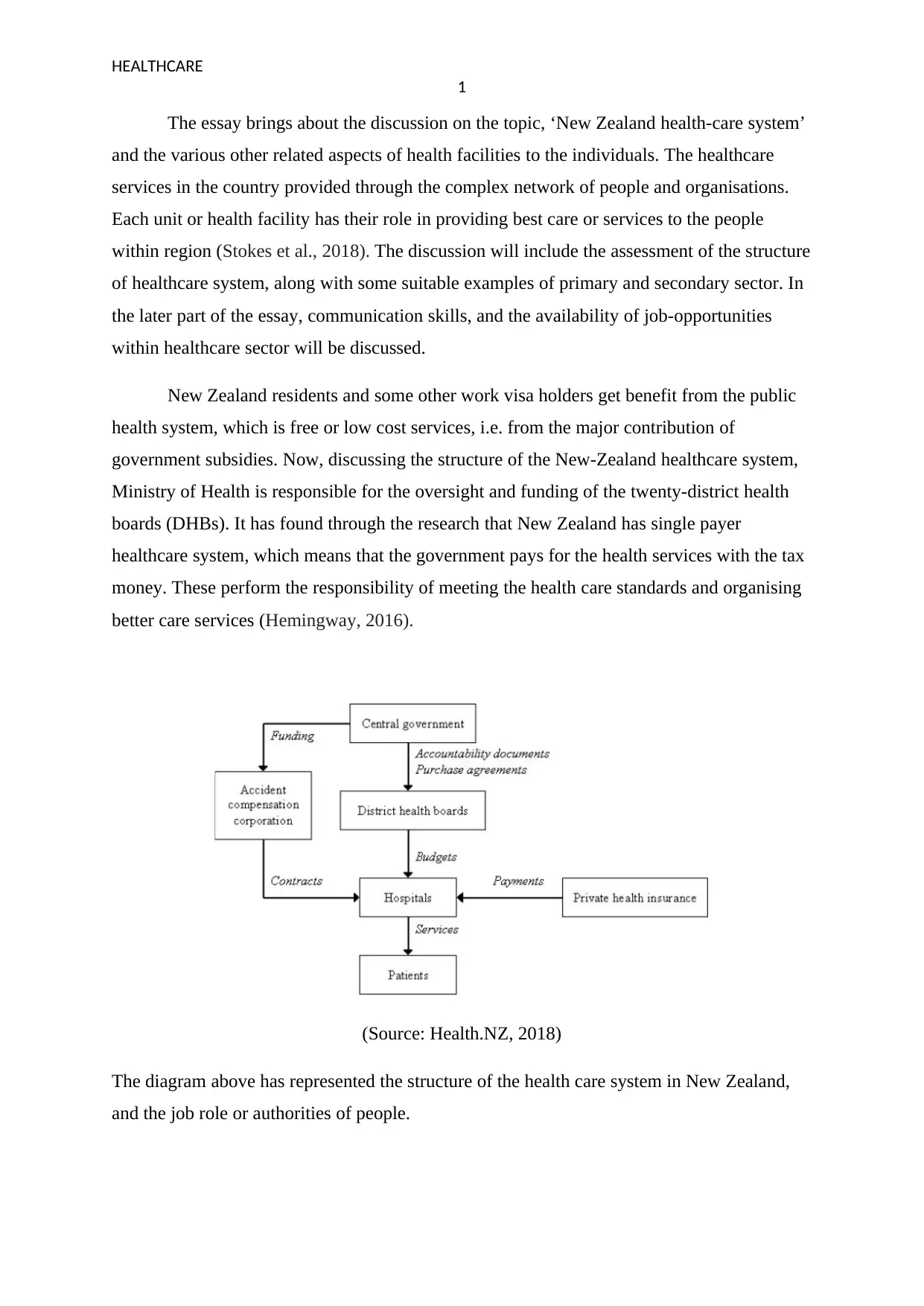
(Source: Health.NZ, 2018)
The diagram above has represented the structure of the health care system in New Zealand,
and the job role or authorities of people.
1
The essay brings about the discussion on the topic, ‘New Zealand health-care system’
and the various other related aspects of health facilities to the individuals. The healthcare
services in the country provided through the complex network of people and organisations.
Each unit or health facility has their role in providing best care or services to the people
within region (Stokes et al., 2018). The discussion will include the assessment of the structure
of healthcare system, along with some suitable examples of primary and secondary sector. In
the later part of the essay, communication skills, and the availability of job-opportunities
within healthcare sector will be discussed.
New Zealand residents and some other work visa holders get benefit from the public
health system, which is free or low cost services, i.e. from the major contribution of
government subsidies. Now, discussing the structure of the New-Zealand healthcare system,
Ministry of Health is responsible for the oversight and funding of the twenty-district health
boards (DHBs). It has found through the research that New Zealand has single payer
healthcare system, which means that the government pays for the health services with the tax
money. These perform the responsibility of meeting the health care standards and organising
better care services (Hemingway, 2016).
(Source: Health.NZ, 2018)
The diagram above has represented the structure of the health care system in New Zealand,
and the job role or authorities of people.

HEALTHCARE
2
First established in the year 2002, the DHBs govern or manage forty-six primary
health-care organisations established across the nation. They operate with a main objective,
i.e. to focus on the health of the individuals in the community. The primary healthcare
organisations are funded by the DHBs, as they work as democratic, non-profit bodies
focusing on the improvement of health of the individuals (Bartys et al., 2017).
Few examples of the healthcare organisations in the primary health care sector include
‘Health care Aotearoa’, Ministry of health, Health Funding Authority and several others. On
the other hand, the health organisations in secondary health care sector include, Southern
Cross Health Insurance, is one non-profit organisation (Ministry of Health, 2018).
The health care system in the country has undergone several changes through the past
several years, as it was earlier a completely public based system. Now, the health system is a
public-private mix, which includes insurance elements as important for delivering effective
care services. The research on the New Zealand’s health care system has mentioned an issue,
that there has been a high nurse turnover rates in the facility (Blakely et al., 2019).
Not all nurses leave the health care, or job rather they consistently switch their
organisation on a frequent basis. This further leads to the problem of the reduced continuity
care to the patients, disruption of the services and a fall in the overall productivity. This has
raised the concern and importance of the health care institutions to focus on the recruitment
or selection of competent individuals for appropriate role. Hospitals and practices in the
country are looking for the doctors, midwives, nurse, surgeons, and 36 other healthcare
occupations (Wilson et al., 2019).
Job-Opportunities in New Zealand
According to the recent estimation on the requirement of individuals in the health
organisations, it has been analysed that 380 extra specialists are required every year to meet
the OECD average by the year 2021. In context to the shortage of skills, there are numerous
opportunities available for the nursing students and other individuals to acquire suitable job
in the organisations. The information from varied resource has stated about the requirement
of individuals in the public health cares or hospitals, than others (Squires and Anderson,
2015).
2
First established in the year 2002, the DHBs govern or manage forty-six primary
health-care organisations established across the nation. They operate with a main objective,
i.e. to focus on the health of the individuals in the community. The primary healthcare
organisations are funded by the DHBs, as they work as democratic, non-profit bodies
focusing on the improvement of health of the individuals (Bartys et al., 2017).
Few examples of the healthcare organisations in the primary health care sector include
‘Health care Aotearoa’, Ministry of health, Health Funding Authority and several others. On
the other hand, the health organisations in secondary health care sector include, Southern
Cross Health Insurance, is one non-profit organisation (Ministry of Health, 2018).
The health care system in the country has undergone several changes through the past
several years, as it was earlier a completely public based system. Now, the health system is a
public-private mix, which includes insurance elements as important for delivering effective
care services. The research on the New Zealand’s health care system has mentioned an issue,
that there has been a high nurse turnover rates in the facility (Blakely et al., 2019).
Not all nurses leave the health care, or job rather they consistently switch their
organisation on a frequent basis. This further leads to the problem of the reduced continuity
care to the patients, disruption of the services and a fall in the overall productivity. This has
raised the concern and importance of the health care institutions to focus on the recruitment
or selection of competent individuals for appropriate role. Hospitals and practices in the
country are looking for the doctors, midwives, nurse, surgeons, and 36 other healthcare
occupations (Wilson et al., 2019).
Job-Opportunities in New Zealand
According to the recent estimation on the requirement of individuals in the health
organisations, it has been analysed that 380 extra specialists are required every year to meet
the OECD average by the year 2021. In context to the shortage of skills, there are numerous
opportunities available for the nursing students and other individuals to acquire suitable job
in the organisations. The information from varied resource has stated about the requirement
of individuals in the public health cares or hospitals, than others (Squires and Anderson,
2015).
⊘ This is a preview!⊘
Do you want full access?
Subscribe today to unlock all pages.

Trusted by 1+ million students worldwide

HEALTHCARE
3
It means public health systems in New Zealand has more job-opportunities than other
sectors, stating that the primary health care are more focused towards hiring or looking for
forward for the new employees. For an example, Kiwi’s Health Jobs found one major sector
determining the lack of skills or nurses required for the treatment of patients. Therefore, it is
the gateway to various job-opportunities in the country leading to the effectiveness of the
system (Osborn et al., 2016).
This trend of seeking people for various job roles within healthcare may continue due
to the reason that the health care sector is facing the shortage of skill, and further leads to
development of health-care sector within country. Therefore, it has found that a better-
developed health system of the country will ensure attainment of effective care services to the
people. For fulfilling various job-opportunities in the health facility, it has found that
specialists or professionals should emphasize providing suitable training and development of
the people. This would help facilitate in effective recruitment of the competent nurse and
other professionals in the NZ health system (Chalmers, Ashton and Tenbensel, 2017).
To conclude the above discussion it has been analysed that the health care system is
one of the significant system, which delivers health care services to the individuals. The New
Zealand health system, focuses on the public system, and emphasizes the aspect of
emergency care. The discussion in the above essay has demonstrated well the aspects of
health care services provided in the country, and the structure of New Zealand health system,
along with the examples of primary health sector, and secondary health sector. Moreover, the
health sectors are in constant need of the individuals or people for various job positions in the
health facilities. Hence, new facilities, or services need to be undertaken, such as medical
insurance and others to ensure best treatment to the citizens of the country.
3
It means public health systems in New Zealand has more job-opportunities than other
sectors, stating that the primary health care are more focused towards hiring or looking for
forward for the new employees. For an example, Kiwi’s Health Jobs found one major sector
determining the lack of skills or nurses required for the treatment of patients. Therefore, it is
the gateway to various job-opportunities in the country leading to the effectiveness of the
system (Osborn et al., 2016).
This trend of seeking people for various job roles within healthcare may continue due
to the reason that the health care sector is facing the shortage of skill, and further leads to
development of health-care sector within country. Therefore, it has found that a better-
developed health system of the country will ensure attainment of effective care services to the
people. For fulfilling various job-opportunities in the health facility, it has found that
specialists or professionals should emphasize providing suitable training and development of
the people. This would help facilitate in effective recruitment of the competent nurse and
other professionals in the NZ health system (Chalmers, Ashton and Tenbensel, 2017).
To conclude the above discussion it has been analysed that the health care system is
one of the significant system, which delivers health care services to the individuals. The New
Zealand health system, focuses on the public system, and emphasizes the aspect of
emergency care. The discussion in the above essay has demonstrated well the aspects of
health care services provided in the country, and the structure of New Zealand health system,
along with the examples of primary health sector, and secondary health sector. Moreover, the
health sectors are in constant need of the individuals or people for various job positions in the
health facilities. Hence, new facilities, or services need to be undertaken, such as medical
insurance and others to ensure best treatment to the citizens of the country.
Paraphrase This Document
Need a fresh take? Get an instant paraphrase of this document with our AI Paraphraser

HEALTHCARE
4
References
Bartys, S., Frederiksen, P., Bendix, T. and Burton, K. (2017) System influences on work
disability due to low back pain: an international evidence synthesis. Health Policy,
121(8), pp.903-912.
Blakely, T., Kvizhinadze, G., Atkinson, J., Dieleman, J. & Clarke, P. (2019). Health system
costs for individual and comorbid noncommunicable diseases: An analysis of publicly
funded health events from New Zealand. PLoS medicine, 16(1), 1002716.
Chalmers, L.M., Ashton, T. and Tenbensel, T. (2017) Measuring and managing health system
performance: An update from New Zealand. Health Policy, 121(8), pp.831-835.
Health.NZ. (2018). The Structure of New Zealand health and disability sector. Retrieved
from: https://www.health.govt.nz/system/files/documents/pages/structure-nz-health-
disability-sector-oct16.pdf
Hemingway, S. (2016) The future of mental health nursing education in the United Kingdom:
reflections on the Australian and New Zealand experience. Journal of psychiatric and
mental health nursing, 23(5), pp.331-337.
Ministry of Health. (2018). Overview of the health system. Retrieved from:
https://www.health.govt.nz/new-zealand-health-system/overview-health-system
Osborn, R., Squires, D., Doty, M.M., Sarnak, D.O. and Schneider, E.C., 2016. In new survey
of eleven countries, US adults still struggle with access to and affordability of health
care. Health Affairs, 35(12), pp. 2327-2336.
Squires, D. and Anderson, C. (2015) US health care from a global perspective: spending, use
of services, prices, and health in 13 countries. The Commonwealth Fund, 15(3), pp.1-
16.
Stokes, T., Tumilty, E., Doolan-Noble, F. & Gauld, R. (2018). Health Pathways
implementation in a New Zealand health region: a qualitative study using the
Consolidated Framework for Implementation Research. BMJ open, 8(12), 25094.
4
References
Bartys, S., Frederiksen, P., Bendix, T. and Burton, K. (2017) System influences on work
disability due to low back pain: an international evidence synthesis. Health Policy,
121(8), pp.903-912.
Blakely, T., Kvizhinadze, G., Atkinson, J., Dieleman, J. & Clarke, P. (2019). Health system
costs for individual and comorbid noncommunicable diseases: An analysis of publicly
funded health events from New Zealand. PLoS medicine, 16(1), 1002716.
Chalmers, L.M., Ashton, T. and Tenbensel, T. (2017) Measuring and managing health system
performance: An update from New Zealand. Health Policy, 121(8), pp.831-835.
Health.NZ. (2018). The Structure of New Zealand health and disability sector. Retrieved
from: https://www.health.govt.nz/system/files/documents/pages/structure-nz-health-
disability-sector-oct16.pdf
Hemingway, S. (2016) The future of mental health nursing education in the United Kingdom:
reflections on the Australian and New Zealand experience. Journal of psychiatric and
mental health nursing, 23(5), pp.331-337.
Ministry of Health. (2018). Overview of the health system. Retrieved from:
https://www.health.govt.nz/new-zealand-health-system/overview-health-system
Osborn, R., Squires, D., Doty, M.M., Sarnak, D.O. and Schneider, E.C., 2016. In new survey
of eleven countries, US adults still struggle with access to and affordability of health
care. Health Affairs, 35(12), pp. 2327-2336.
Squires, D. and Anderson, C. (2015) US health care from a global perspective: spending, use
of services, prices, and health in 13 countries. The Commonwealth Fund, 15(3), pp.1-
16.
Stokes, T., Tumilty, E., Doolan-Noble, F. & Gauld, R. (2018). Health Pathways
implementation in a New Zealand health region: a qualitative study using the
Consolidated Framework for Implementation Research. BMJ open, 8(12), 25094.

HEALTHCARE
5
Wilson, R., Chua, J., Briggs, A.M. and Abbott, J.H. (2019) The cost-effectiveness of
recommended adjunctive osteoarthritis management options in New Zealand: results
from a computer simulation model. Osteoarthritis and Cartilage, 27, p.313.
5
Wilson, R., Chua, J., Briggs, A.M. and Abbott, J.H. (2019) The cost-effectiveness of
recommended adjunctive osteoarthritis management options in New Zealand: results
from a computer simulation model. Osteoarthritis and Cartilage, 27, p.313.
⊘ This is a preview!⊘
Do you want full access?
Subscribe today to unlock all pages.

Trusted by 1+ million students worldwide
1 out of 6
Related Documents
Your All-in-One AI-Powered Toolkit for Academic Success.
+13062052269
info@desklib.com
Available 24*7 on WhatsApp / Email
Unlock your academic potential
Copyright © 2020–2025 A2Z Services. All Rights Reserved. Developed and managed by ZUCOL.