Industrial Dispute Analysis: Oaky Coal Mine and Glencore Report
VerifiedAdded on 2021/06/14
|13
|3649
|78
Report
AI Summary
This report provides a comprehensive analysis of the industrial dispute between the Oaky coal mine workers and Glencore. It examines the context of the dispute, which arose from the expiration of the enterprise agreement. The report details the viewpoints of both the Oaky Creek Coal Pty Ltd and the Construction, Forestry, Mining and Energy Union (CFMEU), highlighting their contentions and demands. It also explores the role and effectiveness of the Fair Work Commission (FWC) in resolving the dispute, discussing its limitations and the need for increased powers. The report covers the tactics employed by both parties, the involvement of the Fair Work Ombudsman, and the impact on the workers and the company. Recommendations for improving dispute resolution mechanisms are also included, offering insights into the complexities of industrial relations and the need for effective interventions by the FWC, especially in cases that don't threaten public interest and the economy.

Report
Industrial Dispute
(Student Details: )
Industrial Dispute
(Student Details: )

Paraphrase This Document
Need a fresh take? Get an instant paraphrase of this document with our AI Paraphraser
Report
Executive Summary
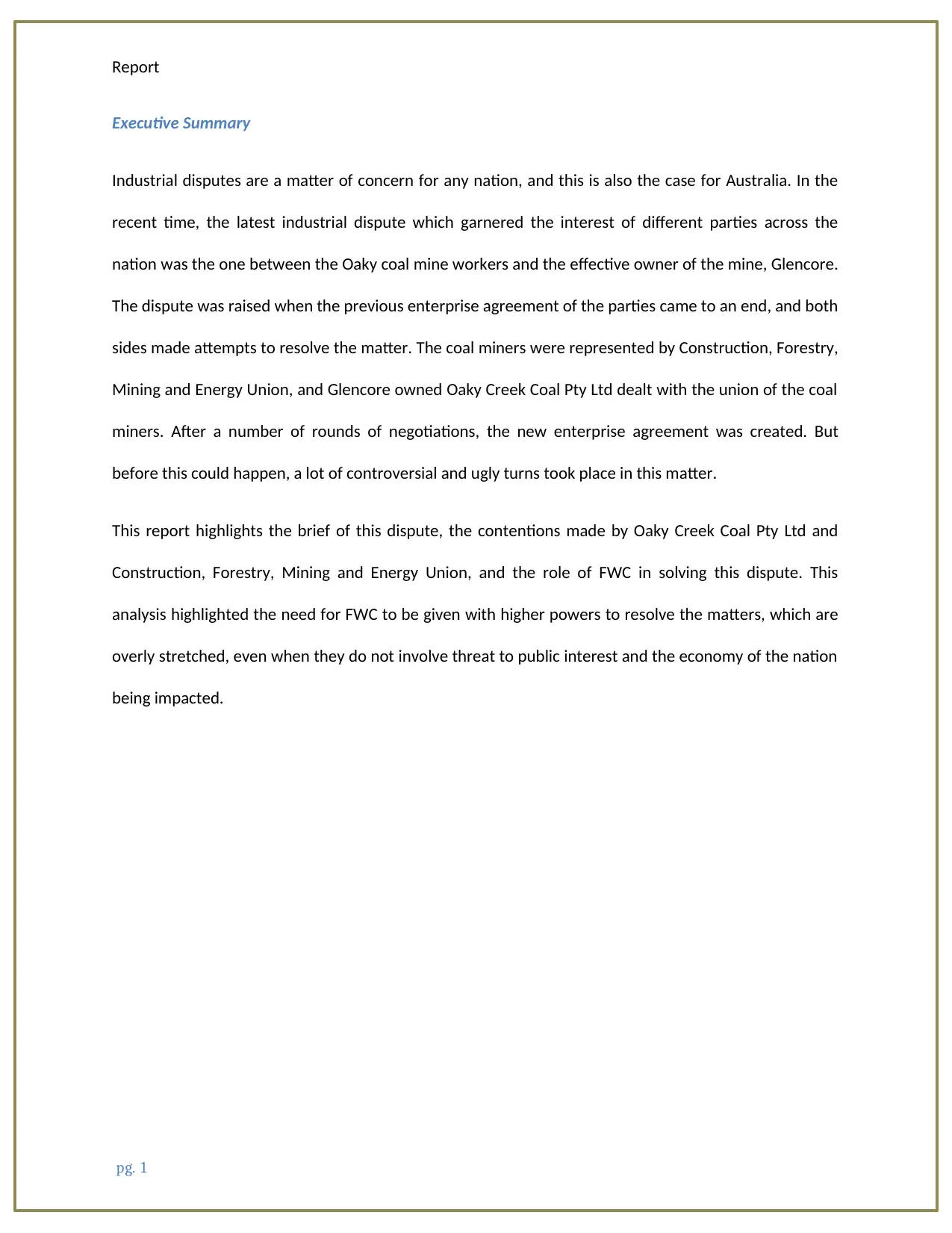
Industrial disputes are a matter of concern for any nation, and this is also the case for Australia. In the
recent time, the latest industrial dispute which garnered the interest of different parties across the
nation was the one between the Oaky coal mine workers and the effective owner of the mine, Glencore.
The dispute was raised when the previous enterprise agreement of the parties came to an end, and both
sides made attempts to resolve the matter. The coal miners were represented by Construction, Forestry,
Mining and Energy Union, and Glencore owned Oaky Creek Coal Pty Ltd dealt with the union of the coal
miners. After a number of rounds of negotiations, the new enterprise agreement was created. But
before this could happen, a lot of controversial and ugly turns took place in this matter.
This report highlights the brief of this dispute, the contentions made by Oaky Creek Coal Pty Ltd and
Construction, Forestry, Mining and Energy Union, and the role of FWC in solving this dispute. This
analysis highlighted the need for FWC to be given with higher powers to resolve the matters, which are
overly stretched, even when they do not involve threat to public interest and the economy of the nation
being impacted.
pg. 1
Executive Summary
Industrial disputes are a matter of concern for any nation, and this is also the case for Australia. In the
recent time, the latest industrial dispute which garnered the interest of different parties across the
nation was the one between the Oaky coal mine workers and the effective owner of the mine, Glencore.
The dispute was raised when the previous enterprise agreement of the parties came to an end, and both
sides made attempts to resolve the matter. The coal miners were represented by Construction, Forestry,
Mining and Energy Union, and Glencore owned Oaky Creek Coal Pty Ltd dealt with the union of the coal
miners. After a number of rounds of negotiations, the new enterprise agreement was created. But
before this could happen, a lot of controversial and ugly turns took place in this matter.
This report highlights the brief of this dispute, the contentions made by Oaky Creek Coal Pty Ltd and
Construction, Forestry, Mining and Energy Union, and the role of FWC in solving this dispute. This
analysis highlighted the need for FWC to be given with higher powers to resolve the matters, which are
overly stretched, even when they do not involve threat to public interest and the economy of the nation
being impacted.
pg. 1
Report
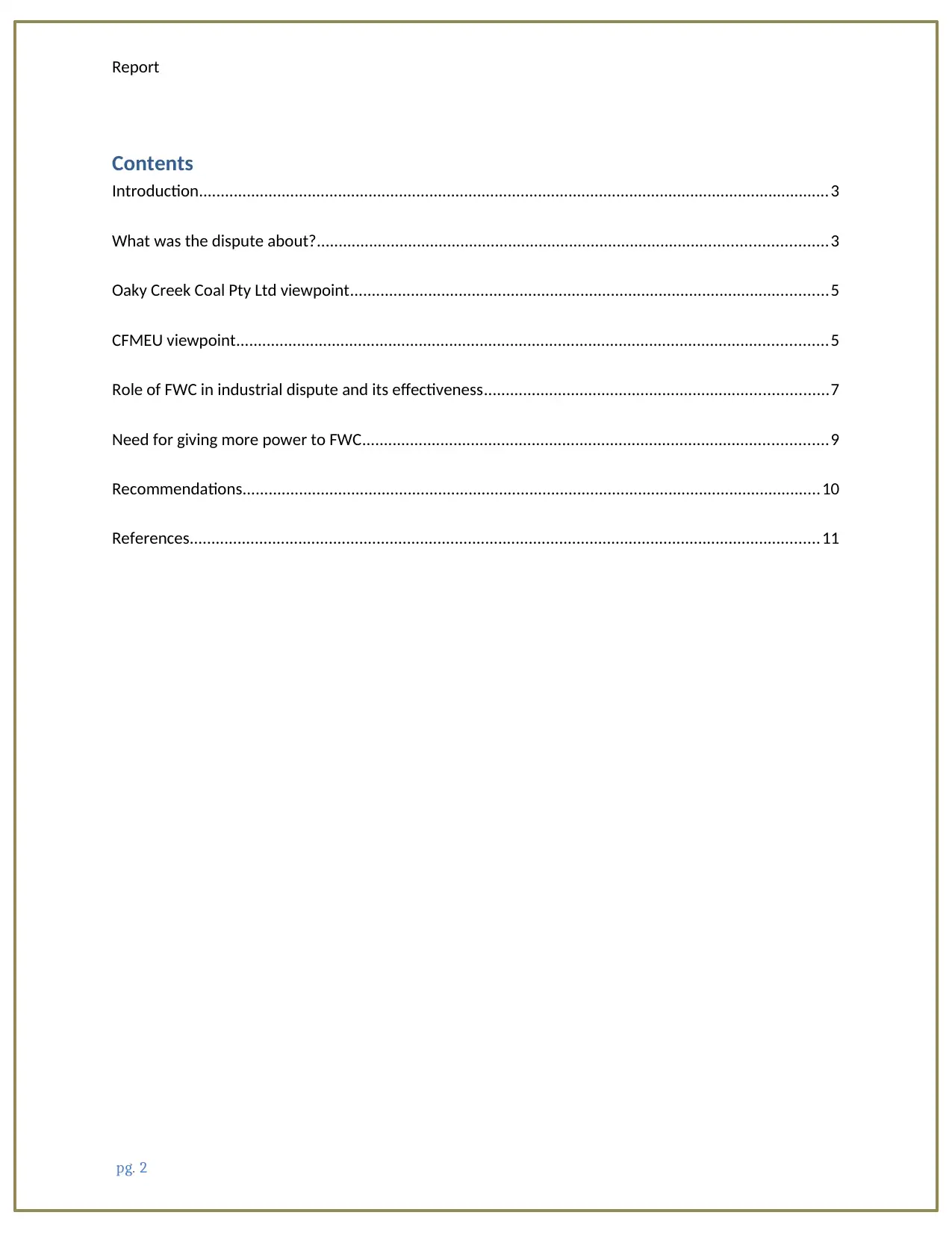
Contents
Introduction.................................................................................................................................................3
What was the dispute about?.....................................................................................................................3
Oaky Creek Coal Pty Ltd viewpoint..............................................................................................................5
CFMEU viewpoint........................................................................................................................................5
Role of FWC in industrial dispute and its effectiveness...............................................................................7
Need for giving more power to FWC...........................................................................................................9
Recommendations.....................................................................................................................................10
References.................................................................................................................................................11
pg. 2
Contents
Introduction.................................................................................................................................................3
What was the dispute about?.....................................................................................................................3
Oaky Creek Coal Pty Ltd viewpoint..............................................................................................................5
CFMEU viewpoint........................................................................................................................................5
Role of FWC in industrial dispute and its effectiveness...............................................................................7
Need for giving more power to FWC...........................................................................................................9
Recommendations.....................................................................................................................................10
References.................................................................................................................................................11
pg. 2
⊘ This is a preview!⊘
Do you want full access?
Subscribe today to unlock all pages.

Trusted by 1+ million students worldwide
Report
Introduction
Employment relationship refers to the legal link which is present between an employee and an
employer (Bray et al., 2018). An important aspect of maintaining industrial dispute is to avoid the
presence of industrial disputes. Industrial disputes basically denote the divergence between the
employer and employee’s representatives, which includes the role of trade unions, in context of pay or
working condition issues, and the result of which is industrial action being taken (Corthésy and Harris-
Roper, 2014). Common tactics in cases of industrial actions include each party putting pressure on the
other party and includes instances of lockouts and strikes on part of employers and employees
respectively. Neither of the parties gets much by indulging in industrial disputes, as both parties lose
revenue and their work balance (Shaw, McPhail and Ressia, 2018).
In Australia, the Fair Work Commission herein referred to as FWC, plays the role of assisting the
employers and employees in resolving the disputes and this is deemed as their key function. This is
based on the Fair Work Act, 2009 (Cth) where the FWC’s objective was deemed as forwarding assessable
and effective process for resolving the grievances and disputes (Floyd et al., 2017). One of the longest
industrial disputes in the nation was the one which took place between Oaky miners and Glencore,
which is discussed in detail in the following segments, and also includes the role played by FWC in this
matter.
What was the dispute about?
The dispute which took place between the Oaky North coal miners and the main company Glencore was
initiated as the collective agreement which was present between the two parties ended nearly three
years back. The Oaky North coal miners were represented by Construction, Forestry, Mining and Energy
pg. 3
Introduction
Employment relationship refers to the legal link which is present between an employee and an
employer (Bray et al., 2018). An important aspect of maintaining industrial dispute is to avoid the
presence of industrial disputes. Industrial disputes basically denote the divergence between the
employer and employee’s representatives, which includes the role of trade unions, in context of pay or
working condition issues, and the result of which is industrial action being taken (Corthésy and Harris-
Roper, 2014). Common tactics in cases of industrial actions include each party putting pressure on the
other party and includes instances of lockouts and strikes on part of employers and employees
respectively. Neither of the parties gets much by indulging in industrial disputes, as both parties lose
revenue and their work balance (Shaw, McPhail and Ressia, 2018).
In Australia, the Fair Work Commission herein referred to as FWC, plays the role of assisting the
employers and employees in resolving the disputes and this is deemed as their key function. This is
based on the Fair Work Act, 2009 (Cth) where the FWC’s objective was deemed as forwarding assessable
and effective process for resolving the grievances and disputes (Floyd et al., 2017). One of the longest
industrial disputes in the nation was the one which took place between Oaky miners and Glencore,
which is discussed in detail in the following segments, and also includes the role played by FWC in this
matter.
What was the dispute about?
The dispute which took place between the Oaky North coal miners and the main company Glencore was
initiated as the collective agreement which was present between the two parties ended nearly three
years back. The Oaky North coal miners were represented by Construction, Forestry, Mining and Energy
pg. 3
Paraphrase This Document
Need a fresh take? Get an instant paraphrase of this document with our AI Paraphraser
Report
Union, herein referred to as CFMEU, and they bargained for getting the company to agree on a new
enterprise agreement. Both the parties made allegations against each other. Glencore made a number
of attacks and brought in a new agreement where the right of employees to union representation,
rostering and safety was stripped. The other demands included workers accepting wage cut and high
payment for the accommodation. As per the workers, the company was attempting to eradicate the
permanent workforce and wanted to make the entire workforce casual. The other claims included the
choice of the company to apply the roster which they wanted to apply and to remove the union’s say in
such matter. As a result of the company owning everything in the area, Glencore wanted to raise the
accommodation costs as well. Owing to these reasons, the enterprise agreement suggested by Glencore
was rejected by the miners and this in turn resulted in the work being stopped by the miners from May.
Glencore did not back out from this behaviour of the workers and locked them out from July. The
workers got constant notifications on the need of not getting back to work. In retaliation to this, the
workers maintained a picket line just outside the mine, while the work in the mine was undertaken by
the contractors (De, 2017).
Due to the instances of ferocity of picket line and also that of Scabby the Rat, a formal investigation was
started by the Fair Work Ombudsman in the conduct being undertaken by the two parties, particularly
that of the coal union (Allen and Landau, 2018). This also involved the seniors being informed regarding
the entire case. The role played by CFMEU in this dispute was attempted to be understood by the Fair
Work Ombudsman, particularly in sense of the picket line being organized and the workers being
supported by being given supporting money (Stevens, 2018). The overview of the disputes clarifies that
both the parties did something wrong, where the independent contractors were brought in by the
company and the union paid subsidy wages to the workers who had been locked out just to continue
with the picket line outside of the mine location. This led to Fair Work Commission getting externally
pg. 4
Union, herein referred to as CFMEU, and they bargained for getting the company to agree on a new
enterprise agreement. Both the parties made allegations against each other. Glencore made a number
of attacks and brought in a new agreement where the right of employees to union representation,
rostering and safety was stripped. The other demands included workers accepting wage cut and high
payment for the accommodation. As per the workers, the company was attempting to eradicate the
permanent workforce and wanted to make the entire workforce casual. The other claims included the
choice of the company to apply the roster which they wanted to apply and to remove the union’s say in
such matter. As a result of the company owning everything in the area, Glencore wanted to raise the
accommodation costs as well. Owing to these reasons, the enterprise agreement suggested by Glencore
was rejected by the miners and this in turn resulted in the work being stopped by the miners from May.
Glencore did not back out from this behaviour of the workers and locked them out from July. The
workers got constant notifications on the need of not getting back to work. In retaliation to this, the
workers maintained a picket line just outside the mine, while the work in the mine was undertaken by
the contractors (De, 2017).
Due to the instances of ferocity of picket line and also that of Scabby the Rat, a formal investigation was
started by the Fair Work Ombudsman in the conduct being undertaken by the two parties, particularly
that of the coal union (Allen and Landau, 2018). This also involved the seniors being informed regarding
the entire case. The role played by CFMEU in this dispute was attempted to be understood by the Fair
Work Ombudsman, particularly in sense of the picket line being organized and the workers being
supported by being given supporting money (Stevens, 2018). The overview of the disputes clarifies that
both the parties did something wrong, where the independent contractors were brought in by the
company and the union paid subsidy wages to the workers who had been locked out just to continue
with the picket line outside of the mine location. This led to Fair Work Commission getting externally
pg. 4
Report
involved towards attempting at getting a new enterprise agreement being created in between Glencore
and Oaky miners (Terzon and Robinson, 2018).
Oaky Creek Coal Pty Ltd viewpoint
Glencore, which owns Oaky North Coal Mine, refuted the allegations laid down against it by issuing a
statement to media. As per Glencore, the members of CFMEU were misusing the provisions of Fair Work
Act, and were portraying themselves as the victims, just to make this dispute as their national campaign.
Glencore blamed CFMEU for being engaged in bully tactics against the workers who were still working at
the coal mine. Glencore stated the stated the steps taken by it to get an enterprise agreement created
before FWC, which would have allowed for the lock out to end long go, and how CFMEU walked away
from the proposed enterprise agreement at the last moment, taking advantage of the Act’s evergreen
nature (Glencore, 2018).
The company stated that the union decided to walk away even when it had agreed to this agreement
and walked away moments before the handshake was to be made in this enterprise agreement. One of
the officers of Glencore highlighted the lack of desire of CFMEU in closing the matter. Glencore clarified
the manner in which the suggested enterprise agreement was favourable and against the various
allegations. This agreement, as per the company, properly protected the workers’ rights as provided
through the governing act. This agreement also allowed for maintenance of average annual wages,
accommodation rent, proposed wage increase and also covered detailed of meals and services. The
company highlighted CFMEU’s role in harassing, threatening and abusing the workers who were coming
to work, particularly around the picket line, and in doing so a number of parties were being harmed by
CFMEU, including the family of workers (Glencore, 2018).
pg. 5
involved towards attempting at getting a new enterprise agreement being created in between Glencore
and Oaky miners (Terzon and Robinson, 2018).
Oaky Creek Coal Pty Ltd viewpoint
Glencore, which owns Oaky North Coal Mine, refuted the allegations laid down against it by issuing a
statement to media. As per Glencore, the members of CFMEU were misusing the provisions of Fair Work
Act, and were portraying themselves as the victims, just to make this dispute as their national campaign.
Glencore blamed CFMEU for being engaged in bully tactics against the workers who were still working at
the coal mine. Glencore stated the stated the steps taken by it to get an enterprise agreement created
before FWC, which would have allowed for the lock out to end long go, and how CFMEU walked away
from the proposed enterprise agreement at the last moment, taking advantage of the Act’s evergreen
nature (Glencore, 2018).
The company stated that the union decided to walk away even when it had agreed to this agreement
and walked away moments before the handshake was to be made in this enterprise agreement. One of
the officers of Glencore highlighted the lack of desire of CFMEU in closing the matter. Glencore clarified
the manner in which the suggested enterprise agreement was favourable and against the various
allegations. This agreement, as per the company, properly protected the workers’ rights as provided
through the governing act. This agreement also allowed for maintenance of average annual wages,
accommodation rent, proposed wage increase and also covered detailed of meals and services. The
company highlighted CFMEU’s role in harassing, threatening and abusing the workers who were coming
to work, particularly around the picket line, and in doing so a number of parties were being harmed by
CFMEU, including the family of workers (Glencore, 2018).
pg. 5
⊘ This is a preview!⊘
Do you want full access?
Subscribe today to unlock all pages.
Trusted by 1+ million students worldwide
Report
CFMEU viewpoint
As stated earlier, the Oaky miners were represented by their union CFMEU in this dispute and so the
contentions of Oaky miners were put forth by the union. A lot of negotiations were undertaken between
the two parties, but none of these got any favourable results for the two parties and as a result of this,
the industrial dispute was stretched. As per the suggestions put forth by CFEMU, the enterprise
agreement being proposed was declined on different grounds by the coal miners. This was on different
grounds which included the dispute procedures, severance and retrenchment, casual hires, workplace
representations and the ability of Glencore of changing the roster without consultations with the coal
miners. As a result of this, the coal miners took a strong stand against the giant company and decided to
fight against it as a combined force (Cook, 2018). The picket line made by the coal miners outside the
Oaky mine was also justified by them, and they deemed it as a protest against the staff and contractual
employees at Oaky, as they were performing the work of the company, while these miners were busy in
advancing the CFMEU’s bargaining position and were taking the protected industrial action (FWC, 2017).
It was claimed upon by the CFMEU that the allegations letters being issued and the surveillance
conducted on them by Glencore was unfair conduct (Gahan, Pekarek and Nicholson, 2018)
In this matter, CFMEU negotiated on behalf of the miners, for getting the new agreement finalized,
which was being hoped by Fair Work Australia, and which involved FWC showing its desire in solving the
industrial dispute. The enterprise agreement recommended by FWC was retracted by the coal miners
where they stated that when the company had not adopted the recommendations of the Fair Work,
than they were also free to ignore the same. CFMEU reiterated the claims of the coal miners, where one
of the workers was cited as saying that the company indulged in this dispute just to bring up the number
of casual and contract workers, which effectively resulted in the job security of the coal miners being put
at a risk. There were attempts of the company in making use of these casual/contractual workers as they
pg. 6
CFMEU viewpoint
As stated earlier, the Oaky miners were represented by their union CFMEU in this dispute and so the
contentions of Oaky miners were put forth by the union. A lot of negotiations were undertaken between
the two parties, but none of these got any favourable results for the two parties and as a result of this,
the industrial dispute was stretched. As per the suggestions put forth by CFEMU, the enterprise
agreement being proposed was declined on different grounds by the coal miners. This was on different
grounds which included the dispute procedures, severance and retrenchment, casual hires, workplace
representations and the ability of Glencore of changing the roster without consultations with the coal
miners. As a result of this, the coal miners took a strong stand against the giant company and decided to
fight against it as a combined force (Cook, 2018). The picket line made by the coal miners outside the
Oaky mine was also justified by them, and they deemed it as a protest against the staff and contractual
employees at Oaky, as they were performing the work of the company, while these miners were busy in
advancing the CFMEU’s bargaining position and were taking the protected industrial action (FWC, 2017).
It was claimed upon by the CFMEU that the allegations letters being issued and the surveillance
conducted on them by Glencore was unfair conduct (Gahan, Pekarek and Nicholson, 2018)
In this matter, CFMEU negotiated on behalf of the miners, for getting the new agreement finalized,
which was being hoped by Fair Work Australia, and which involved FWC showing its desire in solving the
industrial dispute. The enterprise agreement recommended by FWC was retracted by the coal miners
where they stated that when the company had not adopted the recommendations of the Fair Work,
than they were also free to ignore the same. CFMEU reiterated the claims of the coal miners, where one
of the workers was cited as saying that the company indulged in this dispute just to bring up the number
of casual and contract workers, which effectively resulted in the job security of the coal miners being put
at a risk. There were attempts of the company in making use of these casual/contractual workers as they
pg. 6
Paraphrase This Document
Need a fresh take? Get an instant paraphrase of this document with our AI Paraphraser
Report
could be substituted and supplied easily, which the company could not do in case of permanent labour
force (Terzon and Robinson, 2018).
CFMEU agreed that this stretched industrial dispute was harmful for all the parties and attempted to
resolve it. However, the substandard agreement being presented by Glencore made it difficult to do so.
Central Queensland University employment and workplace relations teacher, Julian Teicher, highlighted
the apathetic condition of FWC from being actively involved in this matter, which is discussed later on
(Terzon and Robinson, 2018). Apart from making use of contractual workers, the coal miners highlighted
a more serious issue, where Glencore was claimed to be undermining the safety standards in Oaky mine.
The coal miners used to ensure that safety standards were enforced in the mine, but the same was not
being done by labourers owing to lack of proper experience and training. Since the time the coal miners
were locked out, the company had failed the dust limit standards applicable in the coal mining industry.
There were also instances of Oaky mine being shut down twice, due to electrical fault resulting in fire, by
the mining inspector. The protesting miners feared for more safety related disasters, and made
reference to safety record of company, and the chances of safety going down at Oaky coal mine (De,
2017).
Role of FWC in industrial dispute and its effectiveness
FWC could not directly involve itself in the matter directly, but did intervene where the powers given to
it allowed so. FWC analysed the situation where the Glencore indulged in military styled tactics for
intimidating union members, where Glencore deployed private security guards for the individual union
members and their family members being intervened. As a result of the evidence presented in this
context to the FWC, Glencore was ordered to stop this surveillance and also asked the company to
withdraw the directive for banning workers and for allowing them to wear gear of union. FWC
condemned the company undermining collective bargaining and freedom of association of the coal
pg. 7
could be substituted and supplied easily, which the company could not do in case of permanent labour
force (Terzon and Robinson, 2018).
CFMEU agreed that this stretched industrial dispute was harmful for all the parties and attempted to
resolve it. However, the substandard agreement being presented by Glencore made it difficult to do so.
Central Queensland University employment and workplace relations teacher, Julian Teicher, highlighted
the apathetic condition of FWC from being actively involved in this matter, which is discussed later on
(Terzon and Robinson, 2018). Apart from making use of contractual workers, the coal miners highlighted
a more serious issue, where Glencore was claimed to be undermining the safety standards in Oaky mine.
The coal miners used to ensure that safety standards were enforced in the mine, but the same was not
being done by labourers owing to lack of proper experience and training. Since the time the coal miners
were locked out, the company had failed the dust limit standards applicable in the coal mining industry.
There were also instances of Oaky mine being shut down twice, due to electrical fault resulting in fire, by
the mining inspector. The protesting miners feared for more safety related disasters, and made
reference to safety record of company, and the chances of safety going down at Oaky coal mine (De,
2017).
Role of FWC in industrial dispute and its effectiveness
FWC could not directly involve itself in the matter directly, but did intervene where the powers given to
it allowed so. FWC analysed the situation where the Glencore indulged in military styled tactics for
intimidating union members, where Glencore deployed private security guards for the individual union
members and their family members being intervened. As a result of the evidence presented in this
context to the FWC, Glencore was ordered to stop this surveillance and also asked the company to
withdraw the directive for banning workers and for allowing them to wear gear of union. FWC
condemned the company undermining collective bargaining and freedom of association of the coal
pg. 7
Report
miners. FWC also interfered in the disciplinary action which Glencore had taken against 24 workers,
particularly of employee Lachlan who as per the company had been involved in inappropriate conduct
calling the contract labour force as maggots and grubs. However, FWC did not impose penalties on the
company for workers being intimidating and even when refusal was made by the company on relenting
the union workforce lockout issue (De, 2017).
FWC could only play the role of being a helper in this matter, where it came when it was called upon,
and watched the dispute from sidelines, till a new enterprise agreement was agreed upon, between the
parties. The enterprise agreement was attained this year after the coal miners agreed on removing the
CFMEU restrictions on the coal mine operations. After a long battle between the two sides, nearly three
quarter of the miners agreed upon the proposed agreement. This dispute saw the parties being involved
in ugly and controversial tactics in proving themselves right, as is usually found in industrial dispute
cases (Marin-Guzman, 2018).
FWC condemned the wrong behaviour equally of both sides, where the Commission of FWC ordered the
company to end the lockout, thereby allowing the miners to take participation in return to work
program. This is when the dispute starting the resolution stages, and this step was one which satisfied
the needs of both the parties. FWC Commissioner also ordered the miners to make their vote on the
new agreement as it covered the support for the key members of CFMEU and of the company (Gellie,
2018). The suspension of lockout was a temporary fix and FWC constantly showed its desire in pushing
towards the new enterprise agreement. This led to the FWC deciding on the bargaining order being
issued, pursuant to section 228 of the Fair Work Act, and took a balanced approach in doing so. FWC did
uphold that the allegation letters contributed to unfair conduct for being indulged in undermining of the
freedom of association and that of collective bargaining. FWC did so as it agreed with the application
which the union had made in context of the bargaining order (FWC, 2017).
pg. 8
miners. FWC also interfered in the disciplinary action which Glencore had taken against 24 workers,
particularly of employee Lachlan who as per the company had been involved in inappropriate conduct
calling the contract labour force as maggots and grubs. However, FWC did not impose penalties on the
company for workers being intimidating and even when refusal was made by the company on relenting
the union workforce lockout issue (De, 2017).
FWC could only play the role of being a helper in this matter, where it came when it was called upon,
and watched the dispute from sidelines, till a new enterprise agreement was agreed upon, between the
parties. The enterprise agreement was attained this year after the coal miners agreed on removing the
CFMEU restrictions on the coal mine operations. After a long battle between the two sides, nearly three
quarter of the miners agreed upon the proposed agreement. This dispute saw the parties being involved
in ugly and controversial tactics in proving themselves right, as is usually found in industrial dispute
cases (Marin-Guzman, 2018).
FWC condemned the wrong behaviour equally of both sides, where the Commission of FWC ordered the
company to end the lockout, thereby allowing the miners to take participation in return to work
program. This is when the dispute starting the resolution stages, and this step was one which satisfied
the needs of both the parties. FWC Commissioner also ordered the miners to make their vote on the
new agreement as it covered the support for the key members of CFMEU and of the company (Gellie,
2018). The suspension of lockout was a temporary fix and FWC constantly showed its desire in pushing
towards the new enterprise agreement. This led to the FWC deciding on the bargaining order being
issued, pursuant to section 228 of the Fair Work Act, and took a balanced approach in doing so. FWC did
uphold that the allegation letters contributed to unfair conduct for being indulged in undermining of the
freedom of association and that of collective bargaining. FWC did so as it agreed with the application
which the union had made in context of the bargaining order (FWC, 2017).
pg. 8
⊘ This is a preview!⊘
Do you want full access?
Subscribe today to unlock all pages.
Trusted by 1+ million students worldwide
Report
Julian Teicher highlighted the lack of legal base with the FWC to interfere in this matter due to the
restrictions of public interest and national economy. In essence, FWC was restricted legally and was at
an impasse as it could not solve this long running dispute through use of mediation or conciliation. All
FWC could do was letting the parties know that it was available in case any of the parties needed help.
CFMEU lacked the legal armour of protected action of FWC, due to which the union was put at risk of
losing its membership, if it declined the return to work of miners (Stevens, 2018). FWC made attempts
to resolve the matter whenever its help was cited. In this context, it effectively suspected the industrial
action, which was deemed as a motivator leading to final enterprise agreement being passed in between
the parties of this dispute (Smith, 2018).
Need for giving more power to FWC
The preceding section was a proof of FWC being restricted from getting involved in industrial disputes
unless they cover the matters related to harm being caused to interest of general public, or have a
negative impact over the economy of the nation. Due to these restrictions, FWC would not interfere
much in the Oaky miners and Glencore dispute, resulting in the matter being stretched over a period of
nearly three years. The dispute highlighted the lack of power with FWC to stop the unions and the
companies from being indulged in unfair tactics, particularly when they are legal, but breach the good
standards or the ethical norms. CFMEU instigated the workers in this case, whilst Glencore got involved
in breach of good faith bargaining requirements, where it also indulged in unfair conduct which
undermined the freedom of association and collective bargaining. Yet, this case is an example of
workers being stopped from breaching the companies policies, whilst they were taking protected
industrial action or were involved in any union activity. Based on the powers which FWC could
implement in this case, it did its role, and issued the bargaining order, pursuant to section 228 of the
governing act (FWC, 2017).
pg. 9
Julian Teicher highlighted the lack of legal base with the FWC to interfere in this matter due to the
restrictions of public interest and national economy. In essence, FWC was restricted legally and was at
an impasse as it could not solve this long running dispute through use of mediation or conciliation. All
FWC could do was letting the parties know that it was available in case any of the parties needed help.
CFMEU lacked the legal armour of protected action of FWC, due to which the union was put at risk of
losing its membership, if it declined the return to work of miners (Stevens, 2018). FWC made attempts
to resolve the matter whenever its help was cited. In this context, it effectively suspected the industrial
action, which was deemed as a motivator leading to final enterprise agreement being passed in between
the parties of this dispute (Smith, 2018).
Need for giving more power to FWC
The preceding section was a proof of FWC being restricted from getting involved in industrial disputes
unless they cover the matters related to harm being caused to interest of general public, or have a
negative impact over the economy of the nation. Due to these restrictions, FWC would not interfere
much in the Oaky miners and Glencore dispute, resulting in the matter being stretched over a period of
nearly three years. The dispute highlighted the lack of power with FWC to stop the unions and the
companies from being indulged in unfair tactics, particularly when they are legal, but breach the good
standards or the ethical norms. CFMEU instigated the workers in this case, whilst Glencore got involved
in breach of good faith bargaining requirements, where it also indulged in unfair conduct which
undermined the freedom of association and collective bargaining. Yet, this case is an example of
workers being stopped from breaching the companies policies, whilst they were taking protected
industrial action or were involved in any union activity. Based on the powers which FWC could
implement in this case, it did its role, and issued the bargaining order, pursuant to section 228 of the
governing act (FWC, 2017).
pg. 9
Paraphrase This Document
Need a fresh take? Get an instant paraphrase of this document with our AI Paraphraser
Report
Recommendations
Based on this discussion, certain recommendations have been drawn for the FWC President. Some of
these include:
There is a need to give more power to FWC in interfering in such industrial disputes, particularly
where they are prolonged like the Oaky miners and Glencore dispute.
There is a need to bring discipline to the unions as well, whereby the acts, as were undertaken
by CFMEU, could be avoided. In doing so, there is a need to be careful regarding not breaching
the rights of union or that of the workers being represented by the union.
A safety measure to be brought in force to avoid misuse of interference of FWC, based on the
first recommendation.
Lastly, brining in comprehensive changes in the role of FWC to intervene even when the matter
does not involve national interest or its economy.
pg. 10
Recommendations
Based on this discussion, certain recommendations have been drawn for the FWC President. Some of
these include:
There is a need to give more power to FWC in interfering in such industrial disputes, particularly
where they are prolonged like the Oaky miners and Glencore dispute.
There is a need to bring discipline to the unions as well, whereby the acts, as were undertaken
by CFMEU, could be avoided. In doing so, there is a need to be careful regarding not breaching
the rights of union or that of the workers being represented by the union.
A safety measure to be brought in force to avoid misuse of interference of FWC, based on the
first recommendation.
Lastly, brining in comprehensive changes in the role of FWC to intervene even when the matter
does not involve national interest or its economy.
pg. 10
Report
References
Allen, D., and Landau, I. (2018) Major court and tribunal decisions in Australia in 2017. Journal of
Industrial Relations, 60(3), pp. 397–413. DOI: 10.1177/0022185618759746
Bray, M., et al. (2018) Employment relations: Theory and practice. 4th ed. Sydney: McGraw-Hill Education
(Australia).
Cook, T. (2018) Australian mining union isolates locked out Oaky North workers. [online] WSWS.
Available from: https://www.wsws.org/en/articles/2018/02/03/oaky-f03.html [Accessed on: 07/05/18]
Corthésy, N. G., and Harris-Roper, C. A. (2014) Commonwealth Caribbean Employment and Labour Law.
Oxon: Routledge.
De, P. (2017) ‘A fight we must not back down from’ – Oaky North coal miners take on Glencore. [online]
Red Flag. Available from: https://redflag.org.au/index.php/node/6095 [Accessed on: 07/05/18]
Fair Work Act, 2009 (Cth)
Floyd, L., et al. (2017) Employment, Labour and Industrial Law in Australia. Melbourne, Victoria:
Cambridge University Press.
FWC. (2017) Construction, Forestry, Mining and Energy Union v Oaky Creek Coal Pty Ltd (B2017/640).
[online] FWC. Available from:
https://www.fwc.gov.au/documents/decisionssigned/html/2017fwc5380.htm [Accessed on: 07/05/18]
Gahan, P., Pekarek, A., and Nicholson, D. (2018) Unions and collective bargaining in Australia in 2017.
Journal of Industrial Relations, 60(3), pp. 337–357. DOI: 10.1177/0022185618759135
pg. 11
References
Allen, D., and Landau, I. (2018) Major court and tribunal decisions in Australia in 2017. Journal of
Industrial Relations, 60(3), pp. 397–413. DOI: 10.1177/0022185618759746
Bray, M., et al. (2018) Employment relations: Theory and practice. 4th ed. Sydney: McGraw-Hill Education
(Australia).
Cook, T. (2018) Australian mining union isolates locked out Oaky North workers. [online] WSWS.
Available from: https://www.wsws.org/en/articles/2018/02/03/oaky-f03.html [Accessed on: 07/05/18]
Corthésy, N. G., and Harris-Roper, C. A. (2014) Commonwealth Caribbean Employment and Labour Law.
Oxon: Routledge.
De, P. (2017) ‘A fight we must not back down from’ – Oaky North coal miners take on Glencore. [online]
Red Flag. Available from: https://redflag.org.au/index.php/node/6095 [Accessed on: 07/05/18]
Fair Work Act, 2009 (Cth)
Floyd, L., et al. (2017) Employment, Labour and Industrial Law in Australia. Melbourne, Victoria:
Cambridge University Press.
FWC. (2017) Construction, Forestry, Mining and Energy Union v Oaky Creek Coal Pty Ltd (B2017/640).
[online] FWC. Available from:
https://www.fwc.gov.au/documents/decisionssigned/html/2017fwc5380.htm [Accessed on: 07/05/18]
Gahan, P., Pekarek, A., and Nicholson, D. (2018) Unions and collective bargaining in Australia in 2017.
Journal of Industrial Relations, 60(3), pp. 337–357. DOI: 10.1177/0022185618759135
pg. 11
⊘ This is a preview!⊘
Do you want full access?
Subscribe today to unlock all pages.
Trusted by 1+ million students worldwide

1 out of 13


Related Documents


Your All-in-One AI-Powered Toolkit for Academic Success.
+13062052269
info@desklib.com
Available 24*7 on WhatsApp / Email
![[object Object]](/_next/static/media/star-bottom.7253800d.svg)
Unlock your academic potential
Copyright © 2020–2026 A2Z Services. All Rights Reserved. Developed and managed by ZUCOL.