Obesity and Depression Correlation
VerifiedAdded on 2020/03/01
|5
|1790
|73
Essay
AI Summary
This essay discusses the correlation between obesity and depression, detailing how obesity affects self-image, social interactions, and self-esteem, ultimately leading to depression. It highlights the bidirectional relationship between these two conditions and emphasizes the public health implications of obesity as a chronic illness.

UNIT:
NAME:
DATE:
NAME:
DATE:

Paraphrase This Document
Need a fresh take? Get an instant paraphrase of this document with our AI Paraphraser
Obesity causes depression
Introduction
Obesity refers to an individual who has much body fat. Being obese is different from overweight as it
specifically refers to weighing too much. Obesity is measured by Body Mass Index (BMI). Body mass
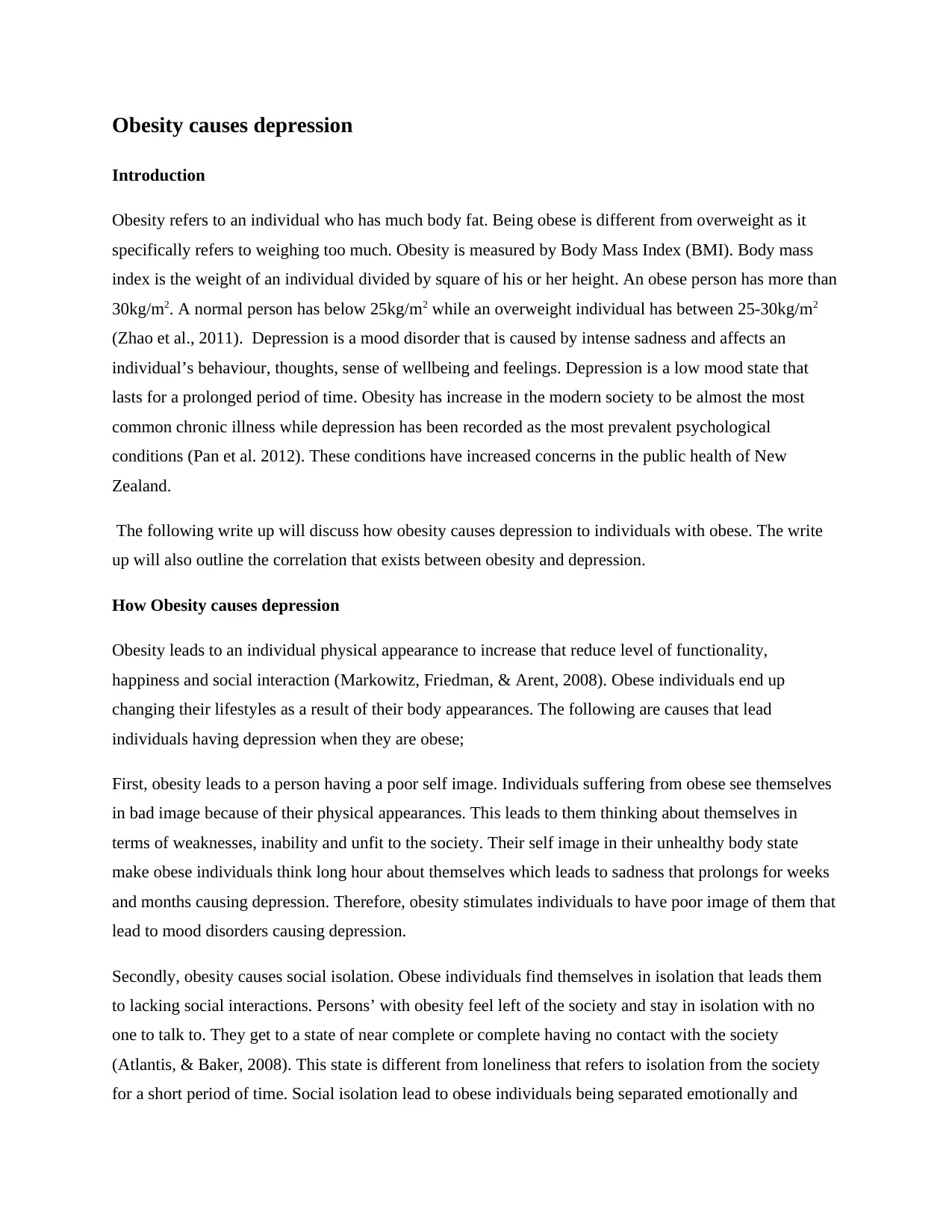
index is the weight of an individual divided by square of his or her height. An obese person has more than
30kg/m2. A normal person has below 25kg/m2 while an overweight individual has between 25-30kg/m2
(Zhao et al., 2011). Depression is a mood disorder that is caused by intense sadness and affects an
individual’s behaviour, thoughts, sense of wellbeing and feelings. Depression is a low mood state that
lasts for a prolonged period of time. Obesity has increase in the modern society to be almost the most
common chronic illness while depression has been recorded as the most prevalent psychological
conditions (Pan et al. 2012). These conditions have increased concerns in the public health of New
Zealand.
The following write up will discuss how obesity causes depression to individuals with obese. The write
up will also outline the correlation that exists between obesity and depression.
How Obesity causes depression
Obesity leads to an individual physical appearance to increase that reduce level of functionality,
happiness and social interaction (Markowitz, Friedman, & Arent, 2008). Obese individuals end up
changing their lifestyles as a result of their body appearances. The following are causes that lead
individuals having depression when they are obese;
First, obesity leads to a person having a poor self image. Individuals suffering from obese see themselves
in bad image because of their physical appearances. This leads to them thinking about themselves in
terms of weaknesses, inability and unfit to the society. Their self image in their unhealthy body state
make obese individuals think long hour about themselves which leads to sadness that prolongs for weeks
and months causing depression. Therefore, obesity stimulates individuals to have poor image of them that
lead to mood disorders causing depression.
Secondly, obesity causes social isolation. Obese individuals find themselves in isolation that leads them
to lacking social interactions. Persons’ with obesity feel left of the society and stay in isolation with no
one to talk to. They get to a state of near complete or complete having no contact with the society
(Atlantis, & Baker, 2008). This state is different from loneliness that refers to isolation from the society
for a short period of time. Social isolation lead to obese individuals being separated emotionally and
Introduction
Obesity refers to an individual who has much body fat. Being obese is different from overweight as it
specifically refers to weighing too much. Obesity is measured by Body Mass Index (BMI). Body mass
index is the weight of an individual divided by square of his or her height. An obese person has more than
30kg/m2. A normal person has below 25kg/m2 while an overweight individual has between 25-30kg/m2
(Zhao et al., 2011). Depression is a mood disorder that is caused by intense sadness and affects an
individual’s behaviour, thoughts, sense of wellbeing and feelings. Depression is a low mood state that
lasts for a prolonged period of time. Obesity has increase in the modern society to be almost the most
common chronic illness while depression has been recorded as the most prevalent psychological
conditions (Pan et al. 2012). These conditions have increased concerns in the public health of New
Zealand.
The following write up will discuss how obesity causes depression to individuals with obese. The write
up will also outline the correlation that exists between obesity and depression.
How Obesity causes depression
Obesity leads to an individual physical appearance to increase that reduce level of functionality,
happiness and social interaction (Markowitz, Friedman, & Arent, 2008). Obese individuals end up
changing their lifestyles as a result of their body appearances. The following are causes that lead
individuals having depression when they are obese;
First, obesity leads to a person having a poor self image. Individuals suffering from obese see themselves
in bad image because of their physical appearances. This leads to them thinking about themselves in
terms of weaknesses, inability and unfit to the society. Their self image in their unhealthy body state
make obese individuals think long hour about themselves which leads to sadness that prolongs for weeks
and months causing depression. Therefore, obesity stimulates individuals to have poor image of them that
lead to mood disorders causing depression.
Secondly, obesity causes social isolation. Obese individuals find themselves in isolation that leads them
to lacking social interactions. Persons’ with obesity feel left of the society and stay in isolation with no
one to talk to. They get to a state of near complete or complete having no contact with the society
(Atlantis, & Baker, 2008). This state is different from loneliness that refers to isolation from the society
for a short period of time. Social isolation lead to obese individuals being separated emotionally and
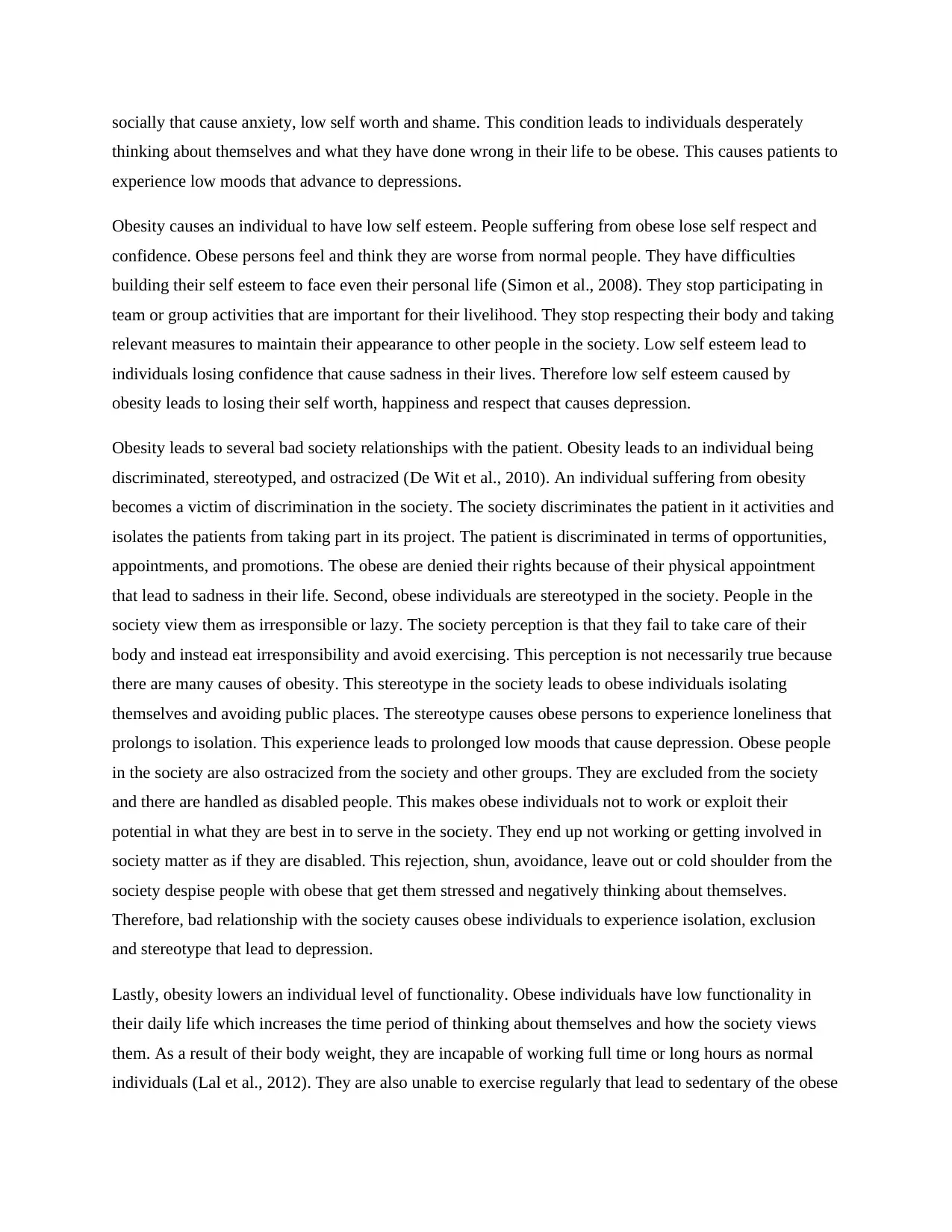
socially that cause anxiety, low self worth and shame. This condition leads to individuals desperately
thinking about themselves and what they have done wrong in their life to be obese. This causes patients to
experience low moods that advance to depressions.
Obesity causes an individual to have low self esteem. People suffering from obese lose self respect and
confidence. Obese persons feel and think they are worse from normal people. They have difficulties
building their self esteem to face even their personal life (Simon et al., 2008). They stop participating in
team or group activities that are important for their livelihood. They stop respecting their body and taking
relevant measures to maintain their appearance to other people in the society. Low self esteem lead to
individuals losing confidence that cause sadness in their lives. Therefore low self esteem caused by
obesity leads to losing their self worth, happiness and respect that causes depression.
Obesity leads to several bad society relationships with the patient. Obesity leads to an individual being
discriminated, stereotyped, and ostracized (De Wit et al., 2010). An individual suffering from obesity
becomes a victim of discrimination in the society. The society discriminates the patient in it activities and
isolates the patients from taking part in its project. The patient is discriminated in terms of opportunities,
appointments, and promotions. The obese are denied their rights because of their physical appointment
that lead to sadness in their life. Second, obese individuals are stereotyped in the society. People in the
society view them as irresponsible or lazy. The society perception is that they fail to take care of their
body and instead eat irresponsibility and avoid exercising. This perception is not necessarily true because
there are many causes of obesity. This stereotype in the society leads to obese individuals isolating
themselves and avoiding public places. The stereotype causes obese persons to experience loneliness that
prolongs to isolation. This experience leads to prolonged low moods that cause depression. Obese people
in the society are also ostracized from the society and other groups. They are excluded from the society
and there are handled as disabled people. This makes obese individuals not to work or exploit their
potential in what they are best in to serve in the society. They end up not working or getting involved in
society matter as if they are disabled. This rejection, shun, avoidance, leave out or cold shoulder from the
society despise people with obese that get them stressed and negatively thinking about themselves.
Therefore, bad relationship with the society causes obese individuals to experience isolation, exclusion
and stereotype that lead to depression.
Lastly, obesity lowers an individual level of functionality. Obese individuals have low functionality in
their daily life which increases the time period of thinking about themselves and how the society views
them. As a result of their body weight, they are incapable of working full time or long hours as normal
individuals (Lal et al., 2012). They are also unable to exercise regularly that lead to sedentary of the obese
thinking about themselves and what they have done wrong in their life to be obese. This causes patients to
experience low moods that advance to depressions.
Obesity causes an individual to have low self esteem. People suffering from obese lose self respect and
confidence. Obese persons feel and think they are worse from normal people. They have difficulties
building their self esteem to face even their personal life (Simon et al., 2008). They stop participating in
team or group activities that are important for their livelihood. They stop respecting their body and taking
relevant measures to maintain their appearance to other people in the society. Low self esteem lead to
individuals losing confidence that cause sadness in their lives. Therefore low self esteem caused by
obesity leads to losing their self worth, happiness and respect that causes depression.
Obesity leads to several bad society relationships with the patient. Obesity leads to an individual being
discriminated, stereotyped, and ostracized (De Wit et al., 2010). An individual suffering from obesity
becomes a victim of discrimination in the society. The society discriminates the patient in it activities and
isolates the patients from taking part in its project. The patient is discriminated in terms of opportunities,
appointments, and promotions. The obese are denied their rights because of their physical appointment
that lead to sadness in their life. Second, obese individuals are stereotyped in the society. People in the
society view them as irresponsible or lazy. The society perception is that they fail to take care of their
body and instead eat irresponsibility and avoid exercising. This perception is not necessarily true because
there are many causes of obesity. This stereotype in the society leads to obese individuals isolating
themselves and avoiding public places. The stereotype causes obese persons to experience loneliness that
prolongs to isolation. This experience leads to prolonged low moods that cause depression. Obese people
in the society are also ostracized from the society and other groups. They are excluded from the society
and there are handled as disabled people. This makes obese individuals not to work or exploit their
potential in what they are best in to serve in the society. They end up not working or getting involved in
society matter as if they are disabled. This rejection, shun, avoidance, leave out or cold shoulder from the
society despise people with obese that get them stressed and negatively thinking about themselves.
Therefore, bad relationship with the society causes obese individuals to experience isolation, exclusion
and stereotype that lead to depression.
Lastly, obesity lowers an individual level of functionality. Obese individuals have low functionality in
their daily life which increases the time period of thinking about themselves and how the society views
them. As a result of their body weight, they are incapable of working full time or long hours as normal
individuals (Lal et al., 2012). They are also unable to exercise regularly that lead to sedentary of the obese
⊘ This is a preview!⊘
Do you want full access?
Subscribe today to unlock all pages.

Trusted by 1+ million students worldwide
patients. Low level of functionality of the obese individual’s body leads to increasing body weight. This
situation makes the patients more incapable of undertaking exercises, and working. Therefore, low level
of functionality cause obese individuals to become more sedentary that lead to low mood that prolong to
cause depression.
Correlation between obesity and depression
Depression is highly correlated to obesity. Depression is highly dependent on an individual weight.
Obesity changes one’s self view and other people perceptive that can adversely affect one thought. Obese
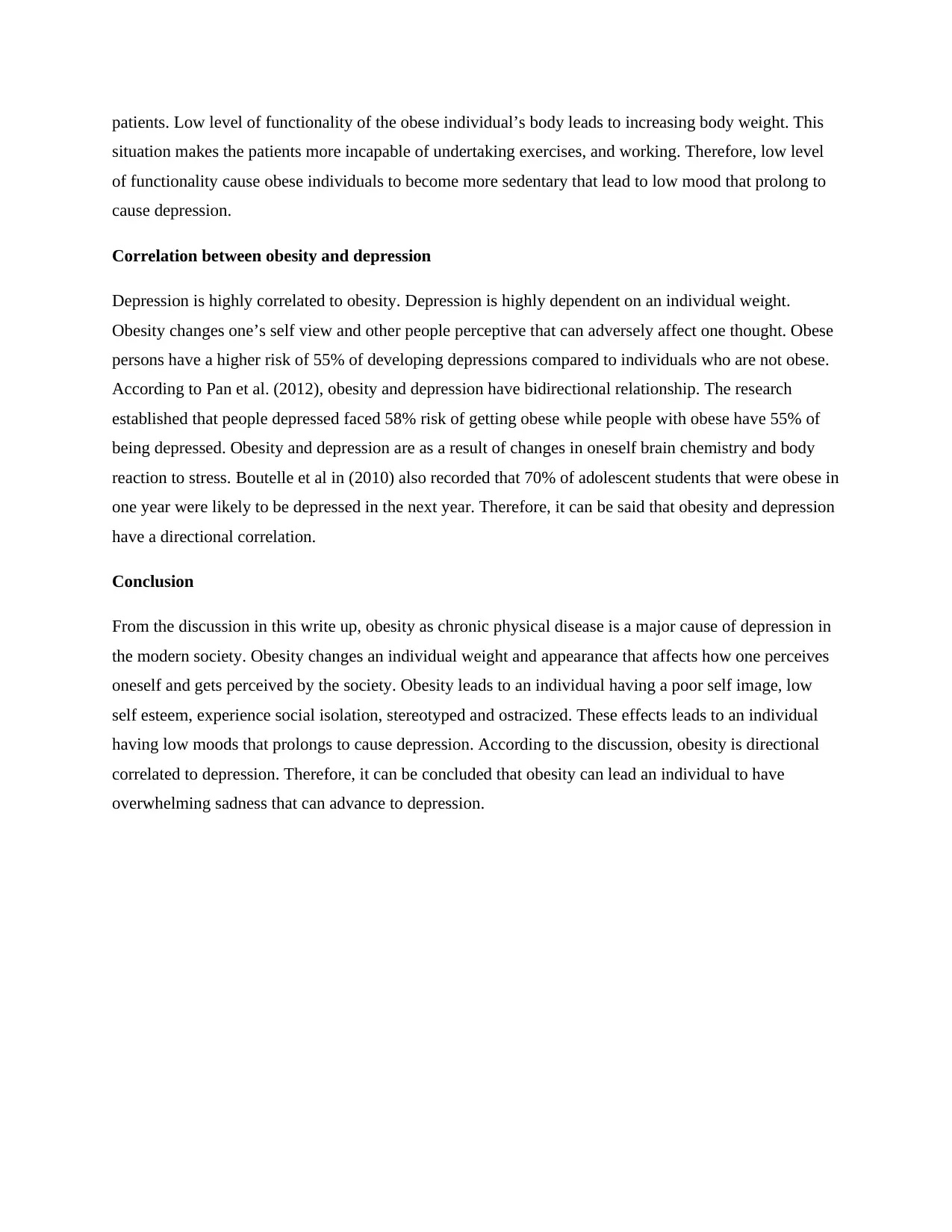
persons have a higher risk of 55% of developing depressions compared to individuals who are not obese.
According to Pan et al. (2012), obesity and depression have bidirectional relationship. The research
established that people depressed faced 58% risk of getting obese while people with obese have 55% of
being depressed. Obesity and depression are as a result of changes in oneself brain chemistry and body
reaction to stress. Boutelle et al in (2010) also recorded that 70% of adolescent students that were obese in
one year were likely to be depressed in the next year. Therefore, it can be said that obesity and depression
have a directional correlation.
Conclusion
From the discussion in this write up, obesity as chronic physical disease is a major cause of depression in
the modern society. Obesity changes an individual weight and appearance that affects how one perceives
oneself and gets perceived by the society. Obesity leads to an individual having a poor self image, low
self esteem, experience social isolation, stereotyped and ostracized. These effects leads to an individual
having low moods that prolongs to cause depression. According to the discussion, obesity is directional
correlated to depression. Therefore, it can be concluded that obesity can lead an individual to have
overwhelming sadness that can advance to depression.
situation makes the patients more incapable of undertaking exercises, and working. Therefore, low level
of functionality cause obese individuals to become more sedentary that lead to low mood that prolong to
cause depression.
Correlation between obesity and depression
Depression is highly correlated to obesity. Depression is highly dependent on an individual weight.
Obesity changes one’s self view and other people perceptive that can adversely affect one thought. Obese
persons have a higher risk of 55% of developing depressions compared to individuals who are not obese.
According to Pan et al. (2012), obesity and depression have bidirectional relationship. The research
established that people depressed faced 58% risk of getting obese while people with obese have 55% of
being depressed. Obesity and depression are as a result of changes in oneself brain chemistry and body
reaction to stress. Boutelle et al in (2010) also recorded that 70% of adolescent students that were obese in
one year were likely to be depressed in the next year. Therefore, it can be said that obesity and depression
have a directional correlation.
Conclusion
From the discussion in this write up, obesity as chronic physical disease is a major cause of depression in
the modern society. Obesity changes an individual weight and appearance that affects how one perceives
oneself and gets perceived by the society. Obesity leads to an individual having a poor self image, low
self esteem, experience social isolation, stereotyped and ostracized. These effects leads to an individual
having low moods that prolongs to cause depression. According to the discussion, obesity is directional
correlated to depression. Therefore, it can be concluded that obesity can lead an individual to have
overwhelming sadness that can advance to depression.
Paraphrase This Document
Need a fresh take? Get an instant paraphrase of this document with our AI Paraphraser
References
Atlantis, E., & Baker, M. (2008). Obesity effects on depression: systematic review of epidemiological
studies. International journal of obesity, 32(6), 881.
Boutelle, K. N., Hannan, P., Fulkerson, J. A., Crow, S. J., & Stice, E. (2010). Obesity as a prospective
predictor of depression in adolescent females. Health Psychology, 29(3), 293.
De Wit, L., Luppino, F., van Straten, A., Penninx, B., Zitman, F., & Cuijpers, P. (2010). Depression and
obesity: a meta-analysis of community-based studies. Psychiatry research, 178(2), 230-235.
Lal, A., Moodie, M., Ashton, T., Siahpush, M., & Swinburn, B. (2012). Health care and lost productivity
costs of overweight and obesity in New Zealand. Australian and New Zealand journal of
public health, 36(6), 550-556.
Markowitz, S., Friedman, M. A., & Arent, S. M. (2008). Understanding the relation between obesity and
depression: causal mechanisms and implications for treatment. Clinical Psychology: Science
and Practice, 15(1), 1-20.
Pan, A., Qi Sun, D., Czernichow, S., Kivimaki, M., Okereke, O. I., Lucas, M., ... & Hu, F. B. (2012).
Bidirectional association between depression and obesity in middle-aged and older women.
International journal of obesity (2005), 36(4), 595.
Simon, G. E., Ludman, E. J., Linde, J. A., Operskalski, B. H., Ichikawa, L., Rohde, P., ... & Jeffery, R. W.
(2008). Association between obesity and depression in middle-aged women. General hospital
psychiatry, 30(1), 32-39.
Zhao, G., Ford, E. S., Li, C., Tsai, J., Dhingra, S., & Balluz, L. S. (2011). Waist circumference,
abdominal obesity, and depression among overweight and obese US adults: National Health
and Nutrition Examination Survey 2005-2006. BMC psychiatry, 11(1), 130.
Atlantis, E., & Baker, M. (2008). Obesity effects on depression: systematic review of epidemiological
studies. International journal of obesity, 32(6), 881.
Boutelle, K. N., Hannan, P., Fulkerson, J. A., Crow, S. J., & Stice, E. (2010). Obesity as a prospective
predictor of depression in adolescent females. Health Psychology, 29(3), 293.
De Wit, L., Luppino, F., van Straten, A., Penninx, B., Zitman, F., & Cuijpers, P. (2010). Depression and
obesity: a meta-analysis of community-based studies. Psychiatry research, 178(2), 230-235.
Lal, A., Moodie, M., Ashton, T., Siahpush, M., & Swinburn, B. (2012). Health care and lost productivity
costs of overweight and obesity in New Zealand. Australian and New Zealand journal of
public health, 36(6), 550-556.
Markowitz, S., Friedman, M. A., & Arent, S. M. (2008). Understanding the relation between obesity and
depression: causal mechanisms and implications for treatment. Clinical Psychology: Science
and Practice, 15(1), 1-20.
Pan, A., Qi Sun, D., Czernichow, S., Kivimaki, M., Okereke, O. I., Lucas, M., ... & Hu, F. B. (2012).
Bidirectional association between depression and obesity in middle-aged and older women.
International journal of obesity (2005), 36(4), 595.
Simon, G. E., Ludman, E. J., Linde, J. A., Operskalski, B. H., Ichikawa, L., Rohde, P., ... & Jeffery, R. W.
(2008). Association between obesity and depression in middle-aged women. General hospital
psychiatry, 30(1), 32-39.
Zhao, G., Ford, E. S., Li, C., Tsai, J., Dhingra, S., & Balluz, L. S. (2011). Waist circumference,
abdominal obesity, and depression among overweight and obese US adults: National Health
and Nutrition Examination Survey 2005-2006. BMC psychiatry, 11(1), 130.

1 out of 5


Related Documents


Your All-in-One AI-Powered Toolkit for Academic Success.
+13062052269
info@desklib.com
Available 24*7 on WhatsApp / Email
![[object Object]](/_next/static/media/star-bottom.7253800d.svg)
Unlock your academic potential
Copyright © 2020–2026 A2Z Services. All Rights Reserved. Developed and managed by ZUCOL.