Report on Obesity in India: Primary Healthcare, Nurses, and Prevention
VerifiedAdded on 2022/09/27
|9
|3264
|23
Report
AI Summary
This report examines the prevalence of obesity in India, highlighting its increasing incidence in both rural and urban areas, and the role of primary healthcare in addressing this critical health issue. It delves into the impact of social determinants like poverty, lack of education, and unemployment on obesity rates, while also analyzing epidemiological factors. The report emphasizes the crucial role of nurses in identifying and preventing obesity, acting as a vital link between healthcare organizations and the affected population. It discusses the application of WHO's five key principles of primary healthcare, including accessibility, community participation, technology, health promotion, and intersectoral collaboration, to ensure equitable healthcare services. The report also underscores the importance of cultural competence among nurses in improving health outcomes and addresses the significance of education and awareness in combating obesity within the Indian context. This report highlights how primary healthcare, particularly through the efforts of nurses, can be leveraged to combat the growing obesity crisis in India.
Running Head: Obesity in India
Obesity in India
Report
System04104
10/7/2019
Obesity in India
Report
System04104
10/7/2019

Paraphrase This Document
Need a fresh take? Get an instant paraphrase of this document with our AI Paraphraser
Obesity in India
1
Introduction
Obesity in India is a common issue in both rural and urban areas. The current report
talks about the role of primary healthcare in prevention of obesity in India. The report also
discusses about the role of nurses in identifying and preventing the obesity in the country and
aware people about this serious issue. The report analyses the impact of various social
determinants factors in this health issues with analysing the Epidemiological factors that can
be helpful to prevent obesity in the country. The role of WHO and its five key principles of
primary healthcare has been discussed to analyse the current role of primary healthcare
system in India to prevent obesity.
Overview about Obesity in India
Obesity or overweight is an emerging and most common health issue in the Asian
continent and India is the hub of obese people. Obesity has been dramatically increasing in
the rural areas of Indian and most of children and adult people who belong to middle income
or lower income class people are suffering from obesity (Sahoo, Sahoo, Choudhury, Sofi,
Kumar & Bhadoria, 2015). Obesity has reached epidemic proportions in the 21st century with
morbid affecting 5% of the country. As a report published by Indian Health Ministry,
somewhere around 5.74% to 8.82% of schoolchildren are suffering from obesity while this
number is around 32% in adult people (Corsi & Subramanian, 2019). There are large
numbers of people (around one third of the population) in India are living with poverty or
below poverty line in the country and it is the major cause of obesity. The role of primary
healthcare in India to prevent obesity is really crucial and especially the role of nurses who
can serve as a middle factor between primary healthcare organisations and obese people.
India is a developing country and it spends a huge amount on healthcare and poverty (Fan,
Kim, & Wong, 2017). However, poverty is the major reason in the country that leads to
obesity among people.
Obesity is also a global issue and it has been seen that this health issue is very
common in both developing and developed country. Since 1975, the numbers of obesity
patients is almost tripled. . There are more than 1.9 billion adult people and around 41 million
children (under age of 5 years) in the world are suffering from obesity. While more than 340
million adolescents aged between 5-19 years old are suffering from overweight or obese in
2016 (Ranjani, Mehreen, Pradeepa, Anjana, Garg, Anand, & Mohan, 2016). However, WHO
1
Introduction
Obesity in India is a common issue in both rural and urban areas. The current report
talks about the role of primary healthcare in prevention of obesity in India. The report also
discusses about the role of nurses in identifying and preventing the obesity in the country and
aware people about this serious issue. The report analyses the impact of various social
determinants factors in this health issues with analysing the Epidemiological factors that can
be helpful to prevent obesity in the country. The role of WHO and its five key principles of
primary healthcare has been discussed to analyse the current role of primary healthcare
system in India to prevent obesity.
Overview about Obesity in India
Obesity or overweight is an emerging and most common health issue in the Asian
continent and India is the hub of obese people. Obesity has been dramatically increasing in
the rural areas of Indian and most of children and adult people who belong to middle income
or lower income class people are suffering from obesity (Sahoo, Sahoo, Choudhury, Sofi,
Kumar & Bhadoria, 2015). Obesity has reached epidemic proportions in the 21st century with
morbid affecting 5% of the country. As a report published by Indian Health Ministry,
somewhere around 5.74% to 8.82% of schoolchildren are suffering from obesity while this
number is around 32% in adult people (Corsi & Subramanian, 2019). There are large
numbers of people (around one third of the population) in India are living with poverty or
below poverty line in the country and it is the major cause of obesity. The role of primary
healthcare in India to prevent obesity is really crucial and especially the role of nurses who
can serve as a middle factor between primary healthcare organisations and obese people.
India is a developing country and it spends a huge amount on healthcare and poverty (Fan,
Kim, & Wong, 2017). However, poverty is the major reason in the country that leads to
obesity among people.
Obesity is also a global issue and it has been seen that this health issue is very
common in both developing and developed country. Since 1975, the numbers of obesity
patients is almost tripled. . There are more than 1.9 billion adult people and around 41 million
children (under age of 5 years) in the world are suffering from obesity. While more than 340
million adolescents aged between 5-19 years old are suffering from overweight or obese in
2016 (Ranjani, Mehreen, Pradeepa, Anjana, Garg, Anand, & Mohan, 2016). However, WHO
Obesity in India
2
provide five key principles of primary healthcare to fight with obesity in the world. These
five principles of WHO are related with accessibility of people to basic primary healthcare
services, community participation to aware people about the health issue, appropriate use
of technology to do research in the field of obesity, health promotion to keep aware people
that how they can be fit and avoid the possibility of any health disease (Siddiqui, 2018). The
last principle is called intersectoral collaboration to provide great health services to the
people. The major idea to implement these principles in the world is to ensure health equality
for all and eliminate the health inequality in the country based on economic, social, or
religious basis. These principles determine that people will get best possible healthcare
facilities on affordable cost without any biases. Another idea to implement these primary
healthcare principles is to eliminate the healthcare inequality on the health sector because of
social determinants, epidemiological factors, and social injustice (Shannawaz & Arokiasamy,
2018).
Social Determinants of Health in India and Its Impact
Social determinates are those factors that have direct impact on the health of people.
These factors can be considered in forms of unemployment situation, poverty, lack of
education, social factors etc. These factors are directly related with the health of people and
can have both positive and negative effects on the health of people. As per survey conducted
by the Indian government, more than 32% of people are living in the country below poverty
while illiteracy rate in Indian is around 30% in the country. These two are the major factors
behind obesity because poor hygiene and unhealthy fat food are the basic reasons in the
country for obesity (Shrivastava, Misra, Mohan, Unnikrishnan, & Bachani, 2017).
The large numbers of people are facing issues related to unemployment in the
country. From last one two decades the population of the country increased by 320 million
people and a majority of population do not have proper job or qualification for finding jobs in
the country. In such a scenario, most of the people do not have any idea about the proper food
consumptions, maintains body mass index or importance of nutritious foods to stay healthy
and fit (Poobalan & Aucott, 2016).
Education is the other crucial factor in the India. More than 35% people in rural areas
and 18% people in the urban areas are not literate, so they are facing many challenges related
to education about various health issues. Most of them are living in rural areas where the
2
provide five key principles of primary healthcare to fight with obesity in the world. These
five principles of WHO are related with accessibility of people to basic primary healthcare
services, community participation to aware people about the health issue, appropriate use
of technology to do research in the field of obesity, health promotion to keep aware people
that how they can be fit and avoid the possibility of any health disease (Siddiqui, 2018). The
last principle is called intersectoral collaboration to provide great health services to the
people. The major idea to implement these principles in the world is to ensure health equality
for all and eliminate the health inequality in the country based on economic, social, or
religious basis. These principles determine that people will get best possible healthcare
facilities on affordable cost without any biases. Another idea to implement these primary
healthcare principles is to eliminate the healthcare inequality on the health sector because of
social determinants, epidemiological factors, and social injustice (Shannawaz & Arokiasamy,
2018).
Social Determinants of Health in India and Its Impact
Social determinates are those factors that have direct impact on the health of people.
These factors can be considered in forms of unemployment situation, poverty, lack of
education, social factors etc. These factors are directly related with the health of people and
can have both positive and negative effects on the health of people. As per survey conducted
by the Indian government, more than 32% of people are living in the country below poverty
while illiteracy rate in Indian is around 30% in the country. These two are the major factors
behind obesity because poor hygiene and unhealthy fat food are the basic reasons in the
country for obesity (Shrivastava, Misra, Mohan, Unnikrishnan, & Bachani, 2017).
The large numbers of people are facing issues related to unemployment in the
country. From last one two decades the population of the country increased by 320 million
people and a majority of population do not have proper job or qualification for finding jobs in
the country. In such a scenario, most of the people do not have any idea about the proper food
consumptions, maintains body mass index or importance of nutritious foods to stay healthy
and fit (Poobalan & Aucott, 2016).
Education is the other crucial factor in the India. More than 35% people in rural areas
and 18% people in the urban areas are not literate, so they are facing many challenges related
to education about various health issues. Most of them are living in rural areas where the
⊘ This is a preview!⊘
Do you want full access?
Subscribe today to unlock all pages.

Trusted by 1+ million students worldwide
Obesity in India
3
accessibility of primary healthcare services is also questionable. Although the major issues
for India is to implement primary healthcare principles of WHO in the country because the
poverty of people affect the principle of “affordability” of healthcare services of WHO. Apart
from this, the lack of employment opportunities is also a questionable thing in the country.
Large numbers of people are facing issues related to finding employment in the country while
the inflation is increasing every day (Anuradha, Sathyavathi, R. Reddy, Hemalatha,
Sudhakar, Geetha, & Reddy, 2015).
The inequality and social justice in the primary healthcare services is also a major
concern in India for Obese people. It has been observed that there are large numbers of obese
people resides in the rural areas (approx. 72%) and they cannot have proper facilities or
healthcare services in the remote areas from the government (Arora, Shinde, & Patwardhan,
2017). People who live in urban area can get better healthcare facilities than people who live
in rural areas. Apart from this, most of the people in rural areas cannot afford the benefits of
government health programs and neither have they availed the free medicines or care
facilities provided by the government for people. However, social injustice is really a major
problem in the country where poor and middle class people are suffering from obesity and
they are dominated by the upper class (Poobalan & Aucott, 2016).
Epidemiological Factors that can help to identify the Obesity in India
The major symptom of obesity in people is overweight or excessive weight in people.
However, this can be easily identified in the people who are suffering from excessive body
mass index and heavy body with fat. Generally, obesity can be defined in terms of Body
Mass Index (BMI) and consider those people having 30 or more than 30 BMI. Large numbers
of people in rural areas are suffering from this issue. People who are consuming more fat or
unhygienic food are the primary victim of obesity in India (Lin, Genden, Shen, Wu, Yang,
Hung, & Yang, 2018). However, this leads to several other health issues in people such as
cardiovascular disease, high blood pressure, diabetes, and other heart related heath issues. To
prevent such type of problem in the people it is required that government take some great
initiatives which is socially equitable and follow the primary health principles of WHO. The
social justice and equality in health program not only ensure to effectiveness and success of
various healthcare programs rather it would also reduce the differences in health outcomes
(Poobalan & Aucott, 2016).
3
accessibility of primary healthcare services is also questionable. Although the major issues
for India is to implement primary healthcare principles of WHO in the country because the
poverty of people affect the principle of “affordability” of healthcare services of WHO. Apart
from this, the lack of employment opportunities is also a questionable thing in the country.
Large numbers of people are facing issues related to finding employment in the country while
the inflation is increasing every day (Anuradha, Sathyavathi, R. Reddy, Hemalatha,
Sudhakar, Geetha, & Reddy, 2015).
The inequality and social justice in the primary healthcare services is also a major
concern in India for Obese people. It has been observed that there are large numbers of obese
people resides in the rural areas (approx. 72%) and they cannot have proper facilities or
healthcare services in the remote areas from the government (Arora, Shinde, & Patwardhan,
2017). People who live in urban area can get better healthcare facilities than people who live
in rural areas. Apart from this, most of the people in rural areas cannot afford the benefits of
government health programs and neither have they availed the free medicines or care
facilities provided by the government for people. However, social injustice is really a major
problem in the country where poor and middle class people are suffering from obesity and
they are dominated by the upper class (Poobalan & Aucott, 2016).
Epidemiological Factors that can help to identify the Obesity in India
The major symptom of obesity in people is overweight or excessive weight in people.
However, this can be easily identified in the people who are suffering from excessive body
mass index and heavy body with fat. Generally, obesity can be defined in terms of Body
Mass Index (BMI) and consider those people having 30 or more than 30 BMI. Large numbers
of people in rural areas are suffering from this issue. People who are consuming more fat or
unhygienic food are the primary victim of obesity in India (Lin, Genden, Shen, Wu, Yang,
Hung, & Yang, 2018). However, this leads to several other health issues in people such as
cardiovascular disease, high blood pressure, diabetes, and other heart related heath issues. To
prevent such type of problem in the people it is required that government take some great
initiatives which is socially equitable and follow the primary health principles of WHO. The
social justice and equality in health program not only ensure to effectiveness and success of
various healthcare programs rather it would also reduce the differences in health outcomes
(Poobalan & Aucott, 2016).
Paraphrase This Document
Need a fresh take? Get an instant paraphrase of this document with our AI Paraphraser
Obesity in India
4
The obesity can be recognised in those people who have increased intake of energy-
dense or fat foods. Obesity can be identified in those people who are facing breathing issues
and facing extremely high risks of facing fracture because of heavy weight. In adult people,
hypertension and diabetes are the major symptoms because of obesity in people. In India,
children and adults between 18 to 35 years are the major target of obesity and they are not
only face issues related to their clothing styles rather they also face issues while they
performing their daily activities (Palo, Swain, Priyadarshini, Behera, & Pati, 2019).
Role of Primary Healthcare Nurses in India to Prevent Obesity
Role of primary healthcare nurses are very crucial in India. Currently, India has
launched many heath care programs under which nurses provide care facilities to the people
both in remote and urban areas. Some crucial names in this sector are ASHA nurses,
Aanganwadi workers, etc. (Anuradha, Sathyavathi, R. Reddy, Hemalatha, Sudhakar, Geetha,
& Reddy, 2015). These nurses are working in the country in collaboration with the primary
healthcare nurses and visiting door to door in the rural areas to provide crucial information
about obesity and ask them to take proper diets to prevent obesity in the children and young
people in the country (Anuradha, Sathyavathi, R. Reddy, Hemalatha, Sudhakar, Geetha, &
Reddy, 2015).
Through the Aanganwadi program and Mid-day meal program, the government is
trying to use their primary health workforce to educate and aware people about the
importance of proper and nutritious diet in people. The nurses can also play a role of
counsellor that can educate and suggest people that how exercise and yoga can help the
people to stay healthy and fit. India is known for its Yoga and Ayurveda system of medical
health programs and inventions. The government is also promoting its Yoga exercise and
Ayurveda medicines to eliminate obesity from the people (Arora, Shinde, & Patwardhan,
2017).
Around 4 million nurses and additional 1 million other healthcare workers are
supporting the role of nurses in the country (Subica, Agarwal, Sullivan, & Link, 2017).
However, some of them are government nurses while some of them are practicing with
private healthcare organisations. The nurses plays the role of counsellors who can persuade
people that how they can avoid unhealthy diet and junk foods to avoid obesity in people.
Nurses are also involved in the country in vaccination programs while they visiting in the
4
The obesity can be recognised in those people who have increased intake of energy-
dense or fat foods. Obesity can be identified in those people who are facing breathing issues
and facing extremely high risks of facing fracture because of heavy weight. In adult people,
hypertension and diabetes are the major symptoms because of obesity in people. In India,
children and adults between 18 to 35 years are the major target of obesity and they are not
only face issues related to their clothing styles rather they also face issues while they
performing their daily activities (Palo, Swain, Priyadarshini, Behera, & Pati, 2019).
Role of Primary Healthcare Nurses in India to Prevent Obesity
Role of primary healthcare nurses are very crucial in India. Currently, India has
launched many heath care programs under which nurses provide care facilities to the people
both in remote and urban areas. Some crucial names in this sector are ASHA nurses,
Aanganwadi workers, etc. (Anuradha, Sathyavathi, R. Reddy, Hemalatha, Sudhakar, Geetha,
& Reddy, 2015). These nurses are working in the country in collaboration with the primary
healthcare nurses and visiting door to door in the rural areas to provide crucial information
about obesity and ask them to take proper diets to prevent obesity in the children and young
people in the country (Anuradha, Sathyavathi, R. Reddy, Hemalatha, Sudhakar, Geetha, &
Reddy, 2015).
Through the Aanganwadi program and Mid-day meal program, the government is
trying to use their primary health workforce to educate and aware people about the
importance of proper and nutritious diet in people. The nurses can also play a role of
counsellor that can educate and suggest people that how exercise and yoga can help the
people to stay healthy and fit. India is known for its Yoga and Ayurveda system of medical
health programs and inventions. The government is also promoting its Yoga exercise and
Ayurveda medicines to eliminate obesity from the people (Arora, Shinde, & Patwardhan,
2017).
Around 4 million nurses and additional 1 million other healthcare workers are
supporting the role of nurses in the country (Subica, Agarwal, Sullivan, & Link, 2017).
However, some of them are government nurses while some of them are practicing with
private healthcare organisations. The nurses plays the role of counsellors who can persuade
people that how they can avoid unhealthy diet and junk foods to avoid obesity in people.
Nurses are also involved in the country in vaccination programs while they visiting in the
Obesity in India
5
schools and primary schools to review the health of school children. Along with the
vaccination work, nurses can also spread knowledge about obesity in the people (Poobalan &
Aucott, 2016).
Importance of Cultural Competence in the Primary Healthcare Nurses Role as
contributors to improving health outcomes
Large numbers of people in India are suffering from obesity and overweight issues.
However, most of the people or children who are obese belong to rural areas. The lack of
knowledge and information about obesity is the major reason behind increasing numbers of
obesity cases in the country (Subica, Agarwal, Sullivan, & Link, 2017). Apart from this,
people who live in rural areas find not to be serious about their intakes or diet system. The
junk food and oily foods are the major source of obesity and fat in the body, which is
consumed by large numbers of people in the country. In such a scenario, nurses can play a
crucial role to develop skills and knowledge among the people about the serious health issue
in India (De Silva, De Silva, Haniffa, Liyanage, Jayasinghe, Katulanda, & Rajapakse, 2015).
The people who live in rural areas and having low income are the major victim of
obesity in India because they have unhygienic and unsystematic diet pattern. The poor people
generally not considers about their food and nutritious diets. This will lead to a major
problem for the country. More than 40% of India’s total population are youths and all are
now very conscious about their health especially in urban areas (Purty, Mishra, & Singh,
2015). However, the 72% population resides in villages or rural areas where people are not
very serious about their health and diets. Nurses can play a significant role to educate and
aware these people about their health concerns and educate them how they can stay healthy
and fit in their life by following the hygienic diets and avoiding junk and oily foods (Satija,
Hu, Bowen, Bharathi, Vaz, Prabhakaran, & Ebrahim, 2015).
Conclusion
In conclusion, India is facing extreme challenges related to obesity in the country.
However, the huge number of nurses that are working in the primary healthcare centres can
contribute to eliminate this health issue from the country, if government educate and train
them to provide information about obesity to people who live in rural areas. The major issues
related to obesity has been reported in the rural areas and if government follow the five key
principles of primary healthcare and use its healthcare workforce then cases related to obesity
5
schools and primary schools to review the health of school children. Along with the
vaccination work, nurses can also spread knowledge about obesity in the people (Poobalan &
Aucott, 2016).
Importance of Cultural Competence in the Primary Healthcare Nurses Role as
contributors to improving health outcomes
Large numbers of people in India are suffering from obesity and overweight issues.
However, most of the people or children who are obese belong to rural areas. The lack of
knowledge and information about obesity is the major reason behind increasing numbers of
obesity cases in the country (Subica, Agarwal, Sullivan, & Link, 2017). Apart from this,
people who live in rural areas find not to be serious about their intakes or diet system. The
junk food and oily foods are the major source of obesity and fat in the body, which is
consumed by large numbers of people in the country. In such a scenario, nurses can play a
crucial role to develop skills and knowledge among the people about the serious health issue
in India (De Silva, De Silva, Haniffa, Liyanage, Jayasinghe, Katulanda, & Rajapakse, 2015).
The people who live in rural areas and having low income are the major victim of
obesity in India because they have unhygienic and unsystematic diet pattern. The poor people
generally not considers about their food and nutritious diets. This will lead to a major
problem for the country. More than 40% of India’s total population are youths and all are
now very conscious about their health especially in urban areas (Purty, Mishra, & Singh,
2015). However, the 72% population resides in villages or rural areas where people are not
very serious about their health and diets. Nurses can play a significant role to educate and
aware these people about their health concerns and educate them how they can stay healthy
and fit in their life by following the hygienic diets and avoiding junk and oily foods (Satija,
Hu, Bowen, Bharathi, Vaz, Prabhakaran, & Ebrahim, 2015).
Conclusion
In conclusion, India is facing extreme challenges related to obesity in the country.
However, the huge number of nurses that are working in the primary healthcare centres can
contribute to eliminate this health issue from the country, if government educate and train
them to provide information about obesity to people who live in rural areas. The major issues
related to obesity has been reported in the rural areas and if government follow the five key
principles of primary healthcare and use its healthcare workforce then cases related to obesity
⊘ This is a preview!⊘
Do you want full access?
Subscribe today to unlock all pages.
Trusted by 1+ million students worldwide
Obesity in India
6
can easily be reduced in the country. Poverty and lack of education are two more effectual
social determinants factors, which can have major role in reducing obesity in adult people.
The Indian government should also focus on providing nutritious foods and diets to the
children under its mid-day meal program to reduce the obesity in children.
6
can easily be reduced in the country. Poverty and lack of education are two more effectual
social determinants factors, which can have major role in reducing obesity in adult people.
The Indian government should also focus on providing nutritious foods and diets to the
children under its mid-day meal program to reduce the obesity in children.
Paraphrase This Document
Need a fresh take? Get an instant paraphrase of this document with our AI Paraphraser
Obesity in India
7
References
Anuradha, R. K., Sathyavathi, R. B., Reddy, T. M., Hemalatha, R., Sudhakar, G., Geetha, P.,
& Reddy, K. K. (2015). Effect of social and environmental determinants on
overweight and obesity prevalence among adolescent school children. Indian journal
of endocrinology and metabolism, 19(2), 283.
Arora, M., Shinde, S., & Patwardhan, R. P. (2017). Prevalence of Overweight or Obesity in
Adolescent School Children from Pune India. Imperial Journal of Interdisciplinary
Research, 3(3), 1272-1276.
Corsi, D. J., & Subramanian, S. V. (2019). Socioeconomic Gradients and Distribution of
Diabetes, Hypertension, and Obesity in India. JAMA network open, 2(4), e190411-
e190411.
De Silva, A. P., De Silva, S. H. P., Haniffa, R., Liyanage, I. K., Jayasinghe, K. S. A.,
Katulanda, P., ... & Rajapakse, L. C. (2015). A cross sectional survey on social,
cultural and economic determinants of obesity in a low middle income
setting. International journal for equity in health, 14(1), 6.
Fan, J. G., Kim, S. U., & Wong, V. W. S. (2017). New trends on obesity and NAFLD in
Asia. Journal of Hepatology, 67(4), 862-873.
Lin, B. Y., Genden, K., Shen, W., Wu, P. S., Yang, W. C., Hung, H. F., & Yang, K. C.
(2018). The prevalence of obesity and metabolic syndrome in Tibetan immigrants
living in high altitude areas in Ladakh, India. Obesity research & clinical
practice, 12(4), 365-371.
Palo, S. K., Swain, S., Priyadarshini, S., Behera, B., & Pati, S. (2019). Epidemiology of
obesity and its related morbidities among rural population attending a primary health
centre of Odisha, India. Journal of family medicine and primary care, 8(1), 203.
Poobalan, A., & Aucott, L. (2016). Obesity among young adults in developing countries: a
systematic overview. Current obesity reports, 5(1), 2-13.
Purty, A. J., Mishra, A. K., & Singh, Z. (2015). Obesity among adult population of a rural
coastal area in South India. International Journal, 1(3), 155.
7
References
Anuradha, R. K., Sathyavathi, R. B., Reddy, T. M., Hemalatha, R., Sudhakar, G., Geetha, P.,
& Reddy, K. K. (2015). Effect of social and environmental determinants on
overweight and obesity prevalence among adolescent school children. Indian journal
of endocrinology and metabolism, 19(2), 283.
Arora, M., Shinde, S., & Patwardhan, R. P. (2017). Prevalence of Overweight or Obesity in
Adolescent School Children from Pune India. Imperial Journal of Interdisciplinary
Research, 3(3), 1272-1276.
Corsi, D. J., & Subramanian, S. V. (2019). Socioeconomic Gradients and Distribution of
Diabetes, Hypertension, and Obesity in India. JAMA network open, 2(4), e190411-
e190411.
De Silva, A. P., De Silva, S. H. P., Haniffa, R., Liyanage, I. K., Jayasinghe, K. S. A.,
Katulanda, P., ... & Rajapakse, L. C. (2015). A cross sectional survey on social,
cultural and economic determinants of obesity in a low middle income
setting. International journal for equity in health, 14(1), 6.
Fan, J. G., Kim, S. U., & Wong, V. W. S. (2017). New trends on obesity and NAFLD in
Asia. Journal of Hepatology, 67(4), 862-873.
Lin, B. Y., Genden, K., Shen, W., Wu, P. S., Yang, W. C., Hung, H. F., & Yang, K. C.
(2018). The prevalence of obesity and metabolic syndrome in Tibetan immigrants
living in high altitude areas in Ladakh, India. Obesity research & clinical
practice, 12(4), 365-371.
Palo, S. K., Swain, S., Priyadarshini, S., Behera, B., & Pati, S. (2019). Epidemiology of
obesity and its related morbidities among rural population attending a primary health
centre of Odisha, India. Journal of family medicine and primary care, 8(1), 203.
Poobalan, A., & Aucott, L. (2016). Obesity among young adults in developing countries: a
systematic overview. Current obesity reports, 5(1), 2-13.
Purty, A. J., Mishra, A. K., & Singh, Z. (2015). Obesity among adult population of a rural
coastal area in South India. International Journal, 1(3), 155.
Obesity in India
8
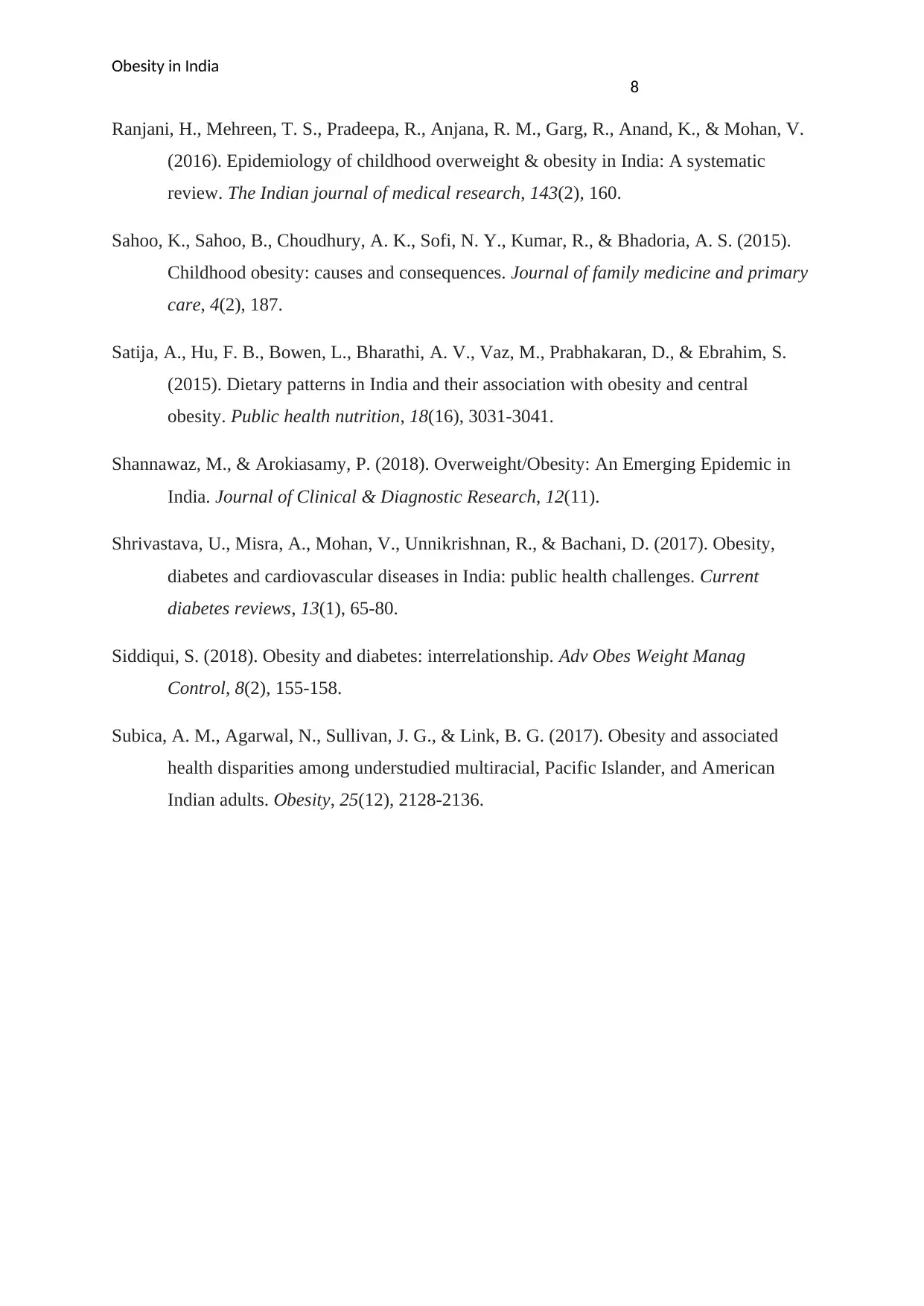
Ranjani, H., Mehreen, T. S., Pradeepa, R., Anjana, R. M., Garg, R., Anand, K., & Mohan, V.
(2016). Epidemiology of childhood overweight & obesity in India: A systematic
review. The Indian journal of medical research, 143(2), 160.
Sahoo, K., Sahoo, B., Choudhury, A. K., Sofi, N. Y., Kumar, R., & Bhadoria, A. S. (2015).
Childhood obesity: causes and consequences. Journal of family medicine and primary
care, 4(2), 187.
Satija, A., Hu, F. B., Bowen, L., Bharathi, A. V., Vaz, M., Prabhakaran, D., & Ebrahim, S.
(2015). Dietary patterns in India and their association with obesity and central
obesity. Public health nutrition, 18(16), 3031-3041.
Shannawaz, M., & Arokiasamy, P. (2018). Overweight/Obesity: An Emerging Epidemic in
India. Journal of Clinical & Diagnostic Research, 12(11).
Shrivastava, U., Misra, A., Mohan, V., Unnikrishnan, R., & Bachani, D. (2017). Obesity,
diabetes and cardiovascular diseases in India: public health challenges. Current
diabetes reviews, 13(1), 65-80.
Siddiqui, S. (2018). Obesity and diabetes: interrelationship. Adv Obes Weight Manag
Control, 8(2), 155-158.
Subica, A. M., Agarwal, N., Sullivan, J. G., & Link, B. G. (2017). Obesity and associated
health disparities among understudied multiracial, Pacific Islander, and American
Indian adults. Obesity, 25(12), 2128-2136.
8
Ranjani, H., Mehreen, T. S., Pradeepa, R., Anjana, R. M., Garg, R., Anand, K., & Mohan, V.
(2016). Epidemiology of childhood overweight & obesity in India: A systematic
review. The Indian journal of medical research, 143(2), 160.
Sahoo, K., Sahoo, B., Choudhury, A. K., Sofi, N. Y., Kumar, R., & Bhadoria, A. S. (2015).
Childhood obesity: causes and consequences. Journal of family medicine and primary
care, 4(2), 187.
Satija, A., Hu, F. B., Bowen, L., Bharathi, A. V., Vaz, M., Prabhakaran, D., & Ebrahim, S.
(2015). Dietary patterns in India and their association with obesity and central
obesity. Public health nutrition, 18(16), 3031-3041.
Shannawaz, M., & Arokiasamy, P. (2018). Overweight/Obesity: An Emerging Epidemic in
India. Journal of Clinical & Diagnostic Research, 12(11).
Shrivastava, U., Misra, A., Mohan, V., Unnikrishnan, R., & Bachani, D. (2017). Obesity,
diabetes and cardiovascular diseases in India: public health challenges. Current
diabetes reviews, 13(1), 65-80.
Siddiqui, S. (2018). Obesity and diabetes: interrelationship. Adv Obes Weight Manag
Control, 8(2), 155-158.
Subica, A. M., Agarwal, N., Sullivan, J. G., & Link, B. G. (2017). Obesity and associated
health disparities among understudied multiracial, Pacific Islander, and American
Indian adults. Obesity, 25(12), 2128-2136.
⊘ This is a preview!⊘
Do you want full access?
Subscribe today to unlock all pages.
Trusted by 1+ million students worldwide

1 out of 9


Related Documents


Your All-in-One AI-Powered Toolkit for Academic Success.
+13062052269
info@desklib.com
Available 24*7 on WhatsApp / Email
![[object Object]](/_next/static/media/star-bottom.7253800d.svg)
Unlock your academic potential
Copyright © 2020–2026 A2Z Services. All Rights Reserved. Developed and managed by ZUCOL.