Economic Externalities of oBike's Stationless Bike Sharing System
VerifiedAdded on 2023/06/04
|5
|1077
|401
Essay
AI Summary
This essay examines the intended positive and negative externalities of oBike's stationless bike sharing system, which operated in Melbourne starting in June 2017. The positive externalities include the reduction of air pollution due to increased bike usage and the promotion of physical exercise, leading to lower healthcare costs. Conversely, negative externalities encompass the reduction of aesthetic values due to bike dumping and the potential for increased crime, such as bike theft and resale. The essay highlights the role of government intervention in mitigating these negative externalities to prevent market failure and promote social welfare. The analysis draws upon various economic theories and real-world examples to provide a comprehensive understanding of oBike's impact on society.
1
ECONOMICS
ECONOMICS
Paraphrase This Document
Need a fresh take? Get an instant paraphrase of this document with our AI Paraphraser

2
Table of contents
Question 1.1 - Intended positive externalities of oBike’s stationless bike sharing system........3
Question 1.2- Negative externalities of oBike’s station less bike sharing system.....................3
Reference....................................................................................................................................5
Table of contents
Question 1.1 - Intended positive externalities of oBike’s stationless bike sharing system........3
Question 1.2- Negative externalities of oBike’s station less bike sharing system.....................3
Reference....................................................................................................................................5

3
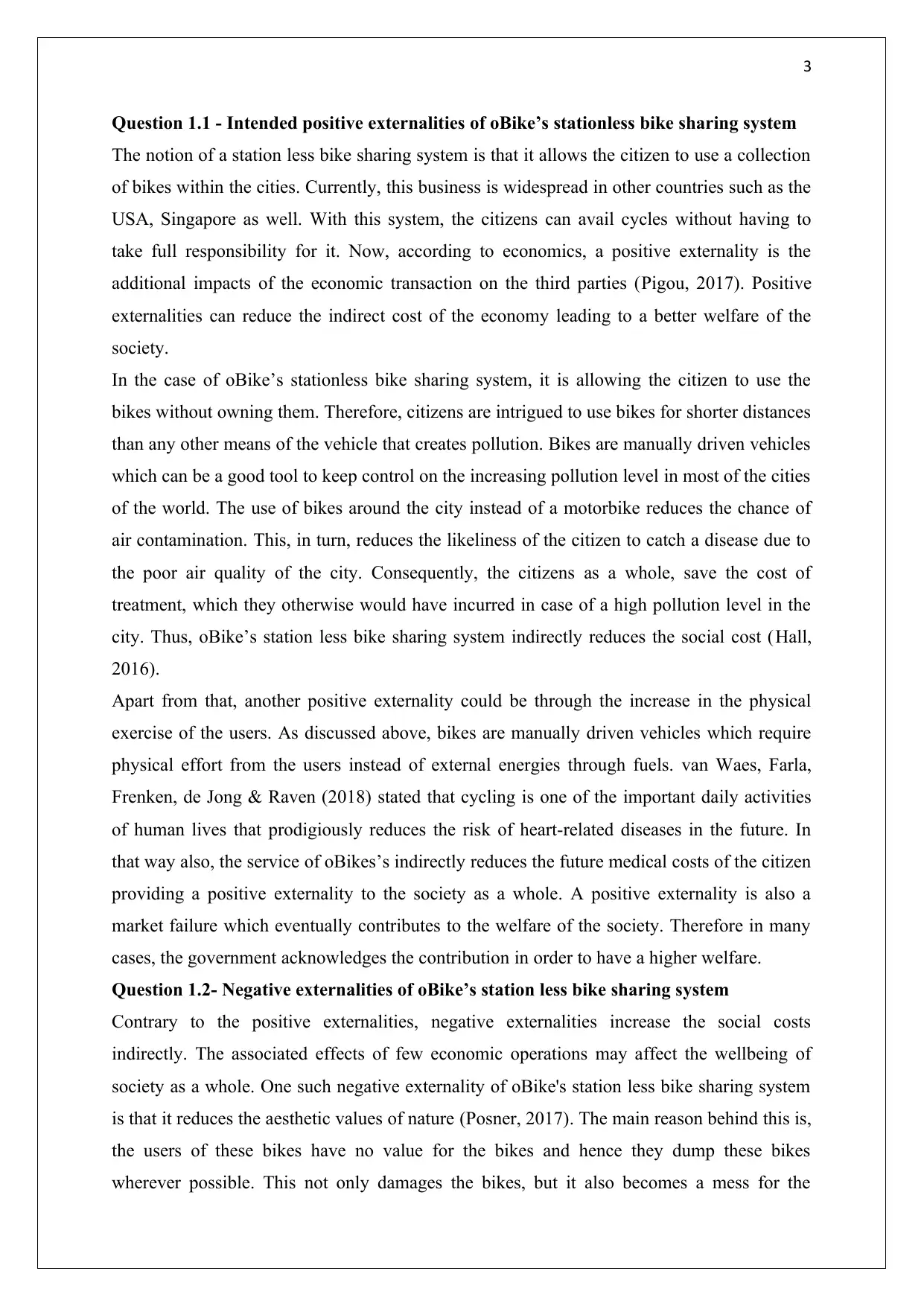
Question 1.1 - Intended positive externalities of oBike’s stationless bike sharing system
The notion of a station less bike sharing system is that it allows the citizen to use a collection
of bikes within the cities. Currently, this business is widespread in other countries such as the
USA, Singapore as well. With this system, the citizens can avail cycles without having to
take full responsibility for it. Now, according to economics, a positive externality is the
additional impacts of the economic transaction on the third parties (Pigou, 2017). Positive
externalities can reduce the indirect cost of the economy leading to a better welfare of the
society.
In the case of oBike’s stationless bike sharing system, it is allowing the citizen to use the
bikes without owning them. Therefore, citizens are intrigued to use bikes for shorter distances
than any other means of the vehicle that creates pollution. Bikes are manually driven vehicles
which can be a good tool to keep control on the increasing pollution level in most of the cities
of the world. The use of bikes around the city instead of a motorbike reduces the chance of
air contamination. This, in turn, reduces the likeliness of the citizen to catch a disease due to
the poor air quality of the city. Consequently, the citizens as a whole, save the cost of
treatment, which they otherwise would have incurred in case of a high pollution level in the
city. Thus, oBike’s station less bike sharing system indirectly reduces the social cost (Hall,
2016).
Apart from that, another positive externality could be through the increase in the physical
exercise of the users. As discussed above, bikes are manually driven vehicles which require
physical effort from the users instead of external energies through fuels. van Waes, Farla,
Frenken, de Jong & Raven (2018) stated that cycling is one of the important daily activities
of human lives that prodigiously reduces the risk of heart-related diseases in the future. In
that way also, the service of oBikes’s indirectly reduces the future medical costs of the citizen
providing a positive externality to the society as a whole. A positive externality is also a
market failure which eventually contributes to the welfare of the society. Therefore in many
cases, the government acknowledges the contribution in order to have a higher welfare.
Question 1.2- Negative externalities of oBike’s station less bike sharing system
Contrary to the positive externalities, negative externalities increase the social costs
indirectly. The associated effects of few economic operations may affect the wellbeing of
society as a whole. One such negative externality of oBike's station less bike sharing system
is that it reduces the aesthetic values of nature (Posner, 2017). The main reason behind this is,
the users of these bikes have no value for the bikes and hence they dump these bikes
wherever possible. This not only damages the bikes, but it also becomes a mess for the
Question 1.1 - Intended positive externalities of oBike’s stationless bike sharing system
The notion of a station less bike sharing system is that it allows the citizen to use a collection
of bikes within the cities. Currently, this business is widespread in other countries such as the
USA, Singapore as well. With this system, the citizens can avail cycles without having to
take full responsibility for it. Now, according to economics, a positive externality is the
additional impacts of the economic transaction on the third parties (Pigou, 2017). Positive
externalities can reduce the indirect cost of the economy leading to a better welfare of the
society.
In the case of oBike’s stationless bike sharing system, it is allowing the citizen to use the
bikes without owning them. Therefore, citizens are intrigued to use bikes for shorter distances
than any other means of the vehicle that creates pollution. Bikes are manually driven vehicles
which can be a good tool to keep control on the increasing pollution level in most of the cities
of the world. The use of bikes around the city instead of a motorbike reduces the chance of
air contamination. This, in turn, reduces the likeliness of the citizen to catch a disease due to
the poor air quality of the city. Consequently, the citizens as a whole, save the cost of
treatment, which they otherwise would have incurred in case of a high pollution level in the
city. Thus, oBike’s station less bike sharing system indirectly reduces the social cost (Hall,
2016).
Apart from that, another positive externality could be through the increase in the physical
exercise of the users. As discussed above, bikes are manually driven vehicles which require
physical effort from the users instead of external energies through fuels. van Waes, Farla,
Frenken, de Jong & Raven (2018) stated that cycling is one of the important daily activities
of human lives that prodigiously reduces the risk of heart-related diseases in the future. In
that way also, the service of oBikes’s indirectly reduces the future medical costs of the citizen
providing a positive externality to the society as a whole. A positive externality is also a
market failure which eventually contributes to the welfare of the society. Therefore in many
cases, the government acknowledges the contribution in order to have a higher welfare.
Question 1.2- Negative externalities of oBike’s station less bike sharing system
Contrary to the positive externalities, negative externalities increase the social costs
indirectly. The associated effects of few economic operations may affect the wellbeing of
society as a whole. One such negative externality of oBike's station less bike sharing system
is that it reduces the aesthetic values of nature (Posner, 2017). The main reason behind this is,
the users of these bikes have no value for the bikes and hence they dump these bikes
wherever possible. This not only damages the bikes, but it also becomes a mess for the
⊘ This is a preview!⊘
Do you want full access?
Subscribe today to unlock all pages.

Trusted by 1+ million students worldwide

4
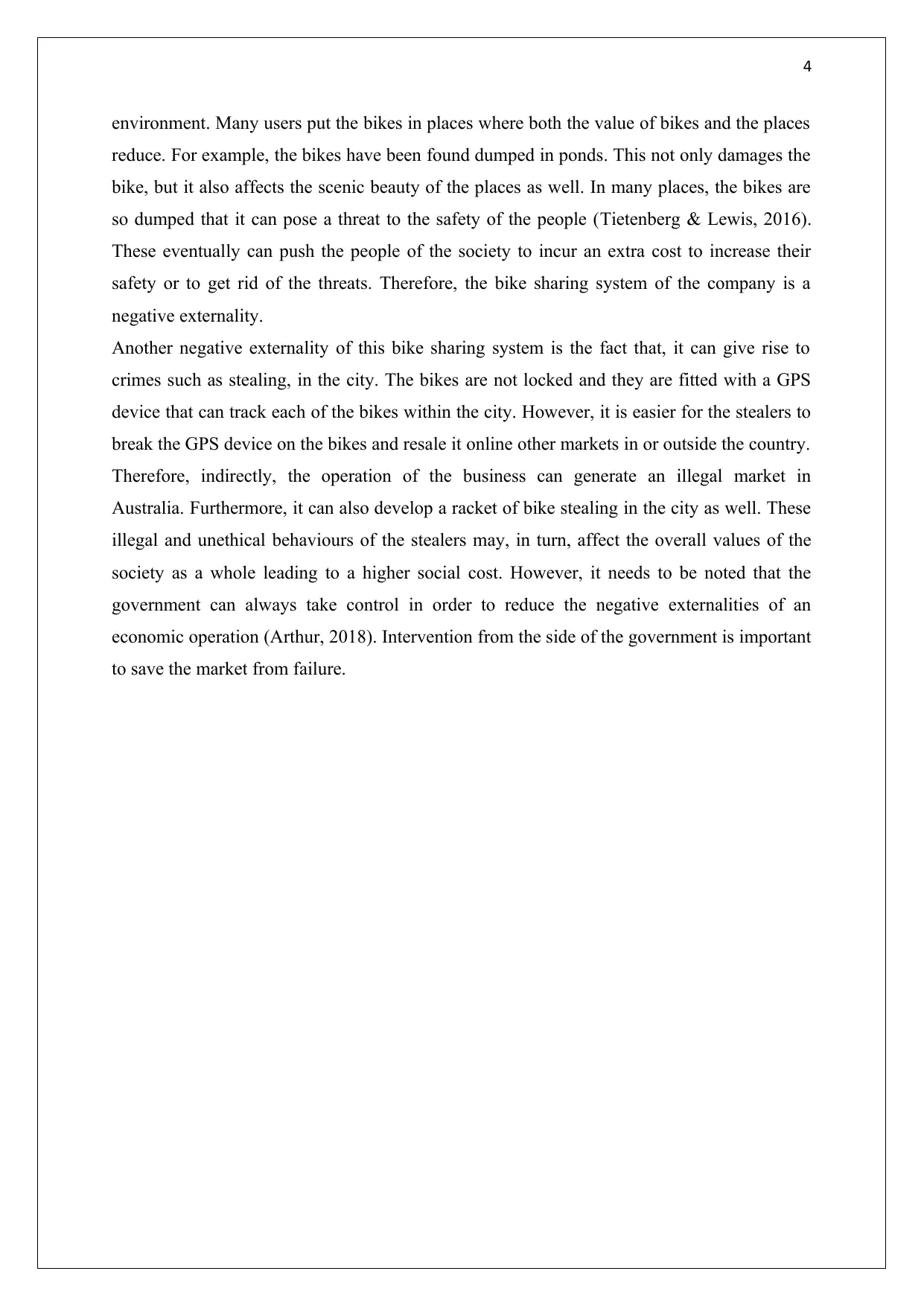
environment. Many users put the bikes in places where both the value of bikes and the places
reduce. For example, the bikes have been found dumped in ponds. This not only damages the
bike, but it also affects the scenic beauty of the places as well. In many places, the bikes are
so dumped that it can pose a threat to the safety of the people (Tietenberg & Lewis, 2016).
These eventually can push the people of the society to incur an extra cost to increase their
safety or to get rid of the threats. Therefore, the bike sharing system of the company is a
negative externality.
Another negative externality of this bike sharing system is the fact that, it can give rise to
crimes such as stealing, in the city. The bikes are not locked and they are fitted with a GPS
device that can track each of the bikes within the city. However, it is easier for the stealers to
break the GPS device on the bikes and resale it online other markets in or outside the country.
Therefore, indirectly, the operation of the business can generate an illegal market in
Australia. Furthermore, it can also develop a racket of bike stealing in the city as well. These
illegal and unethical behaviours of the stealers may, in turn, affect the overall values of the
society as a whole leading to a higher social cost. However, it needs to be noted that the
government can always take control in order to reduce the negative externalities of an
economic operation (Arthur, 2018). Intervention from the side of the government is important
to save the market from failure.
environment. Many users put the bikes in places where both the value of bikes and the places
reduce. For example, the bikes have been found dumped in ponds. This not only damages the
bike, but it also affects the scenic beauty of the places as well. In many places, the bikes are
so dumped that it can pose a threat to the safety of the people (Tietenberg & Lewis, 2016).
These eventually can push the people of the society to incur an extra cost to increase their
safety or to get rid of the threats. Therefore, the bike sharing system of the company is a
negative externality.
Another negative externality of this bike sharing system is the fact that, it can give rise to
crimes such as stealing, in the city. The bikes are not locked and they are fitted with a GPS
device that can track each of the bikes within the city. However, it is easier for the stealers to
break the GPS device on the bikes and resale it online other markets in or outside the country.
Therefore, indirectly, the operation of the business can generate an illegal market in
Australia. Furthermore, it can also develop a racket of bike stealing in the city as well. These
illegal and unethical behaviours of the stealers may, in turn, affect the overall values of the
society as a whole leading to a higher social cost. However, it needs to be noted that the
government can always take control in order to reduce the negative externalities of an
economic operation (Arthur, 2018). Intervention from the side of the government is important
to save the market from failure.
Paraphrase This Document
Need a fresh take? Get an instant paraphrase of this document with our AI Paraphraser

5
Reference
Arthur, W. B. (2018). Self-reinforcing mechanisms in economics. The economy as an
evolving complex system (pp. 9-31). CRC Press.
Hall, J. (Ed.). (2016). Explorations in Public Sector Economics: Essays by Prominent
Economists. Springer.
Pigou, A. (2017). The economics of welfare. Routledge.
Posner, E. A. (2017). Coase Theorem. In Economic Ideas You Should Forget (pp. 101-103).
Springer, Cham.
Tietenberg, T. H., & Lewis, L. (2016). Environmental and natural resource economics.
Routledge.
van Waes, A., Farla, J., Frenken, K., de Jong, J. P., & Raven, R. (2018). Business model
innovation and socio-technical transitions. A new prospective framework with an
application to bike sharing. Journal of Cleaner Production.
Reference
Arthur, W. B. (2018). Self-reinforcing mechanisms in economics. The economy as an
evolving complex system (pp. 9-31). CRC Press.
Hall, J. (Ed.). (2016). Explorations in Public Sector Economics: Essays by Prominent
Economists. Springer.
Pigou, A. (2017). The economics of welfare. Routledge.
Posner, E. A. (2017). Coase Theorem. In Economic Ideas You Should Forget (pp. 101-103).
Springer, Cham.
Tietenberg, T. H., & Lewis, L. (2016). Environmental and natural resource economics.
Routledge.
van Waes, A., Farla, J., Frenken, K., de Jong, J. P., & Raven, R. (2018). Business model
innovation and socio-technical transitions. A new prospective framework with an
application to bike sharing. Journal of Cleaner Production.
1 out of 5
Related Documents
Your All-in-One AI-Powered Toolkit for Academic Success.
+13062052269
info@desklib.com
Available 24*7 on WhatsApp / Email
Unlock your academic potential
Copyright © 2020–2026 A2Z Services. All Rights Reserved. Developed and managed by ZUCOL.