Object Oriented Database: Advantages and Disadvantages Report

Verified

Added on  2023/05/31

|5
|853
|219
Report
AI Summary
This report provides a comprehensive overview of Object Oriented Database (OODB) and its comparison with Relational Database (RDBMS). It begins with an introduction to OODB, explaining its core concepts and how it differs from traditional relational databases. The report then delves into a detailed comparison of OODB and RDBMS, highlighting their respective objectives, data storage methods, and data handling capabilities. The advantages of OODB, such as reduced maintenance costs, better flexibility, easier management of large data, and faster data access, are discussed. Conversely, the report also explores the advantages of RDBMS, including its user-friendly table format, multi-user access capabilities, and privilege control features. The report references relevant sources to support its analysis, offering a well-rounded understanding of the strengths and weaknesses of each database system.
Document Page
Running head: OBJECT ORIENTED DATABASE
OBJECT ORIENTED DATABASE
Name of Student
Nam of University
Author’s Note
tabler-icon-diamond-filled.svg

Paraphrase This Document

Need a fresh take? Get an instant paraphrase of this document with our AI Paraphraser
Document Page
1OBJECT ORIENTED DATABASE
Object Oriented Database (OODB) Overview
Object Oriented Database is system of database management system which supports modeling
and creation of various data in the form of objects. These databases are sort of niche offering in
the system of relational database management system, this is not very successful or popular as a
mainstream engine of database (Ogunlere and Idowu 2015). Objects present in the object
oriented database refers the capacity to develop a specific product, after that they are defined as
well as named.
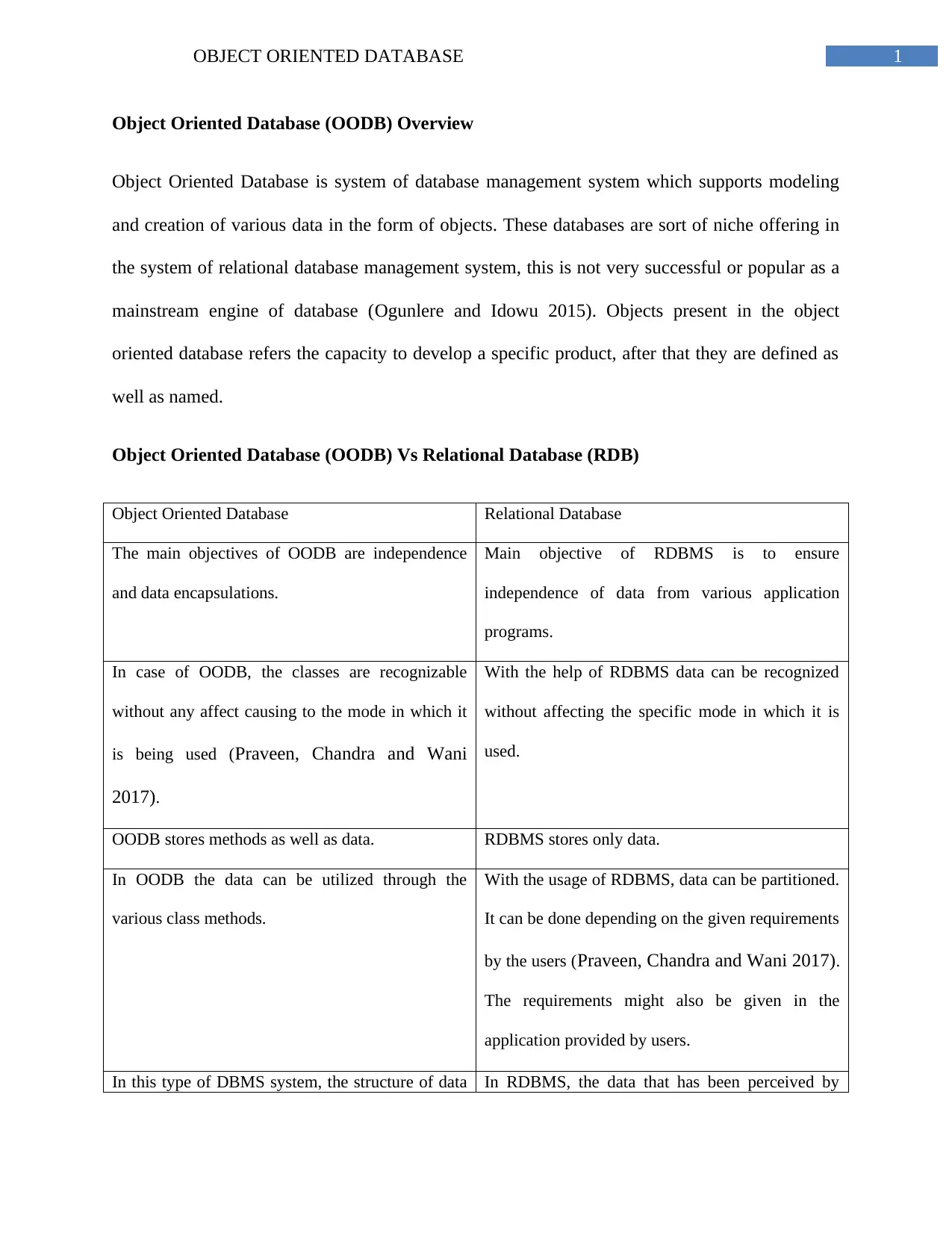
Object Oriented Database (OODB) Vs Relational Database (RDB)
Object Oriented Database Relational Database
The main objectives of OODB are independence
and data encapsulations.
Main objective of RDBMS is to ensure
independence of data from various application
programs.
In case of OODB, the classes are recognizable
without any affect causing to the mode in which it
is being used (Praveen, Chandra and Wani
2017).
With the help of RDBMS data can be recognized
without affecting the specific mode in which it is
used.
OODB stores methods as well as data. RDBMS stores only data.
In OODB the data can be utilized through the
various class methods.
With the usage of RDBMS, data can be partitioned.
It can be done depending on the given requirements
by the users (Praveen, Chandra and Wani 2017).
The requirements might also be given in the
application provided by users.
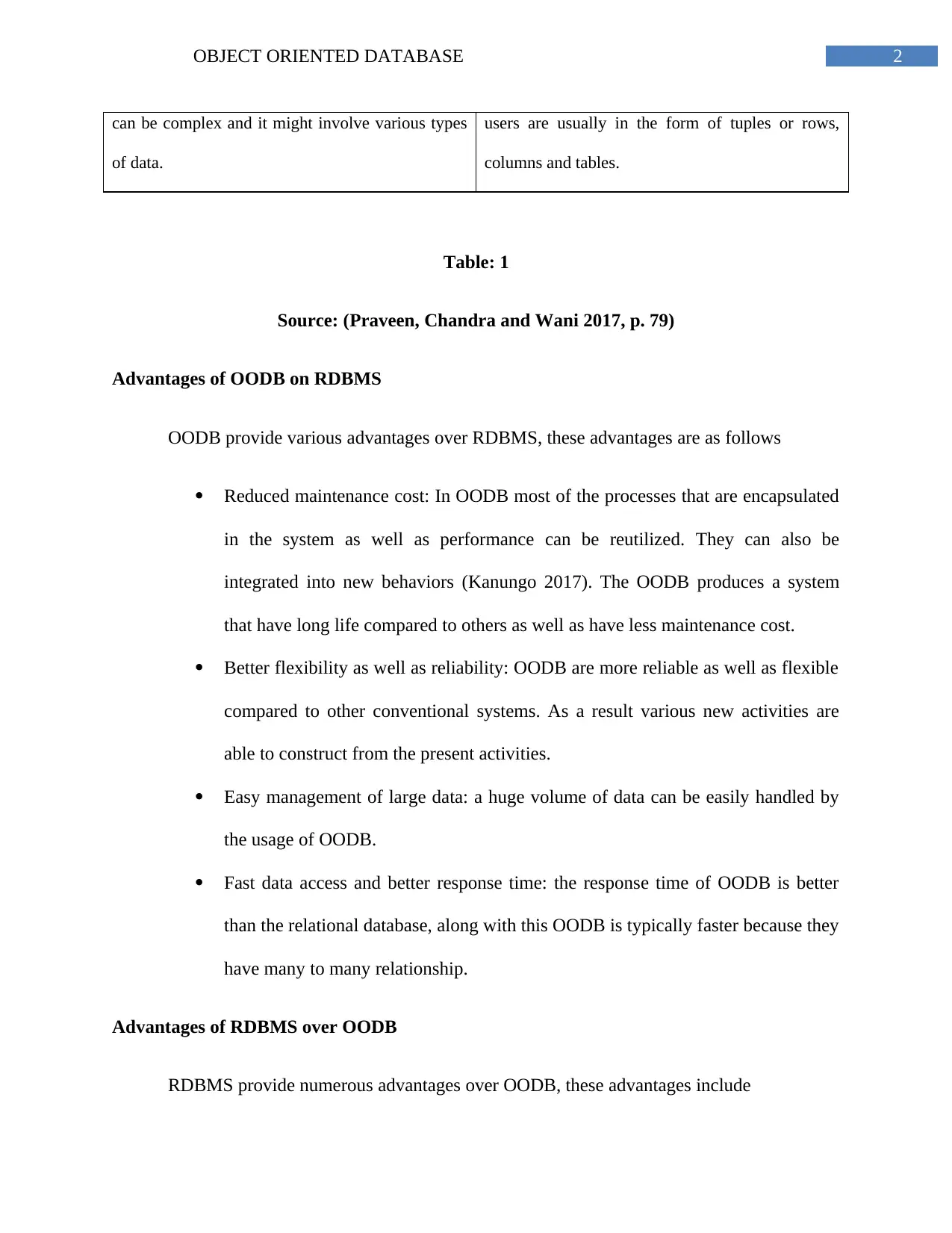
In this type of DBMS system, the structure of data In RDBMS, the data that has been perceived by
Document Page
2OBJECT ORIENTED DATABASE
can be complex and it might involve various types
of data.
users are usually in the form of tuples or rows,
columns and tables.
Table: 1
Source: (Praveen, Chandra and Wani 2017, p. 79)
Advantages of OODB on RDBMS
OODB provide various advantages over RDBMS, these advantages are as follows
Reduced maintenance cost: In OODB most of the processes that are encapsulated
in the system as well as performance can be reutilized. They can also be
integrated into new behaviors (Kanungo 2017). The OODB produces a system
that have long life compared to others as well as have less maintenance cost.
Better flexibility as well as reliability: OODB are more reliable as well as flexible
compared to other conventional systems. As a result various new activities are
able to construct from the present activities.
Easy management of large data: a huge volume of data can be easily handled by
the usage of OODB.
Fast data access and better response time: the response time of OODB is better
than the relational database, along with this OODB is typically faster because they
have many to many relationship.
Advantages of RDBMS over OODB
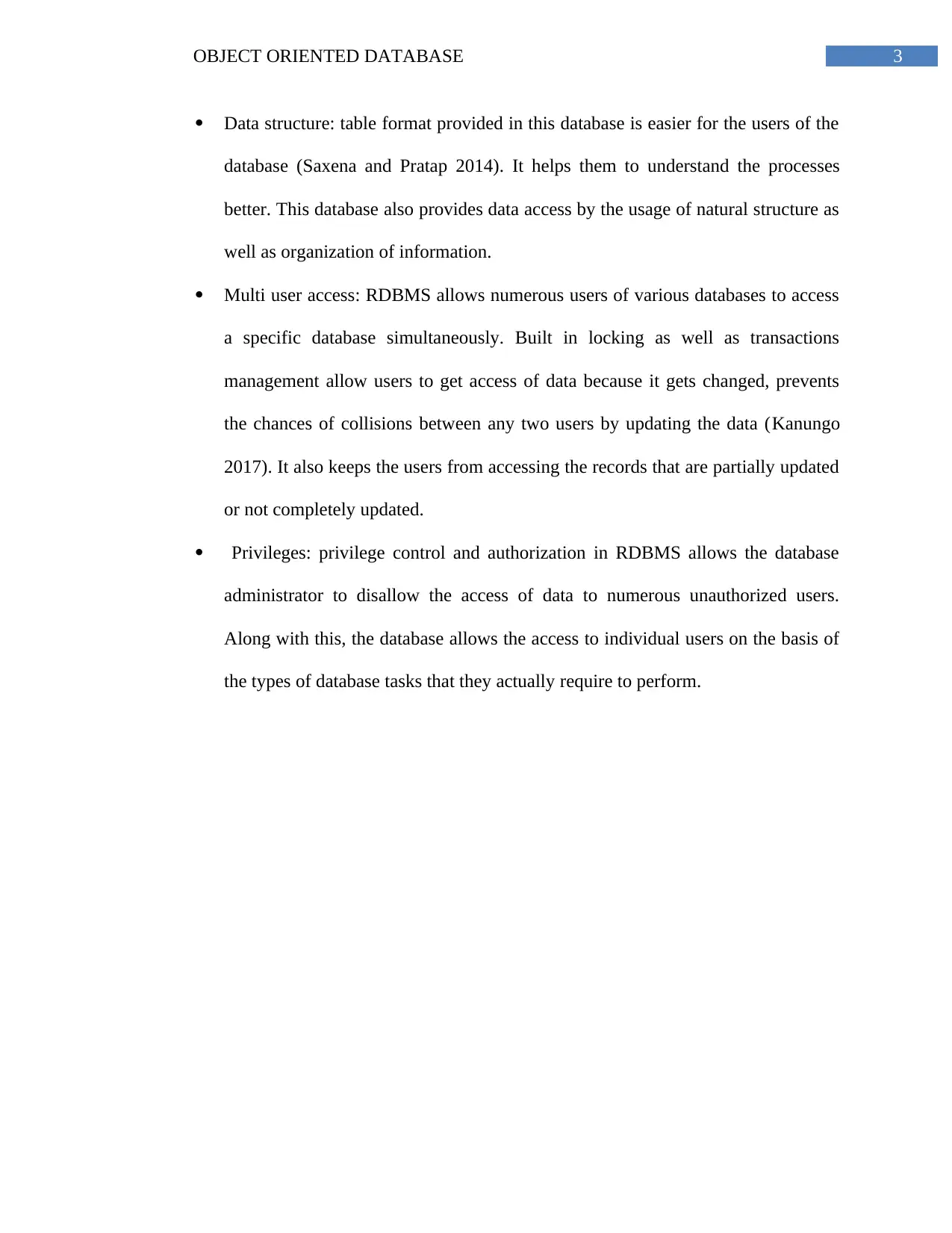
RDBMS provide numerous advantages over OODB, these advantages include
Document Page
3OBJECT ORIENTED DATABASE
Data structure: table format provided in this database is easier for the users of the
database (Saxena and Pratap 2014). It helps them to understand the processes
better. This database also provides data access by the usage of natural structure as
well as organization of information.
Multi user access: RDBMS allows numerous users of various databases to access
a specific database simultaneously. Built in locking as well as transactions
management allow users to get access of data because it gets changed, prevents
the chances of collisions between any two users by updating the data (Kanungo
2017). It also keeps the users from accessing the records that are partially updated
or not completely updated.
Privileges: privilege control and authorization in RDBMS allows the database
administrator to disallow the access of data to numerous unauthorized users.
Along with this, the database allows the access to individual users on the basis of
the types of database tasks that they actually require to perform.
tabler-icon-diamond-filled.svg

Paraphrase This Document

Need a fresh take? Get an instant paraphrase of this document with our AI Paraphraser
Document Page
4OBJECT ORIENTED DATABASE
References
Kanungo, S., 2017. Semantic model for Complex object in Object oriented
database. International Journal of Advanced Research in Computer Science, 8(5).
Ogunlere, S.O. and Idowu, S.A., 2015. Comparison Analysis of Object-Based Databases, Object-
Oriented Databases, and Object Relational Databases. Asian Journal of Computer and
Information Systems (ISSN: 2321–5658), 3(02).
Praveen, S., Chandra, U. and Wani, A.A., 2017. A Literature Review on Evolving
Database. International Journal of Computer Applications, 162(9).
Saxena, V. and Pratap, A., 2014. A Framework for Performance Estimation of Object-Oriented
Databases. methodology, 4(2).
chevron_up_icon
1 out of 5
circle_padding
hide_on_mobile
zoom_out_icon
[object Object]