Universiti Teknologi MARA: OBM260 Case Study on Steve Jobs' Leadership
VerifiedAdded on 2021/06/08
|11
|1956
|1235
Case Study
AI Summary
This case study examines Steve Jobs' leadership and influence within Apple, focusing on his use of power, influence tactics, and organizational politics. The study identifies four sources of power employed by Jobs, including legitimate, reward, expert, and coercive power. It further explores five influence tactics that Jobs could use to enhance employee involvement, such as silent authority and coalition formation, and discusses persuasion and assertiveness as key tactics he utilized. The analysis also considers the influence tactics employees might adopt for survival, like impression management, and concludes by justifying whether Jobs' actions constituted organizational politics, particularly in the context of scarce resources. The study draws upon various sources, including academic texts and online resources, to support its findings and provide a comprehensive understanding of Jobs' leadership style and its impact on Apple's organizational dynamics.
BEHAVIOR IN ORGANIZATIONS
OBM260
INDIVIDUAL CASE STUDY
CASE STUDY (1)
PREPARED FOR:
MADAM NOORSURAYA BINTI MOHD MOKHTAR
PREPARED BY:
MUNIFAH BINTI PAZAMI
2018219844
BA118 4C
Faculty Business and Management
Diploma in Office Management and Technology
Universiti Teknologi MARA Pahang Branch
Jengka Campus
SUBMISSION DATE:
3 JULY 2020
OBM260
INDIVIDUAL CASE STUDY
CASE STUDY (1)
PREPARED FOR:
MADAM NOORSURAYA BINTI MOHD MOKHTAR
PREPARED BY:
MUNIFAH BINTI PAZAMI
2018219844
BA118 4C
Faculty Business and Management
Diploma in Office Management and Technology
Universiti Teknologi MARA Pahang Branch
Jengka Campus
SUBMISSION DATE:
3 JULY 2020
Paraphrase This Document
Need a fresh take? Get an instant paraphrase of this document with our AI Paraphraser

ACKNOWLEDGEMENT
Bismillahirrahmanirrahim. Alhamdullilah, I am most grateful to Allah S.W.T for
the completion of this Case Study as one of the requirements that need to be
accomplish in the course work assessment for the code OBM 260 which is Behaviour
in Organizations.
In this case, I would like to wish a very deepest gratitude to my lecturer which
is Madam Noorsuraya Bt Mohd Mokhtar and her kindness in helping me during the
process of completion of this case study. She has given a good service by teaching
and providing useful information to us even through by the online session because of
Movement Control Order (MCO). Without madam, I would not be able to complete my
case study. I also encountered with many problems when complete this case study
report, but my lecturer helps a lot, alhamdullilah finally I can solve the problem and
lump sum can finish this course work smooth and easily.
Through this problem, I manage to become more organize and mature in
dealing with problems that occur during my research. This case study covers Topic 6
which is Power and Influence in the Workplace. This case study is help me to identify
what types sources of power, the influence tactic used by their superior when in
organization and organizational politics that happen in organization.
Last but not least, I am really hoping that all efforts and results to complete this
case study report can satisfy my lecture. Thank you.
Bismillahirrahmanirrahim. Alhamdullilah, I am most grateful to Allah S.W.T for
the completion of this Case Study as one of the requirements that need to be
accomplish in the course work assessment for the code OBM 260 which is Behaviour
in Organizations.
In this case, I would like to wish a very deepest gratitude to my lecturer which
is Madam Noorsuraya Bt Mohd Mokhtar and her kindness in helping me during the
process of completion of this case study. She has given a good service by teaching
and providing useful information to us even through by the online session because of
Movement Control Order (MCO). Without madam, I would not be able to complete my
case study. I also encountered with many problems when complete this case study
report, but my lecturer helps a lot, alhamdullilah finally I can solve the problem and
lump sum can finish this course work smooth and easily.
Through this problem, I manage to become more organize and mature in
dealing with problems that occur during my research. This case study covers Topic 6
which is Power and Influence in the Workplace. This case study is help me to identify
what types sources of power, the influence tactic used by their superior when in
organization and organizational politics that happen in organization.
Last but not least, I am really hoping that all efforts and results to complete this
case study report can satisfy my lecture. Thank you.

1
SYNOPSIS OF THE CASE STUDY
This case study tells of a man who co-founded Apple since 1976, Steve Jobs.
It is about the fall and rise he and Apple in 1985 where he resigned and came back to
the company in 1997 bringing the company back from the brink of failure. In October
2011, Steve Jobs passed away but he was able to collect his wealth at the time of his
death and made it into the most profitable company in the world. He has helped in
many industries throughout his journey that included music, personal computing, retail
stores, phones, and digital publishing. In the case study shown the characteristics of
Steve Jobs towards the organization and employees.
Power is capacity of person, team or organization to influence others. In this
case study, Steve Jobs has applied and draws types sources of power in the
organization such as legitimate power, reward power, expert power and coercive
power. Besides that, influence is any behavior in attempt to alter someone’s attitude
or behavior. Steve Jobs shown that he used influence tactics in the organization to
influence his employees which is persuasion and assertiveness. Influence tactics that
have been used by Jobs towards his members or employees is because in order to
help survive the company.
Organizational politics is behavior that others perceive as self-serving tactics
at the expense of other people and possible the organization. Condition supporting
that encourage organizational politics that used by Jobs is scarce resources.
SYNOPSIS OF THE CASE STUDY
This case study tells of a man who co-founded Apple since 1976, Steve Jobs.
It is about the fall and rise he and Apple in 1985 where he resigned and came back to
the company in 1997 bringing the company back from the brink of failure. In October
2011, Steve Jobs passed away but he was able to collect his wealth at the time of his
death and made it into the most profitable company in the world. He has helped in
many industries throughout his journey that included music, personal computing, retail
stores, phones, and digital publishing. In the case study shown the characteristics of
Steve Jobs towards the organization and employees.
Power is capacity of person, team or organization to influence others. In this
case study, Steve Jobs has applied and draws types sources of power in the
organization such as legitimate power, reward power, expert power and coercive
power. Besides that, influence is any behavior in attempt to alter someone’s attitude
or behavior. Steve Jobs shown that he used influence tactics in the organization to
influence his employees which is persuasion and assertiveness. Influence tactics that
have been used by Jobs towards his members or employees is because in order to
help survive the company.
Organizational politics is behavior that others perceive as self-serving tactics
at the expense of other people and possible the organization. Condition supporting
that encourage organizational politics that used by Jobs is scarce resources.
⊘ This is a preview!⊘
Do you want full access?
Subscribe today to unlock all pages.

Trusted by 1+ million students worldwide

2
QUESTION 1
Identify and explain 4 sources of power used by Jobs in the case study.
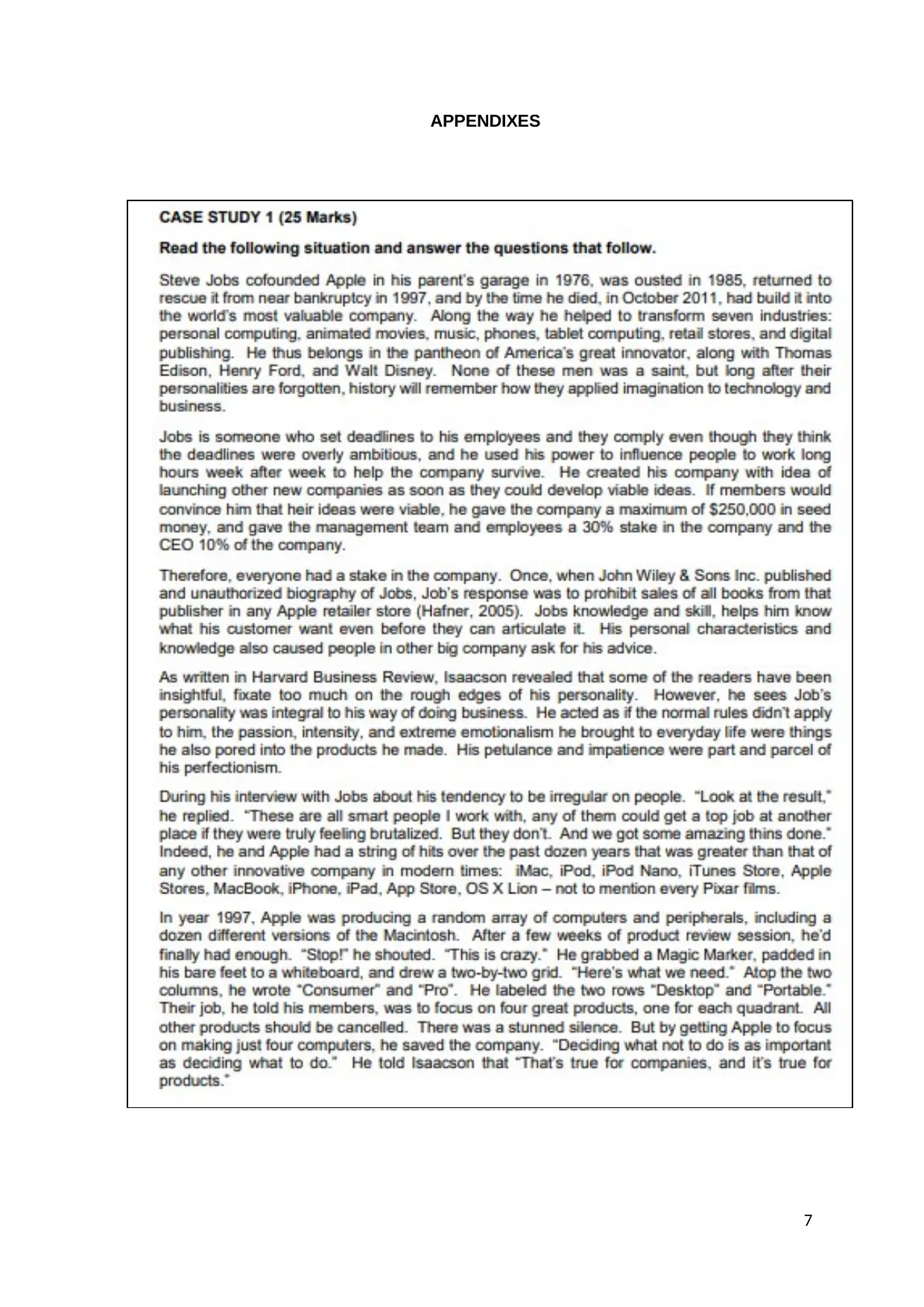
First is legitimate power because usually this power based on the position or
formal authority. Jobs is CEO of Apple, he enjoys unquestioned legitimate power and
since he is the one who control the company, so the employees will accept what the
Jobs instructions as their superiors. For example, on the case study Jobs sets the
deadline to his employees and they comply even they think the deadlines were overly
ambitious.
Second is reward power. Reward power is derived from the person’s ability to
control the allocation of rewards valued by others. For examples, Jobs gave the
company maximum of $250,000 in seed money and gave 30% stake in the company
to management team and employees also 10% of the company to CEO if the
employees could able to convince Jobs of that their idea were viable.
Third is expert power is originating from within the person and it is an individual
to influence others by possessing knowledge or skills valued by others. Usually
someone who did not expert in certain part of management or department they will get
someone who really expert on that thing to advise them. For instance, because of
Jobs personal characteristics and his knowledge in organization, people in another big
company also ask for his advice and from Jobs ability he know what customer want
even before they can articulate it.
Lastly is coercive power being the ability to apply discipline, punish and
withhold rewards and it have short term benefit which follower and peer feel pressure
through the form of coercive power. For instances, Jobs known as who use coercive
by yelling to employees and threat to fired them. When John Wiley & Sons Inc.
published and unauthorized biography of Jobs, the response was to prohibit sales of
all books from that publisher in any Apple retail store (Hafner, 2005).
QUESTION 1
Identify and explain 4 sources of power used by Jobs in the case study.
First is legitimate power because usually this power based on the position or
formal authority. Jobs is CEO of Apple, he enjoys unquestioned legitimate power and
since he is the one who control the company, so the employees will accept what the
Jobs instructions as their superiors. For example, on the case study Jobs sets the
deadline to his employees and they comply even they think the deadlines were overly
ambitious.
Second is reward power. Reward power is derived from the person’s ability to
control the allocation of rewards valued by others. For examples, Jobs gave the
company maximum of $250,000 in seed money and gave 30% stake in the company
to management team and employees also 10% of the company to CEO if the
employees could able to convince Jobs of that their idea were viable.
Third is expert power is originating from within the person and it is an individual
to influence others by possessing knowledge or skills valued by others. Usually
someone who did not expert in certain part of management or department they will get
someone who really expert on that thing to advise them. For instance, because of
Jobs personal characteristics and his knowledge in organization, people in another big
company also ask for his advice and from Jobs ability he know what customer want
even before they can articulate it.
Lastly is coercive power being the ability to apply discipline, punish and
withhold rewards and it have short term benefit which follower and peer feel pressure
through the form of coercive power. For instances, Jobs known as who use coercive
by yelling to employees and threat to fired them. When John Wiley & Sons Inc.
published and unauthorized biography of Jobs, the response was to prohibit sales of
all books from that publisher in any Apple retail store (Hafner, 2005).
Paraphrase This Document
Need a fresh take? Get an instant paraphrase of this document with our AI Paraphraser

3
QUESTION 2
Identify and explain 5 influence tactics that can be used by Jobs to increase employee
involvement in the organization.
Five influence tactics that can used by Jobs to increase employee involvement
in the organization is first silent authority. This can happen when you comply with
boss’s request to complete the particular task and if the task is within your job scope
boss has the right to make the request. This influence strategy operates without
negotiation, threats or other tactics since the task is under your job scope.
Second is information control. It is explicitly manipulating of someone else’s
access to information for the purpose of changing their attitudes and/or behavior.
Next is coalition formation which is forming a group that attempts to influence
others by gathering the resources and power of its members. A coalition of people
who support the proposed change might form when people lack of sufficient power to
influence others in the organization.
Besides, Jobs can used upward appeal because it involves calling on higher
authority or expertise, or symbolically relying on these sources to support the
influencer’s position.
Lastly, exchange activities involve the promise of benefits or resources in
exchange for the target person’s compliance with your request. For instance, Jobs
employee might negotiate with Jobs for a day off in return for working a less desirable
shift at a future date.
QUESTION 2
Identify and explain 5 influence tactics that can be used by Jobs to increase employee
involvement in the organization.
Five influence tactics that can used by Jobs to increase employee involvement
in the organization is first silent authority. This can happen when you comply with
boss’s request to complete the particular task and if the task is within your job scope
boss has the right to make the request. This influence strategy operates without
negotiation, threats or other tactics since the task is under your job scope.
Second is information control. It is explicitly manipulating of someone else’s
access to information for the purpose of changing their attitudes and/or behavior.
Next is coalition formation which is forming a group that attempts to influence
others by gathering the resources and power of its members. A coalition of people
who support the proposed change might form when people lack of sufficient power to
influence others in the organization.
Besides, Jobs can used upward appeal because it involves calling on higher
authority or expertise, or symbolically relying on these sources to support the
influencer’s position.
Lastly, exchange activities involve the promise of benefits or resources in
exchange for the target person’s compliance with your request. For instance, Jobs
employee might negotiate with Jobs for a day off in return for working a less desirable
shift at a future date.

4
QUESTION 3
Discuss 2 influence tactics used by Jobs to influence his employees.
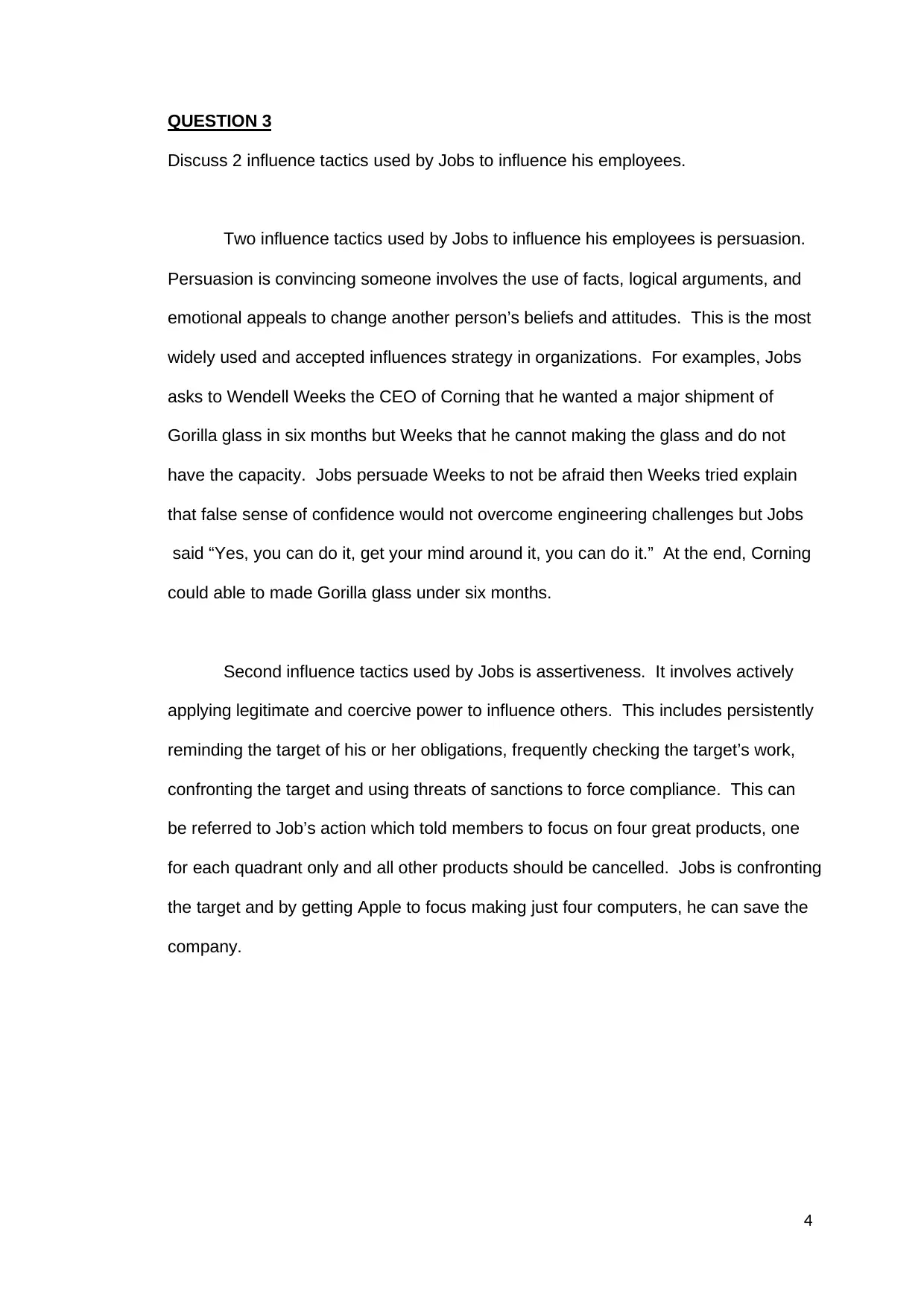
Two influence tactics used by Jobs to influence his employees is persuasion.
Persuasion is convincing someone involves the use of facts, logical arguments, and
emotional appeals to change another person’s beliefs and attitudes. This is the most
widely used and accepted influences strategy in organizations. For examples, Jobs
asks to Wendell Weeks the CEO of Corning that he wanted a major shipment of
Gorilla glass in six months but Weeks that he cannot making the glass and do not
have the capacity. Jobs persuade Weeks to not be afraid then Weeks tried explain
that false sense of confidence would not overcome engineering challenges but Jobs
said “Yes, you can do it, get your mind around it, you can do it.” At the end, Corning
could able to made Gorilla glass under six months.
Second influence tactics used by Jobs is assertiveness. It involves actively
applying legitimate and coercive power to influence others. This includes persistently
reminding the target of his or her obligations, frequently checking the target’s work,
confronting the target and using threats of sanctions to force compliance. This can
be referred to Job’s action which told members to focus on four great products, one
for each quadrant only and all other products should be cancelled. Jobs is confronting
the target and by getting Apple to focus making just four computers, he can save the
company.
QUESTION 3
Discuss 2 influence tactics used by Jobs to influence his employees.
Two influence tactics used by Jobs to influence his employees is persuasion.
Persuasion is convincing someone involves the use of facts, logical arguments, and
emotional appeals to change another person’s beliefs and attitudes. This is the most
widely used and accepted influences strategy in organizations. For examples, Jobs
asks to Wendell Weeks the CEO of Corning that he wanted a major shipment of
Gorilla glass in six months but Weeks that he cannot making the glass and do not
have the capacity. Jobs persuade Weeks to not be afraid then Weeks tried explain
that false sense of confidence would not overcome engineering challenges but Jobs
said “Yes, you can do it, get your mind around it, you can do it.” At the end, Corning
could able to made Gorilla glass under six months.
Second influence tactics used by Jobs is assertiveness. It involves actively
applying legitimate and coercive power to influence others. This includes persistently
reminding the target of his or her obligations, frequently checking the target’s work,
confronting the target and using threats of sanctions to force compliance. This can
be referred to Job’s action which told members to focus on four great products, one
for each quadrant only and all other products should be cancelled. Jobs is confronting
the target and by getting Apple to focus making just four computers, he can save the
company.
⊘ This is a preview!⊘
Do you want full access?
Subscribe today to unlock all pages.

Trusted by 1+ million students worldwide

5
QUESTION 4
Refer to paragraph 5, In your opinion, what are the influence tactics that may be used
by employees in order to survive in the organization.
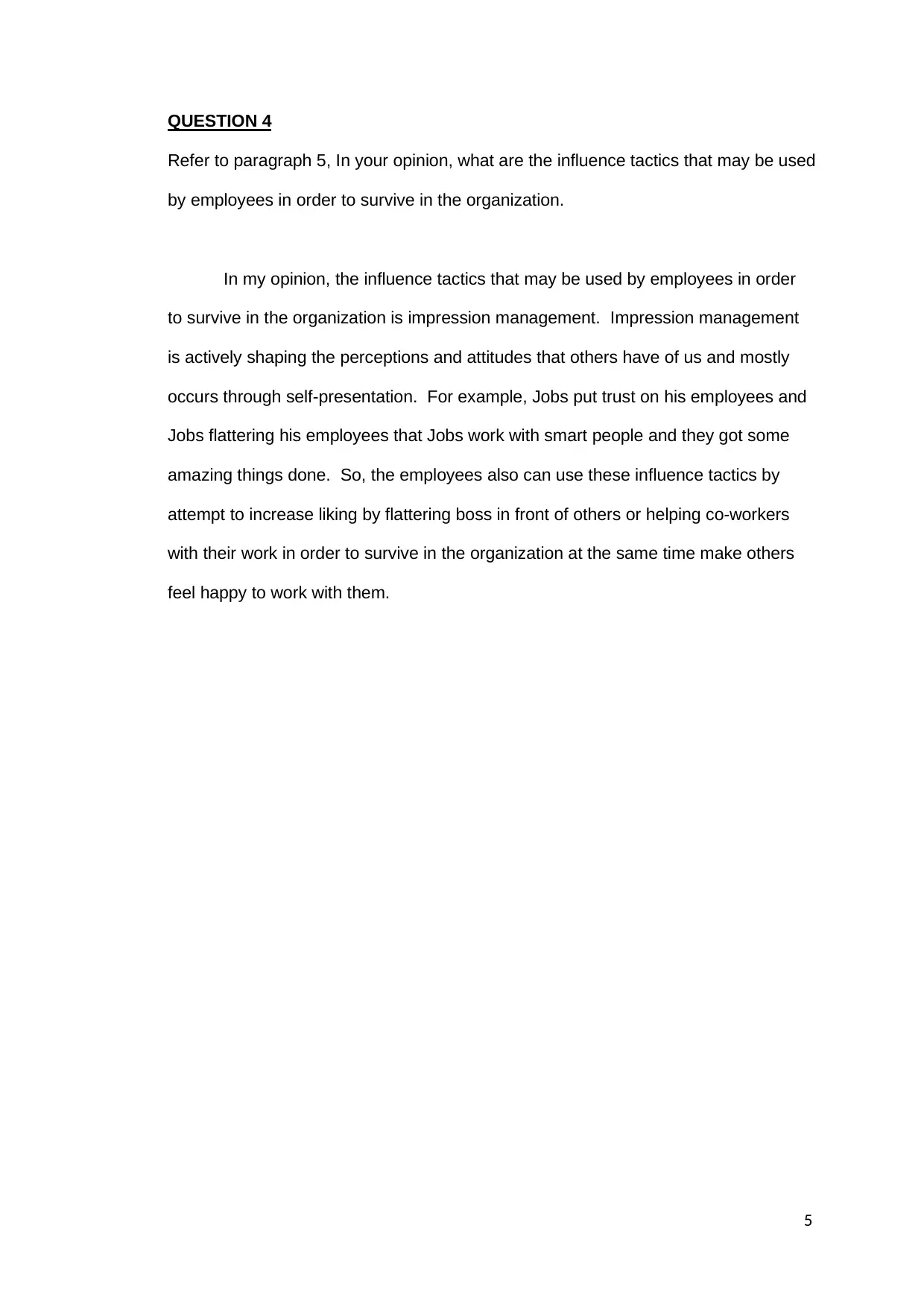
In my opinion, the influence tactics that may be used by employees in order
to survive in the organization is impression management. Impression management
is actively shaping the perceptions and attitudes that others have of us and mostly
occurs through self-presentation. For example, Jobs put trust on his employees and
Jobs flattering his employees that Jobs work with smart people and they got some
amazing things done. So, the employees also can use these influence tactics by
attempt to increase liking by flattering boss in front of others or helping co-workers
with their work in order to survive in the organization at the same time make others
feel happy to work with them.
QUESTION 4
Refer to paragraph 5, In your opinion, what are the influence tactics that may be used
by employees in order to survive in the organization.
In my opinion, the influence tactics that may be used by employees in order
to survive in the organization is impression management. Impression management
is actively shaping the perceptions and attitudes that others have of us and mostly
occurs through self-presentation. For example, Jobs put trust on his employees and
Jobs flattering his employees that Jobs work with smart people and they got some
amazing things done. So, the employees also can use these influence tactics by
attempt to increase liking by flattering boss in front of others or helping co-workers
with their work in order to survive in the organization at the same time make others
feel happy to work with them.
Paraphrase This Document
Need a fresh take? Get an instant paraphrase of this document with our AI Paraphraser

6
QUESTION 5
Justify your opinion, were Job’s action in the last paragraphs is considered as
organizational politics? Justify your answer.
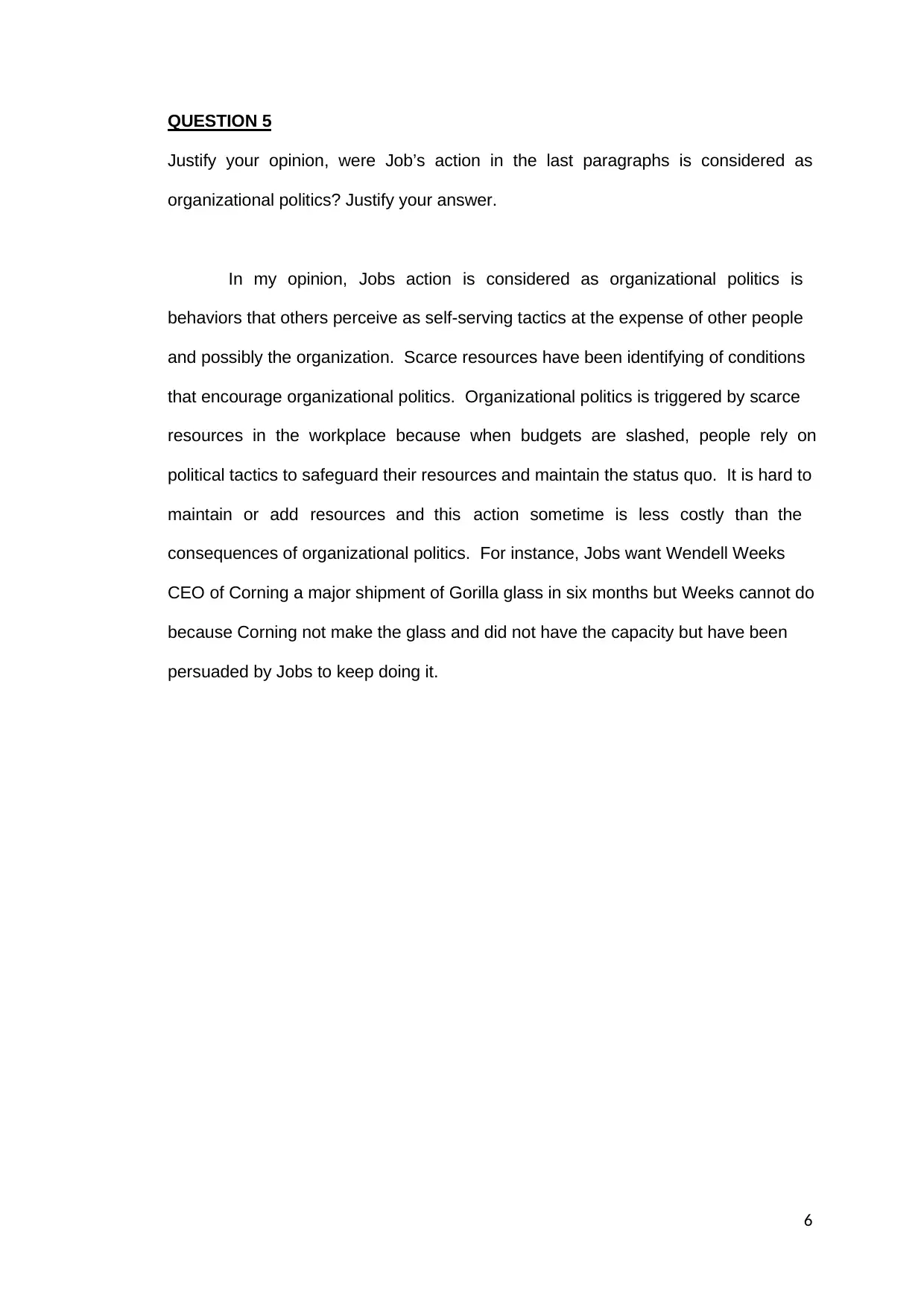
In my opinion, Jobs action is considered as organizational politics is
behaviors that others perceive as self-serving tactics at the expense of other people
and possibly the organization. Scarce resources have been identifying of conditions
that encourage organizational politics. Organizational politics is triggered by scarce
resources in the workplace because when budgets are slashed, people rely on
political tactics to safeguard their resources and maintain the status quo. It is hard to
maintain or add resources and this action sometime is less costly than the
consequences of organizational politics. For instance, Jobs want Wendell Weeks
CEO of Corning a major shipment of Gorilla glass in six months but Weeks cannot do
because Corning not make the glass and did not have the capacity but have been
persuaded by Jobs to keep doing it.
QUESTION 5
Justify your opinion, were Job’s action in the last paragraphs is considered as
organizational politics? Justify your answer.
In my opinion, Jobs action is considered as organizational politics is
behaviors that others perceive as self-serving tactics at the expense of other people
and possibly the organization. Scarce resources have been identifying of conditions
that encourage organizational politics. Organizational politics is triggered by scarce
resources in the workplace because when budgets are slashed, people rely on
political tactics to safeguard their resources and maintain the status quo. It is hard to
maintain or add resources and this action sometime is less costly than the
consequences of organizational politics. For instance, Jobs want Wendell Weeks
CEO of Corning a major shipment of Gorilla glass in six months but Weeks cannot do
because Corning not make the glass and did not have the capacity but have been
persuaded by Jobs to keep doing it.

7
APPENDIXES
APPENDIXES
⊘ This is a preview!⊘
Do you want full access?
Subscribe today to unlock all pages.

Trusted by 1+ million students worldwide

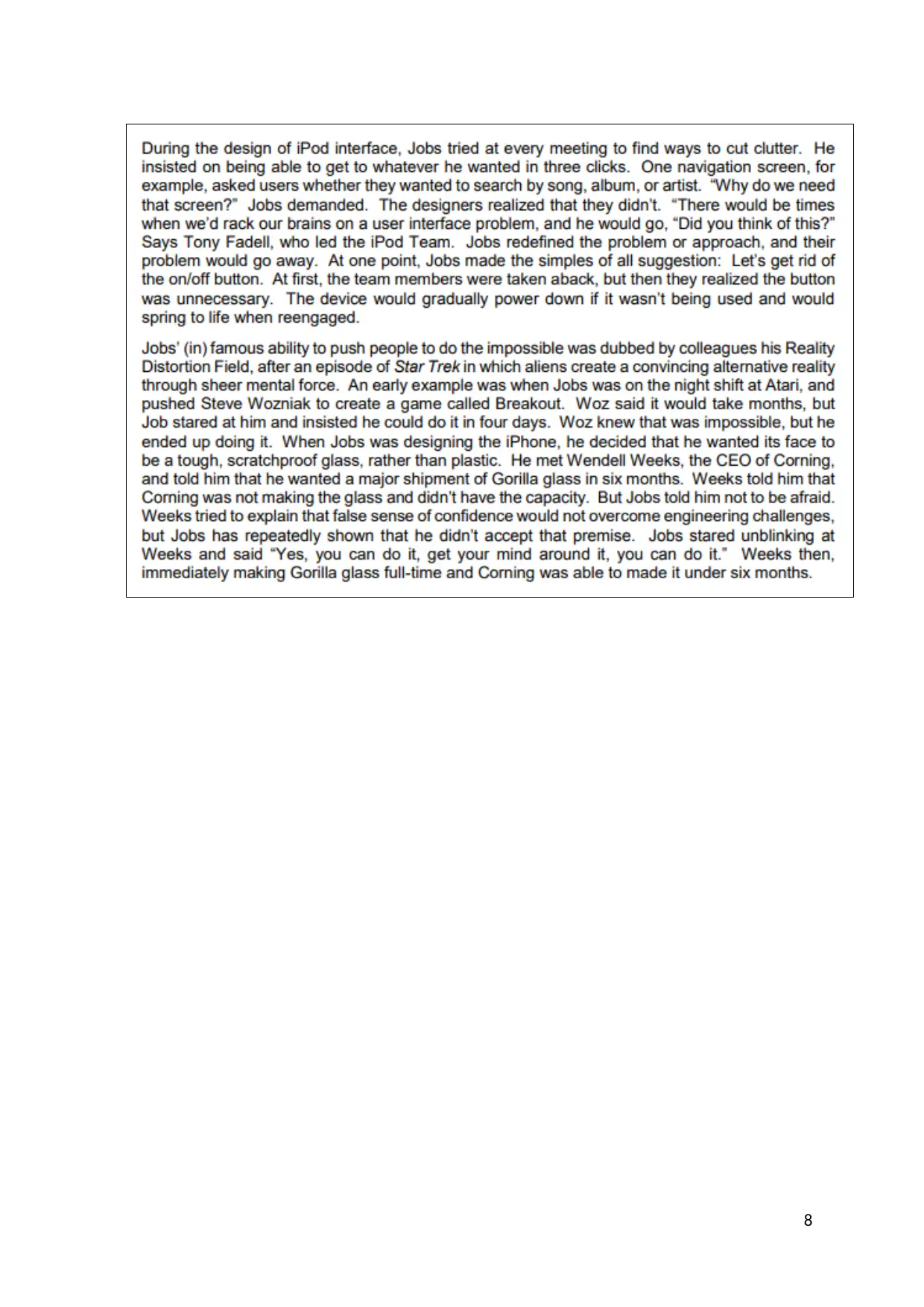
8
Paraphrase This Document
Need a fresh take? Get an instant paraphrase of this document with our AI Paraphraser

9
REFERENCES
13.3: The Power to Influence. (2020, May 10). Retrieved from Business LibreTexts:
https://biz.libretexts.org/Bookshelves/Management/Book%3A_Organizationa
l_Behavior/13%3A_Power_and_Politics/13.3%3A_The_Power_to_Influence
M. Bolino, D. Long, and W. Turnley, “Impression Management in Organizations:
Critical Questions, Answers, and Areas for Future Research,” Annual
Review of Organizational Psychology and Organizational Behavior 3, no. 1
(2016): 377-406
Shontell, A. (2011, January 19). The Amazing Story of How Steve Jobs Took Apple
from Near Bankruptcy to Billions In 13 Years. Retrieved from Business
Insider: https://www.businessinsider.com/how-steve-jobs-took-apple-from-
near-bankruptcy-to-billions-in-13-years-2011-1#1997-partnering-with-the-
enemy-microsoft-1
Steve Jobs Leadership Style (Essay). (2019, February 5). Retrieved from
DISSERTATIONMASTERS.COM:
https://dissertationmasters.com/essays/argumentative-essay/steve-jobs-
leadership-profile-and-attributes.html
Steven L. McShane, Mary Ann Von Glinow. (2018). Organizational Behavior:
Emerging Knowledge. Global Reality, 8th edition. New York: McGraw-Hill
Education.
REFERENCES
13.3: The Power to Influence. (2020, May 10). Retrieved from Business LibreTexts:
https://biz.libretexts.org/Bookshelves/Management/Book%3A_Organizationa
l_Behavior/13%3A_Power_and_Politics/13.3%3A_The_Power_to_Influence
M. Bolino, D. Long, and W. Turnley, “Impression Management in Organizations:
Critical Questions, Answers, and Areas for Future Research,” Annual
Review of Organizational Psychology and Organizational Behavior 3, no. 1
(2016): 377-406
Shontell, A. (2011, January 19). The Amazing Story of How Steve Jobs Took Apple
from Near Bankruptcy to Billions In 13 Years. Retrieved from Business
Insider: https://www.businessinsider.com/how-steve-jobs-took-apple-from-
near-bankruptcy-to-billions-in-13-years-2011-1#1997-partnering-with-the-
enemy-microsoft-1
Steve Jobs Leadership Style (Essay). (2019, February 5). Retrieved from
DISSERTATIONMASTERS.COM:
https://dissertationmasters.com/essays/argumentative-essay/steve-jobs-
leadership-profile-and-attributes.html
Steven L. McShane, Mary Ann Von Glinow. (2018). Organizational Behavior:
Emerging Knowledge. Global Reality, 8th edition. New York: McGraw-Hill
Education.
1 out of 11
Related Documents
Your All-in-One AI-Powered Toolkit for Academic Success.
+13062052269
info@desklib.com
Available 24*7 on WhatsApp / Email
Unlock your academic potential
Copyright © 2020–2025 A2Z Services. All Rights Reserved. Developed and managed by ZUCOL.