Occupational Therapy: Client and Caregiver Interview Report Analysis

Verified

Added on  2023/06/10

|6
|1545
|257
Report
AI Summary
This report presents an analysis of interviews conducted with a 55-year-old client diagnosed with Non-Hodgkin’s lymphoma and their caregiver, focusing on the application of occupational therapy. The study explores the assumptions made before the interviews, the client’s and caregiver’s perspectives on the illness, and their adaptation strategies. The client, who underwent stem cell transplant and experienced complications, discussed how occupational therapy helped manage cancer-related fatigue and pain, enabling them to perform daily activities. The caregiver, utilizing their knowledge, introduced effective assessments and interventions such as strategies for reducing depression, improving energy conservation, and incorporating exercise. The report highlights changes in the client's routines and roles, emphasizing the positive impact of occupational therapy on their well-being and ability to adapt to their illness. The client has started to gather knowledge about cancer management. Strategies to reduce pain and anxiety have been introduced in the routine. He has started to focus on his role as a father and spouse. Such changes in the routine have helped him to maintain wellbeing while suffering from cancer.
Document Page
Running head: OCCUPATIONAL THERAPY
OCCUPATIONAL THERAPY
Name of the student:
Name of the University:
Author note:
tabler-icon-diamond-filled.svg

Paraphrase This Document

Need a fresh take? Get an instant paraphrase of this document with our AI Paraphraser
Document Page
1OCCUPATIONAL THERAPY
Background:
Occupational therapy refers to the therapeutic use of daily activities in order to improve
the participation in daily activities, habits, school workplace, society, community and other place
(Schell et al., 2013). The purpose of the study is to demonstrate the ability to gather information
using structured interview in order to understand the requirements, experiences and concerns of
the care giver and the client. In this regards an interview has been conducted with a 55 years old
client who has been diagnosed with cancer (Non- Hodgkin’s lymphoma) a few months ago and
his care giver for 30 minutes each. Questions listed in the annexure 1 have been asked to the
interviewees. The paper will outline the assumptions that were made before meeting the
interviewees, the way of managing the illness by the client and the care giver, the process of
adaptation to the client’s decreased abilities and changes in the routine due to the therapy.
Assumptions about the client and the caregiver before meeting them:
Before meeting the interviewee has been assumed that they would participate in the
interview in an effective manner. The Client and the care giver would share their experience
without any hesitation. The information provided by them would help to understand the
importance of occupational therapy in depth. It was expected that their participation in the
systemic interview would help to gather enough information to demonstrate the needs, concern
and experience of the clients and care giver.
The way of framing the illness by the client:
From the interview it has been identified that the client has faced some painless swelling
in some body parts, weight loss, night sweat and diagnosed with Non-Hodgkin’s lymphoma. The
biological therapy and chemotherapy have failed to address the illness. The client was
Document Page
2OCCUPATIONAL THERAPY
hospitalized for 20 days and underwent stem cell transplant or SCT. SCT defined as the process
of receiving stem cells from a matching donor (Craddock & Chakraverty, 2015). Complications
related to the graft versus host disease (GVHD) have been found. The client was recommended
to outpatient occupational therapy. The client has stated that he has participated in the functional
assessment of cancer therapy provided by the care giver and it has helped him to manage his
illness in an effective manner. He has succeeded to reduce his cancer related fatigue and pain
through the help of occupational therapy. Now he is able to perform his daily activities without
the help of others. However, he needs help in performing instrumental activities of daily living at
home.
The way of framing the illness by the caregiver:
It has been recognized during the interview session that the care giver has utilized his
knowledge and skills in order to introduce effective assessment and provide interventions to help
him to manage the illness and maintain well-being. The care giver has used human occupation
screening tool to identify the functional inactivity of the client. Some assessment process such as
brief fatigue inventory, pain assessment, measurement of activity and post-acute care are useful
in functional assessment of cancer (Tefferi et al., 2014). The care giver has stated that he has
used such assessment process in a wise manner. A depression therapy has provided by the care
giver to identify the mental situation. The care giver was aware about the risk factors of SCT and
GVHD. Thus, he has provided focus on patient report related to hemoglobin, white blood cells,
blood pressure and pulse rate. He has provided information regarding the signs and symptoms of
GVHD. Based on the assessment he has introduce effective interventions such as strategies for
reducing depression, improve energy conservation, improve the sleep quality and some exercise
Document Page
3OCCUPATIONAL THERAPY
and yoga to improve the ability to perform daily activities. Such support has helped the patient to
manage his illness in an effective manner.
Adaptation of client’s decreased or changed abilities by the client and the caregiver:
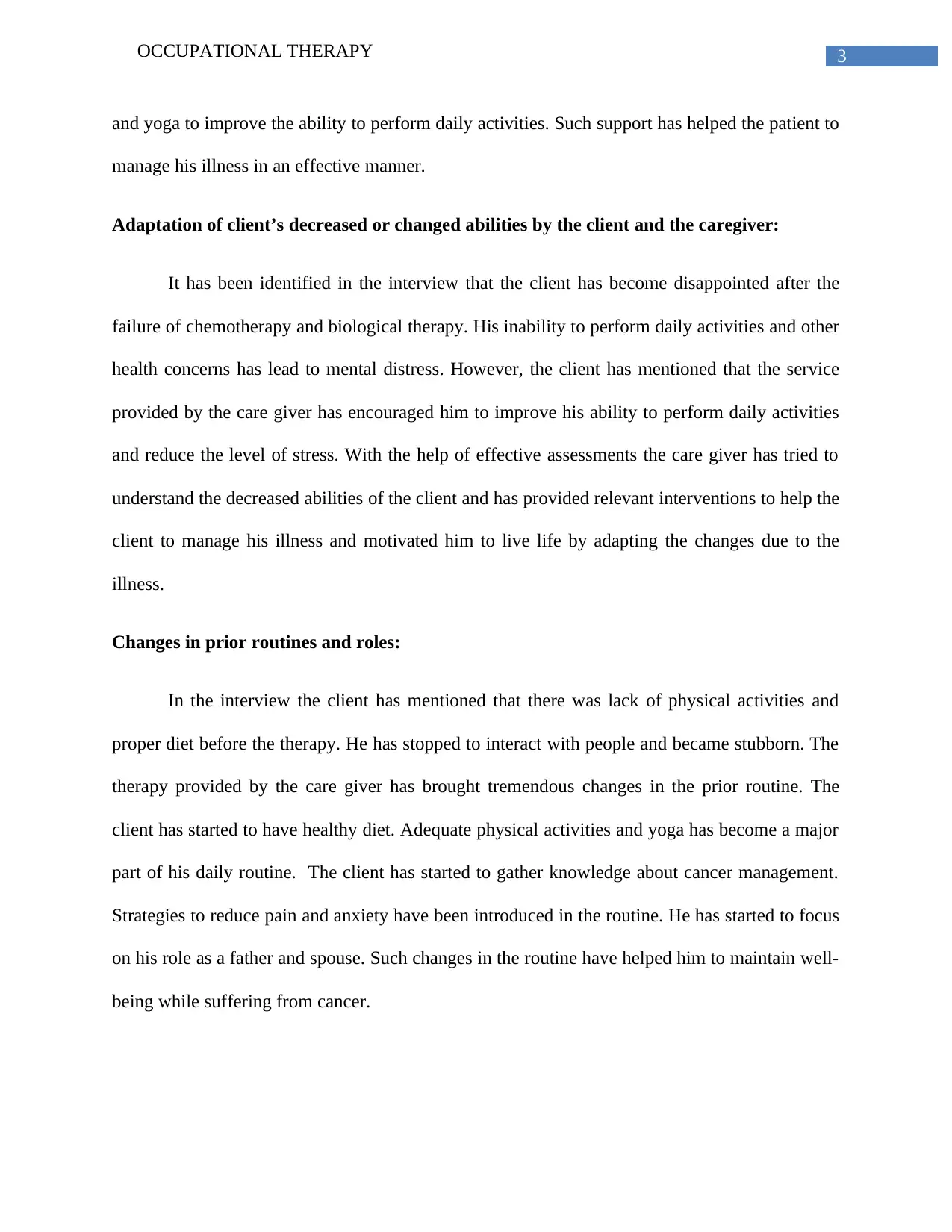
It has been identified in the interview that the client has become disappointed after the
failure of chemotherapy and biological therapy. His inability to perform daily activities and other
health concerns has lead to mental distress. However, the client has mentioned that the service
provided by the care giver has encouraged him to improve his ability to perform daily activities
and reduce the level of stress. With the help of effective assessments the care giver has tried to
understand the decreased abilities of the client and has provided relevant interventions to help the
client to manage his illness and motivated him to live life by adapting the changes due to the
illness.
Changes in prior routines and roles:
In the interview the client has mentioned that there was lack of physical activities and
proper diet before the therapy. He has stopped to interact with people and became stubborn. The
therapy provided by the care giver has brought tremendous changes in the prior routine. The
client has started to have healthy diet. Adequate physical activities and yoga has become a major
part of his daily routine. The client has started to gather knowledge about cancer management.
Strategies to reduce pain and anxiety have been introduced in the routine. He has started to focus
on his role as a father and spouse. Such changes in the routine have helped him to maintain well-
being while suffering from cancer.
tabler-icon-diamond-filled.svg

Paraphrase This Document

Need a fresh take? Get an instant paraphrase of this document with our AI Paraphraser
Document Page
4OCCUPATIONAL THERAPY
Bibliography:
Cheson, B. D., Fisher, R. I., Barrington, S. F., Cavalli, F., Schwartz, L. H., Zucca, E., & Lister,
T. A. (2014). Recommendations for initial evaluation, staging, and response assessment
of Hodgkin and non-Hodgkin lymphoma: the Lugano classification. Journal of Clinical
Oncology, 32(27), 3059.
Craddock, C., & Chakraverty, R. (2015). Stem cell transplantation. Postgraduate Haematology,
651-675.
Jagasia, M. H., Greinix, H. T., Arora, M., Williams, K. M., Wolff, D., Cowen, E. W., ... & Kerr,
H. (2015). National Institutes of Health consensus development project on criteria for
clinical trials in chronic graft-versus-host disease: I. The 2014 Diagnosis and Staging
Working Group report. Biology of Blood and Marrow Transplantation, 21(3), 389-401.
Kurzrock, R., Voorhees, P. M., Casper, C., Furman, R. R., Fayad, L., Lonial, S., ... & Van De
Velde, H. (2013). A phase I, open-label study of siltuximab, an anti-IL-6 monoclonal
antibody, in patients with B-cell non-Hodgkin's lymphoma, multiple myeloma, or
Castleman's disease. Clinical cancer research, clincanres-3349.
Schell, B. A., Gillen, G., Scaffa, M., & Cohn, E. S. (2013). Willard and Spackman's
occupational therapy. Lippincott Williams & Wilkins.
Tefferi, A., Hudgens, S., Mesa, R., Gale, R. P., Verstovsek, S., Passamonti, F., ... & Khan, Z. M.
(2014). Use of the Functional Assessment of Cancer Therapy− Anemia in Persons with
Myeloproliferative Neoplasm-Associated Myelofibrosis and Anemia. Clinical
therapeutics, 36(4), 560-566.
Document Page
5OCCUPATIONAL THERAPY
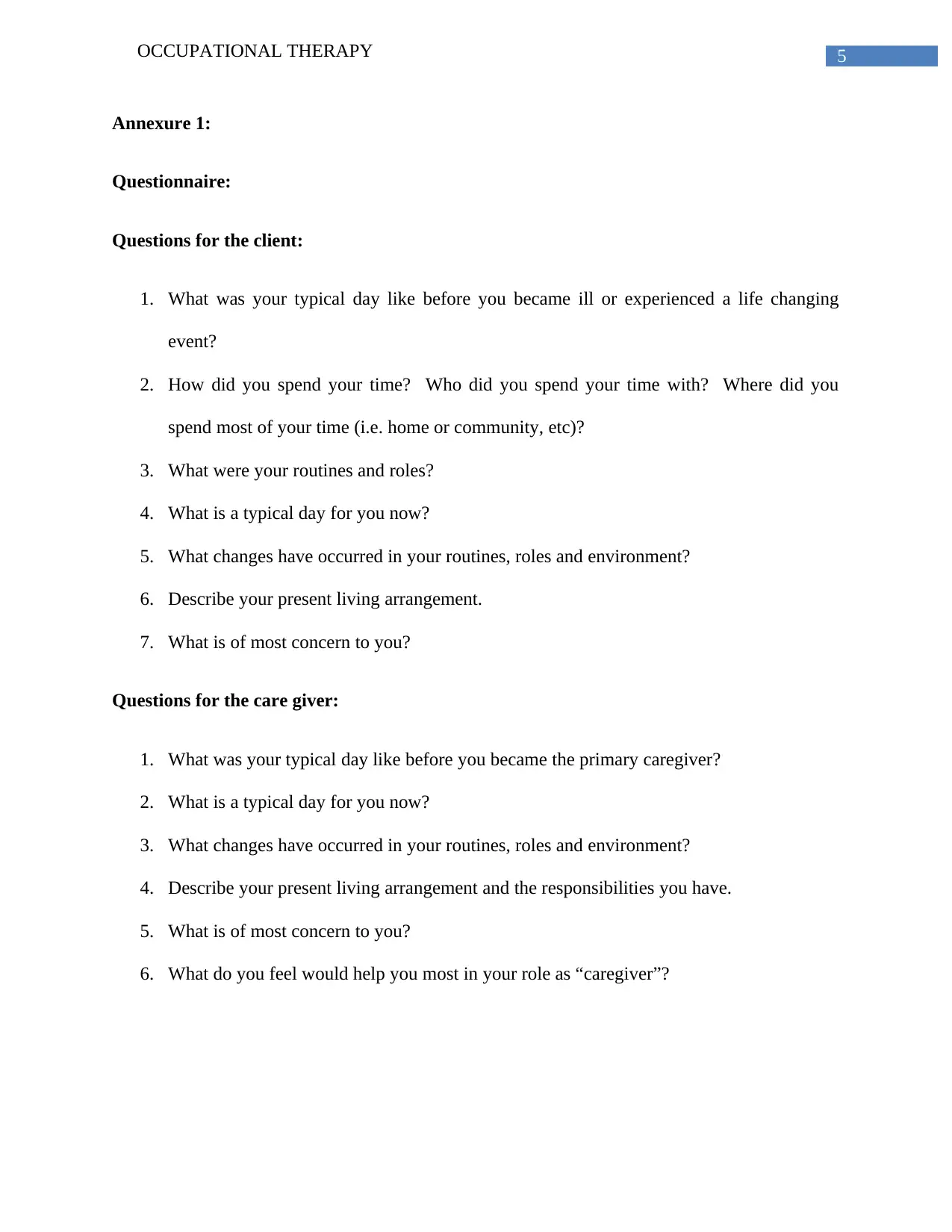
Annexure 1:
Questionnaire:
Questions for the client:
1. What was your typical day like before you became ill or experienced a life changing
event?
2. How did you spend your time? Who did you spend your time with? Where did you
spend most of your time (i.e. home or community, etc)?
3. What were your routines and roles?
4. What is a typical day for you now?
5. What changes have occurred in your routines, roles and environment?
6. Describe your present living arrangement.
7. What is of most concern to you?
Questions for the care giver:
1. What was your typical day like before you became the primary caregiver?
2. What is a typical day for you now?
3. What changes have occurred in your routines, roles and environment?
4. Describe your present living arrangement and the responsibilities you have.
5. What is of most concern to you?
6. What do you feel would help you most in your role as “caregiver”?
chevron_up_icon
1 out of 6
circle_padding
hide_on_mobile
zoom_out_icon
[object Object]