Occupational Therapy and Medication Management: Article Review

Verified

Added on  2021/04/17

|4
|641
|59
Report
AI Summary
This report reviews an article that investigates the role of occupational therapy (OT) in medication management for individuals with chronic health conditions. The study explores an OT intervention designed to encourage medication adherence, comparing it to a standard care intervention. The methodology includes a literature review, participant selection (19 individuals), data collection through baseline evaluations, interventions, and follow-up sessions, and a qualitative data analysis using closed-ended questions and grounded theory. The results indicate that participants in the OT intervention group reported greater self-perceived improvements in medication management compared to the standard care group, with a majority of participants acknowledging the need for additional medication management services. However, the study acknowledges limitations, including the small sample size, which restricts the generalizability of the findings. The report emphasizes the importance of OT in addressing the gap in medical management and its potential to improve patient outcomes by enhancing medication adherence, offering valuable insights for entry-level practitioners in the field.
Document Page
Running head: REVIEWING ARTICLE 1
Reviewing Article
Name
Institution
tabler-icon-diamond-filled.svg

Paraphrase This Document

Need a fresh take? Get an instant paraphrase of this document with our AI Paraphraser
Document Page
REVIEWING ARTICLE 2
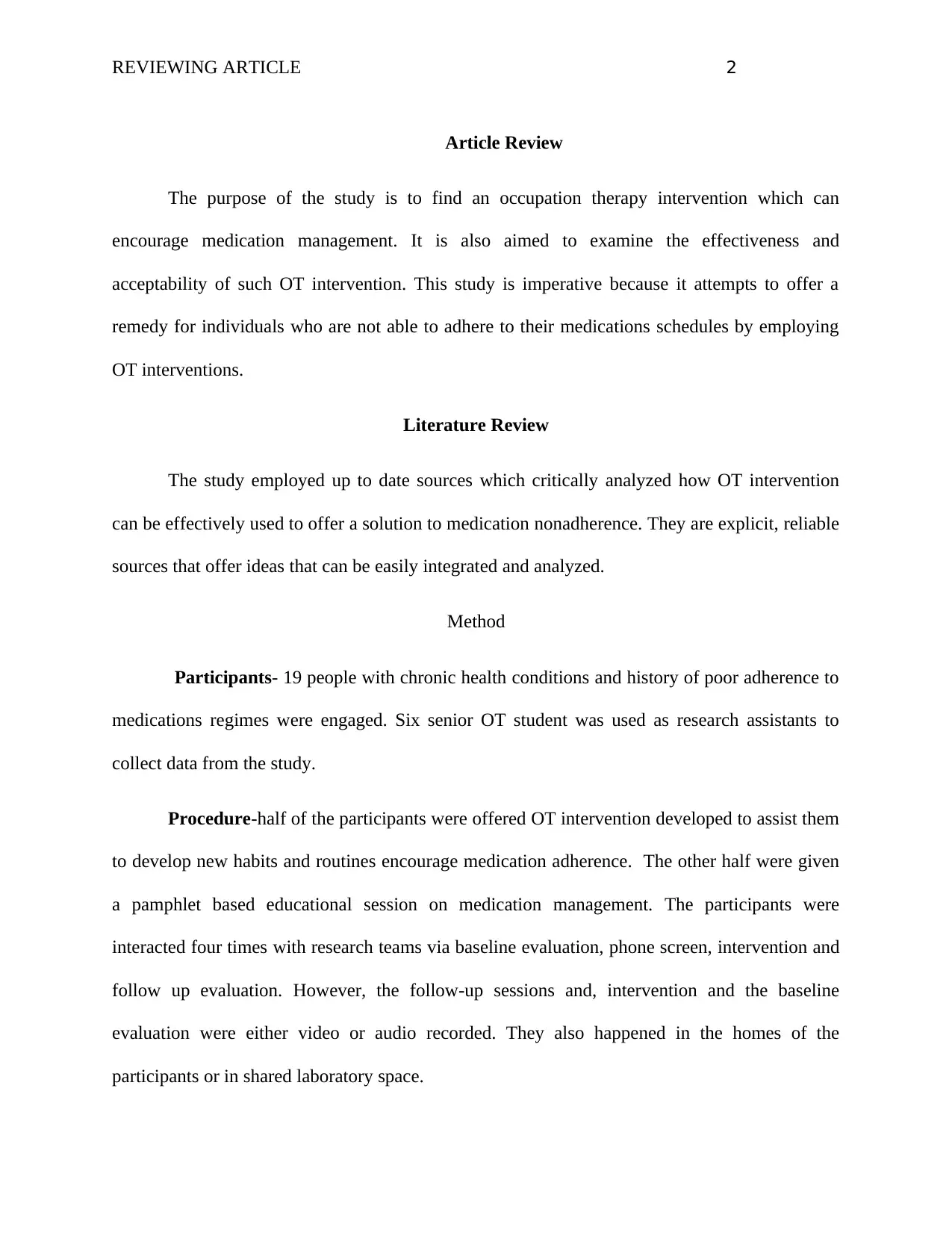
Article Review
The purpose of the study is to find an occupation therapy intervention which can
encourage medication management. It is also aimed to examine the effectiveness and
acceptability of such OT intervention. This study is imperative because it attempts to offer a
remedy for individuals who are not able to adhere to their medications schedules by employing
OT interventions.
Literature Review
The study employed up to date sources which critically analyzed how OT intervention
can be effectively used to offer a solution to medication nonadherence. They are explicit, reliable
sources that offer ideas that can be easily integrated and analyzed.
Method
Participants- 19 people with chronic health conditions and history of poor adherence to
medications regimes were engaged. Six senior OT student was used as research assistants to
collect data from the study.
Procedure-half of the participants were offered OT intervention developed to assist them
to develop new habits and routines encourage medication adherence. The other half were given
a pamphlet based educational session on medication management. The participants were
interacted four times with research teams via baseline evaluation, phone screen, intervention and
follow up evaluation. However, the follow-up sessions and, intervention and the baseline
evaluation were either video or audio recorded. They also happened in the homes of the
participants or in shared laboratory space.
Document Page
REVIEWING ARTICLE 3
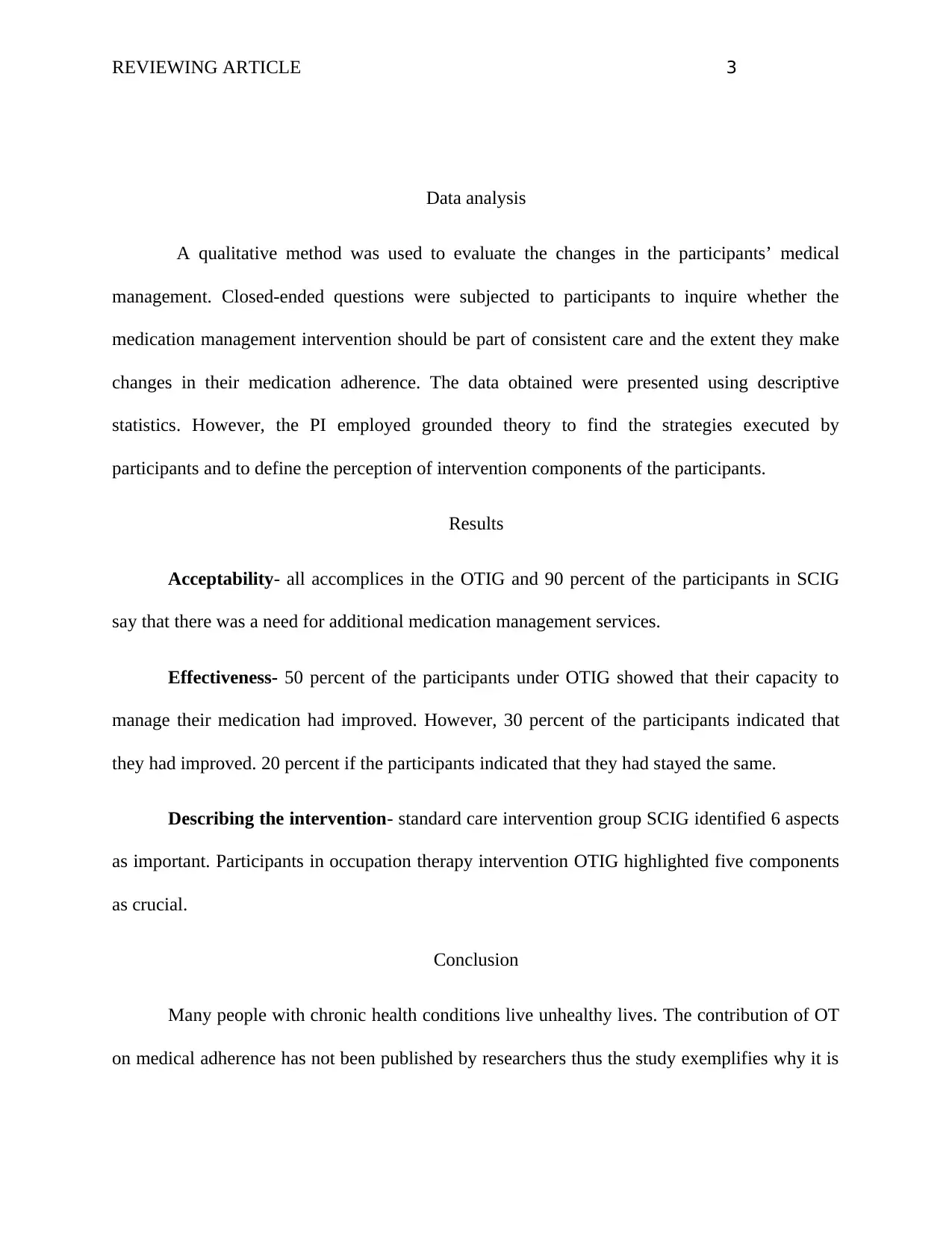
Data analysis
A qualitative method was used to evaluate the changes in the participants’ medical
management. Closed-ended questions were subjected to participants to inquire whether the
medication management intervention should be part of consistent care and the extent they make
changes in their medication adherence. The data obtained were presented using descriptive
statistics. However, the PI employed grounded theory to find the strategies executed by
participants and to define the perception of intervention components of the participants.
Results
Acceptability- all accomplices in the OTIG and 90 percent of the participants in SCIG
say that there was a need for additional medication management services.
Effectiveness- 50 percent of the participants under OTIG showed that their capacity to
manage their medication had improved. However, 30 percent of the participants indicated that
they had improved. 20 percent if the participants indicated that they had stayed the same.
Describing the intervention- standard care intervention group SCIG identified 6 aspects
as important. Participants in occupation therapy intervention OTIG highlighted five components
as crucial.
Conclusion
Many people with chronic health conditions live unhealthy lives. The contribution of OT
on medical adherence has not been published by researchers thus the study exemplifies why it is
Document Page
REVIEWING ARTICLE 4
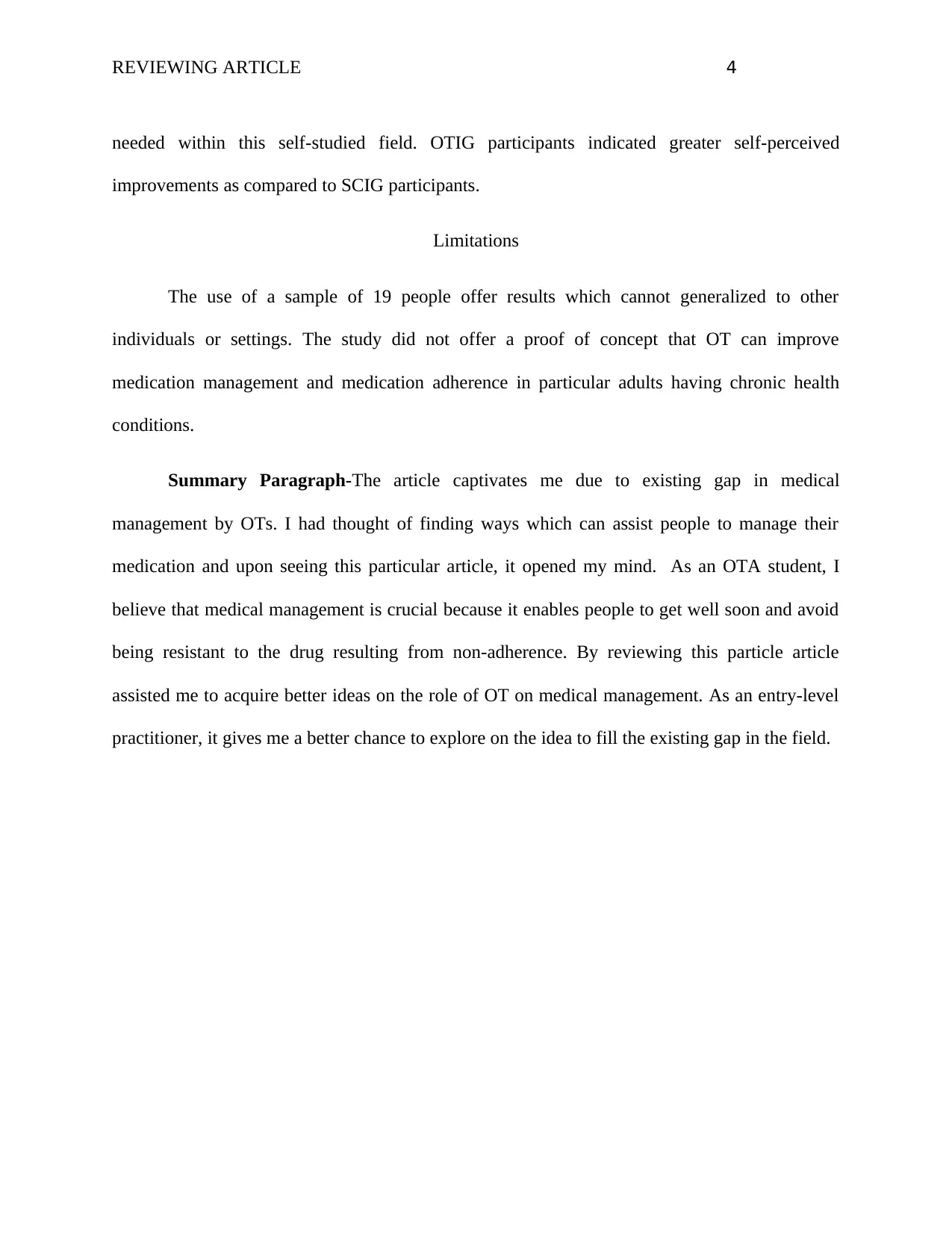
needed within this self-studied field. OTIG participants indicated greater self-perceived
improvements as compared to SCIG participants.
Limitations
The use of a sample of 19 people offer results which cannot generalized to other
individuals or settings. The study did not offer a proof of concept that OT can improve
medication management and medication adherence in particular adults having chronic health
conditions.
Summary Paragraph-The article captivates me due to existing gap in medical
management by OTs. I had thought of finding ways which can assist people to manage their
medication and upon seeing this particular article, it opened my mind. As an OTA student, I
believe that medical management is crucial because it enables people to get well soon and avoid
being resistant to the drug resulting from non-adherence. By reviewing this particle article
assisted me to acquire better ideas on the role of OT on medical management. As an entry-level
practitioner, it gives me a better chance to explore on the idea to fill the existing gap in the field.
chevron_up_icon
1 out of 4
circle_padding
hide_on_mobile
zoom_out_icon
[object Object]