Interactive Media Report: Social Media's Impact on Occupy Movement
VerifiedAdded on 2020/05/28
|13
|3134
|58
Report
AI Summary
This report examines the Occupy Movement, a significant social media-driven protest in the United States, focusing on the role of interactive media in its organization and spread. It analyzes the movement's objectives, background, and organizational procedures, highlighting the use of platforms like Facebook, Twitter, and YouTube for communication and mobilization. The report discusses the consequences of the movement, including its impact on business legislation and its role in inspiring a more sustainable global system. It concludes that social media has become essential for effective communication and mass protest, breaking down traditional media's dominance and enabling broader participation regardless of cultural, economic, or geographical backgrounds. The report uses both quantitative and qualitative data collection methods, including web journals and articles, to support its analysis.
Running head: INTERACTIVE MEDIA
Interactive Media
Name of the Student
Name of the University
Author Note
Interactive Media
Name of the Student
Name of the University
Author Note

Paraphrase This Document
Need a fresh take? Get an instant paraphrase of this document with our AI Paraphraser
1INTERACTIVE MEDIA
Executive Summary
This assignment sheds light on the interactive media in the context of a protest movement
in the United States of America. The Occupied Movement has been considered as the prominent
phenomenon of social-media uprising. The purpose of this assignment is to critically evaluate the
role of social media in organising a public protest movement. The Occupied Movement
demanded in resolving economical disparity in American society. Social media communication
enabled this protest movement to expand across the world. The participants of Occupied
Movement would use social media in all its forms. This assignment has discussed all about the
Occupied Movement along with conclusion. Thus, it is concluded that the trend of traditional
media has been broken down. Today, social media has no exception in terms of involving the
maximum number of population beyond cultural, economical and geographical background in
the most effective way.
Executive Summary
This assignment sheds light on the interactive media in the context of a protest movement
in the United States of America. The Occupied Movement has been considered as the prominent
phenomenon of social-media uprising. The purpose of this assignment is to critically evaluate the
role of social media in organising a public protest movement. The Occupied Movement
demanded in resolving economical disparity in American society. Social media communication
enabled this protest movement to expand across the world. The participants of Occupied
Movement would use social media in all its forms. This assignment has discussed all about the
Occupied Movement along with conclusion. Thus, it is concluded that the trend of traditional
media has been broken down. Today, social media has no exception in terms of involving the
maximum number of population beyond cultural, economical and geographical background in
the most effective way.
2INTERACTIVE MEDIA
Table of Contents
Introduction......................................................................................................................................4
Discussing about Occupy Movement..............................................................................................6
The purpose and problem of Occupy Movement........................................................................6
Background of Occupy Movement..............................................................................................7
Organisational procedure of the Occupy Movement...................................................................8
The role of digital communication in the Occupy Movement.....................................................9
The consequences of Occupied Movement...............................................................................10
Conclusion.....................................................................................................................................11
Reference list.................................................................................................................................12
Table of Contents
Introduction......................................................................................................................................4
Discussing about Occupy Movement..............................................................................................6
The purpose and problem of Occupy Movement........................................................................6
Background of Occupy Movement..............................................................................................7
Organisational procedure of the Occupy Movement...................................................................8
The role of digital communication in the Occupy Movement.....................................................9
The consequences of Occupied Movement...............................................................................10
Conclusion.....................................................................................................................................11
Reference list.................................................................................................................................12
⊘ This is a preview!⊘
Do you want full access?
Subscribe today to unlock all pages.

Trusted by 1+ million students worldwide
3INTERACTIVE MEDIA
Introduction
The Occupy Movement is one of the remarkable international American movements for
achieving social equality and egalitarianism. This movement has been organised through
interactive media. Interactive media is a digital based communication system, which is operated
through computer or mobile with the connection of internet. Facebook, Twitter, YouTube are
considered in Occupy Movement for coordinating mass protest. Information Communications
Technology plays the most prominent role in developing and continuing the Occupy Movement
in terms of fulfilling the particular protest intention. American civilians first initiated this
moment on 17 September in 2011 in order to raise their voice against capitalism, corporate
influence over government, economic and social inequality (Biagini, Gamm and Winters 2012).
The movement first took place at Zuccotti Park in New York City. At a rapid rate, this report had
spread across 951 cities of 82 countries (Costanza-Chock 2012). More than 600 communities
from the United States participated in this movement (Gaby and Caren 2012). This protest
movement is focused in this report in terms of looking into the effectiveness of digital
communication activity. The main objective of this report is to critically evaluate the role of
social media in the Occupy Movement. The main discussion of this report will focus on people,
events and ideas from the perspective of social media communication. In addition, this report
discusses the purpose of the Occupy Movement, background of the Occupy Movement,
organisational procedure of the Occupy Movement, the role of digital communication in the
Occupy Movement and the consequences of the Occupied Movement. Decision making process
within the Occupy Movement is also necessary to take into account in this context. The
organisers of this protest movement opened a site on Facebook named “Occupy Together” which
was considered the main forum of participants in this protest movement. During the protest
Introduction
The Occupy Movement is one of the remarkable international American movements for
achieving social equality and egalitarianism. This movement has been organised through
interactive media. Interactive media is a digital based communication system, which is operated
through computer or mobile with the connection of internet. Facebook, Twitter, YouTube are
considered in Occupy Movement for coordinating mass protest. Information Communications
Technology plays the most prominent role in developing and continuing the Occupy Movement
in terms of fulfilling the particular protest intention. American civilians first initiated this
moment on 17 September in 2011 in order to raise their voice against capitalism, corporate
influence over government, economic and social inequality (Biagini, Gamm and Winters 2012).
The movement first took place at Zuccotti Park in New York City. At a rapid rate, this report had
spread across 951 cities of 82 countries (Costanza-Chock 2012). More than 600 communities
from the United States participated in this movement (Gaby and Caren 2012). This protest
movement is focused in this report in terms of looking into the effectiveness of digital
communication activity. The main objective of this report is to critically evaluate the role of
social media in the Occupy Movement. The main discussion of this report will focus on people,
events and ideas from the perspective of social media communication. In addition, this report
discusses the purpose of the Occupy Movement, background of the Occupy Movement,
organisational procedure of the Occupy Movement, the role of digital communication in the
Occupy Movement and the consequences of the Occupied Movement. Decision making process
within the Occupy Movement is also necessary to take into account in this context. The
organisers of this protest movement opened a site on Facebook named “Occupy Together” which
was considered the main forum of participants in this protest movement. During the protest
Paraphrase This Document
Need a fresh take? Get an instant paraphrase of this document with our AI Paraphraser
4INTERACTIVE MEDIA
movement, continuous YouTube uploads concerned people about the brutality of police on the
humble citizen. On the other hand, news feed of Twitter would give people constant update
about the protest movement. Social media facilitated the growth, development and
internalization of this protest movement through all its forms. The Occupy Movement has been
chosen for the project, as it is the best in terms of understanding discourse, context and media.
This report claims that mass media and broadcasting are not enough to define the one
twentieth century. Social media is essential to consider as the best platform of today in order to
maintain effective communication at global context. It is seen throughout the last decade that the
trend of political and economic based mass media has been broken down. The people have
evolved new media and new practices in order to reflect mass protestation. Rise of social media
minimises the difference between ‘public’ broadcast media and private ‘interactive’ media. In
terms of accessing to the most suitable information for executing this research project,
quantitative data collection method has been followed. This data collection system is reliable and
reasonable in order to collect all the necessary and relevant information about the Occupy
Movement. Qualitative data collection method leads this research to focus on a number of web
journals and articles in order to know all the detail about the protest movement.
movement, continuous YouTube uploads concerned people about the brutality of police on the
humble citizen. On the other hand, news feed of Twitter would give people constant update
about the protest movement. Social media facilitated the growth, development and
internalization of this protest movement through all its forms. The Occupy Movement has been
chosen for the project, as it is the best in terms of understanding discourse, context and media.
This report claims that mass media and broadcasting are not enough to define the one
twentieth century. Social media is essential to consider as the best platform of today in order to
maintain effective communication at global context. It is seen throughout the last decade that the
trend of political and economic based mass media has been broken down. The people have
evolved new media and new practices in order to reflect mass protestation. Rise of social media
minimises the difference between ‘public’ broadcast media and private ‘interactive’ media. In
terms of accessing to the most suitable information for executing this research project,
quantitative data collection method has been followed. This data collection system is reliable and
reasonable in order to collect all the necessary and relevant information about the Occupy
Movement. Qualitative data collection method leads this research to focus on a number of web
journals and articles in order to know all the detail about the protest movement.
5INTERACTIVE MEDIA
Discussing about Occupy Movement
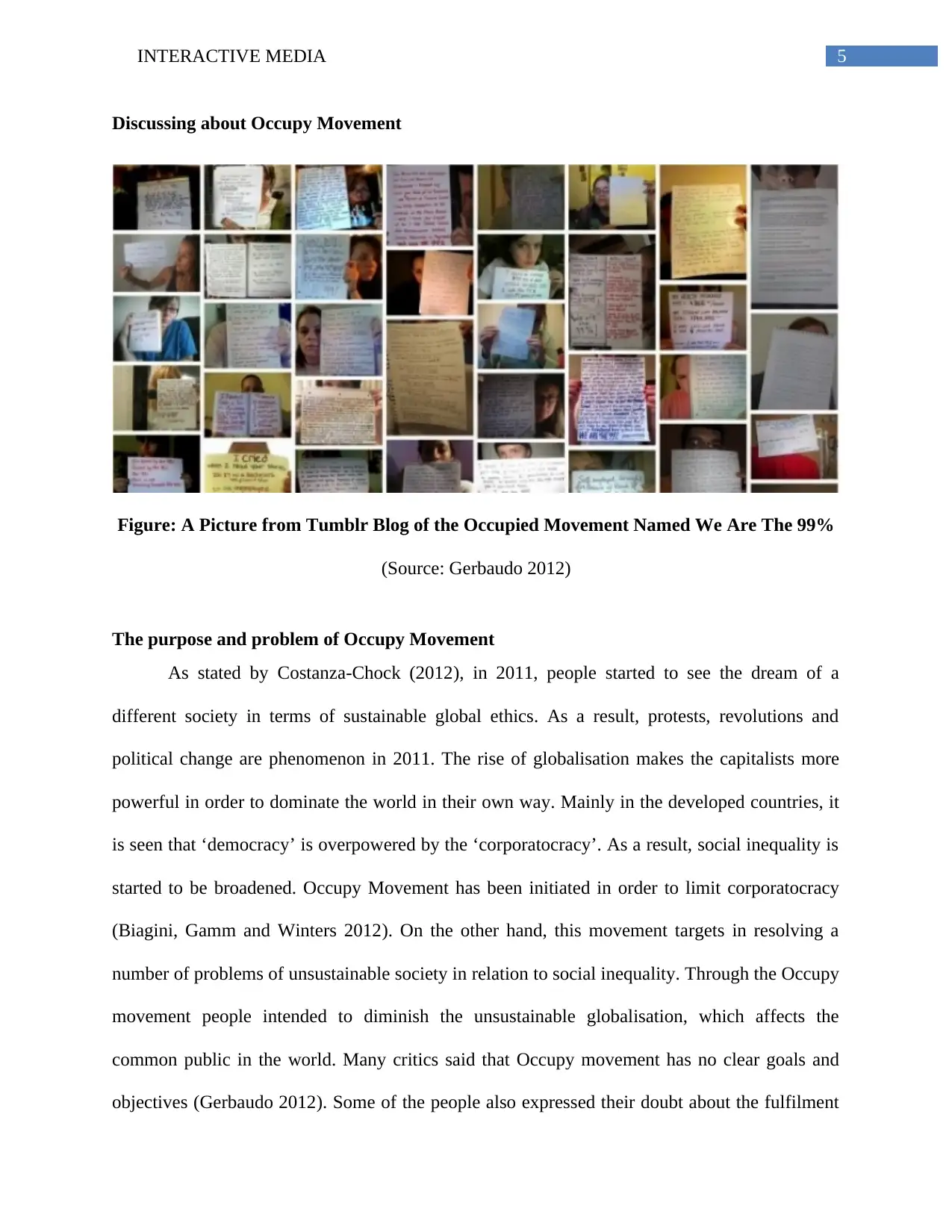
Figure: A Picture from Tumblr Blog of the Occupied Movement Named We Are The 99%
(Source: Gerbaudo 2012)
The purpose and problem of Occupy Movement
As stated by Costanza-Chock (2012), in 2011, people started to see the dream of a
different society in terms of sustainable global ethics. As a result, protests, revolutions and
political change are phenomenon in 2011. The rise of globalisation makes the capitalists more
powerful in order to dominate the world in their own way. Mainly in the developed countries, it
is seen that ‘democracy’ is overpowered by the ‘corporatocracy’. As a result, social inequality is
started to be broadened. Occupy Movement has been initiated in order to limit corporatocracy
(Biagini, Gamm and Winters 2012). On the other hand, this movement targets in resolving a
number of problems of unsustainable society in relation to social inequality. Through the Occupy
movement people intended to diminish the unsustainable globalisation, which affects the
common public in the world. Many critics said that Occupy movement has no clear goals and
objectives (Gerbaudo 2012). Some of the people also expressed their doubt about the fulfilment
Discussing about Occupy Movement
Figure: A Picture from Tumblr Blog of the Occupied Movement Named We Are The 99%
(Source: Gerbaudo 2012)
The purpose and problem of Occupy Movement
As stated by Costanza-Chock (2012), in 2011, people started to see the dream of a
different society in terms of sustainable global ethics. As a result, protests, revolutions and
political change are phenomenon in 2011. The rise of globalisation makes the capitalists more
powerful in order to dominate the world in their own way. Mainly in the developed countries, it
is seen that ‘democracy’ is overpowered by the ‘corporatocracy’. As a result, social inequality is
started to be broadened. Occupy Movement has been initiated in order to limit corporatocracy
(Biagini, Gamm and Winters 2012). On the other hand, this movement targets in resolving a
number of problems of unsustainable society in relation to social inequality. Through the Occupy
movement people intended to diminish the unsustainable globalisation, which affects the
common public in the world. Many critics said that Occupy movement has no clear goals and
objectives (Gerbaudo 2012). Some of the people also expressed their doubt about the fulfilment
⊘ This is a preview!⊘
Do you want full access?
Subscribe today to unlock all pages.
Trusted by 1+ million students worldwide
6INTERACTIVE MEDIA
of the Occupy movement. However, the social networking communication fuelled the Occupy
Movement at a rapid rate. Protesters would use the communication medium of Facebook,
Twitter, YouTube, live stream, MeetUp, Typing, Texting, and The global Square in order to
spread this protest all around the world (Razsa and Kurnik 2012). This communication mode is
characterised by Organised Demonstration. This communication method helped the Occupy
Movement to organise their protest campaign with maximum number of population. In this
communication system, in which way decision has been made is called leaderless consensus.
This decision-making method leads to make a consensus with the support of maximum number
of population. The Occupy Movement is one of the most coordinated movements of modern
century (Gleason 2013). It has no such specific problem. However, it is true that this movement
had no defined goal at the beginning.
Background of Occupy Movement
As opined by Thorson et al. (2013), the emergence of flash mob is necessary to take into
account in the context of the background of the Occupy Movement. In 2003, a group of people
has been collaborated through email, blogs, twitter and text messages in order to celebrate a
specific thing at public place. A larger population of flash mobs set a trend of using social media
as a medium of assembling large masses of people. In December 2010, a protest movement took
place at the Middle East of Arab. This protest movement is called Arab Spring, which has been
initiated mainly due to political instability in the Arab countries (Halvorsen 2012). The Occupy
movement has been inherited from the Arab Spring (Gamson and Sifry 2013). The protestation
of Arab Spring has been followed by the countries Tunisia, Libya, Syria, Egypt, Yemen,
Bahrain, Spain, Greece and the US (Fuchs 2014). It is argued that this protestation had no
specific reason. However, in this report it is claimed that the Occupy Movement had very
of the Occupy movement. However, the social networking communication fuelled the Occupy
Movement at a rapid rate. Protesters would use the communication medium of Facebook,
Twitter, YouTube, live stream, MeetUp, Typing, Texting, and The global Square in order to
spread this protest all around the world (Razsa and Kurnik 2012). This communication mode is
characterised by Organised Demonstration. This communication method helped the Occupy
Movement to organise their protest campaign with maximum number of population. In this
communication system, in which way decision has been made is called leaderless consensus.
This decision-making method leads to make a consensus with the support of maximum number
of population. The Occupy Movement is one of the most coordinated movements of modern
century (Gleason 2013). It has no such specific problem. However, it is true that this movement
had no defined goal at the beginning.
Background of Occupy Movement
As opined by Thorson et al. (2013), the emergence of flash mob is necessary to take into
account in the context of the background of the Occupy Movement. In 2003, a group of people
has been collaborated through email, blogs, twitter and text messages in order to celebrate a
specific thing at public place. A larger population of flash mobs set a trend of using social media
as a medium of assembling large masses of people. In December 2010, a protest movement took
place at the Middle East of Arab. This protest movement is called Arab Spring, which has been
initiated mainly due to political instability in the Arab countries (Halvorsen 2012). The Occupy
movement has been inherited from the Arab Spring (Gamson and Sifry 2013). The protestation
of Arab Spring has been followed by the countries Tunisia, Libya, Syria, Egypt, Yemen,
Bahrain, Spain, Greece and the US (Fuchs 2014). It is argued that this protestation had no
specific reason. However, in this report it is claimed that the Occupy Movement had very
Paraphrase This Document
Need a fresh take? Get an instant paraphrase of this document with our AI Paraphraser
7INTERACTIVE MEDIA
definite objectives. In all the protestation movement of 2010, the protesters tried to stop civil war
and violence over the common people (Castañeda 2012). In all the series of protest movements,
the common reasons were socio political corruption, corporatocracy, unemployment, human
rights violation, sectarianism in main (Uitermark and Nicholls 2012).
It came to be known that on July 13, a Canadian anti-consumerism blog named Abduster
appealed the Americans to take the lead the Arabian protestation in Occupying Zuccotti Park
(Kavada 2015). It is argued in many journals and articles that Arab Spring, Tunisian Revolution
and Occupy Movement had a vague demand (Gaby and Caren 2012). However, this report
claimed that all the noted protest movements were highly significant in terms of developing a
sustainable global system. In the Occupy Movement, the demand of the protestors was the
separation of corporate power and money from government. Their demand was to President
Obama for enforcing a justified law in resolving wealth disparities (Pickerill and Krinsky 2012).
They cried to restrict the use of tax-generated money of government for corrupt corporations.
Organisational procedure of the Occupy Movement
None has nominated the protesters of the Occupy Movement. All of them have been self-
selected person in order to participate in the Occupy movement (Lubin 2012). Social media is
accessible to all. In this case, it enables to ensure the engagement of the maximum number of
population from different cultural, geographical and economical background. In the crowd of the
protesters in Occupy Movement, mainly the common people have been found. A deal of
diversified voices came to be heard from the participants of the Occupy Media (Stekelenburg
2012). This report asserts that through the venues of traditional social media it has never been
possible to incite a huge diversity of voices. However, in order to participate in the Occupy
movement there were two barriers. One is education and the second is internet connection. The
definite objectives. In all the protestation movement of 2010, the protesters tried to stop civil war
and violence over the common people (Castañeda 2012). In all the series of protest movements,
the common reasons were socio political corruption, corporatocracy, unemployment, human
rights violation, sectarianism in main (Uitermark and Nicholls 2012).
It came to be known that on July 13, a Canadian anti-consumerism blog named Abduster
appealed the Americans to take the lead the Arabian protestation in Occupying Zuccotti Park
(Kavada 2015). It is argued in many journals and articles that Arab Spring, Tunisian Revolution
and Occupy Movement had a vague demand (Gaby and Caren 2012). However, this report
claimed that all the noted protest movements were highly significant in terms of developing a
sustainable global system. In the Occupy Movement, the demand of the protestors was the
separation of corporate power and money from government. Their demand was to President
Obama for enforcing a justified law in resolving wealth disparities (Pickerill and Krinsky 2012).
They cried to restrict the use of tax-generated money of government for corrupt corporations.
Organisational procedure of the Occupy Movement
None has nominated the protesters of the Occupy Movement. All of them have been self-
selected person in order to participate in the Occupy movement (Lubin 2012). Social media is
accessible to all. In this case, it enables to ensure the engagement of the maximum number of
population from different cultural, geographical and economical background. In the crowd of the
protesters in Occupy Movement, mainly the common people have been found. A deal of
diversified voices came to be heard from the participants of the Occupy Media (Stekelenburg
2012). This report asserts that through the venues of traditional social media it has never been
possible to incite a huge diversity of voices. However, in order to participate in the Occupy
movement there were two barriers. One is education and the second is internet connection. The
8INTERACTIVE MEDIA
maximum people who belong to the lower class of society either do not have education or have a
little education. The people hardly can link them with the advance technology. In addition,
internet connection is not accessible for the homeless people due to money and all the required
provisions of internet connection. Hence, only a few people from the lower class were able to
participate in the Occupy movement.
Through social media, anyone can post anything that affects legitimacy. With this consideration,
the participants of the Occupy Movement developed their individual social media named ‘The
Global Square’, which was limited only to the people within the Occupy network (Liboiron
2012). In order to join this network, one needed to be invited by someone who had been already
the member of The Global Square (Costanza-Chock 2012). It led the Occupy network to
maintain the authenticity of sharing information to the individual participants. However, the
protesters of the Occupy Movement restricted the information in accessing to the police. The
Occupy Movement was highly coordinated in order to support a group decision (Biagini, Gamm
and Winters 2012). Decision of the Occupy Movement has been made in the way of leaderless
consensus (Gerbaudo 2012).
The role of digital communication in the Occupy Movement
Organised demonstration mode of communication has been followed in the Occupy
movement. Face to face interaction had been hardly possible for the participants of the Occupy
movement. In that case, the participants of the Occupy movement have had virtual
communication through video conference (Razsa and Kurnik 2012). The methods of interaction
in the Occupy movement were Facebook, Livestream, Twitter, YouTube, The Global Square,
MeetUp, Skyping, and Texting (Gleason 2013). Digital communication enabled the widespread
of the Occupy Movement. It led people to participate in the movement across geographical and
maximum people who belong to the lower class of society either do not have education or have a
little education. The people hardly can link them with the advance technology. In addition,
internet connection is not accessible for the homeless people due to money and all the required
provisions of internet connection. Hence, only a few people from the lower class were able to
participate in the Occupy movement.
Through social media, anyone can post anything that affects legitimacy. With this consideration,
the participants of the Occupy Movement developed their individual social media named ‘The
Global Square’, which was limited only to the people within the Occupy network (Liboiron
2012). In order to join this network, one needed to be invited by someone who had been already
the member of The Global Square (Costanza-Chock 2012). It led the Occupy network to
maintain the authenticity of sharing information to the individual participants. However, the
protesters of the Occupy Movement restricted the information in accessing to the police. The
Occupy Movement was highly coordinated in order to support a group decision (Biagini, Gamm
and Winters 2012). Decision of the Occupy Movement has been made in the way of leaderless
consensus (Gerbaudo 2012).
The role of digital communication in the Occupy Movement
Organised demonstration mode of communication has been followed in the Occupy
movement. Face to face interaction had been hardly possible for the participants of the Occupy
movement. In that case, the participants of the Occupy movement have had virtual
communication through video conference (Razsa and Kurnik 2012). The methods of interaction
in the Occupy movement were Facebook, Livestream, Twitter, YouTube, The Global Square,
MeetUp, Skyping, and Texting (Gleason 2013). Digital communication enabled the widespread
of the Occupy Movement. It led people to participate in the movement across geographical and
⊘ This is a preview!⊘
Do you want full access?
Subscribe today to unlock all pages.
Trusted by 1+ million students worldwide
9INTERACTIVE MEDIA
cultural border. Social media let a greater diversity of voices to be arisen. On the other hand, it
also created a larger pool of misinformation (Thorson et al. 2013).
The consequences of Occupied Movement
Social media enabled the Occupy Movement to be internationalised (Halvorsen 2012).
Apart from that, the easy and accessible communication of the social media truly involved
people in the Occupy Movement. It is the major thing, which is necessary to take into account
for the success of the Occupy movement (Gamson and Sifry 2013). The president Obama had to
renovate business legislation of the U.S. in order to limit the power of corporation (Fuchs 2014).
This movement inspired people a lot in order to initiate a sustainable system in terms of making
a new world in the favour of the commoners. The violation of the police cannot curve the spirit
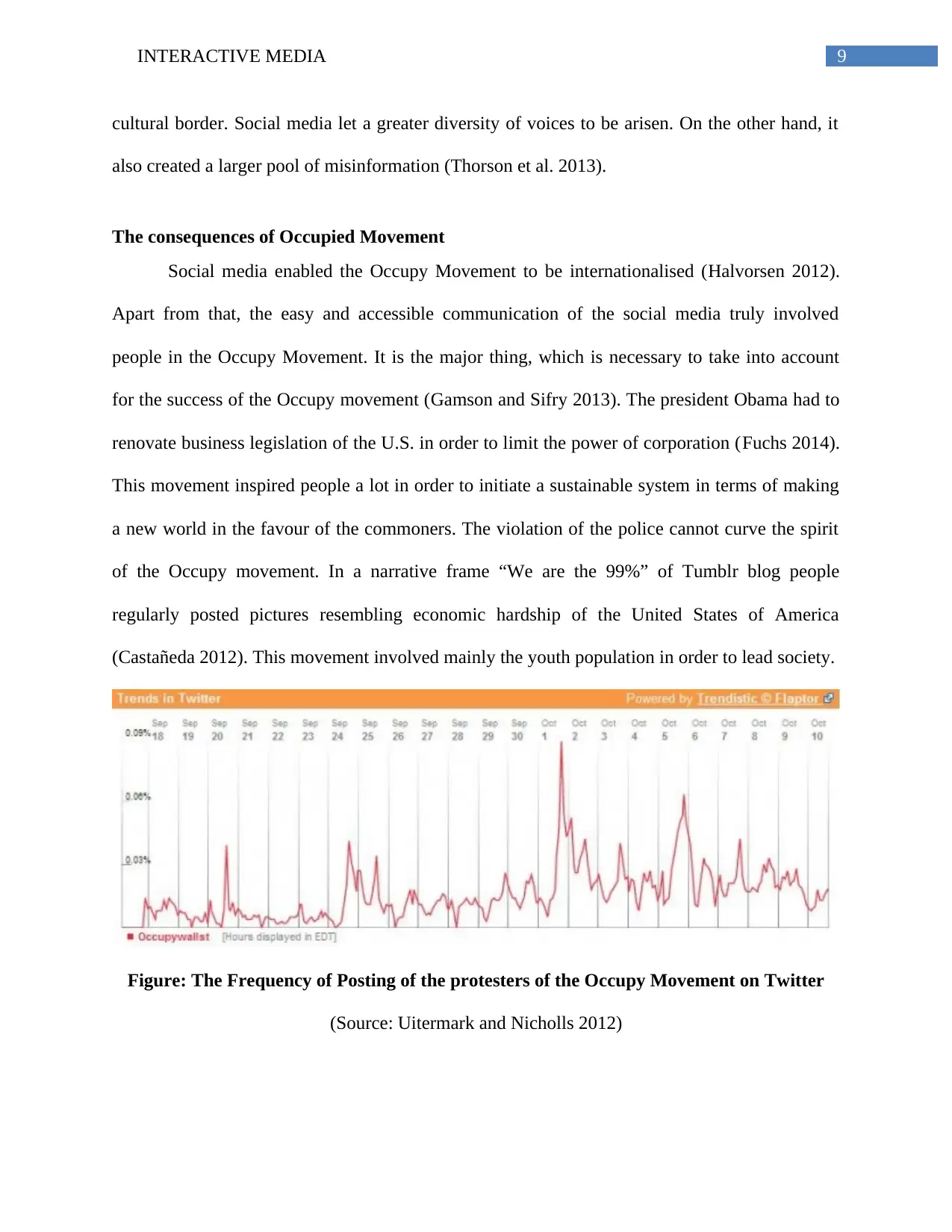
of the Occupy movement. In a narrative frame “We are the 99%” of Tumblr blog people
regularly posted pictures resembling economic hardship of the United States of America
(Castañeda 2012). This movement involved mainly the youth population in order to lead society.
Figure: The Frequency of Posting of the protesters of the Occupy Movement on Twitter
(Source: Uitermark and Nicholls 2012)
cultural border. Social media let a greater diversity of voices to be arisen. On the other hand, it
also created a larger pool of misinformation (Thorson et al. 2013).
The consequences of Occupied Movement
Social media enabled the Occupy Movement to be internationalised (Halvorsen 2012).
Apart from that, the easy and accessible communication of the social media truly involved
people in the Occupy Movement. It is the major thing, which is necessary to take into account
for the success of the Occupy movement (Gamson and Sifry 2013). The president Obama had to
renovate business legislation of the U.S. in order to limit the power of corporation (Fuchs 2014).
This movement inspired people a lot in order to initiate a sustainable system in terms of making
a new world in the favour of the commoners. The violation of the police cannot curve the spirit
of the Occupy movement. In a narrative frame “We are the 99%” of Tumblr blog people
regularly posted pictures resembling economic hardship of the United States of America
(Castañeda 2012). This movement involved mainly the youth population in order to lead society.
Figure: The Frequency of Posting of the protesters of the Occupy Movement on Twitter
(Source: Uitermark and Nicholls 2012)
Paraphrase This Document
Need a fresh take? Get an instant paraphrase of this document with our AI Paraphraser
10INTERACTIVE MEDIA
Conclusion
From the above discussion it is derived that social media is one of the most effective tools
of communication in terms of developing a larger mass opinion at global context. On the other
hand, in order to draw the attention of a larger number of populations, social media
communication has no exception. In order to assemble people in the most coordinated way also,
social media has no exception. The Occupy Movement had very cohesive demand, which was
expressed in a plurality of voices. By the posting of information and sharing information, the
intention of the Occupy movement was clearly revealed. The main intention of the Occupy
movement was to draw the attention of the people on the income disparity in the society of the
United States. In addition, the corruption of the corporatocracy was also highlighted in the
movement of the Occupy movement. The political corruption had also been drawn into the
limelight in the Occupy Movement. The social networking communication let the movement to
take the scope of a huge expansion. This protest movement inspired the population from the
intellectual class a lot in terms of leading society. As mainly the educated youth participated in
the protest movement, they can lead the protest movement with a great spirit in terms of
fulfilling its mission, visions and objectives.
Conclusion
From the above discussion it is derived that social media is one of the most effective tools
of communication in terms of developing a larger mass opinion at global context. On the other
hand, in order to draw the attention of a larger number of populations, social media
communication has no exception. In order to assemble people in the most coordinated way also,
social media has no exception. The Occupy Movement had very cohesive demand, which was
expressed in a plurality of voices. By the posting of information and sharing information, the
intention of the Occupy movement was clearly revealed. The main intention of the Occupy
movement was to draw the attention of the people on the income disparity in the society of the
United States. In addition, the corruption of the corporatocracy was also highlighted in the
movement of the Occupy movement. The political corruption had also been drawn into the
limelight in the Occupy Movement. The social networking communication let the movement to
take the scope of a huge expansion. This protest movement inspired the population from the
intellectual class a lot in terms of leading society. As mainly the educated youth participated in
the protest movement, they can lead the protest movement with a great spirit in terms of
fulfilling its mission, visions and objectives.
11INTERACTIVE MEDIA
Reference list
Biagini, C., Gamm, A. and Winters, P., 2012. The Occupy Movement. Uhuru, 10(1), p.14.
Castañeda, E., 2012. The indignados of Spain: a precedent to occupy wall street. Social
Movement Studies, 11(3-4), pp.309-319.
Costanza-Chock, S., 2012. Mic check! Media cultures and the Occupy movement. Social
movement studies, 11(3-4), pp.375-385.
Fuchs, C., 2014. OccupyMedia!: The occupy movement and social media in crisis capitalism.
John Hunt Publishing.
Gaby, S. and Caren, N., 2012. Occupy online: How cute old men and Malcolm X recruited
400,000 US users to OWS on Facebook. Social Movement Studies, 11(3-4), pp.367-374.
Gamson, W.A. and Sifry, M.L., 2013. The# Occupy movement: an introduction. The
Sociological Quarterly, 54(2), pp.159-163.
Gerbaudo, P., 2012. Tweets and the streets: Social media and contemporary activism. Pluto
Press.
Gleason, B., 2013. # Occupy Wall Street: Exploring informal learning about a social movement
on Twitter. American Behavioral Scientist, 57(7), pp.966-982.
Halvorsen, S., 2012. Beyond the network? Occupy London and the global movement. Social
Movement Studies, 11(3-4), pp.427-433.
Kavada, A., 2015. Creating the collective: social media, the Occupy Movement and its
constitution as a collective actor. Information, Communication & Society, 18(8), pp.872-886.
Liboiron, M., 2012. Tactics of waste, dirt and discard in the Occupy movement. Social
Movement Studies, 11(3-4), pp.393-401.
Reference list
Biagini, C., Gamm, A. and Winters, P., 2012. The Occupy Movement. Uhuru, 10(1), p.14.
Castañeda, E., 2012. The indignados of Spain: a precedent to occupy wall street. Social
Movement Studies, 11(3-4), pp.309-319.
Costanza-Chock, S., 2012. Mic check! Media cultures and the Occupy movement. Social
movement studies, 11(3-4), pp.375-385.
Fuchs, C., 2014. OccupyMedia!: The occupy movement and social media in crisis capitalism.
John Hunt Publishing.
Gaby, S. and Caren, N., 2012. Occupy online: How cute old men and Malcolm X recruited
400,000 US users to OWS on Facebook. Social Movement Studies, 11(3-4), pp.367-374.
Gamson, W.A. and Sifry, M.L., 2013. The# Occupy movement: an introduction. The
Sociological Quarterly, 54(2), pp.159-163.
Gerbaudo, P., 2012. Tweets and the streets: Social media and contemporary activism. Pluto
Press.
Gleason, B., 2013. # Occupy Wall Street: Exploring informal learning about a social movement
on Twitter. American Behavioral Scientist, 57(7), pp.966-982.
Halvorsen, S., 2012. Beyond the network? Occupy London and the global movement. Social
Movement Studies, 11(3-4), pp.427-433.
Kavada, A., 2015. Creating the collective: social media, the Occupy Movement and its
constitution as a collective actor. Information, Communication & Society, 18(8), pp.872-886.
Liboiron, M., 2012. Tactics of waste, dirt and discard in the Occupy movement. Social
Movement Studies, 11(3-4), pp.393-401.
⊘ This is a preview!⊘
Do you want full access?
Subscribe today to unlock all pages.
Trusted by 1+ million students worldwide

1 out of 13


Related Documents


Your All-in-One AI-Powered Toolkit for Academic Success.
+13062052269
info@desklib.com
Available 24*7 on WhatsApp / Email
![[object Object]](/_next/static/media/star-bottom.7253800d.svg)
Unlock your academic potential
Copyright © 2020–2026 A2Z Services. All Rights Reserved. Developed and managed by ZUCOL.